



Abstract
Introduction
Developmental coordination disorder affects a child’s motor abilities and participation across environments. This study aimed to review systematically the effectiveness of interventions using a motor, cognitive or psychological approach on participation outcomes in children with developmental coordination disorder.
Method
A systematic review of the literature published between 2001 and November 2017 was conducted. Eight electronic databases were searched: Embase, PubMed, CINAHL, PsycINFO, the Cochrane Library, Education Full Text (H. W. Wilson databases), SPORTDiscus (all via EBSCO) and Scopus (Web of Science).
Results
In total, 12 studies met the inclusion criteria: seven randomised controlled trials, two quasi-experimental and three case series. Systematic quality assessment and meta-analysis was not possible given the heterogeneity of research designs, interventions and outcome measures. Limited evidence for participation outcomes was found. The cognitive orientation to daily occupational performance intervention found a between-group effect on the Canadian Occupational Performance Measure (COPM) outcome measure performance, g = 1.0 (0.02, 1.9), and COPM satisfaction, g = 1.4 (0.4, 2.3), in favour of the cognitive orientation to daily occupational performance for one randomised controlled trial. Large significant within-group effects were found for the cognitive orientation to daily occupational performance intervention on the COPM outcome measure COPM satisfaction, d = –2.1 (–5.2, –0.2).
Conclusion
More high-quality research is needed to strengthen the evidence base regarding occupational therapy interventions to improve participation outcomes for children with developmental coordination disorder.
Introduction
Developmental coordination disorder (DCD) is a neuro-developmental condition not attributable to a neurological condition, intellectual disability or visual impairment (American Psychiatric Association, 2013). DCD affects between 5% and 6% of school-age children (American Psychiatric Association, 2013). The predominant characteristic is the presence of gross and fine motor proficiency difficulties, which influence participation in activities of daily living (ADL). Children with DCD show differences in brain structure and function compared with typically developing children, and these neural mechanisms have been associated with other developmental conditions. Hence, co-morbid screening is recommended (Fuelscher et al., 2018). Cognitive issues frequently co-occur with DCD (Sumner et al., 2016) and executive function difficulties persist over time, which may affect ADL and academic achievement in addition to motor deficits (Bernardi et al., 2018).
Consequences of DCD on health and wellbeing
DCD has long-term morbidity with an increased risk of obesity, and poor cardiorespiratory health due to primary motor difficulties (Cairney et al., 2010). Although primarily a disorder involving coordinated movement, DCD is also associated with a range of mental health difficulties. Anxiety and depression are the predominant secondary consequences of DCD (Missiuna et al., 2014; Pratt and Hill, 2011). In late childhood, the emotional impact of DCD may be more severe than the primary motor difficulties that are experienced (Missiuna et al., 2014; O’Dea and Connell, 2016). Health service data indicate an ongoing and high demand for occupational therapy and psychology services for adolescents with DCD (O’Dea and Connell, 2016). This multi-faceted profile of motor, cognitive and psychological difficulties for children with DCD is concerning given the potential impact on health services and the long-term associated social and economic costs.
Participation is a key indicator of overall health and wellbeing across the lifespan and is identified as a key outcome for parents of children with DCD and health professionals (Camden et al., 2015; Jasmin et al., 2018). Progressive and significant withdrawal from participation in free play and organised activities emerge over time (Cairney et al., 2010). The reasons for withdrawal include poor motor performance (Cairney et al., 2010), fear of failure, poorly perceived competency and bullying (Missiuna et al., 2008). Participation restrictions due to DCD have been shown to have a negative influence the individual’s emotional state (O’Dea and Connell, 2016; Sylvestre et al., 2013; Tal-Saban et al., 2012).
DCD and participation
Participation is an important construct and valued goal, but its definition and conceptualisation vary widely (Dijkers, 2010). The World Health Organization’s international classification of functioning, disability and health for children and youth (ICF-CY) promotes a framework for health that illustrates the relationship between a health condition such as DCD, body structures and function, activity performance, participation, environmental factors and personal factors. The ICF-CY defines participation as a child’s involvement in life situations, and activity performance is defined as the execution of a task or action by an individual (World Health Organization, 2007). The evolving nature of participation as a construct and health outcome has important implications for occupational therapy. Occupational therapy is the profession concerned with enabling occupation to support the involvement in life. Occupation is a broad term used to capture the scope and meaning of ‘everyday life activity’ (AOTA, 2014). Typically, children with DCD are referred to occupational therapy for treatment to target occupational performance difficulties associated with daily activities and to address participation restrictions across home, community or school environments. The absence of the subjective experience of meaning in participation within the international classification of functioning (ICF) is recognised as an important aspect of occupation (Hemmingsson and Jonsson, 2005). However, Imms et al. (2016) proposed a new conceptual approach, the family of participation-related constructs (fPRC), which defines participation as having two essential components: attendance, defined as ‘being there’ and measured as frequency of attending and/or the range of diversity of activities; and involvement, the experience of participation while attending. This comprehensive definition and framework captures the objective and subjective experience of participation, which may provide a common language for occupational therapists and other professionals and researchers to communicate health outcomes.
Research examining health service data shows there is a high demand for occupational therapy services for children with DCD to help address the heterogeneous profile of performance skill difficulties, activity and participation restrictions (O’Dea and Connell, 2016). Numerous occupational therapy interventions exist, aiming to improve motor, behavioural and functional outcomes (Novak and Honan, 2019). Occupational therapy interventions for children with DCD are frequently multi-component and complex, and it can be challenging to categorise the type and content of interventions (Smits-Engelsman et al., 2018). However, interventions need to be clearly defined to enhance replication (Miyahara et al., 2017). Motor-based occupational therapy interventions typically use physical activity or motor learning approaches to target motor proficiency skills (Preston et al., 2016). Psychological approaches have been incorporated into motor intervention programmes to target psychological factors, such as self-efficacy and motivation (Peens et al., 2008). Cognitive-based interventions primarily use cognitive strategies to support motor proficiency in ADL for children with DCD (Polatajko et al., 2001). The cognitive orientation for daily occupational performance (CO-OP) is an occupation-centred cognitive-based intervention that enhances children’s skill acquisition, enables engagement in relevant occupations and hence promotes participation in ADL through strategy use (Rodger, 2010).
To support the child’s participation, clinical guidelines for occupational therapists encourage the use of collaborative goal-setting that embraces child, family and community contexts (Forsyth et al., 2008). The parental expectation of effective occupational therapy intervention has focused not on the remediation of motor impairments, but rather on broader issues such as developing their child’s ability to engage in self-care and play activities, self-worth and social participation (Morgan and Long, 2012). Evidence suggests that children with DCD are specific in their descriptions of activity outcomes regarding sports, play and self-care activities (Jasmin et al., 2018; Morgan and Long, 2012).
No reviews of occupational therapy interventions for children with DCD to date have considered participation as the primary outcome; however, studies have shown that task-oriented intervention approaches are effective at improving motor proficiency outcomes at the body function or activity level (Miyahara et al., 2017; Smits-Engelsman et al., 2013, 2018).
Aims
This review aims to identify and analyse the totality of the evidence regarding motor, psychological and cognitive interventions used to target participation and activity outcomes for children with DCD.
Method
Design and search strategy
The PRISMA guidelines were followed in the conduct and reporting of this systematic review (Liberati et al., 2009). A modified PICOS framework (population, intervention, comparison, outcomes, and study types) was used to develop the selection criteria (Liberati et al., 2009). The study protocol was registered on Prospero on 21 December 2017, registration number CRD42017080747. Eight databases were searched: Embase, PubMed, CINAHL, PsycINFO, the Cochrane Library, Education Full Text (H. W. Wilson databases) and SPORTDiscus (all via EBSCO) and Scopus (Web of Science). The search was performed in November 2017. A comprehensive search strategy using free-text terms and MeSH keywords was developed. An example of the search terms used in CINAHL is ‘Developmental Coordination Disorders OR Dyspraxia OR Motor Disorders, AND Interventions OR Treatment OR Programme AND Physical OR Cognitive OR psychological’. The search strategy was limited to children aged 0–18 years and to articles published from 2001 onwards, following publication of the International Classification of Functioning, Disability and Health, which defined participation and its importance as a health outcome (World Health Organization, 2001). Reference lists of the selected studies were reviewed to check for any additional eligible articles.
Screening and study selection
Database searches were uploaded to EndNote software and duplicates were removed. The study search was uploaded to Rayyan (Ouzzani et al., 2016) so that two independent reviewers (ÁO’D and KR) could independently screen articles by title and abstract based on the inclusion criteria. Studies included were then full-text screened for eligibility by both reviewers. Disagreements in the screening were resolved by discussion, with the involvement of a third reviewer (SC) when necessary. Results from the search strategy and screening process are displayed in Figure 1.

PRISMA flowchart of articles identified (based on Liberati et al., 2009).
Selection criteria
Participants
Children aged 5–18 years were included. Children younger than 5 years were excluded as they would not typically be diagnosed with DCD before 5 years of age to allow adequate opportunities for learning and developmental variation (Blank et al., 2012).
Participants were required to have a diagnosis of DCD diagnosed according to the Diagnostic and Statistical Manual of Mental Disorders 4th or 5th edition (DSM-IV/V) or probable DCD. Studies that described participants as having probable DCD had to outline how each of the DSM-V criteria was fulfilled. For example, studies had to report motor impairment scores as below the 15th percentile on a standardised motor test, describe how the participants’ ADL are affected as a result of the motor skills difficulties, provide an explanation of the participants cognitive ability and confirm that it is within the normal intellectual ranges, and finally indicate that parents, guardians, teachers or health professionals reported no underlying medical condition.
Intervention
The included studies had to examine an experimental intervention to treat children with DCD. The experimental intervention could be motor-based, cognitive based, psychologically based or a combination of these types of intervention.
Outcome measures
The primary outcome in this review was participation and the secondary outcome was activity. Eligible studies had to report a quantitative participation outcome(s) measure, which meets the ICF definition or the fPRC definition of participation. Participation is defined as involvement in everyday life situations according to the ICF (World Health Organization, 2001, 2007). Within the fPRC, participation has two essential components: attendance, defined as ‘being there’ and measured as the frequency of attending and the range or diversity of activities; and involvement is defined as the experience of participation while attending. Involvement includes elements of engagement, motivation, persistence, social connection and level of affect (Imms et al., 2016). The secondary outcome(s) was activity, defined as the execution of a task or action by an individual (World Health Organization, 2007).
Study design
Randomised controlled trials (RCTs), quasi-experimental and case series study designs were included.
Data extraction
The data extracted included study design, participant age, gender, diagnostic criteria, a description of the experimental intervention/comparator, participation outcome measure(s), activity outcome measure(s) and results for all participation and activity outcome measures (pre/post-intervention means and standard deviations and effect sizes where provided). When necessary, original authors were contacted to provide additional information. The TIDieR (template for intervention description and replication) checklist was used to report details of the intervention elements (Hoffmann et al., 2014). The data extraction form was trialled on one article by two independent reviewers to ensure the clarity of the instructions and that the required information was elicited. Two authors (ÁO’D and KR) independently extracted data for all included papers.
Risk of bias and quality assessment
For ease of comparison, the Cochrane Collaboration risk of bias tool (Higgins et al., 2011) was used for the RCTs (Bonney et al., 2017; Hammond et al., 2014; Hillier et al., 2010; Hung and Pang, 2010; Miller et al., 2001; Thornton et al., 2016; Wood et al., 2017) and the two quasi-experimental studies (Cacola et al., 2016; Noordstar et al., 2017). Due to the inherent risk of bias associated with case series study design, they were not included in the risk of bias assessment. It was not feasible to conduct any systematic quality assessment as recommended in the PRISMA statement, given the heterogeneity of the included studies, regarding different interventions and outcome measures used (Liberati et al., 2009). Two reviewers (ÁO’D and SC) independently assessed the risk of bias. Discrepancies were reviewed and resolved by discussion.
Data synthesis
It was not feasible to conduct a meta-analysis as recommended in the PRISMA statement, given the heterogeneity of the included studies, regarding study design, different interventions and measures used (Liberati et al., 2009). The focus of this review was the effectiveness of interventions on participation and activity outcomes. Therefore, to facilitate comparison, we reported effect sizes for participation and activity outcomes. The indexes used were Cohen’s d for within-group effect and Hedges’ g for between-group effect (Lakens, 2013). The magnitude of effects on norm-referenced tests was interpreted using the conventions of Cohen’s d: small = 0.2, medium = 0.5 and large = 0.8 for and Hedges’ g: small = 0.2, medium = 0.5 and large = 0.8 (Lakens, 2013). Confidence intervals were calculated to allow interpretation of the effect size. Extracted data were tabulated and discussed narratively.
Results
The search results are presented in a PRISMA flowchart in Figure 1. Of the 4672 studies screened, 12 were included. Most studies were excluded during the full-text review because participation was not measured. Four studies used non-standardised questionnaires and did not present sufficient data to enable data extraction for participation measures (Bonney et al., 2017; Hillier et al., 2010; Hung and Pang, 2010; Wood et al., 2017).
Characteristics of studies
Seven of the included studies were RCTs (Bonney et al., 2017; Hammond et al., 2014; Hillier et al., 2010; Hung and Pang, 2010; Miller et al., 2001; Thornton et al., 2016; Wood et al., 2017). Six of the RCTs had an active control, either a usual care group or a comparator intervention; one RCT had an inactive control group but only reported activity data for the control group (Thornton et al., 2016). Two studies used a quasi-experimental design comparing two interventions (Cacola et al., 2016; Noordstar et al., 2017). Three studies used a case series pre-test–post-test design without a control group (Chan, 2007; Dunford, 2011; Zwicker et al., 2015). Table 1 presents a summary of the study characteristics.
Study characteristic of the included papers.
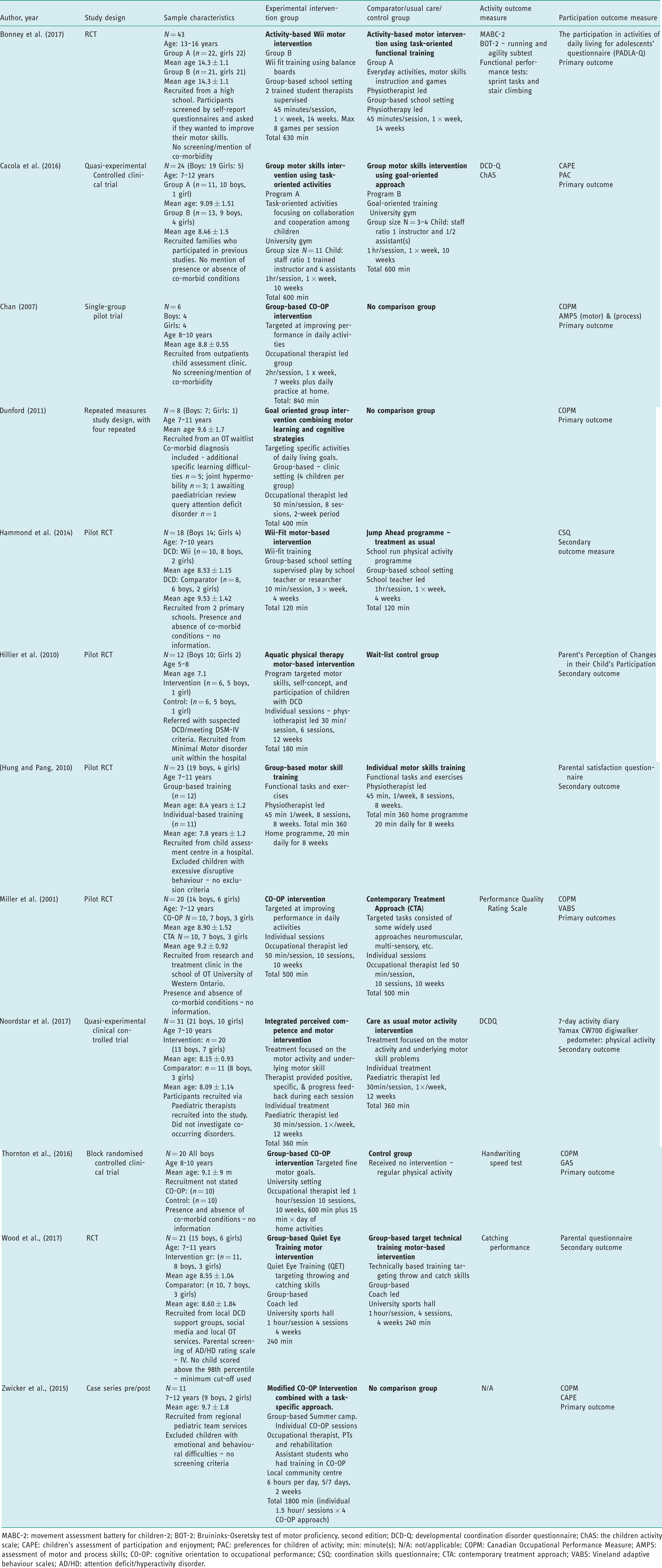
MABC-2: movement assessment battery for children-2; BOT-2: Bruininks-Oseretsky test of motor proficiency, second edition; DCD-Q: developmental coordination disorder questionnaire; ChAS: the children activity scale; CAPE: children’s assessment of participation and enjoyment; PAC: preferences for children of activity; min: minute(s); N/A: not/applicable; COPM: Canadian Occupational Performance Measure; AMPS: assessment of motor and process skills; CO-OP: cognitive orientation to occupational performance; CSQ: coordination skills questionnaire; CTA: contemporary treatment approach; VABS: Vineland adaptive behaviour scales; AD/HD: attention deficit/hyperactivity disorder.
Risk of bias and intervention reporting
Risk of bias was completed using the Cochrane risk of bias tool for nine of the included studies (see Figure 2). Studies were classified as ‘low risk’ of bias, ‘high risk’ of bias or ‘unclear risk’ of bias for each domain. If insufficient detail about what happened in the study was reported, the judgement was classified as ‘unclear risk’ of bias as per the Cochrane guidelines (Higgins et al., 2011). Overall, the risk of bias was high for blinding of participants and personnel; it was difficult to assess selective reporting in many of the studies as no protocol was published before the study.

Risk of bias.
The TIDieR checklist is presented as a web appendix (see online Supplementary Table 4). The majority of studies have lack of information detailing the procedures and content of activities used, with a lack of an intervention guide or intervention protocol published that would facilitate intervention replication. Fidelity was addressed by way of an intervention protocol and a review of intervention delivered in two of the included studies (Hillier et al., 2010; Miller et al., 2001).
Participants
The majority of studies included children aged between 5 and 12 years bar one, which included children aged 13–16 years (Bonney et al., 2017). Ten studies included samples of mixed gender; in these studies combined, the boy:girl ratio was 3:1 (132 boys; 44 girls). One study involved all female participants (Bonney et al., 2017) and one included male participants only (Thornton et al., 2016). All studies outlined how participants met each diagnostic criterion by the DSM-IV/V for a diagnosis of DCD or probable DCD. Two studies clearly describe co-morbidity screening for participants (Dunford, 2011; Wood et al., 2017).
Outcome measures
The participation and activity measures used in this review varied widely (see Table 1). Participation was a primary outcome in four studies (Bonney et al., 2017; Cacola et al., 2016; Thornton et al., 2016; Zwicker et al., 2015). Two studies used standardised measures of participation; the children’s assessment of participation and enjoyment (CAPE) tool (Cacola et al., 2016; Zwicker et al., 2015) and the preferences for activities of children (PAC) (Cacola et al., 2016). One study used a pedometer to measure physical activity participation objectively (Noordstar et al., 2017).
The Canadian Occupational Performance Measure (COPM) (or the CSQ, modelled on the COPM) was the most common individualised outcome measure of participation used in six studies (Chan, 2007; Dunford, 2011; Hammond et al., 2014; Miller et al., 2001; Thornton et al., 2016; Zwicker et al., 2015).
Each of the seven studies that measured activity used a different measure (Bonney et al., 2017; Cacola et al., 2016; Chan, 2007; Miller et al., 2001; Noordstar et al., 2017; Wood et al., 2017) (see Table 2).
Activity level outcomes.

MABC-2: movement assessment battery for children-2; BOT-2: Bruininks-Oseretsky test of motor proficiency, second edition; TFT: task-oriented functional training; DCD-Q: developmental coordination disorder questionnaire; ChAS: the children activity scale; CTA: contemporary treatment approach; CO-OP: cognitive orientation to occupational performance; PQRS: performance quality rating scale; HST: handwriting speed test; QET: quiet eye training; TT: technical training.
Interventions
The interventions varied widely across the 12 studies (Table 1). Motor-based interventions combined with another approach(es) were delivered in eight studies (Bonney et al., 2017; Cacola et al., 2016; Dunford, 2011; Hammond et al., 2014; Hillier et al., 2010; Hung and Pang, 2010; Noordstar et al., 2017; Wood et al., 2017). Table 1 presents the range of combined motor-based interventions included in the eight studies, which were Wii-training; task-orientated functional training; group motor skill intervention; group motor skill intervention; goal-oriented group intervention; aquatic physical therapy; individual motor skills training; group motor skills training; Wii-fit intervention; jump ahead intervention; integrated perceived competence and motor intervention; care as usual motor activity intervention; quiet eye intervention training group; and technical training group. One study used a cognitive intervention using the CO-OP protocol in its original individual format (Miller et al., 2001). One study used a modified CO-OP approach for individual instruction plus incorporating elements of the CO-OP approach into all task-specific activities (Zwicker et al., 2015). Two studies modified the CO-OP for group delivery (Chan, 2007; Thornton et al., 2016).
Intervention effects
Table 3 presents the treatment effects for the eight studies reporting quantitative participation measures. Four studies investigated the effect of a combined motor-based intervention on participation outcomes (Cacola et al., 2016; Dunford, 2011; Hammond et al., 2014; Noordstar et al., 2017). Noordstar et al. (2017) report a large significant between-group effect was found in favour of the care-as-usual motor intervention on the leisure physical activity log g = –0.9 (–1.7, –0.2). A between-group difference was not noted in the objective measurement of physical activity g = –0.03 (–0.7, 0.6). Few significant between-group effects were noted for the other two studies which compared two interventions (Cacola et al., 2016; Hammond et al., 2014). A large significant between-group effect was found in favour of the Wii-fit over usual care on the CSQ ability g = 1.0 (0.04, 2.0) (Hammond et al., 2014). Most between-group effects for the CAPE, PAC and CSQ satisfaction were small and non-significant in these two studies. A large between-group effect was noted in favour of goal-oriented motor skill intervention over task-oriented motor skill intervention for CAPE enjoyment g = –1.2 (–2.1, –0.3) (Cacola et al., 2016). However, we note that the baseline scores appear to differ between groups.
Studies reporting quantitative participation outcomes.
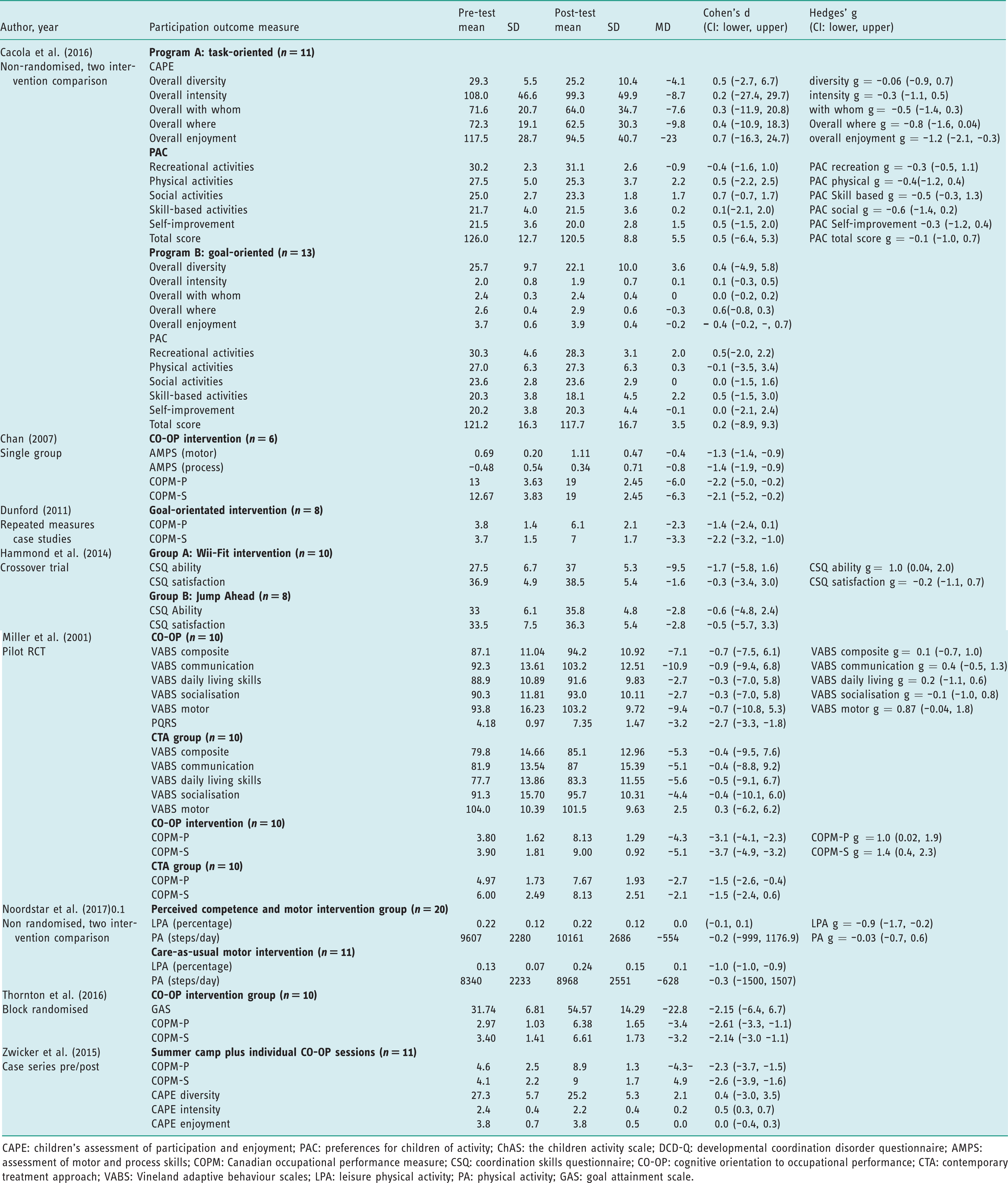
CAPE: children’s assessment of participation and enjoyment; PAC: preferences for children of activity; ChAS: the children activity scale; DCD-Q: developmental coordination disorder questionnaire; AMPS: assessment of motor and process skills; COPM: Canadian occupational performance measure; CSQ: coordination skills questionnaire; CO-OP: cognitive orientation to occupational performance; CTA: contemporary treatment approach; VABS: Vineland adaptive behaviour scales; LPA: leisure physical activity; PA: physical activity; GAS: goal attainment scale.
Two of the combined motor-based intervention studies demonstrated significant within-group effects; goal-oriented intervention had a large significant effect on COPM satification d = –2.2 (–3.2, –1.0) (Dunford, 2011) and small significant effects on the CAPE enjoyment d = –0.4 (–0.2, –0.7) (Cacola et al., 2016).
Four studies used a cognitive intervention, namely the CO-OP or modified CO-OP (Chan, 2007; Miller et al., 2001; Thornton et al., 2016; Zwicker et al., 2015). One of these studies was a RCT study which compared the CO-OP to usual care (Miller et al., 2001). A large significant between-group effect was found in favour of the CO-OP intervention on the COPM performance g = 1.0 (0.02, 1.9) and COPM satisfaction g = 1.4 (0.4, 2.3). Miller et al. (2001) also found a large between-group effect on the Vineland adaptive behaviour scales (VABS) motor in favour of the CO-OP intervention, but this did not reach significance g = 0.87 (–0.04, 1.8). A small non-significant between-group effect was found on VABS communication g = 0.4 (–0.5, 1.3) and VABS daily living g = 0.2 (–1.1, 0.6). Large significant within-group effects were found for CO-OP intervention on the COPM outcome measure (Chan, 2007; Miller et al., 2001; Thornton et al., 2016; Zwicker et al., 2015). The CO-OP intervention also found large significant within-group effects for the assessment of motor and process skills (AMPS) a measure of individuals chosen ADL performance AMPS motor d = –1.3 (–1.4, –0.9) AMPS process d = –1.4 (–1.9, –0.9) (Chan, 2007).
Activity outcomes
Table 2 presents the treatment effects for the activity level outcomes; pre and post-intervention data, mean change, and within and between-group effect sizes are reported for studies that reported adequate data. Three studies used a combined motor-based intervention to evaluate activity level outcomes (Bonney et al., 2017; Cacola et al., 2016; Wood et al., 2017), two of these studies were RCTs (Bonney et al., 2017; Wood et al., 2017). Overall, very few of the between-group effects were significant for activity outcomes (see Table 2). A positive between-group effect was found in favour of the task-oriented functional training group on the stair climbing test g = 1.1 (–1.7, –0.5) (Bonney et al., 2017).
Across the three combined motor-based intervention studies, within-group effects on a range of activity outcomes were typically moderate to large but non-significant. The only within-group effects were noted for the Wii-training intervention on the BOT 2 running and agility d = –1.7 (–2.9, –1.0) (Bonney et al., 2017) and for the quiet eye training intervention on catching performance d = –1.4 (–2.3, –0.1) (Wood et al., 2017).
Discussion
This systematic review aimed to evaluate the effectiveness of interventions on participation outcomes for children with DCD. Overall, the risk of bias of included studies was unclear for items such as ‘selective outcome reporting’ and high for ‘blinding participants’ and ‘personnel’. Intervention reporting standards were poor, with a lack of protocol development and publication. In total, seven RCTs were included in this review; however, we were only able to extract participation data for one RCT. It was not feasible to complete a systematic quality assessment given the heterogeneity of participation and activity outcomes reported. There is limited evidence for the effectiveness of the CO-OP intervention, as within-group effects were found for participation outcomes and a between-group effect on participation in favour of the CO-OP for one RCT. Studies that targeted specific activities showed a within-group effect for those activity level outcomes.
Overall, the findings of this review suggest that there is little evidence to guide clinical practice regarding effective intervention to improve participation outcomes for children with DCD, although the CO-OP intervention warrants further investigation. Within and between-group effects were found for participation outcomes in favour of the CO-OP, and this was the only treatment approach based on a clearly articulated theoretical framework and implementation protocol. At an activity level, where an intervention targeted specific activity, improvements were noted for that activity (Bonney et al., 2017; Wood et al., 2017). However, intervention effects were not linear; improvements at an activity level did not necessarily reflect similar effects at a participation level or vice versa. This is in keeping with previous research findings that changes at one level of the ICF may not result in concomitant changes in participation (Adair et al., 2015). Indeed, the two studies in this review which outlined their outcomes across the ICF domains, did not present an association between levels (Bonney et al., 2017; Thornton et al., 2016).
Across studies, interventions which showed improved participation outcomes used a goal-setting measure such as the COPM (Chan, 2007; Dunford, 2011; Miller et al., 2001; Thornton et al., 2016; Zwicker et al., 2015). The COPM is administered and used by a therapist with the child and family to identify personal goals. These goals become the target for intervention and underpin the measurement of outcome. The relationship between goal-setting and participation-focused outcomes may be an important factor. Participation is a complex multidimensional construct, and research has shown that participation needs are unique to the individual, and can differ between the parent and child (Jasmin et al., 2018; Morgan and Long, 2012). Goal-setting to identify important client-centred activities may be a key element that influences participation.
There is a need for future studies to measure participation robustly. Several studies measured participation by non-standardised questionnaires and did not publish the content of the questionnaire. Very few studies in this review used a standardised measure of participation, which may reflect previous research findings that current measures may not be sensitive to measuring change (Reedman et al., 2017). Future studies developing participation measures need to design the tool in line with current approaches to the operationalisation of participation and participation-related constructs (Imms et al., 2016). There has been rapid development and understanding of the construct of participation, and as such, the debate on what constitutes participation outcome measurement continues to evolve. Adair et al. (2018) published a comprehensive review examining what outcome measures exist that quantify participation and their alignment with the fPRC. This paper was published after this review was completed, had it been available at an earlier stage in this review it would have influenced the authors’ thinking and protocol development. The authors would not have divided the outcomes according to the ICF classification of participation and activity. It was very challenging to differentiate measures without completing a mapping exercise to the fPRC (Imms et al., 2016), and this was not the objective of this review. The Adair et al. (2018) review will help guide future research and practice regarding the selection of participation measures or the development of new tools. Finally, due to the low quality of evidence available, there are limitations to the generalisability of the results of this systematic review. Future studies need to measure participation outcomes so that systematic quality assessment can be completed across studies as the evidence base develops.
The operationalisation of participation and participation-related constructs is evolving rapidly. Some studies used a measure that was not originally designed to measure participation, such as the COPM. However, when clearly articulated, goal-based individualised outcomes, such as the COPM, have the potential to capture changes in participation goals that are specific to the individual’s daily activities, preferences and their environment (Reedman et al., 2017). For example, many of the studies in this review reported COPM goals that reflect a focus on participation at home and in the community. Home-based participation reflected involvement in specific activities such as dressing, or meaningful home and community sports activities such as tennis (Thornton et al., 2016). What may be important is that these activity goals reflect the broader definition of participation as proposed by Imms et al. (2016), but also reflect parent views regarding successful occupational therapy interventions such as those that enabled their child to participate in their chosen motor activities (Morgan and Long, 2012). Occupational therapists are concerned with enabling occupation to support participation in life. Therefore, when selecting a measurement tool, occupational therapists may need to consider capturing both everyday life activity and participation outcomes.
The complexity and enduring nature of DCD presents challenges for intervention development. Children with DCD present with a heterogeneous profile and the need for ongoing health services persist into adulthood (O’Dea and Connell, 2016). Different interventions may be required at key stages of development or periods of transition to target participation. This review identified that the quality of evidence was poor, and there was a lack of well-powered trials. Adopting the Medical Research Council (MRC) framework is a means to address these issues (Craig et al., 2008). Complex interventions are necessary that are theory focused and multi-component, building on the evidence that client priorities regarding home and community participation are important. However, robust well-powered studies using active and inactive controls and reporting quantitative participation outcomes are essential to guide clinical practice and advance treatment outcomes. As part of complex intervention development, there is an urgent need for the use of intervention reporting guidelines. This review found a lack of well-designed studies that report the components of the intervention and publish a protocol. The range of interventions delivered varied in type, intensity, duration and frequency across the included studies. Future research needs to be designed and reported using tools such as the TIDieR checklist (Hoffmann et al., 2014) to facilitate study replication and intervention comparison. Without transparent reporting of the intervention components, it is challenging to unpack how an intervention facilitated change.
Strengths and limitations
A strength of this review lies in the robust design, the pre-published protocol and use of the PRISMA guidelines. An additional strength is the use of the TIDieR checklist to aid intervention comparison and reporting. A comprehensive search was undertaken to identify the wide range of physical, cognitive, psychological or combined interventions used with children with DCD.
The simple categorisation of interventions into the motor, cognitive, and psychological approaches or combined could be considered a limitation of this review. Interventions to treat children with DCD are complex; many studies used more than one approach to inform the intervention design. Accurate comparisons were hindered by the lack of clear differentiation between the interventions.
Future work should prioritise building the evidence base about interventions that improve a child’s participation in life (Novak and Honan, 2019). Using conceptual frameworks such as fPRC is essential to inform the intervention design (Imms et al., 2016), as this will support researchers to articulate what concepts and key ingredients are the target of the intervention.
We used the ICF and fPRC framework to define participation; this created challenges regarding language and classification of measures at participation or activity level. The indistinctness for classification between participation and activity is a limitation of this review. Future research may benefit from using the fPRC definition of participation. The definition of participation of Imms et al. (2016) aligns closely to occupational therapy taxonomy which views participation as the involvement in life situations through activity in a social context (Ghysels et al., 2017).
This review did not consider the children’s self-perceptions of adequacy in and predilection for physical activity (CSAPPA) questionnaire as a measure of participation (Bonney et al., 2017) as it was difficult to identify the components of the questionnaire that related to involvement. The authors of this review deemed the CSAPPA to be a measure of self-efficacy. However, a recently published paper has examined measures used to quantify participation in childhood disability and their alignment with the fPRC’s (Adair et al., 2018). This comprehensive review was not published when this systematic review was completed, highlighting the evolving consensus of participation outcome measurement.
Conclusion
This systematic review is the first, to our knowledge, to generate a summary of the evidence for the effects of motor, cognitive and psychologically based or combined interventions on participation outcomes in children with DCD. Cognitive interventions such as the CO-OP have limited evidence of effectiveness for improving participation outcomes on the COPM, and combined motor interventions targeting specific activities may produce effects at that activity level. This review identified the need for future studies to measure participation as a primary outcome, and to use reporting guidelines so that the intervention replication and comparison can be completed. Future interventions need to be developed using the MRC framework so that the theory and mechanisms for change can be articulated.
Key findings
Limited evidence exists regarding the effectiveness of interventions to improve participation outcomes. More high-quality research is needed to study the effects of occupational therapy interventions ensuring that participation is measured as a primary outcome.
What the study has added
This review suggests that the development of complex interventions is needed to help guide clinical practice and improve outcomes for children with DCD across the lifespan. The CO-OP intervention may help to increase participation in prioritised daily activities in the home or community.
Supplemental Material
Supplemental material for Effectiveness of interventions to improve participation outcomes for children with developmental coordination disorder: A systematic review
Supplemental Material for Effectiveness of interventions to improve participation outcomes for children with developmental coordination disorder: A systematic review by Áine O’Dea, Katie Robinson and Susan Coote in British Journal of Occupational Therapy
Footnotes
Research ethics
Ethical approval was not required for this systematic review.
Consent
This systematic review did not involve any contact with humans, as such ethical approval was not sought. However, a study protocol was published a priori on Prospero registration number CRD42017080747.
Declaration of conflicting interests
The authors declared no potential conflicts of interest with respect to the research, authorship, and/or publication of this article.
Funding
The authors disclosed receipt of the following financial support for the research, authorship and/or publication of this article: The author ÁOD disclosed that she is a full time PhD scholar on a structured PhD programme in health service research and population health, funded by the Health Research Board (SPHeRE/2013/1), Ireland. This programme funds postgraduate fees and a stipend for four years.
Contributorship
ÁOD and SC conceived and designed this systematic review. ÁOD and SC participated in the development of the search strategy. All authors contributed to the methodology of the study; ÁOD completed the database searches. ÁOD and KR completed the screening and data extraction. ÁOD and SC completed the quality appraisal of included studies. ÁOD carried out the statistical and descriptive analysis and all authors were involved in the interpretation of the data. ÁOD wrote the first draft of the manuscript. All authors reviewed and edited the manuscript and approved the final version.
References
Supplementary Material
Please find the following supplemental material available below.
For Open Access articles published under a Creative Commons License, all supplemental material carries the same license as the article it is associated with.
For non-Open Access articles published, all supplemental material carries a non-exclusive license, and permission requests for re-use of supplemental material or any part of supplemental material shall be sent directly to the copyright owner as specified in the copyright notice associated with the article.
