



Abstract
Introduction
The Schenkenberg Line Bisection Test is a brief screening tool following stroke to assess for unilateral spatial neglect. This assessment takes under five minutes to administer, but scoring using the guidelines of the original authors is lengthy and complex. This study examined the interrater, intrarater, and test–retest reliability of the test using both a brief and detailed method of scoring developed for this study that are more readily used in the clinical setting.
Method
Fifteen participants following stroke were assessed using the Schenkenberg Line Bisection Test. Assessments were scored by four occupational therapists on two separate occasions using both the brief and detailed scoring method developed for this study.
Results
Intraclass correlation coefficients obtained for interrater reliability for the brief scoring method ranged from .89 to 1, and from .82 to .95 for the detailed method. Intraclass correlation coefficients for intrarater reliability ranged from .82 to 1 for the brief method and from .72 to .99 for the detailed method. Strong agreement was observed between first and second assessments in most situations for test–retest reliability.
Conclusion
Preliminary exploration of the revised scoring methods for the Schenkenberg Line Bisection Test demonstrate high reliability and that scoring can be completed relatively quickly in clinical practice.
Introduction
Unilateral spatial neglect (USN) is one of the most serious visuospatial disorders experienced by people who have survived a stroke (Ogourtsova et al., 2011). USN has been defined as ‘the failure to report, respond or orient to novel or meaningful stimuli presented to the side opposite a brain lesion, when this failure cannot be attributed to either sensory or motor defects’ (Heilman et al., 2010: 296). This impairment is more commonly associated with a stroke of the right cerebral hemisphere than with a stroke of the left cerebral hemisphere (Chen-Sea, 2000). The estimated prevalence for USN following stroke varies, with one study reporting as low as 17% (Lisa et al., 2013) and another as high as 90% (Massironi et al., 1988). USN may manifest in an inability of the patient to attend to one side of their own body (personal neglect), an inability to attend to the space within arm’s length of their own body (peri-personal neglect), or the inability to attend to the space beyond reaching distance (far peri-personal neglect) (Menon and Korner-Bitensky, 2004).
A screening tool is used to quickly identify the presence of a problem such as USN in stroke survivors, and more detailed assessments are used with those patients who screen positive for a problem such as USN to further evaluate the nature and extent of the condition and its impact on occupational performance (Cooke et al., 2005). Assessment results are also used to guide intervention planning (Menon and Korner-Bitensky, 2004), to measure change over time, and as an outcome measure to determine the effectiveness of a rehabilitation programme (Cooke et al., 2005). There are vast numbers of standardised and non-standardised assessments available to occupational therapists for the screening and assessment of USN (Menon and Korner-Bitensky, 2004). Assessments and screening tools used to detect and measure USN following stroke include a range of brief screening tasks, self-rating scales, table-top assessments, more detailed and in-depth assessments of USN, and ‘top-down’ observational methods of assessing performance in functional tasks (Menon and Korner-Bitensky, 2004).
USN can severely impact on an individual’s ability to engage in their daily occupations. A patient who has a more severe USN may be observed colliding with objects within their environment, eating food on only one half of the plate, or performing self-care tasks such as dressing on only one side of the body (Menon-Nair et al., 2006). Because of this, occupational therapists have an integral role in the assessment and treatment of USN (Cooke et al., 2005). The National Clinical Guideline for Stroke (Royal College of Physicians, 2016) recommend that ‘People with stroke affecting the non-dominant cerebral hemisphere should be considered at risk of impaired awareness on the contralateral side and should be assessed for this using standardised measures’ (recommendation 4.3.7.1, page 64). Important psychometric properties for occupational therapists to consider when selecting assessments for use in clinical practice include reliability, validity, clinical utility, standardisation of test administration and scoring, sensitivity and responsiveness of a test, as well as the availability of normative data (Cooke et al., 2005).
‘The reliability of a test refers to how stable its scores remain over time and across different examiners’ (Fawcet, 2007: 194). It is vital for occupational therapists to use assessments that have demonstrated reliability to ensure that any measurements or scores collected can be trusted as being free from error and confidently used to inform clinical decision-making (Portney and Watkins, 2015). Several types of reliability need to be considered. These include interrater reliability, the degree of agreement between two or more raters who are measuring the same test items; intrarater reliability, the degree of agreement between the scores obtained by one rater across two or more trials of the same assessment; and test–retest reliability, which refers to the level of agreement between scores obtained by the same rater across repeated administrations of the same test (Portney and Watkins, 2015).
The Schenkenberg Line Bisection Test (SLBT) (Schenkenberg et al., 1980) is one of many brief screening tools that is used with stroke survivors to screen for USN (Figure 1). This assessment specifically screens for peri-personal neglect, or neglect in the space within the close surrounds of the person’s body. The assessment consists of 20 horizontal lines printed on an A4 piece of paper (21cm × 29.5cm). The top and bottom lines are used for demonstration and instruction purposes and are not scored. The remaining 18 horizontal lines are organised into three groups of six, with one group of lines on the left, one group of lines located centrally, and one group of lines on the right-hand side of the page. Each group has a line of 100mm, 120mm, 140mm, 160mm, 180mm, and 200mm in length. The paper is placed or taped to the table in the midline position of the patient and they are asked to use a pen to bisect each horizontal line by marking the centre of each line. The expectation is that if left sided USN is present the person may miss lines on the left side of the page, or bisect lines incorrectly by deviating further to the right of the midpoint of each line (Lezak et al., 2012; Schenkenberg et al., 1980). The opposite pattern may be observed in instances of right sided USN. The scoring method described by the original authors of the SLBT involved counting the number of lines marked out of a maximum of 18, and also determining the percentage deviation a mark was made from the midpoint for each line on the test (Schenkenberg et al., 1980). This original scoring and calculation method may be useful as a sensitive measure of change; however, it is mathematically very complicated and time-consuming to score (approximately 15 minutes), and hence this method is not widely used in clinical practice.

Schenkenberg Line Bisection Test (scaled down to size).
While the SLBT is considered a clinically useful tool as it takes under five minutes to administer, there have been few studies examining the reliability of this tool (Menon and Korner-Bitensky, 2004). Two studies have examined only the test–retest reliability of the SLBT using the complex method of determining percentage deviation from the centre of each line marked (Schenkenberg et al., 1980; Sea and Henderson, 1994). There have been no previous reports of interrater or intrarater reliability for the SLBT using the brief scoring method of counting the number of lines omitted (Menon and Korner-Bitensky, 2004). The aim of the study was to provide preliminary analysis of the reliability of scoring for two simpler and quicker methods of scoring and reporting on results of the Schenkenberg Line Bisection Test.
Simplification of the scoring methods developed and described in this study as well as demonstration of the reliability of the SLBT using these two methods were the focus of this preliminary study. These two methods of scoring of the SLBT (brief and detailed methods) are expected to be more readily understood and implemented in clinical practice, while at the same time providing relevant and repeatable measurement information for patients and clinicians. Written permission has been provided by the author of the SLBT, Dr Thomas Schenkenberg, to reprint a copy of the tool (scaled down in size), as well as to report on the modified scoring methods described in this study.
SLBT brief scoring method
The brief scoring method used in this study involved counting the number of marked lines and noting their position (omissions of lines on the left or right side of the page). The patient is given a score out of six for lines marked on the left of the page, a score out of six for lines marked centrally, and a score out of six for lines marked on the right of the page, as well as an overall score out of 18 for all line bisections attempted on the assessment. This score simply reflects the number of line bisections attempted and their location on the page (right, central, or left side of the page), but not the level of accuracy in locating the midpoint of any of these lines. This is one of the methods of scoring outlined by the original authors of the SLBT (Schenkenberg et al., 1980). A score of 15 and below is indicative of USN as reported by the original authors of this tool (Schenkenberg et al., 1980). The brief method of scoring takes less than one minute to complete in clinical practice, and is a quick method for reporting of results for people with more marked USN who may miss marking many lines on the assessment sheet.
SLBT detailed scoring method
The detailed scoring involved recording (a) how many of the patient’s attempted bisections deviated more than 5 mm from true centre, (b) noting whether these marks were made to the left or right of centre, and (c) the average distance in millimetres these attempted bisections deviated from the true midpoint of the line. A transparent overlay scoring template was placed on top of the completed SLBT assessment form to enable fast and accurate scoring and recording of the distance a patient may have marked a line from its true centre (Figure 2). The transparent overlay template included marks that indicated the true centre of each line on the SLBT and were colour coded (blue for lines on the left, red for lines centrally located, and green for lines located on the right) to allow for quick identification of lines that a patient had located and marked. A ruler was included on the template with distance measurements in millimetres to enable fast and accurate recording of the distance a patient may have marked a line from its true centre. This overlay template was created using the Microsoft® Office Visio® computer graphics program and printed onto a transparent plastic sheet (21cm × 29.5cm). Standard instructions for use of this detailed scoring method and overlay template were developed and used in this study.
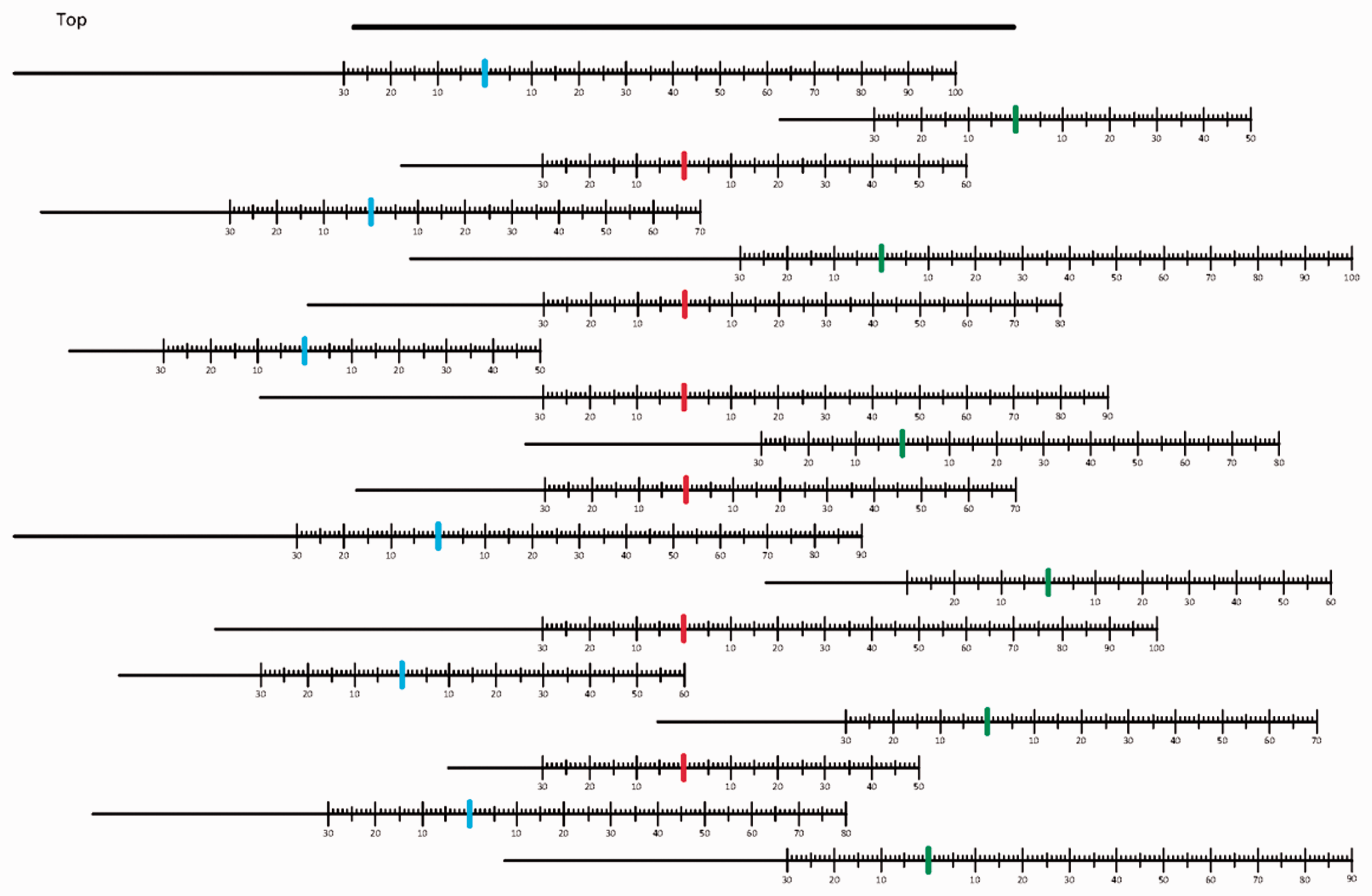
Schenkenberg Line Bisection transparent scoring overlay template.
This detailed method of scoring the SLBT was developed specifically for this study and based on the principles of the original authors. It is, however, much quicker to complete (less than five minutes) and report on in clinical practice. Marks made within 5 mm of the true midpoint were counted as accurate given that healthy subjects are known to deviate up to 5mm either side of true centre (Hillier and Tarbutton, 2014). This method of scoring provides a sensitive means of reporting change in visual scanning abilities and accuracy over time for people with USN. It is especially useful for those who are initially able to locate all lines on the page using the quick scoring method, but deviate greater than five millimetres from the midpoint of many lines (indicating the presence and severity of USN), and for whom improvement in spatial judgement and accuracy in systematic scanning ability occurs through treatment and recovery. Reporting the average distance from the true midpoint of each line and indicating the direction of deviation from the centre is a quicker and more readily understood result than the method of percentage deviation from centre proposed by the original authors of the SLBT.
Each SLBT sample examined in this study using the detailed scoring method included: (a) a score out of 18 for the number of marked lines with the midpoint equal to or less than 5mm either side of true centre; (b) a count of the number of marked lines with the midpoint more than 5mm to the right of true centre; (c) the average distance that the patient deviated from true centre for lines marked to the right of true centre recorded in millimetres; (d) a score out of 18 for the number of marked lines with the midpoint greater than 5mm to the left of true centre; and (e) the average distance (in millimetres) that the patient deviated to the left of true centre for these lines. The detailed method developed for this study takes under five minutes to complete in clinical practice.
The reliability of these two scoring methods was examined in this study as they are both quick to score and readily understood in the context of a screening tool for USN, and results were interpreted in conjunction with performance on functional tasks such as dressing and showering. In instances where a patient is found to have USN, it would be expected that both scoring methods for the SLBT would provide therapists with important information to report on as a measure of the person’s progress over time.
Research design
This study involved a prospective study of a convenience sample of people with stroke receiving treatment following stroke in acute care, inpatient, or outpatient day therapy services of an individual hospital during the study period. Ethics approval for this study was obtained from the Mater Health Services Human Research Ethics Committee (approval code: HREC/17/MHS/26), and the Australian Catholic University Human Research Ethics Committee (approval code: 2017-127R).
Participants
Stroke patient participants
Participants were a convenience sample of people with stroke, admitted to the acute stroke unit, the inpatient rehabilitation unit, or day therapy service of the hospital where the study was conducted, and met the inclusion criteria during a two-month period from July to August 2017. To be included in this study participants were required to be 18 years or over, have a diagnosis of stroke as confirmed by computed tomography or magnetic resonance imaging, and have sufficient comprehension of the English language to give informed consent or have an interpreter present during the consent and assessment process. The study did not specifically seek to recruit participants with USN. Participants were excluded if they had dementia, receptive aphasia, vision impairment, impaired basic cognition, or an inability to understand and carry out the task demands of the SLBT. All participants provided written informed consent prior to their inclusion in the study. Each person receiving occupational therapy following stroke during the study period at the hospital where the project was carried out, and who met the inclusion criteria for the study and provided consent to participate, was assessed using the SLBT by the second or third researcher. Five participants receiving inpatient rehabilitation who were available on the following day and provided consent completed the SLBT a second time and results were used for comparison in the test–retest reliability analysis for the study.
Occupational therapist raters
Occupational therapist raters were a convenience sample recruited from the hospital where the study was undertaken in Brisbane, Australia, and included the third investigator of this study. All occupational therapists working at the hospital in the month of July 2017 were notified of the study via email and were invited to participate. Occupational therapists who volunteered were provided with a participant information sheet and provided written informed consent prior to their inclusion in the study.
Procedures
Stroke patient participant SLBT administration
The SLBT was administered to all 15 stroke patient participants by the second or third study investigators using the standard administration method. The patient was seated, and the assessment was taped to the table in front of the patient in their midline. The patient was instructed to: (a) place the hand that you are not using to hold the pen on your lap; (b) cut each line in half by placing a small mark though each line as close to its centre as possible; (c) do not make more than one mark on any line; and (d) mark each of the lines without skipping any. Five of the stroke patient participants agreed to complete the SLBT a second time on the following day, 24 hours after the first assessment, for test–retest reliability examination purposes. It was expected that there would be no change in performance over this 24-hour period. The completed assessments were then coded and de-identified.
Occupational therapist scoring
Each of the therapist raters was provided with a copy of the written instructions for administering and scoring the SLBT using both the brief and more detailed scoring methods, a copy of the completed and de-identified SLBTs, a scoring sheet for recording results, and a copy of the transparent overlay scoring template (Figure 2). The therapist raters were also provided with five minutes of individual training on both scoring methods by one of the investigators, and were provided with an opportunity to ask questions prior to completing scoring of the 15 assessment samples.
The completed assessments were independently scored by each of the occupational therapist raters on two separate occasions two to three weeks apart, using both the brief and detailed scoring methods. This timeframe was chosen to minimise memory and learning effects on therapists’ results, and scored in a different randomised order on each occasion. Each occupational therapist rater completed the scoring for all 15 SLBTs on the first occasion of test scorings, as well as the five additional test–retest samples, to test for interrater reliability and test–retest reliability. The five test–retest samples were not scored on the second scoring occasion.
Data analysis
Descriptive statistics, including means and ranges, were used to describe demographic data of the occupational therapist raters and the stroke patient participants. Quantitative analysis of the SLBT scoring results was conducted with IBM SPSS version 22 (SPSS Institute, Chicago, IL, USA). ICCs (intraclass correlation coefficients) (3,k) were used to determine the interrater and intrarater reliability of both the brief and the detailed methods of scoring the SLBT used in this study. The ICC is a common statistic used in determining reliability and ‘is calculated using variance estimates obtained through analysis of variance’ (Portney and Watkins, 2009: 589). No statistics were determined for test–retest reliability using SPSS due to the small sample size of four occupational therapists. However, the results were examined and the range of difference between the therapists’ scores for the two assessments was recorded.
Portney and Watkins (2015) have reported that the general guidelines for acceptable reliability statistics are as follows: coefficients below .50 suggest poor reliability; coefficients between .50 and .75 suggest moderate reliability; and coefficients above .75 represent high reliability. Confidence intervals of 95% were reported for all ICCs.
Results
Stroke patient participants
In total, 15 participants with stroke were recruited, with a mean age of 66.8 years (range 38–87 years). The participants included seven females and eight males: six with right hemisphere stroke, eight with left hemisphere stroke, and one following a brainstem stroke. Three participants were recruited from the acute stroke unit with a mean length of time since onset of stroke of eight days (range 1 to 18 days), six were recruited from inpatient rehabilitation with a mean length of time since onset of stroke of 16.33 days (range 6 to 31 days), and six were recruited from day therapy with a mean length of time since onset of stroke of 2.98 years (range 31 days to 6.77 years). The broad range in length of time post stroke for participants is reflective of the different locations within the one hospital that they were drawn from (acute care, inpatient rehabilitation, and day therapy). A convenience sample of people who have suffered stroke was sought for this preliminary study for the purpose of evaluating the reliability of the assessment process, not specifically seeking participants with USN.
Stroke severity was recorded using the Modified Rankin Scale (New and Buchbinder, 2006), with participant scores ranging between 2 and 4 (mean = 2.78). Scores on the Modified Rankin Scale range from 0 to 5, with a higher score indicating a more severe or higher level of patient disability. The Functional Independence Measure (FIM) is an 18-item (13 motor with a maximum score of 91, and five cognition with a maximum score of 35), seven-point scale that is used to evaluate the level of dependence in basic activities of daily living and evaluate patient outcomes following rehabilitation (Granger et al., 1993). A high score on the FIM indicates a high level of independence. The mean FIM score for participants in this study was 94.61 (range: 40–124).
Occupational therapist raters
Four occupational therapists, three males and one female, volunteered to participate in the study. The raters’ mean length of time since graduation with an occupational therapy degree was 16.75 years (range 12–22 years), with a reported average of 15.62 years (range 11.5–22 years) working with adults with neurological conditions.
Interrater reliability
ICCs for the interrater reliability for the brief and detailed scoring methods of the SLBT are shown in Table 1. The results show that the interrater reliability for both methods of scoring the SLBT across four raters for all nine measures on the 15 patient samples was high. The ICCs ranged from .89 to 1 for the brief scoring method (measures 1–4, M1–M4) and .82 to .95 for the more detailed scoring method (measures 5–9, M5–M9).
Interrater reliability for the Schenkenberg Line Bisection Test using the brief and detailed scoring methods.

ICC: intraclass correlation coefficient; CI: confidence interval.
aAs all patients received the same score, ICCs could not be calculated. Note that all raters gave exactly the same score.
M1 = Line bisections attempted on the left of page out of 6.
M2 = Line bisections attempted in the centre of page out of 6.
M3 = Line bisections attempted on the right of page out of 6.
M4 = Total number of line bisections attempted out of 18.
M5 = Total number of lines marked within 5mm of true centre point.
M6 = Total number of lines marked more than 5mm to the right of centre.
M7 = Average deviation distance of line bisection attempts made more than 5mm to the right of centre in millimetres.
M8 = Total number of lines marked more than 5mm to the left of centre in millimetres.
M9 = Average deviation distance of line bisection attempts made more than 5mm to the left of centre in millimetres.
Intrarater reliability
ICCs for the intrarater reliability for each of the four therapist raters using the brief and detailed scoring methods are shown in Table 2. All measurements for the brief scoring method (M1–M4) had high intrarater reliability as the ICCs ranged from .82 to 1. All but one measurement using the detailed scoring method (M5–M9) had high intrarater reliability. ICCs ranged from .72 to .99. Measurement 7 (M7), as scored by therapist number 4, had an ICC of .72, indicating a moderate reliability. The brief scoring method demonstrated high intrarater reliability, and the detailed scoring method demonstrated moderate to high intrarater reliability.
Intrarater reliability for the Schenkenberg Line Bisection Test using the brief and detailed scoring methods.

ICC: intraclass correlation coefficient; CI: confidence interval.
aAs all patients received the same score, ICCs could not be calculated. Note that the rater gave exactly the same score on both occasions.
M1 = Line bisections attempted on the left of page out of 6.
M2 = Line bisections attempted in the centre of page out of 6.
M3 = Line bisections attempted on the right of page out of 6.
M4 = Total number of line bisections attempted out of 18.
M5 = Total number of lines marked within 5mm of true centre point.
M6 = Total number of lines marked more than 5mm to the right of centre.
M7 = Average deviation distance of line bisection attempts made more than 5mm to the right of centre in millimetres.
M8 = Total number of lines marked more than 5mm to the left of centre.
M9 = Average deviation distance of line bisection attempts made more than 5mm to the left of centre in millimetres.
Test–retest reliability
Five of the stroke patient participants completed the SLBT twice, on two separate occasions 24 hours apart, to examine test–retest reliability. Each of the therapists scored these two assessments of the five participants. There was almost 100% agreement observed across all measurements between the first and second sample using the brief scoring method (M1–M4). The only difference between the first and second sample scored for the brief scoring method was participant 12: measurement 1 (M1) (first sample = 5/6, second sample = 6/6) and measurement 4 (M4) (first sample = 17/18, second sample = 18/18). Results demonstrate that there was very high percentage agreement and therefore high test–retest reliability between the first and second samples using the brief scoring method.
Using the detailed scoring method there was some variation between four out of the five patient test–retest samples, with just one patient receiving 100% agreement between all scores, by all therapists across each of the two samples. Measurements 5, 6, and 8 (M5, M6, M8) involved raters needing to identify the number of lines that have been marked within 5 mm of true centre. The difference between the raters for the first and second sample scored was between zero and seven lines. Measurements 7 and 9 (M7 and M9) relate to the average deviation distance in millimetres for those test samples where deviation from true centre was greater than five millimetres. Difference between the first and second sample ranged between .2 mm and 10.8 mm. Measures 7 and 9 are dependent upon results of measures 5, 6, and 8, contributing to some of the variability in the test–retest reliability results.
Discussion
This preliminary analysis of revised and simplified scoring methods for the SLBT was found to have high interrater reliability for both the brief and detailed scoring methods, with all ICCs greater than .80 (Portney and Watkins, 2015). The intrarater reliability for the brief method was high (ICC > 75) and the intrarater reliability for the detailed method ranged from moderate (ICCs .50–.79) to high (ICC > .75) (Portney and Watkins, 2015). The brief scoring method included counting the number of lines and noting the position (left, centre, or right side of the page) on the assessment page where line bisection was attempted. This brief method of scoring had slightly higher ICCs for interrater reliability (ICCs .89–1) and intrarater reliability (ICCs .82–1) than the second, more detailed scoring method. This more detailed scoring method involved measuring the distance of the patient’s attempted bisection from true centre in millimetres and calculating the average deviation distance for marks placed on the left of true centre and for marks placed on the right of true centre. ICCs for the detailed scoring method ranged from .82–.95 for interrater reliability and from .72–.99 for intrarater reliability.
Test–retest reliability results showed very high agreement for the raters between the first and second patient samples scored using the brief scoring method. There was a greater variation between the raters when scoring the same assessments using the detailed method of scoring for four out of five patient samples. The brief method of scoring the SLBT demonstrated stronger agreement between the raters for the first and second sample scored and thus a higher test–rest reliability than the more detailed method, which was consistent with the interrater reliability and intrarater reliability results obtained in this study.
The brief scoring method is quick and simple to complete as it only involved counting the number of lines and noting the position of these lines where bisection attempts have been made. In this study, the brief scoring method had slightly more reliable interrater, intrarater, and test–retest reliability results than the detailed scoring method. While the brief method of scoring is useful in screening for peri-personal USN in stroke survivors, it does not evaluate how close the patient has placed each bisection to the true centre of each line. A deviation from true centre of greater than 5 mm on the line bisection task is also indicative of USN (Hillier and Tarbutton, 2014), and can be used as an indicator of the severity of neglect when reporting on the results of this assessment. The average deviation from true centre may also be seen as a measure of progress of a person with USN over time if the amount of deviation from true midpoint reduces. Both scoring methods have application in clinical practice for initial screening and recording of improvement over time. The detailed method of scoring takes longer (less than five minutes) to complete; however, it may be a more sensitive measure of a person’s USN change or improvement over time than the brief method of scoring. Both the brief and the detailed scoring methods described and evaluated in this study take less than five minutes to score. This is 10 minutes quicker than scoring using the method described by the original authors, which is mathematically too complicated and too lengthy for routine use in clinical practice.
The transparent overlay scoring template developed for this study provided a quick and accurate means of measuring, scoring, and reporting results of the SLBT, and was demonstrated in this preliminary study to have high reliability when used by occupational therapy clinicians. This scoring method was developed as an alternative to the original and complex scoring method of calculating percent deviation used by Schenkenberg et al. (1980) in the original study. The original method of calculating percent deviation was designed to accommodate for the differences in line length (Lezak et al., 2012; Schenkenberg et al., 1980) but takes too long to be used in clinical practice. It is anticipated that patient results reported using this new method will be more readily understandable when communicating assessment results to patients and other health professionals, and more readily adopted in clinical practice than the original method of calculating percent deviation described by Schenkenberg et al. (1980).
Limitations
A recognised limitation of this preliminary study was the small sample of four occupational therapists, and the limited patient sample of 15 people following stroke, very few of whom were assessed as having neglect (missed three or more lines or deviated more than five millimetres to right of midline). The stroke participant sample in this preliminary study was small and heterogenous, with none screened using the SLBT found to have a severe form of USN. The highest deviation from true centre of a participant in this study was 35 mm. It would be expected that assessments where a patient has performed poorly might require therapists to exercise more complex clinical judgement and measurement of greater deviation distances than assessments where a person has performed well. This lack of variability in the sample of SLBTs may have influenced the results of this study.
Previous study of reliability of the SLBT has been limited. Only test–retest reliability for the SLBT using the brief scoring method and the method of percent deviation had been demonstrated (Schenkenberg et al., 1980; Sea and Henderson, 1994). There have been no previous reports of interrater or intrarater reliability for the SLBT using the brief scoring method of counting the number of lines omitted (Menon and Korner-Bitensky, 2004). This is the first study investigating use of this new clinically achievable but detailed method of scoring the SLBT measuring the average distance from true midpoint.
Many forms of line bisection have been reported in the literature, including single line bisection, three line bisection, 12 line bisection (Lezak et al., 2012), and 18 line bisection (Schenkenberg et al., 1980). People with USN may not consistently make the same error, so a single line placed in their midline is deemed to be inadequate to detect USN in all cases (Lezak et al., 2012). Line bisection involving multiple lines for bisection such as the SBLT has been demonstrated to be a more sensitive measure of neglect than a single line for bisection (Lezak et al., 2012). Normative data for the SLBT is limited. Schenkenberg et al. (1980) reported on the normative data for a small sample of 38 college students using the brief scoring method for this tool. Van Deusen (1983) reported normative data for the SLBT based on 93 elderly patients with a mean age of 70.5 years using the method of percent deviation.
Future research
Future research is needed to establish a larger and more representative sample of people following stroke who demonstrate more severe USN, and also a larger normative data set, with an extended age range to include older adults using both the brief and revised detailed scoring methods of this study. This would improve the accuracy in screening and reporting on USN with this brief screening tool in clinical practice as well as recording progress over time for people following stroke. It should be recognised that a pencil and paper tool such as the SLBT should be used in combination with other functional measures of neglect as it measures only one aspect of behaviour of those exhibiting USN.
Conclusion
This preliminary study demonstrated high levels of interrater and intrarater reliability for the SLBT using both a brief and a new revised detailed method of scoring. Test–retest for the SLBT was demonstrated through strong agreement between the scores of the first and second occasion for the brief method of scoring. A quick and reliable method of measuring and reporting detailed results of the SLBT has been shown to have high levels of reliability in this study. Further research is required to establish normative data for the SBLT across a broader age range, including older adults using the more detailed scoring method described in this study. A broader normative dataset, and further examination of reliability and sensitivity of this tool with a larger sample size including people with more severe USN, will better support its use and interpretation in clinical practice.
Key findings
Preliminary analysis of revised scoring methods for the SLBT have been quick to complete and shown promising interrater, intrarater, and test–retest reliability. Further research on normative data for adults of all ages for the SLBT is required.
What the study has added
This study has provided a preliminary demonstration of a brief and improved method of screening and reporting on unilateral neglect following stroke.
Footnotes
Acknowledgements
The contribution of all participants in this study is gratefully acknowledged.
Research ethics
Ethical approval was obtained from the Mater Health Services Human Research Ethics Committee (HREC/17/MHS/26), and the Australian Catholic University Human Research Ethics Committee (2017-127R).
Consent
All participants provided written informed consent for involvement in this study
Declaration of conflicting interests
The authors declared no potential conflicts of interest with respect to the research, authorship, and/or publication of this article.
Funding
The authors received no financial support for the research, authorship, and/or publication of this article.
Contributorship
Andrew Stone and Deirdre Cooke researched literature, applied for ethical approval, and undertook statistical analysis and write up of this article. Deirdre Cooke and Deborah Morton completed participant recruitment and assessment. Michael Steele carried out the statistical analysis. All authors contributed to interpretation of the data, reviewed and edited the manuscript, and approved the final version.