



Abstract
Introduction
In response to growing demands on health and social care services there is an emphasis on communities addressing the needs of local populations to improve lives and reduce inequalities. Occupational therapists are responding to these demands by expanding their scope of practice into innovative settings, such as working with refugees, the homeless and residents of nursing homes, and within sport and leisure environments. The benefits of sport are widely acknowledged, and this paper argues that occupational therapists could play a pivotal role in enabling people to participate.
Method
This qualitative study drew on a phenomenological approach and used interviews and thematic analysis to explore five occupational therapists’ experiences of enabling people to participate in sport.
Findings
Findings revealed that participants demonstrated the uniqueness of occupational therapy when enabling people to participate in sport and practised according to their professional philosophy. There were opportunities to reach wider communities and promote the value of occupational therapy by collaborating with organisations, but there were also challenges when working outside of traditional settings.
Conclusion
The study emphasises the unique skills occupational therapists can bring to this setting. It highlights opportunities to expand their practice, to forge new partnerships in sports and leisure environments, and to address the national inactivity crisis.
Introduction
Evidence gathered from disciplines including public health, medicine, sports science, psychology and occupational therapy highlights the benefits of participating in sport, for example preventing and managing physical and mental health conditions, increasing quality of life and increasing social participation (Creek, 2014; Public Health England, 2018; Sport England, 2017). By participating in the recommended amount of exercise per week the risk of developing long-term conditions such as heart disease can be reduced by up to 40% and type 2 diabetes by 50% (Academy of Medical Royal Colleges, 2015). Despite this evidence, Public Health England (PHE) (2018) are concerned that people are becoming less active, highlighting how physical inactivity costs the United Kingdom (UK) £7.4 billion annually, with £0.9 billion of these costs falling to the National Health Service (NHS).
In response to growing demands on health and social care services there is an emphasis on communities addressing the needs of local populations to improve lives and reduce health inequalities (National Health Service, 2019). Government drives towards health promotion, wellbeing and illness prevention include strategies to increase participation in sport (PHE, 2018). In ‘Sporting future: A new strategy for an active nation’ (HM Government, 2015: 10), the focus is on enabling participation to achieve ‘physical well-being, mental well-being, individual development, social and community development and economic development’. Similar strategies to increase levels of physical activity in local populations are mirrored across the globe, for example campaigns such as ‘Every Body Active’ in New Zealand (Sport New Zealand, 2020) and ‘Get Ireland Active!’ in Ireland (Healthy Ireland, 2016).
This presents opportunities for occupational therapists to enact the core philosophy of the profession, promoting occupational engagement to enhance wellbeing (Wilcock, 2006) by expanding their scope of practice into innovative settings and addressing social and occupational injustices experienced by those with disabilities such as inaccessible environments, stigma, attitudes, policies, and limited choice or control (Whiteford, 2011). Occupational therapists could play a pivotal role promoting the benefits of sport and supporting engagement in participation (Royal College of Occupational Therapists, 2018a). Using their unique skills, occupational therapists could enhance opportunities for participation through activity analysis, through adaptations and by eliminating barriers to inclusion (Creek, 2014; Sharp et al., 2012). However, there appears little evidence to support this assertion. The overall aim of this study was therefore to gain a deeper understanding of the experiences of occupational therapists working in diverse settings who enable people to engage in sport as a therapeutic activity. For the purposes of this study sport included a range of activities from, for example, incorporating physical activity into people’s daily lives through meaningful activities such as walking the dog, through to team sports.
Literature review
Occupational therapists are increasingly working outside of traditional settings to enable people to participate in sport. ‘Sense Rugby’, for example, is an Australian occupational therapy practice enabling children with developmental delays and conditions to participate in rugby (Sense Rugby, 2020). Similarly, ‘Box Positive’, set up by a UK occupational therapist, uses boxing as a therapeutic intervention for people with Parkinson’s disease (Box Positive, 2019). However, there appears to be an absence of empirical research exploring these kinds of innovative practices.
Arguably, sports coaches and personal trainers are best placed to enable participation in sport because they receive sports-specific training (De Lyon et al., 2017). This may explain the absence of occupational therapy literature. However, in a systematic review by Stacey et al. (2010) exploring the education and training of sports coaches and personal trainers, the authors revealed concerns about the lack of evidence-based knowledge used in their training. Further evidence suggests a lack of awareness about disability and how to enhance opportunities for participation (Wareham et al., 2018). A qualitative study examining the perspectives and experiences of Paralympic coaches also revealed a need for mentoring from specialists such as occupational therapists about the complexities of disability and a need for this to be included in their training (Fairhurst et al., 2017).
Physiotherapists support people to be physically active as part of their role (Williams et al., 2018). The World Confederation of Physical Therapy (WCPT) hail physiotherapists as ‘specialists in human activity and movement’ who use physical activity to promote health and improve lifestyles (WCPT, 2020). However, Lee et al. (2017) highlighted how physiotherapists are often perceived by other health professionals as being concerned with specific musculoskeletal problems or injuries, and that there is a lack of understanding about its relevance within mental health teams and concern about the lack of knowledge and skills in this field. This is in contrast to occupational therapists, who are dual-educated in physical and mental health theories, philosophies and interventions that support their direct patient care and enable participation in sport (Hunter et al., 2017; Sharp et al., 2012; Siegel et al., 2017). However, despite this holistic approach, Turner (2011) has highlighted how occupational therapy is often similarly misunderstood and there has been a historical struggle for therapists to identify and assert their unique identity in multi-professional teams. This highlights the importance of research that seeks to highlight the clear role for occupational therapists in practice settings, including emerging and innovative practice such as sports.
Literature suggests occupational therapists could play a pivotal role enabling participation in physical activity (Hunter et al., 2017; Sharp et al., 2012; Siegel et al., 2017). In a systematic review evaluating physical activity interventions for people with rheumatoid arthritis, Siegel et al. (2017) advocated for the role of occupational therapy facilitating exercise-based interventions. In a similar review, Hunter et al. (2017) suggested occupational therapists are well placed to facilitate physical activity interventions in cancer rehabilitation. However, the majority of the papers reviewed in both these studies included interventions that focused on impairment or functional performance rather than occupational engagement or the experiences of the therapists.
In their literature review, Sharp et al. (2012) identified a role for occupational therapists enabling children and young people to participate in adaptive physical activity. The paper explored the types of interventions occupational therapists could use in this setting; however, it did not offer an in-depth exploration of the experiences of occupational therapists working in these settings. It is therefore difficult to gain an understanding of the benefits, potential challenges and associated risks of working outside traditional settings and enabling participation in sport.
Whilst literature suggests that occupational therapists may have a significant role in enabling people to participate in sport, this specialist area of practice appears to be underexplored. The aim of this study was therefore to develop further insight into the experiences of occupational therapists who work with individuals to enable their participation in sport.
Method
This study adopted a qualitative research design, based on phenomenological principles, which allowed for an in-depth exploration of occupational therapists’ unique experiences of enabling others to engage in sports and how they attributed meaning to their practice. The study was located within an interpretivist paradigm with a critical realist ontology. This means the researcher acknowledges that they are part of the world they are studying, and their collection and interpretation of data will be influenced by their values, experiences and assumptions (Finlay, 2006). The researcher believes that phenomena will be experienced, interpreted and understood differently by different individuals (Green and Thorogood, 2018) but that there may be commonalities that enable the reader to gain insight into what the experience of working in this area of practice may be like.
Participants and recruitment
Ethical approval was procured from the University of Brighton Research Ethics Committee to recruit five experienced occupational therapists working outside of NHS and social care settings. Small sample sizes are recommended in order to remain focused on gaining an in-depth understanding of each participant’s experience whilst credibly demonstrating patterns across the data set (Braun and Clarke, 2013).
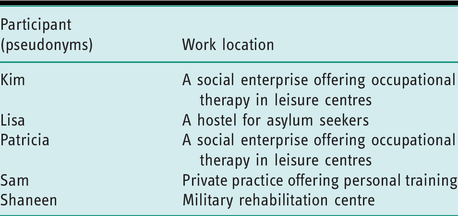
An email, including participant information and a consent form, was sent out by a lecturer to the university’s database of occupational therapists working in diverse settings. Additionally, the researcher obtained permission from the administrators of various social media pages of sport organisations to share information about the study on their community pages. The first five occupational therapists who expressed interest participated in the study. All participants were qualified occupational therapists working in non-traditional settings (Table 1).
Participants.
Data collection
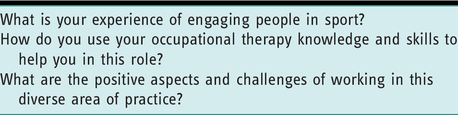
As participants were drawn from around the UK, semi-structured interviews were undertaken by the first author via telephone or Skype. These lasted up to 60 minutes and were audio recorded for transcription purposes, with consent from the participants. Each interview started with a broad question about the participant’s experiences of facilitating sport and then prompts were used to help them provide more detailed examples of their experiences (see Table 2).
Example questions.
This approach allowed the interview to be led by the experiences that were important and meaningful to each participant. It is the approach most commonly used in qualitative health research, allowing in-depth exploration of a person’s unique experience (Braun and Clarke, 2013).
Data analysis
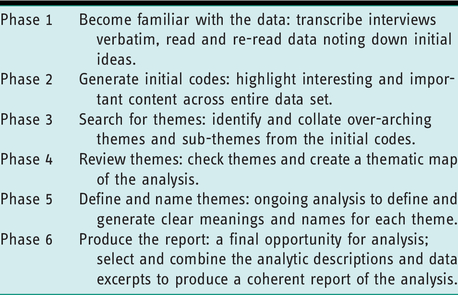
The interviews were transcribed verbatim by the researcher and systematically analysed using Braun and Clarke’s (2013) inductive approach to highlight themes and patterns of meaning in the data. Braun and Clarke (2013) describe thematic analysis as a foundational method for qualitative research and recommend six phases of thematic analysis to guide the research process, as illustrated in Table 3.
Summary of Braun and Clarke’s (2013) six phases of thematic analysis.
Example codes, sub-themes and over-arching themes.

The transcripts were read and re-read by the researcher, and ideas were noted down, reviewed and collated into 120 initial codes. The codes were collated into sub-themes and over-arching themes, and the themes that were present across all data sets were included in the findings (see Table 4 for examples).
Rigour
The research was carried out as part of a master’s degree in occupational therapy. The researcher became interested in the use of sport as a therapeutic intervention having successfully used physical activities with children on a clinical practice placement. In order to acknowledge this interest and the researcher’s personal beliefs, experiences and potential bias when interpreting and synthesising the data, a reflexive journal was kept, as literature suggests this enhances rigour in qualitative research (Finlay, 2006). This was regularly discussed with the research supervisor to ensure the findings stayed true to participants’ experiences.
To further enhance trustworthiness, the research process was meticulously documented, and transcripts and emergent themes were reviewed by the researcher’s supervisor, who is an experienced qualitative researcher. Additionally, verbatim quotations from the transcripts were used to demonstrate how the themes reflected the participants’ experiences, which Noble and Smith (2015) recommend as best practice.
Ethical considerations
As recommended by Taylor and Kielhofner (2017), before giving their informed consent participants were prospectively informed about the purpose of the study, the benefits and risks of participating, and information about confidentiality, anonymity and data protection, according to the General Data Protection Regulation (2018). They were informed their participation was voluntary and that they could withdraw from the study at any time. Assurance was given that identifiable information would be removed, pseudonyms would be used throughout and data would be destroyed after 10 years.
Findings
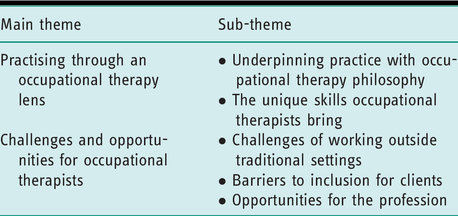
Following data analysis, two over-arching themes emerged: ‘practising through an occupational therapy lens’ and ‘challenges and opportunities for occupational therapists’. Each of these themes had sub-themes, illustrated in Table 5.
Themes.
Theme 1: practising through an occupational therapy lens
This theme demonstrates how participants viewed their clients through an occupational therapy lens, using a holistic approach to understand their needs. Participants remained focused on occupation, using meaningful activities as a therapeutic medium, breaking down activities and addressing the occupational performance skills required in order to grade and adapt the activity and enable successful participation. It was evident that participants used their dual education in mental and physical health and core skills to address all areas of their clients’ lives, assessing physical, mental, environmental, cultural and social factors.
Underpinning practice with occupational therapy philosophy
When discussing the importance of engaging their clients in occupations that were meaningful or relevant to their needs, participants highlighted the links between ‘doing’, activity and wellbeing: In offering gym and boxercise we really saw a change in their engagement and their health and wellbeing as a consequence. (Sam) From an occupational justice point of view, it’s about offering a diversity of opportunity, not just saying that the only opportunity for people to play sport is with other disabled people. Often they say, ‘I’m really bored and it’s really causing me stress’ … innately we do stuff, we are humans, we want to be engaged and when we’re not allowed to that’s torturous. We talk a lot about … how you think and how you feel and the more activities that you do the likelihood is that you’ll feel better. You have people who have a learning disability or … mental health issues or they are socially isolated … have had a stroke … lots of stuff, so then obviously the interventions … and your approach just differs massively because of the variety of people that come to the sessions. (Kim) sessions not only have a positive impact on their mood and behaviour and … managing their stresses … it has an impact on their whole experience in the hostel. They say they feel much happier and feel more connected to other people and less alone. We have a dementia friendly swimming session and a gentleman and his wife came to that, he was experiencing early stages dementia and she was saying that he’d like to come down and swim and she’d like him to because at the moment he’s well enough to walk there on his own and walk back and that gave her important respite, but she said she wouldn’t feel happy for him to do that without her knowing that we are at the other end, has he got there okay, is he getting on alright in the changing room, in the pool and then someone seeing him off home back the other way. I think those kind of things are really important. (Patricia) We often see that people establish friendships and then they meet up and go to the cinema at the weekend … Once people start to establish those relationships through the occupation that then inevitably often leads to other occupations and other participation as people have people to do things with. (Patricia)
The unique skills occupational therapists bring
Participants highlighted how they used sport therapeutically and collaborated with clients to set meaningful occupational goals. They used their core skills to grade or modify activities or adapt the environment to enable successful participation. Sam reflected on how she motivated clients: That’s where [occupational therapy] comes in and our understanding around motivation, for some people physical activity will be intrinsically motivating in itself and that’s fabulous … because of the market I’m aiming towards that isn’t ever the case, it’s about finding other ways of building on that motivation and that volition and that’s got to be through looking at what’s meaningful to them and their daily lives. When I pitch it around walking her dog and doing other meaningful activities she’s able to engage in it much more regularly. So sometimes we would bring the activity to them first, to introduce it to them, introduce ourselves to them, get them comfortable with us and slowly grade the approach. It’s like an activity analysis, you’re breaking down all the steps that are involved in playing this, or doing this activity, and you’re comparing it to the abilities of the person and you’re just trying to identify what they might be able to do and what they might be able to cope with and slowly building it from there. (Kim) … not putting them in an environment where they are likely to fail. (Shaneen) They tended to think of accessibility in terms of physical health whilst I would say, ‘look, there’s a lot of barriers for people with mental health disabilities in accessing this’. (Sam) [Highlighting that] sensory overload and overstimulation is an issue … where actually busy environments and light environments and visually stimulated environments are a problem. (Shaneen) They can see a clear benefit of having us around … we’ll talk to them about things like if you have a black mat in the doorway, that can be a barrier to someone with dementia, they will see that as a hole.
Theme 2: challenges and opportunities for occupational therapists
This theme highlights the challenges participants faced working outside of traditional settings and some of their clients’ barriers to inclusion. The final sub-theme highlights opportunities to promote the profession and the value of their unique perspective in emerging areas of practice.
Challenges of working outside traditional settings
Kim loved the freedom of her job but sometimes felt overwhelmed by the diversity of her practice and the breadth of knowledge and experience she needed to have: … there’s such a variety of people that come along, so in one way you’re not particularly specialised in one thing but in another way you have experience in everything. A lot of our clients don’t have a diagnosis; even those that do have a diagnosis don’t see themselves as having a diagnosis so if things are tagged as a disability sport that’s a barrier in itself because people don’t identify with having a disability … but equally then if we are approaching it from a more conventional way, i.e. ‘I’m your therapist and I’m now doing an assessment’, they will be like, ‘woah, wait a minute, why am I having therapy? It’s just about me coming along to the leisure centre’. I don’t think any of my clients will be able to tell you ‘oh Sam’s professional background is occupational therapy’ … I think there’s a challenge in how we promote our profession to the general public in these kind of role-emerging fields.
Barriers to inclusion for clients
Participants were concerned about the barriers people faced to participating in sport and spoke about increasing accessibility and inclusivity. Kim reflected on the challenges of this and felt that fully inclusive sport could also be a barrier: We might have an activity where there might be someone with … severe autism or something … and then this person might be expressing themselves in a different type of way where they are using loud noises or lots of hand gestures … sometimes people are like … no, I don’t really identify with that or can’t understand it or don’t want to be in an activity where they feel like someone has more needs then they do. Often because of the funding arrangements of disability projects they can only accept disabled people, so it ends up being quite segregated. I feel there is the potential for disability sport to perpetuate marginalisation and segregation; we don’t have disability shopping for example. I think the sports sector quite obviously really tends to employ people who are very sporty, who think sport’s brilliant and who think everyone should be doing more, and to some extent that is great, but I think those people sometimes really struggle to understand some of the issues and challenges and reservations that people who aren’t so active come with.
Opportunities for the profession
By working outside traditional settings, participants felt they were able to reach wider communities and those who were not accessing services because they didn’t ‘meet the criteria for one diagnosis … and so they are just left in limbo’ (Kim).
Participants felt that with the current political climate of promoting health and activity there are lots of opportunities for occupational therapists and described some they were embracing. Sam talked about the opportunities arising from general practitioners (GPs) who were referring patients to social prescribing schemes: … GP referral schemes which massively encourage social prescribing and I’m liaising with the person who coordinates that for my geographical area … so there are opportunities that I’m currently exploring. (Sam) So in terms of working with GPs that would have been done as part of our outreach where we do a lot of media stuff … so any way you can think of to get in touch with people we do. (Kim)
Patricia suggested that now was the ideal moment to form partnerships and promote the value of occupational therapy within the sports sector: We are in quite a unique time where we’ve got this opportunity in terms of this national inactivity problem, we’ve got a sport sector and a health sector that’s saying we need to get more people active and if you want a profession that understands the complex relationship between what people do and their health … tah dah … but I think it’s about making sure that we stand up when we need to.
Discussion
Findings from this study add to the growing research base that has found that occupational therapists are exploring new territory, stretching the boundaries and making a difference in areas outside of traditional practice (Stickley and Hall, 2017; Wood et al., 2013). This study demonstrates how the occupational therapist role can be distinguished from other professionals in the sports sector, and highlights their unique contribution and application of competencies, knowledge and attitudes concerning occupation, enablement and social justice.
By offering services outside of traditional settings the participants were able to extend their professional reach to wider communities and engage hard-to-reach and marginalised groups and underserved populations, including those without a diagnosis. This clearly suggests their practices are underpinned by occupational science concepts such as Wilcock’s (2006) theory of occupational justice, and are congruent with contemporary health and social care drivers such as the World Health Organization (2018) Global Action Plan: ‘More active people for a healthier world’.
Participants believed they empowered their clients by offering choice and control over the occupations they participated in, which the Royal College of Occupational Therapists (2019) recognises as a determinant of health and wellbeing. Findings reinforce Wilcock and Hocking’s (2015: 134) concept of ‘doing, being, becoming and belonging’, suggesting that reengaging in sport activities had an impact on participants’ wellbeing and sense of community. This demonstrates they were able to implement occupational therapy in a way that was congruent with the core philosophy of the profession. These findings are consistent with earlier studies that suggest occupational therapists working in non-traditional settings, and occupational therapy students in emerging role placements, remain true to the profession by adopting a more client-centred, occupational-focused approach (Clarke et al., 2015; Stickley and Hall, 2017).
Findings suggest there were some challenges retaining professional identity. These concerns are consistent with Turner’s (2011) assertion that occupational therapists continue to struggle to identify and assert their identity, and existing research that revealed misunderstandings about the roles of occupational therapists working in social enterprises and primary health promotion (Stickley and Hall, 2017; Wood et al., 2013). This issue of professional identity may have implications for future practitioners and occupational therapy students working in diverse settings. Withers and Shann (2008) state that occupational therapists need to tackle these misunderstandings by confidently demonstrating the unique skills of the profession and by keeping occupation central to their practice. However, it could be argued that the participants of this study successfully marketed themselves in an area dominated by sports professionals by promoting the profession at sports conferences, collaborating with organisations and mentoring staff, and through demonstrating the value of occupation.
There is some evidence suggesting there are risks associated with taking on new roles or infringing upon roles that legitimately belong to other professionals (Letts, 2011). For example, Letts (2011) questions whether the activities of occupational therapists and physiotherapists overlap in stroke rehabilitation. The literature suggests the blurring of roles leads to the continued misunderstanding of what occupational therapists do and where the boundaries of their practice lie (Molineux and Baptiste, 2011). Molineux (2011) asserts that occupational therapists need to be clear about what they do and articulate the core philosophies of their profession and the boundaries of their practice. He emphasises that ‘occupation should permeate all that we do’ (Molineux, 2011: 27), starting with the education of occupational therapy students through to occupational-focused practice, and that it should be the principal focus of research, in order to distinguish the role of occupational therapy from other professions.
The findings of this study demonstrate how the occupational therapy role was quite distinct from other professionals working to enable participation in sport. By using their dual training and holistic perspective and by adopting an asset-based approach (RCOT, 2017), the participants ensured their clients were not seen from a disability perspective and emphasised their strengths and abilities to participate. In addition to demonstrating their unique skills by grading and adapting activities, the participants developed supportive partnerships with the sports sector and helped staff develop skills and awareness. By demonstrating the benefits of environmental adaptations, they provided more accessible and inclusive opportunities. These findings echo existing literature advocating for occupational therapists to educate other professions about grading activities, alleviate prejudgements about an individual’s level of performance, and offer disability-related training (Fairhurst et al., 2017; Sharp et al., 2012) in order to eliminate barriers and enhance opportunities for participation. This has implications for practice and supports Handcock and Tattersall’s (2012) recommendations for occupational therapists to collaborate with graduate sports professionals to achieve increased activity levels within communities. There is also an opportunity here for interprofessional education in curriculums between health and sports science to enhance understanding of each other’s roles and skills.
This study highlights opportunities for future practice and role-emerging placements. Previous studies have shown that placing students in unconventional areas has increased awareness of the profession and the health and wellbeing benefits of occupation, as well as opening up opportunities for employment (Clarke et al., 2015). Literature suggests that role-emerging placements enable students to develop a deeper affinity with the core philosophy of the profession and provides insights into alternative ways of working, potentially cultivating future innovators of diverse practices (Clarke et al., 2015). It is suggested, therefore, that universities forge new partnerships with sports and leisure organisations and support the expansion of the profession into this new terrain.
This study focuses on the experiences of occupational therapists based in the UK. Future research could explore the experiences of occupational therapists internationally who are engaging people to participate in sport outside traditional settings, in order to gain a wider perspective. Additionally, qualitative research that includes clients’ perceptions of occupational therapy services in this setting would be beneficial.
Limitations
This study was limited by the small population size of occupational therapists working in diverse practices in the UK, and in the absence of a central database of information available to the researcher it was challenging to identify potential participants. Therefore, electronic snowballing was undertaken in an effort to extend the reach of the study and locate further participants. However, this approach resulted in responses from two participants who worked in the same organisation and led to similar data outcomes. Ethics did not allow for occupational therapists to be interviewed within the NHS/social care and as such the study excludes work that therapists may be doing to facilitate sport in these settings.
Conclusion
This appears to be the first study to explore the experiences of occupational therapists who enable people to participate in sport outside of traditional health and social care settings. As such, it provides new insights that add to the existing debate and evidence base concerning the scope for occupational therapists to expand their practice into innovative settings and move towards a more occupation-focused approach. This paper illustrates that occupational therapists can play a significant role in sport, an area that is dominated by sports professionals. Therefore, it highlights opportunities for occupational therapists to be pioneering and develop new roles in response to the shifting healthcare landscape (RCOT, 2018b).
Key findings
The occupational lens used by occupational therapists clearly provides opportunities to increase engagement in physical activity and sport and address the nation’s inactivity problem. There are opportunities for occupational therapists to be innovative by forging new paths into mainstream environments such as the sports and leisure industry.
What the study has added
This study highlights opportunities for occupational therapists to expand their practice into innovative settings, such as mainstream sport environments, and play a key role enabling people to participate in sport.
Footnotes
Acknowledgements
Special thanks are given to the research participants for their time and interest in this study.
Research ethics
Ethics approval was obtained from the School of Health Sciences Research Ethics Panel at University of Brighton on 11 October 2018 (ref: 2018-0390-Bullen).
Consent
Every participant gave informed, written consent prior to their interview.
Declaration of conflicting interests
The authors confirm that there is no conflict of interest.
Funding
This research received no specific funding from any funding agency, in the public, commercial or not-for-profit sectors.
Contributorship
Bullen conceptualised and designed the study. She undertook the literature review, data acquisition, analysis and write up. Clarke provided critical guidance with interpretation of data, revision of content and approved the manuscript for publication.
