



Abstract

The need to invest public money wisely has always been a central responsibility of governments. The social and financial pressures arising from the global pandemic that has engulfed us in 2020 brings that into sharp relief. Coronavirus disease (COVID-19) has also positioned health and care services, and those providing them, very much in the public eye and conscience. In this context, there are opportunities for occupational therapy to come to the fore and be recognised for the valuable contribution it makes to the health and wellbeing of the population, particularly in relation to rehabilitation and recovery, community-based services, public health and preventative interventions. Demonstrating that what we do makes a difference, that our interventions are clinically and cost effective, is critical to realising these opportunities.
This is an issue emphasised in the Royal College of Occupational Therapists’ (RCOT’s) research and development strategy 2019–2024, published in November 2019. This document sets out the RCOT’s vision that, within the next decade, a UK-wide culture that embraces engaging in and with research as every occupational therapist’s business will become embedded within the profession. What that looks like in practice for each individual will vary along a spectrum of engagement, from working actively with the existing research evidence, to participating in or leading the development of the evidence base. With the ultimate aim of enhancing the experiences and outcomes of the individuals, groups and communities accessing our services, one of the key aims of the strategy is to ‘support the generation of new knowledge and the continued expansion of the evidence base underpinning the practice of occupational therapy and demonstrating its clinical and cost effectiveness’ (Royal College of Occupational Therapists, 2019: 9).
As we know, the practice of occupational therapy is very broad and complex in scope, but is unified by a fundamental understanding that the ability to engage in meaningful occupation is central to health and well-being. Occupational therapists work with people across the lifespan, from a variety of social, cultural and economic backgrounds, who live in a wide range of different circumstances and face a wide variety of challenges. The evidence base that occupational therapy draws upon needs to reflect this breadth but, as it continues to develop, focusing attention and resources on agreed priorities will help to expand and add depth to the evidence-base in a meaningful way.
In January 2019, the RCOT began working with the James Lind Alliance (JLA) on the occupational therapy priority setting partnership (PSP). The JLA’s well-established methodology for the identification of research priorities is flexible and responsive to particular needs and contexts, but is underpinned by a number of key principles that ensure a robust, transparent, inclusive and auditable approach that is committed to using and contributing to the evidence base (James Lind Alliance, 2018). It brings together people who access services, carers, healthcare professionals and the public to identify and prioritise ‘uncertainties’ or ‘unanswered questions’ about treatments or interventions that they agree are most important in a particular area. The JLA approach deliberately avoids giving primacy to the views and perspectives of researchers established in the area under consideration. The aim is to ensure that researchers and health-related grant-funding bodies are aware of what matters most to the people accessing and delivering services.
Based on the priority setting partnership with the JLA, the RCOT announced the top 10 research priorities for occupational therapy in the UK in July 2020 (see Figure 1).
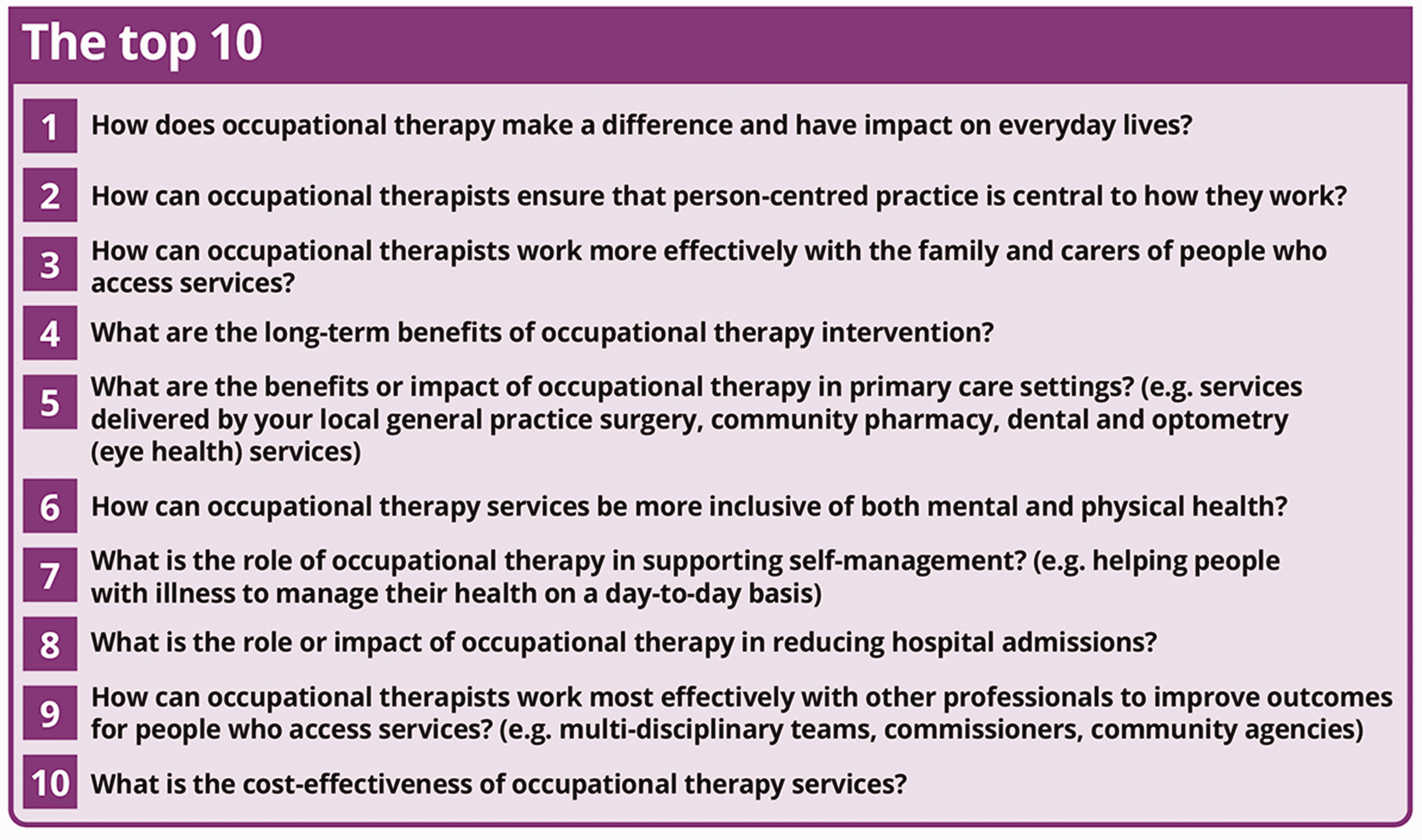
The top 10.
The top 10 are broad summary questions. They were identified from a total of 66 summary questions derived from the 2000+ questions not already fully answered by research that were submitted by 927 respondents to the PSP’s initial survey. Each of the top 10 questions provides an opportunity for several, or even many, focused research questions to be generated across a range of service delivery contexts and areas of practice, across the lifespan and in relation to a whole range of different groups and communities. While the focus is on the top 10 priorities, nothing has been lost in the transparent and auditable process of identifying them. All of the summary questions, and the participant-submitted uncertainties they are based on, are available on the JLA and RCOT websites.
The top 10 priorities steer the future research agenda for occupational therapy in the UK and will help focus energies on addressing the unanswered questions that matter the most to people who access and deliver occupational therapy services. Having this clear agenda for research takes us a step closer to achieving the ambitions set out in the RCOT (Royal College of Occupational Therapists, 2019) research and development strategy, but priorities will not in themselves lead to the development of the evidence base. The focus must now turn to encouraging and supporting occupational therapists, and appropriate others, to undertake and contribute to research adopting appropriate methodologies and pitched at an appropriate level to help answer the research questions the priorities stimulate.
The RCOT remains committed to the actions identified in the research and development strategy (Royal College of Occupational Therapists, 2019). The focus of funding available through the RCOT research foundation will be on supporting studies that address the top 10. The priorities will also be used to influence the availability of external research funding opportunities where possible. The RCOT will continue to expand the range of resources and opportunities offered to develop members’ research-related confidence and skills, and lobby for greater access to and uptake of practice-based research-related career pathways. The RCOT cannot, however, achieve the outcome we seek alone. This must be a shared endeavour with the professional community. The rallying cry therefore goes out to occupational therapists across the UK and beyond to get actively involved in addressing the top 10 research priorities in a way that works for you, wherever you might be on the spectrum of research engagement, and whatever your role may be.
Departmental leads and service managers can build or extend a research-engaged culture by explicitly recognising and valuing the inseparable relationship between engaging in and with research and the delivery of high-quality cost-effective practice. Finding a way to allocate elements of finite human and financial resources will provide a return on investment through longer-term benefits to those who access services and to organisations (Gee and Cooke, 2018; Ozdemir et al., 2015).
Some departments and services will have within them, or have access to, the knowledge, skills and experience to identify and initiate research to address pressing questions within their context that relate to the top 10. Where that is not the case, building mutually advantageous partnerships with universities is a valuable approach that will not only help to answer those questions, but will also provide an opportunity to help build research capability and capacity within the team. Contributing to a literature review, helping to inform a study design alongside those who access services, helping to recruit participants or collect data are all examples of meaningful contributions to addressing the top 10 that, with appropriate guidance, do not require years and years of experience in conducting empirical research.
The RCOT is working with its branches (encompassing specialist sections and regional groups) to align their research-related activity to the research and development strategy (Royal College of Occupational Therapists, 2019). As we move forward, this will include supporting them to identify specific research questions relevant to their specialist areas of practice that respond to the top 10. This avenue provides a further opportunity for occupational therapists, whether as individuals, groups or departments, to help shape and assist the collective effort to progress the identified priorities into evidence that will underpin future practice.
Occupational therapy academics are encouraged to draw on the top 10 to help inspire and build the research-related knowledge, skills and confidence of the next generation. Students and apprentices themselves can consider how their research project might make a small contribution. Maybe, over time, that acorn of an idea might grow into the mighty oak of a whole programme of research directed by one of the profession’s research leaders of the future.
The top 10 research priorities for occupational therapy in the UK provide a framework for focusing efforts to build the evidence base demonstrating the clinical and cost effectiveness and therefore impact of occupational therapy. We all have a role, and a personal stake, in contributing towards addressing these priorities. As the RCOT (Royal College of Occupational Therapists, 2019) research and development strategy highlights, doing so helps to ensure that the individuals, groups and communities we serve receive the best possible input from the profession and that services are developed and delivered in the most cost-effective way. Contributing to the development of the evidence base will support individual therapists to thrive and develop their careers. A growing, robust evidence base will raise the profile of our profession. All of these things will help to position occupational therapy well as we navigate the ongoing uncertainties and complexities of health and care in the modern age.
Footnotes
Research ethics
The National Health Service Health Research Authority was consulted prior to commencing the project. It confirmed that the RCOT/JLA priority setting partnership was not considered research by the NHS and therefore would not require their ethical approval. The project was, however, scrutinised by the RCOT internal research governance process. Approval was granted for each key element following peer review and minor revisions, reference: PE36/2019, PE48/2020, PE55/2020.
Declaration of conflicting interests
The author was the strategic lead for the RCOT/JLA priority setting partnership, lead the RCOT research and development review and wrote the RCOT research and development strategy 2019–2024.
Funding
The author disclosed receipt of the following financial support for the research, authorship, and/or publication of this article: The RCOT funded the RCOT/JLA priority setting partnership to identify research priorities for occupational therapy in the UK.
