



Abstract
Background
Parent support influences adolescent’s social-emotional well-being. One factor that may influence parent’s perception of support is their child’s level of motor competence.
Aim
The purpose of this study was to explore mothers’ experience of providing support for the health of adolescents with low motor competence physical and emotional development.
Methods
A phenomenological approach was used to guide this study. After initial screening, five one-on-one interviews with mothers of adolescents aged 12–16 years were conducted.
Results
Analysis of the interviews identified five themes of ‘supportive building blocks’, ‘building achievement and commitment,’ ‘building mechanisms for future support’ ‘building stability in relationships’ and ‘building confidence and a sense of autonomy’. Mother’s awareness of their child’s motor difficulties resulted in their active provision of alternative strategies for their child by building self-confidence and seeking support from health professionals.
Conclusion
Mothers were aware of their child’s inadequacies and actively sought support to help with their development. Support services that recognise low motor competence could better help mothers support their adolescent’s development. One implication arising from this study is the importance of using multi-disciplinarian teams such as occupational therapist, exercise physiologist and parents to help children with low motor competence.
Introduction
During adolescence, parents are an important source of social, emotional and behavioural support for their child. Many are able to help their child negotiate future goals and work on personal achievements to form their own unique identity (Guan and Fuligni, 2016). Even during infancy, the way a parent interacts affects a child’s understanding of emotions, when to seek support and when to self-soothe (Rowsell et al., 2016). A positive parent–child relationship often assists the child to develop meaningful relationship with significant others (Jung et al., 2013) and initiate open and honest communication. These abilities are needed to form meaningful relationships with significant others (Klostermann et al., 2016). A parent’s awareness of their adolescent’s personal strengths and weaknesses such as their physical ability may be a strong indicator of an adolescent’s sense of self and well-being (Rowsell et al., 2016).
One area that may influence parental support is their child’s motor competence which refers to an individual’s ability to efficiently perform a range of locomotor, stability and manipulative skills proficiently (Stodden et al., 2008). An adolescent’s level of motor competence (high and low) appears to influence the degree and type of parental support. Many parents are unaware of the negative impact of low motor competence (LMC). Often this leads to increased stress for both the parent and child (Soriano et al., 2015), and may be due to constantly modifying daily tasks, and children becoming frustrated and not communicating their difficulties (physical and social) with their parents. Some parents recognise their child’s motor difficulties and work with professionals to receive a diagnosis of developmental coordination disorder (DCD) to manage tasks at school (Kirby et al., 2008). Many parents end up completing most daily tasks, such as preparing lunches and laying out clothing for their child (Missiuna et al., 2006a, 2006b), or find age appropriate social, rather than physical activities (Kirby et al., 2011). However, the impact that LMC has on family life is often not recognised nor reported. Only two studies interviewing parents with children aged 5–8 years with LMC revealed that most daily routines and activities of daily living in the family home were structured to accommodate their child’s motor difficulties (Summers, Larkin, & Dewey, 2008a, 2008b). Extra time was allowed to undertake self-maintenance tasks such as dressing, bathing, oral care and eating (Summers et al., 2008a) and after school activities such as martial arts or swimming were preferred over competitive team sports (Summers et al., 2008b). However, it has not been previously reported whether additional support to complete certain tasks persists into adolescence.
Adolescence is an important phase of development of the self (Harter, 2012). Those with LMC experience motor difficulties with handwriting, using scissors or kitchen utensils, self-care activities (shaving, putting on make-up and brushing one’s hair; Kirby et al., 2011) or mastering new complex tasks such as driving a car (Kirby et al., 2011). Many also experience social-emotional challenges such as social isolation as they may have immature social skills and limited peer interactions (Hill et al., 2011; Payne et al., 2013) and consequently find it difficult to maintain friendships and positive family relations (O’Dea and Connell, 2016). Many also shy away from physical activity opportunities such as joining community sports (Fitzpatrick and Watkinson, 2003; Kirby et al., 2011; Tal-Saban et al., 2012). The presence of additional daily stresses such as anxiety (Mancini et al., 2016) may influence quality of life satisfaction into adulthood (Kirby et al., 2013; Tal-Saban et al., 2014). Therefore, understanding perceptions of support held by mothers with adolescents with LMC may help to further understand their child’s physical and emotional development.
There is a lack of recognition by specialists such as teachers and general practitioners of children and adolescents with motor difficulties or LMC, which often leads to fewer support services for parents and their child (Missiuna et al., 2006a, 2006b). Some studies have indicated that parents feel additional pressure and frustration in regard to their child’s motor difficulties (Payne et al., 2013) or often focus on other areas such as building social skills (Hill et al., 2011). Given the importance of adolescence in the development of self-perceptions (Harter, 2012) and identity (Lingam et al., 2013; Timler et al., 2019), perceptions of mothers support for adolescents with LMC should be investigated. The aim of this study is to use a phenomenological approach to understand mother’s support for their adolescents with LMC and how this may influence their child’s physical and emotional health.
Method
A transcendental phenomenological approach was used in this study to examine the lived experience of the support strategies that mothers use to help their adolescents with LMC (Andrew and Halcomb, 2009; Creswell and Poth, 2018). This approach was chosen so the researchers could gather in-depth information about mothers’ understanding of ‘support’ and then attempt to describe mother’s experiences of supporting their child’s physical and emotional development. This study is a part of a larger project where adolescents and parents were asked to complete a number of surveys regarding motor competence, (adolescent and parent), self-perceptions and identity health (adolescents). The Developmental Coordination Disorder Questionnaire 2007 (DCDQ′07) was completed by parents prior to this study and used as a screening tool for this study to try to identify adolescents with LMC. A subsample of those mother who (1) wished to take part in a follow up interview, (2) placed a score below the 57 cut point on DCDQ′07 [Designed for children aged between 10 and 15 years with 75 being the maximum score (Wilson et al., 2009)] and (3) suspected their child had a motor difficulty and who were contacted approximate 3 months following a larger quantitative study. The study was approved by the Human Research Ethics Committee from the University of Notre Dame Australia, Department of Education and Catholic Education. Written informed consent was obtained from all mothers.
Participants
The number of participants required in a phenomenological study is small in order to provide a rich description of the participants experience and to give them a voice when sharing personal experiences (Creswell and Poth, 2018). On average, 5–10% of school aged children experience difficulties completing motor tasks, with some receiving a diagnosis of DCD more commonly reported among males compared to females (American Psychiatric Association, 2013). The number of interviews in this study reflects the diagnostic and gender ratio for DCD.
Mothers were selected from a final pool of 26 and were invited to participate in a semi-structured one-on-one interview with five agreeing to take part. The inclusion criteria specified mothers with an adolescent aged between 12 and 16 years, who scored their child’s motor competence below the 57 cut point on DCDQ‘07 and suspected they had a motor difficulty, living within the Perth metropolitan area, have English as their first language, possess good linguistic and cognitive ability to comprehend the questions. Mothers were excluded if their child had a diagnosed congenital motor disability such as cerebral palsy or muscular dystrophy.
Measures
Semi-structured interview guide provided for the mothers’ responses.

Procedure
Interviews were conducted either face-to-face (n = 2) or over the phone (n = 3), depending on the participants’ preferences. The interviews were facilitated by the primary researcher and lasted for approximately 1 hour and were audio recorded and transcribed verbatim. Recruitment continued until saturation was reached and no new themes emerged to establish evidence of dependability. The transcripts were analysed using Moustakas (1994) eight-stage phenomenology analysis approach which comprised reduction, textural descriptions (participants’ personal experiences), structural descriptions (the participants experience in relation to the context) and developing an overall essence of the phenomenon developed (Creswell and Poth, 2018). This approach was selected as it allows for ‘bracketing’ the researcher’s personal views (epoche) to ensure the results were reflective of the experts (research participants; Creswell and Poth, 2018).
Data analysis
SPSS version 25 (IBM SPSS Inc., Chicago, IL, USA) was used to analyse the DCDQ’07 responses for screening and descriptive purposes. QSR NVivo 12 was used for data storage, memo writing, coding and theme building. First, the individual transcriptions were coded line by line and personal memos for each individual were completed by the primary author to ensure familiarity with the text and to develop textural descriptions. The transcripts and textural descriptions were re-read to develop a coding scheme, structure and horizonalisation of significant statements (Moustakas, 1994). Lastly, structural descriptions of all five interviews were compiled to form ‘clusters of meaning’ and to ensure that the essence of the lived experience was consistent across all interviews. The participant’s background and descriptions were created to establish transferability of the results. Themes emerged by comparing and contrasting meanings across all transcriptions. Descriptions were discussed between two members of the research team for member checking and to ensure credibility of the results. Lastly, the NVivo function of matrix coding was used to examine differences in responses between mothers with sons compared to daughters. The names of the mothers have been changed to ensure their anonymity is maintained.
Results
Demographic information of the five mothers.
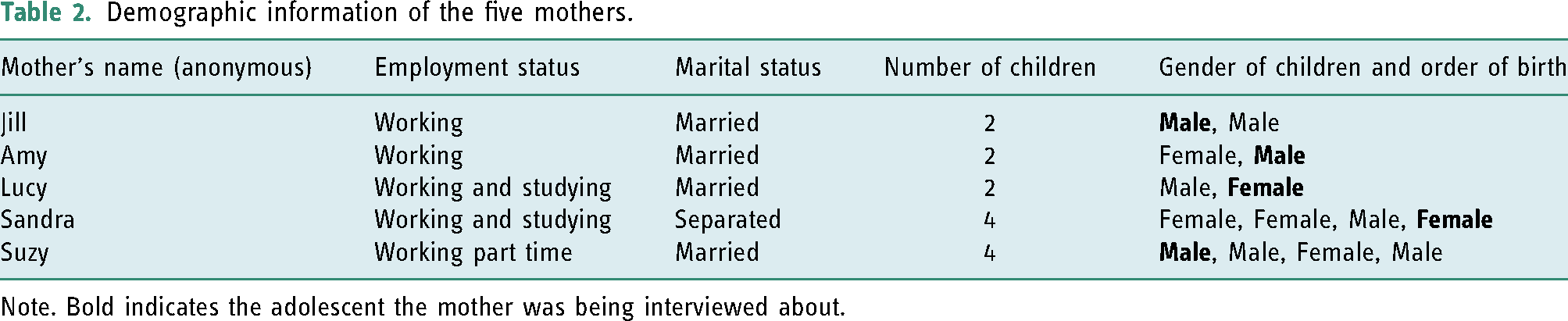
Note. Bold indicates the adolescent the mother was being interviewed about.
The overarching theme that emerged from the interviews was ‘Supportive building blocks.’ In addition, four subthemes encompassed these building blocks and were identified as ‘Building achievement and commitment’, ‘Building mechanisms for future support’, ‘Building stability in relationships’ and ‘Building confidence and a sense of autonomy’ (Figure 1). The connection of the main theme ‘Supportive building blocks’ to the four subthemes of ‘Building achievement and commitment’, ‘Building mechanisms for future support’, ‘Building stability in relationships’, and ‘Building confidence and a sense of autonomy’.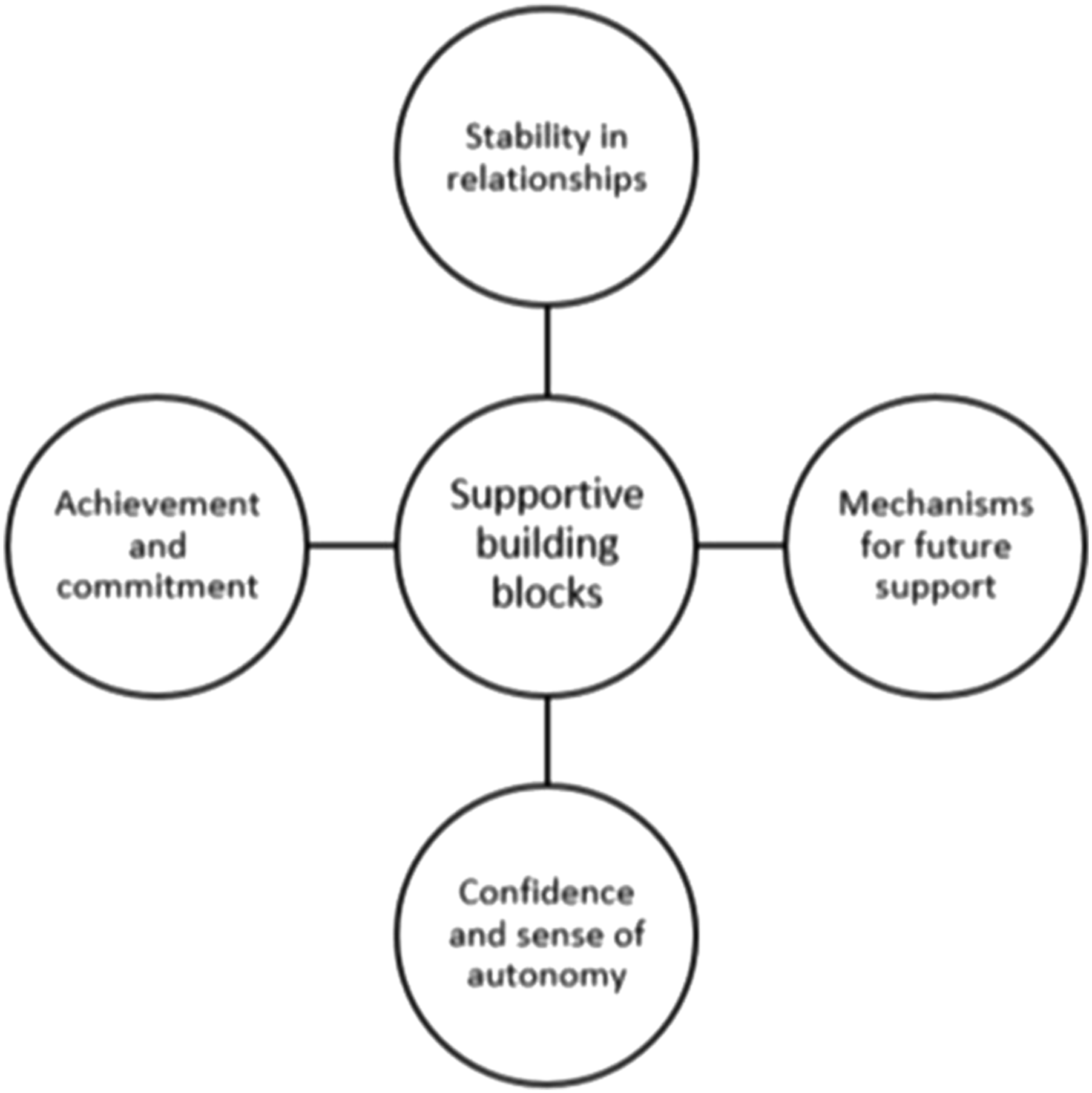
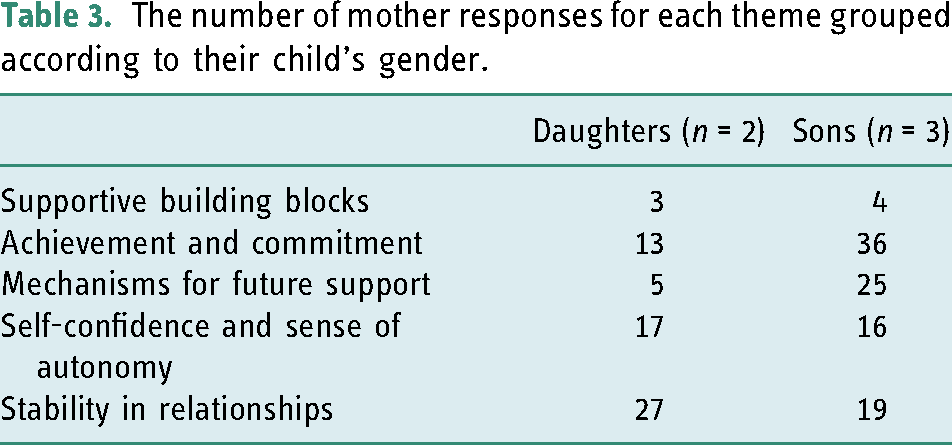
The number of mother responses for each theme grouped according to their child’s gender.
Mothers worked closely with their adolescent to create ‘Supportive building blocks’ that would assist their child’s social skills, sense of self, achieving and committing to future goals and feeling supported in different environments. A mother’s support was related to trying to find ways to improve their adolescent’s ‘poorer’ skills. These building blocks were a result of mothers experiencing a large amount of frustration, trial and error, ‘figuring out’ what worked best for their child, ‘picking their battles’ and seeking additional support from professionals such as teachers and occupational therapists. Suzy, a mother with a 12-year-old son said: It comes down to expectations and huge adjustments as well, where I am now it has taken me 10 years to get there, and it has been a gradual process… and a lot of ups and downs and that sort of thing, but I have not had to do that for a while…
Building achievement and commitment
Mothers helped their adolescent to facilitate their future achievements, which focused on motor skills and physical activity, and school and homework (subthemes). Some mothers were aware that their adolescent had limited interests and tried to hone in on developing their skills in those particular areas. For example, if their adolescent was achieving high grades in subjects of interest then mothers placed less pressure on their performance in other areas such as sports. Mothers with sons and daughters shared similar concerns in regard to taking part in age appropriate activities. Suzy commented about her son not being sporty and focusing on his personal strengths, she said: I think all parents want their kids to be kind of sporty and excel at school and that sort of thing (laughs). It is great when the kids come home with ribbons from their sporting competitions and whatever, but you have to make an adjustment. So it is great when you can find an area of strength… and then you just have to nurture that… and allow them to form their identity.
Motor skills and physical activity: Motor skills were an area where mothers were committed to help build their adolescent feel a sense of achievement. For example, many bought shoes with Velcro instead of laces. Mothers, particularly, those with sons, believed their adolescent experienced difficulties with dressing, doing up buttons and tying shoelaces. Amy, a mother of a 14-year-old son, shared how adjusting clothing items for her son helped to build his sense of achievement: He does not like doing buttons, so we do not give him buttons we give him pull on trousers… he does not like doing up shoelaces so he just slips his feet in... we do not have to help him with it, he is completely independent, but then we structure things so he does not have to do things that he is not particularly confident with. He does not have to do buttons up because he just pulls his trousers on, and he just pulls his button up shirt on over his head maybe he will have to do up one button, so his little frustrations of things he does not want to do has probably come from his fine motor because it maybe a little bit less... he does not have to do because his life has been set up that he does not have to do those things.
Jill commented on her son’s (14-year-old) motor skills as she could see where he had made some improvements over time, but still observed some difficulties when completing tasks at home. She said: His gross motor skills have improved, more than his fine motor skills. His fine motor skills still seem to be quiet limited in certain respects, so using cutlery, and cooking and those types of manual tasks are still quiet clunky for him. In his gross motor he has become far more strategic in the way he plans… and executes his movement rather than his execution from a skill based perspective...
Mother’s valued physical activity participation, although their adolescent often complained about taking part or fatigued easily. Mothers said they had tried a range of activities with their adolescent when they were younger, with many preferring individual, structured activities such as participating in an adolescent movement programme. Only one mother commented on her son’s participation in an indoor soccer team with friends from school. She mentioned that this was the one sport he liked, as he could position himself in open spaces on the court. Another mother felt her son had natural talents for running and swimming but made it very clear he did not enjoy these activities. She was happy with her son’s new found stamina and strength from participating in a movement programme, as he was finally enjoying activities that he previously avoided, such as walking and hiking. Amy said: His growth spurt was before the year, but he is certainly stronger than my husband and I at the moment. I think… his is increasing, like when we were away on holiday, he helped us carry a fridge, you know one of those camping fridges that would normally sit in the back of your car. We had to move it down some stairs and into the car and he just picked it up and walked down the stairs and put it in the car and we were just gob smacked, so that is an example about how confident he has gotten… His stamina has really gone up and like if we go camping and we go for a walk, in the past he would be complaining the whole way, but now he is more interested on going on the walk… he is just more interested in helping. Part of it is maturity I think and part of it is that his muscles are stronger and they are not as painful or awkward like they use to be.
Mothers also commented on their adolescent’s preference to go to a community gym instead of playing team sports such as netball or dancing. Lucy, a mother with a 14-year-old daughter, echoed: My daughter is not very good at sports, she has a fast reaction but she has never been very good in the way of sports or that sort of thing, everyone seems to be into netball but she does not have the coordination for that… Getting her more into the gym based programs for… core strength I think it is more of what she needs, so we have done the horse riding and a lot of other things, but I think if she could get into gym programs then… when she is 15 we can look at getting her into a community gym.
School and homework: School was another area where mothers felt their child needed support to achieve their goals as many mothers wanted their adolescent to attend tertiary education such as university. The mothers commented on times where they had to negotiate stress at school, for example, difficulty completing tasks or being bullied. Many of these mothers worked with their adolescent’s teachers to put strategies in place to avert negative situations. Teacher support encouraged mothers to let their adolescent make their own personal decisions, which lead to greater success and opened up an opportunity to discuss tertiary education. Amy said as parents, their decisions on subject selections were not always helpful for their son’s future: So year 10 and year 11… everything has changed, like for example, he was getting like 50–60% grades but as soon as he was getting the support and he was not being bullied, his grades went up to 70–80%, and now he is aiming [to] get over 90%, [and] achieving… closer to his potently because he is really smart and he could be a doctor if he really pulled his finger out and did some stuff because he still does not do any homework (laughs)… He had to narrow down which subjects to choice and we got the comment as parents for a choice, which was physics, and that did turn out to be his best subject… so he has dropped that and he is doing more like humanities like economics, politics and law.
The mothers also felt that their adolescents were starting to make decisions about their future and as many realised the amount of work required to achieve their goals. Sandra felt her 16-year-old daughter was making her future decisions based on her sibling’s experience, she said: She is thinking along the lines of the medical field because she has three older siblings and one is still at [University] doing nursing, and the older two are in the medical field and in the workplace. So whether that’s just like a safety net thing, I am not sure or whether it does take her interest. She is not sure herself, so I think she is saying it depends on what score she gets, because she has a few things in mind.
Building mechanisms for future support
Mechanisms for the future were related to increasing their child’s achievements such as improving social interactions, supporting physical health and well-being and making use they were getting the most out of their education experience. The main areas where mother’s provided additional support were in regard to their adolescent’s health, lifestyle and schooling. Support from health specialists (occupational therapists, speech therapists and psychologist), sports trainers and teachers mediated some behavioural and social-emotional challenges. A diagnosis of DCD was important so their adolescent could receive special considerations such as extra time for exams. However, many found it difficult to receive a diagnosis, due to the lack of recognition by health professionals. For example, Amy wanted her son to work with a speech therapist to help her son’s peer interactions and emotional frustrations: He sees a [speech therapist] who is helping him with some social skills… and what we are trying to hone down on is his anger that he puts across in some of his interactions that he does not realise that he is doing. It would just be purely because he does not want to do the activity or he does not like what they are trying to ask him to do… but it’s an expressed anger per se, it is just the body language or the way that he talks you know…, we are just trying to make him aware of that at the moment.
Health and lifestyle: All mothers were working with their adolescent to develop a healthy and active lifestyle. They often reminded their adolescent on the importance of being active, which was reinforced through external sources such as personal trainers. Consequently, when the adolescents’ structured activities and programmes finished up for the year, many mothers found it difficult to motivate them to continue to be physically active. Suzy tried to stress the importance of physical activity but was also aware that her son fatigued easily after a busy day at school. She told us: I am concerned… more from a health point of view because he does not like to exercise obviously, and even he talks about “do I have to go to [movement program]” and I say “oh well I really want you to persist with it for as long as you can, because the other alternative is that he will sit and play games…” At the end of the day he is tired mentally, and I suppose physically… and he just needs some encouragement, “okay, go, you need to do this, just go to keep you moving and keep you fit”, because I said that “if you don’t, you will end up like me, I don’t want you just sitting in front of the TV, playing your games and not moving at all, then you will get sick and unhealthy.” So I know it is important for him to keep moving, but he does not have to... win trophies, I just want him to move his body, and… walk or cycle for enjoyment purposes.
School skills: Teachers were not only important for personal achievement, but as mentors. For example, Amy commented about her son almost missing out on an extracurricular opportunity (mock trials) due to his poor handwriting as others needed to read what he had written. In the end, he was able to attend one session and did so well communicating that he was invited to join the group. Lucy commented about how supportive her daughter’s school was, even though she had experienced some difficulties in the past. She reflected on how her daughter’s teacher and psychologist helped develop the skills she needed to excel at school: School is very supportive, she is at a really good school and she has had some really good school experiences there in terms of learning. We have had to involve teachers on some occasions and she did see the psychologist in year five for a little bit.., but I think it was mainly because she is just so kind, so kind hearted and she does not like being mean to others but unfortunately the other kids do not have that same problem behaving like that.
Building stability in relationships
The ability to form strong, lasting relationships was more commonly identified as important by mothers with daughters compared to those with sons. Developing close friendships and social networking were the mother’s primary areas of interest. At times, mothers found it challenging to have conversations with their child about issues such as bullying and peer support, as this caused angst. They often used time together in the car (‘captive audience’) or at the dinner table to try to discuss any pressing matters. In some instances, mothers accepted that their child would avoid uncomfortable social opportunities and chose not to push the issue. For example, Amy commented about her son’s first experience of attending a school dance and how this shaped his view on attending another one: He will not go to any school socials, he will come home and he will say, no absolutely no, no, no and you ask what is absolutely no and he goes no, I do not want you to mention it, I am not going to tell you, and I say “okay, that is alright” and he goes, well I will but the answer is absolutely no. He makes himself quiet clear before he even tells us what the question is, and that is the school social. I will say, “that is okay, we were not expecting you to go”, and then he will say, oh good, and… storm away. He did go to the year 7 or 8 social, so he did give it a try and gave it a go and he hated it, and then we have not pushed him to go to any others. He has had no inclination and he has had quite a negative response, to not going….
Friendships: Those with daughters reported more accounts of close friendships and how important these relationships were for them. Both mothers felt friends inside and outside of school would help their daughter’s development. Sandra expressed how she viewed her daughters peer groups and that her network of friends had enabled her to participate in social activities through the school rather than on social media: She’s got two really supportive best friends and they are just inseparable. They do run things past each other all the time. She is friends with some of the boys as well and they recently had their ball and then another ball with an outside school that she got invited to as well. So because her groups of friends kind of cross over, she has got a big network of friends. There are quite a few eighteenths and things going on so for the planning of all these things and the networking, probably more of that done at school than there is on social media networks.
Social Networking: Many mothers commented that their adolescent were building relationships with others and were starting to branch out of their close friendship groups to form meaningful relationships with others. Lucy said her daughter was taking more time to include others in her life. She told us: She is not looking so much at conversation with people her own age she is looking a bit wider from her friendship group and thinking about being an adult. She is much more thoughtful. She cares about doing the right thing and she is more grateful and more aware of people doing things around her and she is a grateful child for that she does not take it for granted.
Mothers felt their adolescent had to work hard for their friendship groups as many had experienced bullying or negative peer interactions. Lucy mentioned the amount of work she put into making the situation better for her daughter: We worked together because she had quite a lot of bullying in primary school and I think it has been a lot easier for her in high school. I think it is because we have worked with her quite a lot to get her to heal from that and I think the bullying… was really based around that dyspraxia and it was really about not being good at sport and not being good at coordination, so I think because she is such a nice kid I think they took advantage of that but now that she is in high school it matters less.
Building self-confidence and a sense of autonomy
Self-confidence and autonomy were important characteristics, with all mothers suggesting the value this added to their adolescent’s uniqueness and individuality. This was attributed to the perceived improvements in self-confidence and sense of independence. The mothers noted their adolescent had negotiated a number of challenging situations, compared to their peers, but they were now starting to separate themselves from those negative experiences. Some felt like their child had gained a new sense of self-confidence to stand up for themselves, as Amy shared: I know someone tried to grab his bag once and that was probably within the last year and he just twisted away he ended up with someone else’s bag so he just walked over to some stairs and dropped it down there. Whereas that would not have been something that he would have done before, he probably would have gone into his shell and taken it, where he is standing up for himself a bit more.
Others felt their adolescent was still learning to do things that made them feel good about themselves and were not driven by peer pressure. Lucy commented on her daughter being able to negotiate her friendships while still remaining ‘true to herself’: A lot of [independence] is interrelated now which is good…, because she was being bullied she wanted them to like her so I think that motivated her before, but now I think it has come more internal. She wants to do well because she wants to do well for herself, she wants to achieve and she has the confidence, some of it has to do with me, she wants to please me and she wants to make sure that I am proud of her. I think she wants to be proud of herself and I think she is realising that it does not matter as much what other people think of her as long as she enjoys it… I think that is sinking in now she has become much more internally driven, she wants to do things for herself
Similarly, Jill echoed how proud she was of her son’s unique personality. Jill felt a lot of pride in her son as he was not a ‘conformer’ and did things his own way. She commented: He is not a conformer and he won’t do something because everyone else is doing something. He is very independent in his thinking, he is certainly not tied to what others are doing… but he does have his own identity and he prides himself on being a geek and you know he is not too worried about his physical appearance at all…, that does not worry him, the neighbours next door… I think are in his year and he will… put the rubbish out in his pajamas and he does not care… He is still not that self-conscious but he is happy with who he is and what he does.
The ‘mother’s role’ was important for the adolescent’s self-confidence and sense of autonomy as they often pushed them outside their comfort zone. For example, mothers said they had to continually assist with selecting classes or getting a job. Sandra was surprised by her daughter’s determination to get a ball dress, when she felt she still needed reassurance about her school work and socialising: This was a couple of months ago and I said, “we’ll keep on top of it; we’ll talk to the teacher and find out what it was, or you can email the teacher.” Don’t panic, but at the same time I thought I would have to be on her tail a bit like come on, you’ve got homework, but she is locking herself away. …She is a lot more confident now, but she will avoid getting a lift [with family members]. She will say “No, mum can you please just drive me because it is awkward and I don’t know what to talk about”. So that’s probably a confidence thing on her behalf... I say, “they are only giving you a lift to the school”. It’s kind of awkward, but once she has done it she is fine. Walking and handing in her resume, it was oh, I’m a bit nervous, but when it comes to hiring a ball gown for the ball, she says “oh, I’ve already rung up, and that red dress is available and we can go there and I can pick it up at 4.00 o’clock”. And I said, “REALLY! You’ve done all the groundwork??”
Overall, the mothers clearly expressed how their support helped to guide their adolescent’s sense of self and development. Many felt frustrated when negotiating with their adolescent to complete tasks, chose when to intervene and tried to stress the importance of a healthy and active lifestyle. They were conscious of over assisting on tasks and relied on extra support from professionals to help their adolescents find personal interests, express their own uniqueness and build lasting relationships with significant others, all attributes of physical and social-emotional development. In summary, Lucy shared how her daughter had learnt to do things her own way and stand out from the crowd: I think she is starting to find her own sense of identity and to be honest I do not think that she fits into any sort of a stereotype, she is quiet unique and I think she understands that a lot of the other kids her age desperately want to fit in and be popular and being loved, but that is not what really drives her so she accepts that but I do not know if she truly feels if she fits in.
Discussion
Mothers felt the key building blocks to support their adolescents with LMC were related to personal achievements, supportive environments, healthy relationships and self-confidence. To mediate some of the additional challenges and negative experiences, mothers often relied on additional support, developing alternative strategies and building self-confidence. The strategies mothers put in place, although not always deliberate, seemed to help ameliorate some of the negative impacts of their adolescent’s LMC.
Mothers who tried to help their adolescent find personally valued interests improved the avenues of support their child received by exposing them to a range of activities and alternative strategies such as adjusting clothing options. Areas that often require further assistance among those with LMC include participation in physical activity (Barnett et al., 2013a, 2013b) school achievements such as reading, social communication and handwriting (Harrowell et al., 2018), all common areas of concerns shared by these mothers. In this study, mothers used positive strategies such as only intervening when needed, changing tasks to make it easier for their adolescent and provided support for activities their adolescent enjoyed. Similar, Summers et al. (2008a) found parents adapted tasks such as self-care and allowed more time for those with LMC to get ready. From this study, we can suggest that similar difficulties with completing motor tasks continue to persist into adolescence. However, parents seem to place greater importance on finding activities adolescents enjoyed to take part in. Finding personally valued skills during adolescence is important as these guide future endeavours such as employment and lifestyle habits (Kirby et al., 2013) and may help to develop a healthy identity (Goth and Schmeck, 2018).
Mothers often sought advice from professionals and wanted to receive a diagnosis to help with their adolescents’ future as they felt this may help to facilitate how their adolescent accessed support services into adulthood. This was more common among mothers with sons. This finding may be related to a previous finding that parents are more likely to identify their son’s poor motor abilities than their daughters (Timler et al., 2018) and therefore are more inclined to seek additional support. For example, support from speech therapists assisted in developing social skills, sports trainers to build physical skills and key therapists to help adapt tasks to suit the child’s ability. Although only limited evidence is available, some authors suggest that parents feel relieved and less stressed once health professionals and teachers recognise an adolescent’s LMC (Soriano et al., 2015). This highlights the importance of multi-disciplinary teams involving health professionals and parents to improve social and emotional functioning for adolescents with LMC and relieve some of the pressures mothers feel when assisting their adolescent. Similarly, Camden et al. (2019) interviewed parents, health professionals and school staff in Canada working with children with LMC and found increasing services in school, improvements in the identification of the condition, preventing secondary consequences such as lower levels of participation in physical activity and better organised support services were vital to assist LMC. Kirby et al. (2008) also suggested that those with LMC may need to continue to access support from professionals once they start attending tertiary education. A collaborative approach is one effective strategy that mothers use to help their adolescent with LMC develop a sense of independence and achieve success.
Lack of peer support and difficulties forming lasting relationships are often reported among children and adolescents with LMC as many experience social isolation and peer victimisation (Hill et al., 2011; O’Dea and Connell, 2016). However, mother’s support in finding creative ways to address poorer social skills, such as seeking additional guidance from specialist or teachers, seems to guide adolescents to overcome social concerns and develop strong, lasting relationships. A key finding from this study was that mothers felt forming lasting relationships were easier for their adolescent once additional support was in place. Developing meaningful relationships with family and significant others, not only leads to a sense of social connectedness but is also a key aspect for the formation of a healthy identity, a crucial developmental phase during adolescence (Goth and Schmeck, 2018). Other authors have suggested that valued peers in the classroom can assist those with LMC with their school achievements (Payne et al., 2013) including understanding tasks set by teachers (Timler et al., 2019). Similarly, the value mothers placed on supportive teachers was also a successful strategy identified in this study. Therefore, for those mothers who are aware of the importance of good social support (Guan and Fuligni, 2016) seem to help negotiate key social occasions to assist their adolescent’s development.
Other parents may be unware of the poor support experienced by their adolescent as they fail to communicate that they feel like they do not fit in (Dewey and Volkovinskaia, 2018) or feel unpopular (Payne and Ward, 2019) amongst their peers. Adolescents with LMC are usually less inclined to engage in age appropriate activities such as team sports which expose their physical awkwardness (Barnett et al., 2013a, 2013b; Fitzpatrick and Watkinson, 2003) and prefer more sedentary activities such as watching television or playing computer games (Timler et al., 2019) which subsequently limits their access to a range of social networks (O’Dea and Connell, 2016). Parents may need to push their child to go outside of their comfort zone in order for them to overcome and conquer anxiety arising from social interactions, a strategy shared by these mothers. Mothers also felt that if their adolescent participated in a range of activities this would lead to finding strong social networks and a sense of belonging, important for their emotional development.
Another important strategy mothers reported was building supportive networks in and out of school to help develop close friendships. This was reported to a greater extent by mothers with daughters. Many studies have suggested that female adolescents value close friendships (Rose et al., 2015) to a greater extent to males, regardless of level of motor competence, which was also true for these mothers. Harrowell, Hollen, Lingam and Emond (2017) found good social communication and high self-esteem among female adolescents with LMC were more important for their mental health compared to males with LMC. Mothers with sons used fewer strategies for developing close friends, but focused more on developing social skills such as appropriate social behaviours. This may be the result of males with LMC often placing greater value in other areas than peer relationships (Cocks et al., 2009) such as academic achievements. Overall, mothers felt close friendships and forming relationships with significant others were challenging but rewarding for their adolescent once they found peer groups who accepted their differences.
Developing a sense of autonomy and having confidence in their child’s abilities were highly valued among these mothers. Many appreciated their adolescents’ uniqueness, which helped them develop personally valued traits such as being ‘book smart’. Personal likes and dislikes, regardless of peer opinion, can improve the health of an adolescent’s identity (Goth and Schmeck, 2018) and life satisfaction into adulthood (Kirby et al., 2013). The additional support from mothers to help their adolescent develop meaningful commitments was successful through negotiation, knowing when to intervene compared to when to over assist. Mancini et al. (2016) suggested family support was a protective factor for internalising behaviours such as anxiety and depression among adolescents aged 12–16 years with LMC. Therefore, it seems that during adolescence, these parents move away from trying to over assist as reported by Summers et al. (2008b) and focus more on developing personal interests and being able to complete tasks to the best of their abilities with the assistance of professional support. Therefore, mothers who work together with their adolescent develop a sense of autonomy, may help to lower the onset of emotional distress such as increased anxiety.
To summarise, a mother’s support was influenced by negotiating challenging situations their adolescent faced. They focused on assisting in the mastery and achievement of personally valued skills and developing social networks. Common strategies many used included seeking further support from therapists and professionals to develop physical abilities and strong relationships, being selective when assisting with tasks and using alternative strategies to make things easier for their adolescent. Aspects of these strategies used by mothers may be important for their adolescent’s physical and emotional development such as developing self-confidence.
Study’s strengths and limitations
There are a number of limitations of the current study. First, proxy-report questionnaires were used to screen for level of motor competence, which may not be representative of an adolescent’s perceptions of their own motor competence. Therefore, the truthfulness in the responses may have resulted in some group misclassifications. However, all of the interviewees revealed that their child experienced difficulties with their motor competence. Only two mothers with daughters were interviewed. The overrepresentation of mothers with sons reflects the greater ratio (2:1) of LMC among males (American Psychiatric Association, 2013). Consequently, only mothers were selected to be interviewed as very few fathers completed the DCDQ’07. Future in-depth interviews with both parents would enable comparisons between mothers and fathers perception of support for the development of physical and emotional support during adolescence. In addition, further studies that include interviewing both parents and the adolescent would also allow for greater comparisons between a wider range of perceptions.
This study is the first to consider type and degree of parent support for adolescents with LMC. This is reflected through the consistency of the common themes, which ensured data saturation was reached. The matrix coding completed in NVivo also highlighted important gender differences among adolescents with LMC. Further research in this area is needed to understand both parents’ perceptions of support among adolescents with LMC.
Conclusion
Less is known about parent support, and the strategies they use to help with their adolescents development. The results from this study illustrate that a mother’s personal experiences of their adolescent’s development were focused on developing personally desirable skills rather than negative experiences. Mothers with sons used strategies to improve personal commitments and the skills to support future decision making. On the other hand, the mothers with daughters valued friendships and communication skills as more important characteristics. It appears mothers develop a range of supportive avenues in response to the needs of their child. Further support from professional organisations that employ teachers, health professionals including occupational therapist and physical activity specialists could assist mothers to further support their adolescent with LMC. Therefore, services that focus on interpersonal and social skills and personally valued achievements among adolescents with LMC may provide more effective guidance for families with adolescents with LMC.
Footnotes
Acknowledgements
The authors would like to acknowledge the community sporting clubs (Australian Football League [AFL, netball and basketball clubs]) and local schools (Independent, Catholic and Government) for their assistance in promoting and providing participants for the current study. Additionally, the authors would like to thank all of the parents who completed the survey and the mothers who participated in an interview. This project is supported through the Australian Government’s Collaborative Research Networks (CRN) program.
Declaration of Conflicting Interests
The author(s) declared no potential conflicts of interest with respect to the research, authorship, and/or publication of this article.
Funding
The author(s) received no financial support for the research, authorship, and/or publication of this article.
