




Abstract
Introduction
While most children have developed effective handwriting by secondary school age, some have handwriting difficulties that hamper academic progress. Occupational therapists play a role in assessment and planning support, which may include introducing typing as an alternative. However, there is limited understanding regarding how decisions are made about recommending typing. This study explored the support provided to adolescents with handwriting difficulties by occupational therapists, and the contextual factors that influence their decision-making.
Method
Semi-structured interviews were conducted with 13 occupational therapists and analysed using thematic analysis.
Findings
Although there was shared practice underpinned by occupational therapy philosophy, there was also divergent practice due to different approaches. Roles and responsibilities, resources, and evidence and experience influenced occupational therapists’ practice. Understanding the adolescent’s motivation, the effect of handwriting difficulties on well-being and the need for a functional method to record schoolwork, was central to occupational therapists’ decision-making to recommend typing.
Conclusion
Strategies are needed to address the knowledge-practice gap, including evidence-based guidelines. Closer collaboration between occupational therapists and school staff could increase understanding of roles and highlight the unique occupational therapy contribution. Further research examining whether, when and how to introduce typing as an alternative to handwriting would support best practice.
Introduction
Handwriting is a primary occupation of children as it is central to performance in written expression and remains the main mode of writing in the classroom and assessment across primary and secondary schools (McMaster and Roberts, 2016). The ability to produce high quality written text is vital to academic success (Graham et al., 2000). To become skilled writers, children need to develop and integrate a number of skills, including idea generation, vocabulary use, spelling, handwriting, organisation, grammar and punctuation; as well as engaging in ‘higher-level’ planning and reviewing behaviours to monitor what is written (Hayes, 2012). The importance of writing is apparent in educational systems worldwide and is a key taught component in the UK curricula across Key-Stages 1-4 (4–16 years) (Department for Education, 2013). Studies have demonstrated the importance of developing fluent handwriting and highlight a positive relationship between handwriting speed and text length and quality of written work in all children, including those with language, literacy and/or motor difficulties (Prunty et al., 2016; Sumner et al., 2014). Consequently, if a child has difficulties with handwriting speed and/or legibility, it can significantly hamper their written skills and progress in the classroom (Graham et al., 2000).
Although there is variability across studies, it has been reported that up to 27% of school aged children experience handwriting difficulties (Van Hartingsveldt et al., 2011). They are varied in their presentation and can be related to different factors including difficulties with language, motor coordination and/or attention (Feder and Majnemer, 2007). A significant number of referrals to children’s occupational therapy are for difficulties with handwriting and occupational therapists play a key role in addressing them (Asher, 2006). In the UK, children’s occupational therapists work in a range of settings, including National Health Service (NHS) community services, school-based and independent practice.
Two major approaches tend to be adopted by occupational therapists when undertaking handwriting assessments and interventions. The first approach, ‘bottom-up’, focuses on remediating underlying performance components such as visual perception and motor coordination, that are believed to contribute to handwriting difficulties (Cramm and Egan, 2015). Included in this approach are the use of standardised assessments such as the Developmental Test of Visual-Motor Integration (Beery et al., 2010) and Movement ABC-2 (Henderson et al., 2007). In contrast, occupational therapists adopting a ‘top-down’ approach focus their assessment and intervention on the occupation (handwriting) directly. Occupational therapists adopting this approach often use the Detailed Assessment of Speed of Handwriting (DASH) (Barnett et al., 2007) and adopt strategies such as the Cognitive Orientation to Daily Occupational Performance (CO-OP) (Polatajko et al., 2001) to improve legibility and speed. Current evidence suggests a top-down approach is more effective for handwriting skill development (Hoy et al., 2011; Santangelo and Graham, 2016). However, studies conducted in the USA and Canada suggest occupational therapists tend to use bottom-up approaches (Piller and Torrez, 2019) or a combination of both (Cramm and Egan, 2015; Feder et al., 2000; Woodward and Swinth, 2002), and there is limited understanding of how occupational therapists in the UK support children with handwriting difficulties.
Much of the UK secondary school curriculum places considerable handwriting demands on adolescents, both for class work and in formal examinations. Although handwriting remediation is sometimes provided to support adolescents to develop handwriting skills, alternative strategies are often used to compensate for the adolescent’s handwriting difficulties as academic demands increase, and technology in schools has become more accessible (Levy, 2012). For example, some schools allow the use of laptops in the classroom and where typing becomes an adolescent’s normal way of working, they are permitted to use a laptop in examinations (Joint Council for Qualifications, 2021). Occupational therapists often make recommendations for a child to type rather than handwrite in class (Batorowicz et al., 2012). Studies conducted in Canada suggest equipment cost, availability of funding, school support and a lack of guidance may impact on occupational therapists’ decision-making when recommending typing (Cramm and Egan, 2015; Freeman et al., 2004). However, research examining UK practice or focussing specifically on adolescents is lacking.
Existing occupational therapy literature recommends that children should be able to type at least as fast as they can handwrite before typing becomes their normal way of working (Cramm and Egan, 2015; Freeman et al., 2005), and research with higher education students indicates that touch-typing programs can narrow the gap between handwriting and typing speed (Weigelt-Marom and Weintraub, 2018). However, some difficulties that impact on handwriting performance (e.g. language difficulties) also affect typing performance (Rosenberg-Adler and Weintraub, 2020a). Therefore, typing may not always be a suitable option for children with handwriting difficulties. As studies examining typing have mostly included higher education students, there is a need to build the evidence-base regarding whether, when and how to introduce typing as an alternative for secondary school age students experiencing handwriting difficulties.
While the literature suggests occupational therapists have a role in supporting adolescents with handwriting difficulties and recommending the transition to typing, there is limited research in this area of practice. Therefore, the aim of this study was to address this gap by exploring the support that is provided to adolescents with handwriting difficulties and how decisions are made to recommend typing. Individual interviews were conducted with occupational therapists and educators, including special educational needs coordinators and teachers. This paper focuses on the interviews with occupational therapists.
Method
A qualitative research design was used to enable an in-depth exploration and understanding of the support provided by occupational therapists, and the contextual factors that influence their decision-making in practice (Cresswell and Poth, 2018). Institutional ethical approval was obtained and written informed consent was gained via email from all participants.
Sampling and recruitment
Participant characteristics.
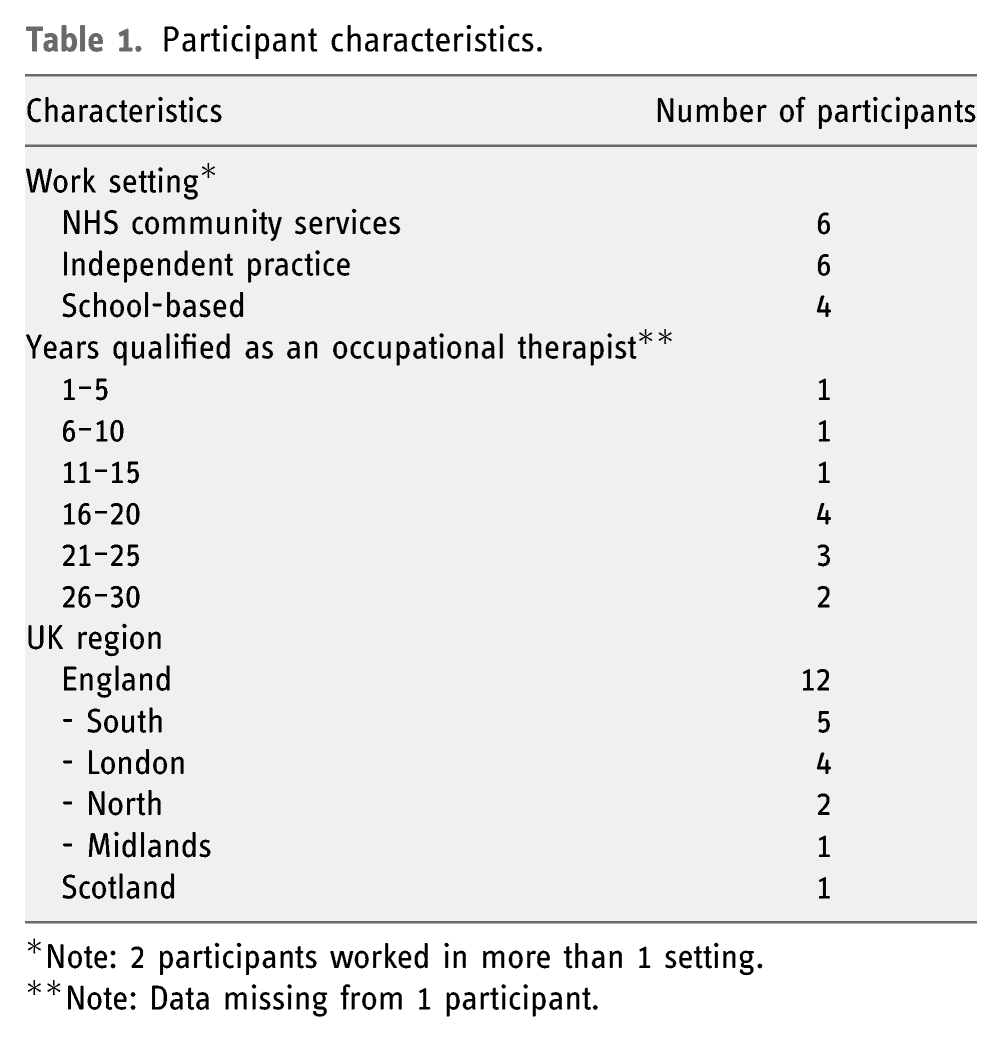
*Note: 2 participants worked in more than 1 setting.
**Note: Data missing from 1 participant.
Data collection
Individual semi-structured interviews were conducted as they provided an opportunity to explore participants’ views and experiences in-depth. Interviews took place via videoconference. Ten interviews were conducted by RN, a qualitative researcher and occupational therapist with experience working in children’s and adult’s services, and three by an MSc occupational therapy student following training by RN. An interview guide was developed by the research team, drawing on the literature, and the authors’ research and practice knowledge and experience (see Supplemental Appendix 1). Questions addressed two broad areas: (1) assessment and support provided to adolescents with handwriting difficulties (2) recommending typing. Additional questions and probes were used to clarify and seek further details. Although the questions did not focus on adolescents with specific diagnoses, participants mostly described how they supported adolescents with developmental coordination disorder, dyslexia, autism spectrum disorders, attention deficit hyperactivity disorder and/or learning disabilities. Interviews lasted 32–58 minutes, were audio-recorded and transcribed verbatim.
Data analysis
Data were analysed thematically using Braun and Clarke’s (2006) approach. The six phases of thematic analysis were followed; first the transcripts were read and re-read by RN, who noted down some initial ideas, prior to coding the entire data set. This involved identifying interesting features in the data, and collating data relevant to each code. Other members of the research team independently reviewed selected transcripts and highlighted interesting aspects that informed the identification of themes. The next phase involved sorting the different codes into potential themes and gathering data that were relevant to each theme. Diagramming was used to develop a visual representation, or thematic map of themes and sub-themes. Following review and discussion with the research team, the themes were revised to clarify their definition, the data they contained and the overall ‘story’ identified during analysis. NVivo 12 software was used for data coding and management. To ensure trustworthiness and credibility and reduce potential bias, reflexivity and regular discussion with the research team, who have professional backgrounds in psychology and special educational needs, was incorporated into the analytic process.
Findings
Study aims, themes and sub-themes.

Shared practice
Although rarely referred to explicitly in the interviews, practice was underpinned by occupational therapy philosophy. Central to this was the recognition that the interaction between the individual, the occupation and the environment shaped adolescents’ engagement and performance in handwriting.
Practice underpinned by occupational therapy philosophy
Occupational therapy philosophy, with its focus on occupation and the link between occupational engagement and well-being was evident throughout participants’ accounts. An holistic approach was adopted to understand each adolescent’s needs; this meant assessment and intervention considered physical, cognitive, psychological, social and environmental factors. Although handwriting often prompted the referral to occupational therapy, participants were aware that adolescents who had difficulties with the component skills required for handwriting, often experienced challenges in performing other occupations:
As an occupational therapist, you're very rarely just looking at one thing. If you understand that this child has global motor difficulties you'd then start thinking, are they able to dress themselves or are they having difficulties in P.E? (OT2)
Participants described how having an holistic understanding of an adolescent’s difficulties could sometimes make decision-making around recommending typing more complex:
It’s tricky when their fine motor skills are so poor, that you think they are going to struggle with the typing as well. That makes it harder to work out what to recommend. (OT12)
Similarities in practice were also evident in participants’ emphasis on being client-centred, through prioritising the adolescents’ needs while considering other’s perspectives, including those of parents and the school. Participants described the importance of understanding the adolescent’s motivation when deciding on interventions and making recommendations around handwriting and typing:
I first have conversations with older students about how important handwriting is to them, because often in secondary school the children that are struggling with handwriting have started to disengage from learning. They are like, ‘I'm not going to be practicing my handwriting for 10 minutes every day’. And it's not going to work, it’s a waste of time. So in those cases I don't work on the handwriting, I work on developing typing skills because they are more interested in typing. They think it's more relevant for life after school. (OT2)
Interaction between the adolescent, handwriting and the environment
Although only one participant explicitly referred to using an occupational therapy model, all participants’ understanding of the connection between the adolescent, handwriting and the environment was central to their practice. Factors such as diagnosis and age affected assessment and intervention, and influenced decision-making around whether to recommend typing as an alternative to handwriting:
At the end of primary, we would be advising that they start to use a laptop to build up their keyboard skills so by the time they get to secondary, and they need to be writing longer pieces of work, they have got those foundation skills instead of struggling. We would always encourage doing shorter pieces of work using their handwriting but more of a mixed, laptop and handwriting, approach. (OT5)
There was a shared recognition that being able to record schoolwork was a significant occupation for adolescents and handwriting demands increase as they progress through school. Participants’ consideration of the psychological impact of handwriting difficulties and the interaction between the adolescent’s well-being and handwriting performance underpinned practice. This was evident when participants described the impact on adolescents when it was recommended they could type:
He couldn't read it [handwriting]. The teachers couldn't read it. It frustrated him. Emotionally, his self-esteem was quite low, because handwriting is a big, big thing when it comes to school. It made him feel good about himself, that he was able to keep up with everybody else using the laptop. (OT6)
Although participants understood typing often had a positive effect on adolescents’ engagement in their schoolwork, there was shared acknowledgement that some adolescents perceived using a laptop as stigmatising. This suggested participants acknowledged how the environment, in particular the social context, could impact on adolescents’ motivation to continue writing by hand or use an alternative:
Not all children will be happy using a laptop as they are very self-conscious. They're teenagers, they don't want to be different, but actually they will be different because most of their peers will be writing. (OT7)
Divergent practice
There was also evidence of different approaches among participants that meant there was divergence in the support provided to adolescents with handwriting difficulties. These were apparent in whether participants adopted a top-down or bottom-up approach, and their perceptions around when intervention should shift from remediation to compensation.
Top-down or bottom-up
Participants described using either top-down, bottom-up or mixed approaches in their assessment and intervention. This tension about whether to focus on the component skills required for handwriting, or examine the adolescent’s occupational performance, meant there was divergent practice. Participants used both standardised assessments and less formal methods of assessment, such as classroom observations and discussions with the adolescent, their parents and school, to gather information. Although most used the DASH, there was variation in whether participants used additional standardised assessments to examine component skills. Whereas some participants believed using these assessments was helpful to ‘unpick’ the underlying difficulties and identify areas for intervention, others emphasised the importance of assessing occupational performance in real-life contexts:
I would as part of my assessment do a class observation so that I can pick up environmental factors. Testing one-to-one is great, you get loads of information, but being able to observe the child in the environment that they're doing that work most of the time, you can pick up a lot of information about what else might be going on. Sometimes it's as simple as where they're sitting in the class and the level of distraction. (OT9)
Divergent approaches that utilised top-down or bottom-up principles were also evident in interventions. Some participants described focussing on the component skills they believed underpinned handwriting, such as hand strength, fine motor and visual perceptual skills:
We do a lot of gross motor, weight bearing, we look outside of what's going to help the handwriting. I start with gross motor things and gradually work down to the table…I'm not one for spending lots of time on handwriting. I love those activities to free up the body. That helps when they're trying to break it down into smaller movements for handwriting. (OT13)
In contrast, other participants questioned the value of using a bottom-up approach. Some described how bottom-up interventions with the adolescent when they were younger had not resulted in handwriting skill acquisition. Cognitive strategies, such as the CO-OP, were used instead to promote the adolescent’s occupational performance in handwriting and typing:
I've had really good outcomes using CO-OP for handwriting, getting them to critique their own work. ‘What do you think worked? What do you think you need to do?’ (OT4)
Other participants described using a mixed approach, focussing on developing the adolescent’s component skills alongside their handwriting performance. However, regardless of what approach was adopted, there was a shared recognition of the importance of adolescents having a functional method to record their schoolwork and equal access to examinations. This emphasis on function was central to occupational therapists’ recommendations around typing:
If they are so aversive to handwriting, then why not go straight to typing because the priority is looking at what they know, showing you they understand the learning and for them to engage in the lesson. (OT8)
Remediation or compensation
There was divergence in practice due to participants’ uncertainty around the optimum time to shift from remediation to a compensatory approach. Some participants provided remediation to support adolescents to acquire handwriting skills. In addition to adopting top-down or bottom-up approaches, they provided teaching around letter formation and recommended specific handwriting programs. Recommendations around regular practice were an important aspect of interventions aiming to promote handwriting skill acquisition, although issues around skill transfer were recognised:
In the treatment sessions, they do better with their sizing and spacing because they're focusing just on that, but when they're using it functionally, it falls apart. (OT12)
Other participants described handwriting interventions with adolescents as ‘an absolute waste of time’. They perceived the ‘window of opportunity’ for remediation had passed by this age, and focused on compensation, recommending alternative methods for recording schoolwork. Participants emphasised the importance of adolescents learning to touch type, so that typing was equal to, or faster than handwriting speed. However, recommending typing was sometimes challenging and needed to be made in consultation with others in the adolescents’ network:
When you decide ‘enough's enough’ and transition to typing, you've often still got parents going, ‘I want you to work on handwriting’… The main thing is to have the confidence to go, ‘Typing is going to be the way forward’. (OT1)
Participants who adopted a compensatory approach tended to view adolescents as ‘digital natives’. This awareness that most adolescents were familiar with using technology and were more likely to type rather than handwrite once they left school, influenced decision-making.
The reality of practice
Roles and responsibilities, resources, and evidence and experience, influenced occupational therapists’ practice and decision-making.
Roles and responsibilities
Although the work setting had an impact on the nature of support provided to adolescents with handwriting difficulties, there was variation in provision within each type of setting. There were differences in occupational therapists’ roles within NHS services, depending on the size of the service, what the service was commissioned to provide and whether a tiered (universal, targeted and specialist) model of service provision was adopted. There also appeared to be tension around how handwriting was viewed within some NHS services, which impacted on decision-making and whether occupational therapists could provide assessment and advice only, or also interventions:
In the NHS we didn't provide any interventions to address handwriting because it was beyond the scope of the amount of sessions that we had to offer a child. It was felt that it's an educational issue rather than a health issue. (OT3)
School-based occupational therapists tended to provide more one-to-one and group handwriting interventions, and support teachers through training and development of school handwriting policies. However, similar tensions appeared to arise in the interface between education and health. Participants’ perceptions of their own role and how they perceived the roles of others, such as teachers, impacted on practice. There was a shared understanding that working with adolescents with handwriting difficulties was a key aspect of the occupational therapy role. However, differing expectations of occupational therapy appeared to create tension around defining occupational therapists’ and teachers’ responsibilities:
The OTs role is to mediate when it's going wrong, not to teach handwriting. That's a challenge because as soon as there are OTs who are specialists in handwriting, the assumption is that you teach the handwriting, but actually it's a teacher who needs to teach it, you're there to help with the problem. (OT1)
Resources
The availability of resources, including those of the occupational therapy service and the school, had an impact on decision-making and the support provided to adolescents with handwriting difficulties. All participants described completing assessments, making recommendations and providing advice. However, there was variation in how much direct intervention occupational therapists were able to deliver. Many seemed to find the constraints on providing intervention challenging, and described being able to provide ongoing individual therapy as a ‘luxury’:
In an ideal world, it would be different to what we can offer. Staff numbers are so small, the follow up could be more comprehensive, but we just don't have capacity. (OT5)
Despite being able to provide more direct intervention, school-based occupational therapists also described challenges presented by limited resources and competing pressures within the school curriculum. When recommending the use of alternative methods of recording schoolwork, all participants were aware that a school’s budget could affect whether a recommendation was implemented:
For schools, there’s a resource issue. They think, ‘Oh my goodness, we’ve got to find a laptop. We've got to find time to get this kid proficient in typing’. (OT9)
Evidence and experience
Having evidence to guide their decision-making was important to participants. Standardised assessments were valued for corroborating recommendations and participants expressed concern about the lack of assessments for typing:
It would be nice to have more standardised assessments so you can quantify what you're doing. There's a gap that doesn't sit well with me. I know what I'm looking for, but it'd be nice to have that validated with a scoring system. (OT10)
Although some participants described how training and guidance, such as a school’s handwriting policy, guided their decision-making, most participants expressed concern regarding the lack of research and local pathways or protocols. Participants described a need for research and/or guidance to address some of the uncertainties that resulted in divergent practice:
We just don't know enough about typing, because if children have motor difficulties with handwriting, why would they not have motor difficulties with typing? Is it easier to train typing than teach handwriting? We definitely need evidence about whether typing is more beneficial than handwriting, and whether starting children typing at a young age then means their handwriting deteriorates. That would help us to make more informed decisions. (OT2)
Limited evidence comparing laptop and tablet use, around the effectiveness of touch-typing programs, and the optimum time for starting to type, were also identified as impacting on practice. The lack of an evidence-base meant participants emphasised how their experience and clinical reasoning were critical to their decision-making. Although participants were generally confident in their decision-making ability, pathways and protocols were seen as particularly important for less experienced staff:
When you're starting out, you need that prescriptive thing to follow, to help your clinical reasoning. If you don't have knowledge and experience, something more formal, a pathway would be helpful in that decision-making process. (OT5)
Discussion
This study aimed to explore the support provided by occupational therapists to adolescents experiencing handwriting difficulties and how decisions are made to recommend typing. To the best of our knowledge, this is the first study that has focused on UK practice with adolescents rather than children; this distinction is important due to the considerable handwriting demands in secondary school, both for class work and formal examinations. Findings from the study suggest that despite similarities in practice, there is variation in support and decision-making due to different approaches and contextual factors that impact on occupational therapists’ everyday practice. This divergence in practice reflects the limited research in this area and highlights the need for an evidence base to support occupational therapists’ decision-making when recommending typing as an alternative to handwriting.
Occupational therapy philosophy underpinned participants’ practice. Assessment and intervention was shaped by participants’ recognition that the interaction between the individual, the occupation and the environment was critical to understanding adolescents’ engagement and performance in handwriting. This clearly impacted on occupational therapists’ decision-making; understanding the adolescent’s motivation, the effect of handwriting difficulties on emotional well-being and the need for a functional method to record schoolwork, was central to decision-making around recommending typing. Additionally, the recognition that learning to type was a useful skill that would be beneficial post-school suggests occupational therapists considered both adolescents’ current and future needs. Although previous research has explored occupational therapists’ practice with children experiencing handwriting difficulties (Cramm and Egan, 2015; Feder et al., 2000; Woodward and Swinth, 2002; Piller and Torrez, 2019), and technology recommendations with this group (Freeman et al., 2004), the current study has highlighted the core principles that underpin UK practice. These key findings align with current literature and professional guidelines that emphasise occupational therapy as person-centred and based on understanding of the connection between the person, occupation and environment (Royal College of Occupational Therapists, 2021; Pentland et al., 2018).
Findings suggested that both top-down, bottom-up and mixed approaches were used in assessments and interventions. This is consistent with previous research in Canada and the USA, that found occupational therapists often used an ‘eclectic’ approach, focussing on performance components, alongside cognitive strategies to support the development of handwriting skills (Cramm and Egan, 2015; Feder et al., 2000; Piller and Torrez, 2019). However, some participants in our study clearly rejected bottom-up approaches, demonstrating an awareness of the current evidence-base that indicates how interventions addressing underlying performance components are not effective in improving handwriting (Hoy et al., 2011). This is an interesting finding as it suggests Cramm and Egan’s (2015) identification of a ‘substantial’ evidence-to-practice gap among Canadian occupational therapists, is not universal to all occupational therapists’ targeting handwriting in the UK.
Although some participants in this study provided remediation as part of their interventions, all recognised the need for compensation and were involved in recommending typing as an alternative to handwriting. Previous studies suggested experienced occupational therapists were more likely to recommend typing (Freeman et al., 2004); however, our study found occupational therapists with less experience also advised that adolescents use alternative methods to record schoolwork. This finding may reflect both this study’s focus on adolescents, as well as the increase in technology in the last 10–20 years which means adolescents are now considered ‘digital natives’ (Bennett et al., 2008). For some participants, the decision to advise an adolescent to transition from handwriting to typing was straightforward. However, others experienced uncertainty around the optimum time, and whether typing or an alternative method for recording schoolwork, should be recommended. Participants’ need for increased knowledge to guide decision-making around recommending typing has been identified in earlier Canadian studies (Cramm and Egan, 2015; Freeman et al., 2004) and highlights the evidence gap in this area of occupational therapy practice in the UK.
Previous research indicates that making recommendations around typing is a complex process and requires consideration of individual and environmental factors (Batorowicz et al., 2012). In recognition that recommendations need to be individually tailored, Rosenberg-Adler and Weintraub (2020b) developed a protocol for occupational therapists when selecting accommodations for written examinations. Although the protocol demonstrated both reliability and validity, findings were based on a small sample of higher education students in Israel; therefore, further research is needed to assess whether it would be transferable to adolescents with handwriting difficulties in other settings. However, our findings suggest that due to occupational therapy philosophy underpinning practice, occupational therapists have a unique understanding of the issues raised when an adolescent transitions to typing. For example, although typing was motivating for many adolescents, participants recognised that some found using a laptop stigmatising. This new finding extends existing literature that predominantly identifies typing as motivating children to write (Batorowicz et al., 2012; Morphy and Graham, 2012) and has implications for practice across all settings.
Our findings demonstrate that a range of contextual factors impact on occupational therapists’ decision-making. Existing literature suggests occupational therapists’ professional identity and how their role in schools is perceived impacts on the support provided to children with handwriting difficulties (Bolton and Plattner, 2020; Clough, 2019). Resources, including availability of support and funding for equipment, have been identified in previous studies as influencing what occupational therapists recommend (Freeman et al., 2004). Research in Canada has identified ‘system’ barriers to best practice as the agencies that employ occupational therapists require them to adopt a bottom-up approach (Cramm and Egan, 2015). However, as the first study exploring occupational therapy with adolescents experiencing handwriting difficulties in the UK, this study extends the existing literature by identifying additional important features, such as work setting, roles and responsibilities and the value placed on evidence, that shape practice. Although there are specific contextual factors, such as the health and education systems that impact on UK practice, these findings are likely to be transferable to other countries and settings. Of particular interest is the tensions experienced by some participants around professional boundaries and the perception that handwriting falls under an education, not a health remit. This reinforces the need for increased collaboration between educators and occupational therapists (Villeneuve and Shulha, 2012).
The findings of our study have implications for occupational therapy practice and research, both in the UK and internationally. Training and other knowledge-translation strategies would be beneficial to address the knowledge-practice gap that appeared to exist in some areas, in particular to support the use of top-down approaches. Evidence-based guidelines could help to promote best practice and support less experienced occupational therapists when making decisions around whether, when and how to recommend typing as an alternative to handwriting. Closer collaboration between secondary school staff and occupational therapists to increase understanding of roles is recommended.
Further research that examines: the optimum time for children to start typing; the impact of typing on handwriting performance; the effectiveness of touch-typing programs; and how typing compares with other methods of recording schoolwork, such as scribes or voice-to-text software, is needed. Finally, development of a typing assessment would support occupational therapists to make evidence-based, informed decisions when recommending typing.
As a small-scale qualitative study, findings need to be interpreted with regard to the sample and context. The diversity in the sample, in terms of work settings and experience, ensured a range of experiences were explored, although this may not reflect the practices of all children’s occupational therapists working in the UK.
Conclusion
This study has explored the support provided by occupational therapists to adolescents with handwriting difficulties and explained what influences their decision-making when recommending typing. Despite considerable shared practice underpinned by occupational therapy philosophy, there was also evidence of divergent practice due to different approaches and values. Although roles and responsibilities, resources, and evidence and experience, influenced occupational therapists’ decision-making, balancing the need for a functional method to record schoolwork with the adolescent’s motivation and the effect of handwriting difficulties on well-being were key when making the decision to recommend typing. These new insights reinforce the need for strategies to address the knowledge-practice gap, including evidence-based guidelines. To increase understanding of roles and highlight the unique occupational therapy contribution, closer collaboration between occupational therapists and secondary school staff is recommended. Further research examining whether, when and how to introduce typing as an alternative for adolescents with handwriting difficulties needs to be undertaken to support evidence-based practice and informed decision-making.
Key findings
• Although there is shared practice underpinned by occupational therapy philosophy, there is also divergent practice due to different approaches. • Understanding the adolescent’s motivation, the effect of handwriting difficulties on well-being and the need for a functional method to record schoolwork, underpins decision-making to recommend typing.
What the study has added
This study highlights the need for strategies to address the knowledge-practice gap, including evidence-based guidelines. Closer collaboration between occupational therapists and school staff could increase understanding of roles and highlight the unique occupational therapy contribution.
Patient and public involvement data
During the development, progress and reporting of the submitted research, Patient and Public Involvement in the research was included in planning and progress of the research.
Supplemental Material
sj-pdf-1-bjo-10.1177_03080226221097314 – Supplemental Material for Handwriting and typing: Occupational therapy practice when supporting adolescents with handwriting difficulties
Supplemental Material, sj-pdf-1-bjo-10.1177_03080226221097314 for Handwriting and typing: Occupational therapy practice when supporting adolescents with handwriting difficulties by Ruth Nightingale, Emma Sumner, Mellissa Prunty and Anna Barnett in British Journal of Occupational Therapy
Footnotes
Acknowledgements
The authors would like to thank: the participants for their time and interest in the study; Royal College of Occupational Therapists Specialist Section for Children, Young People and Families for their support with recruitment; and Amber Uhrin for assisting with data collection.
Research ethics
Ethical approval was obtained from the College of Health and Life Sciences Research Ethics Committee at Brunel University London (19318-MHR-Feb/2020-24671-2).
Declaration of conflicting interests
The author(s) declared no potential conflicts of interest with respect to the research, authorship, and/or publication of this article.
Funding
The author(s) disclosed receipt of the following financial support for the research, authorship, and/or publication of this article: This study was funded by a research priority grant awarded by the UK Occupational Therapy Research Foundation to MP (Principal Investigator), Brunel University London.
Contributorship
MP, AB and ES conceived the study. MP and RN were involved in gaining ethical approval and recruitment. RN was responsible for data collection and analysis. AB and ES contributed to data analysis. All authors reviewed and edited the manuscript and approved the final version.

Supplemental Material
Supplemental material for this article is available online.
References
Supplementary Material
Please find the following supplemental material available below.
For Open Access articles published under a Creative Commons License, all supplemental material carries the same license as the article it is associated with.
For non-Open Access articles published, all supplemental material carries a non-exclusive license, and permission requests for re-use of supplemental material or any part of supplemental material shall be sent directly to the copyright owner as specified in the copyright notice associated with the article.
