



Abstract
Introduction
The term ‘occupational profile’ is widely used within the occupational therapy profession; however, its use and application appear inconsistent in the literature. Understanding how occupational profile is described in existing literature can reduce ambiguity and strengthen consistent use of terminology across practice and research.
Methods
A scoping review was conducted to examine how occupational profile has been described in occupational therapy and occupational science literature.
Results
Seventy-six journal papers were included. A lack of consistent definitions, conceptualisation and measurements was identified. Key concepts relating to the conceptualisation of occupational profile included occupational history, motivation and performance. Only one measurement was used consistently with paediatric clients to identify individuals’ occupational profiles. Occupational profiles of populations and communities were not identified.
Conclusion
The lack of consistency in definitions, conceptualisation and measurement of the term ‘occupational profile’ presents significant issues for occupational therapy practice, including an inability to compare populations. Researchers should articulate their conceptualisation of occupational profile in the absence of a universally agreed-upon definition. More comprehensive measures seeking to explore the occupational profile of a variety of clients need to be developed. Occupational profiles of communities and populations should be explored to understand occupational patterns and identify potential occupational issues.
Introduction
‘Occupational profile’ is a term of relevance within the occupational therapy profession (American Occupational Therapy Association, 2020) that has been presented in occupational therapy literature for over 40 years with various definitions and applications. Within the Occupational Therapy Practice Framework: Domain and Process, Fourth Edition (AOTA, 2020), there is considerable emphasis on exploring an occupational profile during the occupational therapy process to understand the client’s perspective and background. Furthermore, it is recommended in Kearney et al. (2018) Guidelines for Documentation of Occupational Therapy that therapists should document their clients’ occupational profiles and adjust practice accordingly as progress is made through the occupational therapy process. The information obtained from an occupational profile contributes to an individualised approach to the evaluation, intervention planning and implementation stages of the occupational therapy practice process (AOTA, 2020). The American Occupational Therapy Association (AOTA, 2021) argues that consistently developing and documenting such a profile is the first step in improving the quality of occupational therapy services and demonstrates the profession’s distinct value to other health professions and clients. Additionally, the profile demonstrates occupational therapy practitioners’ commitment to clients as collaborators in the occupational therapy process and facilitates client-centred practice (AOTA, 2021).
Like many concepts used within the profession, the conceptualisation of the term ‘occupational profile’ lacks consensus. In early literature, MacKinnon et al. (1994) described occupational profile as time spent in work, leisure and activities of daily living. The definition of occupational profile has since developed. In 2002, AOTA defined the term as ‘information that described the client’s occupational history, experiences, patterns of daily living, interests, values and needs’ (p. 616). Radomski and Latham (2014) defined occupational profile as a summary of information related to the client’s history, resources and performance. More recently, Molineux (2017) defined occupational profile as ‘a summary of the information often gathered as part of the initial interview such as occupational history, occupational patterns, occupational issues, barriers, enablers and occupational diagnosis’. These definitions reveal common terms such as ‘history’ and ‘patterns’ as well as variations and inconsistencies in terminology.
Having a coherent professional vocabulary is important to occupational therapists in explaining the purpose and process of occupational therapy to clients and other health professionals, and for maintaining a strong professional identity (Creek and Lawson-Porter, 2010). Wilding and Whiteford (2008) and Turner and Knight (2015) found occupational therapists experience difficulties describing what occupational therapy is and what it involves. Therapists often avoid using occupational therapy specific language resulting in a lack of professional identity and representation (Wilding and Whiteford, 2008). Having a lack of clear professional identity has profound effects on the profession (Turner and Knight, 2015). As an example, it can lead to practitioners being over-influenced by other professions, leading to the use of biomedical language rather than undertaking and articulating their practice from an occupational perspective (Britton et al., 2015; Murray et al., 2015). Unifying language can enhance professional identity and the understanding and representation of occupational therapy (Wilding and Whiteford, 2008).
Term clarification is topical in occupational therapy. As examples, Backman (2004) described the vague and poorly defined concept of occupational balance. Further analysis of the term was completed by Wagman et al. (2012), who identified that occupational balance had been measured using different methods, creating difficulties in gaining of systematic knowledge in relation to the concept. Walder et al. (2021) argued that a lack of clarity regarding the term occupational adaptation contributed to difficulties applying the concept consistently across theory, practice and research. They concluded that further refinement of the term would lead to improved clinical utility (Walder et al., 2021). Further, work by Hansson et al. (2022), examining the use of the term occupational identity, suggested that conceptual clarity was vital in order to improve research and use of the term throughout occupational therapy. Across these papers, there is argument that when terms in occupational therapy are used without consistency, it creates challenges for theory-to-practice integration and professional identity within health care. Additionally, these papers argue that development of concepts and terms supports development of theory, practice and research. Occupational therapists are often requested, by funding bodies, to complete an occupational profile to support provision of services and equipment. Term clarity supports occupational therapists to do this in consistent ways and further supports university programs to prepare graduates for this practice.
Despite the widespread use of the term ‘occupational profile’, only one scoping review has examined the term to date. Eschenfelder and Gavalas (2018) explored the evidence regarding the effectiveness of expressive art techniques to enhance the occupational profile of clients with communication deficits. Although the review focused on occupational profiles, it failed to explore the use of the term in occupational therapy or occupational science literature. Consequently, it did not address the current gaps in the literature’s conceptualisation, measurement or application of the term occupational profile. Given that occupational profile is a core term within occupational therapy practice, clearly defining it and understanding its use in current literature is imperative to occupational therapy practice and research. For this reason, a scoping review examining how the term occupational profile is described in the occupational therapy and occupational science literature was conducted.
Methods
Study design
A scoping review was chosen to map the literature and understand the scope and size of available research to answer the research question. The scoping review framework described by Arksey and O'Malley (2005) and further refined by Levac et al. (2010) was used. This framework has five stages: (i) identifying the research question, (ii) identifying relevant studies, (iii) study selection, (iv) charting of data and (v) collating, summarising and reporting the results (Arksey and O'Malley, 2005).
Stage 1: Identifying the research question
This review arose as the research team were designing a research study to develop an occupational profile of a group of adults using standardised assessments. In a preliminary literature search, we identified variation in definitions, prompting the need for a comprehensive literature review. Thus, this study was created with the intention of answering the research question: ‘How is the term “occupational profile” described in the occupational therapy and occupational science literature?’
Stage 2: Identifying relevant studies
The search was completed in five databases (CINAHL, Medline, PubMed, Scopus, and Web of Science), using a search strategy that was created with support from a health librarian. A Boolean search string was developed through the CINAHL Subject Headings. The search terms were (“occupational therap*” OR “occupational science”) AND “occupational profile.” Reference lists of identified articles were searched to discover any additional relevant literature.
Stage 3: Study selection
Studies were included if they met the following pre-determined criteria: (i) published in English; (ii) contained ‘occupational profile’ in the title, abstract or body of the text and (iii) were related to occupational therapy or occupational science. Occupational science-related papers were included as occupational science is the study of humans as occupational beings (Wilcock, 2001). Therefore, it was assumed that the term ‘occupational profile’ might be explored in this body of literature. Journal articles, professional magazines and research theses were included to maximise and broaden the scope of literature, but conference abstracts were excluded due to the minimal content available.
The titles and abstracts of all identified papers were extracted and uploaded into Covidence (Veritas Health Innovation, 2021) for review. Two authors screened titles and abstracts of the retrieved papers to identify relevant literature. When both authors agreed, the paper was forwarded for the full-text review. When authors disagreed, the paper was discussed in a research team meeting and a decision was reached through team discussions. The full text of the retained papers was reviewed by all authors, and conflicts regarding inclusion, quality and relevance were again resolved through discussions at a team meeting. Consistent with scoping review methodology recommended by Arksey and O’Malley (2005), quality assessment of papers reviewed was not performed.
Stage 4: Charting of data
Two authors independently extracted data and the research team then met to discuss any arising differences in data extraction. The data were recorded in a Microsoft Excel spreadsheet under headings suggested by Arksey and O’Malley (2005), along with additional headings related to how occupational profile was described in the paper. The information captured was author’s name(s), year of publication, publishing journal, geographical location of the corresponding author, study design, aim/objective, who the occupational profile referred to, how extensively occupational profile was explored, definition of occupational profile, conceptualisation of occupational profile and measures used to capture the occupational profile. The second and third authors confirmed the extracted data by independently completing data extraction.
Stage 5: Collating, summarising and reporting the results
Descriptive numerical analysis was undertaken in an Excel spreadsheet for publication year, publishing journal, type of methodology, country of origin and people being profiled. During data extraction, it became evident that the conceptualisation of occupational profile was inconsistent across the included studies. When authors of included papers described components of their occupational profile, this was recorded into Excel. When they did not, the research team considered key terms described in the studies and linked key concepts together to support interpretation of the existing literature. The process was atheoretical in recognition that included papers were underpinned by different or no specific occupational therapy theories.
Results
Search results
A flow diagram for the selection of included papers based on the Preferred Reporting Items for Systematic Reviews and Meta-Analysis (PRISMA) guidelines (Moher et al., 2009) is shown in Figure 1. A total of 102 papers were initially identified through the database search. Hand-searching of reference lists identified an additional five papers. A column series published in the Journal of Occupational Science was identified. The search term ‘occupational profile’ was applied to the journal to locate all papers in this series, resulting in an additional 25 papers. Forty-three duplicates were removed, resulting in 89 papers undergoing abstract and title screening. Seven papers were excluded in this stage, resulting in 82 papers undergoing full-text review. A further six papers were excluded in this stage as they either did not explore occupational profile, were a newspaper article, a conference abstract or were not related to occupational therapy or occupational science. Consequently, 76 papers were included in this review. PRISMA flow diagram showing literature results.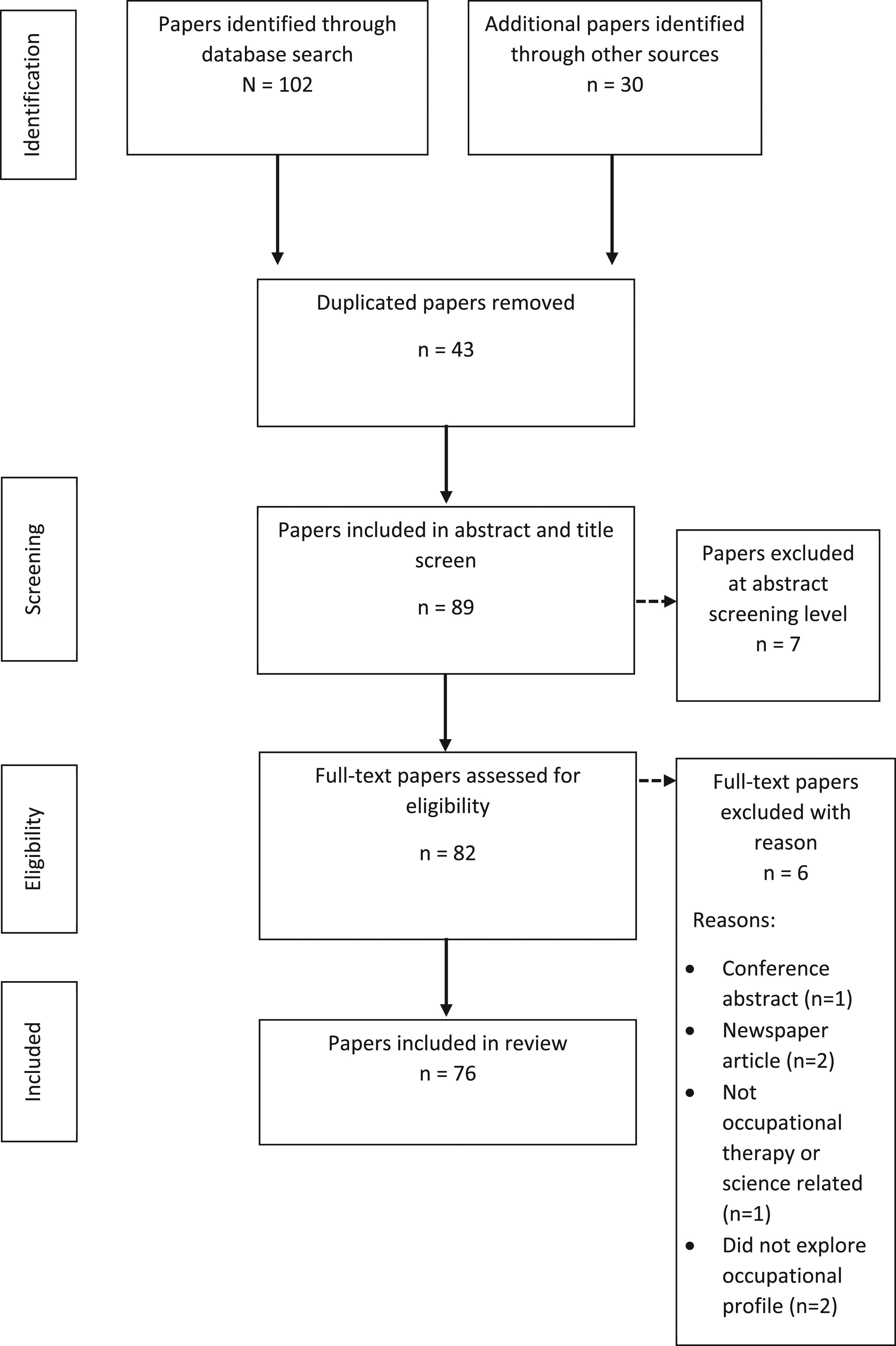
Descriptive numerical summary
Summary of included papers.
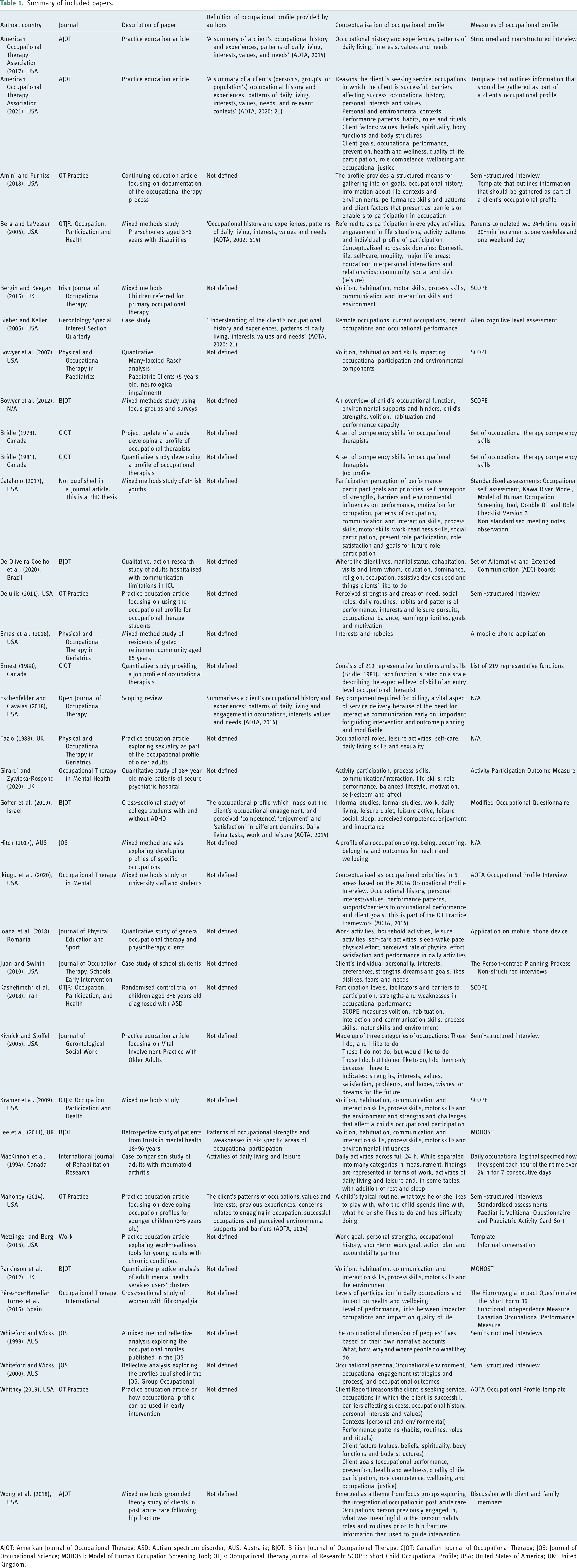
AJOT: American Journal of Occupational Therapy; ASD: Autism spectrum disorder; AUS: Australia; BJOT: British Journal of Occupational Therapy; CJOT: Canadian Journal of Occupational Therapy; JOS: Journal of Occupational Science; MOHOST: Model of Human Occupation Screening Tool; OTJR: Occupational Therapy Journal of Research; SCOPE: Short Child Occupational Profile; USA: United States of America; UK: United Kingdom.
Definitions of occupational profile
As shown in Table 1, few studies (n = 9) provided definitions of occupational profile. The most frequently used was the definition provided by the AOTA (2002, 2014, 2020) (n = 7). One study referred to the Model of Human Occupation (Kielhofner 2002) as the theoretical underpinning for their definition (Lee et al., 2011). One study did not appear to draw from any citation in their provided definition (MacKinnon et al., 1994).
Of the papers that included definitions, over half (56%) included occupational history and experiences, values and interests (AOTA, 2017, 2021; Berg and LaVesser, 2006; Eschenfelder and Gavalas, 2018; Mahoney, 2014). The following terms were also included in the definitions: patterns of daily living (AOTA, 2017, 2021; Berg and LaVesser, 2006; Eschenfelder and Gavalas, 2018), engagement (Berg and LaVesser, 2006; Eschenfelder and Gavalas, 2018), work (Goffer et al., 2019; MacKinnon et al., 1994), leisure (Goffer et al., 2019; MacKinnon et al., 1994), strengths (Lee et al., 2011; Metzinger and Berg, 2015), weaknesses (Lee et al., 2011), environmental supports and barriers (Mahoney, 2014), enjoyment and satisfaction (Goffer et al., 2019).
Conceptualisation of occupational profile
The majority (94%) of papers conceptualised occupational profile as a profile of a client’s engagement in occupations. Three papers conceptualised the occupational profile to describe a job profile (Bridle, 1978; Bridle, 1981; Ernest, 1988). Hitch (2017) conceptualised occupational profile to describe the occupation of housework.
Conceptualisation of the term occupational profile.
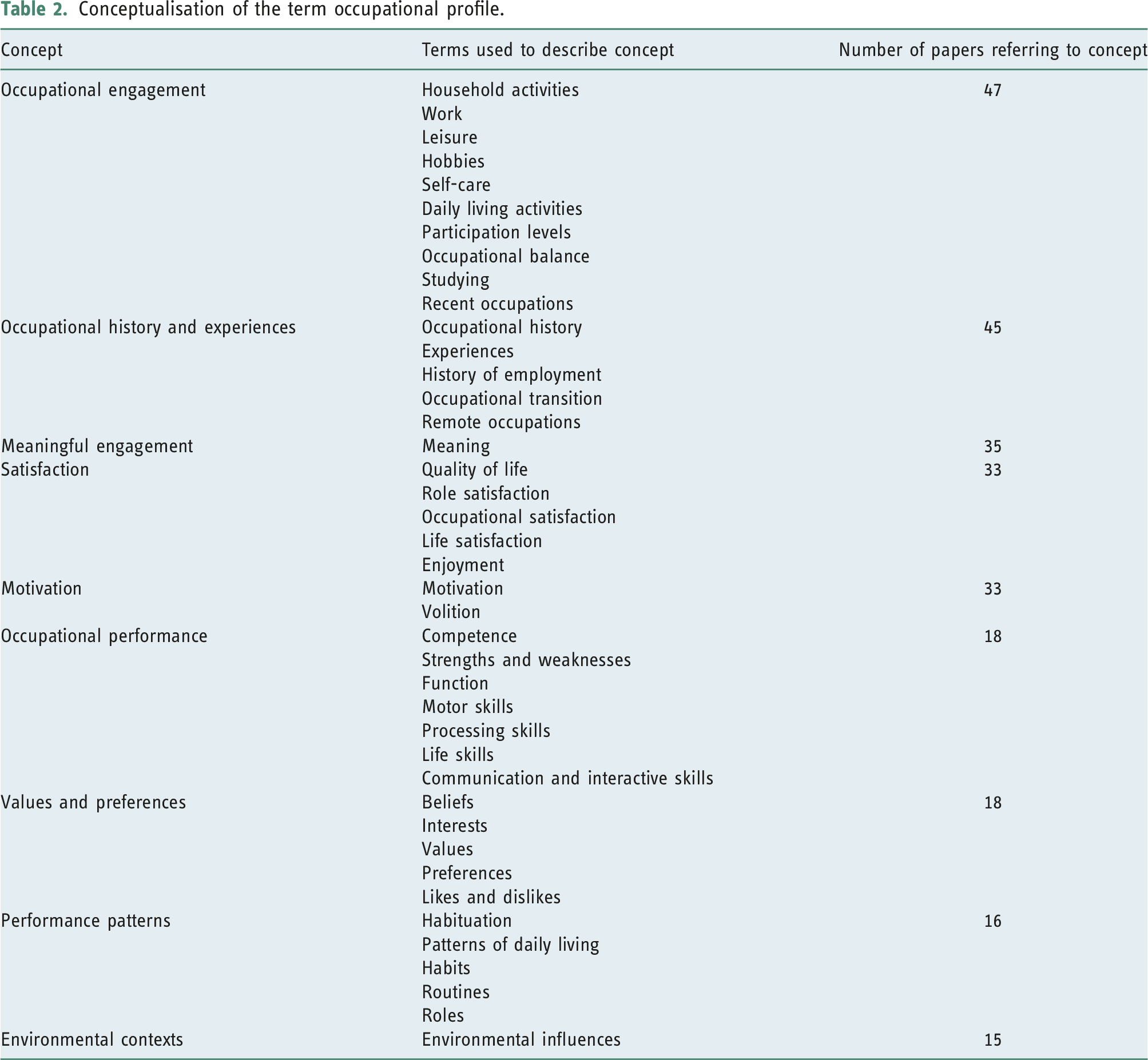
Papers included in the Journal of Occupational Science Occupational Profile Column series commonly explored occupational history and environmental influences by asking the interviewees to reflect on their life history, some childhood occupations and career transitions. An additional eight papers conceptualised occupational profile by describing motivation and occupational performance using the Model of Human Occupation (MOHO; Keilhofner, 2002) terminology (Bergin and Keegan, 2016; Bowyer et al., 2007; Bowyer et al., 2012; Kashefimehr et al., 2018; Kramer et al., 2009; Lee et al., 2011; Mahoney, 2014; Parkinson et al., 2012).
Individuals profiled
Most papers provided occupational profiles that explored multiple occupations of individual people or groups of individuals who shared commonalities including diagnoses, while others provided education on how to complete an occupational profile with different clients. The most common group of individuals profiled was children aged 3–8 years with various health conditions (Berg and LaVesser, 2006; Bergin and Keegan, 2016; Bowyer et al., 2007; Kashefimehr et al., 2018; Mahoney, 2014; Whitney, 2019) including autism spectrum disorder (Kashefimehr et al., 2018) and neurological impairments (Bowyer et al., 2007). Four papers profiled adults with mental health conditions (Catalano, 2017; Girardi and Zywicka-Rospond, 2020; Lee et al., 2011; Parkinson et al., 2012). Other groups of individuals profiled were adults with hip fractures (Wong et al., 2018), women with fibromyalgia (Pérez-de-Heredia-Torres et al., 2016), adults with rheumatoid arthritis (MacKinnon et al., 1994) and adults with communication limitations (De Oliveira Coelho et al., 2020).
The majority of papers (93%) exploring an occupational profile of individuals were published in the Journal of Occupational Science Occupational Profile Column series. The interviewees consisted of professors (Blair, 1997; Hocking, 2020; Thew, 2008), artists (Blijlevens, 2012; Knight, 2007; Meltzer, 2004a; Reed and Rawlings, 2014), occupational therapists (Boerema, 2006; Dickie, 2009; Meltzer, 2004b), band members (Copeland, 2013), a photographer (Hamburg and Meltzer, 2011), students (Martin, 2008; Reed, 2003), a member of the Royal Family (Stewart, 1998), a survivor of rape (Twinley, 2012), an engineer (Weston, 2000), politicians (Hocking, 1999; Whiteford, 1995), a cancer survivor (Wicks, 2000), a bookbinder (Wicks, 2005), a museum director (Yeager, 2005) and a stone carver (Christie, 2008). Other papers not included in the series were individual profiles of a 3-year-old with complex medical needs (Whitney, 2019), a school student (Juan and Swinth, 2010) and an older adult (Kivnick and Stoffel, 2005). Continuing practice education articles provided information on how to complete occupational profiles with a group of individuals based on commonalities such as student occupational therapists (Deluliis, 2011), older adults with chronic conditions (Kivnick and Stoffel, 2005), young adults with chronic conditions (Metzinger and Berg, 2015), school students (Juan and Swinth, 2010) and children (Bowyer et al., 2012; Mahoney, 2014).
Measurements of occupational profile
Several different approaches have been used to evaluate occupational profiles, including standardised and non-standardised approaches. The most commonly used standardised assessment was the Short Child Occupational Profile (SCOPE) (Bowyer et al., 2005). The SCOPE (Bowyer et al., 2005) is a measure for children and is based on the Model of Human Occupation (Kielhofner, 2002). Another standardised assessment used with paediatric clients was the Person Centred Planning Process (Cornwell University, n.d). Mahoney (2014) also suggested using the Paediatric Volition Questionnaire (Basu et al., 1998) and the Paediatric Activity Card Sort (Mandich et al., 2004) to measure occupational profiles of children.
The Activity Participation Outcome Measure (Casteleijn, 2011) was used in one study to measure the occupational profile of adult male psychiatric patients (Girardi and Zywicka-Rospond, 2020). Another study used the Occupational Self-Assessment (Baron et al., 2006), Double OT (Cyrs and Haworth, 2017), Role Checklist Version 3 (Scott et al., 2017) and Model of Human Occupation Screening Tool (MOHOST) (Parkinson et al., 2006) to measure the profile of at-risk young adults (Catalano, 2017). The MOHOST was also used with adults with mental health conditions in two other studies (Lee et al., 2011; Parkinson et al., 2012). One study used the Fibromyalgia Impact Questionnaire (Burckhardt et al., 1991), Canadian Occupational Performance Measure (McColl et al., 2005), Functional Independence Measure (State University of New York at Buffalo, 1993) and Short Form 36 (Ware and Sherbourne, 1992) together to measure the occupational profile of women with fibromyalgia (Pérez-de-Heredia-Torres et al., 2016). The Modified Occupational Questionnaire (Smith et al., 1986) was used to measure the occupational profile of college students with and without attention deficit hyperactivity disorder (Goffer et al., 2019).
A variety of non-standardised measures have also been used to construct occupational profiles. The most commonly used related to the implementation of non-structured and semi-structured interviews. The AOTA Occupational Profile Template was mentioned in four papers to guide interviews (AOTA, 2017, 2021; Amini and Furniss, 2018; Whitney, 2019), while Metzinger and Berg (2015) provided their own template to gain information about the occupational profile of young adults with chronic conditions. Semi-structured methods were employed in the Journal of Occupational Science Occupational Profile Column series, in which the interviewer did not follow a formalised list of questions, instead, asking open-ended questions allowing for a discussion with the interviewee. Daily occupational logs were used in Berg and LaVesser’s (2006) study to measure the occupational profile of preschool students and in the MacKinnon et al. (1994) study to measure the profile of adults with rheumatoid arthritis.
Discussion
This scoping review explored the use of the term ‘occupational profile’ in occupational therapy and occupational science literature and revealed that the description of the term occupational profile is inconsistent in existing literature. Papers did not routinely include a definition of occupational profile, and the concepts considered to represent an occupational profile varied. Further, a range of approaches have been used to measure occupational profile.
It appears that the term ‘occupational profile’ lacks a universally agreed-upon definition, and its conceptualisation in the occupational therapy and occupational science literature varies. Despite three papers using the term ‘occupational profile’ prior, the earliest definition was provided by MacKinnon et al. (1994), whose study originated in Canada. No other included papers provided definitions of occupational profile until 2011 when Lee et al. (2011) defined occupational profile in relation to the MOHO (Keilhofner, 2002) six domains of occupational performance. Papers that defined occupational profile after this cited the Occupational Therapy Practice Framework: Domain and Process (AOTA, 2002, 2014, 2020). Only one paper originated from outside the United States of America (USA). While there were similarities among definitions provided by included papers, there were also inconsistencies in specificity and terminology. This lack of clarity in articulating how occupational profile is defined reflects other recent studies which found inconsistencies in definitions and conceptualisations of other key occupational therapy terminology (Black et al., 2019; Walder et al., 2021). This lack of agreed-upon definition may be the reason for inconsistencies in how the term is conceptualised.
Conceptualisation of the term occupational profile varied, with papers describing job competencies, patterns of daily living, performance components and occupational history. Some briefly covered leisure occupations; however, self-care occupations were not explored. In fact, few papers explored comprehensive occupational profiles covering productivity, leisure and self-care occupations. This may have implications for occupational therapy practice as therapists may miss important aspects when developing a client’s occupational profile. Given the importance of consistent terminology in the occupational therapy profession (Creek and Lawson-Porter, 2010; Turner and Knight, 2015; Wilding and Whiteford, 2008), future research should develop a clear definition and conceptualisation of the term ‘occupational profile’. At the very least, future research should articulate definitions when exploring occupational profile in the absence of a universally agreed-upon definition and conceptualisation. This would provide greater clarity regarding the use of the term in research and professional practice and assist in developing instruments to accurately measure occupational profiles.
The findings from this review reveal that there are no commonly used tools to measure occupational profile. The lack of consistent measures may result from the lack of clear definitions and conceptualisation of the term; an assertion echoed in previous studies exploring occupational therapy terminology (Black et al., 2019; Grajo et al., 2018). AOTA (2017) created an occupational profile template in response to the American Medical Association (2016) Current Procedural Terminology Evaluation Codes which required occupational therapists to complete an occupational profile of clients for funding purposes. This was described in some included papers as a means of measuring the occupational profile of clients; however, this template does not capture a comprehensive occupational profile. The template fails to inform the user to address all aspects of occupation (self-care, leisure and productivity) and instead emphasises occupational performance components. The template also does not address occupational history or patterns of daily living, which are included components of the AOTA (2020) definition of occupational profile. Additionally, while this template suggests categories that may be included in the occupational profile, it does not recommend assessments for occupational therapists to gather such information. The only comprehensive assessment identified in this scoping review to measure occupational profile is the SCOPE (Bowyer et al., 2005) which was developed to measure the occupational profile of children. Without clear instruments to measure occupational profile, it is difficult to compare similarities and differences between individuals, groups and communities. The ability to review comparisons between individuals, groups and communities could assist in developing and implementing occupational therapy practice with these client groups. Future research should develop comprehensive assessments to measure the occupational profile of different client groups to provide greater clarity regarding the conceptualisation of the term in research and professional practice.
Published occupational profiles have typically explored individuals. As an example, the Journal of Occupational Science profiled individual adults with diverse career backgrounds who were well known in their field (Whiteford and Wicks, 1999). The focus of these profiles was on occupational transition in productive occupations. Other papers, not included in the Occupational Profile Column series, provided occupational profiles of children and an older adult with complex medical conditions. These profiles explored occupational performance and engagement. Papers in this review also profiled groups of individuals based on key characteristics, including mental health diagnoses and various medical conditions. Despite sources describing the term ‘client’ within the profession to include communities and populations (AOTA, 2020; World Federation of Occupational Therapists, 2012), no communities or populations were profiled in the included papers. Theoretically, profiling of communities and populations appears logical; however, the absence of literature may indicate a gap between knowledge and practice. It is plausible that inconsistent conceptualisation may hinder the development of clear profiles of these types of occupational therapy clients. This needs to be further explored to determine if there are differences in the occupational profile of communities and populations compared to individuals. Future research should explore the relevance of occupational profile concepts to communities and populations and develop suitable assessments if relevant. Exploring such profiles is important given contemporary occupational therapy practice includes communities and populations as clients in the occupational therapy process (AOTA, 2020; WFOT, 2012). This may then provide a greater understanding of these client types and the relevance of occupational therapy.
Despite the lack of definitions, conceptualisation and forms of measurement, the term ‘occupational profile’ is used widely in the occupational therapy profession. Occupational profiling allows occupational therapists and researchers to gather information about clients’ past and current occupational engagement, barriers and enablers to occupational engagement and assess whether occupational therapy input is necessary (AOTA, 2020). The findings from this review have highlighted the need for future development of how occupational therapy and occupational science conceptualise and define occupational profile as a term. The occupational therapy profession would benefit from future research clearly defining the term to reduce ambiguity and allow for consistency in practice. Future comprehensive assessments should be developed to explore the occupational profile of a diverse range of communities and populations. This would enable comparisons between individuals, groups and communities. Additionally, future research should focus on exploring occupational profiles of communities to establish potential occupational needs.
Limitations
Despite best efforts to identify all relevant data, there is a possibility that the search strategy does not identify every paper that would meet the inclusion criteria. Due to time and funding restraints, papers were excluded if they were not published in English; therefore, the majority of included papers originated in western countries. The authors acknowledge that the term ‘occupational profile’ may have a different meaning in other cultures and languages, and this may not be reflected in this review. Additionally, when authors of included papers did not provide a conceptualisation of occupational profile, the research team of this scoping review interpreted the conceptualisation. The authors acknowledge the subjective nature of the conceptualisation of included papers based on the research team’s perspective which, again, is situated within a western context. Thus, it could be conceptualised differently be other researchers.
Conclusion
This scoping review examined how the term ‘occupational profile’ was described in occupational therapy and occupational science literature by scoping definitions, conceptualisations and measures used. Findings indicated that there is a lack of definitions of occupational profile used in the literature. The conceptualisation of occupational profile mainly focused on engagement in productive and leisure occupations with a lack of self-care occupations. This scoping review highlighted that only individuals and groups are being profiled, not communities. Future research should develop a comprehensive assessment to measure the occupational profile across different populations and provide clear definitions of the term occupational profile.
Key findings
• The term ‘occupational profile’ is not consistently used or defined in literature. • Individuals and groups have been profiled; however, there are no occupational profiles of communities or populations.
What the study has added
This review highlights the need for assessments designed to measure occupational profile as well as clear articulation of the conceptualisation of occupational profile in the absence of a universally agreed-upon definition.
Supplemental Material
Supplemental Material - The use of the term ‘occupational profile’ in occupational therapy and occupational science literature: A scoping review
Supplemental Material for The use of the term ‘occupational profile’ in occupational therapy and occupational science literature: A scoping review by Chloe Hansell, Michelle Bissett, Anne-Maree Caine in British Journal of Occupational Therapy
Footnotes
Author contributions
MB and A-MC conceptualised this research. CH researched literature, conducted database searches and wrote the first draft of the manuscript. All authors completed data analysis, reviewed and edited the manuscript and approved the final version.
Declaration of conflicting interests
The author(s) declared no potential conflicts of interest with respect to the research, authorship, and/or publication of this article.
Funding
The author(s) received no financial support for the research, authorship, and/or publication of this article.

Supplemental Material
Supplemental material for this article is available online.
References
Supplementary Material
Please find the following supplemental material available below.
For Open Access articles published under a Creative Commons License, all supplemental material carries the same license as the article it is associated with.
For non-Open Access articles published, all supplemental material carries a non-exclusive license, and permission requests for re-use of supplemental material or any part of supplemental material shall be sent directly to the copyright owner as specified in the copyright notice associated with the article.
