



Abstract
Background/aim:
Occupational therapists use different models and measurements for assessing children with attention-deficit/hyperactivity disorder (ADHD). One of those measurements is the Child Occupational Self-Assessment. In this study, concurrent validity of the Child Occupational Self-Assessment with Pediatric Quality of Life was tested in children with ADHD.
Methods:
A correlational study was conducted. The Child Occupational Self-Assessment and Pediatric Quality of Life were filled by 128 children with ADHD aged between 8 and 11 years.
Findings:
The results indicated that in competency subscale the highest correlation coefficient was for the total score of Pediatric Quality of Life (r = 0.56, p < 0.01) and the lowest was for social performance (r = −0.44, p < 0.01). The highest and lowest correlation coefficient in value subscale were for the total score (r = −0.46, p < 0.01) and emotional performance of Pediatric Quality of Life (r = −0.34, p < 0.01), respectively.
Conclusions:
The Child Occupational Self-Assessment has an acceptable concurrent validity with Pediatric Quality of Life. It can be a suitable measurement for assessing of children with ADHD.
Introduction
Attention-deficit/hyperactivity disorder (ADHD) is one of the most common disorders in children. Children with ADHD often have problems in different areas of occupation (Sattari et al., 2015; Wennberg et al., 2021). Noting the need for client-centered interventions in children with ADHD in occupational therapy (Graham et al., 2009), it is necessary to use occupation-based outcomes to indicate health, wellbeing, and occupational participation at the individual level. Considering children’s priorities in occupational therapy assessment and intervention planning guarantees the best practice and indicates the importance of prioritizing these components in young people with ADHD (Keller and Kielhofner, 2005).
Child Occupational Self-Assessment (COSA) is a pediatric occupational therapy assessment based on the Model of Human Occupation. The COSA is a self-report assessment tool and outcome measure that involves the child in occupational therapy intervention planning and goal setting (Kramer et al., 2010; Ten Velden et al., 2013). The COSA was designed to assess children’s perceptions regarding their sense of competence in everyday activities. Studies have shown that COSA can be used in children with disabilities but their response patterns may differ from those of their nondisabled peers (Ohl et al., 2015). The use of the COSA has been also suggested for children with ADHD in Spain (Romero Ayuso and Kramer, 2009). Clinically, the COSA can be used in all occupational domains of pediatric practice along with other assessment tools. It can promote collaboration between occupational therapists and children to achieve the best occupational and client-centered goals (Harney and Kramer, 2007; Yokoi et al., 2020). The COSA is a 25-item questionnaire that is related to routine activities at home, school, and the child’s special environment and it consists of two subscales including competence and value. The tool provides the child with an opportunity to consider their needs (Kramer et al., 2010). Each item of the measurement is scored on a 4-point rating scale. Scoring for competence is done as follows: 1 (I have a big problem doing this), 2 (I have a little problem doing this), 3 (I do this ok), 4 (I am really good at doing this) and scoring for the value is done as follows: 1 (not really important to me), 2 (important to me), 3 (really important to me), 4 (most important of all to me). There are also visual signs that help the child to score accurately (Keller and Kielhofner, 2005). Several studies have been conducted on the psychometric properties of COSA in different countries. Evidence suggests that the COSA could be used as a reliable measurement in children with ADHD and age ranging from 7 to 11 years old (Romero Ayuso and Kramer, 2009; Sattari et al., 2013). After establishing the preliminary validations for an instrument, demonstrating concurrent validity using an external criterion instrument would be the next step in the validation process (Gutierrez, 2007). To the best of our knowledge, there is no study to investigate the concurrent validity of the COSA in children with ADHD. Concurrent validity is an important psychometric aspect of measurement that shows how much two measurements measure the same conceptual construct (Ziviani et al., 2002). Concurrent validity is a kind of criterion-related validity that refers to the similarity between a special measurement and another instrument for which its validity has already been approved (Feldman et al., 1990; Gutierrez, 2007).
To select the proper criterion, a literature search was done and the Pediatric Quality of Life (PedsQL), which has been extensively researched and validated for children with disabilities including ADHD and has similar constructs (Amiri et al., 2012; Chen et al., 2007; Upton et al., 2005; Varni and Burwinkle, 2006), was chosen. PedsQL is a health-related quality of life measurement. This questionnaire is a self-administered and paper-and-pencil-based questionnaire (Gkoltsiou et al., 2008) that is available and easy to measure. The questionnaire is a client-centered tool that reports the functions of the child in the most important areas according to the child’s values and beliefs (Felder-Puig et al., 2004). The satisfaction with activities related to quality of life in PedsQL align theoretically with competence and value of activities in the COSA. This questionnaire contains 23 questions that cover physical, emotional, social, and school performance and measures health-related quality of life in children and teenagers between 2 and 18 years of age. In this study, the child self-report version was used (ages 8–12). Item responses are measured on a 5-point rating scale. The children are asked to select their answers based on the problems they have encountered in the past month. Higher scores in this measurement show a lower quality of life (Felder-Puig et al., 2004). The United States English version of the PedsQL has been validated in many non-English-speaking countries (Amiri et al., 2012). In cases where this questionnaire was used in children with ADHD, the results showed that they reported more impaired psychosocial functioning compared to children with other disorders (Varni and Burwinkle, 2006).
Determination of concurrent validity would be more useful when the new measurement has some advantages over the criterion measurement such as saving time and cost (Kimberlin and Winterstein, 2008). Developing and using measurements that are based on occupation can help occupational therapists accurately identify problems related to occupation. In other words, the evaluation will be completely consistent with the core of occupational therapy. Considering the validity and reliability of the Persian version of this questionnaire in children with ADHD (Sattari et al., 2013), in this study we tested the concurrent validity of the COSA as a relatively new measurement and PedsQL when they are used with children with ADHD.
Material and methods
Participants
A correlational study has been conducted. A convenient sampling method was employed to select participants from the Children’s Medical Center of Imam Khomeini Hospital and the Atiyeh Clinic which are two important referral centers for children with ADHD in Tehran. One hundred and thirty-six children with ADHD were included. Inclusion criteria were as follows: (a) To be aged between 8 and 11 years, (b) to be diagnosed with ADHD according to the child’s medical records, (c) to have an Intelligence Quotient (IQ) above 90, (d) to be a Persian native speaker, and (e) to have the ability to read in Persian. If the child had any kind of physical disability that would interfere with his/her daily living skills, and/or resistant epilepsy, he/she was excluded from the study. The validity and reliability of both questionnaires had been previously confirmed in the Persian language (Amiri et al., 2012; Sattari et al., 2013).
Instruments
Raven progressive matrices test, which is used to assess nonverbal intelligence as an indicator of the general factor of intelligence, was used to measure IQ. The Short Form which consists of 36 items is used for individuals aged between 5 and 11 years with intellectual disability and physical dysfunctions and individuals who do not understand English, was used. Several studies have demonstrated the reliability of this test in Iran and other countries (Baraheni, 1974; Kazlauskaite and Lynn, 2002; Rajabi, 2008).
COSA was developed for children aged between 8 and 13 years who have enough cognitive ability for self-reflection and planning and willingness to create therapeutic goals. Experiencing attention deficits, cognitive disorders, and lack of insight into the weaknesses and strengths of the child make the test unsuitable to be used with the child. COSA takes 20–45 minutes to complete (Federico, 2002). The validity and reliability of each scale on the Persian version of COSA were approved by Sattari et al. (2013).
PedsQL is used to assess the quality of life of children aged between 8 and 12 years old. There are two versions of the PedsQL including the parent version and the children version. The children’s version was employed in this study. The construct validity of the PedsQL was approved by Amiri et al. (2012), in Iran.
Procedures
Informed consent was taken from parents of children with ADHD before the commencement of the study. The concurrent validity of measurement involves utilizing both the criterion measurement and the alternative measurement at the same time. Therefore, each child was asked to fill out two questionnaires. The children were instructed according to the manual instruction when they faced ambiguous items. Two trained occupational therapists scored children. The questionnaires were completed in a quiet room with the child and the occupational therapist. It took 30–45 minutes for every child to complete the two questionnaires. It is important to note that the study was approved by the Ethics Committee for Human Experiments, the University of Social Welfare and Rehabilitation Sciences, Tehran, Iran. Ethical considerations were as follows: informing children and their parents about possible benefits of attending this research, signing informed consent, the confidentiality of the disclosed information, not imposing any financial cost on families, and not interfering with the routine rehabilitation program of the child.
Statistical analysis
Spearman correlation coefficient (rs) was used to assess the concurrent validity of the COSA with the PedsQL questionnaire. The correlations were made between each subscale of the COSA and the total score of the PedsQL questionnaire. Another correlation was also made between the subscale scores of COSA and the subscale scores of the PedsQL questionnaire. The correlation values ranged from 0.34 to 0.56 rs. A correlation ranging from 0.50 to 0.100 rs was considered to demonstrate a large correlation. Correlations ranging from 0.30–0.49 rs demonstrate an intermediate correlation and correlations lower than 0.29 rs indicated a small correlation (Vranceanu et al., 2010). Descriptive statistics were utilized to calculate the demographic characteristics of the participants. A p-value of lower than 0.01 was considered to be statistically significant. Data were analyzed using Statistical Package for Social Sciences version 17.
Results
Eight questionnaires were not fully completed and they were excluded from the analysis. One hundred twenty-eight completed questionnaires were included in the study. The mean age of the participants was 8.91 years (SD = 1.11) (Table 1).
Demographic characteristics of the children.

Both competence and value subscales as measured by COSA were significantly correlated with four performance areas and the total score of the PedsQL questionnaire. The highest correlation coefficient in the competence subscale was the total score of quality of life which represented a large correlation (r = 0.56, p < 0.01). The emotional performance area of the PedsQL questionnaire was the second highly correlated area which showed an intermediate correlation (r = 0.49, p < 0.01). Social performance area showed the lowest correlation coefficient in competence subscale (r = 0.44, p < 0.01) (Table 2).
Correlation coefficient of scales of COSA with PedsQL and its subscales.
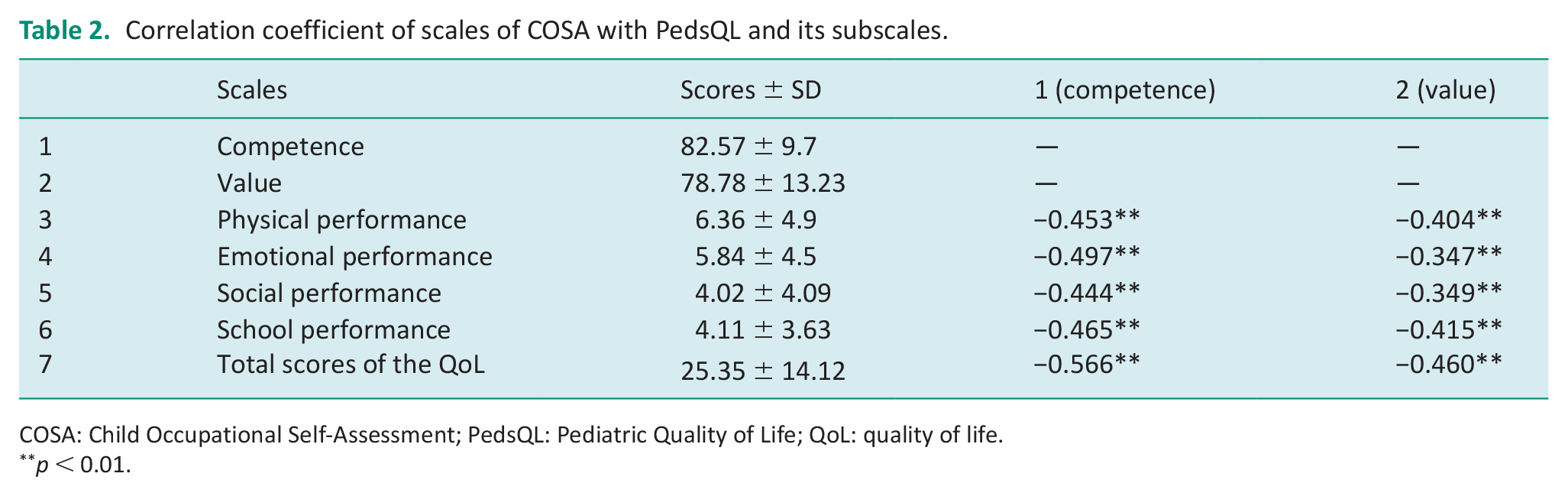
COSA: Child Occupational Self-Assessment; PedsQL: Pediatric Quality of Life; QoL: quality of life.
p < 0.01.
The total score of quality of life demonstrated an intermediate correlation with the value subscale (r = 0.46, p < 0.01). The correlation coefficient of the school performance area of the PedsQL questionnaire in the value subscale represented the second highly correlated area which also showed an intermediate correlation (r = 0.41, p < 0.01). The correlation coefficient of the emotional performance area (r = 0.34, p < 0.01) showed the lowest correlation coefficient in the value subscale (Table 2).
Discussion
This study aimed to examine the concurrent validity of the COSA by using the PedsQL questionnaire in children with ADHD. Concurrent validity studies provide the opportunity to compare the instruments in the same time framework (Hart, 2002) and to introduce a new measurement. These studies indicate the effectiveness or usefulness of measurement in predicting the desired trait (Polit and Beck, 2004). The COSA is an occupation-based and client-centered measurement that is compatible with the core concepts of occupational therapy and it can be used in various intervention contexts (Keller et al., 2005). Successful performance in activities of daily living provides a ground giving rise to people to be ready for social and occupational roles (Desai, 2008; Laverdure and Beisbier, 2021). By recognizing problems in different domains of daily activities in children with ADHD, therapists could plan the therapeutic process more accurately (Federico, 2002). Children with ADHD usually have reduced self-worthiness compared to children with typical development (Desai, 2008).
The results indicated that the competence subscale of the COSA was significantly correlated with all dimensions of quality of life in children with ADHD at the level of 1% which means that the chances are not greater than 1 out of 100 that the population correlation is zero (Gutierrez, 2007). The large correlation of the competence subscale of the COSA with the total score of the PedsQL is consistent with the purpose of the COSA developers (Keller and Kielhofner, 2005). That is, the purpose of COSA developers was to assess a variety of daily living occupations; likewise, the total score of the PedsQL covers different activities. However, the correlation coefficient of 0.56 indicates that COSA and PedsQL are not completely assessing the same construct when they are used to assess the daily activities of children with ADHD. When testing the concurrent validity of an instrument, a high correlation means that the two instruments are examining the same constructs and that the new instrument may not be required (Romero Ayuso and Kramer, 2009).
Other performance areas of the PedsQL questionnaire had intermediate correlations with the competence subscale of the COSA. The emotional performance area of the PedsQL questionnaire was the second most highly correlated area in the competence subscale whereas the social performance area showed the lowest correlation in the competence subscale. That is, children with ADHD feel more competent in emotional performance areas than social performance areas. This lower feeling of competency in social performance areas may result in experiencing impaired interactions with other people which is among the signs of ADHD (Adler et al., 2012; Barkley, 1997; Comer et al., 2013; Gilliam and Shahar, 2006; Wherry et al., 1993).
The value placed on daily occupations by children with ADHD was correlated with all domains of quality of life. This shows that the quality of life may be the sum of the occupations that people do during the day. The correlation between the value subscale and PedsQL’s performance areas was intermediate which infers that the value subscale of COSA is assessing the correct construct.
There are a few similarities and differences in ranking different performance areas of PedsQL when comparing the correlation coefficients of the value subscale with the competence subscale. Similarly, the total score of quality of life had the highest correlation coefficient with both the value subscale and competence subscale of the COSA. Although school and the physical performance had the highest value for children with ADHD, they felt more competent in emotional and school performance. It is not surprising that school activities are highly valued for children and according to the American Occupational Therapy Association, formal education is an important part of occupational areas for every child. The emotional performance area had the least value for children with ADHD; however, children with ADHD felt more competent in this area. Children with ADHD usually pay more attention to their weaknesses rather than their strengths and they usually ignore their abilities (O’Brien et al., 2009; Uekermann et al., 2010). Feelings of reduced self-worthiness and low confidence in children with ADHD could be important reasons for the mismatch between what children with ADHD feel competent about and what they value.
Limitations
This study was the first study on the concurrent validity of the COSA and there was not enough evidence to compare the results of different studies. It is recommended to investigate the convergent validity of the COSA which may further benefit both researchers and clinicians. Testing of changes over time based on the two measurements can also be another suggestion for future studies. Finally, we would recommend examining the validity and reliability of the COSA in other groups of children with special needs such as children with cerebral palsy.
Conclusion
According to the findings, the COSA is assessing the competence and value of meaningful occupations in children with ADHD accurately and it is correlated with the PedsQL questionnaire. Occupation is important in promoting the health and well-being of occupational therapy clients, and since the COSA is based on occupation, it can help in evaluating clients based on their values. In other words, the COSA can be used when delivering client-centered services is the aim of therapists.
Key points
Concurrent studies would provide both researchers and clinicians with evidence of utilizing a new measurement.
The COSA and the PedsQL are not the same; however, they assess similar constructs.
Depending on different children’s needs, goals of therapy, and assessment settings, a more suitable measurement could be selected.
Footnotes
Correction (November 2023):

Research ethics
The study was approved by the Ethics Committee for Human Experiments, University of Social Welfare and Rehabilitation Sciences (USWRS), Tehran, Iran (IR.USWR.REC.1392.123).
Patient and public involvement data
During the development, progress, and reporting of the submitted research, Patient and Public Involvement in the research was: included in the reporting of the research.
Consent
Written informed consent was taken from parents of children with ADHD before the commencement of the study.
Declaration of conflicting interests
The author(s) declared no potential conflicts of interest with respect to the research, authorship, and/or publication of this article.
Funding
The author(s) received no financial support for the research, authorship, and/or publication of this article.
Contributorship
MS and MAK researched literature and conceived the study. MS and MAK were involved in protocol development, gaining ethical approval, patient recruitment, and data analysis. MAK wrote the first draft of the manuscript. All authors reviewed and edited the manuscript and approved the final version of the manuscript.