




Abstract
Introduction:
While exercise after breast cancer treatment is important, some breast cancer survivors (BCS) find it difficult to maintain motivation for physical activity (PA).
Objectives:
To investigate Danish female BCS’ motivation to play Football Fitness (FF) after the termination of a research project (Football Fitness After Breast Cancer), and whether the participation influenced occupational identity and adaptation.
Methods:
Two qualitative focus group interviews with seven female BCS (53 ± 5 years; Mage ± SD) were performed. The interviews were analyzed to identify the forms of motivation experienced according to Self-Determination Theory using thematic analysis.
Results:
Due to increasing connections and recognition of one another, FF gradually became meaningful and a part of the women’s occupational identity. They experienced increasing cohesion and competence through common experiences, thus increasingly identifying as a unit. The women reported that they gradually adopted healthier lifestyles by participating in FF, which positively impacted other diagnoses for some.
Conclusion:
Recognition of one another impacted intrinsic motivation. Similarly, as the women felt more competent playing FF, it became a part of their occupational identity leading to an effective adaptation. Access to FF as an integral part of rehabilitation for female BCS may be a way to support long-term PA and to adapt a new occupational identity.
Introduction
Cancer is the leading cause of death in developed countries and is the second leading cause of death in developing countries (Jemal et al., 2011). There has been a particular increase in cases caused by an aging population and an adoption of cancer-associated lifestyle choices, including physical inactivity, smoking, and unhealthy diet (Jemal et al., 2011). For women, breast cancer (BC) is the most frequent cancer diagnosis and is the leading cause of cancer-related death among women, accounting for 23% of total cancer cases and 14% of cancer deaths (Jemal et al., 2011). Due to the increasing incidence of cancer worldwide, there is a strong focus on early diagnosis, prevention, and control to limit mortality (World Health Organization, 2013). Furthermore, increased focus on screening and improvements to treatment has improved the survival rate in the United States and other developed countries in recent decades (Siegel et al., 2019).
BC and its treatment, including chemotherapy, radiation therapy, and endocrine therapy (Uth et al., 2020), are associated with a lot of negative side effects, long-term symptoms, and troubling changes in appearance that can hinder health-related quality of life (HRQoL; Ray and Verhoef, 2013). HRQoL refers to the extent to which one’s usual or expected physical, emotional, and social well-being is affected by a medical condition or its treatment (Cella, 1994). The most distressing consequences of BC and its treatment reported by BC survivors includes fatigue, insomnia, pain, arm morbidity, lymphoedema, depression, and fear of recurrence (Ray and Verhoef, 2013). Furthermore, the literature suggests that transitions in life provoked by illness, such as BC, makes it impossible or complicates the meaningful participation in different aspects of life, which can have a negative effect on occupational identity, roles, and perceived meaningfulness in life through occupation (Lee et al., 2017). Moreover, studies suggest that women can have trouble participating in meaningful occupation for up to 5 years after diagnosis, especially regarding participation in meaningful physically strenuous activities. This is referred to as physical activity (PA) throughout this article (Schreuer et al., 2020). To combat the BC survivors’ psychosocial, physical, and functional concerns, PA has proven to be effective regarding diminishing cancer-related fatigue and significantly improves quality of life (QoL) outcomes and the physiological capacity of the women (Hewitt et al., 2005). A growing body of literature therefore supports PA as an effective intervention strategy (Ray and Verhoef, 2013).
Football (soccer) is considered the most popular sport in the world, with more than 13 million girls and women playing organized football (FIFA, ). A recent review by Krustrup et al. (2018) shows that football can be used as prevention for lifestyle diseases for women aged 18–65. The review demonstrated that 1 hour of football training twice a week led to health improvements, such as improvements in maximal oxygen uptake, lower blood pressure and lower fat percentage, as well as improved postural balance, muscle strength, and bone mineralization. Thus, football seems to be an effective tool for preventing and treating lifestyle diseases, including hypertension, osteopenia, prediabetes, and type 2 diabetes (Krustrup et al., 2018). Based on these assumptions, Football Fitness (FF) was developed as a healthy and social training program that combines football with fitness. It was designed specifically to attract adults, as the concept is independent of sports clubs, cheaper and more flexible, and health-oriented without being too competitive (Bennike et al., 2020).
In 2017, Football Fitness After Breast Cancer (FF ABC) was conceptualized as a further development of a long-term and successful collaboration with the FC Prostate project (Uth et al., 2021). The project had multiple aims: (1) to examine women who had been treated for BC and to explore the health benefits of twice-weekly football training for 12 months (Uth et al., 2020), (2) to offer and test a new rehabilitation approach for treated BC patients (Uth et al., 2021), (3) to empower women at a physiological level after their cancer treatment, and (4) to create a sense of community through team training with women in the same situation as oneself (Weber, 2017). The training sessions consisted of 10–15 minutes of warm-up (e.g., running, squats, sit-ups, core-strength, and balance exercises), followed by 15 minutes of football drills (e.g., dribbling, passing, shooting) and 3–4 × 7 minutes of small sided (4–5 players per side) games on a grass pitch with 2-minute breaks in between games (Bloomquist et al., 2021). Some of the women who participated in the FF ABC research project, both control and intervention group, continued to play FF as an independent group after the end of the research project. In this article, FF ABC refers to the women’s participation in the research project conducted by Uth et al. (2020) and FF refers to the women’s independent group.
As Wilson et al. (2006) found that Self-Determination Theory (SDT) is an optimal framework for understanding motivational processes in PA contexts with cancer survivors, this motivational theory was chosen when analyzing the motivational processes experienced by the women participating in FF. SDT is a commonly used theory when explaining motivation toward PA (Deci and Ryan, 1985; Ryan and Deci, 2000, 2002; Wilson et al., 2006). SDT can be described as a multidimensional theory used to explain human motivation and personality, and to explore the motivating factors of the social conditions that promote or inhibit human well-being (i.e., in social sports activities such as football; Ryan and Deci, 2017). SDT distinguishes between intrinsic motivation and extrinsic motivation. Intrinsic motivational behaviors are carried out because of the inherent satisfaction in the activity rather than the results yielded. In contrast, the primary characteristic of extrinsically motivated behavior is to attain an outcome (Vallerand et al., 1993). In SDT there are six mini-theories; of these, we have chosen to focus on Basic Psychological Needs Theory and Organismic Integration Theory (OIT). According to SDT, well-being is rooted in three basic psychological needs: autonomy, competence, and relatedness. When satisfied, they are believed to cause the individual to thrive psychologically and experience well-being (Ryan and Deci, 2000). OIT describes the various forms of external motivation and contextual factors that either promote or inhibit the internalization and integration of regulation of behaviors (Deci and Ryan, 1985). Participation in PA is regulated by four types of motives located along a self-determination continuum, which is anchored at the extremes by controlling and autonomous reasons for participation. The types of controlled motivation are external regulation and introjected regulation. Types of autonomous motivations are identified regulation and integrated regulation (Ryan and Deci, 2000). As SDT focus on how to engage the human self and emphasizes the social context and its ability to facilitate or thwart optimal motivation (Ryan and Deci, 2000), Wilson et al. (2006) found SDT an optimal framework in understanding motivational processes and investigate the distinction between autonomous and controlled forms of motivation in a PA context with cancer survivors. Thus, the theory was used to investigate how and why the female BC survivors participated willingly, voluntarily and with engagement in FF ABC as an independent project (Deci and Ryan, 1985).
To understand the potential changes in the female BC survivors’ occupational identity and/or occupational adaptation, we employed the Model of Human Occupation (MOHO) as a secondary theoretical framework for this study. As for the SDT, MOHO was chosen for its applicability in occupational therapy interventions and programs (Park et al., 2019). For instance, the MOHO has been used in a study including seven participants with mental health issues, which concluded that the MOHO can be an effective model to help conceptualize the complexity of one’s engagement in PA prior to setting goals and plans for activities and interventions (Cole, 2010).
In the MOHO, the interactions and dynamic nature of occupation are described to be influenced by a person’s volition, habituation, performance capacity, and environment. Based on these understandings, the MOHO describes an individual’s occupational adaptation—that is, the construction of a positive occupational identity, which is the sense of who you are and wish to become (Taylor, 2017). Furthermore, the model describes how occupational competence is achieved through the occupational participation that reflects the person’s occupational identity (Taylor, 2017). Occupational therapists seek to engage individuals in occupation-based interventions such as FF ABC, which enables the individuals to participate in their desired occupational lives (Ziviani, 2015).
The aim of this study was to ascertain an understanding of the women’s motivational processes for participating in FF ABC and FF and whether their participation had an impact on their occupational identity and/or occupational adaptation. Such knowledge could be useful for health professionals in general and occupational therapists specifically when designing, creating, and implementing future rehabilitation programs for female BC survivors. Therefore, a qualitative investigation of this group was performed to gain insight into the female BC survivors’ thoughts and experiences.
Methods
Design
A semi-qualitative design was applied obtaining data from a sample of female BC survivors who participated in FF. As a means of facilitating trustworthiness, we applied triangulation (Curtin and Fossey, 2007), where all participants initially completed a short, qualitative questionnaire to reflect upon their motivation for participation in the program. Hereafter we chose to use a phenomenological and hermeneutical perspective inspired from the theory of Paul Ricoeur when conducting qualitative focus group interviews (Tan et al., 2009). The methodology is most appropriate for describing and interpreting the central nature of human experience when investigating how and why the female BC survivors participated willingly, voluntarily, and with engagement in FF as an independent project (Deci and Ryan, 1985).
Participants
All women currently involved in the FF team are from the Capital Region of Copenhagen, Denmark and were invited to participate in the qualitative investigation of recreational FF in BC survivors. Among the 15 team members, 7 women aged 53 ± 5 years (range: 45–59) volunteered to be interviewed. The seven women had an average of 5.5 years since BC diagnosis. Representative sampling was not considered, as the goal of this initial qualitative investigation was to gain a deeper understanding of the women’s motivational processes and impact on their occupational identity and/or occupational adaptation. Due to COVID-19 restrictions, one woman participated via Zoom.
Procedure
The data was collected between October and November 2020 using focus group interviews. Prior to the interview, an interview guide was developed with inspiration from Agee (2009) to secure effective and open-ended questions. The first two authors created the interview guide and questions based on the main elements of the MOHO and the aforementioned motivation sub-theories from SDT. Drafts of the interview guide were sent to the co-authors for feedback, and questions were edited to clarify the connection between the aim of the study and the theoretical framework. The final interview guide consisted of 11 main questions and 8 sub-questions regarding motivation for participation, occupational identity, social relations, and environment (Appendix 1). Such as, “What have influenced your motivation to continue playing FF after the research project ended?” “Do you feel that playing football is important to you? Why or why not?” and “Have your participations in FF changed? If yes, in what way have they changed?”
A pilot interview with a female BC survivor was performed prior to the first focus group interview. The interviewee provided feedback regarding the interviewers’ clarity, techniques, and active listening.
Before performing and participating in the focus group interview, the women were asked to fill out a questionnaire about their motivation to participate in the research project. The triangulation of data sources was used to examine if the answers from the questionnaire and the focus group interviews corresponded, as well as to prime the women on the topic before engaging in the interviews.
The first two authors performed two qualitative focus group interviews lasting 30–45 minutes each (30), with 3 and 4 women in each. The first author acted as the facilitator and the second author as the assistant. The interviews were performed after the women’s football practice, so they had a fresher memory of their experiences and were in a natural setting.
Data analysis
The focus group interviews were audio-taped and filmed, so the authors could tell which women said what. The interviews were transcribed verbatim with InqScribe by the second author and then were checked against the recordings for accuracy by the first author. The two transcriptions were analyzed using the thematic analysis by Braun and Clarke (2006). The method required searching across a data set to find repeated patterns of meaning and followed the six phases detailed in Table A2 to extract relevant data. In the first four phases, the preliminary coding was conducted by the first two authors in an inductive manner to identify themes and codes on a semantic level. In phase five and six, the data were analyzed on a latent level, which involved interpretative work to identify the underlying ideas and assumptions through the theoretical framework (Braun and Clarke, 2006).
Results
To ascertain an understanding of the women’s motivational processes for participating in FF ABC and FF and whether the participation had an impact on their occupational identity and/or occupational adaptation, Table A3 shows a matrix of our interpretation and categorization of data into 5 candidate themes and 11 sub-themes. The results are presented with quotes that are formulated to maintain the meaning of the statement, so that repetitions, connectives, and the construction of the sentences have been edited to limit superfluous information. The participants will be referred to as “the women.”
Football Fitness
The women have all partaken in other forms of sport on and off during their life, though only two have played team sports before participating in FF ABC. Most have periodically had gym memberships both before and after the diagnosis and treatment of cancer. None of them had played football before participating in the FF ABC project.
Too tired to engage
All of them shared the feeling of daily exhaustion to such a degree that it had an impact on activities in their everyday lives. They expressed that the afternoons are a particularly difficult time, where doing anything besides taking a break on the couch is too demanding. Even though it has been years since they finished their treatment for BC, they still experience fatigue and a lack of understanding from close family and friends on how it impacts their energy levels.
I was at a place where I would have said yes to almost anything [i.e., rehabilitation programs] (Infor5)
The women stressed that their reasons for enrolling in FF ABC and participating in FF were the weakening of their physical strength and how they wanted to improve, as well as the positive impact of PA that they previously had experienced on their mental state and energy levels.
The desire for action
Regardless of the women’s belief in the benefits of PA, they all described their troubles staying motivated to exercise on their own, and how participating in different research projects had been their way to maintain an active life. When those projects ended, they lacked motivation to partake in regular PA.
I simply couldn’t motivate myself to workout in any way (Infor2)
Furthermore, because FF ABC was aimed specifically at women who had survived BC, it helped facilitate a feeling of security and reassurance among the women; they had all been through a similar course of illness, dealt with the need to explain how they felt when down and suffered the nervousness of awaiting test results. They stressed how this sense of security also functioned as a factor in continuing their engagement in FF after the duration of the research project.
It does something good for the body
When asked about what impact participating in FF ABC and FF has had on a physical and mental level, the women described that they felt they gained a healthier lifestyle, better general fitness, and experienced weight loss. Some of them explained how football in combination with the fitness exercises had positively improved some of the impacts of their other diagnoses, including osteoporosis and disc herniation.
It’s amazing when all the small muscles are trained, I can feel my body and that I have the strength to do different things (Infor6)
Others also described how participating in FF ABC and FF gave them a boost of energy, and the fatigue they all experience ‘disappears when you come down to the field and you start practice’ (Infor7). When asked about what causes the tiredness to disappear, most expressed that it was a combination of having a reason to get out the door, knowing someone was waiting for you and expecting you to partake, and being active on the field. In addition to these social and physical benefits, being part of the group proved to be emotionally motivating for the women. More specifically, the women indicated that it had a direct impact on their mental health, particularly their level of happiness: After practice, you walk out feeling happier (Infor7) Sometimes I was so tired and almost couldn’t go to football. But after practice, I was always so happy (Infor2)
Environment
The physical environment
When the women participated in FF ABC, they played on a good grass field. Now, in FF, their training was inhibited due to the lack of regular access to a sufficient football field. They described the one they were currently using as: ‘a lawn on the sideline’ (Infor2) . . . ‘with dog droppings’ (Infor1)
Furthermore, this lack of a consistent facility negatively affected recruitment of new players. They expressed much interest in making their team bigger and having more BC survivors join the team.
The social environment
All the women mentioned the social relationships as the biggest motivator for the continuous participation in FF. Furthermore, they felt that the activity provided a place for them to talk and express their mutual experiences with one another. Furthermore, they valued that there was room to joke about things in a manner that their closest family and friends could not. For instance, they often joked about their hair (or lack thereof). Because they had all gone through the same process, participating in FF was described as a safe place where they could share emotions and thoughts in confidence. Additionally, the women stressed that there was a higher ‘recognition’ for one another than between their closest friends and family.
Even though we did not talk a lot about breast cancer, it helped just hearing that “I know” and getting a real hug (Infor7)
All of them had a hard time explaining how they felt they were attached to one another. Some called each other friends, and some described it as: a network that does not look like any other networks that I have (Infor3)
Independent of each other, participants in both interviews described their group as a “unit.” Moreover, one of them stated how they were all in the “same boat.” The women felt a strong connection to each other and felt obligated to supporting one another to continue the team as an independent football group.
Motivation
Enrolling in the project
Most of the women heard about FF ABC from a municipal health facility for cancer and were recommended to participate by health professionals. Some of the women had previously taken part in cancer research focusing on sports, and the fact that they contributed to a field of science and being part of “something bigger” was stressed to be very meaningful. This also became a motivation for participation in FF ABC. Furthermore, they stated that being part of a unit also had an important factor for enrolling.
I did not want to go back to a gym because I had very short hair and did not look like the person I was before. So, for me it was about safety, where everyone had the same background (Infor3)
One of the women stated that playing in FF ABC and FF would improve their chances of survival in case of relapse, because they felt healthier and not as susceptible as before, which the others agreed with.
It was more community than it was football
After the end of the research project the women continued to play football as an independent group. When asked what motivated them to the continue playing, one of the primary explanations offered was simply that playing football was “fun.” However, most importantly, they all agreed that it was because of the community that they have created together. Many of them worried that joining a local football club could harm the community.
We are very motivated to continue in the group that we are now . . . because there is room for showing up to practice and having a bad day, but midway through it could change and you go home happier than before (Infor7)
The women felt more motivated to continue exercising after feeling the experienced benefits of football. They expressed a heightened feeling of joy through the sport, their participation and their community: When I go to practice, I cannot imagine anything better to do (Infor2)
Occupational identity
Roles
Between the beginning of the research project and continuing as an independent unit, they experienced a need to change their roles within the team. At first, the women explained that they were all “just players” and “got everything served to them.” The research project provided a field, motivational coaches, and planned the entire practice; all they had to do was “just show up.” Now when playing as an independent team, they stressed the importance of helping each other, and therefore they have taken on new roles to make sure the team survives.
I have often been in social groups where there are multiple people who want to take charge, but no one actually does it. That is not how it is here. Here everybody is willing to take on responsibility and all of us offer our help . . . we make it work as a unit (Infor4)
The women emphasized that now they must help each other and take on different tasks, like who takes the balls to practice or who calls for a water break.
Football as a social talking point
They explained how their participation in FF ABC had drawn admiration and positive comments from their families and friends who thought it was impressive. Moreover, one of the women expressed how she thought that they were “awesome” for playing at their age. When asked if they identified themselves as football players, they all said no. However, they stated that playing FF was a part of their identity, that it was a big part of their leisure activities, and that they “love” playing. Furthermore, some of the women claimed that when telling people about themselves they often mentioned that they play football. One of them even wrote it in her resume under personal information when applying for jobs, and at every interview she had been to, she had been asked about it.
Meaningful activity and prioritizing
During the interview, the women were asked if playing football is a meaningful activity for them, which they all agreed to. All women felt that it is an important part of their lives: We missed it a lot during lockdown because of Covid-19 (Infor5)
Football practice was a priority for all the women. Everybody stressed how Tuesday was important because it was the football evening. There was no room to make social arrangements and rescheduled other things to have Tuesday evening off, even work: My work life is pretty busy, but I’m more than willing to work late on Wednesdays so I can get off work early Tuesday (Infor3)
When asked if they felt like a part of the group and if they could identify themselves with one another, every woman agreed.
Occupational adaptation
The women were surprised by how physically and mentally demanding football was in the beginning, stressing that concentrating on running, passing the ball, and calling another player’s name at the same time was extremely difficult. The women’s perception of the physical demands has changed over the years, from hard and difficult to a feeling of appreciation when being sweaty after a practice, being physically exhausted and being able to use their bodies during tackles: There is not a lot of those when you play badminton (Infor4)
When asked whether they would consider themselves as good football players, there was a choir of “no’s,” yet they all agreed that their football skills and competencies had clearly improved during their participation. This reflects their history with organized sport and PA: for six of the seven women, sport and fitness had played at most a casual role in their adult life prior to being diagnosed with BC and joining the FF ABC. Now, as discussed above, their identity is largely intertwined with their participation in FF. Moreover, they stressed how the skill of playing together as a team has improved massively, and that teamwork is more important than scoring goals. The women felt that playing football gave them a new opportunity and an arena to strive for improvement of skills and competencies: I have had the same job for a long time, and there is not a lot of personal development anymore . . . but playing football has given me new challenges to think about and strive to overcome, like learning to do “the step over” when passing an opponent (Infor6)
Discussion
The aim of this study was to ascertain an understanding of the women’s motivational processes for participating in FF ABC and FF and whether their participation had an impact on their occupational identity and/or occupational adaptation. We applied methodological triangulation initially using a short, qualitative questionnaire and, hereafter, using these results to prime the women on the topic before completing focus group interviews using a phenomenological and hermeneutical perspective. Using TA, we identified five themes: (1) FF, (2) Environment, (3) Motivation, (4) Occupational identity and (5) Occupational adaptation. This study contributes to the existing literature not only by expanding the knowledge about FF ABC and FF, but aids health professionals in general and occupational therapists in particular when designing, creating, and implementing future rehabilitation programs for female BC survivors.
The women described how fatigue and a lack of motivation affected their life. They stressed how much energy practice gave them, and how happy they became during and after. These findings are similar to a study by Hefferon et al. (2013) who stated that lack of motivation and fatigue were barriers to participate in PA, and Midtgaard et al. (2012) who found a substantial reduction in fatigue being a notable reward of PA participation for female BC survivors. Moreover, the women stressed the importance of the prospect of gaining new insight into and knowledge about their health as a motivating factor. This finding is similar to Oliffe et al. (2010) who explains how knowledge-building helps to downplay cancer as an illness, casting it as a condition that can be objectified and managed, and two studies on prostate cancer patients (Bruun et al., 2014; Wenger and Oliffe, 2014), demonstrating how knowledge-building (understanding the disease and its consequences) was a way of taking responsibility for one’s health.
The women stressed the importance of playing FF ABC and FF with other women who have been in the same situation. We discovered that they met each other with an understanding and recognition that led to the development of strong social bonds, describing both of these as a motivational factor. Previous research by Emslie et al. (2007) supports this, even quoting BC survivors using the same metaphor as the women in our study: “being in the same boat.” Not feeling self-conscious in front of others and not having to explain yourself was important (Emslie et al., 2007), which also corresponds with statements from our study. Ryan and Deci (2020) stated that people generally are inherently prone to psychological growth and integration, and thus toward learning, mastery, and connection with others. However, this does not happen automatically and therefore the identified feeling of community and relatedness among the women can be seen as a supportive condition to explain their continued participation in FF. Another study by Wurz et al. (2015) and Bruun et al. (2014), found that the support and help with which the cancer patients provided each other when participating in PA was facilitating and team spirit was crucial for their motivation and adherence to the training. The same feeling of obligation and relatedness was found among the women in our study.
When FF ABC project period ended, the women in our study found great pleasure in playing FF, which led to their decision to create their own FF team and continue practice. In this decision, all women had to actively consider whether they wanted to continue, a process that can lead to a strengthened feeling of autonomy. This finding connects with Ryan and Deci’s (2000) theory on basic psychological needs, which states that the experience of autonomy facilitates the internalization process, as well as being a critical element for the integration of a behavioral regulation. As an example of this Elbe et al. (2016) described how football participants had more influence on the challenge they chose than did Zumba participants, the latter being an activity more strongly determined by the pace the instructor sets. Additionally, Nielsen et al. (2014) showed that playing football left participants feeling more competent in the activity due to visible improvement in abilities, while Wikman et al. (2020) described how football to a great extent satisfies the basic psychological needs, including the social element (relatedness). These studies suggest that football satisfies the basic psychological need for autonomy to a greater extent than a fitness activity and individual sports. The women all agreed that their football skills and competencies had improved during their participation. This feeling was created with the changes they could see on the field and through positive reinforcement from the community within the FF team, which is supported by Ryan and Deci (2000). who stated that perceived competence in an activity is created when a relevant social group values efficacy in the activity. In relation to our findings, this suggests that the women experienced intrinsic motivation and well-being while playing football, because all three basic psychological needs—competence, relatedness, and autonomy—were fulfilled, and enjoyment and happiness were expressed.
Based on the SDT, our data suggests that the women have experienced a change in their motivation during their participation in FF. Their enrolment in the project was facilitated by recommendations from health professionals, which can be described as generating extrinsic motivation with external regulation. This is reflected in a similar study from FC Prostate (Bruun et al., 2014), wherein the researchers highlight encouragement from professionals as a strong predictor for PA in prostate cancer survivors. After continuing as an independent project, the women experienced extrinsic motivation, but gradually with identified regulation and integrated regulation. Occasionally they experienced intrinsic motivation and intrinsic regulation during and after practice, where the perceived locus of causality was internal, which is evidenced through their experiences of enjoyment and satisfaction during play (Ryan and Deci, 2000). Through statements expressing experiences of enjoyment when playing FF, we suggest that the women went from experiencing controlled motivation to somewhat autonomous motivation. This is important since autonomous motivation yields more effective performance and greater wellness (Ryan and Deci, 2000). Sometimes autonomous motivation relates to feeling intrinsically motivated which can be described as an inherent feeling of interest and satisfaction inherent in engaging in an activity (Ryan and Deci, 2000). Autonomous motivation and experiencing intrinsic motivation when performing an activity such as FF will support a person’s volition, habituation, and performance capacity and over time through occupational adaptation potentially create a positive occupational identity (Taylor, 2017). Studies by Robertson et al. (2018) and Fong et al. (2020) detail how individuals who find PA enjoyable have a greater likelihood of experiencing intrinsic motivation and work out more often than the individuals who worked out for reasons like “the way they looked” or “pressure from others.” Therefore, our results based on the women’s motivational processes going from extrinsic to occasionally intrinsic suggest that the women will continue their participation in FF due to motivational factors and the social conditions within FF.
The women stated that they experienced a change of their roles from the transition of the research project to continuing as an independent group. Taking on a new role is a process over time; the women describe how from time to time the responsibilities change, as does the need for everyone to take part in structuring the practice. Kielhofner et al. (1999) stated that the internalization of any role is a process in which the person negotiates over time with others in the social group how the individual will fill the role. This relates with our findings on the transition process the women describe from a research project to an independent team.
All women agreed that playing FF changed their perception of being physically active from being mentally and physically demanding to a feeling of appreciation. Gradually FF, therefore, became an important part of their occupational identity and changed how they identified with one another. From our analysis, it was clear that it had become an internalized role for them. Furthermore, they described how they prioritized FF, stating that it made them happy during and after they had been exercising. This finding is in accordance with a previous study by Castagna et al. (2020), which explains how team sports are enjoyable, socially rewarding, and may be considered a resource for people to improve QoL and independence. The women stressed that the social component embodied in FF as a team sport was an essential part of their perception of exercise as a meaningful activity.
The women appreciated the support and praise of friends and family about playing FF. Bruun et al. (2014) highlighted a similar level of admiration and support from relatives of the FC Prostate men, and a study by Phelan and Kinsella (2009) explained how a positive occupational identity was fostered when individuals perceive approval from people in their social circles and from society in general. In an earlier study by Unruh et al. (2000), active engagement in a meaningful occupation was found to help women with BC to counterbalance the negative psychological effects of the disease; to engage in the familiar occupation restores the women’s perceptions of being normal and healthy and provided continuity in occupational routine. Another study by Unruh and Elvin (2004) explained how active engagement in a meaningful occupation was also found to help female BC survivors. The dragon boat race was new to them, and they found the sport as a way to challenge cancer and embrace life. Support and regaining control had an important role in the women’s motivation for participating. These finding supports our claim that the women have obtained a positive occupational identity through participation in FF. The women were attracted to an occupation because it was new to them and because it included women in a similar situation. The women in our study and those from Unruh et al. (2000) used engagement in occupation to reconstruct the meaning of their experience with BC. Thus, we posit that participation in FF has created an arena in which the women could construct a positive occupational identity, achieve occupational competence and therefore experience occupational adaptation over time.
Methodological considerations
We wanted to ascertain an understanding of the women’s motivational processes for participating in FF ABC and FF and whether the participation had an impact on their occupational identity and/or occupational adaptation. In order to ensure reliability and transparency in the project, the research group has strictly documented the work process along the way. The project’s analysis method, Braun and Clarke’s thematic analysis, dovetails well with both the project’s objectives and research design. There is therefore a strong connection between the aim of the project, choice of methods, analysis, and results—a connection which served as a methodological advantage. The benefits of this method are its flexibility and its accessibility to researchers with little experience of qualitative research. However, the thematic analysis has also been criticized for being merely a descriptive method, useful for summarizing only surface meaning, and of use just in research focused on participants’ experiences and subjective meanings (Clarke and Braun, 2018). We have flexibly used thematic analysis within our different theoretical frameworks as intended, but our analytical approach is a product of our choices made and, therefore, this process might be biased due to our interpretation of data and our positive attitudes toward the use of football as an intervention for female BC survivors.
All participants completed a short, qualitative questionnaire to reflect upon their motivation for participation in the program. This was done prior to the interview itself, so as to limit the extent to which other participants’ opinions and experiences could influence how each individual perceived their own motivation. In a cross-examination of the two types of data (questionnaire and interview), we confirm the findings. This form of cross-examination through triangulation strengthens the credibility of the project’s conclusions.
Prior to the data collection, the project group considered various types of interview format. Initially, the research group preferred to do individual interviews to gain deeper insight into the individual informant’s motivational processes, activity identity and activity adaptation. In the end, however, the group opted to proceed with focus group interviews. This decision was based on Guest et al.’s (2017) analysis of which interview type—individual or focus group—generated the most data, as well as what kind of data—“sensitive themes” or “items generating in brainstorms”—was generated as a result of the selected interview type. The study group concluded that approximately the same amount of “items” were generated during the brainstorm phase in both types of interviews, and that focus group interviews led to greater sharing of “sensitive themes” (Guest et al., 2017). The latter was the research group’s primary rationale for opting for focus group interviews, as we wanted to create a safe space where informants felt comfortable sharing personal information, deepening the project’s level of insight, and thereby strengthening its empirical contribution to the literature.
One of the strengths of using focus group interviews is the flexibility of the method, as it can be used both to understand individual participants’ thoughts and ideas, as well as to form and examine collective opinions amongst a group. Contrary to an individual semi-structured interview, the social interaction between participants can produce shared knowledge about complex topics. This stems largely from the interpersonal dialog and subsequent commentary on one another’s statements and opinions. However, as a methodological concern, a focus group interview must account for any dominant participants who may have a disproportionate influence on the direction, flow, and general mood of the discussion. This places additional demands on the interviewer, who might not be able to ensure that all participants contribute on a relatively equal playing field and that a good group dynamic is created (Guest et al., 2017).
Conclusion
To our knowledge, this is the first qualitative study to investigate BC patients’ experiences with participation in recreational football as rehabilitation. Conceptualized within the framework of the MOHO and SDT, this study examined female breast cancer survivor’s motivational processes for participating in FF ABC and FF and whether their participation had an impact on their occupational identity and/or occupational adaptation.
Our findings indicate that the female breast cancer survivors consider football as a meaningful activity because of the importance for their own health, the strong connection to each other and the feeling of relatedness within the team, the latter being one of the primary reasons behind their decision to continue playing FF even after the project ended. The findings indicate that the women found that football gradually became a part of their occupational identity, and through playing football they became more competent in performing the activity. The integration of team sport (i.e., football) into the field of breast cancer rehabilitation may be a way to promote PA, as it allows former breast cancer patients to create a safe space to connect with women with similar life experiences as themselves. Team sports hold the promise of supporting the internalization of motivation, both intrinsic and extrinsic, and can lead to continued participation in PA for female breast cancer survivors.
Footnotes
Appendix 1
Coding framework: A deeper understanding of motivation, occupational identity, and occupational adaptation in the women from FF ABC.
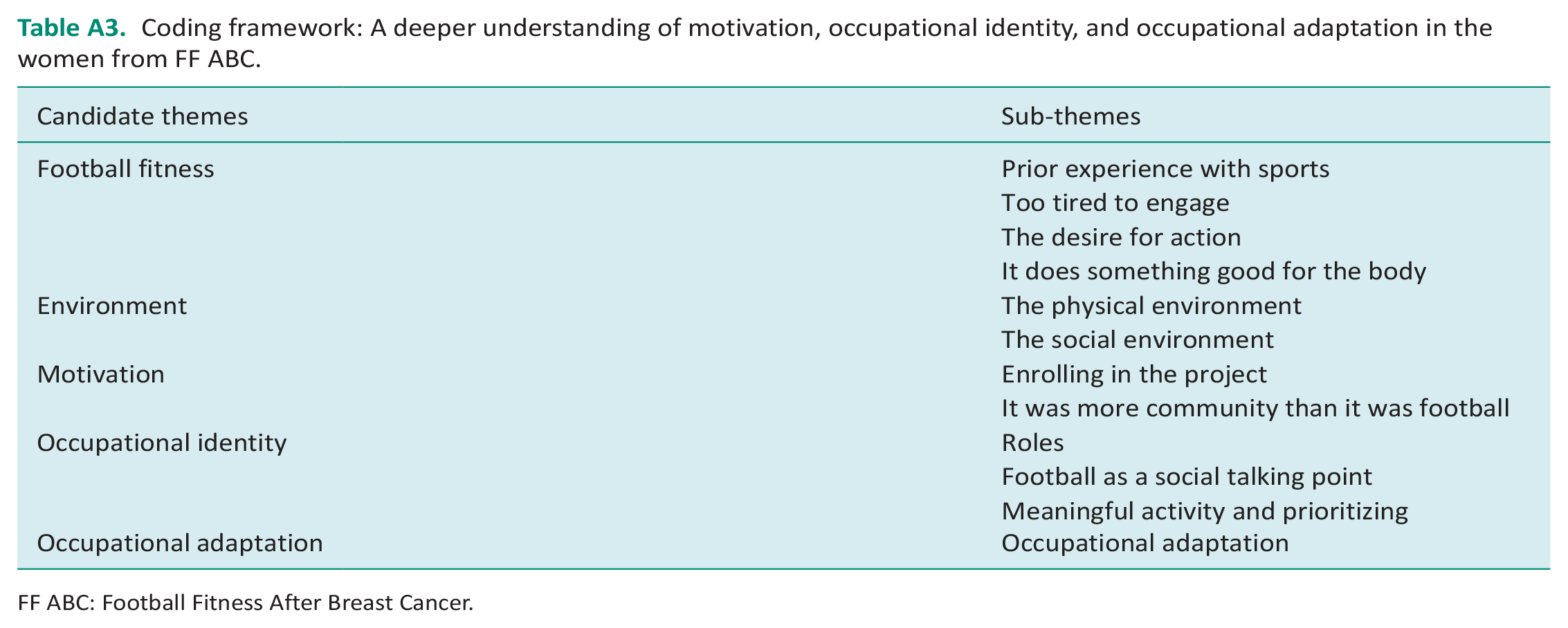
| Candidate themes | Sub-themes |
|---|---|
| Football fitness | Prior experience with sports |
| Too tired to engage | |
| The desire for action | |
| It does something good for the body | |
| Environment | The physical environment |
| The social environment | |
| Motivation | Enrolling in the project |
| It was more community than it was football | |
| Occupational identity | Roles |
| Football as a social talking point | |
| Meaningful activity and prioritizing | |
| Occupational adaptation | Occupational adaptation |
FF ABC: Football Fitness After Breast Cancer.
Acknowledgements
The authors would like to thank the players in the Football Fitness ABC team for their committed participation.
Research ethics
The Football Fitness After Breast Cancer study was approved by the ethics committee of the Capital Region of Copenhagen, Denmark, in 2016 (Reg. No. H-16029533).
Consent
Consent was obtained for participation in the study and publication of the results. All participants provided a signed consent form.
Patient and public involvement data
During the development, progress, and reporting of the submitted research, Patient and Public Involvement in the research was not included at any stage of the research.
Declaration of conflicting interests
The author(s) declared no potential conflicts of interest with respect to the research, authorship, and/or publication of this article.
Funding
The author(s) declared no financial support for the research, authorship, and/or publication of this article.
Contributorship
SDT and FASG researched literature, conceived the study, and wrote the manuscript. JU was involved in gaining ethical approval. JU, AEL, PK, and EEM provided guidance throughout the process. All authors reviewed and edited the manuscript and approved the final version of the manuscript.
