



Abstract
Introduction:
Several United Kingdom Higher Education Institutions are seeking accreditation of new, doctoral entry routes to occupational therapy. This research explored stakeholder perspectives regarding the implications of introducing this additional pre-registration pathway.
Method:
A mixed-method design gathered data via four virtual events (n = 42). Descriptive statistics summarise the levels of agreement with prepared belief statements. Qualitative data from online functions were subject to reflexive thematic analysis.
Findings:
Participants agreed that introducing pre-registration doctorates was beneficial (68%) and an exciting opportunity with the potential to expedite evidence-base expansion (68%). Recognising the challenges, eight emergent themes coalesced into a statement guiding future work: ‘It will take an ongoing commitment from all of us to influence, shape and take positive actions to make structural changes to enhance equity and justice into and within the profession encompassing the themes of value, visibility, viability, expectations, perceptions, equity and diversity, accessibility and clarity of vision. Continued dialogue and communication, with compassionate listening, is required for this’.
Conclusion:
An additional pre-registration doctoral route into United Kingdom occupational therapy is broadly welcomed, acknowledging the need for ongoing dialogue. The emergent themes provide a framework for proceeding with care and intention as discussions move towards implementation and may assist other nations having similar debates.
Introduction
The Royal College of Occupational Therapists (RCOT) is the professional body for occupational therapy in the United Kingdom (UK). Amongst other responsibilities and services, it accredits pre-registration routes into the profession in the UK. Since 2021, RCOT has been approached by several Higher Education Institutions (HEIs) seeking guidance regarding their ambitions to introduce a new pre-registration doctoral pathway.
The introduction of pre-registration occupational therapy doctoral routes would complement and augment existing BSc (Hons), pre-registration master’s level and apprenticeship pathways, and mark a significant development in the evolution of occupational therapy education in the UK. Initial discussions highlighted the perceived benefits of this new route and the complexity of the intended and unintended consequences, including the impact on the other entry routes and the potential for social exclusion and injustice.
Literature review
In the UK, experience has shown that professional disquiet exists when considering the introduction of new routes into the occupational therapy profession. Practitioners with diplomas feared job reprofiling with the introduction of the degree route (Gape and Hewin, 1995). There was anecdotal evidence to suggest their concerns were valid as some practitioners felt they were subsequently overlooked for promotions that favoured those who entered via the degree route.
Caution was recommended regarding the development of pre-registration master’s level routes on the grounds of academic and professional credibility, alongside concerns for the profession’s integrity with people who access services (Waters, 2000). These concerns were based on perceptions of ‘over-academisation’ of the profession, alongside the perceived risk of developing a master’s level workforce that would reject the more practical and creative elements of the profession. By contrast, it has been suggested that pre-registration occupational therapy doctoral routes could bolster the profession’s ability to deliver increased leadership and research capacity (Brown et al., 2016), the latter of which is a key strategic focus within the profession in the UK (RCOT, 2019).
In the global context, the World Federation of Occupational Therapists (WFOT) recognise that education models must shift in response to changing contexts and circumstances, to prepare occupational therapists to be autonomous, empowered practitioners, who can act as leaders (including research leaders) to address the challenges and barriers faced by the populations they serve (WFOT, 2023).
The United States (US) already offers over 80 pre-registration occupational therapy doctorate (OTD) courses (American Occupational Therapy Association (AOTA), 2018). While in the UK, pre-registration doctorates are being considered as additional routes into the profession, in the US there have been discussions about the OTD becoming the only route into the profession. To date, both master’s and doctoral entry routes remain available.
Most respondents to a US-based survey (n = 600) did not approve of moving to the doctorate for entry-level occupational therapy practice (Dickerson and Trujillo, 2009), citing concerns including social exclusion and inequality of opportunity. 1 Indeed, data from the annual reporting of occupational therapy students (AOTA, 2018: 10) show, for example, that there are even more white students on doctoral-level courses in the US (85%) than those studying on the master’s route, where the percentage of white students is already very high (80%). This highlights the importance of proactively reflecting on and addressing social justice issues when considering the introduction of an additional level of entry into the profession in the UK.
The health and care policy landscape of the UK has long recognised the need to transform service delivery to better meet the needs of the diverse population (Department of Health and Social Care (DHSC), 2019, 2022). A significant element of identifying new ways of working and delivering services centres on developing the skills, capabilities and diversity of the workforce, including building research capability and capacity to complement practice expertise (DHSC, 2019, 2022; Jones and Keenan, 2021; Manley et al., 2022; National Health Service England, 2022). Recent years have seen the introduction of a range of frameworks and principles defining and describing the different levels of practice through which the careers of health and care practitioners outside medicine, including occupational therapists, might pass as they unfold. Providing a basis for consistency and good governance, they include those focused on enhanced, advanced and consultant levels of practice, each linked to incremental engagement with four pillars of a practice: professional practice, leadership, facilitation of learning, and evidence, research and development (see, e.g. Health Education England (HEE), 2017, 2022; Health Education and Improvement Wales (HEIW), 2023; Leary, 2022).
There is also growing recognition of the valuable role of non-medical clinical and practitioner academics in UK service delivery. These are research-active practitioners working concurrently in practice and academic contexts (Carrick-Sen et al., 2019). Clinical and practitioner academic roles can exist across all levels of practice, from new entrants to the professions to consultant practitioners (Cooper et al., 2019), although they are more commonly associated with advanced and consultant levels. A systematic review by Newington et al. (2021) highlighted a range of positive impacts, including those for people accessing services (e.g. wider access to evidence-based healthcare and improved patient/carer experiences) and for service delivery and the workforce (e.g. improved care delivery and the ability to translate research into practice and implement evidence). With sufficient opportunity and practice-based experience to develop across all pillars of practice, doctorally qualified entrants to occupational therapy in the UK may be well placed for an accelerated trajectory into advanced and consultant practitioner roles, helping to inform and lead future service development and transformation. For more than 5 years, the Chartered Society of Physiotherapy has welcomed and accredited two pre-registration physiotherapy doctorates in Scotland (Chartered Society of Physiotherapy, 2017). Contexts and circumstances are shifting, and occupational therapy needs to remain competitive, recognised and respected within the new landscape.
There are also practical considerations for the introduction of new routes, including workforce supply and demand and quality assurance. The impetus for pre-registration OTDs in the UK came from a small number of HEIs currently providing other routes into the profession. They have the staff capacity at the appropriate academic level to develop and deliver pre-registration doctoral programmes. These HEIs reported that their initial scoping or market research identified a demand for the route and the workforce it delivers, within the wider system. They reported this appetite was evident within, and potentially beyond, the UK.
Notwithstanding the many transferrable skills developed during doctoral studies, this seems somewhat at odds with recent research identifying that only 11% of advanced practitioners in England were undertaking research within their roles (Fothergill et al., 2022) and that only approximately one-third of respondents to studies undertaken by Comer et al. (2022), and Cordrey et al. (2022) reported that research-related activities are part of their roles. Evidence indicates that despite practitioners’ appetite to engage in research, there remain many barriers to doing so (Comer et al., 2022; Cordrey et al., 2022; Fothergill et al., 2022; Newington et al., 2021; Watson et al., in review). The reported appeal to local employers of doctorally qualified occupational therapy entrants may be indicative of progress towards narrowing the gap between policy and practice. Regardless, the demand for, and number of, pre-registration doctoral learners is anticipated to be much smaller in comparison to other UK entry routes.
The RCOT (2019) Learning and Development Standards for Pre-registration Education set the professional body’s expectations for pre-registration education, and the associated accreditation processes supporting the implementation of the Standards. They are an integral part of maintaining the quality and integrity of pre-registration learning and of the profession itself within the UK. Should pre-registration doctoral routes become a reality, the Standards will need to be revised (as was the case when pre-registration master’s and degree-level apprenticeship routes were introduced), to ensure their ongoing applicability and to address any new challenges or concerns associated with the new pathway.
The introduction of pre-registration doctoral-level routes is a complex issue with wide-ranging implications for the profession, in whichever country might be considering it. Appreciating these complexities, RCOT commissioned research to scope multiple stakeholder perspectives and identify the implications of introducing this new, additional pathway into the profession in the UK.
Method
Careful consideration was given to the design of the research, which was crafted deliberately to support people to engage in deep learning, to critically consider the multiple and complex factors within this topic and to create spaces for holding and respecting different opinions. Situated within a participatory and reflexive paradigm, the iterative design drew upon the principles of action research (Reason and Bradbury, 2001: 1) and appreciative inquiry (Whitney and Trosten-Bloom, 2010). The phased approach initially focused on learning from subject matter experts and then used these insights to inform a series of three virtual community discussion events. The outcomes from these events were subsequently shared and refined at a final consensus-building virtual event. All the events were held between December 2021 and March 2022.
Subject matter expert opinion – Informal conversations
In preparation for the research, subject matter experts were approached with a request for informal conversations. They included a lay representative, two doctoral programme leads – one from physiotherapy in Scotland and one from occupational therapy in the US – and a former senior leader for a professional body with the experience of accreditation of doctoral programmes. The lay representative was renumerated for their event contribution, which involved preparing a short film played at the discussion events.
Learning from the conversations with the subject matter experts informed the design of parts of the community discussion events, including some of the pre-prepared belief statements which participants were asked to rate in terms of their level of agreement.
Community discussion and consensus-building events
Recruitment for the virtual community discussion events was open to anyone within and beyond the UK profession with an interest in the topic. The events were advertised through all RCOT channels (print, website, newsletters, committee structures and social media) with a request to share widely. All attendees at the community discussion events were subsequently invited to the consensus-building event.
Interactive technology – including an online survey, chat box function and the Google Jamboard data collection tool – was used to ensure multiple opportunities for sharing individual opinions, anonymously if participants preferred.
Governance and ethics
Relevant governance and permissions were secured through the RCOT ethical approval processes (project ref: PE73-22) for the virtual discussion events and the consensus-building event.
When registering for the events, participants were asked to consent to the use and sharing of anonymised, aggregated data, including for publication; agree to avoid using abbreviations and terms specific to a work setting; offer respectful challenge and contribute to an atmosphere that fosters inclusive and insightful debate; and confirm their understanding that there would be people attending from a variety of settings, with different levels of experience and that all voices and opinions are welcome and equal.
It was also important for the project team to work within a transparent ethical framework to mitigate perceived conflicts of interest. For example, the event facilitator (ST) and sponsors (CH and JW) all worked for or had previously worked for RCOT and within three different HEIs providing pre-registration education. They also recognised the privilege of their positions within the profession, including their dominant white identity.
The ethical framework for the project had three components. As registered occupational therapists themselves, the project team worked within the HCPC (2016) Standards of Conduct, Performance and Ethics and the RCOT (2021) Professional Standards for Occupational Therapy Practice, Conduct and Ethics. Reflecting the public service nature of the work, the project adopted the broader principles of public life, namely selflessness, integrity, objectivity, accountability, openness, honesty and leadership (Committee on Standards for Public Life, 2014).
Data collection methods
Four virtual discussion events, including the consensus-building event, were hosted, and demographic data were collected as part of the registration process for each. To enhance inclusivity, the events were held on different days and at different times, including in the evening.
A social media hashtag was used with careful intention, given the sensitive nature of the topic, to engage in virtual conversations on Facebook and (formerly) Twitter, including as participants shared content of the events from their accounts. The posts were added to the data set for analysis and this intention was also shared on social media. In this context, careful intention means the purpose of the social media engagement was to hear and learn from the responses of other people who were unable to attend the event (and where necessary, ask for clarification or more detail) but not to challenge their responses or engage in conversations that sought to change them.
At the start of each of the four discussion events, participants were asked to complete an online survey containing 20 pre-determined belief statements derived from the literature and the subject matter expert conversations. Participants were asked to rate their level of agreement using a Likert-type scale: strongly agree/agree/neither agree nor disagree/disagree/strongly disagree. The survey was designed to gather participants’ initial opinions on different aspects of the debate, prior to participating in the discussions. The survey was piloted within the project team, with amendments made to the design, but not the content, to enhance user experience.
Qualitative data were gathered throughout the discussion events in the form of word-based data from social media posts and the interactive elements within the discussion events (Jamboard, Chat function, evaluation form).
Data analysis
Quantitative scoring of belief statements and qualitative analysis of word-based data were undertaken by ST.
Analysis of belief statement responses revealed that there were very small numbers selected at the extreme ends of the rating scale. The categories were therefore collapsed to increase the cell sample size (DiStefano et al., 2021). The data for the two positive categories (strongly agree and agree) and the data for the two negative categories (strongly disagree and disagree) were combined to obtain one overall figure for agree, one overall figure for disagree, with separate reporting for the neither agree nor disagree category. All are reported as percentages. The threshold for overall agreement or disagreement was set at 50% across all participants. Failure to reach the threshold indicated a higher level of uncertainty. Descriptive statistics were deemed most appropriate given the small sample size.
The qualitative data analysis followed Braun and Clarke’s reflexive thematic approach (2021) and their six stages of (1) becoming familiarised with the dataset; (2) coding; (3) generating initial themes; (4) developing and reviewing themes; (5) refining, defining and naming themes and (6) writing up.
People who attended one of the three virtual community discussion events were subsequently invited to join the final consensus-building event. At this event, a summary of the quantitative and qualitative analysis was presented. As a form of member checking, participants (n = 14) were asked if the findings reflected their recollection of the discussion they had been involved in. It was agreed they did.
Findings
The overall aim of this study was to scope stakeholder perspectives of pre-registration OTDs and to identify the implications of introducing a pre-registration doctoral entry pathway as an additional route to registration in the UK.
Participant demographics
A range of people participated, including occupational therapists and learners, people who access services, a representative from the UK regulator (the Health and Care Professions Council (HCPC)), service managers and other people interested in the topic.
Table 1 summarises the demographic data of the virtual community discussions and consensus-building event participants (n = 42 unique individuals) across all four events. In all, 41 people chose to complete the demographic data survey. There was a high proportion of HEI-based participants and participants who held doctoral-level qualifications.
Summary of participant demographic data (n = 41 of 42 unique participants) (reported in percentage only due to the small participant sample size; some data sets are incomplete).
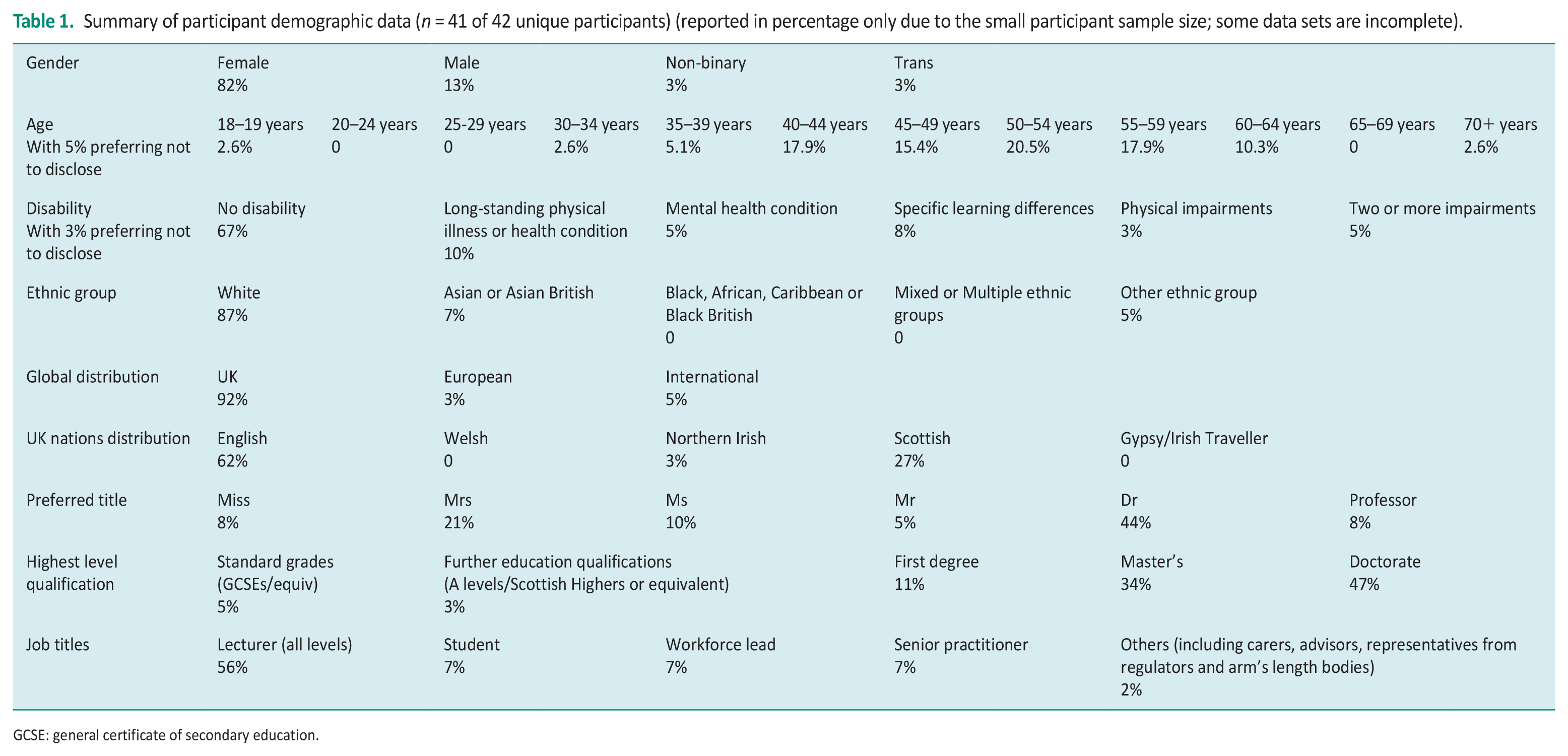
GCSE: general certificate of secondary education.
Beliefs about pre-registration occupational therapy doctoral routes
Table 2 summarises three sets of data:
1) the six statements where over 50% of the 42 participants agreed;
2) the six statements where over 50% of the 42 participants disagreed and
3) the eight statements which failed to reach the threshold, indicating a higher level of uncertainty.
Findings from belief statements rated by participants at the start of the discussion sessions.

OTD: occupational therapy doctorate.
Perceived implications of introducing new pre-registration doctoral-level routes
Eight themes emerged from the analysis of 84 A4 pages of qualitative data (see Table 3) identifying implications that warrant further consideration. The eight themes were as follows: Value, Visibility, Viability, Expectations, Perceptions, Equity and Diversity, Accessibility and Clarity of Vision. The definition for each theme was crafted from the data itself, using participants’ words to stay as close as possible to their original meaning. Of note is that each theme incorporates both opportunities and positive implications, and risks and challenges. Also of note, the definitions incorporate assumptions made by participants, for example, that doctorally qualified graduates are more likely to go into research-only/non-clinical roles.
Themes and their definitions, as agreed with participants.

HEI: Higher Education Institution; OTD: occupational therapy doctorate; RCOT: Royal College of Occupational Therapists; UK: United Kingdom.
Based on the corpus of data collected during the three virtual community discussion events, a statement was proposed as an overarching, synthesised outcome from the research, which was discussed and refined by participants at the final consensus-building event. Participants at this event did not feel in a position to offer a specific direction of travel. That is, they did not reject or endorse the introduction of a pre-registration doctoral-level route into the profession in the UK. Reflecting on the complexity of the decision-making process, participants agreed on the following statement:
It will take an ongoing commitment from all of us to influence, shape and take positive actions to make structural changes to enhance equity and justice into and within the profession encompassing the themes of value, visibility, viability, expectations, perceptions, equity and diversity, accessibility and clarity of vision. Continued dialogue and communication, with compassionate listening, is required for this.
Discussion and implications
The findings from this study provide an initial, in-depth insight into the complexities surrounding the introduction of pre-registration doctoral routes into the profession in the UK. While theoretically the proposition is broadly welcomed, many factors need to be considered in practice. Participants in this study concluded that it will take an ongoing commitment from all stakeholders and that we must proceed with care and intention, with due consideration given to a wide range of factors as part of the decision-making and (possible) implementation processes.
Before discussing the findings in relation to the existing body of knowledge, it is important to clarify the meaning of two key phrases that have emerged from the research and from the process of writing this article, namely ‘compassionate listening’ and ‘care and intention’.
Compassionate listening is a pivotal element of attending – the first of four behaviours required for compassionate leadership; the other three are understanding, empathising and helping (Bailey and West, 2022). Compassionate listening involves attending to and listening with fascination and without judgement, being present and focusing on what others are saying. It involves taking time to hear the challenges and the successes (Bailey and West, 2022). It is the opposite of providing space for people to speak while you plan what you are going to say next.
The word ‘care’ has multiple dictionary definitions but for this discussion, it is used as a noun to mean ‘serious attention applied to avoid damage, risk or error’, as in the phrase ‘handle with care’(Oxford English Dictionary, 2023). Intention is used alongside it, also as a noun to mean ‘an aim or plan’ (Oxford English Dictionary, 2023). Therefore, combined in a phrase, care and intention means a plan that has been formulated through a process of attending to possible damage, risk or error.
In the context of this research, the phrase ‘compassionate listening’ was used by a participant and subsequently included in the statement that was agreed upon by participants at the consensus-building event. By contrast, the phrase ‘care and intention’ has been introduced into this article by the authors as a point of discussion. The findings highlight there are multiple perspectives, potential challenges and benefits to the introduction of this new route; therefore, there is a need to proceed and plan carefully and intentionally when considering the introduction of it into the UK education system and profession.
Subject matter experts and participants advised establishing a clear vision for doctoral-level entry routes and clarifying the end goal. To illustrate, participants highlighted the potential for doctoral-level entrants into the profession to work in different roles and sectors, including practice-based research roles, and to support and expedite the development of the evidence base, a point previously raised in the literature (Brown et al., 2016). Doctoral-level entrants may wish to consider a research career within academia from the start of their careers, working in collaboration with practitioners. Entrepreneurial doctoral graduates may have the opportunity to develop partnerships with industry to provide research expertise for product design. These opportunities would increase the visibility of the profession within different sectors and roles, and potentially attract a more diverse range of people, with different and complementary skill sets, into the profession.
Running in parallel with the overarching ambitions of the profession and professional body, consideration must be given to the readiness of the health and care system in the UK to accommodate doctoral-level entrants. Doctoral studies provide graduates with many transferable skills across all four pillars of practice, including, for example, critical thinking, analytical skills, time management, negotiating skills, educational skills and advanced understanding of a particular area of practice (Watson et al., in review). There is potential for doctoral entrants to have an accelerated trajectory to leadership and service improvement roles, for example. The extent to which it can safely be assumed that they will have the opportunity to embark on careers that embrace practice and research remains unclear.
Despite clear policy direction (DHSC, 2019, 2022), the availability of frameworks and guidance specifying expectations across the four pillars at different levels of practice (HEE, 2017, 2022; HEIW, 2023; Leary, 2022), and the repeated spotlighting of the many barriers to research-engagement (e.g. lack of dedicated time, limited access to funding and mentorship, lack of managerial support, inadequate organisational infrastructure supporting cultures of research engagement, the availability of backfill, among others), these barriers persist to a large extent (Watson et al., in review). The broader system may not yet be ready to support an occupational therapy end goal centred on fostering greater levels of research in practice, should such a goal emerge. However, the lead-in time associated with agreeing to introduce doctoral-level pathways to the profession, accrediting those programmes and graduating the first cohort/s may see a positive shift in this regard.
Regardless of the roles doctoral-level entrants might take up and progress to, there is a need for a strong rationale and vision to capitalise on the benefits they could offer the system, in part by supporting creative thinking in workforce development and planning. Health and care employers could continue to be encouraged to do more to develop new roles that offer research elements alongside clinical work, to support and enhance service development, and as part of supporting the growth and development of diverse career opportunities to aid recruitment and retention.
The viability of doctoral entry routes requires further consideration, including on a practical level in relation to placement capacity. Additional pre-registration student numbers will increase the demand on finite and already stretched placement capacity (St John-Matthews et al., 2021). However, recent advances in expanding practice-based learning opportunities across the four pillars of practice, such as the introduction of research and leadership placements (Brown et al., 2023), signal that the profession is already taking action in this area. Developing additional, quality-assured routes into the profession is recognised as essential in responding to the increasing capabilities demanded of the occupational therapy workforce (WFOT, 2023). However, quality education must be accessible to those who want to engage with it, so it is within the implementation of a new offer that the complexity lies.
Participants in this study did not feel the introduction of new, pre-registration doctoral routes would negatively impact those graduating from other routes. They did, however, recognise a need to value all routes into the profession, and indeed the knowledge and skills of all practitioners. Further work is needed to ensure any new routes, and existing routes, are accessible to all, including from a racial equity perspective and for people who need to work part-time while studying. Without care and intention, doctoral entry routes could become elitist and classist pathways for those from economically privileged backgrounds, perpetuating social injustice and continuing to limit access to education and the diversity of the profession. As participants in this study reinforced, it will take an ongoing commitment from all stakeholders to influence, shape and take positive actions to make structural changes to enhance equity and justice including, for example, through the admissions processes, scholarship opportunities, the content and the delivery of programmes.
Limitations
The limitations of this study include the small number of participants (n = 42) with limited demographic variability. Most participants were white (87%), women (82%) and declared no disability (67%) which is in keeping with the demographics of the occupational therapy profession in the UK. Only 7% of participants were pre-registration learners and there was a skew towards other participants working within the Higher Education sector (56%).
There was a need to maintain the focus of discussions on the proposed pre-registration doctoral pathway. It became evident that there were varying levels of understanding about the characteristics of different existing post-registration doctoral pathways (e.g. PhDs, clinical doctorates and educational doctorates) which impacted the flow of debate. Furthermore, discussions revealed a lack of parity of esteem associated with these different pathways.
However, the findings from this study represent the first of its kind exploring the complexities of introducing pre-registration doctoral routes into the profession in the UK. As the research was situated within the UK context, readers from outside the UK will need to consider the findings in relation to their context.
RCOT is committed to supporting ongoing dialogue about this important subject. Further events, specifically aimed at groups who were under-represented in this research, are planned and the conversations continue.
Conclusion
The aim of this study was to scope stakeholder perspectives regarding the introduction of pre-registration OTDs in the UK and to identify the associated implications to be considered. While the new pathway is broadly welcomed in theory, continued dialogue and communication, with compassionate listening, is required to support a positive introduction in practice. The emergent eight themes from this research can be used as a Framework to support any future implementation planning, which needs to be undertaken with care and intention.
Key findings
An additional pre-registration doctoral route into occupational therapy is broadly welcomed
Introduction of UK pre-registration OTDs must proceed with care and intention
Stakeholder commitment to continued dialogue, including compassionate listening, is required
What the study has added
This research provides in-depth insights and a potential framework for action to address complex issues surrounding the potential introduction of a new, additional pre-registration doctoral route into the UK occupational therapy profession.
Footnotes
Acknowledgements
The authors would like to acknowledge the virtual event participants and those who supported the preparation and organisation of the events.
Research ethics
This study received ethical approval through the Royal College of Occupational Therapists’ approval processes (project ref: PE73-22) in 2022.
Consent
Not applicable.
Patient and public involvement data
During the development, progress and reporting of the submitted research, Patient and Public Involvement in the research was included in the planning and progress of the research.
Declaration of conflicting interests
The author(s) declared the following potential conflicts of interest with respect to the research, authorship and/or publication of this article: Jo Watson was Assistant Director, Education and Research at the Royal College of Occupational Therapists when the study was commissioned. She was the Project Sponsor who initiated and commissioned the research but left the organisation at the end of March 2022. Stephanie Tempest was the Professional Development Manager at the Royal College of Occupational Therapist (2016–2021) and previously worked at one of the Higher Education Institutions exploring the introduction of the pre-registration doctoral programme (2004–2016), before working as the Project Lead in a freelance capacity. Carolyn Hay was the Pre-Registration Education Manager at the Royal College of Occupational Therapists when the study was commissioned. She continues to work for the organisation as the Head of Education.
Funding
The author(s) disclosed receipt of the following financial support for the research, authorship, and/or publication of this article: This study was funded by the Royal College of Occupational Therapists.
Contributorship
JW has initiated and commissioned the study; contributed to the conception and design of the study; reviewed the initial draft of the manuscript; contributed to data interpretation and led subsequent revisions of the manuscript. ST has led the conception and design of the study, including securing governance approvals; acquisition of data, data analysis, interpretation of data; wrote the initial draft of the manuscript and contributed to revisions of the manuscript. CH has contributed to the conception and design of the study; oversaw delivery of the commissioned research in her role as Project Manager; contributed to revisions of the manuscript. All authors reviewed and approved the final version of the manuscript.
