




Abstract
Introduction:
Entrepreneurial orientation is a critical factor in the success of an organization and encourages higher performance. Individual entrepreneurial orientation can be influenced by organizational commitment and perceived organizational support. The study aimed to examine the relationship between occupational therapists’ organizational commitment, perceived organizational support levels, and their individual entrepreneurial orientation.
Method:
Using an online form, a cross-sectional survey study was conducted with 88 occupational therapists aged between 22 and 28. Occupational therapists completed a socio-demographic information form, the Organizational Commitment Scale, the Perceived Organizational Support Scale, and the Individual Entrepreneurial Orientation Scale. Data were analyzed using descriptive statistics and correlation analysis.
Results:
Significant positive correlations were found between occupational therapists’ individual entrepreneurial orientations and organizational commitment (p = 0.015; r = 0.260) and perceived organizational support (p = 0.045; r = 0.214).
Conclusion:
This study indicates that occupational therapists’ individual entrepreneurial orientation increases when their levels of organizational commitment and perceived organizational support increase. Therefore, organizations should strive to maintain high levels of organizational commitment and the support provided by the organization to enhance the entrepreneurial orientation of occupational therapists, which is important for their creativity and innovation.
Keywords
Introduction
Individuals spend a significant majority of their daily lives in the workplace. The support provided by the organization and the individual’s commitment to the organization significantly influence their work capacity and work-life balance (Hu et al., 2022). Organizational commitment is an important concept in the workplace and has been a significant research topic for years (Silva et al., 2023). Although there are many definitions of organizational commitment, most studies have explained organizational commitment in terms of three components as defined in Meyer and Allen’s (1991) model: affective commitment, continuance commitment, and normative commitment . Affective commitment is commitment based on emotional ties the employee develops with the organization, primarily via positive work experiences. Normative commitment refers to commitment based on perceived obligation toward the organization, rooted in the norms of reciprocity. Continuance commitment reflects commitment based on the perceived economic and social costs of leaving the organization. (Meyer et al., 2002). Organizational commitment, which is one of the most essential variables in management and organization in the workplace, is a factor that determines the level of identity unity and the intention to maintain organizational membership for healthcare professionals (Çınar et al., 2022). Healthcare professionals with high organizational commitment desire to continue staying in the organization based on their preferences or interests, and they can identify the organization’s values with their own. This situation plays a significant role in the success of the organization’s success and healthcare professionals’ job satisfaction (Eliyana and Ma’arif, 2019).
The concept of perceived organizational support entered the literature in the 1980s and is a prominent concept in the business sector, similar to organizational commitment. It explains the relationship between employees and the organization (Sarason et al., 1991). Perceived organizational support represents employees’ general beliefs about the extent to which the organization values their contributions and cares about their well-being. In a study by Gaković and Tetrick (2003), it was noted that a high perception of organizational support is beneficial in meeting employees’ socio-emotional needs, and the organization is ready to reward employees when their efforts increase . Perceived organizational support contributes positively to individuals’ performance levels. Employees who feel a significant level of organizational support demonstrate better performance, and perceived organizational support can affect important factors such as job satisfaction, motivation, commitment, and job performance (Ogbonnaya et al., 2018).
Entrepreneurs can be defined as individuals who strive to achieve their goals with characteristics such as the ability to take risks to a certain extent for their entrepreneurial aspirations, being proactive, and being innovative (Hendrikx et al., 2022). Another important aspect that is significant in entrepreneurship is the measurement and determination of entrepreneurial orientation. This allows prospective entrepreneurs to be better recognized, and structured training programs can be developed. Entrepreneurial orientation was initially defined by Miller (1983), further developed by Covin and Slevin (1989), and later expanded by Lumpkin and Dess (1996) (Santos et al., 2020). Entrepreneurial orientation is described as “processes, practices, and decision-making activities that lead to a new venture.” The literature suggests that entrepreneurial orientation can be addressed at the organizational and individual levels (Ferreira et al., 2017). Entrepreneurial orientation is considered a fundamental factor for the success of organizations, especially firms (Cho and Lee, 2018). It has been noted that the entrepreneurial orientation of healthcare professionals has increased in recent years. Many healthcare professionals are interested in establishing businesses or developing innovative ideas in the healthcare sector (Vecchiarini and Mussolino, 2013).
Occupational therapy is an essential profession in the rehabilitation of individuals in activities of daily life, and the demand for occupational therapy services is increasing (Porter and Lexén, 2022). Occupational therapists should learn to think entrepreneurially and develop innovative and creative ways to improve people’s lives (McClure, 2011). The importance of entrepreneurship in the occupational therapy profession has been expressed in previous studies (Bissett et al., 2021). Occupational therapists work in various fields such as pediatrics, adults, hand rehabilitation, and community-based settings (Abaoğlu et al., 2021; Amini et al., 2014). The diversity of these fields affects individuals’ interpersonal relationships and organizational commitment (Seruya and Hinojosa, 2010). It has been stated that organizational commitment among occupational therapists impacts job-related burnout, continuance, exhaustion, lateness, and job performance. A positive and strong relationship exists between organizational support and organizational commitment (Ćulibrk et al., 2018). It has been noted that organizational commitment and perceived organizational support affect an individual’s work capacity and job satisfaction.
When reviewing the literature, it is stated that entrepreneurial orientation positively affects employee performance, and higher levels of organizational commitment can strengthen this relationship (De Clercq et al., 2010; Murphy and Callaway, 2004). However, the impact of organizational commitment and perceived organizational support on entrepreneurial orientation and the relationships among them has not been sufficiently explored (Soomro and Shah, 2019). Additionally, organizational commitment influences various factors for occupational therapists, such as job performance, continuance, and burnout. However, there is a lack of studies specifically examining the relationship between entrepreneurial orientation, organizational commitment, and perceived organizational support among occupational therapists. Therefore, this study aimed to address this gap in the literature by investigating the relationship between occupational therapists’ entrepreneurial orientation, organizational commitment, and perceived organizational support.
Method
This research was conducted as a cross-sectional survey study between January 2023 and May 2023. The study was carried out following the Helsinki Declaration and received ethical approval from the Hacettepe University Non-Interventional Clinical Research Ethics Committee with decision number 2023/01-34. Occupational therapists working in Türkiye were included in the study. The convenience sampling method was used to reach the samples. The inclusion criteria were having more than 1 year of professional experience, currently working in Türkiye, and voluntary participation in the research. Occupational therapists who were not working or on a break from the profession were excluded from the study. The G*Power 3.1.9.7 program was used to determine the sample size and based on the analysis with an effect size of 0.3, α = 0.05, and Power (1–β) = 0.80, a minimum sample size of 82 participants was required. Considering a 30% dropout rate, invitation letters were sent to 106 individuals. Ninety-eight participants volunteered to take part in the study. Ten individuals were excluded from the study as they did not meet the inclusion criteria. The study was conducted with 88 participants, and there were no missing data.
Data collection tools
Demographics: Demographic characteristics including age, gender, marital status, employment status, academic qualification, employed institution, and practice area were recorded.
Organizational Commitment: The Organizational Commitment Questionnaire was initially prepared by Allen and Meyer (1990) in a format consisting of three dimensions with 8 items each, totaling 24 items. Meyer et al. (1993) revised the scale, reducing it to three dimensions with six items each, totaling 18 items. The final version of the scale consists of three dimensions (affective, continuance, and normative) and 18 items. Meyer and Allen’s organizational commitment scale was designed as a 5-point Likert scale (1: strongly disagree, 2: disagree, 3: undecided, 4: agree, and 5: strongly agree). There are four items that are scored in revere in scale. The total score of the scale ranges from 18 to 90. Higher scores indicate a high level of organizational commitment. The Turkish validity and reliability of the scale were conducted by Dağlı et al. (2018), and the Cronbach’s alpha coefficient of the scale is 0.884.
Organizational Support: The Perceived Organizational Support Scale (POS) was used to measure participants’ perceptions of the level of support they receive from the organization. This scale was developed by Eisenberger et al. (1986). It consists of Likert-type items with seven levels (1 = “strongly disagree” to 7 = “strongly agree”). Half of the items are presented as positive statements and the other half as negative statements to control for the tendency to respond positively. The total score ranges from 9 to 63. Higher scores indicate a high level of perceived organizational support. The Turkish validity and reliability of the shortened version of the POS were conducted by Yokuş (2006), with an additional item added to the scale. The Cronbach’s alpha coefficient of the scale is 0.90.
Entrepreneurial Orientation: The Individual Entrepreneurial Orientation Scale (IEOS) was developed by Balton and Lane in 2012. The IEOS consists of three subdimensions: “risk-taking,” “innovativeness,” and “proactiveness.” The scale consists of 10 items, with the risk-taking dimension composed of items 1, 2, and 3; the innovativeness dimension composed of items 4, 5, 6, and 7; and the proactiveness dimension composed of items 8, 9, and 10. The items in the IEOS are rated on a 5-point Likert scale ranging from “Strongly Disagree (1)” to “Strongly Agree (5).” All items are positively worded. The total score ranges from 10 (strongly disagree) to 50 (strongly agree). A high score indicates a high level of entrepreneurial orientation. The Turkish validity and reliability of the scale were conducted by Ercan and Yıldıran (2021), and the Cronbach’s alpha coefficient of the scale is 0.80.
Data analysis
The data analysis was conducted using the IBM SPSS (Statistical Package for the Social Sciences) version 28.0.1.1 Chicago, IL, USA software package. Continuous variables were summarized using mean and standard deviation, while categorical variables were summarized as frequencies and percentages. The normality of the distribution for continuous variables was examined through visual methods (histograms and probability plots) and analytical methods (Kolmogorov–Smirnov/Shapiro–Wilk tests). Since not all variables followed a normal distribution, the relationship between variables was analyzed using the Spearman correlation analysis. The significance levels according to Spearman’s correlation coefficient were determined as r = 0.75–1.00, excellent; r = 0.70–0.75, very strong; r = 0.60–0.70, strong; r = 0.40–0.60, moderate; r = 0.30–0.40, lower moderate; and r = 0.05–0.30, weak or an insignificant relationship (Schober et al., 2018). Statistical significance value was determined as p < 0.05.
Findings
This study included a total of 88 occupational therapists. The average age of the participants was 25.19 ± 2.21. The vast majority of the participants were women (87.5). They mostly worked full-time (79.5) and pediatrics (72.7). Descriptive characteristics of the participants are presented in Table 1.
Demographic characteristics of occupational therapists who participated in the research.

In this study examining occupational therapists’ organizational commitment, perceived organizational support, and individual entrepreneurial orientation, the medians and interquartile ranges (IQR) of therapists’ scores on these scales are presented in Table 2. Occupational therapists’ total scores on organizational commitment, perceived organizational support, and individual entrepreneurial orientations from the scales were moderately high.
Median scores for organizational commitment, perception of organizational support, and individual entrepreneurial orientation reported by occupational therapists.
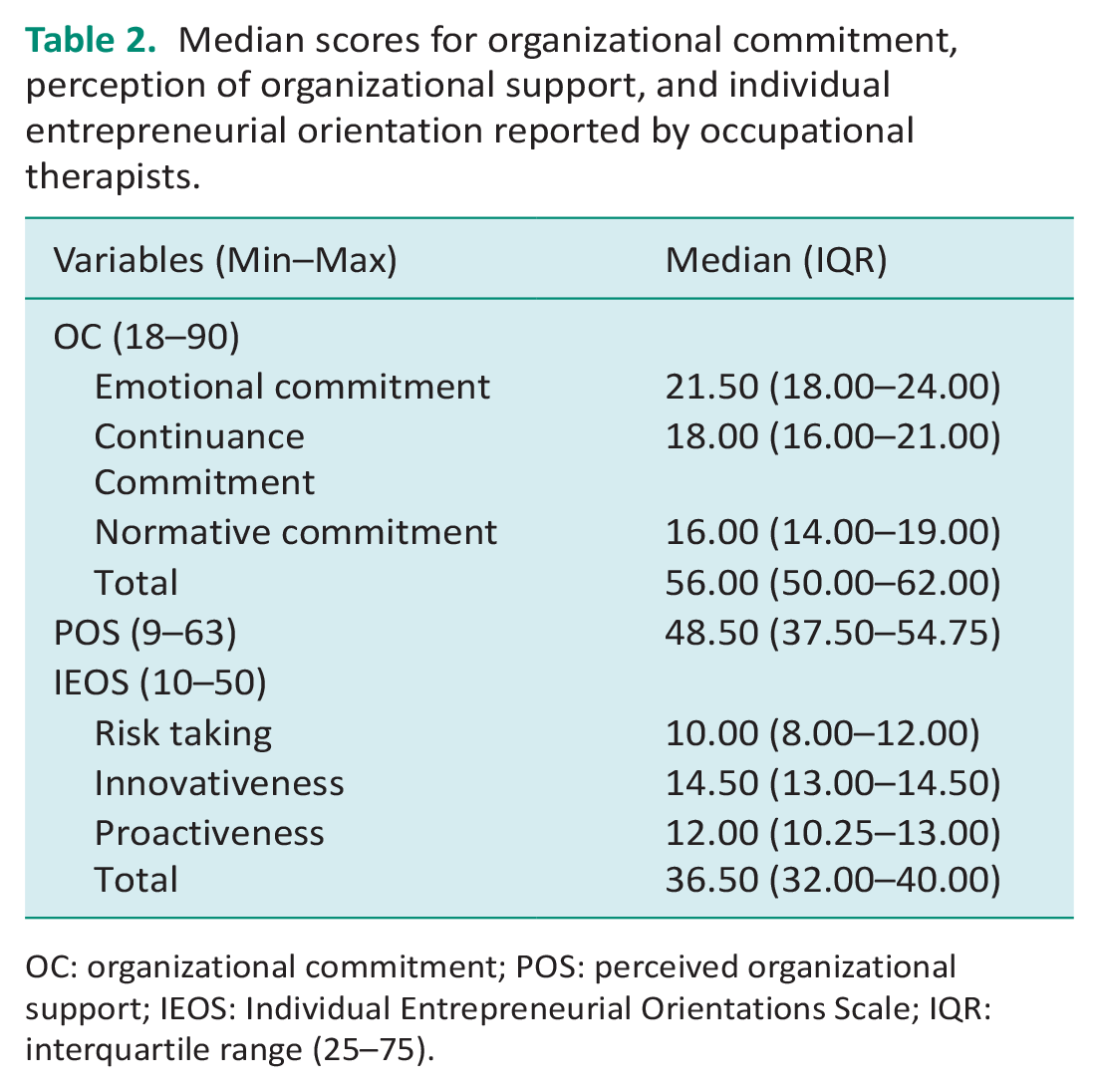
OC: organizational commitment; POS: perceived organizational support; IEOS: Individual Entrepreneurial Orientations Scale; IQR: interquartile range (25–75).
The relationship between organizational commitment, perceived organizational support, and individual entrepreneurial orientation among occupational therapists is presented in Table 3. According to Table 3, there is a positive and statistically significant low-level relationship between the emotional commitment subscale of organizational commitment and the innovativeness and proactiveness subscales, as well as the total score of individual entrepreneurial orientation. There is also a positive and statistically significant low-level relationship between the total score of organizational commitment and the innovativeness subscale of individual entrepreneurial orientation. There is a positive and statistically significant low-level relationship between perceived organizational support and the proactiveness subscale as well as the total score of individual entrepreneurial orientation.
Relationships between occupational therapists’ organizational commitment, perceived organizational support, and individual entrepreneurial orientations.
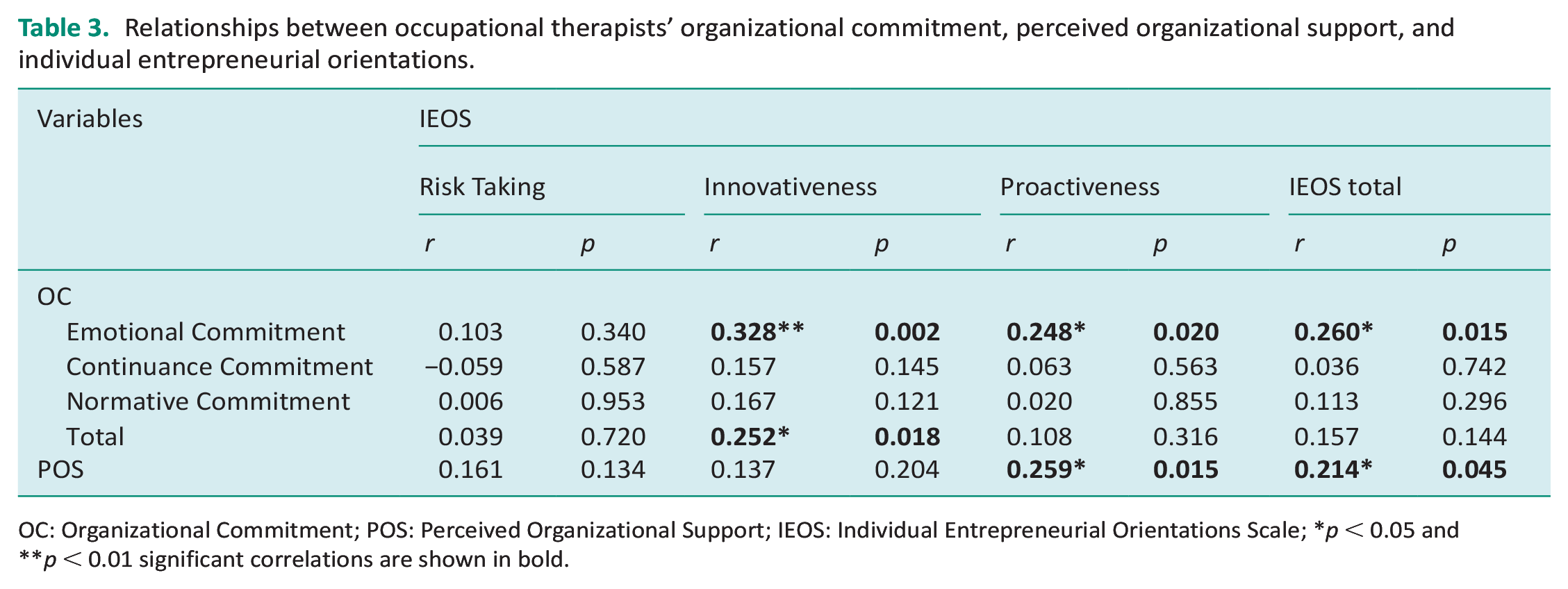
OC: Organizational Commitment; POS: Perceived Organizational Support; IEOS: Individual Entrepreneurial Orientations Scale; *p < 0.05 and **p < 0.01 significant correlations are shown in bold.
Discussion
This study examined the relationship between organizational commitment, perceived organizational support, and individual entrepreneurial orientation among occupational therapists. The study, which is the first in this field, showed a significant relationship between organizational commitment and individual entrepreneurial orientation. This suggests that occupational therapists who demonstrate a higher level of commitment to their organization are more likely to display entrepreneurial tendencies, such as being innovative and proactive in their work. In addition, the study reveals a positive relationship between perceived organizational support and entrepreneurial orientation, especially in terms of the proactivity dimension. This means that when occupational therapists perceive a higher level of support from their organization, they are more inclined to exhibit proactive behaviors and entrepreneurial traits.
Our study found occupational therapists’ organizational commitment levels to be moderately high. Similar to this result, Seruya and Hinoja (2010) examined the organizational commitment of pediatric occupational therapists and stated that the occupational commitment levels of occupational therapists were high. Another result of the study was that the organizational commitment of occupational therapists working in medical care centers was higher than that of those working in schools (Seruya and Hinojosa, 2010). It has been suggested that the main reason for this situation is that occupational therapists working in schools generally work alone in isolated areas. On the other hand, it has been stated that occupational therapists working in medical care centers can interact with and be part of an established group of professionals in their profession (Seruya and Hinojosa, 2010). Research showed that health professionals’ organizational commitment levels are generally high (Anshebo et al., 2021; Rodríguez-Fernández et al., 2021), and this has been associated with better patient care, job engagement, job satisfaction, and dignity at work (Cho et al., 2021). The study found a positive relationship between organizational commitment and individual entrepreneurial orientation. We think that this result of our study is related to the emotional commitment factor, which plays an important role in job satisfaction for occupational therapists (Jung et al., 2017), and this may be effective in their desire to produce new ideas and solutions due to their relatively high emotional commitment. Similarly, a study by Mousa and Puhakka (2019) examining the relationship between leadership and organizational commitment among healthcare professionals found a positive relationship between leadership and organizational commitment . Another study examining organizational commitment and entrepreneurial orientation found a significant positive relationship between the emotional and continuity dimensions of organizational commitment and entrepreneurial orientation (Toghraee, 2016). Similarly, in another study by Zhao et al. (2021), a positive relationship was found between emotional commitment and entrepreneurship. Still, they stated that there was a negative relationship between continuance commitment and entrepreneurship and that continuance commitment was not a very important indicator for entrepreneurship (Zhao et al., 2021).
As another result of this study, occupational therapists’ perceived organizational support levels were found to be moderately high. Similarly, Patrick and Laschinger’s (2006) study with nurses stated that they perceived moderate organizational support. Another study among healthcare professionals, including occupational therapists, reported an average level of perceived organizational support (Cherubin, 2012). In this study, it was determined that there is a positive relationship between perceived organizational support levels and individual entrepreneurial orientations. This result could have an impact on the motivation and job satisfaction of occupational therapists who feel supported in their workplaces. Accordingly, we believe that they will tend to be assertive in innovation and proactivity, such as starting their projects, taking the initiative, producing innovative solutions, and actively participating in professional development opportunities, which are also related to our results. These findings are consistent with a study that examined the connection between proactive personality and perceived organizational support, which found a significant positive relationship (Maan et al., 2020). Vieira et al.’s (2023) study stated that organizational support is an important determinant of entrepreneurial orientation in employees. In another study by Zampetakis et al. (2009), with employees in the public and private sectors, it was stated that perceived organizational support was significantly related to the entrepreneurial orientation of the employees. The researchers suggested that employees who perceive higher levels of organizational support tend to experience higher job satisfaction and exhibit more significant commitment to their organization (Zampetakis et al., 2009).
There are some limitations of this study. First, causal inferences cannot be made because of the cross-sectional nature of the study. Second, our sample group is not homogeneous in terms of age, working time, and unit of work. There is a need for studies that consider these factors and examine them more comprehensively. The data collected in this study were more person-centered, such as the effect of organizational support perceived by the individual on the entrepreneurial orientation of the individual. In future research, it is recommended to conduct studies that will analyze the teams, groups or departments of occupational therapists.
Conclusion
This study is the first to examine the organizational commitment of occupational therapists, their perceived organizational support and their relationship with individual entrepreneurial orientations. The profession of occupational therapy is relatively new in Türkiye. Occupational therapists usually work as a single person in their affiliated institutions. This situation improves the entrepreneurial orientation of occupational therapists. In the present study, entrepreneurial orientation was related to organizational commitment and perceived organizational support, indicating that employers should take into account the organizational commitment of individuals and the amount of support provided by the organization in developing the entrepreneurial orientation of occupational therapists, which is important for their productivity, generating new projects and ideas, becoming leaders and job performance.
Key findings
Individual entrepreneurial orientation of occupational therapists is at medium-high level in Türkiye. Organizations should give importance to organizational commitment in order to develop and contribute to increasing their individual entrepreneurial orientations of occupational therapists in Türkiye. Supporting occupational therapists within the organization can contribute to the increase of their individual entrepreneurial orientation.
What this article adds
This article reveals that occupational therapists’ perceptions of organizational commitment and organizational support, which are very important in their occupational performance, are related to their individual entrepreneurial orientation.
Footnotes
Research ethics
Hacettepe University Non-Interventional Clinical Research Ethics Committee with decision number 2023/01-34.
Consent
A written consent was received from the participants.
Patient and public involvement data
During the development, progress, and reporting of the submitted research not included at any stage of the research’ (delete as applicable).
Declaration of conflicting interests
The authors declared no potential conflicts of interest with respect to the research, authorship, and/or publication of this article.
Funding
The authors declared no financial support for the research, authorship, and/or publication of this article.
Contributorship
EG: conceptualisation, ethics, methodology, formal analysis, data collection, writing-original draft. MNÖD: data collection, ethics, editing. HA: conceptualisation, ethics, methodology, editing, supervision.
