



Abstract
Abstract
This article comprises the edited version of the 2017 meeting of the Group for Debates in Anthropological theory held at Manchester. The motion debated was: Violence and Violation are at the Heart of Racism. It is edited by Soumhya Venkatesan (Manchester). Pnina Werbner (Keele) and Christopher (Kit) Davis (SOAS) proposed the motion; Peter Wade (Manchester) and John Hartigan Jr. (Texas) opposed it.
The presentations
Supporting the motion
Pnina Werbner
We live in scary times. Racism and brutal racial violence seem to be everywhere around us. We are witnessing the rise of an assertive, publicly visible white supremacist movement in the US, drawing millions of followers, with members of the Ku Klux Klan marching brazenly in front of TV cameras shouting openly racist slogans, its members apparently endorsed by the US President and his close advisors. There has been a precipitous increase in publicly reported hate crimes not only in America but in Britain too, and alongside this the rise of explicitly racist, anti-immigrant populist parties and their leaders throughout Europe. On our TV screens we watch nightly the slaughter of Rohinga Muslims in Burma, in what amounts to state-sponsored genocide. Israeli settlers attack and murder helpless Palestinians while grabbing their lands, apparently with impunity, backed by a right-wing Israeli government, while the international community looks the other away. Not only that: As authors of a recent AAA Newsletter lament in an article on White Nationalism, ‘we are faced with the dismal reality that the [election] of a first African American presidency ended not with a movement towards racial progress but towards an overt racist backlash’.
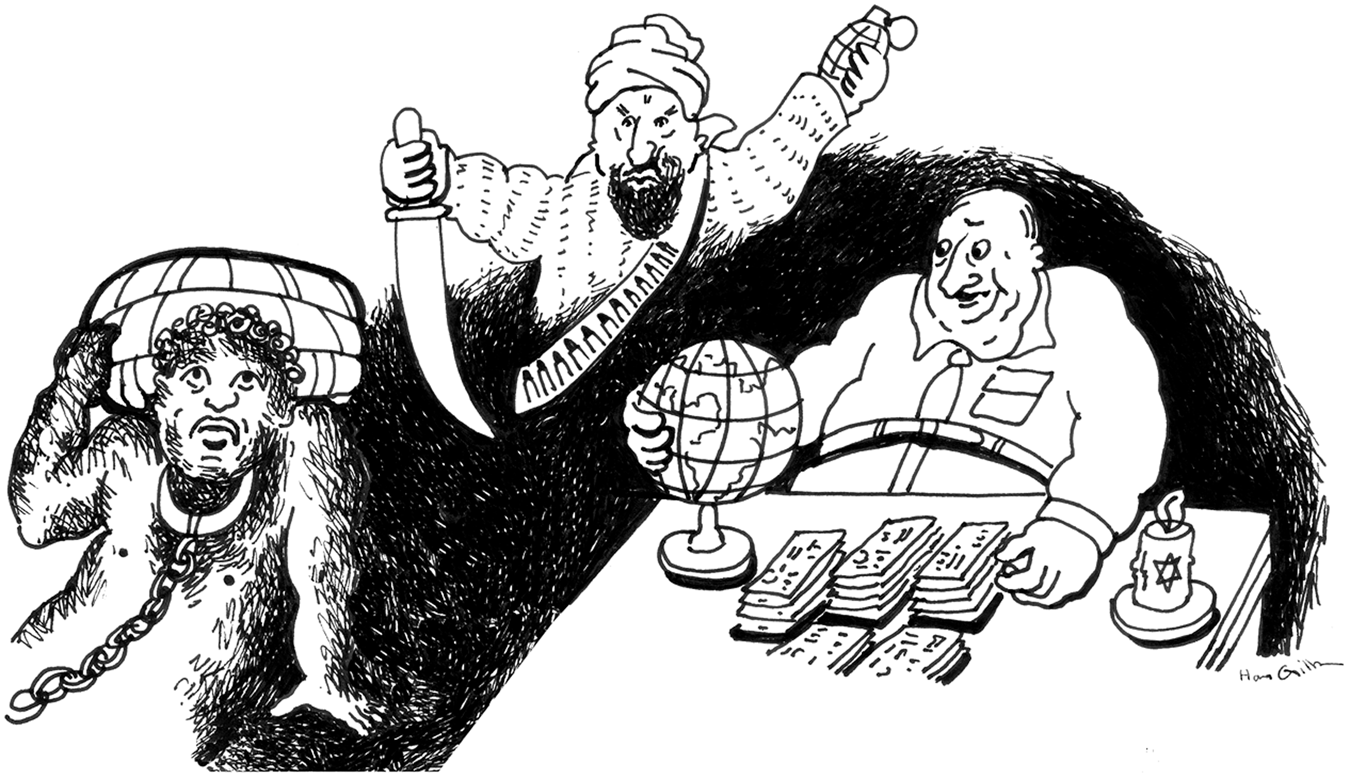
Racist imaginaries of three folk devils (cartoon by Hava Gillon).
You have all seen the images, just as you’ve seen the violent images of black men and some black women being shot dead by police, often with no provocation whatsoever. You have all no doubt seen images of a murdered young English MP, of peaceful church attenders slaughtered in Charleston, South Carolina, and of a young black teenager killed walking innocently through his Miami neigbourhood, all murdered by racists and white supremacists. Most of the time, the perpetrators get away with it. I don’t think there is any need for me to elaborate further.
But these manifestations of racial violence are not what moves my argument. I am not simply stating the obvious – that racist expressions are often brutally violent or that racist slurs violate personal dignity, as the philosopher Charles Taylor has argued – that non-recognition or misrecognition can be a form of oppression, imprisoning someone in a false, distorted, and reduced mode of being.
No. My argument here is different and, I believe, more profound. First, I want to propose that race and racism is not simply a discourse or even ideology as is often argued but that – seen from the perspective of the racists – racism is a visceral, atavistic social imaginary, embodying deep-seated psychological fears of difference and sameness, animated by imagined folk devils. When I said we live in scary times I meant it quite literally – racism is generated by and builds upon fear, rage and deep resentment.
Second, I propose that, seen from the point of view of the victims of racism, beneath the surface of apparently differential racisms lurks a single, violent message: The Other must be effaced and subordinated – physically, culturally, economically and politically. Hence what distinguishes racism, xenophobia, ethnic violence and state terror from ordinary political ethnicity is its violence and violations. Racists target the human body – perceived as a source of dangerous and contagious pollution and threatening physicality; they target collective cultural symbols – mosques, flags, graves – for destruction; they expropriate and destroy property and sources of livelihood; they spread deadly, false conspiracy theories, and they efface the political voice of the racialised Other. In other words, if racisms are many and the political-cum-historical contexts in which they arise unique, the violations of racism are familiar and repetitive – public humiliation, denial, enslavement, pogroms, ethnic cleansing, rape, murder, torture, destruction, expropriation, starvation, industrial death, genocide.
If I were Mary Douglas I would say that racism in Europe and America – though not perhaps in Latin America – is constituted from the beginning by category violation: Race violates the purity of blood of white people and their privileged superiority, whether by proximity or miscegenation. 2 In his book ‘Race’, Nature and Culture and elsewhere (Wade, 1993, 2004), Peter Wade defines ‘race’ or ‘racial discourse’ as a historically inflected idea about human difference in which selected visible (or indeed invisible) biological and cultural differences, regarded as hereditary, are naturalised and inferiorised as embodied, essential human nature. Missing from this definition, however, is the visceral disgust, fear and aggression that so-called ‘race’ invokes. This is where racism and my own analysis begin.
There seems to be agreement among scholars of race that since Second World War there has been an erasure and delegitmation of discourses of race in Europe and America (Goldberg, 2008; Stoller, 2002; Wade, 2010, 2015). 2 Political correctness and euphemistic references to ‘culture’ replaced explicit references to race. But if there was indeed such a moment when race talk went underground or was privatised, as these scholars contend, the present moment is one in which race and racism, as we have seen, have been shockingly and brutally visibilised and legitimised.
Before going on to elaborate further on my main argument, I need to make two things clear. First, I am not arguing that all violence is racist. There are many forms of violence including sexual and domestic violence, sectarian violence and nationalist violence, which may share some features with racism but are not racist. Second, I am not arguing that ethnocentrism is the same as racism. Ethnocentrism, the valorisation of one’s own culture or society above others, is – let’s face it – normal and common. Most people think their own culture is good, possibly better than other cultures, and sometimes that some cultures – say, Japanese culture or American Indian culture – are more attractive than others (Levi-Strauss). I am not arguing that all those who voted for Brexit are racists. But what is undoubtedly the case is that ethnocentrism can easily descend into racism in response to competing interests or perceived threats (Bar-Tal, 1990). The sign for this shift is always, I put to you, violation and violence, often cycles of revenge. That is why multiculturalism is such an important framework for relations of peaceful tolerance. Multiculturalism teaches the need to respect other cultures and their rights to equal visibility and recognition in the public sphere.
But, you may ask, what about institutional racism – where is the violence there? After all, most of the time racism only surfaces in statistics showing discrimination. My answer to this is to invoke the example of Barack Obama who dared to break the glass ceiling, the taken-for-granteds of everyday racism. As Susan Anderson (2016) writes in her book White Rage, ‘the vitriol heaped on Obama was simply unprecedented.’ The hatred started, it seems, when he was only a candidate. In his first year in office there was a 400 percent increase in death threats. Facebook eventually shut down a page where hundreds answered yes to the question ‘Should Obama be killed?’ He was accused of being a Muslim, a Kenyan, an un-American monstrosity. He was repeatedly called a nigger, depicted as a chimpanzee. His crime was to buck the ramparts of institutional racism. The violence against him was only visibilised because he did not accept his place in the racial hierarchy. But that violence was there all along.
Hence, the challenge facing anti-racist scholars, I propose, is to grasp the visceral, atavistic nature of the social imaginaries and the deep-seated psychological fears of difference and sameness that constitute contemporary racisms and their mutations in the face of changing historical circumstances. A common approach has it that the folk devil of racist imaginaries is a displaced figure of collective anxieties and fears and, as such, an arbitrary scapegoat embodying racist paranoid convictions that only cultural, ethnic and racial purity can stem the breakdown of social order and the collapse of society. This view sees the racist gallery of folk devils, and the differential or cultural racist fantasies of which they are constituted, as mere facades disguising more unitary, fundamental processes in which a constellation of Others – blacks, Jews, liberals, Asians, Muslims – is constructed as a threat to the purity and order of the nation, the ethnos, seen as a moral community (see Figure 1 above). In this interpretation, beneath the surface of apparently different racist imaginaries lurks a single, violent message: The Other must be effaced and subordinated – physically, culturally, economically and politically.
Against this singularity, Wieviorka (1995) has argued that the logic of racism is a dual logic – of inferiorisation and differentiation; of subordination and exclusion. The duality seems to explain the three central historical exemplars of racism that form, as Etienne Balibar (1991) recognises, our fundamental imaginaries of racism: American slavery, colonialism (including apartheid) and the Holocaust. But the racisms of late modernity, as Stoller (2002) notes, are altogether more subtle and insidious. In our era of heightened self-consciousness and cultural reflexivity, a further principle or logic of racism becomes apparent. This is suggested by Zygmunt Bauman (1993) who argues, citing Levi-Strauss, that the uncertainties of modernity crystallise around the disturbing figure of the alien or stranger. We deal with the stranger in our midst, Bauman contends, through two strategic alternatives: Anthropophagy – literally, cannibalism, and by extension, ingestion, assimilation; or anthropoemy – literally, vomiting, and by extension, expulsion, exile, incarceration. The first ‘assimilates’ the strangers to neighbours, the second merges them with the aliens. Together, he says, ‘they posit a genuine “either/or”: Conform or be damned, be like us or do not overstay your visit, play the game by the rules or be prepared to be kicked out from the game altogether’ (Bauman, 1993: 163). The impulse of the modern nation state is to pulverise its ethnic peripheries and stubborn minorities in the cultural blender of nationalism.
The array of imaginary folk devils which I have labelled the Slave, the Witch and the Fanatic have their roots in three parallel racist ontologies. All three ontologies share the paradoxical feature that violent racists perceive themselves to be defending the nation against the threat of an evil aggressor and potential usurper.
Where exploitation and subordination are the key defining principles of racism, the fear is of the physically powerful, wild, out-of-control slave. This is the dangerous street mugger who threatens the law and order of society, as Hall et al. (1978) show in Policing the Crisis, a figure reflecting fear of insurrection.
Against that, the witch crystallises fears of the hidden, disguised, malevolent stranger, of a general breakdown of trust, of a nation divided against itself. Your neighbour may be a witch who wants to destroy you. He or she is culturally indistinguishable in almost every respect because the witch masquerades as a non-alien. The nefarious Jewish merchant, icon of suppressed greed, may be said to undermine the integrity of the ego. Hence, long-settled middleman minorities – Jews, Indians, Chinese – although often wealthy, publicly compliant and assimilated, become intermittently the object of extreme destructive violence or national purification. Anti-Semitism invokes the folk devil of the Jew as the nefarious feeder on the blood of children, the avaricious capitalist and perpetrator of violent global conspiracies.
Finally, the Muslim, the religious fanatic, the violent terrorist, negates – indeed despises – all these impulses motivated by the id and ego. Islamophobia is the fear of the super-ego gone wild. At stake is not the battle between Christendom and Islam, as many Muslims believe. What is scary about Islam is the way that it evokes the spectre of a past puritanical Christianity, a moral crusade, European sectarian wars, the Crusaders, the Inquisition, the attack on the permissive society. The Islamic fanatic is not a disguised, assimilated threat as the Jewish ‘witch’ was; ‘he’ is not subservient and bestial like the black ‘slave’. He is upfront, morally superior, openly aggressive, denying the morality of the promiscuous society and the validity of other cultures – in short, a different kind of folk devil altogether. He is a figure constructed by fearful elites that may nevertheless legitimise far cruder forms of biological racism. Anti-fundamentalist images provide these racists with a legitimising discourse against Muslims, to which may be added the usual epithets directed against all racialised groups: That they are dirty, promiscuous, licentious, violent and so forth. Muslim terrorists prove that the Koran itself and the Prophet of Islam are intrinsically ‘evil’ and promote violence. In some ways Muslims have now replaced Jews as the conspiratorial hidden witches, whereas for Muslims, Jews and Americans are seen as the new Crusaders, openly violent, inhuman and destructive.
To sum up my argument then: Racist folk devils are no mere illusions and fantasies. They represent deep-seated, atavistic, real fear, displaced onto strangers and what strangers come to represent symbolically. Racism, the racist imagination, is fundamentally violent and violating.1
Kit (Christopher) Davis
Race is not a professional study for me. It’s just that race is something that follows me around and fights with me like something out of a bad screwball comedy. So, this is a bit of an auto-ethnography. I am going to start with three ethnographic instances and we’re going to draw out of them some broader principles that will allow us to find a way forward. It’s appropriate to be having this discussion right now because sixty years ago this year nine black students attempted to enter a previously all white high-school in Little Rock Arkansas and the governor of Arkansas, Orval Faubus called the National Guard to block their entry and then president Eisenhower in turn called the army in to enforce integration. That’s vignette number one now. It was also the point when I first discovered white racism. I remember asking my mother ‘what is happening, why are they doing this?’ My mother very wisely said ‘I don’t know’ because, really, why should she speak for them.
Number two: A little more than 50 years ago the SCLC, the Southern Christian Leadership Conference, brought the struggle from the South to Chicago as a way of broadening the struggle to include economic as well as racial disparities. They were also attempting to desegregate housing. Chicago is an extremely segregated city – it’s one of the most segregated cities in the country. There were covenants by which people promised not to sell properties to Blacks and Jews. The idea was to walk in peaceful protest through all-white areas that were directly adjacent to all-black areas in which black people were paying more in rent than white people across the street were paying for mortgages. Martin Luther King came. These walks, they were exercises in militant non-violence, took place on Sunday afternoons and I went along. You had to have a briefing before you began where you taught not to fight back and to remain passive in the face of violence, to take off your earrings and jewellery so that people couldn’t hurt you, and also, at a certain point, to kneel and pray. You can catch glimpses of it in Raoul Peck’s recent film ‘I am not your Negro’ which is a celebration of James Baldwin’s work, but in the background you see a tremendous amount of the violence. There were a series of critical events, obviously, during that time, but it was critical particularly in terms of my own life and changed my life in a direct way. First of all, King said that the white violence was worse than anything he had ever seen in the south and that he had knelt to pray with one eye open. People threw things, they screamed, they could hardly physically express the magnitude of their hatred, and that included women and children as well as men. There were swastikas, there were flags saying ‘white is might and might is right,’ they adapted little jingles that they sang about wishing to kill all the ‘niggers’, or that they wished they were Alabama troopers so they could kill us all. It was quite extraordinary. You would always tell new people coming along to keep walking, because they would be so astonished by this. But for me, first of all instead of feeling frightened I felt jubilant, because you look at this and say ‘this is what I can do by simply walking down the street. I can make you act like this’. And when I started reading Foucault on the distribution of power over the population, while everyone else said there’s no centre of power here, I remembered that. Everyone plays a part in power and if you get out of place you can disrupt the power system. It was the first time I had seen police there to protect me, I had never seen that before. Also each week the number of protesters grew and they included people who seemed other than the usual white folks I knew. I had an integrated background, but all the white people I knew were like anthropologists, they were on the Left, they wore ethnic clothing and jewellery, they were part of the CND. You would expect to see them at a march. But there were also other people with bubble hairdos and plastic hand bags – just normal looking white people that you would never expect to see or think were on your side. I learned that I myself had a prejudice that I didn’t realise I had. That was a learning experience for me and for them. They would say things like ‘my family don’t know I’m here, but I couldn’t possibly just let another week of this go on without coming.’ That’s ethnographic example number two, and I want to emphasise there the element of choice as well.
The third thing was teaching structuralism in the University of Michigan. I remember once somebody making the observation that Levi Strauss was writing Elementary Structures of Kinship while the Second World War was going on, and there was no trace of the politics of the Holocaust and of that mass destruction in his text. So in some way, in order to have a futuristic approach, I’m taking a page from Levi-Strauss’s book because he taught us to pay attention to the underlying logics of things that create the different manifestations of things in varying times and places, and that account for both repetition and difference, the system of transformations. I think it’s important if we’re thinking in terms of being open to the future that we think in terms of looking at the underlying logic. On this basis, I would argue that we understand racism for what it is, which is to say it’s one visible form of a type of political/personal passion, itself combining two inherently precarious, and therefore tending to violence, passionate ideologies. These are supremacism and purism. They are emotional ideologies that are a way of negotiating our creaturely condition as empathic predators, to which I would now add an idea, a missing piece provided by Andrew Irving in conversation last night, we are also paranoid! So, we’re empathic, paranoid predators. It means that every time we try to dispossess others of something that is rightfully theirs we have to protect ourselves from our own empathy by making that other deserving of the violence we are perpetrating on them.
Equally, supremacism and purism are two unnatural states, they’re precarious states. We are always conscious of the fact that they need consistent reassertion and consistent defence because otherwise they’ll decline into nothingness. So we’re constantly then in a state of anxiety. In addition, as passions they are emotions in search of an object. They are formulations of resentments that are fundamental to human beings. I would draw attention to the work of Melanie Klein or Lacan or early psychoanalysts who look at the fact that the alternatives to feelings of affection and belonging are to feel excluded, resentful and cast out. Shakespeare was very good on this. Characters like Iago or Don John are just pissed off and for no other reason than that they’re excluded and they’re bastards and they don’t like it and they are going to make everybody pay. So we have to just recognise that these are passions. But, in addition, coded into our philosophy of being, in whatever it is we mean by us, through people like Hegel and Nietzsche, there’s always also an unhappy consciousness. There’s always also a master-slave dialectic. The notion of freedom is very heavily coded with its opposition to slavery and that’s another problem that we have to deal with. So if we’re going to begin to have a properly anthropological approach to the problem which is to understand it both in its particularities of time and space but also in its commonalities across time and space, we need to understand that these are the driving forces and that they will produce three kinds of violence which we have all experienced in our life time.
The first is vigilantism, which can be communal or collective violence. It can be things like lynching, it can be things like Faubus calling the National Guard, it can be individual acts of attempted terrorism. The point is that they are all appealing to a higher law that is above the law of the state, and they are justified by this broader purpose, and in fact one of the satisfactions is breaking the law to show how supremely important this thing is.
The second kind of violence is structural violence in the sense of obviously abiding deprivation and imposition of disabling constraints on others which are then normalised and racialised and made and perceived as a reflection of the others’ degraded ontological condition, rather than as something that is imposed on them in order to create the purism and the supremacism that one is feeling oneself.
The third element is the psychic violation in the sense of the mentalities of both actors. Both the person that is the victim of persecution and the supremacist are psychically distorted by these emotions. In fact they take bodily forms as well.
If we think about it this way, in terms of the psychic life of power and in terms of the fact that underneath it all, psychologically, even in terms of infant development, these are things that people think of as fundamental to human coming into being. Thinking in this way allows us to tolerate, because we have to, the abiding nature of these passions. In other words, not to hope for a time when they will ever go away because they are part of our self-construction. An infant is incredibly uncaring about whether or not its mother has any sleep, whether or not she is in a good mood or a bad mood. It just wants to eat. It is only later that it comes to say ‘oh’. Because these operate at the level of individual psyche, they operate to frame experience. It is a position one can occupy and I’m thinking also of what people would say in the Congo using the mentality of a sorcerer. There is a word in Swahili (chuki) to describe the kind of rage you feel when you see something really inappropriate and impossible such as a child talking back to a parent, or a parent being rude to a child, or when somebody comes along and you have to share your food. And it is just really deeply annoying. The average person gets over that, a sorcerer does not. And if they take against you, every time they see you, you just piss them off and they are not going to be happy until they have made medicine against you that will kill you. And when you are dead they will be the first person at your funeral, because they want to be sure to see you in the ground. And the problem then is the fixity of that emotion, I think, because we all experience that irritation that becomes a proof that sorcery exists. We all could feel the same feeling and that is how we know that other people feel worse than we do. So I am saying that the persistence of these passions is what matters when we begin to think about the future and that is why I wanted to kind of cut through the flesh, so to speak, of racism. I like that moment in Terminator, especially the first Terminator, when he cuts into his arm and you realise that it is a machine underneath. But your first feeling is ‘oh, my God.’ It’s a bit like that cut through the flesh of the machine. The sentiments appear unchanging but of course they change because they adapt. And that is why I want to go back to the fact that when we now look at things like Charlottesville and when we look at the current arguments and compare them to what things were 50 years ago, you see it is the same but it has also significantly changed because the social circumstances around those feelings have changed, and because they are debatable in different ways, and because among other things you can fight back. Until the Black Panther party came along, the idea of fighting back was kind of not a thing.
So what I want to then argue, again thinking futuristically, is to look in our contemporary society at the role that algorithms play in this model, in this kind of constant repetition, both the newness and repetition. So the encoding of racism or of ideologies in algorithm is crucial and I just want to take the example of Dylann Roof who was the young man who went to a prayer meeting at a historically black church in South Carolina and who shot and killed nine people. He refused to have a psychiatric assessment as part of his defence. He left a manifesto that was what he wanted to be his only statement. He did not come from a racist household, he had black friends as a young man, but he was affected by the shooting of Trayvon Martin in Florida (the young man to whom Pnina referred), who was walking through a neighbourhood, his own neighbourhood in fact, and some self-appointed security person decided that he should not be there and he ended up being shot dead. So Dylann Roof went online, the Southern Poverty Law Center has recorded this, to look at black on white crime. He googled it and what popped up was a whole series of bits of evidence left by rightwing groups that itemised and gave individual names of instances of black on white crime. What did not pop up was the rarity of such crimes. So what we see happening is a weaponised artificial intelligence, that’s one way of putting it. Artificial intelligence learns from every single click that you make on every single thing. Every single click you make on Facebook and all your friends. Data gathering organisations harvest information and they attach it now to psychological profiling. So they have a sense of who you are, what you are as an individual mind. Therefore if I were to google black on white crime, I would get a different set of things from Dylann Roof. The Southern Poverty Law Center has been trying to get Google to acknowledge and to change their algorithmic methods, so that it cannot be gamed in this way.
Going back to the open occupancy demonstrations, what I want to emphasise is that people choose. It is not where you begin, it is what you choose at a critical moment that makes you who you are. And what I like, not only about my own learning, was seeing that also ordinary white people, to whom the proposition had never been put, had made a choice in that moment. And what I am saying now in terms of our point of view as anthropologists is that this emphasises the significance of the social, and of the politics of the social, and it emphasises the future. What we see with algorithms is that they reinforce passions, they are meant to be addictive. They diminish choice and freedom because they do not allow us to think outside of the box. This is our challenge, to be able to find ways to continue to regroup, continue to reform.
Opposing the motion
Peter Wade
The idea that violence/violation ‘are at the heart’ of racism is a bit vague – which is what makes it a typical and productive Group for Debates in Anthropological Theory (GDAT) motion. I think it means that all you need to understand racism is the concept of violence/violation. That is, to understand racism, violence is not only necessary but sufficient.
I do not deny that racism very frequently involves violence and violation. It is hard to deny this when ‘violence’ has been conceptually expanded so that it now includes: Symbolic violence (such as invisibilisation in the media, the operation of stereotypes, etc.); micro-aggressions (unthinking remarks that betray underlying assumptions, which make people feel uncomfortable or violated); and structural violence (the impact on people of segregation, inequalities, etc.).
But what does a focus on violence/violation hide from us? It is not so much that it is wrong, as that it narrows our view, it foregrounds some things while backgrounding others, and it predisposes us to see things in a certain light. It closes down asking the ‘other question’. The ‘other question’ is a conceptual tool developed by legal scholar Mari Matsuda (1991) in thinking about the intersection of different forms of oppression. If something looks racist, you ask: ‘where’s the sexism?’ If something looks sexist, you ask: ‘where’s the racism?’ So, in our case, if we see violence/violation, we should ask: ‘What else is going on that we are not seeing?’ This of course raises the question of what is the ‘other thing’ that is being hidden from view?
A first response here might be to claim that we are not seeing structural processes of exclusion. A focus on violence tends to foreground the experience of stigmatisation, and to push into the background structural processes of exclusion. Stigmatisation can be defined as an ‘assault on worth’, an attack on, or violation of, one’s moral value as a person by means of insults, jokes, negative stereotypes, being ignored, etc. Exclusion, on the other hand, involves denying someone access to a resource or opportunity, such as jobs, promotions, housing, education, etc. (see Lamont et al., 2016).
Obviously, stigmatisation and exclusion are connected. Being denied access to something can often make a person feel stigmatised; if a person is stigmatised, this can often mean they will be denied an opportunity. But the distinction can be helpful because it suggests a perspectival difference between (a) focusing on a sense of woundedness, which is the result of a perceived violation; and (b) focusing on structural processes of exclusion, which may not be experienced as violence or violation because they appear as everyday normality. An added benefit of attending to structural processes is that we can see more clearly structural processes of inclusion; it focuses our attention on the maintenance of privilege through everyday behaviours, rather than on the maintenance of privilege by the active use of violence/violation.
Now this first objection can of course be worked around to some extent by using the idea of ‘structural violence’. This concept encompasses structural processes that do not necessarily operate through direct violence and violation, but that nevertheless reproduce racial hierarchies; and the effects of these hierarchies may include a violation of the right to a decent life (for example, when racial minorities end up living in dangerous and polluted environments, which reduce their life span). So the idea of ‘structural violence’ can get us past this first problem of what we might be missing. However, the idea of structural violence, by its very recourse to the concept of violence, tends to channel the analytic gaze towards a binary of wounded and wounders, of victims and victimisers.
This binary leads us to a much deeper problem with the focus on violence/violation – which is that some of the key experiences and structural processes involved in reproducing racism are actually about conviviality and equality. I will illustrate this by looking at Latin America, which is a particularly useful location to think about structural processes that reproduce racial hierarchy, but are themselves non-violent.
Latin America is characterised by long-established processes of racial mixture, which have produced nations with majorities of mestizos (i.e. people recognised as a mixture of white European, brown native American and black African). A key characteristic of the region is the co-existence of racial conviviality with racial inequality and racism.
Mixture has a dual aspect. On the one hand, it is a site for conviviality: People make families across racial differences; they live in families that encompass racial difference; they have social networks of friends and colleagues that cross racial difference; and in some important domains of social life, they interact in convivial ways that pay little attention to racial difference.
On the other hand, the same mixture is also and simultaneously a site for the reproduction of racial hierarchy and privilege. Mixture is not a neutral process, but instead is stratified by racial meanings. In general, being darker is less valued, and being whiter or lighter is more valued; people often seek to achieve a lighter look for themselves (as it is seen as more attractive) and they may seek a lighter partner so they can have lighter kids. These processes can often be experienced by people as involving violation: For example, the darkest sibling in the family may feel slighted or treated less favourably; or darker women may feel they are ugly, or that they have ‘bad’ hair, etc. How are we to understand this duality of conviviality and racism?
One way is to interpret conviviality as a mere superficial pretence under which lies the violent reality of racism. This interpretation is given weight by the fact that Latin American states and elites have often highlighted conviviality above all else, and used this to make claims to ‘racial democracy’, denying or minimising racism and creating an ideological front. This interpretation is also often adopted by Latin American academics and by ethno-racial social movements, whose aim is to uncover the racism hidden behind this ideological front. And this is certainly a valuable process, which I support.
But here we should ask the ‘other question’. What are we missing with such a perspective? We are missing the fact that the conviviality is also a structural reality; that it is part of everyday experience for many people. It is not just an elite ideology or mask, which hides the realities of racist violations. We need to highlight that conviviality is constitutive of the way racism operates in Latin America; and that it is the co-existence of conviviality and racial hierarchy that underlies the structures of racism in the region.
The focus on violence/violation misses the fact that the very social practices in which racism works its violence are the same ones in which racial conviviality operates; racial conviviality and racism happen at the same time and in the same space. While the idea of racial conviviality certainly does act as an ideological front, it is vital to see that the maintenance of Latin American racial formations depends on racial conviviality being more than just a front: It is a lived reality as well, albeit a partial one.
Latin America is a particularly good example of the operation of certain structural processes of conviviality, because mixture there is long-standing, pervasive, and institutionalised. But the same principle applies more widely: Liberal democracies in general exhibit a constitutive tension between hierarchy and equality, or between violence and conviviality.
There is a view that conquest and racism are constitutive parts of modernity; this has been expressed forcefully by coloniality theorists such as Walter Mignolo (2011), but also by others, such as Paul Gilroy (1993). They say that conquest and racism are the ‘dark side’ of modernity and its public claims to progress, equality, liberty, etc. These claims only exist (and only for the privileged) by virtue of conquest and racism, understood as a series of violations imposed on the subalterns. This is undoubtedly true – but it also begs ‘the other question’. Which is: ‘Does racism only exist by virtue of the idea of equality?’ I argue that it is only through the promise of equality that racism gains its meaning. And more than just a false promise, it is the possibility, however remote, of realising that promise that puts equality into a relationship of mutual constitution with racism. It is only the existence of real processes of inclusion that make the existence of real processes of exclusion possible. These are both partial realities. Thus racism, and the violence and exclusion that it involves, cannot be understood in isolation from the opposite processes of equality, conviviality and inclusion.
In 1944, Gunnar Myrdal published a book, An American Dilemma, in which he said that in the US, the principle of equality stood in direct contradiction to the existence of racial inequality. There were two things wrong with this. First, the dilemma was not just ‘American’ (i.e. US), but is in fact a key tension in all liberal social orders. Second, insofar as Myrdal was talking about contradiction, his analysis misunderstood the relationship between the equality and inequality. They are not separate forces in opposition or contradiction; instead they depend on each other for their existence. So my argument is that racism is constituted by its relationship to non-violence – and this is why I think it is not actually wrong, but rather too narrow to say violence and violation are at the heart of racism. To understand racism, violence is necessary but not sufficient.
The sense of woundedness and injury implied in a focus on violation is immensely powerful; it has driven the politics of identity and recognition that we live with; it has driven the idea of affirmative action and reparations, which seek to repair past violations. However, my argument is that, beyond the partial truth of the world divided between victim and victimiser, is the figure of the person who is neither victim nor victimiser, but without whom the concepts of victim and victimiser could not exist.
John Hartigan Jr
Rather than violence, race is at the heart of racism. At the risk of being simplistic and countervailing ‘what everybody knows,’ I suggest racism is the belief in race. Before racial violence, we have to explain how people come to believe and feel race so palpably. They did so first through practices of care applied to domesticated species, a history I recount in detail in my recent book, Care of the Species: Races of Corn and the Science of Plant Biodiversity. This process and experience are quite distinct for racial subject and objects – those objectified by and through racial violence and those subjects who perceive others as warranting assault and attack. If our principal concern is intervening in the reproduction of racial thinking, whiteness requires the closet scrutiny. Attending to violence will likely only offer an oblique point of entry into thinking of white racial subjects, since they largely eschew or reject such overt, unwieldy acts. But if we can lay bare the forms of care that inform racial thinking, perhaps we have a chance to disrupt the conditioning of white racial subjects that leads to violence.
In social terms, violence arises in the maintenance and reproduction of forms domination. Sociality operates by keeping violence limited and effective; it does so largely by encasing subjects in multilayered, overlapping forms of politeness and decorum. Prior to violence social subjects are constituted to feel the realness, weight and import of these conventions. So what is this sociality of race that serves as the predicate for racial violence? How do racial subjects come to feel both the realness of race and the sense of threat from which violence springs?
Social anthropologists answer these questions with the ‘idea of race.’ 4 It’s a convenient artefact for us to assail. This stance suggests, first, that ‘it’ emerged at a defined point in the past, suggesting we may be free of it in the future. Second, in order to reach that future, we have to get people to stop believing this idea. Simple. I used to adhere fiercely to this tenet but I no longer do. It does not jibe with what I’ve found from years of studying whiteness and race. 5 Violence is not primally there as whites are socialised into a comforting unmarked sense of normativity, one that bestows a sheen of respectability and rightness to what we do. Importantly, this comfort is there before the threat of otherness. And it does not start as an ‘idea.’ It begins with breeding. It is achieved through practices of care, and perhaps the first act of such racial subjects is deciding who and what is unworthy of care. 6
Humans, like other social species, are characterised by a capacity to extend care to each other. One of our distinguishing features in evolutionary time is care extended to injured or frail conspecifics; even our dead warranted such attention, with burials, which grew increasingly elaborate, necessitating monumental structures. Race begins with the recognition that such attention can be directed to altering, to ‘improving,’ the life forms we care about: First, our ‘beasts of burden,’ our ‘domesticates.’ The doubled referent in that term of racial servitude needs to resonate, as with the doubled connotations of ‘breeding’ – both privilege and directed sexual reproduction. When the violence of the eugenics movement was subject to critique in early 20th century, only its ‘negative’ forms such as forced sterilisation were targeted; its ‘positive’ forms – selective choices about mating that reproduce class privilege and racial identity – largely went unassailed and remain active today and are proliferating rapidly. 7
When Darwin wrote about race in Origin of Species (the book’s subtitle, ‘the preservation of favoured races in the struggle for life,’ is often elided) he did not reference humans. As was common parlance at the time – and as is still the case today in Spanish-speaking countries, with the word ‘raza’ – he talked about pigeons and dogs and cabbages, about goats, ducks, and rabbits. He talked about the vaunted capacity of breeders to discern what was imperceptible to most others and to direct that perception toward an improved lineage – a species vision drawing from and directing millennia-old practices of care. That combination of vision and practice creates races, first of nonhumans; later we ably applied it to humans. Race results from practices of care. This also may seem counterintuitive at first, especially when considering the violence of the slave trade. But consider: That human horror was entailed by the care and cultivation of several domesticated plant species: Cotton, sugar, tobacco and then coffee. Importantly, racism later arose as an ideological means of justifying slavery; for its initiation, the slave trade largely required only religious justifications. 8
When Johann Friedrich Blumenbach, a founder of racial science, gazed into the visage of the first ‘Caucasian’ skull, it was beauty and sameness he beheld, not otherness. And the power of that sense of recognition was capable of extending great care or privilege, on one hand, while impelling acts of violence on the other. Racial violence arises for varied reasons, but certainly crucial to its venting and explosion is when and how this combination of vision and practice is disrupted or disputed, when the privilege extended to subjects of good breeding is threatened. Or even earlier, in order to secure and perpetuate that form of privilege, that breeding, other are killed and terrorised or simply left to suffer and starve.
In intersectional terms, white, middle-class men in the United States commit mass murder when their racial, sexual, and class forms of entitlement are ruptured. This does not happen instantly, as the spew of furious violence might suggest. First, they must acquire that privilege; that entitlement is inculcated over time, imbibed through parental care that extends to securing homes and schools away from people of colour; they are aided in doing so by a vast infrastructure of caring, extended through loans and financing, jobs and networking. 9 Then the economy that made such extensions of care has to shudder and shift; too, the political and social discourse that naturalised it all has to be disrupted or disputed. Then, as they are exposed to the precarity of such care and directly encounter its disruption or termination, some respond quite violently.
The outbreak of spectacular racial violence in the United States today is predicated on disruptions of practices of care that have long protected most whites from the vagaries and perils of ‘market forces.’ Confronting economic and social ‘failure’ in various guises, for which many advantaged white men are not prepared, violence seems warranted. Defending against ‘threats,’ real and imagined, to those forms of advantage, violence seems necessary and righteous. In the face of ‘loss’ of a long-assumed, thoroughly socialised sense of dominance, violence appears the only recourse. And its fury may be all the greater because its targets were not deemed worthy of the same extensions of care that constituted this angry, unhinged white racial subject.
For several decades, we have largely addressed race in terms of perceptions of otherness, and this approach has been revelatory. But the psychoanalytic model that undergirds this critique too narrows our attention to race and its forms of socialisation – to the often silent equations made seemingly effortlessly between whiteness and comfort, between white and nice. 10 The sense of sameness so crucial to whiteness begins with a feeling of belonging, in cultural terms. Its cultivation does not require the Other, though it demands domesticates to serve as its sustenance. Violence draws a firm line around who does and does not warrant care, but it is peripheral to the prior, fixated perception on cultivating subjects of care, on breeding toward an improving lineage. Ask any gardener about the violence entailed by caring for plants – the weeding, for instance – and you will soon see how an attention to care can reveal the roots of violence in practices that seem so gentle and good.
What’s the answer? How do we engage critically with the racial conditioning that is the predicate of violence? By getting whites to grasp their breeding, to dislodge the sense of rightness and comfort via a ‘making strange,’ perhaps through the intuition or odd sensation of recognising we are breed for privilege much like our dogs and the other domesticated species about which Darwin wrote. I’m haunted by an image of white diplomatic workers being evacuated from a compound in Rwanda as the genocide was breaking out – pets cradled carefully in their arms, passing rows of black ‘domestics’ who remained behind to face certain slaughter. 11 Or recall the dog Excalibur, whose owner, a Spanish nurse, was the first person in Europe to contract Ebola; the global outcry over the decision to euthanise the animal echoed eerily in the pall of silence over the fate of Africans dying of the disease. 12 More recently, I’m haunted by a noble effort of sending private jets to rescue pets-at-risk in Florida in the face of Hurricane Irma, while no such mobilisation materialised for imperilled migrant works unable to evacuate. 13 Certainly, extending privilege to our pets, feeding them gourmet treats as ‘family members,’ while homeless people starve on the streets, offers a glimpse of how deeply breeding runs. 14 It also is a good gauge of the ancillary power of racial privilege to incite violence.
What we glimpse in white people and our pets is that what’s being privileged here – an extension of sameness to nonhumans – parallels and perhaps even mirrors the dehumanisation by race. These forces work in tandem, and we won’t get sufficient critical purchase on racial thinking without drawing both into view. It’s the underlying assumptions and projections of sameness that allow the operations of othering to seem commonsensical and undisturbing. Recognising this will expand what we consider in response to the crucial question, ‘Is it racial?’
The discussion
On micro-aggressions: In the old days when we were integrating things you had to put up with a lot more than that. You were bodily and socially informed to be an integrator. If you want to know the conditions under which I was brought up, there is a wonderful ethnography that came out in 1945 called Black Metropolis: A Study of Negro Life in a Northern City. The first part is a sociology of the black community in Chicago; the second part is an ethnography that gives a description of social classes and modes of living within the black community. The last chapter in that book is called ‘Advancing the Race’ and it's a category of thinking about political struggle. I was brought up in that category. Advancing the race meant that everything you did and everything you were was about making a way for other people. You had to be twice as well prepared and twice as armed and if you messed up, nobody black was ever going to get a chance after you. What I am saying is that race isn’t something that you are passively and unthinkingly. It's something that comes into being, and it has a heritage and a tradition including a heritage of political struggle. Now we have advanced it to the point where we can think about micro-aggressions.
For the proposition, both Kit and Pnina opened up the possibility of hopeful futures. Kit through the notion of choice, and Pnina with notions of multiculturalism. Can you see multiculturalism as similar to the benign convivialities that Pete was talking about. That, in fact, multiculturalism, like the benign convivialities, is actually the other side of the coin of racism.
The way that I think about racism and the concept of race is, as I said before, rooted strongly in the history of European colonialism. It's got anterior roots in the Iberian peninsula and draws on some of the ideas about breeding, particularly horse breeding and so on, that John was referring to, and then that was transferred to the exclusion of Jews or people of Jewish descents and moros or people of Muslim descent and so on. That's where the word raza first emerges. As applied to human beings it was conceived as a kind of lineage, not as a group of people, but as something that you inherited. Those kinds of ideas were then transferred into the Americas by European conquerors and that's where the whole race complex really emerged. Now there are other kinds of beliefs that are similar in many ways. The way the ancient Chinese thought about people who were non-Chinese was very naturalising, looked at their bodies, saw them as inferior, linked their bodies to their geographies etc. Is that racism? Well, in some ways it is. It’s got the formal characteristics of many aspects of racism but I prefer to retain the idea of race linked to that particular history of European colonialism. That, for me, is what gives it the root, and the categories that emerged in that history, white, black, indigenous, Asian etc. are the key racial categories. And then where you see those categories emerging even if there isn't a discourse about biology, then that's still classed as race and racism in my book. There is a kind of common core but obviously there is a huge amount of variety. Anti-Semetism started from the sixth, seventh, eighth centuries right to the Medieval period when there was growth in anti-Semitism. For me it is not about race at that stage, but in the nineteenth century anti-Semitism in France and Germany elaborates and violently expresses ideas of race and racism that emerged from a colonial history, applying them to a non-colonised population. That for me counts as racism.
In my view, racism always involves sexism, but sexism does not always involve racism. You can think of scenarios where sexist violence occurs which isn’t racialised. But it’s extremely hard to think of scenarios where racialised violence occurs that isn’t sexualised or sexist at the same time.
My first question was to Kit. You had that great point that human beings have to protect themselves from empathy because they are basically predatory creatures. Isn’t your focus on the relationship between empathy and predation basically the same argument as Pete’s – just that yours is at the human scale and Pete’s at the historical?
But, Pete, you end up with the problem that you then have colonial slavery is racist and classical slavery isn’t. This requires a kind of break that's quite hard to defend.
Finally, I wanted to ask Pnina and John to also think about pre-modern racism. I kept thinking of the sixteenth century images of when Spaniards first arrived in South America and they have this fantastic description of the pre-modern races. The images were really amazing because they showed white figures, but they were distorted: People who walked backwards, people who had only one humongous foot, people who had eyes in the middle of their chest. It seems that in those early images there was a kind of fear, but there was also an incredible sense of curiosity. It would be worth thinking about that.
Racism exists in a condition of supremacy and entitlement over the lives of others and the bodily persons of others. In the United States, the promise of equality was encoded in the constitution, but it was not intended to include people of African descent or Native Americans. Equality was among white people. It was not meant to include those others. Racism was made visible in certain ways by the struggle for equality. But it was always there. I'm saying pick this as a model, look at this as a machine. The beauty of the United States as a crucible for this particular discussion is that it's got every single element of endemic racism and racial supremacism, with each operating in its own way but with all still functioning as an ensemble and you pick it apart and then you can begin to see how it works on every part of the population and then see how it also works elsewhere.
Summing up
Pnina
Unlike ‘race’, racism is performative and exemplary. The violence at the heart of racism is an extreme act of symbolic communication which generates a transformation in human relationships. The moral philosopher Emmanuel Levinas contrasts violence with altruism, which be defines as the human recognition of personal responsibility to another in his or her difference. Unlike altruism, violence, he argues, denies otherness its legitimate right to exist and to be different (Levinas, 1987). Hence, I want to put to you, there is a critical difference between processes of objectification and reification – between ‘ethnicity' as a shifting, situational politics of identity or collective representation, and racism or xenophobia – ethnic absolutism – which is an essentialising politics of violation and absolute negation.
By combining the two dualisms suggested by Zygmunt Bauman and Michel Wievroka into a single theoretical framework, we can arrive at the multiple types of violent strategies deployed by racist and xenophobic movements and structures. In this model, the logic of racism is triadic: First, of self-purification through physical expulsion/elimination; secondly, of subordination through physical exploitation of labour; and thirdly, of assimilation through cultural destruction. These strategies are intended to control or banish forever the fantasised demons that threaten in this dystopic vision to destroy the social order.
The three folk devils I have depicted may be contextualised within the three logics of racism outlined here. In the case of the mugger, the insurrectionist slave, the hidden fear is of unemployment and destitution – the loss of jobs and home and all that this would imply. The slave need not be expelled but he must be subordinated.
In the case of the witch, that is, Jews and other economically successful middlemen minority groups (Bonacich, 1973), often highly assimilated, cultured, and wealthy, the fear is of trust and order breaking down inexplicably, with all social relations becoming uncertain and threatening. The witch must be expelled or destroyed.
Finally, if all racist imaginaries construct moral allegories of fear, violence and evil, it is currently the figure of the Muslim terrorist, the religious fanatic – fantasised as the violent and intolerant jihadist fundamentalist – who feeds a special, perhaps historically unique, racist imaginary. To interpret the significance of Islamophobia as a form of differentialist racism, I have suggested that we draw on psychoanalytic theory and, more directly, on the work of Frantz Fanon in particular (1965) who recognised that the coloniser and the colonised cannot escape each other – their internalised subjectivities mirror each other’s hates and fears so that the colonised assumes the image of radical difference imposed upon him or her by the coloniser, and comes to be deracinated, marked by self-hatred for his/her own culture and people, while in the face of popular insurrection the coloniser is filled with the bestiality and violence he attributes to the colonised. The ‘third’ space that is thus created through this encounter between colonised and coloniser is a pathological space of distorted specularities where the stress on radical difference is transmuted into a dialectical mirroring of violence, inhumanity and self-denial. 15
Such an approach illuminates why Islamophobia may be conceived of as a very postmodern kind of fear. The insurrectionist slave is a powerful iconic embodiment of the id – of sexuality unbound – but in the permissive society of today such an icon loses much of its terror. The nefarious Jewish merchant, icon of suppressed greed, undermines the integrity of the ego, but seems less threatening in a postmodern age that celebrates consumption and individual self-gratification, thus necessarily less obsessed than previous generations with the fear of hidden forces of disorder, desire and greed. By contrast, the Muslim fanatic mirrors European society by evoking the spectre of a past puritanical Christianity, a moral crusade, European sectarian wars, the Crusaders, the Inquisition, the attack on the permissive society. Undoubtedly such a figure must be contained, subordinated or assimilated but cannot be allowed to remain within the society.
So, to repeat my argument: Racist folk devils are no mere illusions and fantasies. For those who imagine them, they represent deep-seated, atavistic, real fear, displaced onto strangers and what strangers come to represent symbolically. Racism, the racist imagination, is fundamentally violent and violating and it generates violence as a performative act.
Kit
It’s great to be able to follow such a firm assertion of our position, which I think is quite correct and I think we’ve come back again and again to the role that violent differentiation plays in social life even though it is socially constructed and there’s a kind of an ontological projection that justifies it.
I know that the habit is to reassert the position in the conclusion, but, I want to move in a forward looking way rather than feeling hopelessly enmired in the totemic apparatus itself. Let’s look at the transformations and see what happens. First of all, everyone talks about how love trumps hate, but actually empathy is a lot harder than hatred is. Hatred is simpler, is easier, it makes things clear, it means you do not waste your emotional energy on a whole bunch of people that you don’t even know, and that makes your emotional economy so much simpler. I think that what we have to do, as anthropologists, is to take that seriously. It’s difficult for us because our disciplinary practice has to do with methodological empathy. Think about colleagues who are difficult, who are the most impossible people on the planet, and still, people talk to them. Somebody will come and help them and explain things to them. There’s clearly something in the method that taps into a sort of humanity that we all share. So, I’ve been thinking about how we evolve our social thinking away from a tendency towards fundamentalisms, of which racial fundamentalism is one.
In liberal democracies our very idea of freedom is distorted by the shadow of slavery, because most of our concepts of democracies have put forward an idea of individual autonomy, self-sufficiency and personal independence that was sustained from the beginning and most often by the subordination of other people who were not so free. So, if when we’re singing ‘Rule Britannia, Britannia rules the waves, Britons never never never shall be slaves’, we imagine the deck of a slave ship, the celebration of freedom is a little contradictory, especially when you think what the 18th century was actually like for most people who were on the high seas. We need to be able to move away from an idea of freedom that is overly based on autonomy and self-sufficiency and instead we think of it in terms of idioms of kinship, and the reduction of human exceptionalism as a model. In other words, the way forward is really looking at the devaluation of self-sufficiency and the celebration of certain kind of constraints in order to care; things that have been feminised, for example, and not very highly valued as a consequence.
My last little point is to say that we do see models of advanced inclusion where we find two elements, the mind free from cares as Levi-Strauss would say about pensée sauvage, and the least political resistance and the most financial gain. The two things I would bring to your attention as ethnographic examples are, firstly, Rihanna’s launch of Fenty beauty, her cosmetics line which has forty different shades of foundation going from the whitest of white to the blackest of black skin tones. I met a friend for a coffee in Knightsbridge and there was a line outside Harvey Nichols that went outside the door, down the street and around the corner, of black and brown, a few white women and a few men as well. I said ‘what are you waiting for?’ and they said ‘Foundation!’ And if you look online at her advertisement, it totally shifts the spectrum of beauty away from a Europeanised white model. The other thing is a Toyota advertisement, which targeted eight different kinds of people: Black, Latinos, women … and shows us a kind of inclusion that’s possible when there’s the least political resistance and the most financial gain.
Pete
I’ve been struck by how the arguments of the proposers really depend on showing how racism involves violence. There’s no debate about that, that’s not what’s at issue here. It’s whether violence lies at the heart of racism. My argument is that you can’t think violence without thinking of non-violence. When Pnina says that racists performatively erase conviviality, yes precisely, that’s what they’re erasing: Conviviality. If it wasn’t there to begin with, they wouldn’t be able to erase it and the meaning of their act, of erasure, of violence, takes its meaning precisely from the existence of something called conviviality. It’s an abstract argument, but I think it’s a powerful one.
The other thing that I want to emphasise is that the focus on violence inevitably reduces us to a binary between the victim and the victimiser, which is a very powerful binary opposition. I would urge you not to be drawn in by its power because it’s too simple. Now Dick [Werbner] says that I’m on that side too, that I’m myself drawn in by the power of that binary, because I emphasise the role of colonialism in defining a sphere of phenomena called race, racism etc. This is true, I do emphasise colonialism as a kind of constitutive defining element in my approach to race, but emphasising that doesn’t mean to say that I only think about colonialism as a violent act. You know, the de-colonial approach that’s associated with Latin American theorists, like Walter Mignolo and Ramon Grosfoguel, is again a very attractive approach. Like Marxism, if you put on a pair of Marxist glasses you can understand every phenomenon in the world and talk about it in terms of class. If you put on a pair of de-colonial glasses you can understand every phenomena in the world in terms of the colonial difference and race and so forth. But that’s too simple. For me de-coloniality is a very simplistic way of thinking about colonialism and post-colonialism and so forth because it ignores exactly those processes of conviviality which are constitutive of processes of oppression, subordination, and violation. It ignores how conviviality interpenetrates with violence. They’re not opposed things, they interpenetrate with each other. And it ignores the ambivalence of othering, that when you create the other you want to exclude it, erase it, but also, as Penny [Harvey] said, know it, be curious about it, love it, desire it and so on.
John
What I’ve tried to do today is approach the proposition by challenging how we conceptualise racism. I’ve said it’s a belief in race first and foremost, and that has entailed disrupting some of the scholarly frames that you have seen mobilised today; ones that I was inculcated with when I began my studies and what I’m trying to turn away from at this point. Sometimes I felt very oblique to the proposition and sometimes I feel like, yes, I have something to contribute to it. By way of closing I’ll give you two glimpses of that trajectory for me. I began my study on poor whites in Detroit and these are ‘white trash’ or ‘hillbilly’, and if you listen to their talk they sound completely racist, with the most kind of racial language. Yet they had biracial families, biracial social networks and, importantly, these were whites who stayed behind when white flight occurred and the many whites left Detroit. I was able to contextualise how race mattered for them by looking into other class neighbourhoods: A working class areas and a gentrified area. These whites were much more deft in not saying something racist, and far more effective in controlling their circumstances based on their race. This led me to think racism is poorly conceptualised here.
My current work is a study of razas de mais, races of maize in Mexico. When I began my work in Mexico on the human genome project, I had no idea that maize could have a race and that not only is it a racial subject, there are some 59 razas de mais in Mexico. It also depends on whether you talk to a genetist or a botanist, some will say 62 and some will say 48. When I began talking about it I said, ‘hey, guess what, they think there are these races of corn and they can’t figure out how many they are so it’s got to be a social construct, you know this is racial ideology.’ And I continued in that manner for about a year when I realised I had no ability to actually talk about the maize and no ability to distinguish the way they do between highland and lowland varieties. Picture 59 phenotypically very distinct ears of corn, some are purple, some are yellow, large, tall, etc. This is racial thinking, but there’s no ostensible racism there. They aren’t saying that this breed is a better race that than breed. The genetic difference between any two razas de mais is larger than between us and chimpanzees. This use of race, I thought initially, is projecting racial categories from human onto non-humans, but what I’ve tried to convey a little bit in my responses to questions is that this is an earlier form of thinking about race. It was articulated and developed on non-humans. It’s not the case that this is simply a projection of our current racial sensibilities onto this non-human maize. So that’s my basis for arguing that racism is the belief in race and racial thinking is far broader than just the act of violence that most stunningly brings race into view for us. We have to be able to think through this question of ‘is it racial or not’ in a far broader frame than the focus on violence permits.
The vote
For the motion: 29
Against the motion: 27
Abstain: 4
The motion ‘Violence and Violation are at the heart of racism’ is upheld.
Footnotes
Acknowledgements
In 2016, when we decided that we wanted a debate on the question of racism, we were very clear that it had to be a theoretical debate, which would allow us to think about how to approach racism as a practice and a concept, to ask what counts as racism (for instance, do Islamaphobia or anti-semitism counts as racism?), is there one racism or many racisms. Following a workshop in Manchester, we ended up with 10 possible motions, and selected one in consultation with the debaters. My thanks to everyone who participated in the workshop. My thanks also to the debaters and the audience, who turned up in numbers, some from very far away, and made the debate lively and sharp. Nada Al-Hudaid recorded the proceedings and Rosa Sansone and Ahmad Moradi transcribed the recording. As ever, GDAT is grateful to Critique of Anthropology and the Department of Social Anthropology at Manchester for their support – Soumhya Venkatesan.
Declaration of conflicting interests
The author(s) declared no potential conflicts of interest with respect to the research, authorship, and/or publication of this article.
Funding
The author(s) received no financial support for the research, authorship, and/or publication of this article.