



Abstract
In the Mozambican suburb of Inhapossa, piles of fresh concrete blocks vividly convey a sense of the momentous transformation under way in a place where building is now described as being ‘in fashion’. Exuding promises of a better future, this fresh concrete is emerging amidst the ruins of a not so distant violent past, in a country where the built environment has been scarred by decades of war, economic decline, neglect and vegetalization. If ruins are reminders of what once was or of what could have been, what do they become in a context of growing prosperity? The contrast between fresh and rotting concrete seemed to beg for anthropological attention, to call for an approach that would simultaneously capture the poetics and politics of concrete throughout its life and even longer afterlife. What my ethnography revealed, however, was that unlike the fresh concrete, which inspired songs and made people fall in love, the decaying concrete scattered across the suburb often inspired little more than indifference. By examining how Mozambicans remember the past and project themselves into the future through their engagement with the built environment, I propose to approach indifference neither as refusal to engage, nor simply as silence, and certainly not as political illiteracy, but rather as an affective experience in its own right that speaks of a particular orientation towards the future.
Keywords
It was only in 2007, more than three decades after its construction was interrupted, that the dilapidated shell of the Four Seasons Hotel in Maputo was finally demolished. By 1975, the structure of the building had been completed, and plumbing and electricity, installed – it would have been Mozambique’s tallest and most luxurious hotel – but when the southern African nation gained independence from Portugal later that year, the construction came to a halt. The foreign investors involved in the project were scared away by the uncertainty of the change of regime, and no one ever came forward to take over its completion. 1 The impressive shell of the hotel stood, rotting away, on Maputo’s waterfront for thirty years (see Figure 1).
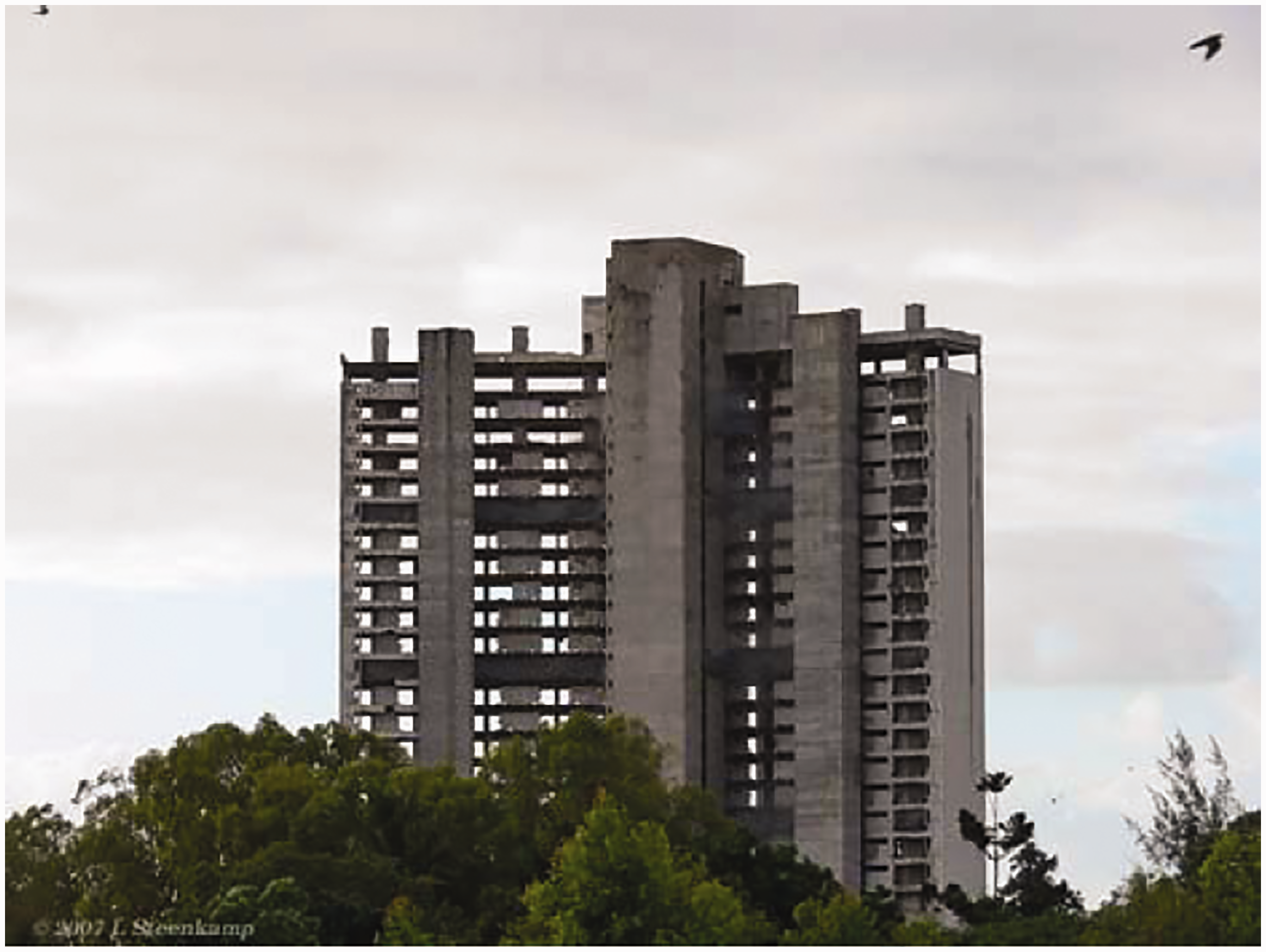
The Four Seasons Hotel before it was demolished on 31 March 2007.
Some believed that the Portuguese had poured wet concrete down the elevator shafts – a parting gift from fleeing settlers designed to render unusable the infrastructure and equipment they were forced to leave behind (Pitcher, 2002: 59). 2 Following the 20–24 order of 1975, settlers who refused to relinquish their Portuguese nationality were given 24 hours to leave the country with no more than 20 kg of personal possessions (Pitcher, 2002: 47). To this day, the Portuguese have remained infamous for their use of wet concrete as a weapon of destruction. Although actual evidence is anecdotal and inconclusive, rumours of concrete violence offer a powerful critique of Portugal’s refusal to meet its colonies’ demands for self-determination (MacQueen, 1997), while also gesturing towards an awareness of the constructive and destructive potentials of concrete. Despite the common metaphor of cement as a binding agent, concrete, like infrastructure more broadly, binds and connects often as it simultaneously excludes and divides (Harvey, 2010; see also de Bruijn and van Dijk, 2012).
The cleared site of the abandoned hotel, a prime real-estate location on Maputo’s waterfront, will soon be home to the new American Embassy Compound (see Figure 2). Allied Works Architecture, the American firm in charge of building the new compound offers the following description on its website: Site-cast concrete walls form the primary structure and extend into the landscape, while a pre-cast brise-soleil of Ultra High Performance Concrete (UHPC) allows in light, ventilation and views that emphasise the landscape’s natural beauty, which transitions from beachfront to forested hills.
3
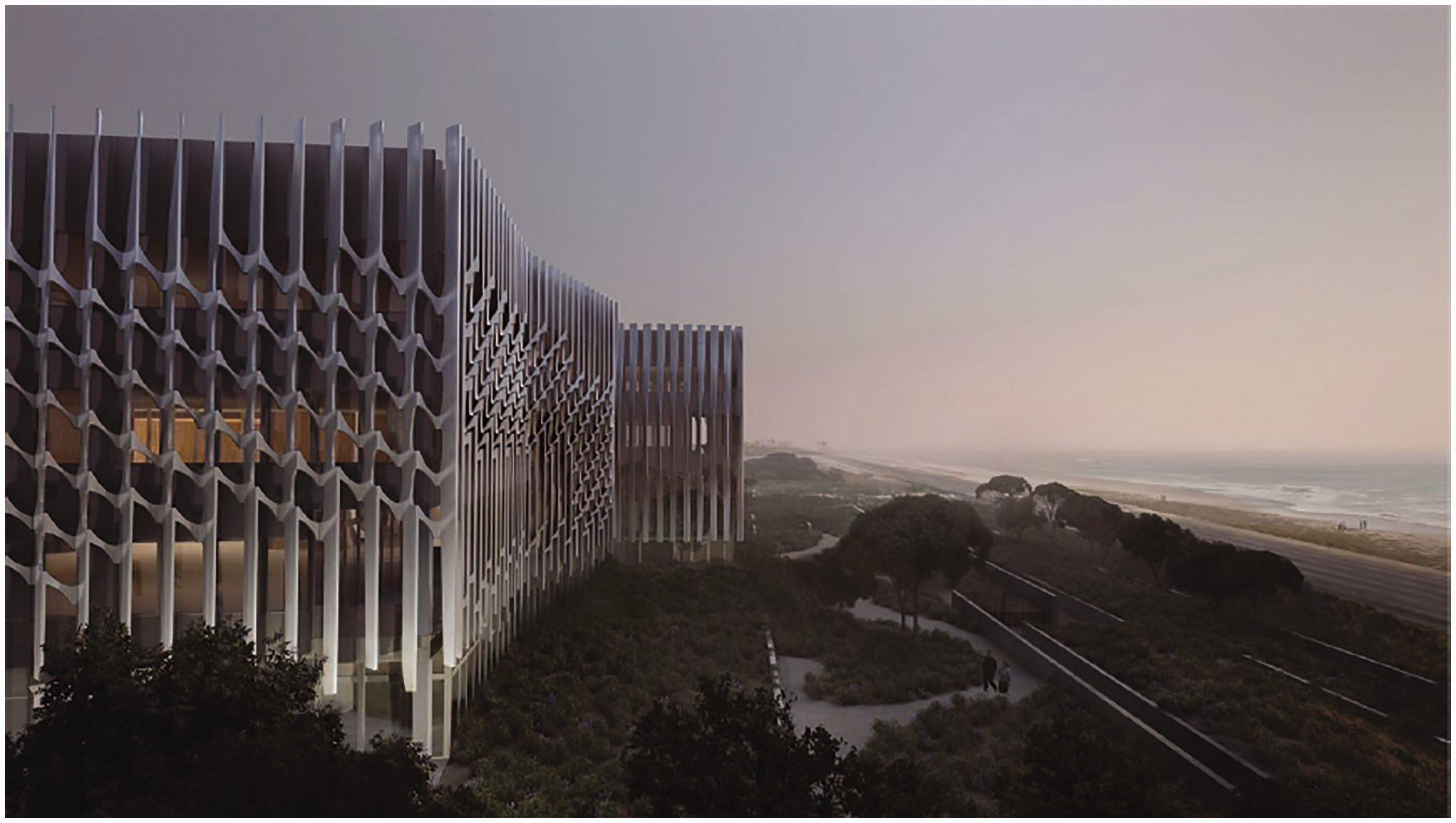
The future US embassy in Mozambique.
In cities all over sub-Saharan Africa, vast quantities of concrete are being used in similarly spectacular, foreign-funded, construction projects, from ring-roads, to shopping malls, to high-rise condominium complexes (Appel et al., 2018; Di Nunzio, 2019; Lufumpa and Yepes, 2017) that are transforming the urban landscape and redrawing lines of inclusion and exclusion, while tapping into imaginaries of progress that have been enthusiastically embraced by people across the continent (De Boeck, 2011; Gastrow, 2017; Pedersen and Nielsen, 2013), and beyond (Harms, 2016). There is also a lot of concrete going toward the thousands of smaller auto-construction projects that are increasingly visible across the landscape, especially the peri-urban landscape.
The construction boom took off at a particular historical moment – often glossed over as ‘Africa rising’ (Brooks, 2017) – when the continent was swept by a wave of prosperity in the early 2010s. In Mozambique, it came at a time of growing inequality and new opportunities, in a post-socialist post-war economy undergoing neoliberalization. The country only gained independence in 1975, after a war of liberation against Portuguese colonial rule waged by the Mozambique Liberation Front (Frelimo). Frelimo took over the country at independence and has remained in power ever since (Bertelsen, 2016). Peace was, however, short-lived, and before long Mozambique was engulfed in a protracted civil war (1976–92) between Frelimo and Renamo (Mozambican National Resistance), a guerrilla movement backed for a time by the settler regimes in Rhodesia and South Africa. Shortly after independence, Frelimo embarked on the socialist modernization of the country and led a continued struggle against what it called ‘the internal enemy’, which included political dissenters and anyone believed to have collaborated with the Portuguese, as well as against institutions deemed counter-revolutionary, such as polygamy and ancestor worship. It also, in the name of service delivery, forced the resettlement of scattered populations into newly created communal villages (West and Kloeck-Jenson, 1999). Renamo was able to capitalize on popular resentment against Frelimo, especially outside its main zones of influence, and attracted some of the people marginalized by Frelimo (Igreja, 2018b: 94). By the end of the civil war in 1992, over 1 million people had lost their lives and another 5 million – more than a quarter of the country’s population at the time – were estimated to have been displaced by the fighting (Myers, 1994: 605).
The signature of the peace accords in 1992, the turn to multi-party democracy, with Renamo becoming the main opposition party, and the liberalization of the economy, came with promises of a peaceful and more prosperous future. In a country that the World Bank had described as having returned to the Stone Age (Hanlon, 2007: 1), things could only get better, and Mozambique was soon hailed as an African success story (Brooks, 2017: 454). However, as reports of deepening poverty among large segments of the population started to emerge, and as the urban poor took to the streets in protest against rising food prices in 2008 and then again in 2010 (Bertelsen, 2014), observers started talking about a more nuanced Mozambican paradox, and of the ‘collapse of narratives of success’ (McKay, 2017). Several observers have similarly reflected on Africa’s ‘seemingly contradictory forecasts’ (Goldstone and Obarrio, 2016: 1).
The shortcomings of the post-war economy were most acutely felt by younger generations (Archambault, 2017). As in many parts of the continent which have similarly undergone substantial state retrenchment and an overall neoliberalization of the economy, the labour market proved unable to absorb the influx of graduates eager to find secure employment (Ferguson, 2015; Pfeiffer et al., 2007). Mozambique did fare relatively well during the so-called global financial crisis, however, and succeeded in attracting foreign investment (Brooks, 2017: 457). The discovery of oil and gas reserves in the north of the country in 2012 then spawned renewed optimism and, before long, Mozambique was boasting one of the world’s fastest growing economies (Smith, 2012), gaining the praise of The Economist (2014) for its ‘stellar economic growth’.
Born during the civil war, the young Mozambicans that I have been following for the past decade shared the fate of young people across sub-Saharan Africa, and beyond, 4 who also faced uncertain futures. For years, I heard them complain about their frustrated aspirations as they struggled to get by, let alone become able and respectable adults (Archambault, 2017). What many emphasized was that they struggled to foresee the day when they would be able to build their own houses and live independently from the relatives on whom most of them depended for their everyday existence. After biding their time for several years, many were, however, eventually able to secure jobs, some as teachers, others as police officers, administrators, drivers, NGO workers and technicians. Then, almost overnight, these young people earnestly started buying cement, making concrete blocks, acquiring land on the outskirts of the city and building their own houses. Mozambique’s claim to the title of one of the world’s fastest growing economies (Smith, 2012) may have had little impact on the lives of the majority. For many of the young adults that I had been following, however, things at this specific juncture were definitely looking up.
In the expanding suburb of Inhapossa, which is situated on the outskirts of the southern Mozambican city of Inhambane, there are piles of neatly stacked concrete blocks everywhere. Everyone is making blocks. People even describe building as being ‘in fashion’ (construir está na moda) (Archambault, 2018). All this fresh concrete exuding promises of a better future is, however, emerging amidst the concrete ruins of a not so distant violent past. Before it became a thriving expansion suburb, Inhapossa went from a scarcely populated peri-urban area to an abandoned and dangerous zone during the civil war. Today, old decrepit concrete houses in various states of vegetalization are still visible across this rapidly changing peri-urban landscape, more than 25 years after the end of the conflict in 1992 (see Figure 3). Unlike the shell of the Four Seasons Hotel, however, these old constructions are not being demolished. Nor are they being refurbished. As obstinate reminders of both an era of relative prosperity, 5 when migrant workers had the means to build concrete houses, and of the years of war that followed, these remains add historical and affective texture to this suburb under construction.

An uninhabited house in Inhapossa.
On walks around Inhapossa, I listened to my companions read the landscape and interpret its histories, as they made assertions based on what they could see. Often, they drew attention to things that I had failed to notice, like perimeters marked by boundary plants, or an abandoned homestead survived only by a cluster of trees. If concrete structures remained, houses built with organic materials, and that were abandoned during the war, had completely vanished. Cassava plants, weeds, shrivelled-up cashew trees that no longer bore fruit, tall palm-leaf fences, family cemeteries with concrete tombstones painted in white and turquoise, winding footpaths and sandy roads – all were imbued with temporal and affective meaning. Trees, in particular, were seen as important temporal markers that dated, albeit approximately, land ownership, while also grounding claims of belonging in more affective ways. For example, Sr. Anastasio, an entrepreneur who was one of the first newcomers to the area after the end of the war, pointed to the three acacias that he had planted in front of his shop as indicators of how long he had been living in Inhapossa, and also of how well established he was, despite not being a nativo, as the original inhabitants of the area like to refer to themselves. My companions offered approximate construction dates of old houses – ‘this one must have been built not long before independence’ – which they also situated within the wider social geography of the region – ‘this one was miner’s house’; ‘that one, the house of a local chief’.
I gathered much of the material on which this article is based on walks around the suburb in the company of some of its newcomer and nativo residents. Most of these walks had a specific purpose and destination, such as visiting a relative or the local administrator, prospecting on a piece of land, going for a drink or two at a local bar or getting to the main road to catch a minibus taxi into town. This ‘walking ethnography’ (Moretti, 2017) allowed me to gain an understanding of the residents’ affective engagement with the suburban landscape that complemented the information I gathered in interviews and through the participant observation of domestic building projects (cf. Meneley, 2019).
An abandoned arms cache was still standing strong, despite the weeds’ efforts at reclaiming the space. No one really talked about it. In fact, no one really talked about the war that much in this part of Mozambique (see Pitcher, 2006). 6 The landscape emerged as a repository of information that could be interpreted, or ignored. Striking, in fact, was how little people had to say about the concrete ruins of the war. Although some experienced the decrepit houses scattered across the peri-urban landscape as haunted, these leftover concrete structures left most people indifferent. Unlike the fresh concrete, which made people fall in love and inspired pop songs (Archambault, 2018), the decaying concrete seemed almost affectiveless.
In an article entitled ‘Life and times of Magda A: Telling a story of violence in South Africa’, Didier Fassin et al. (2008) reflect on the limits of narratives in conveying lived experience. With its nudge to Coetzee’s (1983) famous novel, the piece aims to offer insight into the violence of Apartheid through Magda A’s biographical narrative. The trouble, however, is that Magda remains, as Fassin puts it in a later article, ‘remarkab[ly] silent about the context in which her life was inscribed’ (Fassin, 2014: 45). Fassin argues that ‘Whether agents acknowledge it or not, history is deeply embodied, both objectively through the material conditions in which they live, and subjectively, via the affects, narratives and imagination they produce’ (Fassin, 2014: 45). The question, however, is whether such silence 7 is, as Fassin argues, the result of an ‘unawareness’ 8 or, as Biehl suggests, ‘a profound statement of being-in-the-future’ (Biehl, 2008: 235). I argue, following Biehl, that the general indifference towards the decaying concrete scattered across the suburb of Inhapossa deserves to be understood as shaped by a particular orientation towards the future (cf. McGovern, 2017). In what follows, I propose to approach indifference neither as political illiteracy, nor as silence, but rather as an affective experience in its own right that is entangled in local projects of future-making. I confess that my initial intellectual impulse was to attempt to capture the politics and poetics (Larkin, 2013) of the concrete ruins that I came across in Inhapossa – I found myself moved by these remains, especially by the juxtaposition between fresh and decaying concrete – but I struggled to do so while also staying true to the ethnography. This article is driven by a critical reflection on this tension. I start by briefly examining how ruins have been approached in the anthropological literature, with an emphasis on posthumanist neo-materialist perspectives, and then turn to conceptualizing the notion of indifference. In the main section, I examine how an affect of indifference came to prevail in this Mozambican suburb. I track the origins of the ruins, which I situate within kinship networks in which they operate as a potential source of contamination. I also examine narratives around other forms of decay, arguing that the indifference towards the ruins of the war cannot be seen as a form of ignorance. I argue that, in order to understand how an affect of indifference came to be projected onto, and to exude from, the dilapidated houses of Inhapossa, we need to retrace not only the history of the ruins themselves, but also the projects of future-making that drive the expansion of the suburb. I include elements in support of this argument throughout the article and come back to it in the conclusion.
From nostalgia to indifference
‘Ruinophilia’
Ruins are affectively charged material debris that tend to conjure up anything from nostalgia to abjection, depending on the historical context within which their existence is inscribed (cf. De Jong and Quinn, 2014), depending, also, on whose perspective is taken into account. In Europe, ruins have signalled the birth of modern historicity, conveying a sense of transformation and punctuated progress (González-Ruibal, 2014). Building on Walter Benjamin (1999), scholars interested in post-industrial remains in the former Soviet Union (Pelkmans, 2013), in colonial ruins across sub-Saharan Africa (De Jong and Quinn, 2014; Hecht, 2018), and in various forms of rubble in Latin America (Gordillo, 2014) have reflected on the challenges these remains pose to grand narratives of modernist progress. African artists have also offered powerful critiques of ruination. For example, the Congolese photographer Sammy Baloji (2014) has used layered photographs of the Gécamines to tell a story of prosperity and decay following Mobutu’s takeover of the Belgian company in the 1960s. The South African photographer Guy Tillim (2008) has similarly depicted the decay of colonial buildings across Mozambique in a body of work that offers a nostalgic view of a particular moment of modernist expectations. Ruins emerge not only as remainders of what once was, and of what could have been (De Jong and Quinn, 2014; Stoler, 2013: 21), but also as reminders of what has yet to come (Boym, 2008).
Despite the violence of ruination, there is something quite irresistible, alluring even, about ruins, especially when it seems as though decay and its allies – weeds, the salty sea air, rain and humidity, bacteria and fungi, neglect and time – have poetic intent. Simmel (1958), who was a bit of a ruinophile himself, mused on the role of ‘nature’ in the process of ruination. If Simmel (1958) saw buildings as evidence of man’s victory over ‘nature’, however fleeting, he understood ruins as inhabiting the ‘blurred terrain where nature and culture are not so easily (as if they ever were) distinguished and dichotomised’ (Harrison et al., 2004: 9). Simmel also proposed a typology of ruins based on the level of human intervention at play in their production. In his opinion, the ruins of war were not as romantic, not as aesthetically pleasing, as the ruins of neglect. Although Simmel wrote well before the multi-species ‘turn’, his musings on decay clearly recognized entanglements between ‘nature’, humans and the built environment.
More recently, posthumanist scholars have ethnographically examined the part other-than-human-beings play in processes of decay. In an article on the conservation of an abandoned homestead in Montana, Caitlin DeSilvey (2006) evocatively describes the decay, decomposition and recomposition of stuff in a space long abandoned by its human inhabitants, and the active part played by other-than-human beings (mainly mice and mould) in these processes. Decay and ruination, DeSilvey (2006) argues, echoing Simmel (1958: 381), hold creative potential, and can generate newness. Such emphasis on the generative potential of waste and decay in fostering social relations and inspiring political demands and action (Chalfin, 2014; Elinoff, 2017; Gille, 2007; Harvey, 2017; Reno, 2015) offers an important corrective to more mainstream understandings of waste and decay as either abject or a-social. 9 It is also driven by a broader neo-materialist call to challenge the dichotomy between object and subject and, as it were, between ‘dull matter’ and ‘vibrant beings’; to recognize what Jane Bennett (2010: viii) calls the ‘vitality of material’. Critiques of neo-materialist perspectives, like the one proposed by Gabrielle Hecht (2018), among others (see also Chalfin, 2019), have, however, recently drawn attention to how ‘the joyful connotation [of material metaphors] can all too easily erase the brutal histories and ontologies’ they pretend to capture (Hecht, 2018: 112). These authors point the finger at neo-materialist analyses that gloss over violence with their aestheticizing lens. The decaying concrete on which I focus here is, indeed, anything but joyful.
In Imperial Debris, Ann Stoler (2013) encourages us to look beyond material remains and towards ruination. Acknowledging how we have been ‘schooled to be alert to the fact that ruins hold histories’ (2013: 14), Stoler is, instead, concerned with the ‘occluded, unexpected sites in which earlier imperial formations have left their bold-faced or subtle traces and in which contemporary inequities work their way through them’ (2013: 3); with processes of ruination that continue to shape sensibilities, despite, or in fact precisely because, they are less visible (Stoler, 2013: v). Others speak of the uncanny (Navaro-Yashin, 2012) or of ghostly matters (Gordon, 2008), in reference to what continues to haunt despite no longer being there. If ruination can affect bodies even in the absence of easily identifiable material debris, how can we make sense of instances when, in contrast, highly visible debris does not appear to move those who dwell alongside it?
Gastón Gordillo (2014) has addressed this question in his work in the Argentinian Chaco where he reflects on the difference between his own perception of the material remains of Spanish colonialism and the perception of the gauchos living among them. For Gordillo (2014), ruins are essentially the product of elite sensibilities that transform rubble into something deemed worthy of interest and preservation (see also Rao, 2013).
In her ethnography of everyday affects in northern Cyprus, Yael Navaro-Yashin (2012: 171), who has reflected at length on similar tensions, concludes that affect is simultaneously something that exudes from the ruins themselves, as well as something that is projected onto them by the people who live in and around them. Unlike Bennett (2010), who posits affect as an intrinsic feature of materiality rather than as ‘a separate force that can enter and animate a physical body’ (Bennett, 2010: xiii), both Gordillo and Navaro-Yashin thus emphasize how ruins, or rubble, as it were, can affect different people differently. I wish to further the reflection on this dissonance, not so much by rethinking the category of the ruin, although I find doing so extremely useful, but rather by examining ethnographically the experience of indifference.
In what follows, I therefore resist both an aestheticization and a politicization of matter in an effort to avoid departing from how my Mozambican interlocutors themselves experience building and living amidst the decaying concrete of another era. 10 In doing so, my aim is not solely to stay true to the ethnography but also to show how taking indifference as an affective experience in its own right, rather than as silence or ignorance, can shed light on the subtle ways in which people imagine, build and inhabit new futures.
Indifference
Indifference, which etymologically means not-differing, in the sense of being neither good nor bad, signals an absence of preference and gestures towards an un-moved subject. Indifference is potentially violent, albeit often passively so, as shown so poignantly in João Biehl’s (2013) ethnography of disregard and abandonment in Vita. Indifference can also be an outcome of violence, when trauma not only silences but also numbs. In his study of European bureaucracy, Michael Herzfeld (1993) builds on Weber’s theory of routinization to show how indifference towards the suffering other operates as an instrument of power. Indifference may also be a kind of ‘technique of inattention’ that emerges in contexts of high sensory stimulation (Larkin, 2014) or the more relational outcome of what Danny Miller (2005) calls the ‘humility of things’, that is, the capacity of objects to fade out of focus, to become invisible even while remaining in plain sight. The idea that it is through repeated exposure that certain things start losing their ability to move makes common sense. The more exposed we are, the more immune we become to the affects and effects of things. Medicine, shampoo, a lover … they risk losing their potency, the more we get used to them. Many of the Mozambicans I worked with did, in fact, articulate their experiences with old decrepit houses in the register of habituation. Habituation was, in fact, a process that I often heard young people grapple with in other areas of their lives in this relatively small city where everyone knows everyone (Archambault, 2017). Here, I propose to approach indifference as an affective experience that speaks of a hopeful orientation towards the future. In the following section, I attempt to make sense of how the affects of indifference came to prevail over other ways of engaging with the remains of the war.
The affects of decay in a Mozambican suburb
A brief history of abandonment, pillage and decay
Most of the dilapidated concrete houses of Inhapossa were built in the 1970s, during the decade of relative prosperity that straddled independence in 1975, and are the leftovers of a regional political economy of labour migration. From the end of the 19th century onward, an exploitative labour regime subjugated a large portion of the region’s able-bodied men to work in the mines of neighbouring South Africa (Harries, 1994). As the lingering presence of these houses suggests, however, it was a regime that offered a relatively reliable avenue for social advancement and that allowed migrants and their families to materially improve their living conditions (First, 1983). If these houses were in such a state of disrepair, it was not only because they were old but also because they had been abandoned and then ransacked at the height of the civil war. In the late 1980s, the fighting reached the outskirts of the city of Inhambane and Inhapossa residents were forced to abandon their homes and to seek refuge closer to the city centre.
The wooden doors, window frames and corrugated roofing of these abandoned houses were meticulously extracted, recycled elsewhere or used as firewood – everything was pillaged except the concrete, as there is not much one can do with old concrete, other than break it up and use it as aggregate to make more concrete. Over the years, humidity and weeds have contributed to the further deterioration of the built environment. Trees and shrubs have elected to reside in these abandoned structures, reclaiming some of the space that concrete had temporarily conquered. If concrete rarely has a chance at a second life, it does, in contrast, tend to have a long afterlife.
During the civil war, Renamo was reputed to have engaged in the systematic destruction of state infrastructure, demolishing clinics and schools, while purposefully sparing religious buildings in a bid to gain religious legitimacy both locally and internationally (Lunstrum, 2009; Vines, 1991). In doing so, Renamo aimed to cripple Frelimo’s ability to operate, tarnishing its legitimacy, while showcasing in visually compelling ways its own strength (Wilson, 1992: 540). Renamo would also regularly target communal villages, as this was a form of organization that was associated with allegiance to Frelimo (Geffray, 1990). As more recent accounts have shown, however, the tactics deployed by the two sides of the conflict varied greatly in different parts of the country, as well as over time (Bertelsen, 2016; Morier-Genoud et al., 2018).
Across the country, colonial buildings also suffered damage for want of adequate maintenance, as war, coupled with Frelimo's socialist policies, resulted in severe shortages of consumer goods – including paint and building materials – throughout the 1980s. By the end of the civil war in 1992, 85% of the country’s infrastructure had been destroyed (Hall and Young, 1997).
Inhapossa’s original residents were at first reluctant to return to their ancestral lands. Not to mention that a number had since passed away. It was only nearly a decade later, when people felt confident enough that peace would last, and once the minefields had been cleared, that some started returning for good. At the time, no one could have anticipated that Inhapossa would become the most desirable expansion suburb in the region and that Inhapossa’s nativos would find eager young buyers coming from the overcrowded inner-city neighbourhoods, willing to pay a good price for a piece of land.
Concrete and contamination
By the 2010s, new houses were being built among old decrepit houses that no one dared to either destroy or properly rehabilitate and reside in. Even among the nativo returnees, the ideal was to build a house of one’s own and people only very reluctantly, if ever, moved into the house of a deceased relative. If building was fundamentally aspirational and integral to claims of belonging (Morton, 2015; Nielsen, 2011), the investment in new constructions was also tied to concerns around spiritual contamination. Like other objects that came into close contact with individuals such as clothing, houses were understood to absorb one’s ‘tradition’, one’s occult dealings, and to carry with them the intentions of their previous owner(s). 11 Other people’s stuff was therefore treated with caution, and old concrete houses were, owing in part to their materiality, seen as a particularly dangerous source of contamination. Not only did they resist biodegradation far better than their reed counterparts, concrete houses were also seen as especially dangerous because they would have required far greater sacrifice from their original owner. The general assumption was that it was only through occult dealings, and by having enlisted the help of a curandeiro, the Portuguese term for traditional healer, that one would have succeeded in building a concrete house. And although there were elaborate purification rituals designed to mitigate these risks, most people simply preferred to sleep elsewhere. In fact, it was very common to find a family living in a newly built reed house next to a dilapidated concrete house.
On a walk across the neighbourhood, Neidi, the young daughter of my host family in Inhapossa, shared her thoughts on the decaying concrete that we came across. ‘These old houses are spooky’, she said. ‘Just imagine how many people have lived and died in them … it’s scary [assusta].’ ‘I’d prefer to live in a reed house than in a concrete house that belonged to so many people’, she added. Neidi and her family had moved to Inhapossa a couple of years earlier. They had been living on a small rented parcel of land in a high-density inner-city neighbourhood for over a decade before buying their own piece of land in the suburbs. If my interlocutors were uncomfortable with the thought of taking over a house that had once belonged to someone else, they had no problem recycling parts of a house they had themselves built and lived in. For example, when the family relocated to Inhapossa, they took their old reed house apart and carried many of its components to their new property. They used the old woven palm leaves to insulate their chicken coop. They also reused the concrete that had once served as a floor in their old house as aggregate.
On another walk, I bumped into Jacinto, a young nativo in his mid-twenties who had returned to the area earlier that year to live on his family’s ancestral land. He was marking the boundaries of a parcel that he had recently sold to a young newcomer from the city, someone he knew from school. Jacinto pointed to the place where the homestead in which he was born once stood. ‘By those palm trees’, he specified. As we got closer to the site, we came across the ruins of a small round concrete house. I asked Jacinto if they would eventually sell this parcel as well. ‘No, never’, he answered without hesitation. He then added: ‘There was too much use of the curandeiro. And many people died here. You could never put a child to live here, it would be too dangerous.’ Jacinto’s grandfather, who had recently passed away following a prolonged illness, had confessed on his death bed that he had incurred a significant debt with a powerful curandeiro. The family was planning to use the proceeds of the land sales to settle this debt.
Across Mozambique, the spirits of those who died during the war have been known sometimes to come back to haunt the living. Such encounters, which often take the form of intense bodily experiences, have commonly been understood against the backdrop of a deeply fraught post-war reconciliation in a country where the government’s amnesty law, which precluded prosecution, was designed to encourage silence rather than accountability (Igreja, 2018a; Morier-Genoud et al., 2018). Many war survivors did, in fact, rely on spiritual means in their struggles for post-war accountability and reconciliation (Honwana, 2003; Igreja, 2018a: 172; Obarrio, 2017). In Inhapossa, the spirits involved in the kind of haunting that Neidi and Jacinto described deserve, however, to be understood in terms of a more general, not specifically war-related, cosmology, whereby the dead continue, as ancestors, to exercise power and make demands on the living (see also Igreja, 2018a: 174). The nativos’ ancestors reminded the living of their continued presence, if not always through illness then more mundanely through old houses, as well as through family cemeteries that were commonly built in the vicinity, compellingly showcasing concrete’s affordances in processes of belonging.For the nativos, the ruins were remainders and reminders of lives past, even more than they were debris of the civil war. For the newcomers who rarely had kinship ties in the area, the ruins were entangled in family affairs that did not concern them directly. The threat of contamination, in their case, was therefore essentially theoretical. Although most people would have been reluctant to spend the night in one of these houses, they did not have much else to say about them. Many of the Mozambicans I worked with, whether they were nativos or newcomers to the area, simply articulated their experiences with old decrepit houses in the register of habituation. If the crumbling concrete failed to affect them, it was precisely because they were ‘used to it’, acostumado in Portuguese. 12 Often, they said, more specifically: ‘nos já acostumamos’ (‘us, we are already used to them’), suggesting that this might not have been the case for the anthropologist pestering them with questions.
If the indifference that the ruins of the war inspired came across clearly in Inhapossa residents’ scant exegeses, it also transpired through non-discursive expressions. For example, the proximity of ruins did not affect the value of the land, nor did it come into play in a newcomer’s choice of a land parcel. Buyers were more concerned about other things: flatness, whether there were trees that would provide shade, the likelihood of getting connected to the grid in the near future. And those who did end up building near a dilapidated house did not seem to worry about doing so in a way that would block it from view. In short, the decaying concrete left even those who experienced it as haunted, overall, mostly indifferent, provided, as it were, that they had somewhere else to sleep.
The politics of everyday decay
If my Mozambican interlocutors had little to say about the ruins of the war, they were quite outspoken about their thoughts on other forms of decay. They are surrounded, in their everyday lives, by things that are falling apart, like the minibuses used for public transport, with their ripped upholstery and broken air-conditioning systems, like the school uniform trousers that have been mended and re-mended after being snagged on the way to school, like the cracked plastic bucket used to wash clothes that can now only be filled up to that crack, the threadbare sandals held together with a piece of wire, the mobile phones with worn-out keypads, and the other disassembled electronic devices that carry on working despite having their insides on display. Often this stuff is not even old but was of poor quality to begin with. Often, new things fall apart and deteriorate even more rapidly than older ones. People call the things that fail to pass the test of time, that disappoint in their life expectancy, pirata (counterfeit) or china, which is short for ‘Made in China’, a label Mozambicans allocate to goods of sub-standard quality – whether or not they were actually made in China. Often, they find solace in humour, and turn defects into new affordances. The crappy mobile phone does not risk getting stolen; the torn t-shirt means better ventilation on hot days. Many have a knack for sarcasm and irony. 13
The superior quality of my stuff was not lost on my Mozambican friends. ‘The only problem with your trainers is that they’re a bit dirty, but I can see that they’re “original”’, a young woman once commented on my black leather Vans that have survived several fieldtrips. My bag, my jeans, my sunglasses have all attracted similar kinds of appraisals. And yet, my stuff also takes a beating whenever it accompanies me to Mozambique. The sand, the humidity and the washing powder join their corrosive and erosive powers, and ruin my things; everyone’s things. Even some of the newer concrete houses had already started exhibiting signs of decay. Those built next to colonial-era ones incited informed reflections on the inferior quality and durability of building materials available today. ‘The Portuguese, they knew where to get good things’, one man explained. My Mozambican interlocutors understood all too well the political economy of decay. If the stuff they had access to was of such rubbish quality, it was because of Mozambique’s marginal position in the global economy. They would have agreed with Yael Navaro-Yashin (2012) when she reminds us that: Ruins, rust, dust, and garbage are not material sui generis. They do not just emerge on their own. Rather they are generated through specific social relations between people, materialities, and the built and natural environment. (2012: 152)
Conclusion: Indifference as a hopeful orientation towards the future
The newcomers to Inhapossa, like their nativo neighbours, have not forgotten the atrocities of the war. Many have lost parents and siblings to the conflict; some have lost limbs. But they seem ready and quite keen to put the past behind them and to focus on creating a more prosperous future. If the suburban landscape stood as a repository of information about a fractured past, it was also a speculative space from which young Mozambicans could project themselves into the ‘near future’ (Guyer, 2007). As Goldstone and Obarrio (2016) point out in their introduction to African Futures: ‘present horizons of meaning and conditions of possibility are inflected by various political and economic histories of subjection, misuse, and extraction, but […] these are not absolutely constitutive or determining’ (2016: 11). What truly mattered to my interlocutors at that specific juncture was to build – houses, but also kinship and neighbourly ties. Their prospective, not to say optimistic, outlook fostered indifference toward the material remains of the recent past, as they not only imagined but also constructed a better future. It was the freshly poured concrete, and the bags of cement used to make this concrete, that had captured the imagination of these young men and women whose dreams of a better future, though thwarted for many years, were finally starting to materialize. After years of uncertainty, they had managed to secure jobs and to find the means to move out of the overcrowded inner-city neighbourhoods that had absorbed most of the refugees during the war (Archambault, 2018). The newcomers were also creating new opportunities for their nativo neighbours by buying their land and populating the suburb (Archambault, forthcoming). Indifference, in this case, was neither a refusal to engage, nor simply silence, and certainly not the outcome of ignorance or political illiteracy, but rather an affective experience in its own right that spoke of a hopeful orientation towards the future.
The ways in which we propose to make sense of everyday experience is often quite different to the ways in which our interlocutors themselves articulate how they think and feel about these same experiences. And although one of the aims of anthropology has long been to try and represent the world from the other’s point of view, as an interpretative social science, anthropology has also tasked itself with the role of identifying underlying forces that may not necessarily be visible to those directly involved. Anthropologists also tend to be good at locating experiences and practices within longer histories. Narratives are fleshed out and contextualized, and scant exegeses and silences are commonly filled in by ethnographically informed understandings of the broader context. As the Mozambican case examined here suggests, however, it may sometimes be preferable to take seriously what could come across as absence, and to resist the impulse to ‘fill in’ the gaps. An overemphasis on the politics and/or on the poetics of the concrete ruins of Inhapossa would occlude the affectively subtle ways in which future-making operates in this specific space-time. In approaching indifference as an affective experience in its own right, we not only avoid downplaying the capacity of our interlocutors to think of themselves beyond their own biography (cf. Fassin, 2014: 46), we also complicate understandings of how affects move bodies in contingent and historically inflected ways, including when matter comes across as anything but vibrant.
Footnotes
Acknowledgements
I wish to warmly acknowledge the helpful comments and suggestions I received on earlier versions of this paper that I presented at the Canadian Centre for Architecture as part of the Toolkit for Today Seminar Series in the summer of 2019 and at the departmental seminar in the Department of Anthropology at McGill University in the winter of 2019. I also thank the two anonymous reviewers for helping me sharpen my thinking. I could not have written this article without the guidance and friendship of Mira, Admiro, Neidi, Joaquim, Hernane and the other astute observers in Inhambane who took the time to talk and walk with me.
Declaration of conflicting interests
The author(s) declared no potential conflicts of interest with respect to the research, authorship, and/or publication of this article.
Funding
The author(s) disclosed receipt of the following financial support for the research, authorship, and/or publication of this article: This work was supported by the Leverhulme Trust [grant number ECF-2013-443].
