



Abstract
Over the past decade, Chile has become an important destination for Latin American and Caribbean migrants. In 2022, more than 8% of the population residing in the country were of foreign origin. Since 2018, Venezuelans have been the largest immigrant group, making up 30% of all international migrants living in Chile. This article explores how Venezuelan migrants become citizen-subjects through their residential practices, that is, through actions that symbolically construct their inhabited spaces (neighborhood and housing). Understanding citizenship as a process that implies the ethical formation of the self as a construction of new forms of belonging and political membership, we show how the daily life of these migrants is traversed by tensions surrounding their identity: while in public space they openly affirm their identity as diasporic Venezuelans, in the domestic sphere they hide said identity to accommodate an ideal of citizenship inspired by notions of civility, compliance, and moderation.
Keywords
Introduction
Yuli, a Venezuelan migrant in her late 20s who lived in downtown Santiago, arrived in Chile in 2017 with her partner. Due to the prolonged sociopolitical crisis in her country, Yuli carefully planned her move to Chile. She recounts that she told her partner, “Here we don’t have a future…. I’ll graduate, do my papers [passport, visas, etc.], and we’ll leave.” Then, as soon as she finished her university studies in public accounting and had “all of the papers in order,” they set out on the journey to Chile. The trip took seven days of travel: first by bus to Quito, Ecuador, then by bus to Santiago. In 2019, when we met Yuli, she was working as a manager in a store in Patronato, a well-known commercial district of Santiago. After methodically following Chilean immigration policy rules, she had already received a permanent visa. This allowed her to rent an apartment in the Santa Isabel neighborhood, an area of urban renewal in Santiago’s city center where the presence of Venezuelan migrants stands out.
Aside from labor issues that she had to work through to begin with, Yuli, like many of her compatriots, looked at her life in Chile with a certain optimism; optimism that, from her perspective, could be understood as the result of a series of well-made decisions, the personal sacrifices she had had to make and respect for the duties and obligations imposed upon migrants. If a foreigner meets all the requirements, she explained, the road to a prosperous future would be much easier. Her hope for a better life was presented not only as a prospective and imaginary set of aspirations and desires, but also as a permanent evaluation of the present conditions of existence. In this evaluation, the ability to imagine herself as a citizen—that is, as a member of a political community—was one of the ways that Yuli articulated her ideas about compliance and abiding by the rules: There are certain requirements [for migrants] that you have to meet; if you don’t meet them, you can’t come…. You demand that they treat you at the hospital because you’re paying your bills, you’re complying with everything. [But if] they don’t want to take care of you because they just don’t want to take care of you … well then, yeah, demand your rights because you’re complying with everything…. [You] can’t demand rights when you don’t comply with all of the requirements. (Interview, August 2019)
What are the quotidian practices and ideas of citizenship displayed by Venezuelan migrants residing in Santiago, Chile? In this article, we address this question by examining the residential practices of these actors, that is, by analyzing the actions through which they symbolically construct the places they inhabit (neighborhood and household), as areas of reproduction of urban life (Harvey, 2012; Lefebvre, 1996). Following Ong (1996), we conceptualize citizenship as a simultaneous process of self-making and being made in which migrants, in their construction as citizen-subjects, are imbricated in power relations with a state that defines forms of belonging to the political community. In this process, these subjects not only imagine particular forms of incorporation based on their migrant condition, but also specific modes of ethically understanding the self that are based on a perception of themselves as responsible and self-governing individuals. In this article, we show that Venezuelan migrants, when constructing their ethical-political selves, are traversed by a tension surrounding their identity as migrants. On the one hand, they explicitly affirm their cultural identity and their venezolanidad (Venezuelan identity) through a permanent use of national symbols in neighborhood public space. At the same time, in their domestic life they hide that identity to accommodate an ideal of citizenship anchored in notions of civility, compliance, and moderation.
The migration of Venezuelans to Chile is interesting to analyze due to the magnitude of its growth, the sociological characteristics of the group, and the location patterns they have adopted since arriving in Santiago. 1 According to the most recent Census, 82,998 Venezuelans were living in Chile in 2017. This number grew exponentially over three years, especially once the government introduced migration reforms aimed at facilitating the arrival of Venezuelans and limiting the number of Haitians. 2 In 2018, Sebastián Piñera’s right-wing administration created the Democratic Responsibility Visa. Zenteno and Salazar (2021) point out that the implementation of this visa had two phases. During the first stage of implementation, between April 2018 and June 2019, Venezuelans with an expired passport could request a visa at the Chilean border. In the second phase, from June 2019 onwards, “only those who hold a visa granted by a Chilean consulate were allowed to enter the country” (Zenteno and Salazar, 2021: 4). This latter regulation, however, did not prevent Venezuelans from arriving in Chile. In fact, they became the largest foreign group in Chile reaching 448,138 in 2020 (INE-DEM, 2021), even surpassing the historic and already consolidated Peruvian community. Other groups of foreigners that arrived more or less at the same time—for example, Haitians and Dominicans—follow more “classic” migratory patterns, meaning that their influx is related to the confluence between migrants’ economic needs and the need for workers willing to take on precarious and low-paid jobs in the host societies (Stefoni et al., 2018). These Caribbean populations, in addition to being mostly poor, are thus subjected to explicit forms of housing discrimination, which has forced them to live in run-down areas of the city, both in inner-city slum tenements and in squatter settlements on the outskirts (Pérez and Palma, 2021). In contrast, Venezuelans are characterized as having more economic and cultural capital (Doña-Reveco and Gouveia, 2021). Indeed, this group stands out for being composed of individuals with high levels of education: 50% possess a professional degree, 13% have completed higher technical studies, and 6% have postgraduate degrees (Stefoni and Silva, 2018). In Chile, Venezuelans are thus socially recognized as skilled and entrepreneurial migrants, in contrast to other Latin America countries, where they have been stigmatized as unworthy and undeserving (Roth, 2021).
Venezuelan migration also stands out because of its residential patterns. Many live in middle- and upper middle-class municipalities, such as Santiago, Independencia, Ñuñoa, Estación Central, and Las Condes (Stefoni and Silva, 2018). This explains why more than a third of Venezuelans (34.8%) have decided to rent in neighborhoods of urban renovation, especially in apartment towers located in the central municipality of Santiago. The comuna (district) of Santiago, the foundational area of the city and the space where the principal public institutions are most concentrated, is one of the most dynamic municipalities in the country in terms of real estate. After successive decades of residential “flight,” in the early 1990s the municipality undertook a repopulation project based on an unprecedented urban renewal plan, with financial incentives (subsidies) for purchasing housing, flexible construction regulations, and the liberalization of building heights (Arizaga, 2019). Since then, the district of Santiago has experienced an accelerated process of gentrification in formerly lower middle-class and low-class neighborhoods, motivating the arrival of new residents, many of whom are foreigners (Inzulza, 2016; López-Morales, 2016). 3 In 2021, 226,103 residents of the comuna of Santiago were migrants (INE-DEM, 2022), and Venezuelans made up the largest community, with over 100,000 individuals (INE-DEM, 2019).
In this article we examine how Venezuelan residents in these areas of urban renovation are transformed into “citizen-subjects” endowed with certain ethical and political attributes. In advanced liberal societies, Ong (2003) points out, the transformation of migrants into citizens implies not only obtaining a legal status that guarantees access to rights, but also participation in a moral project of citizenship that seeks to create subjects capable of autonomously conducting their behavior. This article problematizes how, through the symbolic construction of housing and neighborhood spaces, Venezuelan migrants assume, negotiate, and question the political and moral implications associated with their ethical-political subject formation. Specifically, we seek to understand how migrants create new forms of belonging in the political community not through explicit demands for rights or political activism (cf. Bachelet, 2018; Saleh, 2021), but through the ethical formation of the self (see also Lazar, 2013b). In the case of Venezuelans residing in Santiago, the affirmation of migrant identity based on the promotion of an ethic of civility, combined with the concealment of certain elements of identity in conflict with a normative ideal of citizenship, are key in this process.
This article is based on 12 months of ethnographic fieldwork in the Santiago neighborhood Santa Isabel, conducted over two periods between 2019 and 2021. Along with participant observation and informal conversations, we conducted 23 in-depth interviews with Venezuelan migrants (11 men and 12 women), most of whom were between 26 and 35 years old. We carried out interviews and informal conversations in the residences of our informants, as well as in public spaces near where they lived. To protect the identities of our interlocutors, their names have been changed to pseudonyms. However, we use real names when we talk about streets and neighborhoods.
Migration, citizenship, and technologies of the self
Since the late 1990s, Chile has attracted Latin American migrants, a phenomenon that has accelerated significantly in recent years. In 2022, 1,482,390 foreigners lived in Chile, a number more than seven times greater the 187,000 that were living in the country in 2002 (INE-DEM, 2022). 4 The migrant population, therefore, increased from 1.4% to around 8% in less than 20 years. 5 This growth has been accompanied by a diversification of migrant groups. Migration from bordering countries like Peru, Bolivia, and Argentina has been augmented by migration from more geographically distant countries like Venezuela, the Dominican Republic, and Haiti. In numerical terms, the current largest groups are from Venezuela (30%), Peru (16.6%). Haiti (12.2%), Colombia (11.7%), and Bolivia (8.9%), making up almost 80% of all foreigners residing in Chile (INE-DEM, 2022).
The household and residential environment are key to understanding the everyday lives of migrants, as it is their immediate space of socialization (Alexander, 2011; Imilan et al., 2015). Additionally, the house and the neighborhood acquire a dominant value in the construction of social imaginaries about immigration and in the consolidation of new forms of vulnerability to which these groups are exposed (Lukes et al., 2019; Margarit and Galaz, 2018). Since migratory processes tend to jeopardize the lives of migrants, academic research has preferred to examine impoverished residential conditions in both inner-city slum tenements (Contreras, 2011; Pardo, 2020) and in informal squatter settlements located mostly in the peripheries of cities (Pérez and Palma, 2021; Vaccotti, 2017). Less consideration has been given to how accelerated urban renovation processes enable residential experiences through which migrants, actively participating in the private housing market, configure new citizenships. Understanding migration not only as an act of mobility but also of “settlement and habitation” (Sassen, 1999: 6), we ask how Venezuelans are “incorporated” into the host society—that is, how they engage in networks that link them to institutions within and across nation states (Glick-Schiller and Çağlar, 2009: 179–80)—through practices of city making (Glick-Schiller and Schmidt, 2016) in sectors energized by real-estate capital.
The idea of incorporation has long been discussed in the academic literature. The Chicago School, for example, drew on the idea of “assimilation” to conceptualize incorporation as a process of interpretation and fusion in which different social groups in permanent contact with one another would acquire the feelings and attitudes of the other group, thus conforming to a shared and cohesive culture (Park and Burgess, 1924). Defining incorporation as a unidirectional process, this model was widely questioned by proposals that held out the possibility of finding different types and levels of assimilation (Portes and Rumbaut, 2006). In recent decades, the problems of incorporation have become particularly relevant, given perspectives like “transnationalism” (Glick-Schiller et al., 1992); that is, when the phenomena of migration are understood as structured by activities, networks, and patterns built in both the community of origin and the destination. These transnational arrangements, Rouse (1995) points out, have undermined the political domination and cultural authority of the nation state, a phenomenon that has resulted in increased questioning of the modes of political membership that it promotes (Reed-Danahay and Brettell, 2008; Steiner, 2009).
By suggesting the existence of a political community with specific criteria for membership and belonging, the debate surrounding incorporation highlights the question of citizenship. Based on research in political anthropology, we conceive of citizenship as a system of distribution of rights through which, in their quest to manage cultural difference, societies seek to solve the problem of belonging (Holston, 2008; Kipnis, 2004; Postero, 2007). Citizenship is the mechanism through which political communities seek to give shape and content to their identity projects. This explains how, regardless of historical particularities, citizen regimes operate through specific criteria of inclusion/exclusion (Kipnis, 2004). Therefore, citizenship always refers to a relationship between the individual and the political community (Lazar, 2013a; Postero, 2007); a relationship that results from historically situated processes of subject formation (Lazar, 2013a, 2013b) in which citizens not only gain rights, but also ethically construct the self through ethical attitudes toward others and toward themselves (Ong, 1996, 2003).
For anthropologists, citizenship is not a mere legal relationship between the individual and society. Lazar (2013b: 2) argues that citizenship, while alluding to culturally situated forms of political membership, “is a mechanism for making claims on different political communities, of which the state is just one.” Positioning it as a claim or practice rather than a status (Das, 2011; Lazar, 2013b; cf. Walzer, 1989), we conceive of citizenship as a practical arena of “moral and political dialogue and contestation” (Werbner, 1998: 6) wherein the migrant population can dispute dominant regimes that determine similarity and difference. The residential practices of these subjects can give important insight into how, through the quotidian production of the spaces they inhabit and the configuration of new instances of sociability, they construct new forms of belonging. In urbanizing societies, 6 the city has become a strategic locus for reconstructing dominant regimes of citizenship, as it allows excluded populations—such as migrants—to carry out political practices and claim their right to the city (Holston, 2001; Lazar, 2013b; Mitchell, 2003). Cities can thus be seen as “productive spaces for informal or not-yet-formalized politics and subjects” (Sassen, 2002: 4), especially for those who are not granted full membership. In line with other authors, we analyze how actions and discourses around urban life allow the formation of local, residency-based types of citizenship (Caldeira, 2017; Holston, 2001, 2008; Sassen, 2002). However, this article does not focus on the ways that inhabitants claim rights in the public sphere, an aspect that some authors understand as a necessary condition for the emergence of an urban formulation of citizenship (e.g. Holston, 2001, 2008; Pérez, 2017). Instead, we seek to understand how these subjects, while producing their residential spaces on a daily basis through the act of inhabitance (Lefebvre, 1996; Mitchell, 2003), imagine alternative modes of membership and social recognition through the ethical construction of the self. Lazar (2013b) contends that citizenship regimes seek to create particular political subjectivities in order to construct what a society considers a good, virtuous citizen. We understand this phenomenon as part of a process of subjectification by which foreigners become subjects endowed with certain political and moral attributes—a process in which, in addition to the residential practices, the technologies of the self are also relevant (Ong, 2003).
Foucault (2003: 146) defines “technologies of the self” as operations that individuals, by their own means or with the help of others, deploy over their bodies, minds, behaviors, and way of being in the world in order to achieve a certain state of purity, wisdom, or perfection (see also Lazar, 2013a). These procedures which the individual performs upon himself are framed in what Foucault (2005) calls “care of the self,” a specific modality through which individual freedom has been ethically understood in the West. The care of the self supposes, then, a number of actions carried out by the self; actions for which one takes responsibility for oneself, and through which one purifies and transforms one’s self. Projects of citizenship govern through the freedom of citizens by disseminating an ethic inspired by values like autonomy, liberty, individualism, and self-sufficiency (Ong, 2003). This, Ong (1996) says, supposes a set of negotiations and resistance tactics on the part of migrants. Through their participation in public and state spheres—assistance programs, public policies, the judicial system, etc.—they become citizens insofar as they subject their quotidian lives to a system of norms and regulations. However, migrants may question the moral orientations that support these projects of citizenship. In this vein, we describe how Venezuelans inhabiting in the center of Santiago practice new forms of citizenship in their residential spaces; practices through which they construct a political subjectivity by both publicly affirming their migrant identity and accommodating their actions in the domestic sphere to ideals of civility and modesty.
“We’re taking over the center”: Affirmation of migrant identity
Like other areas of the center of Santiago, since the early 2000s the Santa Isabel neighborhood has undergone a rapid process of urban renovation, which has resulted in residential gentrification (López-Morales, 2016). The public spaces of its main streets and avenues—Santa Rosa, Santa Isabel, Eleuterio Ramírez, or Carmen—are mostly made up of buildings up to 25 stories high. In some cases, these constructions are surrounded by old houses whose facades persist as material vestiges of the old urban characteristics of the neighborhood (Figure 1). However, because of the real estate dynamism in the area, it is increasingly common to see rows of up to seven buildings in a single block; buildings that end directly at the sidewalk, leaving a small space of no more than 3 meters for pedestrians. Two tower blocks separated by the facades of older buildings.
In Santa Isabel, the presence of Venezuelan migrants has become as common as the existence of this new residential infrastructure. Day and night, they congregate in the public spaces of the sector, especially in formal and informal venues that sell Venezuelan food and goods. Most of the migrants are young, between 20 and 35 years old, and they intensively use the spaces of the neighborhood, setting “the tone of public life” (Auyero, 2001: 16) of Santa Isabel, a phenomenon that we interpret as one of the ways that these individuals imagine their incorporation into Chilean society. The Venezuelans, in effect, seem proud to wear their national symbols (flags, soccer jerseys, clothing with national colors, etc.) in public spaces. This public affirmation of their national identity is also expressed in the exaltation of “typically Venezuelan” foods and other products. All of this, according to one interlocutor, has resulted in Venezuelans having “taken over” the center of Santiago.
Miranda, a 31-year-old journalist from the state of Lara, claimed that she was one of the first Venezuelans to settle in Santa Isabel. Upon her arrival in Chile in 2015 she lived in Macul, a district on the outskirts of Santiago’s central areas, with her brother. However, she quickly moved to the center of the city in search of a better location and job opportunities. Then, after a short stay of nine months in Peru, in 2016 Miranda returned to settle in Santa Isabel. Regarding her return to Chile, she notes: [I noticed] an abrupt change, from one day to the next, overnight. I arrived in Chile [in 2015] and there wasn’t even flour to make arepas. I didn’t hear Venezuelans in the metro, it was difficult to find someone with a Venezuelan accent in the street. I went to Peru and when I returned [in 2016] it was full, in those 9 months it changed radically, not to mention how it is now…. I noticed it because of the number of Venezuelans there are now, the number of products available … we’ve taken over the center.
There is a strong perception among the neighborhood residents—Venezuelans, migrants of other nationalities, and Chileans—that the first two have “taken over” the residential areas of the district of Santiago. Miguel, a 64-year-old Venezuelan migrant, said that “here we are in ‘Carmenzuela,’” a neologism that joins Carmen—the name of the avenue that crosses the Santa Isabel neighborhood—and Venezuela. The idea that Santa Isabel is a “Venezuelan neighborhood” circulates widely among residents of the sector.
In sociological terms, Santa Isabel is not an ethnic enclave or a “ghetto,” as defined by Louis Wirth (1982). Not only is the neighborhood shared by Chileans and foreigners (Venezuelan and other nationalities), but also the forms of sociability that develop there do not make Venezuelans lose “intimate contact” with other groups (Wirth, 1982: 284). They have, however, brought with them specific forms of occupying public space, which reinforce the “Venezuelan” character of Santa Isabel. This appropriation of neighborhood spaces has been strongly encouraged both through the setting up of small businesses—many of them located on the first floor of apartment buildings—and through the presence of street vendors, especially those selling Venezuelan food. These characteristics are described well by Luis, a young 29-year-old migrant, for whom Venezuelan residents are easily recognizable “by their attitudes, by their way of talking, [and] by their business.”
The rapid growth of formal and informal business directed at the Venezuelan community is, in effect, one of the elements that has made the presence of this group in Santa Isabel more clearly visible.
7
A stroll through streets like San Isidro, Portugal, Arturo Prat, Vicuña Mackenna, or Santa Rosa, at any time of day, is enough for anyone to become aware of the new rhythm of public life that the sector has acquired with the arrival of migrants. Those visiting the neighborhood for the first time can easily identify both small and large stores that offer an array of products, like groceries and prepared foods, of Venezuelan origin (Figure 2). Typical sign for a Venezuelan street food kiosk.
In general, these places have names that reference the Venezuelan origin of their owners like “El Zuliano”, “Los Chamos”, “El Arepazo,” among others. Most offer Venezuelan foods like pabellón criollo (a plate of rice, beans, and meat), hallacas (similar to tamales), cachapas (a type of corn tortilla), arepas (roasted corn flour dough), tequeños (fried dough stuffed with cheese), etc. At the same time, street food has emerged in force, and one can buy from street vendors products similar to those sold in formal businesses, but at a lower price. These food stands are placed in the small spaces that separate the tall buildings from the street. Most are metal carts that include griddles, grills, and compartments to store food (Figure 3). Other more improvised stands are constructed with refurbished shopping carts. Whatever the grade of sophistication of each cart, all have colorful signs, adorned with the national flag and usually including the adjective “Venezuelan.” It is also not unusual to see vendors wearing Venezuelan soccer or baseball team shirts, hats, or sweatpants that allude to the country, leaving no room for doubt about the origin of their products. Venezuelan street food vendor and van.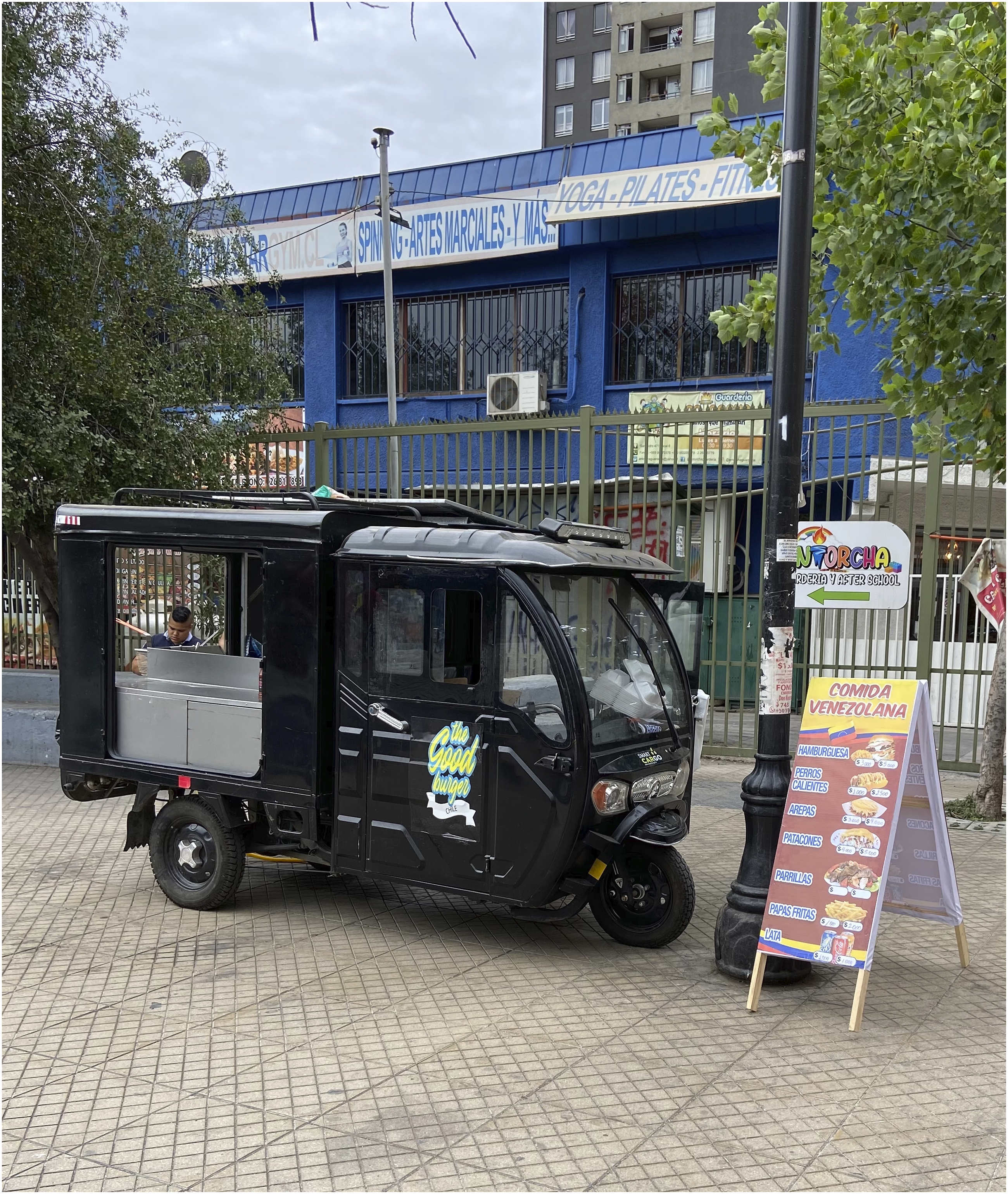
The street food stands not only reveal the visibility that these national symbols have acquired, but also the type of sociability that is generated there. Around the food carts, especially on Fridays and weekends, vendors set up makeshift lights, chairs, and benches where dozens of migrants gather to eat, listen to music, and talk. In these spaces, migrants meet with old friends and family, or make new friendships. There they talk about work, family problems, politics, or as we saw frequently after 18 October 2019, the effects that the Chilean social uprising could have on the domestic economy of migrants. One Venezuelan hamburger vendor said that, at her stand: “they eat, they dance, they sing, and they cry,” alluding to the fact that these sites rarely serve an exclusively commercial function. Jon, a 27-year-old man from Caracas, explained his presence at the food stands in this way: Sometimes you come home [to the apartment] and it makes you hungry. You go down [from the building] and it’s easy because it’s right there. I don’t know if you’ve noticed that Venezuelans are like very happy, [so] you go down there and meet people. You arrive and eat two hotdogs, and with that you gain two hot dogs and three new friends.
We understand the visibility that the Venezuelan flag has acquired in the Santa Isabel neighborhood—which I usually present in public gatherings like those described above—as a form of identity affirmation anchored in a dispute over the meaning of the nation, and as a means of configuring new imaginaries of belonging. In a context where Venezuela has become the Latin American incarnation of a socialist project, migrants living in Chile conceive of themselves as exiled subjects who must take a stance against the political and ideological orientations that their country has taken. In fact, in our observations of the practices surrounding street food it was common to hear discussions about the political situation in Venezuela, such as protests against the government of Nicolás Maduro or the uncertain future of Juan Guaidó, leader of the Venezuelan opposition. In relation to the Venezuelan political crisis, many of our interlocutors expressed their opposition to chavismo—Hugo Chávez’s socialist project—and left-wing agendas in Chile and elsewhere in Latin America. However, it would be a mistake to assume that all of them were rightists. As Kendzior (2011) shows, groups who have experienced diaspora and exile are composed of individuals with indefinite, diverse and antagonistic political positions, which are exacerbated in political climates where distrust and uncertainty prevail. In that sense, our informants’ discourses against leftist governments seemed to be less the result of a cohesive, consistent right-wing political identity than the response to a government that they perceived as the main cause of their forced displacement from Venezuela.
The constant emphasis that our interlocutors placed on their national origin thus sought to expand the limits of their “imagined community” (Anderson, 1991) toward borders that go beyond the nation state. By understanding themselves as Venezuelans in exile, they could imagine situated forms of incorporation into Chilean society vis-à-vis the recognition of their condition as subjects in diaspora who, at some point, could return to their homeland (see also Zenteno and Salazar, 2021). This process of affirming their own identity was not, however, without conflict. Although they were able to display their venezolanidad without any problems in public space, this did not apply when “eat, dance, sing, and cry”—to paraphrase the street vendor—was moved to a private environment governed by strict regulations.
Concealment and the ethics of civility
For our interlocutors, residing in apartment buildings implied submitting oneself to a series of rules and regulations that, in practical terms, began to govern them even before they came to inhabit the dwellings. Daily life for these residents was marked by a preoccupation with following rules imposed on tenants to assure their permanence in the buildings and take advantage of the centralized location that they provide. To deal with this concern, our interlocutors resorted to two different but convergent practices: on the one hand, they concealed their migrant identity so as to camouflage actions that could be disruptive; and on the other hand, they configured an ethic of civility and moderation, in order to provide a moral justification for their concealment of identity.
In diverse and complex societies, the idea of civility, one of the principal virtues promoted by liberal citizenship (Kymlicka, 2001), allows for the coexistence of individuals with different moral understandings of good (Risør, 2018). More than an inherent condition of these subjects, civility is a performance made concrete in the capacity for self-control, restraint, and tolerance among the hierarchies that frame our differentiated forms of belonging (Risør, 2018). In the case that we analyze, it is precisely these quotidian performances of restraint and accommodation that made it possible to make sense of the identity concealment of our interlocutors.
Apartments in urban renewal areas are often the property of small Chilean investors. As part of an emergent rentier class (Vergara et al., 2021), these proprietors obtain permanent income from renting apartments—in most cases one, two, or three bedrooms—to Venezuelan migrants. Unlike with other more precarious forms of housing, such as inner-city slums or peripheral informal settlements, migrants seeking housing in neighborhoods like Santa Isabel must show a series of documents. Two of the most important are employee contracts and paystubs, papers which easily evidence the migration status of these subjects and their ability to pay. They are also required to put down one or more months’ rent as a security deposit to pay for potential damage that they may cause during their lease period. Although we witnessed some forms of subletting between migrants themselves, the existence of these formal requirements generated widespread anxiety among our interlocutors, who worked hard to follow the clauses laid out in the lease contracts. These requirements, for example, put limitations on the number of people that could live in each apartment; they laid out the prohibition on modifying some of the décor of the dwelling, like the wall color, as well as the objects that could or could not be hung on the walls; or they simply emphasized an obligation to tell the owner about any modifications that the renters wanted to make to the interiors of their homes. Although we note complaints on the part of migrants about some of these regulations, we didn’t document any resistance or direct contestation of them beyond some everyday disagreements.
The regulations became more tangible, however, when the migrants began to occupy their apartments, since each resident had to follow the rules of the co-ownership regulation (reglamento de copropiedad). In Chile, every building must abide by Law 19.537 of Real Estate Co-ownership, a law that seeks to regulate coexistence between residents and make property management more effective. It requires that buildings have a set of co-ownership regulations, which functions as a body of norms related to the internal management of a building and the promotion of good cohabitation among neighbors. In the case of the proprietors that we met, co-ownership regulations served to delimit the possible uses of space and the behavior of residents in common areas like hallways, elevators, recreation rooms, swimming pools, and barbecue areas. They also sought to maintain the “image of the condominium”—a phrase taken verbatim from one of the buildings that we visited—which established a series of restrictions regarding the behavior of residents inside of their apartments. They prohibited, for example, activities such as using the balconies for storage, hanging clothes on balconies, or throwing objects from windows into the streets. The administration committee, headed by Chilean apartment owners or external companies specially hired for this task, oversees compliance with norms. In practice, regulations were applied by janitors (conserjes), following anonymous complaints from neighbors about residents who had breached any rule. The sanctions for non-compliance with regulations ranged from a verbal reprimand to a fine, and these were added to the fees (gastos comunes) that residents must pay every month for upkeep of the common parts of the building.
Just like in public spaces, Venezuelan migrants would often violate the rules of the building cooperative. However, unlike what we saw in the streets, on corners, and in plazas, here our informants eagerly promoted an ethic of accommodation and concealment. Rather than an open, contestatory affirmation of their identity, they deployed a series of actions and discourses of the self—what we described above as “technologies of the self” (Foucault, 2003; Lazar, 2013a)—through which they sought to adjust their behaviors according to building rules. The goal was twofold: our interlocutors sought to submit what they understood to be properly “Venezuelan” to a moral code of restraint, civility, and adherence to local customs; and, at the same time, they sought to ethically construct their subjectivity to imagine alternative ways of belonging as migrants.
Cristina, a woman of 34 from Puerto Píritu, assured us that Venezuelan families are very close, gregarious in nature, and tend to form large groups. “My dad,” she told us, “is like a father hen, he’s a very good host. Everyone would come to my house [in Venezuela]. Here [in Santiago] it’s the same.” After her arrival in 2016, several of her cousins, aunts, and uncles took the same path as Cristina and decided to migrate to Chile. Excitedly, she told us that a few days before our interview the whole family was united in her apartment for a traditionally Venezuelan gathering. “I took count and there were 22 of us [in her apartment], although it was a tight fit.” She said that one of her cousins made a fosforera (a seafood soup) and that they also played music, danced, and had a bochinche (party). When asked about the frequency of these activities, Cristina added that “we Venezuelans are relaxed, calm, bochincheros [good for partying]. When my father arrived, I told him that ‘[he should leave] early because they complain about the noise.’”
As Cristina indicated to her father, many other Venezuelans reported feeling restricted in their quotidian forms of inhabiting domestic space. Andi, 26 years old, stated that because of the lease, “you can’t do a lot of things [in your home].” According to him, economic sanctions were the form of control most used by administration committees. One of the most frequent for Venezuelan residents was for “bothersome noise.” Generally, these were applied when, in the opinion of the neighbor complaining, the music or voices of the people participating in a “bochinche” exceeded the maximum allowed. In Andi’s words: Here the issue of co-ownership regulations, fines for noise complaints, is a lot … one time we were singing karaoke and the janitor came to give a first warning, if the noise continued for more than 10 minutes, we would get a ticket.
For our interviewees, the “bochinchera” customs reproduced in the buildings of Santiago Centro had a purely cultural explanation. For Barth (1976), ethnic groups are defined less in relation to a series of common features and objectives than in terms of how their members define cultural boundaries. In this vein, our interlocutors conceived the disruption of their practices as the result of an ethnic difference between a sober and modest tradition like the Chilean one, and another that is bochinchera and party-loving like the Venezuelan one. Raimundo, a 31-year-old Venezuelan, understood it in this way: “Venezuelans tend to be a bit more partiers, or they speak louder than Chileans.”
Among migrants, this way of differentiating “the Chilean” and “the Venezuelan,” far from being used as a mode of ethno-national affirmation, brought with it a set of criticisms of elements understood to be characteristic of venezolanidad. By questioning their “own culture”—those elements that reflect ethnically based interpretations of cultural differences—our interlocutors deployed a series of incorporation tactics inspired by values of respect, responsibility, and civility. To account for the quotidian conflicts that emerged due to “bochinches,” Andi said that “the problem is that Venezuelans don’t respect anything,” suggesting a certain inability of some of his compatriots to adjust to the Chilean context. “There really is no respect … we have friends who are used to that [bochinchero] way of life,” he added. In the same vein, Miranda, when recounting a previous experience as a resident of a tall apartment building, argued: [In the building you would hear] only Venezuelan music … it was annoying to live with the ‘vices’ of the Venezuelans, like talking too loudly, not respecting schedules…. I had a next-door neighbor who had gatherings every night and would be causing a scandal among other residents at midnight, and little by little he calmed down, or they moved or they began to understand a little of the new dynamic that they should have.
In a context that requires new cultural codes and learning “the new dynamic,” to paraphrase Miranda, the idea of acting with modesty and civility is frequently employed by migrants to make sense of their daily life and imagine their incorporation into the host society. “I do ‘bochinche’ too, but I do it in moderation,” or “I’m Venezuelan, but I prefer discretion,” were some of the answers we got when interlocutors shared their opinions about daily conflicts they faced with neighbors. However, the response to the cultural shock that they reference isn’t resolved through a negation of their identity, but through a series of practices of subjection of the self to the local “culture”: a technology of self-governing through which our informants imagined culturally situated forms of incorporation, rather than a total assimilation into the host society. In the words of Jonás, 27 years old: “we try to put a little color [into life] and bring our traditions … [but] you’re also seen as scandalous, very noisy, and it has been a little difficult to adapt.”
Before moving into her current home, Yuli lived in another apartment in the Santa Isabel neighborhood. When accounting for her life in this latter place, she told us that it was “very noisy” because “the apartment faced the street and buses passed all the time.” She normalized such an experience, as if bearing that type of noise was common, only to be expected, an issue that residents of a congested city like Santiago have to undergo. Things were different, however, when it came to describing what it was like dealing with her Venezuelan neighbors. Like Jonás, Yuli conceived of her compatriots as individuals who, not used to following local cultural norms, had to discipline the self. In doing so, they could virtuously integrate themselves into Chilean society, which necessarily involved the strategic concealment of practices understood as properly Venezuelan. What was necessary, thus, was to be “more discreet” and “go unnoticed” (pasar desapercibido): A lot of Venezuelans lived in that area…. I’m not against them, because obviously we come from the same place. But many of them do not realize that they are in another country…. You have to go unnoticed [pasar desapercibido]…. If you have visitors in your house, you don’t want them to make trouble, make noise. I feel that sometimes many Venezuelans are like that and make other Venezuelans look bad…. In Venezuela we have a totally different culture…. [Venezuelans in Chile] listen to music too loudly and make a lot of noise on the streets, as if they want to be seen…. [My old neighbors] used to party a lot. It’s not bad if you do it on weekends, but I could hear the music from their apartment when I got home at 6:00 p.m. on weekdays. I think that you have to be more discreet.
Conclusions: Migrants as citizen-subjects
The arrival of large numbers of Venezuelans in Santiago, a process framed by a big increase in immigration to Chile since 2018, has significantly transformed the urban landscape of the city. Not only has it culturally diversified neighborhoods in the city center but it has also fostered the emergence of new citizenships, in which these subjects, in addition to ethically forming the self, generate specific forms of belonging, recognition, and incorporation. In this article, we show two distinct modes that frame their construction as citizen-subjects. First, we gave an account of the open and explicit affirmation of Venezuelan migrant identity, a phenomenon observed especially in the public spaces of the Santa Isabel neighborhood. Then, we describe the concealment of Venezuelan identity to promote an ethic of accommodation, and the actions carried out inside the apartment condominiums where they live. The first aspect we understand as expressing not only a claim to the right to participate in social life as migrants, but also a cultural and political resistance to the impositions that govern the use of public space. The second we interpret as indicative of ethical practices of the self, through which our interlocutors subordinate their subjectivities to the external conditions that constrain their possibilities of action in the world.
We argue that both cultural affirmation and identity concealment on the part of Venezuelans are modes of action that, following Ong (1996), demonstrate the simultaneous process of self-making and being made that traverses the transformation of migrants into citizen-subjects; processes developed through the immersion of these subjects in power relations both in the state/public domain as well as in private housing markets. As our interlocutors described, the Venezuelans actively seek to “take over” neighborhood public spaces and, in so doing, they proudly displayed those elements that identify them with their political community of origin. This way of constructing their public subjectivity, however, is complemented with practices of ethical construction in the domestic sphere wherein, instead of pushing back against cultural impositions, they ethically submit the self to dominant ideologies of civility, modesty, and individual responsibility.
In the process of self-formation and being formed, the equilibrium between the self and others continuously escapes the control of social groups, giving rise to all kinds of creative tactics and responses (Course, 2013). This is especially evident in migratory contexts, wherein tensions surrounding identity permit the emergence of a diversity of forms of incorporation—public and private, individual and social—in host societies. Although some authors have already established that citizenship is more of a practice rather than a fixed legal status (Das, 2011; Lazar, 2013b), it is necessary to explore which elements give form to the cultural content of said practices and what kind of subjectivity emerges in each case.
The ethnographic analysis of the formation of citizenship does not end, then, with the study of claims, insurgencies, and demands for rights (e.g. Bachelet, 2018; Holston, 2008; Pérez, 2018; Postero, 2007; Saleh, 2021). In relation to this, Lazar (2013b) affirms that political anthropologists have contributed to denaturalizing liberal formulations of citizenship by interrogating the actual constitution of membership and subjectivity in particular historical circumstances. In doing so, they have not only questioned normative approaches to citizenship, which tend to connect it to the act of demanding rights, but have also helped to account for new political communities such as the city. Urban citizenship, Holston (2001: 340) argues, “does not obliterate the importance of the nation-state in continuing to sustain a type of citizenship.” International migrations are indicative in this regard, as non-nationals—especially undocumented immigrants—usually face serious difficulties when it comes to accessing fundamental rights. The dominance of national citizenship, however, has not prevented migrant populations—like Venezuelans in Chile—from performing ethical practices on the self as a way to negotiate their membership in the host society. The way migrants imagine forms of belonging certainly depends on their differentiated aspirations. They could either wish to stay in the receiving society or move to another country, as young Venezuelans often told us, or they might hope to return to their homeland as soon as the political crisis ends, as the older ones hoped. In any case, it is necessary to analyze citizenship by situationally examining the scope and implications of those processes of ethical-political subjectivity construction. Being just as creative as political activism, such a process of subject formation can provide insight into how migrants and other vulnerable groups redefine the social hegemonic forms wherein the problems of membership, similarity, and difference are managed.
Footnotes
Acknowledgements
We thank Tyanna Slobe and the two anonymous reviewers for their comments and suggestions.
Declaration of conflicting interests
The author(s) declared no potential conflicts of interest with respect to the research, authorship, and/or publication of this article.
Funding
The author(s) disclosed receipt of the following financial support for the research, authorship, and/or publication of this article: This work was supported by the research projects ANID/FONDECYT 1210743, ANID/PIA/SOC 180033, and the Center for Social Conflict and Cohesion Studies (ANID/FONDAP 15130009).
