



Abstract
The dynamics of spatial hierarchical processes displays fascinating images of the evolution of attraction basins of towns. Assuming in the present paper a random character of such complex processes, gravitational modeling is employed to depict changes in the nature of fuzzy boundaries between attraction basins in a hexagonal world, i.e. the geographical pattern central in the renowned and influential Christaller–Lösch central place theory in geography. The paper presents various interesting stylized maps of such stochastic processes. Our findings demonstrate that the collective behavior of actors in geographic space shows a white noise pattern that mirrors a fuzzy gravitation towards large population concentrations. These results support the validity of the conventional central place theory.
Keywords
Order must be done. Disorder takes place on its own. Tadeusz Kotarbinski (1886–1981) Polish philosopher.
Introduction
Spatial-economic landscapes display an unprecedented variety of complex geographical configurations, ranging inter alia from rural to urban patterns and from villages to mega-cities. This seemingly chaotic constellation of the economic geography of our world incorporates a hidden multi-layer hierarchical structure that has been uncovered in the context of Zipf’s Law (Zipf, 1949), Gibrat’s Law (Gibrat, 1931) or Reilly’s Law (Reilly, 1931).
Essentially, the empirical city size distribution in a country follows usually a power law, while the size of a city is proportional to its rank. The conceptual-theoretical framework underlying such hierarchical spatial residential and industrial location patterns can be found in the early seminal work of Christaller (1933), Lösch (1954), Tinbergen (1961), Pumain (2016), Cottineau and Morphet (2016) or Ikeda and Murota (2014), and is known as hierarchical spatial systems theory or central place theory (CPT). This framework of systemic spatial decomposition and interaction has been used numerous times in both descriptive and analytical studies in geography and spatial economics, as well as in normative planning studies for land use, urbanization, transportation and trade policy. A recent review by Banaszak et al. (2015) offers a concise overview of the state of the art of advanced research in this field, while in this publication also a novel approach to dynamic spatial-economic hierarchical landscapes is advocated by addressing explicitly the time dependency of spatial hierarchical patterns. Particular attention is paid in the latter study to the emergence of fractal chaos in such complex spatial systems.
The present paper offers new perspectives on the complex spatial-economic dynamics of our planet. Complex spatial systems with interdependent actors or interacting socio-economic units tend to exhibit usually an organized hierarchical pattern in the distribution of the size of these constellations (Arlinghaus, 1985; Batty, 2006; Brakman and Garretsen, 2005; Brakman et al., 2009; Nijkamp et al., 2015; Ponsard, 1983, 1988; Pumain, 2006). Well-known examples, often tested empirically, can be found in the rank-size configurations of cities in geographical space (referred to also as the CPT or Christaller–Lösch model), as well as in the spatial–industrial organization of interlinked firms with different size classes. Clearly, similar regularities can also be found in living systems, such as ecosystems (e.g. predator–prey systems). Such dynamic systems have in recent years received a great deal of attention in complexity analysis, while statistical tests on the rank order and spatial structure of interdependent spatial entities can be found in particular in the above mentioned well-known Zipf Law and its brother, the Gibrat Law.
There is an avalanche of literature on the statistical-econometric mapping and testing of hierarchical regularities among spatial actors or units in a complex spatial urban or regional and industrial world (see e.g. Batty, 2013; Reggiani and Nijkamp, 2014). Thus far, much less attention has been given to the underlying complex dynamics in shaping such rank-size or hierarchical patterns. The present paper aims to advance the analysis of complex multi-level systems in geography by addressing in particular the randomness in the dynamics of settlements (places, cities, socio-economic landscapes) from a spatial perspective (including geographic frictions and opportunities), using simple equations of motion for dynamic systems. The basic idea to be developed here is the impact of dynamic changes in a spatial system that is governed by gravitational forces. A novel element is formed by a systemic approach incorporating a Brownian motion with white noise, with a view to the examination of robustness in complex hierarchical spatial systems. The challenging question here is whether a random behavior of actors in geographic space still tends to induce a hierarchical structure, similar to the hexagonal spatial pattern assumed in CPT (without a city in the center) or racetrack patterns as it is comprehensively presented in refs (Brakman et al., 2009; Forslid and Ottaviano, 2003; Fujita et al., 2001; Ikeda et al., 2017).
The structure of the paper is organized around the concept of gravitational attractors, white noise, fuzzy gravitation and spatial entropy.
Gravitational attractors
An attractor is an area of the convergence of trajectories of a dynamic system that start in various points of a phase space. A gravitational attractor is an area of attraction of trajectories whose source is the force of gravity. The theory of geographical potential is an important component of socio-economic geography (Janowski, 1908/2013; Nijkamp and Reggiani, 1988; Pumain, 1982; Reggiani and Nijkamp, 2014; Stewart, 1948; Wilson, 2009). In a previous study (Banaszak et al., 2015), the authors have demonstrated that hierarchically organized spatial systems (or CPT-like systems) display in a dynamic context a fractal structure of spatial interactions (for example, in case of cities). Classical, gravitational laws of motion appeared to confirm the presence of deterministic chaos and showed that urban areas characterized by distance friction and interaction can be described as gravitational attractors, as in the case of natural systems (see Nijkamp and Reggiani, 1992).
For the readers convenience, we will briefly repeat here the equations the previous study (Banaszak et al., 2015). The attraction forces leading to spatial agglomeration can be derived from a gravitation-like potential (Benguigui et al., 2009; Peitgen et al., 1992; Reggiani, 2009). This potential U(r) can now be described as follows:


The geometric assumption on the hexagonally organized structure of cities (or places) and the deterministic nature of the movement in this system appears to play an important role in explaining the processes of concentration and dispersion of economic and societal activity in the relevant socio-economic space. However, it is clear in many fields of science that full determinism does neither occur in natural, nor in socio-economic systems. Therefore, in the present study, hexagonal spatial systems will be viewed in a dynamic and stochastic perspective on spatial hierarchy. We will present here a stylized configuration.
Figure 1(a) is a picture of the complex interactions generated by six cities of equal mass in a hexagonal system. This picture is a result of solving Newton’s equations of motion using the gravitational potential expressed by equation (1). The question is now: what is the possible trajectory followed by an agent attracted by one of the six cities? This dynamic attraction mechanism is now presented in Figure 1(b). The agent starts from a field very close to the blue city. He is attracted by it, but at the same time also by the remaining cities. Hence, despite the small distance to the blue city, he is not directly and structurally attracted to it, but appears to move towards the red city, and then goes back to the blue city, which finally manages to catch him. His trajectory and the field from which he started are marked in blue. The next – neighboring – field from which the agent starts lies at an infinitesimal distance from the first one. His trajectory now runs successively towards the cities: blue, red, gold, and finally to the green city. The green color marks his trajectory and the field from which he started. The same mechanism applies to the red and other trajectories plotted.
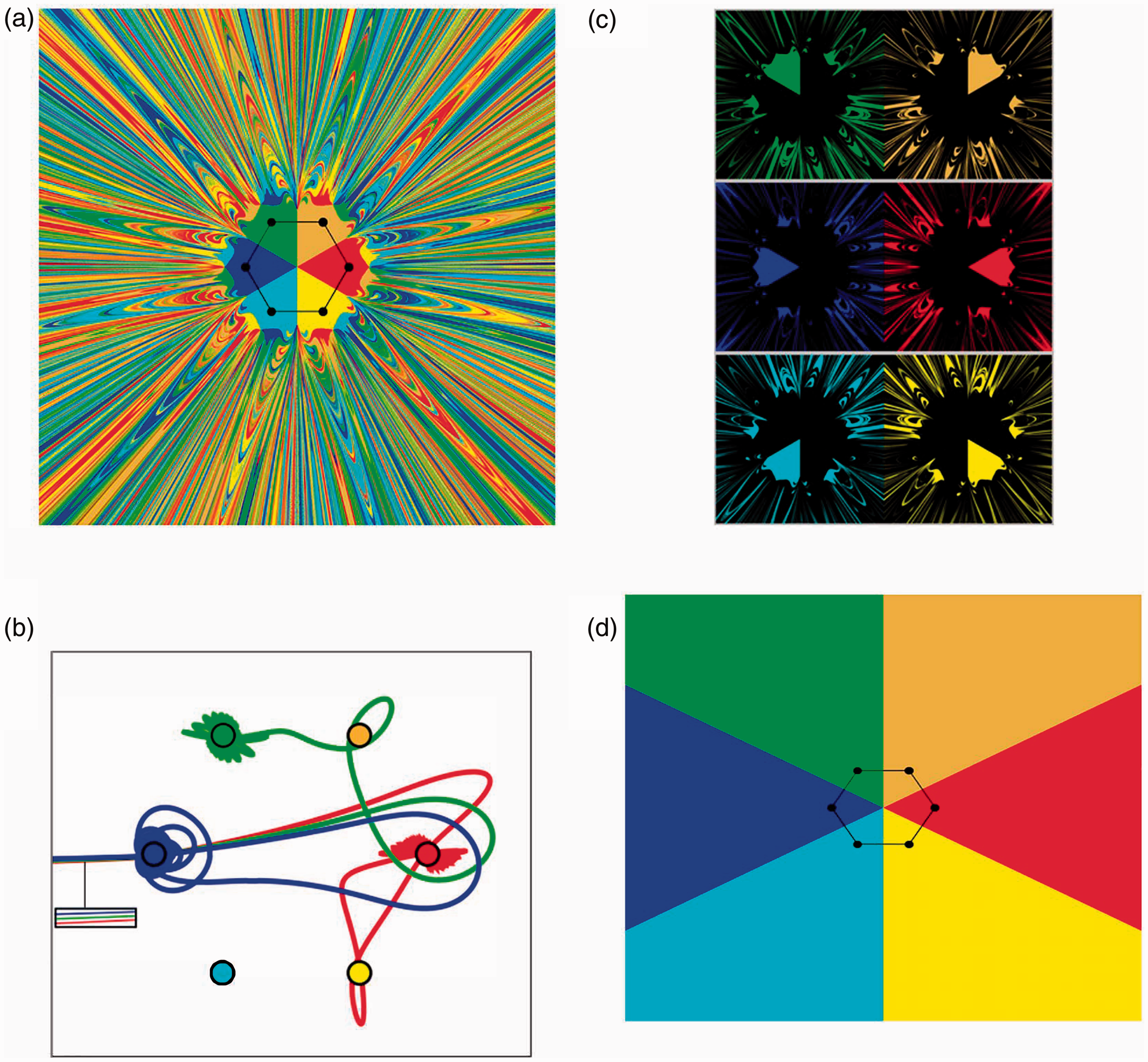
Hexagonal systems in motion: (a) chaos and order in a hexagonal system of cities of equal masses (μ = 0.1); (b) areas of domination of an individual city; (c) deterministic trajectories generated by Newtonian equations of movement; (d) order in a hexagonal system of cities of equal masses (μ = 0.7).
Figure 1(c) presents next the attractors and attraction layers of all cities under consideration. These are their attraction ‘kingdoms’ with a fractal structure. It can also be readily observed that they are a product of deterministic chaos, because both the attractor and the attraction layers have an identical – though complex – geometric structure. This corresponds to a situation when the agent’s movement in space meets with a minimum of friction. This is formally represented in equation (2) by the parameter μ (in an economic interpretation, this represents generalized transport costs). Figure 1(a) to (c) has been created for μ = 0.1. If the friction values rise – i.e. in an economic context, if transport costs go up – then there will be full order in the spatial-economic interaction system, as is illustrated in Figure 1(d), for a value μ = 0.7. This means that the agent will always be attracted by the nearest city and will never leave its gravitational attractor. He will remain in his zone of influence (see the colored sectors of the individual cities in Figure 1(d)). One should also observe that the boundaries of the sectors of the neighboring cities run exactly midway between them. This appears to be identical to the spatial equilibrium anticipated by Christaller’s early contribution to CPT.
Gravitational attractors and white noise
As mentioned above, in reality, spatial socio-economic processes tend to exhibit complex evolutionary patterns that have a random rather than a deterministic character.
This random character of processes can be described using a method of Brownian motion with a white noise (Reichl, 2016) which is a well-established mathematical model representing phenomena which are random by their nature. The concept of white noise was used by Einstein (1905) to account for the microscopic movements discovered by Brown, known as Brownian motions. In this method, random directed forces act on agents. Every direction of forces has the same probability. Hence the sum of all white noise forces is equal to zero. There is no external force acting on the system. The chaotic behavior in this case is a result of locally acting random forces. Moving agents which are attracted by cities (by means of gravitational forces) experience also other forces that are directed randomly. Hence the trajectory of a moving agent in this case is not smooth. It is rather irregular and unpredictable.
Would that change the organized structures of spatial hierarchical systems? This is the key question here. In order to take into account these random effects, we introduce Gaussian white noise η(t) which represents stochastic forces (Allen and Tildesley, 1989; Diebold, 2007; Frenkel and Smit, 1996) acting on the spatial system concerned:



The main aim of this paper is now the identification of salient spatial differences between ordered hexagonal systems of cities (as a result of a chaotic deterministic process, Figure 1(a)) and the same spatial system impacted by disturbances from stochastic factors (model (3) and Figure 2).
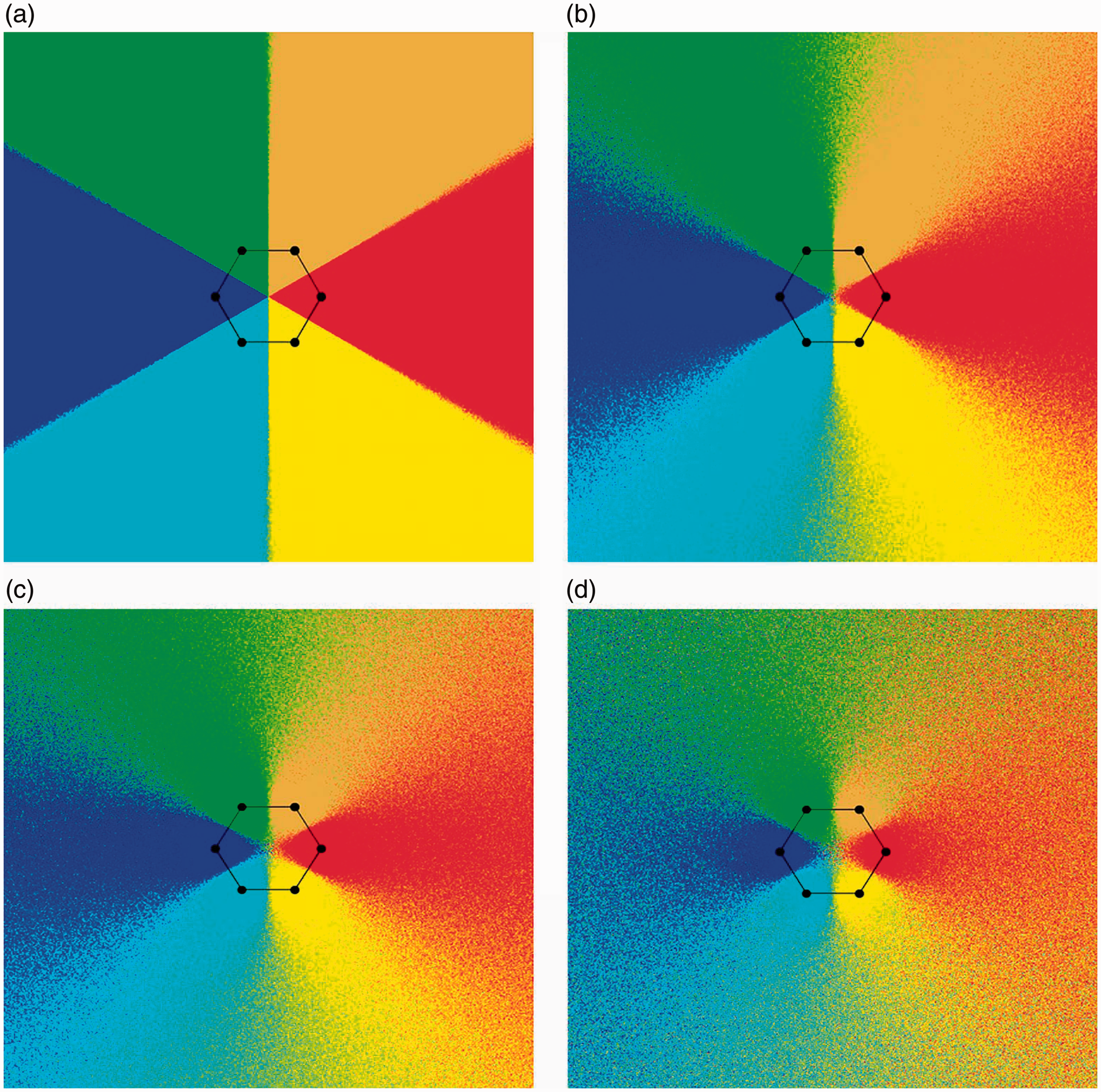
A spatial hierarchical system with white noise amplitudes: (a) A = 0.1, (b) A = 1.5, (c) A = 3.1, and (d) A = 5.0.
The first term (containing the space friction parameter μ) on the right-hand side of equation (1) represents the cost of transportation (or distance friction) of the relevant agent and the second term in this equation corresponds to the metropolitan attraction force (‘magnetism’), as explained in Banaszak et al. (2015). Figure 2 presents the influence of a random factor on the agent’s trajectory. This figure shows very interesting features. A manifest and visible effect is the disappearance of clear-cut boundaries between the gravitational attractors (spatial domination – sectors) of each of the six cities. The boundaries are now becoming fuzzy without a sharp demarcation; they are now zones rather than lines separating the original impact of one city on another with precision. Clearly, geographic boundaries are in this case no longer unambiguous. This result is an effect of the higher irregularity of the agents’ trajectories disturbed by the external random factor. This is next illustrated in Figure 3(a), where the blue trajectory disturbed by white noise shows a clearly distinguishable irregularity with respect to the deterministic trajectory (cyan).
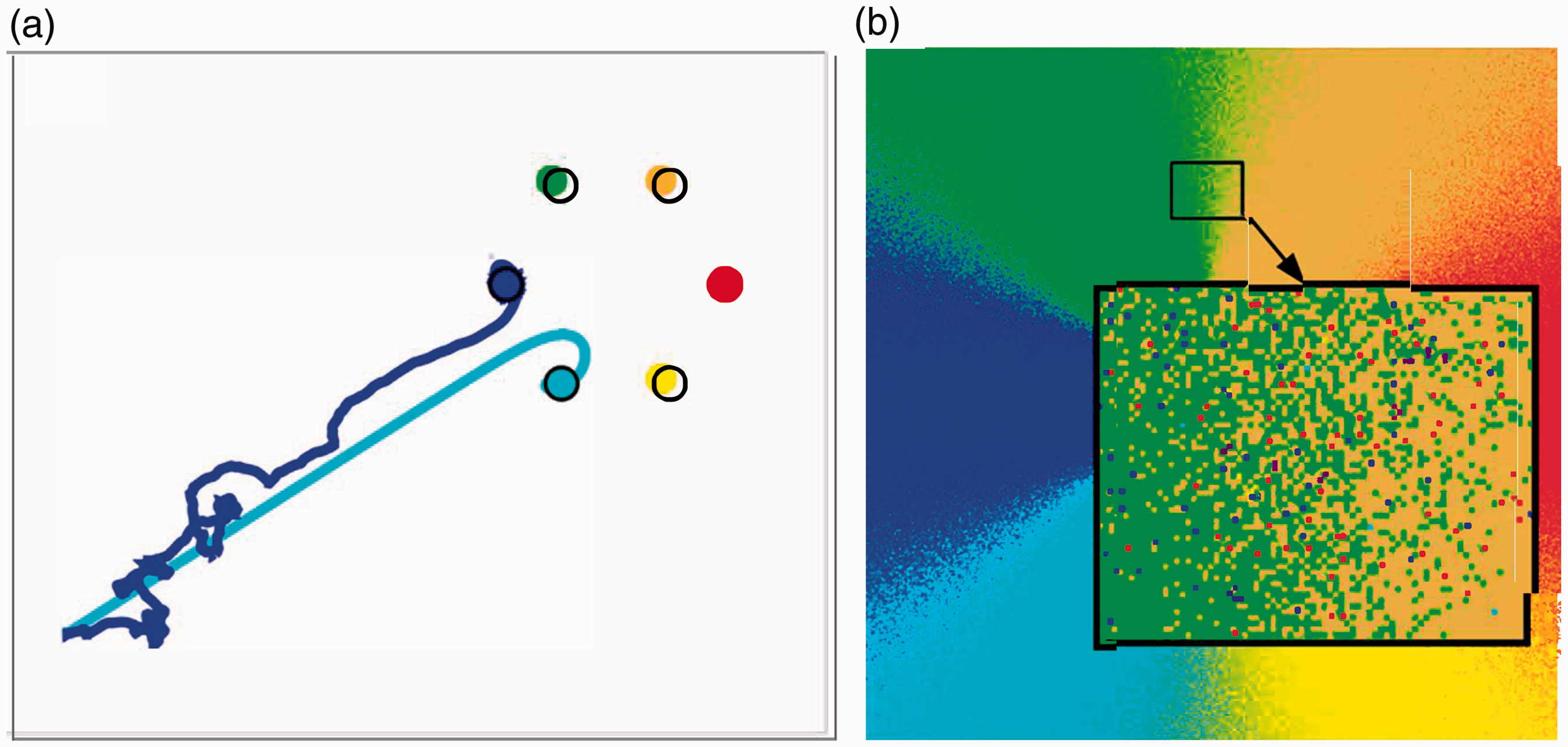
(a) Deterministic trajectory (cyan) and white noise trajectory (blue) of agent starting from the same place; (b) texture of white noise with amplitude A = 1.8.
Figure 3(a) shows a deterministic trajectory (cyan) and a white noise trajectory (blue) of agents starting from the same place. We can see that white noise may lead to a change in the agents’ spatial target. This is surprising, because in this case the friction (transport cost) is high (μ = 0.7, as in Figure 1(d)), so that even neighboring starting places should likely pull an agent to the same target.
Moreover, it is impossible to anticipate which city will attract the agent. This inconclusive nature of our findings can be interpreted in the following novel way. It is possible to establish the relation between the range of the amplitude of white noise and the number of catches of the agent by a city different from the case of deterministic chaos.
A stochastic approach confirms clearly the well-known empirical rule, viz. borders between real urban or spatial units are never straight, smooth lines. They form rather some kind of transitional zones, such as diffuse geographical, climatological or interregional borders, etc.
The same result can be observed in case of attraction areas in cities (‘attractors’). Our experiment shows that the traditional hexagonally positioned cities in traditional CPT systems are only specific, static and idealized cases of geographic specialization and organization as a result of city competition in a dynamic spatial market. Despite the external impact of geomorphological and other conditions on the geographical patterns of a world, we have shown here that hierarchical systems in geography do show a much less rigid hexagonal pattern than expected in earlier stylized CPT studies. Our analysis also suggests that actors in geographical space are ‘thinking and acting particles’ which can take unexpected moves and trajectories that arise from the unpredictability of human minds. In our analysis, we have handled this by adding random forces to conventional urban attractors and by establishing a new model referred as ‘fuzzy gravitation’. Regions and cities in motion do indeed exhibit complex and sometimes unexpected spatial constellations and developmental patterns.
Spatial entropy
The dynamics in a stochastic hexagonal system prompts also a general question on the regularity and order in hierarchical systems in geography. Spatial entropy provides information about the order in any selected geographical system. Entropy was first introduced in thermodynamics and then in statistical mechanics (Reichl, 2016), where it is thought to characterize the degree of randomness of the system. It was introduced into geography in order to measure the degree of randomness in spatial systems (Czyz and Hauke, 2015; Encarnação et al., 2013; Haynes and Storbeck, 1978; Wilson, 1970). When entropy is low, then a high order in the system is observed. The higher the entropy, the higher the disorder in system. Figure 2(a) to (d) shows how ordered structures becomes disordered because of a growing amplitude of white noise. We will use now spatial entropy to show the magnitude of disorder in the selected structures of CPT systems.
For a large μ, we can calculate the spatial entropy S of the final six-color structures using the following equation:


In contrast, a maximal entropy Smax occurs in case of fully mixed colors (


Spatial entropy as a function of the white noise amplitude for μ = 0.7.
Conclusions
The world of geography is in state of flux as a result of complex behavior of many actors seeking for a ‘place under the sun’. The stochastic approach adopted in this paper extends the possibility of applying gravitational attractor theory to describe and understand spatial differences in the forces and forms of attraction among cities of various size as a consequence of the ‘geography of movement’. Our analysis complements earlier conclusions drawn on the basis of the classical theories of Christaller and Lösch, which are essentially static and deterministic. Our study finds that in a white noise hexagonal system the spatial dynamic moves of actors – attracted by cities of various size in a hexagonal system – lead to a fuzzy hierarchical gravitation that displays fascinating variations in the standard CPT constellation.
Combined with modern spatial-economic foundations of nonlinear complexity, the modeling framework presented here is a new powerful tool for describing the spatial dynamics of metropolitan regions and highlighting the critical transport factors that slow down or accelerate this long-range evolution of complex spatial systems.
Footnotes
Acknowledgements
We would like to thank the reviewers for their detailed comments and suggestions for the manuscript.
Declaration of conflicting interests
The author(s) declared no potential conflicts of interest with respect to the research, authorship, and/or publication of this article.
Funding
The author(s) disclosed receipt of the following financial support for the research, authorship, and/or publication of this article: MD and MB gratefully acknowledge the computational grant from the Supercomputing and Networking Center (PCSS) in Poznan.