



Abstract
Legal geography (LG) unravels the co-constitutive relationship between law, space and society. Much LG scholarship has focused on urban issues situated in the Global North, but there is an emerging scholarship that explicitly extends this effort to the Global South and to rural locations. For example, Gillespie’s LG research in Southeast Asia exposes problems in governance institutions and decision-making processes that can unintentionally exacerbate existing socioeconomic disadvantage. The feminist political ecology (FPE) approach, as conceptualized by Rocheleau et al. and more recently expanded upon by Elmhirst provides a useful additional framework for considering the intersectionality of social and environmental factors which constitute identity, and the mutual dependency between identity and ecological processes. In this paper we argue that marrying an LG perspective with FPE results in a more nuanced understanding of complex legal–human–environment dynamics. Our focus on lore/law plus gendered identity as a lens for analysis blends an emergent LG literature with insights from FPE. This paper draws on research from a pilot project on the formal and informal regulatory mechanisms that enable and/or disable sustainable conservation in the protected wetlands of the Tonle Sap (lake) in central Cambodia.
Introduction: Our approach
In this paper we examine a legally protected wetland setting to enable consideration of the people–place–law bond. In so doing, we aim to investigate location-specific legal meanings (Bennett and Layard, 2015). Within this context, our pilot study aims to reveal how gender and identity influence active participation in environmental decision-making, and demonstrate the subtleties of this process in a post-conflict, post-colonial and neo-patrimonial developing country context (Cambodia).
A gendered analysis of the effects of environmental laws is essential in understanding access and participation in decision-making, and exposes the gender–law–place processes that shape our environments. We argue that critical notions associated with gendered scholarship through feminist political ecology (FPE), and more recently through intersectionality perspectives, align strongly with the praxis of legal geography (LG) work. In essence, both approaches take an anti-essentialist approach to question assumptions that normalize or naturalize dominant understandings. Further, both incorporate nuanced analysis of informal and context-specific socioenvironmental interactions to achieve practical outcomes in case study-based research. FPE considers the ways in which privilege and authority act in concert with imposed and overarching environmental protection regimes to reinforce exclusions and to produce particular environmental and social outcomes. Adding an LG perspective draws our attention to the importance of law, in its formal and informal guises, as an equally important place-making instrument. Moreover, an emergent critical legal geography (Bartel et al., 2013; Blomley, 2003; Delaney, 2016) uncovers the ordering and legitimizing of particular spatially inflected governance hierarchies – a process that demands greater exploration. Arguably, past tendencies towards homogeneous classification of social groups and a lack of understanding of complex identities in relation to the role of law (and lore) have, in some instances, resulted in unsuitable policy responses. Taking subjectivities as flexible, performed and simultaneously constituted by the spatial, cultural and contextual environment in which they operate, imposed environmental regulations may have unanticipated and differential effects on local people. We argue that an emerging field of, broadly labelled, feminist LG, through combining the theoretical weight accompanying the lengthy tradition of feminist thought with more recent yet well-established legal geographic insights, will enable a deeper understanding of these immensely complex dynamics.
The setting: Protected areas and biodiversity conservation
Protected areas are the dominant means of ensuring biodiversity conservation – nearly 13% of the Earth’s surface lies within some form of protected area, and nearly 2% of its oceans – yet biodiversity continues to decline (Palomo et al., 2014). In response, governments internationally are re-affirming commitments to maintain and, wherever possible, expand protected area networks. In this context there exists an increased need to engage human communities that live and work in protected areas in the biodiversity conservation effort; an effort now explicitly supported by international conservation agencies (Worboys et al., 2015). Successful biodiversity conservation is considered as much about managing humans as it is about preserving critical species and habitats (Adams and Hutton, 2007; Worboys et al., 2010). An ongoing threat to biodiversity remains unsustainable human use that is enabled through inappropriately drafted laws that do not resonate with impacted human communities (Rands et al., 2010). In this paper we ask whether gendered dynamics play a part in a lack of regulatory compliance that ultimately hinders biodiversity conservation efforts. We suggest that biodiversity conservation may only succeed if we turn attention towards an enhanced understanding of the identity–law nexus in a protected area setting. This involves understanding how laws and norms are enacted by the people who live and work in protected areas. Yet, to speak of a generic ‘people’ is, arguably, far too generic a descriptor to inform this work when the impact of environmental law/lore can be highly asymmetrical within a given community.
Connecting feminist political ecology with legal geography
Here, we bring together relevant scholarship from FPE and LG, emphasizing recent trends in FPE, especially the ideas around gendered resource access/control. This approach links to ideas around intersectionality and, following Nightingale (2011), we draw attention to the urgent need for a more nuanced discussion around spatialized ideas of power/empowerment. Identity-differentiated experiences that constitute people–place interactions are contextual and produced by everyday performance/practices. Nightingale (2011: 155) suggests that ‘[b]y recognising the continual production of social difference, essentialist notions of identity are undermined, and it is possible to illuminate how subjectivity is ultimately a contradictory achievement with subjects exercising and internalising multiple dimensions of power within the same act’. Following Nightingale, we want to draw attention to the need for nuanced discussions around spatialized ideas of power/empowerment.
Feminist political ecology
Political ecology is concerned with the interactions between politics, the economy and the environment, examining multi-scale scenarios to understand the complex political nature of decisions made about the environment (Blaikie and Brookfield, 2015; Robbins, 2012). Among the broader aims of this scholarship is the creation of effective policy to assist with environmental conservation and sustainable development, while ensuring no disenfranchisement of or disadvantage to local people. Since the emergence of Third World Political Ecology in the 1980s (Bryant and Bailey, 1997), political ecology has become focused, inter alia, on understanding social categories and how groups of people are situated in relation to local and global political ecology (Paulson et al., 2003). The more explicit term ‘Feminist Political Ecology’ was proposed by Rocheleau et al. (1996), and was specifically applied to gendered knowledge, gendered environmental rights and responsibilities, and gendered environmental politics and grassroots activism, thus exploring the gendered dimension of inherently politicized interactions with the natural environment. FPE was redefined in 2011 to include a much broader understanding of the ‘multi-dimensional subjectivities’ of individuals as topics for analysis, using the word ‘gender’ to represent this multiplicity (Elmhirst, 2011a).
Gender, as an analytical lens, has permeated many fields of scholarship. Within feminist scholarship, concern has been voiced that the concept of ‘gender’ has become synonymous with ‘women’, and that through various governments and NGOs enacting development programmes the term has been depoliticized and used as a bureaucratic tool with little constructive impact (Bock, 2015). For example, the ‘feminization of poverty’ approach, whereby development programmes both target and use women as tools of poverty alleviation, has been thoroughly critiqued for, in some cases, exacerbating the disadvantage of women (Chant, 2008). The focus on singular categories, such as income, can deflect attention away from other discriminating determinants, including age, religious or cultural factors, meaning policy solutions may lack relevance. A related and popular approach was to use the Women, Environment and Development framework, which was partially based on the material division of labour along gendered lines, where women primarily had reproductive roles. More essentialist, ecofeminist perspectives saw women and nature as linked, both biologically and because of their subjugation at the hands of men (Leach et al., 1995; Shiva, 1989) – what was good for the environment, therefore, was also good for women. However, some of these programmes faltered in that they gave women roles traditionally deemed ‘appropriate for women’, reinforcing gender differences, or increased the burden on women as they struggled to take on new responsibilities on top of traditional roles.
This problematic conception of ‘gender’, particularly in developing countries, has been further challenged by multiple activists. Most prominently and earliest among them was Mohanty, who criticized the concept of the monolithic ‘third world woman’ as a simplistic and inaccurate concept adopted by Western aid agencies and feminists (Mohanty, 1988). In reaction to this, FPE explicitly emphasizes the importance of context, culture and the environment. Hence, new understandings of ‘gender’ have been crucial to the recent reimagining of FPE (Elmhirst, 2011a). In many recent works using the FPE framework, gender is understood as a performative and process-based co-constituent of identity, as conceptualized by Butler (1988). In a post-structural frame, gender exists in a dynamic loop of causality – it is a concept created culturally, socially and ecologically, and enacted through the imposition of social norms on individuals, while the actions of individuals existing within their determined roles simultaneously serve to recreate and redefine its limits (Sultana, 2009). As environments change, so do the interactions of the people reliant on them for their livelihoods, and simultaneously these actions re-shape the social, physical and cultural environments.
It is logical, then, to conclude that other aspects of identity are similarly constituted, and within FPE gender is embedded in multi-scalar contexts that encompass other factors contributing to disadvantage, including race, class and ethnicity (Elmhirst, 2011a; Mollett and Faria, 2013). In line with current mainstream feminist thinking around the importance of considering intersectionality in studying disadvantage (Lau and Scales, 2016; Valentine, 2007), this framework enables a more nuanced understanding of the subjectivities contributing to socioeconomic disadvantage, environmental injustice and other traditional political ecology concerns. From this, context-specific and beneficial policy outcomes become a more realistic goal.
Gender–environment–law (both urban and rural) interactions have been demonstrated to mutually co-constitute through (variously) gender-differentiated access to space, gendered environmental knowledge and gendered environmental rights and responsibilities (Nightingale, 2011; Sultana, 2009; Sundberg, 2004). Performing these gendered roles may have tangible effects on the environment, as is demonstrated in the multitude of studies utilizing the FPE framework, such as Truelove’s (2011) work in India, Doshi’s (2017) work in India, Elmhirst’s (2011b) work in Indonesia or Hovorka’s (2006) work in Botswana, among others (see also Buechler and Hanson, 2015). Perhaps the most salient study in the context of our research has been conducted by Nightingale (2006), in Nepal. Nightingale examined the proposition by high-caste men to impose environmental regulations determining and limiting the specific times that women were allowed to collect leaf litter for fuel, where previously this had been unregulated (Nightingale, 2006). High-caste women opposed this law as it would make it substantially more difficult for them to collect sufficient leaf litter to survive. Nightingale (2006) describes the way in which they protested against these regulations through embracing the concept of leaf litter collection as ‘women’s work’, accepting traditional gender roles and utilizing them in such a way as to gain some form of arguing power.
FPE, despite its value as a powerful lens for examining gendered practices, has not been without critique – particularly from within feminist scholarship itself. Mollett and Faria (2013) comment on the acknowledgement of differing social identities within FPE, but a comparative lack of studies using anything other than gender as an analytical tool. This is a legitimate issue, but, in cases where gender is one of the less politically sensitive aspects of identity (as in the case study we present below), it remains an appropriate tool of analysis.
Key themes evident in the FPE literature are a focus on scale, place, context, pluralistically constituted identity and scale-appropriate sustainable development in natural resource management. The Boeung Tonle Chhmar section of the Tonle Sap lake is an area where there is a clear scalar ‘mismatch’ between the top-down imposed environmental regulations of the protected area and the lived experiences of the local people (Gillespie, 2016). Legal geographic approaches specific to this area have yielded insights into the issues arising from the imposition of environmental regulations (Gillespie, 2016); however, as yet there has been limited research on the gendered impacts and responses. Researchers aiming to contribute to appropriate and practical policy outcomes should have a nuanced understanding of the bio-cultural landscape onto which these regulations have been imposed.
Producing a feminist legal geography
LG scholarship is based on the premise that law, people and space are co-constituted or imbricated. Using an LG approach, scholars researching and writing in this vein produce work that demonstrates the role of law in influencing, and in turn being influenced by, the relationship between people and place (Bartel et al., 2013; Bennett and Layard, 2015). Legal geographers seek to include the heterogeneity and complexity of law–space relationships in their work; using the law and society as core objects of concern (Braverman et al., 2014). There is no coherent theoretical framework for scholars working within LG, nor any prescribed ontological position, and legal geographers draw on a variety of philosophical traditions to inform their work (Holder and Harrison, 2003). However, many legal geographers tend towards an exploration of spatial inequality to reveal how rights and entitlements (or even duties) play out (Blomley and Pratt, 2001; Delaney 2015; Jackson and Wightman, 2003). Within human geography, early legal geographers were concerned to demonstrate that law plays a dynamic role, not an inert one, in shaping space (Braverman et al., 2014). The evolution of LG sees greater nuance to this approach; where we witness an evolving understanding of the complexities of law itself. Building on the work of early legal geographers, including Clark (1985), Pue (1990), Blomley (1994) and Blomley et al. (2001), among others, we may now view LG as attending to law as non-static, layered and situated within intricate human–environment settings (Braverman et al., 2014). Theoretical sophistication is identified by some scholars as coming from the notable recent contributions identified by Delaney (2016) in Valverde (2014) and Philippopoulos-Mihalopoulos’ work (2011). Taking the LG project further in conceptual and empirical forms characterizes LG’s more recent evolution (Bennett and Layard, 2015).
Legal geographers ‘splice’ the world and provide us with insights into the ‘locally enacted encodings’ enabling the ‘weav[ing] together [of] spatial and legal meaning[s]’ (Bennett and Layard, 2015: 409–410). While LG’s contribution to discourse issues of environmental regulation can often be abstract and controversial, it is an area of increasing interest to scholars (for example, Jessup, 2015; O’Donnell, 2016; see Bartel and Graham, 2016; Sherval and Graham, 2013). This place-based emphasis on setting draws our attention to similar scholarship from political ecology (PE) that focuses on people–power–decision-making dynamics in context; yet few explicitly link PE with the LG project (with the notable exception of Delaney, 2016). A further significant exception is Ellie Andrews and James McCarthy’s (2014) paper on shale gas development, in which they clearly link LG to PE. In this work, Andrews and McCarthy argue that both LG and PE scholarship have failed to pay enough attention to the similarities within both strands of scholarship. They observe: One of political ecology’s hallmarks and strengths has been its explication of the often overlooked roles that informal, extra-legal, and tacit relationships and dynamics play in relationships between people and their environments, particularly when those relationships are being reconfigured or contested in contexts of significant power imbalances. These imbalances are often made manifest through the forced imposition of new forms of technical or legal knowledge, administration, and control.… Our work is an extension of this tradition and in no way in conflict with it. (Andrews and McCarthy, 2014: 9)
In this paper we explore environmental regulation through an LG lens, cognizant of the strong associations with PE but also with a particular curiosity about gendered dynamics. Although not expressed as an explicitly LG paper, Herbert et al. (2013) explain, using concepts of ‘scope’ and ‘scale’, how law can be too cumbersome to deal adequately with environmental problems; especially for problems that extend beyond traditional jurisdictional boundaries. This need to pay attention to scale-sensitive environmental governance is evident in LG scholarship (Gillespie, 2016) and is a core concern of PE literature. Such scale sensitivity draws our attention to the importance of the connections, or lack thereof, between institutions, regulations, places and people. In law, as in geography, it becomes apparent that the choice of scale through which an environmental issue is conceptualized or performed enables some solutions and freezes others (Jessup, 2013). Reflecting on this, we particularly want to extend the LG project to consider a feminized LG – one in which the people–law nexus also pays critical attention to gendered considerations. Scalar concerns thus take on distinctly localized qualities, complementary to feminist understandings of knowledges as partial and ‘situated’ (Haraway, 1988).
In the case study presented here we describe the policy tensions associated with biodiversity conservation through habitat/species retention and habitat/species destruction. The protected wetlands of the Tonle Sap are land(water)scape recognized as a biodiversity hotspot and granted international legal protection through a Ramsar designation (site 997), yet the impact of inappropriately framed laws potentially threatens the environmental integrity of this claim. The ways in which laws are framed and enacted matters to place-making; laws function to both include and exclude particular practices and people. Drawing on FPE, we aim to gain a deeper understanding of how these laws and law-making processes interact with performance-based, gendered identity, and consider broader implications for both everyday life and conservation. The need for this situated FPE–LG linkage is further reinforced by Brickell’s (2016a) recent work considering domestic violence and forced eviction in Cambodia, wherein her ‘rule of law/rule by law’ descriptor was useful in demonstrating the ways in which women claim (legal) rights. ‘Rule of law’ denotes human rights for all (akin to the universal claim), but the ‘rule by law’ categorization can distort law’s functions, manifesting power and oppressive features with a distinctive gendered dynamic. Brickell’s work demonstrates that the exploration of gendered dynamics is critical to the creation of more effective and context-specific legislation, and our paper attempts to redress this dearth of information within current research. Our central point in this part is that LG scholarship has not paid enough attention to the gendered dimensions of law.
The Cambodian context: Gendered rights and responsibilities
The Cambodian context in which our work is situated gives unique insights into natural resource management and environmental governance where the ‘rule of law’ vis-à-vis the ‘rule by law’ conundrum plays out (Brickell, 2016a). For the purposes of this paper, we provide a contextual background to the gender roles within contemporary Khmer society. This will allow a more accurate interpretation of results but will also highlight the gaps in understandings of the particular difficulties faced by women in isolated rural communities, such as the villages around the Boeung Tonle Chhmar.
During the Khmer Rouge period (1975–1979), traditional gender roles were disrupted as the normative ideal of the nuclear family, and traditional courting and marriage rituals, were repressed (Heuveline and Poch, 2006). Men and women were treated as relatively equal, and expected to complete many of the same tasks within society. Further to this, the genocide and violent conflict led to the deaths of more men than women, creating a disparity that is reflected in population demographics today (de Walque, 2006). Modern understandings of traditional gender roles in Cambodia are believed to originate primarily from the ‘egalitarian’ time before colonization, and the Chhab Srei or ‘rules for women’, a document created in the 19th century that prescribes appropriate behaviours for men and women. Brickell (2011: 438) reports that it requires women to ‘move quietly around the house, be polite, avoid vulgarity’ and to submit to the will of their husbands in arguments. ‘As the Chhab Srei advices, women are encouraged to respect their husbands by tolerating unacceptable behaviour for the sake of family unity’ (Brickell, 2014: 269). This results in pressure on women to keep their families together, and if divorce occurs the woman is often blamed for not fulfilling her duties, and can afterwards be shunned by her community. Brickell has recently extended this work beyond the male–female spousal domestic violence categorization into a consideration of other dimensions of identity – using intersectionality – when she considers how age, disability and activists’ roles provide the basis for violence against women and girls (Brickell, 2016b). For women living in non-urban locations, in the rural communities of the floating villages, for example, these identities are subject to even less scrutiny.
In terms of decision-making and participatory dynamics for women in Cambodia, a recent publication focusing on women in power (in various settings) reveals that Cambodian women do struggle to break the confines of prevailing gendered identities and roles (Lilja and Baaz, 2016). And yet, contradictions and nuances are apparent in some research findings. Reporting on customary gender relationships in two rural communities, based on field interviews from Takeo and Battambang Provinces, for divorced or separated couple’s access to land, Lilja and Baaz (2016) explain that women – especially mother-in-laws – play a powerful role in distributing family assets (land). This is explained as a paradox for prevailing norms of Cambodian femininity: ‘the image of the strong and in some regards powerful village woman … who in some senses challenges the gentle and passive female pictured in the Chhab Srei’ (Lilja and Baaz, 2016: 311). Clearly, demonstrating and confronting expectations about different gendered roles needs further elaboration.
Individual perspectives from Cambodian men and women themselves on gender difference are diverse. Understandings of gender roles vary and may conflict, but what becomes clear when reviewing the extant literature is that these roles are constantly being redefined and the boundaries renegotiated (Brickell, 2011). Importantly, the majority of gender-focused studies conducted in recent years in Cambodia have focused on urban or semi-urban subjects, particularly with respect to health and labour markets (Gorman et al., 1999). While there is some focus on rural attitudes, little has been done on the particular areas that are the focus of our study. It is likely that gender relationships and roles are substantially different there compared to urban areas, in part due to the easier intrusion of Western ideals and culture into urban life. With all these factors considered, and in order to gain a more comprehensive understanding of gendered life in an isolated local context, the value of conducting this study and further research in an in-depth qualitative format cannot be overstated.
Boeung Tonle Chhmar: A protected area wetland
The Tonle Sap, meaning ‘Great Lake’ in Khmer, is the largest natural lake in the southern hemisphere, and is located on the Mekong River floodplain in central Cambodia. Due to its highly unusual hydrological cycle, the Tonle Sap floodplain is a hotspot for biodiversity, supporting many diverse ecological communities and adding significantly to the natural productivity of Cambodia (Baran et al., 2007). The Tonle Sap is also among the most productive inland fisheries on Earth, and directly supports the diets and livelihoods of more than 1.7 million people in the riparian provinces of Cambodia. Fed by the seasonal flooding of the Mekong River, the lake increases in area from 2500 km2 to 15,000 km2 during the wet season. This ‘flood pulse’ is crucial for communities in the Tonle Sap basin. The economic significance of fish resources alone is enormous, and the deposition of nutrient-laden silt drives primary productivity in the upper floodplains and supports traditional ‘flood recession’ rice agriculture. The Tonle Sap also acts as a restocking source for migratory fish species throughout the lower Mekong River basin (Lamberts, 2006), and the annual fish migration to and from the lake represents one of the largest animal migrations on Earth. Fishing communities in the Tonle Sap were once regulated through Fishing Lots; however, these were cancelled by the Royal Government of Cambodia in 2010 (Sithirith, 2017). Today, there is a common property/open access regime in place (Sithirith, 2017), which is subject to the demands of the protected area restrictions associated with the Ramsar wetlands designation in particular locations.
Parts of the Tonle Sap have been designated under international law as protected area wetlands. Cambodia is a signatory to the Ramsar Convention. The twin goals of the Ramsar Convention are to promote the conservation and ‘wise-use’ of wetlands. The Boeung Tonle Chhmar area of the Tonle Sap was declared a Ramsar protected wetland in 1999. Boeung Tonle Chhmar is composed of lake (open water) within a seasonally inundated (flooded) forest. The site hosts an array of wildlife, many of which are listed as rare, vulnerable or endangered on the International Union for the Conservation of Nature’s Red List of Threatened Species (IUCN, 2016). In implementing its global commitments to ensure the adequate protection of the site, the Cambodian government enacted a number of protected area laws (Gillespie, 2016). These laws restrict the ways people interact with their landscape, and restrict pre-existing practices. By way of example, in order to protect the fishing habitats prohibitions have been placed on access to parts of the wetlands (deep ponds and some riverine channels) and on the types of fishing equipment that may be used (Gillespie, 2016). From a habitat preservation viewpoint these restrictions should act to aid conservation of a range of species in this biodiversity hotspot; yet little attention is paid to the ways people interact with this place.
The observations reported in this paper were derived from a pilot research project into sustainable conservation in Boueng Tonle Chhmar. The purpose of the pilot study was to collect information about the impact of the protected area laws on the lives and lived experiences of local residents and it was intended to provide baseline data where little or no information existed. It was also an attempt to enact a hybrid FPE–LG praxis and apply a gendered lens to the consideration of people–place relations in a rural, developing-nation context. The project undertook fieldwork between December 2013 and January 2014. During that time, 50 households from four floating villages (Peam Bang, Dourng Sdeung, Ba Lot and Ta Our Sar Tuol) were surveyed using a hybridized availability/snowballing approach (Gillespie, 2017, 2018; Newing 2010). A mix of closed and open questions were used in the surveys. Data were collected through a Cambodian research assistant in Khmer and recorded then transcribed into English. The research assistant was a 30-year-old male from Phnom Penh, ethnically Khmer, and fluent in Khmer and English. Women represented 47% of the total sample. In terms of ethnicity, 88% of the sample identified as Khmer, while 12% identified as Vietnamese. Notably, all participants were married, which excluded data from female-headed households. Earlier research suggests female-headed households are significantly different in terms of access to and availability of resources (Resurreccion, 2006).
Gendered regulatory responses?
In this paper we want to draw attention to the gendered dimensions of household activity adjacent to the wetlands, as a distinct qualitative disparity was observed between male and female participants when answering questions about rules and rule-making for the protected area. The layers of regulation imposed on the Boeung Tonle Chhmar protected area (Figure 1) have created a confused and complex system of management. All our respondents indicated that they would like the current rules, which they deemed to be too restrictive, to be changed. However, the ways in which participants wanted change differed between male and female responses. Male respondents generally wanted the rules about the use of different types of fishing methods (and gear) to be less restrictive. Protected area restrictions about fishing methods were considered too onerous; the prohibition on electric shock fishing makes the physical task of fishing more difficult as fishing legally using poles/hooks is considered more physically demanding. In the following section we give voice to the concerns of male respondents that demonstrate their concern with fishing gear restrictions.
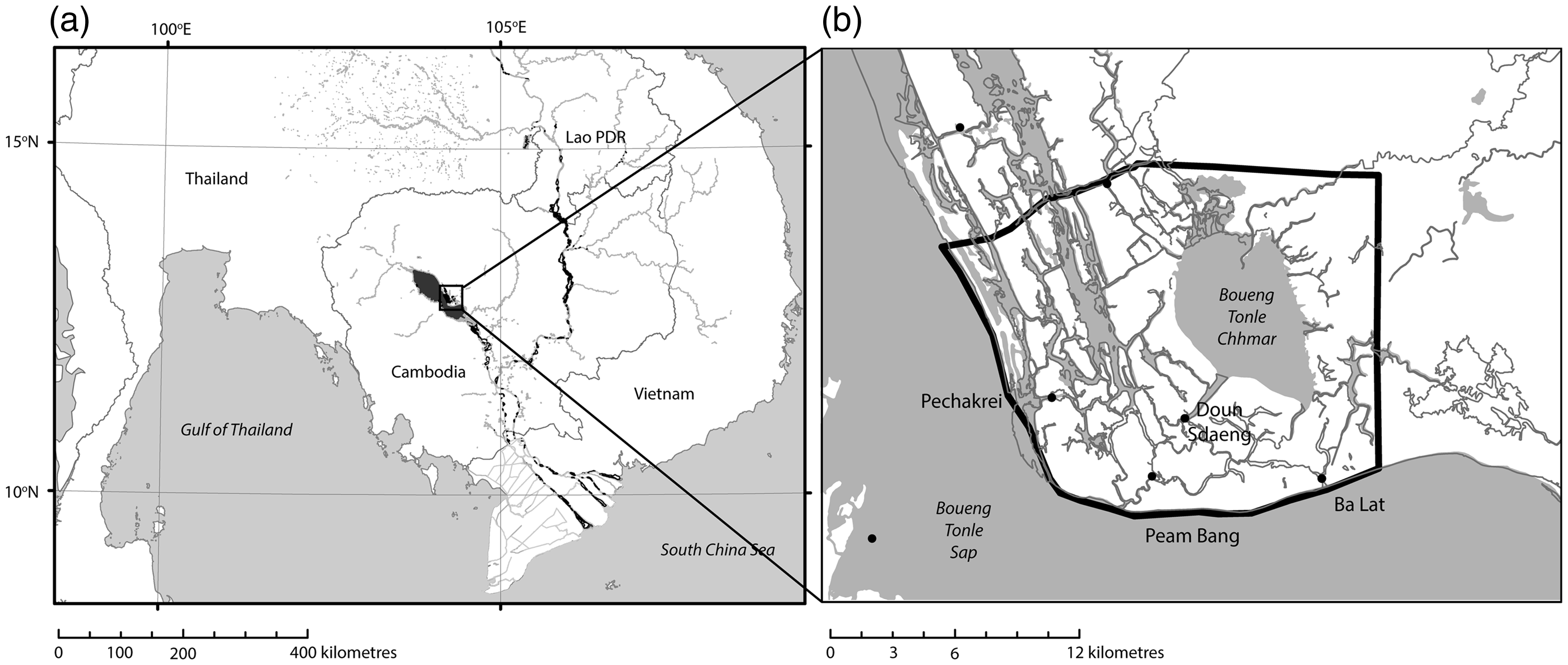
Location of the study site, Boueng Tonle Chhmar, Tonle Sap, Cambodia. (Data from the Japanese International Cooperation Agency [JICA] and the Mekong River Commission [MRC]).
R17, a 28-year-old married male with one child, identified ethnically as Vietnamese although he has lived in Peam Bang village for 20 years. A self-described fisherman, R17 fished and fish-farmed throughout both the wet and dry seasons. He reported a monthly income of US$200. During the wet season he explained that he would use the flooded forest for net fishing and he knew about the restrictions associated with the protected area to the extent that: We are not allowed to fish with more than 5 sets of net – each net is about 50 to 80 meter long, more than 1000 fishing hooks, electric shock, the net hole smaller than 2.5 centimeters. The fishing rules should be less strict than this. They can arrest and fine everyone and everywhere. It is even harder for me as a Vietnamese compare to Khmer. Every year I have to pay 1 million real – $250 to fish with my fishing gear. There are so many rules and they are not clear who is doing what. Whatever I do is wrong. The problem is that there are so many institutions implementing the fishery rules. People need to pay fine to many of them… The rules work only with the poor and we have to be very careful with our fishing activities or we have to pay the fine.
A long-term (30-year) Khmer resident of Peam Bang, Mr R (R21) also self-identified his occupation as a fisher as he performed both fishing and fish-farming during the wet and dry seasons. Mr R reported a monthly income of US$150. During the dry season he explained that he did net and hook fishing and used water hyacinth fish traps. During the wet season he did hook and net fishing. He said of the environmental laws that applied to use of the lake and forests, ‘[W]e are not allowed to do illegal fishing gears’. He went further about changes to these laws: We want the law to be less strict. My fishing gears was confiscated once and I did not have enough money to pay them. Therefore, they took all my fishing gears. The law is too strict only fishing nets are allowed.
The focus for many of our male respondents was clearly expressed as unhappiness with the limitations being placed on the use of fishing equipment near the highly protected wetland. The implication from their concern is that restricting equipment limits catch size and this, in turn, limits immediate income.
Female respondents, on the other hand, were more concerned to change the rules regarding where the protected wetlands boundaries were located. A common concern was to exclude some of the surrounding channels from the ban on fishing. For example, R34, a 34-year-old Khmer woman from Ta Our Sar Tuol village, said: ‘I just want this place to be excluded from the protected area. They want to kick us out of this place. I have got nowhere to go. I just want this place to be open for people to fish.’ Similarly, ‘I want those channels [surrounding the Boeng Chhmar lake] to be free for people to fish’ (R3, 35-year-old woman from Dourng Sdeung village), and ‘I want more area to fish especially the area around Tonle Sap lake’ (R11, 30-year-old Khmer woman from Dourng Sdeung). Some women also expressed despair over their houses being located within protected areas: ‘I just to leave here. Our village should be excluded from the protected area. If we are asked to move inside the forest which is far away from the lake, [life] would be harder. The water body is too small during the dry season’ (R32, a 50-year-old woman from Ta Our Sar Tuol village). There were also concerns expressed by female respondents regarding the clarity of the protected area boundary; R28, a 44-year-old woman from Peam Bang village, remarked that the public fishing grounds were too small, and that ‘the boundary of the protected area should be clear’.
The focus for female respondents was access to particular locations for catch, but also for breeding purposes. They were concerned to ensure that usual fishing habitat spots were excluded from the bounded protected area. Overall, the general trends suggested that women appeared to be more concerned with issues of access and boundaries, whereas men were concerned with issues affecting the size of their overall catch. It is in this contrast that we can observe articulation between the adaptive fluidity of identity, including gender, and the more rigid framing of protected area places. The imposition of this protected area impacts on the way that men and women experience and perform daily acts of life in terms of their fishing livelihood activities. Crucially, many of these impacts are shared but differ between men and women.
However, this gendered narrative, while emerging from male/female responses about equipment and boundaries, might lack depth for a more nuanced intersectional analysis. To this end we would draw attention to some of the counter-narratives apparent in the responses. One example comes from one of the few contrasting views about the fishing equipment restrictions from a younger male. R35, Mr CB, aged 25 and married, with two children, had recently (three years ago) moved to one of the villages. He identified as a fisher with an estimated income of US$100 per month. He indicated that he did not believe the rules needed to be amended: The protection of the Tonle Chhmar is good for our fishery resources. I am only using the nets and hooks to fish, so I am not doing anything illegal. The laws do not impact me that much.
In reviewing all the female responses, we found that only two women mentioned being concerned about the restrictions associated with fishing equipment. R38 (34-year-old Khmer woman from Balot village) opined ‘The rules about fishing gears should be less strict than that. I am not using Chhnok [a traditional form of net fishing] to fish, but if I do I have to pay them 300000 Riel/season [about US$74]’. R16 (58-year-old Khmer woman from Dourng Sdeung) mentioned that electric shock fishing should be strictly prohibited. Beyond these comments, women respondents appeared universally disinterested in restrictions on fishing equipment.
One potential explanation for this disparity, we suggest, is that women are more concerned with access and boundaries because of their traditional roles as caregivers and their work managing fish farms under the house. Potentially, because the onus is on women to care for their children, feed their families and support their households, as outlined in the earlier section on gendered responsibilities in Cambodia, issues of subsistence and long-term sustainability may be more important. Within the FPE literature, these trends can be seen to reflect broader gendered understandings of roles in contexts from all over the globe, wherein the men are responsible for consumable resources (such as hunting) and women are responsible for renewable resources (such as tending to the garden and keeping animals). Interestingly, when questioned about why the forests needed protecting, both men and women were equally aware of the need for conservation to ensure the sustainability of their livelihoods (for example, R48, a 46-year-old Vietnamese male from Peam Bang village, said ‘It is good that they have Tonle Chhmar to be protected. If the lake it open like Tonle Sap, all the fish would be gone’; R47, a Khmer male of 39 years from Balot village, said: ‘If we clear forest, we destruct fish habitat and breeding ground’; R8, a 57-year-old Khmer woman from Dourng Sdeung village, said ‘If there is forest to protected, we have fish for the next year’). These were very common and consistent perspectives across the sample. The value of flooded forest as protection was also well understood (e.g. R36, a 60-year-old Khmer woman from Ta Our Sar Tuol, said: ‘The forest is really important to us here. Without the forest, it is dangerous when there is storm’; R40 and R49 expressed similar concerns). There were only a few exceptions to these dominant perspectives on conservation. A 48-year-old Khmer woman from Dourng Sdeung village, R5, for example, said ‘I can’t see the impacts of those protections on fish and other species’.
A complementary hypothesis may also be drawn from an alternative understanding of traditional expectations of Cambodian women. As Brickell (2014) describes, there exists a Cambodian comic strip illustrating a situation wherein a woman is forced into marriage, then is unable to continue working due in part to her husband’s jealousy. Women are responsible for staying away from areas or situations that may bring them into contact with other men and incite jealousy within their husbands, limiting their movements to more domestic settings (Lilja, 2008). We posit that the channels surrounding the Boueng Tonle Chhmar were perhaps considered to be areas suitable for female fishing, and potentially less open to male fishermen. This would go some way towards explaining the women’s repeated requests for the channels to be opened for fishing access. If this is the case, implications for women (particularly any unsurveyed female-headed households) and their ability to provide for their families are significant.
An additional gendered consideration for the management of the protected wetlands arose in response to answers to the question about how respondents found out about the new regulations. Access to information about the restrictions appears to yield another gendered disparity. Women were more likely (57% of female respondents) to indicate that they had been informed by other villagers, commonly family members, while men (62% of male respondents) were more likely to have been informed in an official context, such as through a village meeting or by the Village Chief (Gillespie, 2018, 2016). For example, a 50-year-old Khmer man from Dourng Sdeung village said: ‘Sometime people from the environmental department come and teach us about the important of flooded forest and wildlife. They also talk about what can and can’t do with fishing and collecting resources within the area.’ R6, a 53-year-old man from the same village, said ‘I have been to a meeting in the pagoda in Pov Veuy village. It was organized by different governments department from the district and province.’ R5, however, a 38-year-old woman, also from Dourng Sdeung village, reported that ‘I heard about that from other people in the village. I have never been told anything by local authorities.’ This was a fairly common response among female respondents.
These findings support earlier research conducted in a nearby area, which revealed significant differences in the roles of men and women in fishery communities on the Tonle Sap. Resurreccion (2008) found that although men are publicly in charge of official fishery matters, women may privately use their ties with high-status men to legitimate their own actions (i.e. fishing in protected areas). By wielding power through acceptance of gender norms, women both accept and re-shape gender roles. Resurreccion (2008) additionally noted the significant implications this had for the wellbeing of female-headed households.
Conclusions
While there are many aspects of critical FPE not covered in detail here, there is a clear resonance between the ideals underpinning FPE and (critical) LG. Scholarship in both areas delves into various investigations that counter dominant narratives and uncover a range of context-specific law/lore/environment/people/identity and power dynamics. There is also a clear convergence between the concerns of FPE with regards to informal, gendered norms and LG’s recent and emergent focus on informal (especially non-state) law – the ‘traditional’/local ‘lore’. Placing more emphasis on the need to unpack identity – through gender (and more) using an intersectionality perspective – would do much to enhance LG work; thus the call for a more explicitly self-conscious feminist LG.
Our findings from this pilot study indicate a number of gendered disparities which require further investigation. Although these are not necessarily disadvantages, we are conscious of the need to not further/contribute to the narrative of the ‘disempowered woman’, and as illustrated by Resurreccion (2008) in the Cambodian country setting, some women have other social channels of negotiation available to them that work very effectively. Furthermore, we would argue that further analysis, focusing on other aspects of identity, have the potential to yield significant insights, particularly with regards to female-headed households and lower socioeconomic status women.
At the outset of this paper we focused on the real and pressing need for the conservation regulations surrounding wetlands, especially in biodiversity-rich locations, to work from both a local and global perspective. The universal appeal of habitat preservation in the face of declining biological diversity is a significant global conundrum. Throughout the paper we press this key point through our contention that understanding the ways in which human actions might undermine (or support) overarching environmental protection regimes is crucial to implementation and success of conservation programmes. Subsistence/dependent communities in wetlands settings are a critical part of the picture; we argue that better understanding of the interaction of environmental regulation and local identities might inform the creation of more suitable, practical outcomes.
Footnotes
Acknowledgements
Gratitude is due to His Excellency Dr Say Samal, Minister of Environment, Royal Government of Cambodia for supporting this research. Thanks are also due to Mr Sopheak Chann as the research assistant for this project and Mr Kimsreng Kong and Mr Pheakdey Sorn of the IUCN Cambodia Office.
Declaration of conflicting interests
The author(s) declared no potential conflicts of interest with respect to the research, authorship and/or publication of this article.
Funding
The author(s) disclosed receipt of the following financial support for the research, authorship, and/or publication of this article: This research is part of an Australian National Commission for UNESCO grant, supported by the Australian Government’s Department of Foreign Affairs and Trade.