




Abstract
This article contributes to the existing literature on the geography of mobility by examining the precarious work experiences of young people in relation to the limits to their mobility. Using 60 in-depth interviews with young immigrants from Eastern Europe who practised mobility to and from Spain, the article highlights the concern of ‘limits to mobility’ to show how respondents try to end their precarious work and labour instability in order to reach a stable destination. What are the limits to mobility? When is the peak reached? I argue that the limits to mobility can be explained by the interplay between the political-economic structure and people’s spatiotemporal experiences. I have found three different types, depending on the life-course contexts in which young people live their limits to mobility: (1) mobility as tiredness – specific to those who have practised mobility to Spain and, after travelling, training and changing precarious jobs in several countries, try to move and settle in one place; (2) mobility as a labyrinth – situated between the fulfilment of objectives and the uncertainty of relocation; and (3) mobility as resistance to precarity through return – practised by people who migrated with their parents at an early age, who studied in Spain, but for professional reasons had to leave, and are currently either back in their countries of origin or in Spain. The limits to mobility have not as yet been researched in this way, and the findings may contribute to a refinement of the spatiotemporal framework of youth mobility.
The ‘mobility turn’ claims the centrality of mobility at all scales according to which people are continually on the move, situated at the crossroads between mobility and immobility (Adey, 2010; Cresswell et al., 2016; Merriman, 2014; Sheller and Urry, 2006). In much the same way, young people are moving around the world, for study or for work, constructing ‘spaces of opportunity or resistance’ (Cope and Lee, 2016: 312) and ‘desire or oppression’ (Kelly, 2018: 7). While the current literature highlights the mobility between East and West (Burrell, 2006; Cairns, 2017; King, 2018), studies mobility through biographical research (Bailey, 2009; Ni Laoire, 2000) and examines work-related mobility, working lives and the centrality to these of relationships and movements between different places (Cresswell et al., 2017; Dorow et al., 2017), the life-course mobility of young people related to precarious work practices – both spatial and temporal – has scarcely been researched. This article contributes to the existing literature on the geography of mobility by examining the precarious work experiences of young people in relation to the limits to their mobility. By using 60 in-depth interviews with immigrants from Eastern Europe who practised mobility to and from Spain, the article highlights the concern of the ‘limits to mobility’ to show how respondents try to end their precarious work and labour instability in order to reach a stable destination. The paper explores the ways in which the limits to their mobility appear and how they may be understood. What might the limit to youth mobility be? When does the tiredness of being mobile appear? Why do respondents manifest aspirations to stay in Spain? How do they resist the limits to mobility? When is the peak reached?
The limits to mobility issue is closely related to precarious work experiences at a time when institutional austerity measures – such as flexible labour markets and cuts in state support for students in higher education – implemented by the member states of the European Union (EU) have led to an acute crisis in unemployment and labour vulnerability (Hall, 2018; King, 2018; McDowell, 2017; Pimlot-Wilson, 2017). In Eastern Europe, specifically, the sheer speed of neoliberal economic and social reform that came after the fall of dictatorial regimes has affected young people’s lives, forcing them to practise mobility that has radically transformed their work experiences (Burrell, 2006; Marcu, 2017).
I argue that the limits to mobility emerge from and may be explained by the interaction between the political-economic structure and subsequent spatiotemporal experiences. The hypothesis posed is that different individual variables – level of studies, purpose of mobility (work or study), family support and occupation – together with the implementation of neoliberal austerity measures generate different, uneven types of limits to mobility experienced by Eastern Europeans in Spain. According to the results of the analysis of the fieldwork carried out for this research, three types of limits to mobility can be identified: (1) mobility as tiredness; (2) mobility as a labyrinth; and (3) mobility as resistance to precarity through return.
Although precariousness and unemployment are relevant for people in all EU countries, I consider it significant to focus this research on Eastern Europeans from Romania and Bulgaria living in Spain, because they represent the most important group of both mobile people and foreigners in this country, and better illustrate the EU trends and levels of precarious mobility between East and West (Marcu, 2017). Moreover, despite being part of the EU, both Romania and Bulgaria have not yet reached a political-economic level of development that enables most young people to work or study in their home countries.
After outlining the theoretical framework, I present the characteristics of Eastern European movers to/from Spain, highlighting their mobility over the life-course. I then define the methodology used and analyse the interviews with Eastern Europeans to highlight their experiences of the limits to mobility. The conclusions emphasize the need to integrate the limits to mobility into the enlarged frame of global (im)mobility.
Connecting youth mobility, precarity and the life-course
This article connects mobility to the precarious experiences of young people throughout the life-course in time and space, taking into account the neoliberal practices that increase economic competition while reducing state participation in markets and state investment in welfare systems (Kideckel, 2008). In this austerity context, the costs of social reproduction are being transferred from the state to households or individuals (Jeffrey and McDowell, 2004; McDowell, 2017). Young people thus move across borders for economic reasons, to invest in their human capital (via education or training) or to relocate to spaces and places that offer greater access to job opportunities (Böheim and Taylor, 2003; King, 2018; Shubin, 2015) at a time when economic recession is increasing the pressure on them (Brown, 2011; Evans, 2008).
Addressing the issue of mobility in time and space, feminist literature criticizes depoliticized and uncritical endorsements of mobility through a lens of social reproduction (Kofman, 2014; McDowell, 2017). Authors emphasize how mobile individuals are frustrated by, tired of or defeated by the power of the state to restrict or prohibit their capacity to work and belong, and/or how they endeavour to construct alternative sources of support as the state increasingly withdraws from its previous social welfare responsibilities (Mitchell et al., 2003; Pratt, 2004).
In this framework, precariousness arises as a consequence of the changing political and economic work structures, while social inequalities increase significantly. Geographers (Lewis et al., 2015; Peck and Tickell, 2002; Strauss, 2018) interpret precarity as an unstable or insecure employment relation and theorize precarious work through exploring the flexibilization of labour markets, change in employment relations, low-wage employment and the conditions of low-paid and migrant workers. These approaches overlap with articulations of precarity and precarious life in the mobility context, which explore, on the one hand, generalized political and social conditions of existence and, on the other, embodied ways in which precarity is experienced and understood (Strauss, 2018). Using the case study of Singapore, Ye and Yeoh (2018: 7) highlight that precarity includes both subjective and structural dimensions. They examine ‘how the aggregate politics of class, citizenship, and migration together shape the contours of precarity’.
Although Bailey et al. (2002) highlight the strategies of resistance to permanent temporariness, few authors analyse how mobility can be understood as a means of managing precarity in young people’s lives. Drawing on Lefebvre (2004), in her study on temporalities in mobility, Marcu (2017) captures the multiple rhythms of mobility (arrhythmic, polyrhythmic and eurhythmic), highlighting the precarious situation of young Eastern Europeans in Spain, who, in most cases, must face the limits to their mobility. The current article engages with these concerns, providing a closer analysis on how Eastern Europeans who have different contexts to their life-course precarious work in Spain and other EU countries experience different limits to their mobility.
As documented in the literature, young people follow varied and differentiated pathways of precarious mobility, depending on their circumstances (Brown, 2011; Hörschelmann, 2011; King, 2018; Valentine, 2003). Previous studies show that they have difficult transitions to adulthood owing to a number of contemporary challenges to the traditional life trajectory, such as later labour market entry (given the higher levels of unemployment), inequalities and barriers that they face as they look towards their future, or delays in marriage and family formation (Ansell et al., 2014; Brown, 2011; Findlay et al., 2012; Hörschelmann, 2011; McDowell, 2002; Pimlot-Wilson, 2017). The transitions from studies to work are thus more complex and the ways that young people experience them can have a lasting effect on their adult lives. Moving in a risk society characterized by unstable and precarious employment forces mobile individuals to play a more active role in constructing their own ‘neoliberal biographies’ (Brown, 2011; Evans, 2008; Kelly, 2006).
Theorizing imagined future youth transitions, Hardgrove et al. (2015) identify the concept of ‘possible selves’, suggesting that young people’s values and their perceived positions in a risk society can be evoked in their life-courses and in their projections of themselves in the future. This conceptualization leads with people’s precarious mobility and highlights how their actual contexts may have implications for their future agency (Hareven, 2000; Ni Laoire, 2000). In this paper, I focus on the importance of life-course events in mobility, emphasizing that the structure and the multiple economically embedded time and space contexts influence people’s actual and future experiences of (im)mobility.
While the life-course suggests a way, it should also be conceptualized as a route with diverse intersections that can lead in different directions. For instance, Eastern Europeans practise mobility, study/work somewhere for a period of time, and return to their country of origin or to the first country of migration. They accumulate relevant experiences throughout their mobile lives, changing spaces and places in search of a job and a future that provides work stability. Studying these connections more deeply, this article argues that people who practised mobility for work or study, as migrant children or through individual trajectories, express their aspirations to find stable places both in their professional and personal spheres, albeit in different ways, depending on the different contexts of their lives and mobility: level of studies, purpose, family support or current occupation. This paper thus asks how mobile individuals orientate themselves in the search for a workplace under conditions of precarity, connecting their life-course to mobile work and linking structure and individual experience. This leads us to the concern being introduced here – that is, the limits to mobility.
The limits to mobility
Two linked concepts are crucial to the analysis of the limits to mobility: the significance of the political-economic structure and the spatiotemporal experiences of people embedded in the context of neoliberal policies, which is closely linked to the collapse of the labour market, mobility and work precarity (McDowell, 2017; Peck and Tickell, 2002). Kelly (2006, 2018) theorizes the ‘political economy of youth’, which contributes to understanding and even shaping the opportunities of the life choices and lifestyles of young people in an uncertain future. Similarly, conceptualizing experiences and strategies of unemployed young men in Uttar Pradesh in northern India, Jeffrey (2010) argues for a sensitive political-economy approach to the study of youth and neoliberal transformation. This literature is particularly relevant in developing the concern of the limits to mobility in the frame of this study. Engaging with Kelly (2006, 2018) and Jeffrey (2010, 2012), I highlight that both the political-economic structure – manifested by the flexibility of labour markets, institutions and structures of power and precarious working conditions – and people’s experiences – manifested by insecure employment, high temporality of contracts and elevated rates of precariousness – affect the mobility prospects of young people. The interconnections between the political-economic structure and people’s experiences of precarious mobility shape the temporal-spatial limit to mobility. Consequently, I distinguish three uneven ways in which respondents in this study experience limits to their mobility.
The first type is characteristic of those who practised initial mobility to Spain and who, after moving and changing precarious jobs in several countries, resent and resist mobility – which in itself might entail some more mobility in order to return to Spain. In this research, the limits to mobility can be expressed through ‘ruptured futures’ (Jeffrey, 2010) or ‘critical moments’ (Shirani et al., 2017), manifested by subjective attitudes and perceptions – tiredness, fear, indignation and despair – which affect lives over time and space. Consequently, mobility as tiredness appears as a result of precarious work and unemployment experienced over years in several countries. Kelly (2006: 26) highlights the concern of ‘youth-at-risk’, grounded in a narrative of youth as becoming, as being a space of transition from childhood to adulthood, as a space that, potentially, jeopardizes the emergence of an entrepreneurial subject. As Kelly (2006: 26) emphasizes, ‘the population of youth-at-risk, in its negativity, illuminates the positivity that is the entrepreneurial Self’. In line with this argument, I show that the interviewees in this study are able to cope with the limits to their mobility.
In this context, the second type of limit to mobility emerges – as a labyrinth – situated between the fulfilment of objectives and the uncertainty of relocation. This type of limit is characteristic of respondents who studied in EU countries and who are currently in Spain with temporary contracts and scholarships. Through their resources – understood as the ability to face risk, work hard and take advantage of opportunities – they try to put an end to precariousness and achieve work stability in Spain.
Conceptualizing the ways in which people can react and overcome periods of difficulty throughout their mobile lives, several authors suggest the importance of ‘youth agency’, which encompasses the multiple forms in which they fight or resist, seeking their goals in different places (Jeffrey, 2010, 2012; Katz, 2004). Young adults’ experiences of life, as Evans (2002: 246) notes, are complicated by the fact that they can react and respond to structural influences, that they can make their own decisions with respect to a number of major, as well as minor, life experiences and that they can actively shape some important dimensions of their experiences.
This leads to the third type of limit to mobility – mobility as resistance to precarity through return, practised by respondents who migrated with their parents at an early age and studied in Spain, but for professional reasons had to leave and are currently back in their countries of origin or in Spain. For Romanian and Bulgarian interviewees, resistance through return can be manifested in two ways: first, they return to stay home and resist the limits to their mobility; and second, they try to fight against precarity to pursue their professional goals. Emirbayer and Mische (1998: 1012) interpret resistance as a form of agency that entails the ability to (self-)transform when the migrant has to confront ‘contradictory or otherwise problematic situations’. In turn, Tran and Vu (2018: 168) highlight the concept of ‘agency as a struggle and resistance’, which refers to the capacity of migrants to resist and reconstruct in response to challenging situations faced in the host country.
Within the frame of this research, the return can also be interpreted as a path through which young people may express disagreement with their lives in the context of mobility (Bygnes and Erdal, 2017). Consequently, when the motivations they had at the beginning of their mobility cease to be fulfilled, people choose the return route in order to stay and reorganize their lives in the countries of origin (Aitken, 2016).
This study adds to these accounts, emphasizing that the interviewees manifest their intentions to limit their mobility by returning to their countries of origin or to Spain. In doing so, some of them demonstrate resistance, by seeking to solve their professional lives through persistence, determination and ‘resourcefulness’, as Jeffrey (2012: 245) argues. This way of expressing the limits to mobility encompasses not only time and space but also the capacity of people to react to these limits. Accordingly, I place particular emphasis on people’s capacity to understand and deploy different visions and uneven experiences of the limits to their mobility.
Mobility of young Eastern Europeans in the context of the economic crisis in Spain
Critical views of global capitalism perceive labour mobility as a side-effect of the uneven development upon which neoliberal capitalism thrives (Kelly, 2006; Peck and Tickell, 2002). In Eastern Europe, mobility for work thus came about as an answer to the increased individual welfare risks caused by a particular form of ‘hypercapitalist’ development (Kideckel, 2008).
Although mobility became more visible after the opening up of the Schengen Area to include Romania and Bulgaria in 2002, the mobility of Eastern Europeans to Spain had already begun with the fall of the communist regimes (Ban, 2012). The regularization processes implemented by the Spanish government in 2002 (Spanish National Institute of Statistics, n.d.) eliminating visa requirements and Romania’s and Bulgaria’s accession to the EU in 2007 led to the free movement of Romanians and Bulgarians in EU countries (for periods of up to three months), setting in motion the process of temporary labour circulation, which has reached unprecedented levels (Marcu, 2015: 511). This period is characterized by substantial mobility to Spain for work, accounting for 27% of total departures of Romanians and 22% of Bulgarians (Spanish National Institute of Statistics, n.d.). From 2007, following the entry of Romania and Bulgaria into the EU, mobility reached very high levels, despite the economic crisis that was hitting Spain hard. According to the Spanish National Institute of Statistics, in 2018 Romanians represented the largest group of foreigners living in Spain, with 1,030,054 citizens registered, while there were 190,981 Bulgarian citizens registered (Ministry of Labour and Immigration, 2018). In 2017 there were 534,211 Romanian and 89,348 Bulgarian residents below 35 years old. Among these residents, only 25% had a contract of employment (mostly below their level of training) (Ministry of Employment and Social Security, n.d.), while the remainder were practising mobility in several countries, or working in the underground economy.
At this point, it is important to note that in 2016 only 36.6% of young people in Spain had a job (Youth Council of Spain, 2016). Moreover, their average salary had fallen by 3.91% in recent years, and in 2015 one in four of the young employed was living in poverty (Youth Council of Spain, 2016).
Regarding the mobility of Eastern Europeans to Spain over the last two decades, we may distinguish three categories. First, there are those who left their countries without their families, mainly to find work and escape precarity. The second category consists of those who practised mobility in the years following the incorporation of their countries into the EU (2007) to study in developed EU countries (the UK, Italy and France) or to find work. At the end of their studies, many of them, taking advantage of their knowledge of languages, came to Spain, where they found temporary jobs or continued studying (Marcu, 2017). Finally, there is the category of migrants whose parents, after arriving in Spain in the early 2000s, carried out family reunification, bringing their children to study in Spain. As they grew up and were unable to find jobs, a large number were forced to leave Spain to look for work in other EU countries or even in other parts of the world.
Methodology
Between September 2015 and July 2016, I conducted 60 in-depth interviews with Romanians and Bulgarians practising mobility to and from Spain in the previous 15 years (Table 1). The interviews were organized as follows. Twenty interviews were conducted with migrants between 30 and 35 years of age (14 Romanians and 6 Bulgarians; 10 men and 10 women), who arrived alone in Spain more than a decade ago, who practised mobility elsewhere and who expressed their determination to find a job in Spain. At the time of the interview, 18 of them were unemployed. Similarly, another 20 interviews were carried out with migrants between 20 and 25 years of age (12 Romanians and 8 Bulgarians; 11 men and 9 women), who have moved in recent years for study in other EU countries (the UK, France and Italy). At the time of the interview they were students, had an internship contract or did part-time work while they studied. The final 20 interviews were conducted with migrants between 30 and 35 years of age (13 Romanians and 7 Bulgarians; 7 men and 13 women), who arrived with their parents and studied in Spain, but have had to leave to look for work in other countries. They expressed their intention to return to Spain but also considered returning to their countries of origin. At the time of the interviews, seven of them were self-employed. Some of them were working on temporary contracts in Spain in the construction, sales, tourism and healthcare sectors.
Key information about respondents.
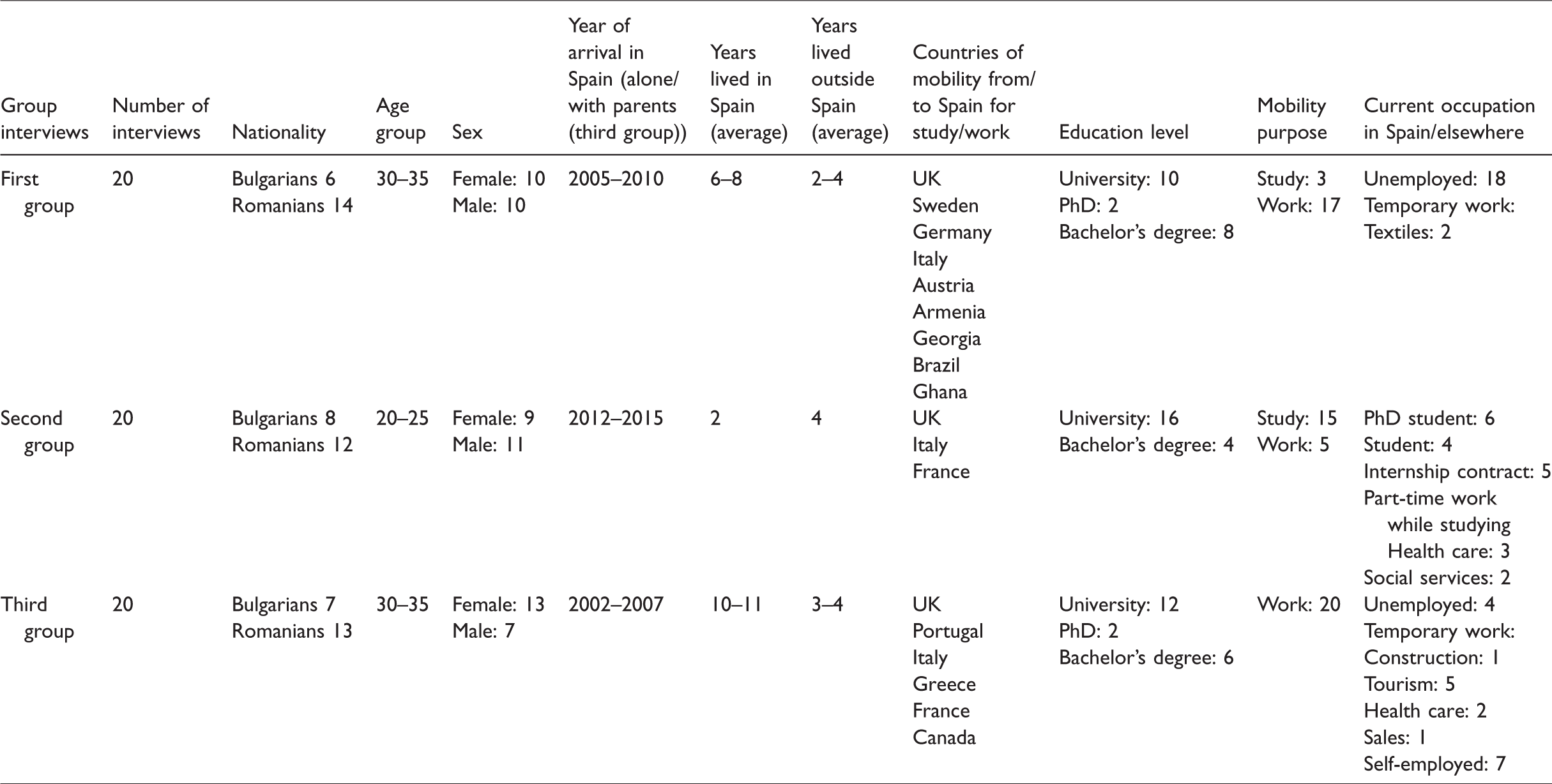
The interviewees were identified through migrant associations, student associations and personal contacts. The interviews were carried out in the cities of Madrid (25), Barcelona (20) and Valencia (10), and also via Skype (5). The questions put to the interviewees covered several areas. First, they were asked how long they had been practising mobility, where and for what reasons. We conversed about how long they had stayed in each place and why they had left. They were then asked where they would like to settle to work, and what future plans they had in relation to their mobility. Finally, they were asked to reflect on the feelings and moods that inspired their mobility in present and past years, with a special emphasis on the different places they had lived and, more specifically, Spain. It is important to note that the mobile experiences of the young interviewees work in the same way for both Bulgarians and Romanians. The interviews were conducted in Romanian, Bulgarian and Spanish, and were later translated, coded and analysed using the qualitative analysis program Atlas ti (version 7.0). All interviewees appear under pseudonyms to guarantee their anonymity. The analysis of the information from the standpoint of codes, concepts and categories identified key relations between the data obtained and conclusions reached (Flick, 2014).
Given the considerable quantity of information, I have used the inductive approach of thematic analysis in which three key themes are identified: mobility as tiredness; mobility as a labyrinth; and mobility as resistance to precarity through return. These key themes are derived inductively and linked to the data, highlighting the experiences of the interviewees as a decisive factor in the analysis. As Collins (2016: 1171), following Lawson (2000: 174), noted, ‘migrant stories generated through interviews can reveal the empirical disjuncture between expectations of migration, produced through dominant and pervasive discourses of modernization, and the actual experiences of migrants’.
Mobility as a limit: Precarious experiences among young Eastern Europeans in Spain
This section contains the main empirical findings of the research. One of the important features of the Eastern Europeans engaged in precarious mobility to and from Spain is that most of them had higher education, even more so than young Spaniards. In 2016 39% of Spanish people aged 25–34 had higher education, while the Romanian and Bulgarian migrants registered in Spain who had higher education reached 52% and 50%, respectively (Ministry of Employment and Social Security, 2017). In spite of this, they were unable to find employment in the Spanish labour market, and thus needed to practise mobility to other countries. Examining the efforts of migrants to access employment, Morosanu (2016: 354) noted that ‘half of those, working in lower-skilled jobs had higher education’. The lack of direct connection with Spanish society has prevented, and continues to prevent, Romanian and Bulgarian professionals from finding qualified jobs in accordance with their education and skills. Consequently, as time passes, and when they realize that their professional precariousness persists, they ask themselves how long they will have to keep moving in search of stability. It is at this point that they face the limits to their mobility. Therefore, in what follows I provide an analysis of my findings in relation to the three key themes that together highlight the existence of the limits to mobility: mobility as tiredness, mobility as a labyrinth and mobility as resistance to precarity through return.
Mobility as tiredness
This section analyses the limits to mobility specific to people who practised mobility to Spain and, after travelling, training and changing precarious jobs in several countries, try to move and settle in one place. Respondents who moved from their countries of origin to Spain 10–15 years ago to study and/or work are frequently people with higher education, even doctorates, but also with a baccalaureate, with knowledge of languages and extensive professional experience. After working in other EU countries, some were passing through Spain, trying to recover professional contacts in the country. This is the case of Ivan, who noted: I got my doctorate in Madrid, but I did not get the maximum grade. This meant that I was unable to find work. In Spain, there is talk of excellence, and since the crisis began even more so. And so many people with doctorates had to leave Spain. I got some scholarships and contracts in Georgia, Switzerland and Germany. After travelling around the Balkans to see if I could find anything there, I am now passing through Spain. I have tried to see what I can do, but Spain is a country of contacts. I want to end this torture of going from one place to another. I’m at the end of my rope, my worst moment. (Male, 34, Bulgarian)
This leads us to the most relevant finding highlighted by the interviewees of the first group: tiredness as a subjective reaction, caused by mobility and work precarity over the life-course. Tiredness thus is interpreted as a consequence of frustrated mobility, which is perceived in negative terms: a source of exasperation, hopelessness, exclusion and perceived vulnerability and precarity. All of the respondents in this group claimed that the search for employment in several countries in Europe and even Latin America was exhausting, and they wondered how long this ‘mobile time’ would last. In her Skype interview, Roxana said: I arrived in Spain alone in 2010, where I worked in a textile company until the crisis came, and it had to close. I’m unemployed, and I’m still moving aimlessly. I tried my luck in Latin America and now I am in Belgium temporarily, where I would like to work in the fashion industry. I’m tired. I would go back to Spain, but there is no work there. Sometimes, I think all this mobility is making me ill; I have to work in one place. If it could be Spain, better, because with all the mobility of recent years, I have lost my country. (Female, 33, Romanian)
Moreover, the interviewees’ discourse shows that in their search for work, temporal mobility and knowledge of languages have made them stronger, allowing them to put spatial limits on their mobility, or even sacrifice their professional careers. This is what Dariana said: I have moved in solitude around the world. I speak five languages, and now I’m trying to find professional and personal stability. I would like … I imagine having a family. I think life is telling me to give up my mobility, even my career, and to live in Spain, although this may lead me down another road. If this is what life wants for me, I’m going to stop for now. Then we shall see. I have my whole future ahead of me, and many roads to choose from. (Female, 34, Romanian)
Surfing in the labyrinth of temporality: Between the fulfilment of objectives and the uncertainty of relocation
This section captures the limit to mobility specific to respondents who started their mobility just as they were beginning their studies, after their country’s integration into the EU, when they were free to move without restrictions. At the time of the interview, they were studying and/or working in Spain on temporary contracts. However, before arriving in Spain they had studied in the UK, France or Italy, as highlighted in their interviews.
Oana noted that: I left Romania when I was 19 to study, and I graduated in Edinburgh. I am now in Alicante on an internship. I came to Spain because I knew the language; I did Erasmus here, and the teachers valued my training and my knowledge of English. I am fulfilling my goals but I don’t know if my labour mobility is over yet. For now, I’m trying to relocate. I will have to prove that I am the best in my team to remain here. (Female, 25, Romanian)
Bozhidar confessed: Every day I struggle to hold on to a job that I sometimes find, then lose, then find again; that they take away, and that I regain. The last contract I had lasted a week and the one I have now is for two months. I am obsessed with always having to move, to leave, to come back. My life is an absolute labyrinth. (Male, 25, Bulgarian)
Vlad said: I will get out of this. Even though times are bad, with periods of employment, unemployment and a lot of mobility, I plan to turn my life around, to do something useful and get ahead. For now, I help in a refugee support office in Madrid. I will try my hardest for everything to turn out well and to bring an end to my precariousness and mobility. (Male, 24, Romanian)
Mobility as resistance to precarity through return
The limits to mobility are clearly captured in this last empirical section, which analyses mobility as resistance to precarity through return, manifested by the interviewees’ struggle to become self-employed in order to cope with precariousness. This type of mobility is practised by people who migrated with their parents at an early age and studied in Spain, but for professional reasons have had to leave. Currently, they desperately want to return to Spain, and even consider returning to their country of origin. As mentioned above, young people in Spain – both foreign and Spanish – did not have the opportunity to access positions that members of less prepared generations have occupied. And if there is no social mobility, the only thing left is transnational mobility. Participants in this research undertook mobility, many times without a fixed destination, and their experience was different from that of their parents. At present, they go back and forth depending on whether they have work or not. Moreover, their couple relationships have been subordinated to the labour and housing markets. Some of them, even in this gloomy context, try to resist and regenerate their lives. And as they themselves admit, they have never valued family and friends as much as they do now. Upon returning to Spain, after living for several years in Canada, Arina said: I arrived in Spain with my parents when I was a teenager. I studied in Madrid, and then I had to go to Canada. But the contract at a company there ended, and I returned to Spain. I still live with my parents, but I know I will eventually get my own place. In fact, I started my own business three months ago. I will resist and I will fight against precarity. I’m excited and I hope it works out. (Female, 34, Romanian) I have many Spanish friends in the same boat as me. It’s outrageous and frustrating. We’ve united to protest against unemployment, and we have created a platform to access jobs in Spain. I hope my mobility is limited, because I’ve already been in many countries. (Female, 35, Bulgarian)
In Spain, the Youth Council promotes platforms and campaigns with youth participation against labour precariousness in all its dimensions, but specifically aimed at labour mobility as a result of career instability, an uncertain future or the inability to access resources. One of them, in which the interviewees in this research participate, is TuTítuloSíSirve (Your Qualifications Are Valid), 2 which is a campaign that criticizes the precariousness of work and youth unemployment that forces young people to leave their country in search of a future.
Nevertheless, the limits to mobility can also have an end point, when respondents, after having experienced mobility in several countries, have not managed to settle in one place and so start to think about returning to their countries of origin.
Maritza noted: I have lived in many places, with and without scholarships. I have lived in Spain for some time, in fact, my parents still work here. But I have not found a job. So, I think I’ll go back to Bulgaria. I need to close the circle of my mobility, at least for now. As my parents’ house is there, I will also have a place to end my mobility. I will resist in my country. (Female, 35, Bulgarian)
Conclusions
This article examines the precarious work experiences of young Eastern Europeans in Spain by analysing the concern of limits to mobility. Drawing on a political-economic approach (Evans, 2008; Kelly, 2006, 2018) embedded in the context of neoliberal policies, I analyse the term of ‘limits’ such that it may enable us to better understand how Eastern European migrants experience and respond to the disequilibrium that precarious labour mobility causes over the life-course. To answer the research questions, I cover three specific points that emerge from the limits to mobility and their interpretation in the context of youth experiences.
First, limits to mobility are interpreted as resulting from the interaction between the life-course – time and space – and precarious mobile work structures. I show that limits to mobility arise from the multiple structures within people’s experiences and lives and can thus be explained according to the contexts in which they develop. The different contexts – duration of precarious mobility, potential to cope with precarious work, to resist or resent, life chances and life choices – experienced over the life-course and the mobility process generate various types of limits to mobility: mobility as tiredness, mobility as a labyrinth and mobility as resistance to precarity through return.
I emphasize the uneven ways in which limits to mobility are experienced. The first group of migrants exhibit tiredness with being mobile after years of precarious movement. They came alone to Spain, lack family support and are unemployed, compared with the third group of respondents who have more family support and include some who have developed entrepreneurial capacity (Kelly, 2006). Younger interviewees, who have not accumulated years of mobility, still hope to be able to link their lives to their most recent work or internship contract to remain in Spain and leave behind the labyrinth of their mobility.
Second, the interviews as well as the theoretical framework reviewed demonstrate that the limits to mobility have both temporal and spatial aspects: the temporal dimension is built up over years of precarious mobility, which erodes the lives of respondents and warns them of the critical moments when they experience the limits to their mobility. I found that the interviewees who have intense experiences of mobility try to overcome the precarity of their mobility and find a stable place that allows them to work, live and even form a family.
The spatial limit has a more subjective aspect and may be expressed by people’s dissatisfaction with the places they experience, and the need to live and work in one place – in this case Spain, as the first country of migration. The limit to their mobility is due to employment precariousness as well as the lack of support in decision-making, since the family is far away and the constant change of houses, cities or countries produces perpetual tiredness, feelings of loneliness or fear of illness.
This leads to the third point, whereby the limits to mobility reach a peak and can be explained in two ways. The findings of this research show that, on the one hand, the limits empower, regenerate and provide support to young adult entrepreneurs who have the ability to resist and fight against precarity by using their agency to set up their own businesses and to innovate. On the other hand, the limits to mobility cause destabilization, despair and loss of direction in respondents who feel they can no longer remain precarious and decide to return to their countries to stay, resist and start again, ending in this way their mobility. In this fashion, respondents interpret the limits to their mobility both as a path of hopelessness and tiredness or as a way to fight against precarious employment through personal effort. Overall, the limits to mobility may be interpreted as a transactional relationship between present and future needs and aspirations; a way to combat precariousness through resourcefulness and personal effort to find their place (Biesta and Tedder, 2007; Brown, 2011; Jeffrey, 2012; Kelly, 2006).
The limits to mobility that I have detected from Eastern Europeans’ experiences may have several applications. A potential future research agenda could include this concept applied to young people worldwide, and especially those countries most affected by unemployment. Moreover, the limits to mobility could be applied to adult and older migrants who worked throughout their lives in precarious conditions, and who are looking for a place to retire and establish a place of residence (return to their country of origin and become entrepreneurs, or grow old in the country of destination – for example, Spain, which offers better healthcare, quality of life and a warmer climate).
To conclude, the future that awaits young people in the framework of their precarious mobility is a question that must be addressed as it shapes the limits to mobility. In this research, respondents suggest that ‘there are many roads to choose from’. Current debates focus on emancipation, the search for a dignified future or for stable work. When might this independence be achieved? Hopelessness, disappointment and uncertainty are the terms that currently define their lives. As long as this group is not taken into consideration at the moment of making decisions, uncertainty and job precarity will remain constant. This reality should become a priority for European policymakers, whereby they endeavour to develop measures aimed at solving the ways in which work and mobility could be made less precarious, putting an end to limits and thus improving youth experiences of work and mobility.
Footnotes
Acknowledgements
I would like to thank the three anonymous reviewers for their insightful comments and critical engagement, and Journal Editor Professor Jamie Peck for his generosity in feedback and support. I also wish to extend my gratitude to all of the Eastern European people who kindly agreed to be interviewed for this research project, for all their time, energy and generosity.
Declaration of conflicting interests
The author(s) declared no potential conflicts of interest with respect to the research, authorship and/or publication of this article.
Funding
The author(s) disclosed receipt of the following financial support for the research, authorship, and/or publication of this article: This work was supported by the Ministry of Science, Innovation and Universities, Spain [CSO2017-82238-R].