



Abstract
China is generally considered a safe place: among the safest for foreigners to visit. For local (long-term) residents and for Chinese criminology scholars, China as a country and its individual cities might be safer compared to many of their foreign peers; however, they might not be as safe as some travel agents claim. To show why this is the case, we crawled and geovisualized the 2015–2016 crime records (n = 24,803) available to the public online. The geovisualization shows that the seven crimes (n = 12,516) that were most likely to be influenced by space in Beijing were aggravated assault, blackmail, cheating and bluffing, dangerous driving, picking quarrels and provoking trouble, robbery and theft. It also shows a Beijing that many might not have known before.
For those who travel abroad or who do business overseas, accurate and timely information about travel risk is important. Because of this, many entities – ranging from the US Department of State to International SOS – undertake great efforts to systematically collect, update and disseminate such information. According to these entities, China is considered a safe place and even one of the safest for foreigners to visit (Zhao et al., 2017). For local (long-term) residents and for Chinese criminology scholars, China as a whole and its individual cities might be safer compared to many of their foreign peers; however, they might not be as safe as some travel agents claim.
At the national level, against the backdrop of an increased crime rate, the Chinese government has launched several rounds of ‘strike hard’ anti-crime campaigns, which have aimed to significantly reduce various crimes and to improve the perception of safety and security among the people (Zhuo, 2012). In Beijing, the capital of China, and arguably one of the safest cities in the eyes of Chinese and foreigners, 24.4% and 59.6% of surveyed residents (n = 1571) had been victims of certain crimes or heard of a crime around their residence, respectively (Zhang et al., 2019).
In light of the above, there could be another comparatively unsafe China/Beijing that many people (especially foreigners) might not be aware of. To understand more about this ignominious China/Beijing, we crawled and geovisualized the 2015–2016 crime records (n = 24,803) available to the public from www.bjcourt.gov.cn, a website of the Beijing Municipal High People’s Court. Before employing the crime rate for statistical analysis, which requires many more independent variables and sophisticated theoretical constructs, we use the number of crimes to geovisualize spatial patterns to show us the big picture first. Figures 1 and 2 show the seven crimes (n = 12,516) we think that were most likely to display a non-random pattern in Beijing: aggravated assault, blackmail, cheating and bluffing, dangerous driving, picking quarrels and provoking trouble (acts of creating social disturbances to public order), robbery and theft. Among these crimes, theft, dangerous driving and picking quarrels and provoking trouble were the three most dominant. We thus further identified and mapped out the top locales where these crimes occurred, to see whether there was a spatial pattern that we could discern.
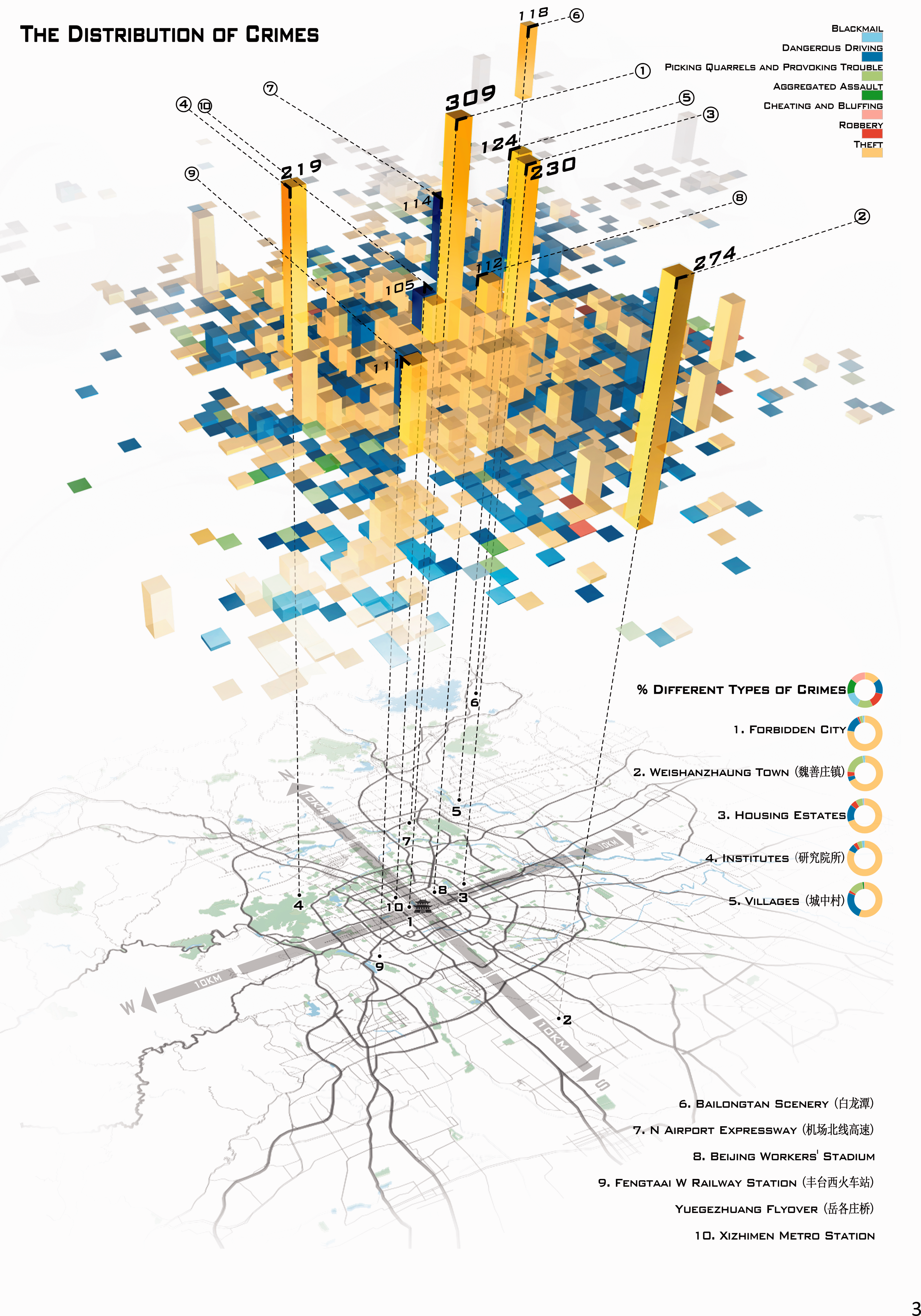
The top crime: theft. Column: the number of crimes; Color: the most dominant crime in a locale.
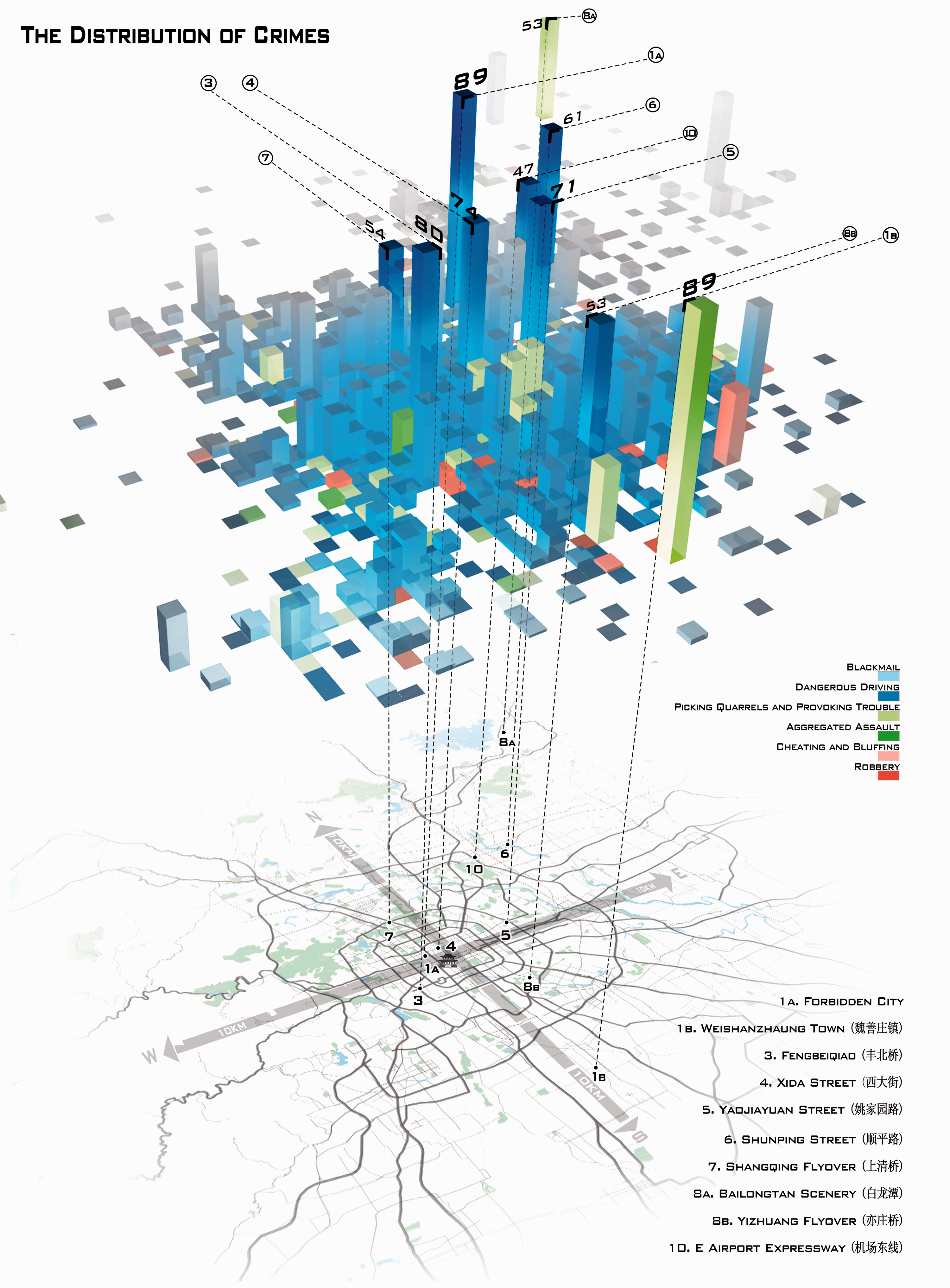
The second and third most prevalent crimes: dangerous driving and picking quarrels and provoking trouble. Column: the number of crimes (exclude Theft); Color: the most dominant crime in a locale.
Interestingly, it was not the major transport hubs like Beijing Railway Station and Liuliqiao that saw the most thefts. To our surprise, it was a tourism hotspot (the Forbidden City) and its vicinity, as well as a suburb in the south (Weishanzhuang) that witnessed the most thefts (1 and 2 in Figure 1). Together with Bailongtan Scenery, Weishanzhuang was also where the most instances of picking quarrels and provoking trouble occurred (1B and 8A in Figure 2). In terms of dangerous driving, it was the areas of the Forbidden City and Fengbeiqiao that experienced the most (1A and 3 in Figure 2). Due to data and time constraints, we could not better relate the above findings to more local sociodemographic information. But, based on the crime data we obtained and geovisualized, we in general agree with Zhang et al. (2019) that preventing and mitigating crimes (in Beijing and even the whole of China) deserves more attention than most have expected, and that it is important for us to conduct more continuous and in-depth studies on local crimes: their patterns, determinants and cures. As China enters a new stage of development, with widening gaps between the rich and the poor, increasingly mobile population, more temptations of luxurious lifestyles and the widespread lure of getting rich quickly, preventing crimes has become more challenging than ever.
Footnotes
Declaration of conflicting interests
The author(s) declared no potential conflicts of interest with respect to the research, authorship and/or publication of this article.
Funding
The author(s) received no financial support for the research, authorship and/or publication of this article.