



Abstract
This paper contributes to the literature on new regional industrial path development by highlighting the multiple roles that demand can play in regional development. We develop a conceptual framework relating different roles of demand to different types of new path development. Based on the literature on regional development, we differentiate between the role of demand as anonymous consumer, sophisticated buyer, active co-developer, public procurer and norm and value setter. These roles influence different types of new path development, including path extension, path upgrading, path importation, path diversification and path creation. New path development can be triggered by changing norms and values in the society (e.g. environmental concerns and the growing demand for cleaner technologies), public procurement for innovation (governments demand new products or services and thereby steer economic development) or by users modifying existing products or developing novel solutions that are not yet on the market (e.g. user innovations). The various roles of demand, as well as its effect on new regional industrial path development, depend on the geographical context. We argue that taking a nuanced view towards demand will add a novel dimension to the debate on new path development in regions.
Introducing new path development
The literature on regional development has recently been devoting considerable attention to the question of how new industries emerge and evolve over time – a research theme that is often framed under the term ‘new (regional industrial) path development’ (Hassink et al., 2019). The initial and agenda-setting contributions on this topic stem from evolutionary economic geography (Boschma and Frenken, 2006; Boschma and Martin, 2010) and typically consider new path development as an outcome of endogenously triggered branching processes through firm diversification, labour mobility, spin-offs or networking. In this way, industries over time diversify into new, but technologically related, fields (Frenken et al., 2007; Neffke et al., 2011). Recent contributions from institutional and political economic geography have sought to shed light on the scope and role of institutions, policy, agency, and exogenous knowledge sources (e.g. Dawley et al., 2015; Isaksen and Trippl, 2016; Morgan, 2013; Pike et al., 2016). All of these contributions regard innovation as the fundamental driving force behind new path development (Isaksen and Trippl, 2016; Trippl et al., 2018).
While the existing literature has enhanced our understanding of these different aspects of innovation as the driving force for regional transformation, it is surprisingly silent on one noteworthy driver for change – namely, demand. One of the central arguments in the literature on regional development is that innovation performance and the competitiveness of firms is based on close interactions between various actors in the regional environment. The main emphasis is therefore on the characteristics of territorial innovation systems (Moulaert and Sekia, 2003) in the form of knowledge linkages between firms and with knowledge infrastructure organizations (Isaksen and Trippl, 2016; Isaksen et al., 2018; Trippl et al., 2018). As Malmberg and Power (2005: 280) note, ‘in many business areas, demand, consumption processes, and customers have a determinant effect on the innovation process’, implying also the need for a better understanding of demand when discussing regional development (Grabher and Ibert, 2018). In this paper, we define demand as consumer needs and wants – that is, the desire or preference to acquire a product or service. It can be private or public and stem from end-users, businesses or governments (NESTA, 2010).
The aim of this paper is to further our understanding on the role of demand in new regional industrial path development. 1 To do so, we derive different roles of demand from the existing literature on regional development and develop a conceptual framework relating the different roles to different types of regional industrial path development. Our research interest lies in regional development and the question of how demand conditions can influence regional industrial structures. Thus, we introduce demand as an additional denominator in the recent literature on new regional industrial path development. Due to this novel approach, we apply a broad definition of demand spanning end-users (i.e. consumers), businesses (i.e. customers) and governmental actors. We also acknowledge that changes in demand can occur at different spatial scales; it is, however, not the primary focus of this paper. Rather, we discuss how changes in demand at any spatial scale can influence path development on the regional level.
Studying the role of demand becomes particularly, though not exclusively, important in the context of problem-driven innovation and grand societal challenges (e.g. Boon and Edler, 2018; Cagnin et al., 2012; Mazzucato, 2015). Here, the prevailing supply-side view of innovation systems as ‘production systems’ (Truffer, 2008) has to be extended with a demand-side perspective on consumer behaviours, norms and values, crucial to ensuring the acceptance and diffusion of innovations in society. This paper therefore also links to the academic debate on how to advance the innovation system approach with a dynamic view on systems and a wider understanding of actors and institutions (see, e.g. Binz and Truffer, 2017; Warnke et al., 2016).
The paper is organized as follows. First, an overview of the literature on new regional industrial path development is provided, identifying forms and triggers of new path development. Second, the broader literature on regional development and innovation is reviewed, focusing on different perspectives on demand and the roles that are ascribed to consumers and customers. We then develop a conceptual framework in which we discuss the role of demand in new regional industrial path development. We end with conclusions and offer suggestions for future research and policy action.
Review of the literature
Different forms of regional industrial path development and their determinants
Most recent work on regional industrial path development distinguishes between five main forms of new path development, including path extension, path upgrading (also referred to as path modernization), path importation, related 2 and unrelated path diversification, and path creation (Asheim et al., 2019; Hassink et al., 2019; Isaksen et al., 2018).
Path extension refers to a continuation in regional industrial structures, mainly achieved via incremental product and process innovations in existing sectors. Firms mainly learn from other actors in industrial paths that are already established. A failure to ensure path extension might lead to a sixth form of path development, path exhaustion – the decline of a previously successful path due to institutional, functional or political lock-ins (Hassink, 2010). It occurs due to the lack of complementary knowledge in a region and a lack of organizational learning processes and absorption capacity (Isaksen and Trippl, 2016). Path upgrading denotes a major intra-path change of an existing industrial structure based on new technologies or organizational innovation, which give an existing path a new direction (Isaksen et al., 2018). Examples can be the use of new technologies in the chemicals or forest industries, allowing firms to produce high-value added materials from forest resources (Coenen et al., 2015; Martin, 2016). Path diversification stands for the development of a new industry based on related or unrelated combinations of knowledge and competencies. Related path diversification describes how new paths grow out of existing industries in a region (Boschma and Frenken, 2011) and requires the combination of different types of knowledge. In line with the arguments of related variety, the focus has been on knowledge spillovers between co-located firms with different but related activities (see, e.g. Boschma and Wenting, 2007; Neffke et al., 2011). Unrelated path diversification results from the combination of firms’ existing competences with new, unrelated knowledge assets (Asheim et al., 2019). Recent studies have pointed out that knowledge exchange with actors in initially unrelated industries can lead to unexpected combinations, and can positively affect industrial renewal (Grillitsch et al., 2018). Path importation stands for the establishment of industries that are new to the region and imported from other locations. It thus describes the setting up of an otherwise established industry, but one that is new to the region (Grillitsch et al., 2018). Path importation happens through the settlement of non-local firms, entrepreneurs or highly skilled workers, and occurs when the new firms and competences establish co-operations with regional actors (Asheim et al., 2019). Path creation is the result of radical change in industrial structures (Boschma and Frenken, 2011; Grillitsch et al., 2018; Trippl and Otto, 2009). It is often associated with a strong scientific knowledge base and new knowledge-intensive activities, which stem from scientific discoveries in the region. An influx of individuals and firms that possess the necessary capabilities and resources to make use of that knowledge base are also characteristic (Grillitsch et al., 2018; Trippl et al., 2018). Path creation has recently also been ascribed to the rise of entirely ‘new to the world’ industries (Asheim et al., 2019; Hassink et al., 2019) and as an outcome of user-driven innovations, social innovations or the search for new business models (Grillitsch et al., 2018; Trippl and Otto, 2009; Trippl et al., 2018).
In line with these recent studies, we argue that different mechanisms are needed to reach various types of novelty of regional industrial development paths. Knowledge exchange and interactive learning between firms and with knowledge providers are considered the most important mechanisms leading to one or another form of new path development. Since learning and knowledge exchange are socially embedded processes, regional institutions and policy practices are also seen as important elements facilitating or hindering new path development (Isaksen and Trippl, 2016). Regional policy might promote new path development by creating arenas for knowledge exchange, setting up schemes for attracting actors with complementary skills and resources to the region or, on the contrary, hindering new constellations due to political lock-ins (Isaksen and Trippl, 2016; Tödtling and Trippl, 2005).
Although recent contributions to the debate have moved away from a pure focus on the firm and do acknowledge the role of actors, institutions and policies, we find that most studies on new path development still have a predominantly supply-side view on formation and transformation of regional industrial structures. Only a few studies touch upon the importance of demand for the long-term development of regions. For example, Martin and Coenen (2015) address the role of regional governments in influencing demand conditions through public procurement. Public authorities in the region of Scania, Sweden, created a market for regionally produced biogas through the use of biogas technology in local public transport. Simultaneously, the development targets set by the regional government created legitimacy for the further expansion of the industry and triggered new firm entries. Further contributions touch upon the role of the state as a purchaser (Morgan, 2013) and on the interplay between national market regulations and regional policy actions (Dawley, 2014; Dawley et al., 2015; Martin and Martin, 2017) for new path development. Other authors propose a stronger consideration of the civil society in regional development and innovation processes (Grundel and Dahlström, 2016; Mattes et al., 2015). These contributions, however, leave the actual mechanisms and various roles played by demand largely undiscussed. It seems fair to state that the current literature on new regional industrial path development has left the notion of demand largely unconsidered, which we attempt to address in this paper.
The role of demand in the literature on regional development
In this section, we provide an overview of various roles of demand that have been pointed out explicitly or implicitly in studies on regional development (Table 1).
Different roles of demands in the literature on regional development.
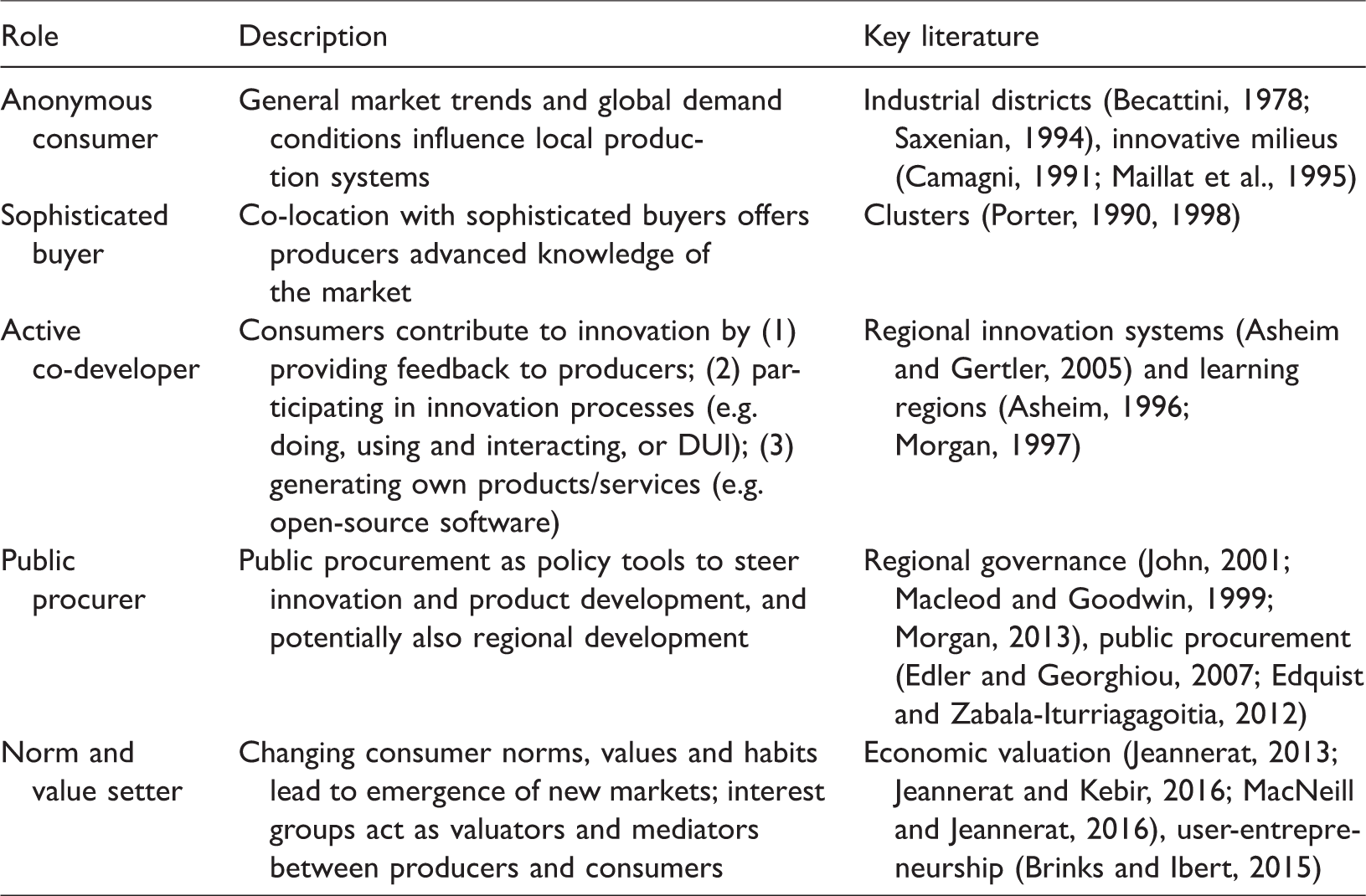
Early works on Italian industrial districts and innovative milieus (Camagni, 1991; Maillat et al., 1995) discuss how local production systems are affected by changing demand conditions in a globalizing world economy. Industrial districts are typically characterized by small and co-located manufacturing firms. This was the dominant form of work organization until the mid-20th century, when mass-production technologies led to a surge of large multinational companies (MNCs), and when the patterns of demand changed towards the consumption of standardized mass-produced goods. The further growth of vertically integrated MNCs seemed inevitable, but scholars studying industrial districts noticed an opposing trend (Piore and Sabel, 1984) and argued that the increase in global competition would drive many firms out of mass markets with standardized products. To survive global competition, firms would have to specialize and move towards high-quality and customized products. Such a specialization would require close collaboration between manufacturers and service providers, which can best be achieved in an industrial district setting (Harrison, 2007). While this literature touches upon a change in demand as the driver for industrial transformation, the specific role of demand is not further discussed. Rather, demand is treated as an anonymous consumer, without considering any functional connections between supply and demand in terms of user-producer feedback, interactive learning or knowledge exchange. This resembles the deductive approach discussed by Grabher and Ibert (2018), where consumers do not play an active part in innovation, but are able to reject new products or services if they do not meet their expectations.
The literature on clusters offers a similar argument on the importance of co-location and specialization despite increasing globalization (Porter, 1990, 1998). Notwithstanding a number of critical evaluations (Martin and Sunley, 2003), the cluster concept has become widely accepted by researchers and policy makers and has also been taken up in the debate on new path development (e.g. Asheim et al., 2017). While the cluster concept shares many arguments with earlier territorial innovation models such as industrial districts, it goes a step further in its conceptualization of demand. The reason why clustered firms have a competitive advantage over non-clustered firms is typically ascribed to four attributes of clusters (Porter, 1998), among them local demand conditions, understood as the nature of home-market demand for the industry’s products or services. Thus, local demand is treated as one essential factor that can explain differences in innovation performance. According to cluster theory, co-location between producers and consumers, notably sophisticated buyers who request the latest technological innovations, offers producers advanced knowledge of the market. This gives clustered firms an advantage over firms that lack geographical proximity to sophisticated buyers and do not gain the same immediate awareness of latest trends and market developments. Local sophisticated demand is important for articulating requirements that producers have to meet, meaning that consumers are perceived as an additional source of knowledge.
The literature on regional innovation systems (RIS) has yet another view on the role of demand (Asheim and Gertler, 2005; Cooke, 1992; Isaksen et al., 2018). In line with industrial districts and clusters, RIS draws on Marshall’s (1920) work on the innovation-enhancing effects of a local concentration of firms and related organizations. Innovation is seen as a key driver for economic development, and as the outcome of non-linear, collaborative and cumulative learning processes that are shaped by formal and informal institutions at various spatial scales. The role of demand is not discussed explicitly; however, the functioning of RIS is grounded on intense collaboration and interactive learning between a wide range of actors, including firms, universities, R&D organizations and even consumers and users. Interactive learning often appears in business-to-business relationships, but also in relationships with public sector actors and end-consumers. Close interactions between producers and service providers are crucial for engineering-based sectors such as software engineering or mechanical engineering, and oftentimes underpinned by permanent co-location of firms. For many industries that draw upon experience-based innovation modes (i.e. doing, using and interacting, or DUI), the interaction and close collaboration between users and producers is seen as vital (Isaksen, 2016; Zukauskaite and Moodysson, 2016). Often in the case of complex products (e.g. industrial machinery), consumers contribute to innovation by providing feedback to manufacturers and demanding products with certain functionalities, or they actively co-develop innovations by suggesting improvements to existing products or by collaborating in the search for solutions to practical problems. The consumer is seen as one of many RIS actors, and its role is primarily seen as a provider of knowledge for innovation, underscoring the emphasis on the supply side of innovation in territorial innovation models.
Furthermore, scholarly work in the field of regional governance (John, 2001; Macleod and Goodwin, 1999) maintains that the state can play an active role in influencing regional development, in particular through public procurement. Through public procurement, understood as the acquisition of goods and services by a government or public authority, 3 the state purchases certain products or technologies and takes over the role of the customer. Public procurement accounts for a significant share of the overall demand for goods and services (Uyarra and Flanagan, 2010; Uyarra et al., 2017). It also possesses a crucial role in promoting solutions to grand societal challenges, as it can set the route and direction for change by shaping markets (e.g. Boon and Edler, 2018; Mazzucato, 2015). Scholarly works on public procurement, though, usually take a non-spatial approach or focus on national or supranational levels, where most of public procurement policies are designed and implemented (e.g. Edler and Georghiou, 2007; Edquist and Zabala-Iturriagagoitia, 2012). Among the few exceptions with regional focus is Morgan (2013), who draws attention to multiple roles of the state in shaping new path development in old industrial regions, emphasizing ‘its roles as producer, regulator, animateur and purchaser’ (Morgan, 2013: 337). The role as a purchaser refers to a situation in which the regional state acquires goods and services from private sector suppliers. Martin and Martin (2017) argue that local governments need different types of policy capacities to successfully steer regional development, and provide a case in which regional policy actors stimulated the emergence of a new industrial growth path through a mix of public procurement and regulation setting. Martin and Coenen (2015) address the role of government in influencing demand conditions through public procurement. These contributions show that the public sector can play a role in directly or indirectly influencing demand conditions for certain products or services, which can, in turn, influence regional development.
A nuanced perspective on the role of consumers is provided in recent works on consumption systems and economic valuation (Jeannerat, 2013; Jeannerat and Kebir, 2016; MacNeill and Jeannerat, 2016). According to Jeannerat and Kebir (2016), consumers do not necessarily have to act as co-developers in order to play an active role in innovation. Via intermediaries and communities of users, consumers can act as evaluators of innovation efforts, providing feedback and articulating demand for new product characteristics. Rather than being anonymous, these consumers are active communicators of the values and attitudes that producers need to meet for their products to succeed in the market. Thus, firms coordinate their innovation efforts in response to market signals provided by consumers and in relation to the strategic positioning of other producers in the market. Distribution channels are established and directed towards the end consumer (e.g. via specialized retailers and media coverage). Estimations about future aggregated demand are communicated via various intermediaries (e.g. consumer organizations; interest groups). The authors maintain that a stronger consideration of end-consumers, as well as the institutional arrangements influencing and intermediating consumer voices, can contribute to better understanding regional economic change (Grabher et al., 2008; Jeannerat and Kebir, 2016; MacNeill and Jeannerat, 2016). Consumers may trigger incremental innovation, as producers react to the aggregated voice of an established consumer community. They can spur innovation by articulating and making identifiable a changing demand for certain products; in other cases, they may engage directly in innovation in the forms of co-development, interpretation or experimentation (Jeannerat and Kebir, 2016; MacNeill and Jeannerat, 2016). They can even lead to radical forms of innovation, such as in the case of user-entrepreneurship, where users’ enthusiasm for particular activities, objects or topics may involve the foundation of new firms or even new industries (e.g. Brinks and Ibert, 2015; Shah and Tripsas, 2007).
The mentioned works deal explicitly with the mechanisms of how demand, and changes thereof, influence innovation. What remains less explicit is the link to regional transformation, i.e. how the various roles of demand affect new regional industrial path development.
Conceptual discussion: relating demand to new regional industrial path development
In this section, we provide a conceptual discussion relating the multiple roles of demand outlined above to the notion of new path development (Table 2). Our ambition is not to comprehensively connect every role to every form of new path development, but rather to point out the different directions paths can take through the influence of different roles of demand. The most explicit connection can be made for the cases of path creation, path importation, path exhaustion and path extension, as these can clearly be separated from one another in their degree of novelty and/or directionality. Path upgrading as well as related and unrelated path diversification, in contrast, are less well separable from one another in our framework, as they concern the alteration of an existing regional path (see the concluding section).
Role of demand in new regional industrial path development
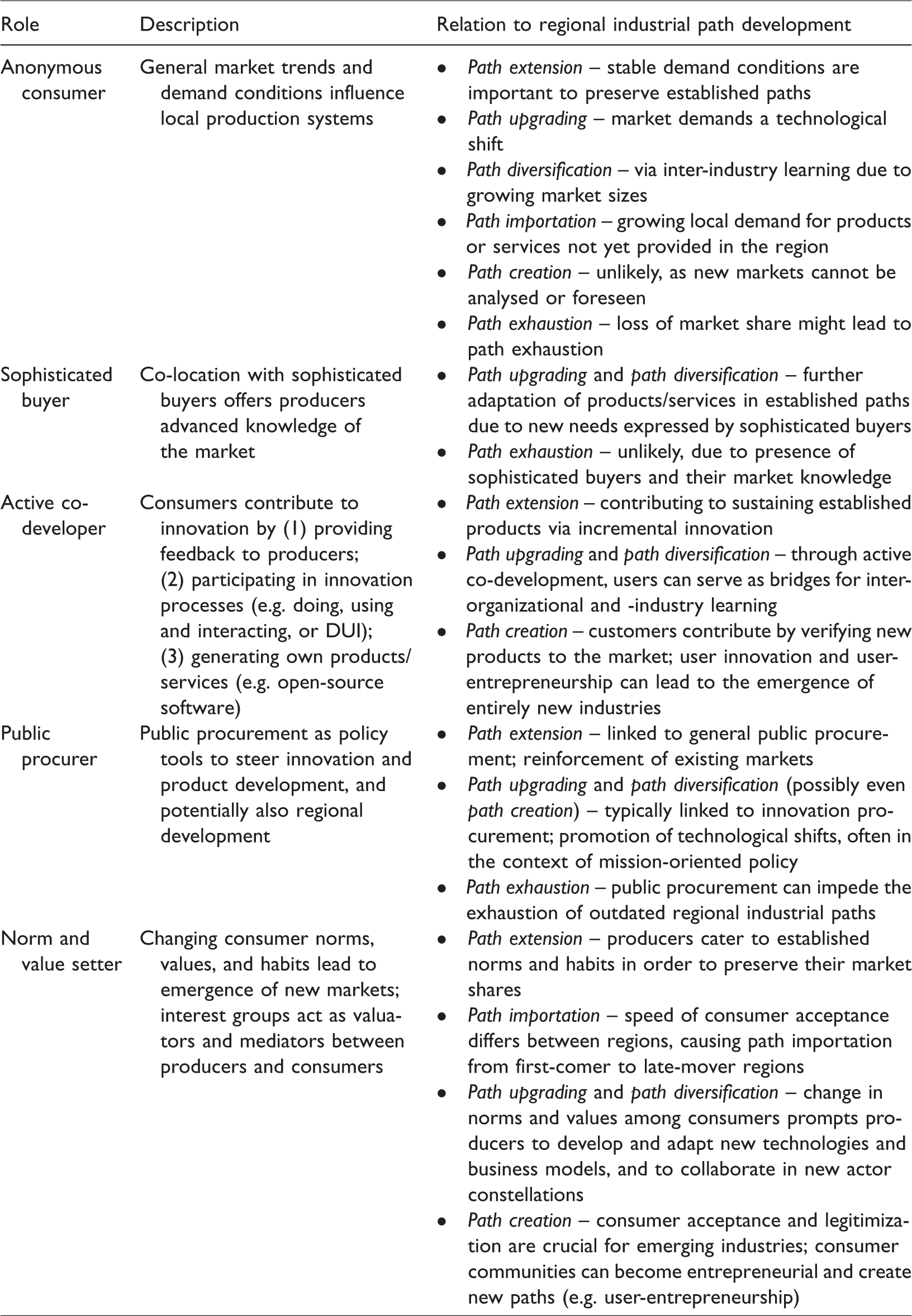
Anonymous consumers influence regional industrial path development via market trends in their aggregated form. Aggregated demand as pure market size can lead to different types of new path development. It is not likely to trigger path creation, since markets for non-existent industries can hardly be foreseen and analysed (Sarasvathy, 2001). For a new growth path to establish itself and to reach a critical mass of companies, growing markets are required. Established consumer bases and clearly divided markets reinforce the continuation of existing industry structures, thus leading to the extension of existing paths. Anonymous demand is thus important for securing and preserving markets sizes. At the same time, a systematic decrease in demand will lead to shrinking markets, slowly but steadily causing an exhaustion of a path over time. Finally, changing overall demand can also cause alteration to an existing path due to overall market development. An example are the recent developments in the automotive industry in Germany, where the demand for diesel-powered cars has been constantly shrinking (Bernhard, 2017). This has led to decreasing profits among many established car manufacturers, and may lead to path exhaustion in regions that host many diesel manufacturers and suppliers. Simultaneously, however, the demand for electric cars is steadily growing, suggesting interest from mainstream consumers (Graham-Rowe et al., 2012; Wesseling et al., 2014). Anonymous demand can thus lead to path upgrading – that is, a major change of an existing industrial structure based on new technologies (Asheim et al., 2019). These processes also trigger inter-industry learning between established car manufacturers and firms in related industries, such as battery manufacturers, resulting in new collaborations, acquisitions and contracts (Klug, 2013). Anonymous demand can also stimulate path diversification through inter-industry learning; and might likewise attract firms from industries that are new to the region, and by doing so trigger path importation (Isaksen et al., 2018). 4 The importation of new paths might be caused by a strong local demand for products or services not already existing in the region. The literature on the sharing economy provides a number of examples in which local demand (e.g. for car- or bike-sharing services) has spurred the emergence of new services and infrastructure specifically in urban areas (e.g. Cohen and Muñoz, 2016).
Sophisticated buyers request the technological state of the art and thereby provide companies with knowledge regarding the latest developments on the market. As companies receive information about current and upcoming market needs, this type of demand is expected to inhibit path exhaustion. Changes in industrial structures do not occur solely as a reaction to changes in aggregated demand, but they may well result from interactions between producers and consumers. Sophisticated demand may trigger path upgrading and path diversification, as the anticipated need to update a product may require new technological or organizational innovations and new business models, as well as new forms of collaboration and inter-industry learning (Asheim et al., 2019). An example is the initiative ‘Locally Grown Plastics’ in Sweden, which aims at creating demand for bio-based packaging materials. The initiative contains food packaging companies and retailers (i.e. customers), the paper and pulp industry on the Swedish east coast (i.e. producers) and the chemicals industry on the Swedish west coast (i.e. producers). A sophisticated demand for bio-based packaging materials implicates new inter-industry collaborations and technological upgrading within and between the involved regional industries (SEKAB, 2019). The concept of the sophisticated buyer has emerged in the literature on clusters (Porter, 1998), suggesting that co-location between customers and producers positively affects the competitiveness and innovation performance of firms. However, sophisticated buyers can equally be located at other geographical scales, since many markets are global in character.
The role of demand as active co-developer is connected to the provision of knowledge in the innovation processes and the search for solutions to practical problems. As opposed to sophisticated buyers, active co-developers not only specify the needs of future markets, but are also involved actively in developing new solutions. Active co-development can take different forms and thus contributes to new regional industrial path development in diverse ways (Grabher and Ibert, 2018). When entirely new industries emerge (i.e. path creation), their offerings – products and services – need to be checked against consumer needs and demands at a very early stage (Malerba, 2007; Ries, 2011). One way of doing this is to develop and test offerings with lead users, who are ahead of the mass market and can contribute with their own custom solutions (Von Hippel, 1986). In this way, they can contribute to the creation of new paths. Producers can also open up the development of their established products, allowing users to introduce changes, catering to their specific needs and/or solving certain limitations. A typical example of the latter is the software industry, where the use and modification of many programming codes is open to different user groups, who collectively contribute to product development (Grabher and Ibert, 2018). By further advancing the product, users contribute to its continual presence on the market, and, as a result, to a path extension in affected regions. Finally, users can also act as bridges for inter-organizational and -industry learning. Consumers can become professional users (i.e. ‘prosumers’), developing their own solutions to cater to their needs when the market lacks a proper alternative (Grabher and Ibert, 2018; also Von Hippel, 1986). Those solutions can later be commercialized and diffused by users themselves (i.e. user-entrepreneurship, see Brinks and Ibert, 2015), and/or by existing firms in the industry, which facilitates path diversification and path upgrading.
The value of consumers as active co-developers is associated with knowledge sharing, often in geographical proximity. Geographical proximity is especially important for tacit knowledge exchange and facilitates user and producer interaction and DUI learning (Maskell and Malmberg, 2007). Thus, the co-location of users and producers eases knowledge exchange, and, as a result, regional industrial change. However, as shown with the software example, physical proximity is not a necessary condition for interaction between users and producers, as co-development may well take place in the virtual space (Aslesen et al., 2018).
The acquisition of goods and services through public procurement accounts for a significant share of overall demand. Public procurement can impede path exhaustion. Examples can be found in many old industrial regions, where outdated industrial paths survive mainly due to generous public subsidy and procurement schemes (Morgan, 2013; Trippl and Otto, 2009). Depending on the novelty of the procured products or services, public procurement can lead to different forms of new path development. It is important to differentiate between general public procurement and public procurement for innovation (Edquist and Zabala-Iturriagagoitia, 2012). In the case of general public procurement, public sector organizations demand a product (or a service) and provide detailed specifications, which limits the opportunity for innovation. Thus, public authorities will strengthen existing markets through increasing markets shares, supporting path extension. In the case of public procurement for innovation, public sector organizations place an order for a specific function to be fulfilled, and specify only the outcomes that should be achieved (Edler and Georghiou, 2007; Edquist and Zabala-Iturriagagoitia, 2012). This allows for a broader range of alternative solutions and can thereby stimulate more radical forms of innovation. Public procurement for innovation can therefore provide considerable momentum to new path development. Nowadays, innovation procurement often relates to providing solutions for grand societal challenges, for example by stimulating new path development of industries that are considered as more environmental friendly. Innovation procurement is less likely to be the sole trigger for the emergence of new to the world industries (i.e. path creation). Rather, it can stimulate upgrading or diversification of a regional industrial path, often with a view that this is societally or politically desired. Examples from the literature include offshore wind power in Norway (Steen and Hansen, 2018) or biogas in southern Sweden (Martin and Coenen, 2015), which are both cases in which public procurement spurred inter-industry learning, new actor constellations and substantial transformations of regional industrial structures. This type of demand by public authorities usually follows administrative boundaries. However, the initiators of public procurement tenders are, at least in the European context, not allowed to give preference to bidders from a certain region. Thus, public demand in one region might trigger new path development in another area.
The role of demand as norm and value setter can be understood in both a narrow and a broad sense. In the narrow sense, it refers to the norms and values of established consumers in a particular industry and of particular market segments. Norms and values are persistent over time, change slowly and often only via generational shifts (Williamson, 2000). They tend to contribute to extension of established paths, since producers will cater to the normative views of their established customers. Producers are able to gain an understanding of consumer norms and values via what Grabher and Ibert (2018) refer to as ‘consumer communities’ (organized by producers around their products) and ‘user communities’ (self-organized around brands, firms and products). By discussing contexts and situations in which products are used, and by providing encouragement and critique regarding new features, consumers also reveal their beliefs, attitudes and expectations. Norm and value setters can, however, also contribute to radical forms of change, including path creation. General public awareness and acceptance are crucial in the early stages of industry formation (Aldrich and Fiol, 1994), when consumers accept and legitimize new types of products and/or services. An example is the recently emerging food industry around insect-based proteins, which is driven by a growing valuation of environmental aspects among various consumer groups (i.e. climate impact of meat consumption; see Dossey et al., 2016). Path creation can also come about if enthusiastic consumers become entrepreneurial and start businesses. Examples can be found in leisure and lifestyle communities, such as fingerboarding or geocaching (Brinks and Ibert, 2015), but also around social or environmental movements such as urban farming (Morgan, 2009; Tornaghi 2014).
By contributing to the societal discourse and shaping norms and values, consumers can also affect regional development more indirectly, for example by expressing concerns in environmental matters (Geels, 2012). Through the articulation of opinions in the virtual space (e.g. Henning-Thurau et al., 2004), the internet acts as a prominent platform for firms to identify topics as important. For coping with societal change, firms perceive the adjustment to consumer norms and values as increasingly relevant, both directly for securing their market shares, but also indirectly for image improvement (Forsmark Karlsson and Östberg, 2016). Changing norms and values can also affect new regional industrial path development. An example is the chemical industry in the Gothenburg region of Sweden (Martin, 2016). Despite lacking mainstream markets and weak policy incentives, but due to a wide societal debate around environmental matters, established companies engage in novel collaborations and demonstration projects related to bio-based raw materials, which may lead to path upgrading and path diversification.
Likewise, changing norms and values in society can bring about new lifestyles that require new products and services, as in the cases of car and bike sharing (Cohen and Muñoz, 2016). Norms and values are space and time contingent and can vary between regional contexts – for example, between urban and rural areas (e.g. Zukauskaite et al., 2017). This implies that new path development can occur differently in different regions. If consumers in one region are slower in accepting and legitimizing new activities that are already acknowledged by consumers in other regions, they might lead to path importation.
Conclusions
In this paper we have called for a stronger consideration of the role of demand in the academic debate on regional development. We have identified multiple roles that demand may play and have related them to different forms of new path development.
We argue that path creation can be triggered by changing norms and values in society, at large or by consumers who help to verify, test and further develop products and services, or even develop and commercialize their own novel solutions. For new firms, technologies or products to turn into a new growth path – i.e. in order to gain a critical mass with a significant impact on the regional economy – market sizes must be established and secured. Industrial transformation in the form of path upgrading and path diversification can gain momentum when market sizes grow. This can happen through innovation procurement, by demand from sophisticated buyers, by changes introduced by active co-developers who act as bridges between industries or by changes in norms and values among consumer groups. Path extension can be supported by public procurement as well as by demand from mainstream consumers with established norms and values. Active co-developers might help to sustain path extension by contributing to incremental innovation along established trajectories. Path importation may be triggered by new and growing local demand by anonymous consumers, or as a result of other alteration processes of regional industries, such as through the settlement of non-local firms.
We admit that not all roles of demand identified and described in this framework can be clearly ascribed to one form of path development, because different roles and forms can co-exist and influence one another. Changing demand may trigger one form of path development in one region and another form in another region, depending on the specific regional setting. The role of demand will vary between regions with different institutional and organizational endowment, such as between thick and diversified, thick and specialized, and thin RIS (Asheim et al., 2019). Further, the role of demand is likely to differ between industries. Capital-intensive industries (e.g. automotive, oil and gas) are more inertial and less likely to react quickly to changes in demand than are non-capital-intensive industries (e.g. software, media). In addition, industries vary in the relationship between producers and customers. Some industries maintain mostly business-to-business relationships (e.g. chemicals, paper and pulp), whereas others are closely inter-linked with consumers and end-users (e.g. fashion, tourism). Consequently, the role of demand will vary considerably between regions with different institutional and industrial structures. This calls for deeper investigation of the role of demand in different regional and industrial contexts.
Previous studies have shown that new path development occurs in different forms and through different mechanisms (Asheim et al., 2019; Grillitsch et al., 2018). The role of demand adds another dimension to this debate. While knowledge input (i.e. the supply side) is crucial to innovation-based regional development, regional transformation may also be triggered by changes in demand, expressed by consumers, business customers or governments. Therefore, knowledge creation and recombination should be studied in connection with demand and market developments (i.e. the demand side), in order to better understand the causes and mechanisms of new regional industrial path development.
This also leads to a number of implications for regional policy aiming at new path development, notably the current EU smart specialization strategy (Foray, 2015). Smart specialization places emphasis on the transformation of regional economies and their diversification into new but related fields, based on existing knowledge bases and capabilities accumulated in the past. 5 Smart specialization has been largely informed by evolutionary economic geography (Boschma and Frenken, 2006; Neffke et al., 2011) and RIS (Asheim and Gertler, 2005; Isaksen et al., 2018), and has consequently a clear emphasis on the supply side of innovation as the vantage point for regional policy actions. Adding a demand-side perspective would lead to an additional range of policy tools. While the presence of sophisticated buyers and active co-developers can be achieved with classic regional policy approaches that target networking between firms and their surroundings (e.g. cluster policies), the consideration of public procurement as a regional policy approach seems far less common. Public procurement allows policy makers not only to support new path development per se, but also to set the directionality of the transformation process. This makes public procurement a powerful regional policy tool, given that regional governments have the necessary formal policy capacities (Martin and Martin, 2017). Targeting norms and values among consumers requires much more subtle policy actions, but might be particularly promising if the policy aim is to reach important societal goals such as addressing the grand challenges. Creating arenas for public debate, encouraging diversity of opinions and lifestyles, and strengthening the civic society are some of the key tools to influence consumer norms and values. The design and implementation of such demand-based policies for new path development is another interesting area for future research.
Footnotes
Declaration of conflicting interests
The author(s) declared no potential conflicts of interest with respect to the research, authorship and/or publication of this article.
Funding
The author(s) disclosed receipt of the following financial support for the research, authorship and/or publication of this article: This research has been generously supported by The Swedish Research Council FORMAS [2016-00646], The Swedish Agency for Innovation Systems VINNOVA [2016-04227], and the Länsförsäkringar Alliance Research Foundation [Svensk regionalekonomisk utveckling och omvandling].