




Abstract
In many domains, including geography, there can be the implicit assumption that improved data analysis and statistical modelling must lead to improved policymaking, and its perceived failure to do so can be disconcerting. Yet, this assumption overlooks the fundamental distinction between epistemological and ontological uncertainty, as discussed herein. Epistemological uncertainty describes the known and bounded inaccuracy of our knowledge about the world as now. Whereas ontological uncertainty describes the rendering completely obsolete of this present knowledge by surprises in the form of currently unknown future events, and by cascading changes to beliefs, attitudes and behaviours made by diverse actors in response to – and in anticipation of others’ responses to – new developments. This paper does the following: (a) shows that because of ontological uncertainty, improved data analysis and statistical modelling can never lead straightforwardly to improved policymaking, no matter how well implemented; (b) outlines how probability-based tools offer little assistance with ontological uncertainty because they are based on present perceptions of future possibilities; (c) urges geographers to reconcile with ontological uncertainty as a source of potentially transformational change, rather than viewing it as a problem to be overcome or something to be defended against; and (d) reviews a range of new, non-probabilistic scenario tools that, when used in combination, can assist in harnessing ontological uncertainty for transformational purposes by surfacing what is to be gained and by whom from enabling, blocking or altering intended policy outcomes, and by searching for future possibilities unconstrained by the present.
Introduction
In many domains, including geography, there can be the implicit assumption that improved data analysis and statistical modelling must lead to improved policymaking, and its perceived failure to do so can be disconcerting (Fusco et al., 2017). Yet, as discussed herein, this implicit assumption overlooks a fundamental distinction: that between epistemological and ontological uncertainty. Epistemological uncertainty describes the known and bounded inaccuracy of our knowledge about the world as now, whereas ontological uncertainty describes the rendering completely obsolete of this present knowledge by surprises in the form of currently unknown future events, and by cascading changes to beliefs, attitudes and behaviours made by diverse actors in response to – and in anticipation of others’ responses to – new developments. Both can disrupt the stability required for data analysis and statistical modelling to prove accurate as a guide to the future, and can enable, alter or negate an intended policy outcome, thereby causing it to happen under circumstances in which it otherwise would not have, or vice versa. Because of ontological uncertainty, improved data analysis and statistical modelling can never lead straightforwardly to improved policymaking, no matter how well implemented (Brown, 2010).
The current penchant for ‘big data’, and increasing emphasis on empirical testing, validation and statistical modelling, therefore does little to assist with ontological uncertainty, and may even be detrimental to our reconciling with it, in two opposing ways. First, by placing heightened focus on the present, it increases vulnerability to futures very different from this focal present. Second, and somewhat conversely, an increasingly detailed focus on the present can make reality appear more susceptible to extreme changes than it really is, given that most of the time they do not occur (Simandan, 2010a). Both effects steer the prevailing ethos towards the short term, at the expense of a more positive and transformational, long-term and visionary perspective on the future (Anderson, 2010; Couclelis, 2005), by reinforcing the two extreme views bookending the necessity–contingency continuum described by Simandan (2010a), here referred to as ‘absolute necessity’ and ‘absolute contingency’, respectively.
The former implies that any future that transpires is wholly determined by its present antecedents; the latter implies that the future is subject to an extreme form of chance for which the only viable response is constant adaptation. Both views do harm to progress. The harm done by absolute necessity is perhaps most obvious, since it implies the absence of an ability to change a future that is bound to happen given what has come before. The harm done by absolute contingency is perhaps less obvious but is no less egregious. Progress requires acceptance that we have, to a significant extent, the ability to achieve desirable outcomes through plans – an acceptance at odds with the perception of plans that are constantly invalidated by change. All systems of interest lie somewhere on the continuum between these two extremes, and consideration of their futures requires an assessment of where and the tailoring of tools accordingly.
Rather than increased focus on the present leading to short-termism (Couclelis, 2005), what is instead required when formulating policy is consideration of the changes to present beliefs, attitudes and behaviours that might ensue, and how the actions induced by these changes may block, alter or fulfil the intended policy outcome, so as to enable or prevent change. Through consideration of what is to be gained, and by whom, by blocking, altering or enabling new developments, transformational possibilities can be identified that lay beyond the bounds of what is conceivable when consideration is constrained by present empirics.
The first part of this paper fleshes out this argument. It explores the nature of ontological uncertainty and the problems associated with data analysis and statistical modelling as a means to reconcile with it. The second part of the paper then reviews some recently innovated scenario-planning tools and highlights how they can contribute to just such a reconciling, allowing for a transformational, long-term and visionary perspective on the future. In concluding the paper, an argument is made that by combining important aspects of these recently innovated scenario tools, they can be appropriately tailored to take account of the relative importance of necessity and contingency in the context under consideration. By combining aspects of the outlined scenario tools, our individual and collective agency to bring about progress and create the future can be recognised, but so too can the constraints on this ability resulting from present circumstances.
The nature of ontological uncertainty: its sources and effect
A recent review in this journal (Fusco et al., 2017) examines uncertainty in the production process of geographical knowledge, discussing uncertainty of information, definition, spatial knowledge, accurate interpretation, and that related to subjectivity. These are all examples of epistemological uncertainty related to the accuracy of what we know presently. Only briefly when referencing ‘unknowns’ and ‘deep uncertainties’ is another, still more problematic form of uncertainty broached (Fusco et al., 2017: 2274). This other form of uncertainty is the specific focus of this paper and is herein referred to as ‘ontological uncertainty’. It stems not from the accuracy (or otherwise) of what we presently know, but rather from the tendency for fundamental changes to disrupt our present knowledge, rendering impossible the closure of the future needed to make modelling and analysis more useful as a basis for intervention and policymaking.
There are multiple approaches to qualitative and quantitative research in the geography domain. Moreover, specifically within quantitative geographic research, modelling has always taken many forms, including simulation-based, multi-agent and dynamical-systems approaches. For this reason, Fusco et al.’s (2017: 2265) assertion that traditional geography research is based on applying probabilistic approaches to empirical data to test theories paints analysis and modelling in geography with too broad a brush. Yet, undoubtedly, much data analysis and modelling is of this type in geography, as is true in many other policy-related domains. Government emphasis on evidence-based policymaking and identifying ‘what works’ promotes the view that ideal knowledge is derived from quantitative modelling aimed at empirical testing and validation of exactly this type (Sanderson, 2002: 6), but this paper contests that view.
Under such an approach, probability is used to mitigate uncertainty by isolating specific causes and their effect through identification of their statistical significance, thereby allowing for interventions based on the resulting knowledge of causal regularities in the form of laws. Alternatively, Bayesian-type subjective probabilities are sometimes used where empirically derived probability distributions are not available (Fusco et al., 2017). However, subjective probability still requires creation of ‘priors’ based on present knowledge of future possibilities, the relative probabilities of which are then updated as new information is revealed over time. New information implying entirely new possibilities is more difficult to accommodate within the subjective-probability framework (Derbyshire and Giovannetti, 2017). A key difference between epistemological and ontological uncertainty is therefore that the former is amenable to probability-based mitigation. Ontological uncertainty cannot be mitigated this way, and indeed, the attempt to do so exacerbates it.
This problem stems from the requirement, explicit in the axioms underpinning standard forms of probability (i.e. frequency-based and subjective probability), to close the future by enumerating all possibilities in advance, so that probabilities summing to unity can be attributed to them (Savage, 1954; Shackle, 1955). The problematic nature of this requirement is highlighted by Feduzi and Runde (2014: 272): it assumes that events cannot occur of a type that fundamentally reframe the decision landscape, not merely by revising and updating the probabilities of known possibilities already residing on it, but by eliminating some possibilities and creating still others that did not previously exist. As such, any learning about possibilities must take place ex ante to the initial assignment of probabilities. Closing the future in this way simply in order to render useful probability-based methods for mitigating uncertainty therefore amounts, essentially, to an assumption that ontological uncertainty does not exist.
As such, use of probability-based tools of the type Fusco et al. (2017) suggest is traditionally used in geographic research inevitably places focus only on known future possibilities, implies that the future can only vary within known bounds based on past variance, and that present circumstances can therefore be subject to only minor changes of known magnitude over time. Using probability ensures that consideration of the future is governed by the past and present, on the basis of which probability distributions are estimated. As noted above, even subjective probabilities are founded in the present because of their requirement for ‘priors’. By contrast, as Tonn and Schaffhauser (1992) aptly put it, uncertainty pervades spatial policy and interventions in geographic space in ways that transcend the classical concepts of probability theory, with their requirement for ex ante–created complete state spaces and stable decision landscapes, and their resulting inability to deal with what are presently unknowns.
These requirements are particularly problematic when it comes to considering the futures of the open systems in which geographic and spatially related policies are enacted. In open systems, the ability to explain how something is occurring presently, based on analysis and modelling to identify relevant causes, does not necessarily imply an ability to predict the system’s future, since the represented causal relations rarely remain stable (Patomäki, 2006). Exactly because they are open, and therefore in constant interaction and exchange with their environment from which they cannot be isolated for the purpose of analysis, such systems exhibit self-organising behaviour leading to the emergence of new possibilities over time (Martin and Sunley, 2007: 577). Because of such emergence, open systems exhibit nonergodicity, implying that the nature of reality is mutable through time, and elevating contingency in importance as a source of change (MacKinnon et al., 2009: 132). Increased emphasis on data analysis and statistical modelling renders it more difficult to grapple with nonergodicity by placing focus on present causal relations, and assuming these to describe accurately the changed future that ensues after the implementation of a new policy, or following the emergence of what is presently an unknown. As Brown (2010: 76) notes then, no matter how well implemented, data analysis and modelling ‘do not circumvent the possibility for surprise’.
The argument herein, however, is something more than just that: not only can data analysis and statistical modelling of the sort Fusco et al. (2017) say is traditional in geography not circumvent the possibility for surprise, it makes surprise more of a possibility. Based on this logic, the current penchant for ‘big data’, and increasing emphasis on modelling using statistical techniques based on variance, will do little to assist in reconciling with ontological uncertainty in geography, and may actually be detrimental to this. While use of data-mining techniques is preferable because they are classificatory rather than probabilistic, even they assist only with epistemological uncertainty, since what is being mined is inevitably data from the past and present. In order to deal better with ontological uncertainty, we instead need to base our interventions on anticipated future circumstances and changed causal relations, and include among these the possibility for futures that are radically different from the present.
Yet, when it comes to consideration of the future, anticipation is hardly neutral (Anderson, 2010). As Keynes (1936) highlighted through his beauty-contest example, anticipations have an effect on the events they anticipate, leading to self-fulfilling and self-denying prophecies, positive feedback and cascading changes to behaviour and strategy (Patomäki, 2018). In Keynes’ beauty contest, respondents are asked to choose the prettiest among six entrants. However, it is those picking the one deemed prettiest on average by all respondents that become eligible for a prize draw and therefore: ‘It is not the case of choosing [who is] … really the prettiest, nor even those that average opinion genuinely thinks the prettiest. We have reached the third degree where we devote our intelligences to anticipating what average opinion expects the average opinion to be. And there are some, I believe, who practice the fourth, fifth and higher degrees’ (Keynes, 1936: 156). Anticipation can therefore extend to third and fourth levels, and higher, in which individuals try to anticipate the average response of individuals who are trying to anticipate the average response of individuals trying to anticipate the average response, and so on.
Closely related to Keynes’ beauty contest is the so-called ‘Lucas critique’ of econometric policy-evaluation methods (Lucas, 1972, 1976). Lucas’s insight was that policy analysed through econometric modelling can negate the outcome it was designed to achieve, and the modelling and empirical analysis used to conceive it. Or conversely, the policy can ensure a desired outcome’s actualisation under circumstances in which it would not otherwise have occurred. The result is ‘reflexivity’ in the form of iterative and cascading adaptations to behaviour made by individuals and groups in response to – and in anticipation of others’ responses to – the new policy. Because of reflexivity, the policy alters the underlying structure of reality that the model it was based on was built to reflect using what were, at the time of its creation, accurate parameter relationships based on empirical analysis.
Such reflexivity can lead to self-fulfilling or self-denying prophecies and overshooting and undershooting when setting policy targets (Patomäki, 2018). An example is inflation targeting in monetary policy, the domain that gave rise to ‘Goodhart’s Law’, a central implication of which is that a new indicator or measure, once it has been created and deemed important, diverges in its relationship with empirical reality from then on because of the reflexivity it has induced (Patomäki, 2018). A similar concept incorporating the idea of reflexivity is that of a ‘crucial decision’ (Shackle, 1955, 1961). Such a decision changes radically the circumstances in which it is taken, so that no future decisions can ever be made in such circumstances again (Basili and Zappia, 2010). In so doing, a crucial decision disrupts the analyses and modelling that gave rise to it, negating the modelling on which it was based by fundamentally and permanently altering the decision landscape that framed it. Reflexivity occurs through the stimulated cascades of responding decisions in the form of iterative, lagged, asymmetric responses (Simandan, 2018b) by multiple actors, leading to high levels of indeterminism, and leading to the non-stationarity that econometric models can only estimate a posteriori, and hence with no policymaking value (Derbyshire and Giovannetti, 2017).
Herein, we see the clear distinction between ontological uncertainty and epistemological uncertainty. The former relates to changes in the nature of reality brought about by the policy itself, which then actualise or negate it, whereas the latter relates to the accuracy of the then-present knowledge incorporated in the model that gave rise to the policy in the first place. Ontological uncertainty results from our ‘unknowledge’ (Shackle, 1980) about the future, one source being the surprises that result from what are presently unknowns, and another the reflexivity brought about by cascades of responding decisions to emerging developments, such as a new policy, made by actors whose behavioural change may not even have been directly targeted by it. However, if, in order to overcome this problem, we instead formulate interventions on the basis of anticipated future circumstances rather than on the assumed continuation of present empirical relations, this leads to its own ontological uncertainty. Anticipation can change the responses made by those doing the anticipating, stimulating multiple behavioural and reflexive-decision responses by still others, which in turn stimulate still other responses at the third and fourth levels, and so on. The present emphasis on more and better data capture, analysis and modelling as a means to overcome uncertainty, and the assumed improvement in policymaking this is expected to bring, therefore overlooks the fundamental distinction between uncertainty that is epistemological and that which is ontological.
Ontological uncertainty and the production of geographic space
Ontological uncertainty has more frequently been referred to as ‘contingency’ or ‘surprise’ in the geography domain, but has nevertheless been a long-standing subject of discussion. For example, Simandan (2018a) searches for geographical scholarship on surprise, returning a small handful of papers, but one that stretches back four decades (Deutsche, 1995; Lee, 1976; Mackenzie, 2007; Mills, 2013). Moreover, the tendency for the subject to be discussed under other rubrics is evidenced in that a similar search using terms such as ‘encounter’ (Adams, 2017; Kallio, 2017), ‘event’ (Dilkes-Frayne and Duff, 2017; Shaw, 2012), ‘unpredictability and uncertainty’ (Simandan, 2010b, 2019), ‘estrangement’ and ‘extraordinary’ (Ash and Simpson, 2016; Larsen and Johnson, 2012), ‘risk’ (Neisser and Runkel, 2017), ‘hazard’ (Nobert and Pelling, 2017) and ‘disaster’ (Hu, 2018) returns a more extensive set of literature (Simandan, 2018a).
Simandan (2018a) highlights the role of ontological uncertainty in producing geographic space over time, as evident in the waves of economic transformation to inner-city Vancouver traced by Barnes and Hutton (2009). Barnes and Hutton (2009) show how macro-level economic factors are always moderated in their effect on a particular context by local-level contingencies, but that the latter are frequently overlooked or downplayed in our quest for overarching and universal theories linking clearly identifiable causes to necessary outcomes. Accounting for this interplay between necessity and contingency is one way in which new scenario tools can assist in our reconciling with ontological uncertainty, as shown subsequently.
A short sketch of ontological uncertainty in policymaking
The renewable heat incentive was designed by the government of Northern Ireland to help businesses meet the cost of installing renewable-heating technologies. It initially had a budget of £25 million, but eventually cost the taxpayer much more (BBC, 2019). Because it subsidised heating produced by renewable energy but did not cap the amount that could be claimed, it incentivised behaviour such as the heating of an empty shed in one particularly egregious case. Essentially, the creators of the scheme did not consider that people would respond to it by heating buildings that were never previously thought to need heating, the upshot being higher rather than lower carbon emissions and a bill of £500 million for the taxpayer. The resulting scandal brought down the Northern Ireland government. Lying behind the policy, even if only implicitly, was a prediction regarding how individuals would respond to it. The policy, because of the way it was implemented, then altered the future and negated this prediction.
This simple example illustrates how reflexivity, in the form of unconsidered changes to beliefs, attitudes and behaviours that stimulates actions different from those expected, can negate the assumptions on which a policy is predicated, blocking its intended outcome or ensuring the exact opposite outcome to that intended, as it did here. Reflexivity undermines certainty in relation to knowledge and the notion that more knowledge means greater control (Giddens, 1990: 43; Sanderson, 2002). Even very simple policy and planning contexts can result in a complex multiplicity of possible future states because of reflexivity (Lord and Gu, 2019). Beliefs are key to which future emerges, and policymakers have the responsibility to manage these beliefs, shaping the process of change towards some end states rather than others (Lord and Gu, 2019: 15). However, the attempt to manage beliefs can itself be subject to reflexivity.
Reforms to the UK welfare system have explicitly targeted changes to beliefs in the form of the expectations and aspirations of welfare recipients based on the logic that low aspirations act in a self-fulfilling way, leading to poor labour-market outcomes and welfare dependency (Raco, 2009). However, stakeholders can use such attempts to shape beliefs in a way that is itself reflexive by seeking ‘to promote their own agendas and visions’ (Raco, 2009: 442) rather than those intended by policymakers. Herein, we see the multiple, complex levels of reflexivity highlighted by Keynes’ beauty contest (Keynes, 1936). Where there is an attempt to shape beliefs for policy purposes, then, a need emerges for tools able to uncover different stakeholders’ interests and agendas, and how they may lead to actions that enable, block or alter a policy’s intended outcome.
With regards to surprises in the form of currently unknown new developments, as part of its Regional Growth Fund policy initiative, the UK government has invested money to dredge the River Mersey, on the banks of which is the city of Liverpool in the North of England. The dredging enables the creation of the ‘Liverpool2’ container terminal, intended to transform Liverpool as a port by allowing the largest container ships to use it, having previously been unable to because of the inadequate depth of the river. The scheme has benefits for multiple other river users too, such as the many cruise ships that frequent Liverpool annually, and the tankers docking at the oil refinery further up river. However, the UK government’s investment in dredging the river unlocks several hundred million pounds of private investment associated with the Liverpool2 container-terminal development in particular.
However, the decision to go ahead with the scheme in circa 2012 did not foresee the then unknown of Brexit (the UK’s departure from the European Union). The empirical landscape framing the decision made at that time has now been fundamentally altered by this then unknown, which could have major implications for the scheme’s success or failure. Its occurrence may help bring into being the very outcome the intervention was designed to realise. The port of Liverpool’s decline was exacerbated by the UK joining the EU and the resulting shift in trade to ports in the East and South of England. If leaving the EU shifts the UK’s trade back to more global ports, Liverpool might regain its prior advantage, rendering the scheme a success. However, the occurrence of this then unknown could also have the opposite effect; Brexit may reduce overall trade flows to the UK, including to Liverpool. As Pot et al. (2018) note, such schemes ‘challenge decision makers to look into the far future’. Decision makers can meet this challenge while taking account of ontological uncertainty by use of scenario tools (Patomäki, 2006; Pot et al., 2018).
Intuitive Logics scenario planning and its recent augmentations
A decade-and-a-half ago, Couclelis (2005) hoped for the return to a long-term and visionary spatial planning through incorporation of methods from futures studies, highlighting the usefulness of scenario planning for that purpose. Scenario planning was invented by the RAND Corporation in the period after the Second World War, was popularised by Royal Dutch Shell in the 1970s and is today widely used in the defence, government and business domains (Bradfield et al., 2005). Scenario planning theory and practice has advanced considerably in recent years such that what was at Couclelis’ (2005) time of writing only its promise to contribute to a future-orientated spatial planning and geography can now be made a reality.
Many recent scenario-planning innovations are augmentations to the common Intuitive Logics (IL) approach (Wright et al., 2019). IL is a primarily qualitative approach and in its basic form follows a series of eight stages as captured in Table 1 (see Wright and Cairns, 2011: ch. 2). A focal issue is first analysed by exploring a range of causal factors (‘driving forces’) pertinent to it – typically, by grouping identified causes under the PESTEL dimensions: political, economic, social, technological, environmental and legal (Cairns et al., 2016). These driving forces are then ‘clustered’ and ‘influence diagrams’ created, representing chronological causal sequences, in order to determine a small number of ‘higher-level factors’ impactful to the focal issue (Cairns et al., 2016). These higher-level factors are then subjected to comparative impact/uncertainty analysis using a matrix in which each is first ranked along the horizontal axis for perceived impact relative to all others and then ranked on the vertical axis on the basis of the perceived relative uncertainty of the outcomes (Cairns et al., 2016). The factors that combine greatest perceived impact and greatest perceived uncertainty as to what that impact will be are given the label Factor A and Factor B (Cairns et al., 2016). These factors frame the scenario creation; four narrative scenarios are constructed based on the resulting combination of ‘extreme outcomes’ (A1/B1, A1/B2, A2/B1 and A2/B2). IL is implemented in a workshop setting over a period of days; the scenario team typically consists of a range of stakeholders plus individuals who are especially knowledgeable on the given topic (Wright and Cairns, 2011).
The Intuitive Logics approach to scenario planning.

A recent augmentation to IL assists in overcoming what Fusco et al. (2017: 2265) call the problem of ‘equifinality’, which further highlights the lack of efficacy of data analysis and statistical modelling when it comes to ontological uncertainty. Brown (2010: 89) refers to the primacy of observation in quantifying and reducing uncertainty as a ‘myth’, one reason being that it assumes all observed outcomes to have a unique explanation. As Brown (2010: 89) notes in contrast to this view, different causal mechanisms can produce the same outcome (equifinality). Equifinality therefore implies that the same outcome occurs from multiple, and potentially very different, chains of causation (Byrne and Callaghan, 2014).
For example, many geographic and spatially related interventions seek to address long-standing differences between places in terms of incomes, opportunities, health outcomes and the like. Yet, while many such interventions have been undertaken for decades (and repeatedly in some places), the outcome in terms of positive change is often negligible or even non-existent. Under these circumstances of inertia, places exhibit high levels of path dependence. As shown by Barnes and Hutton’s (2009) discussion of economic transformations to inner-city Vancouver, overcoming path dependence requires place-based interventions that harness the opportunities provided by contingency to induce changes in expectations and behaviours that are sufficient to take the locality onto an alternative path of development. However, the earlier discussion showed the changes in expectations and behaviours from a policy intervention to be highly uncertain as multiple reflexive responses and counter responses to it are made. The result can be a cancelling out of the intended changes from one or more interventions, leading to no real change despite multiple attempts – equifinality.
The Backwards Logic Method (BLM) scenario augmentation can assist in considering potential equifinality because it uses causal logic that runs in the reverse direction to that in the IL scenario approach (Wright and Goodwin, 2009). As such, in the created influence diagrams, multiple causal sequences extend backwards from a common end point, leading to widely divergent starting points. BLM therefore broadens consideration of the future, not in terms of what outcome might ensue, as this remains the same across scenarios, but in terms of the multiple causal chains that might all lead to that same outcome. As such, it provides a means to consider the path dependence that results in multiple failed interventions in the same place, and whether a newly conceived intervention is truly on a scale, or of a kind, to shift the locality onto an alternative path of development when many similar attempts have failed.
Wright et al. (2019) review other augmentations to the IL scenario approach and their ability to assist with so-called wicked problems, which bear some of the hallmarks of ontological uncertainty. A wicked problem is one that is ‘ill-formulated, where the information is confusing, where there are many clients and decision makers with conflicting values, and where the ramifications in the whole system are thoroughly confusing’ (Churchman, 1967: B141). A central requirement for tackling wicked problems is holism, implying the inadequacy of standard statistical-modelling approaches such as regression analysis, which tackle problems by breaking them into component parts, and examining the effect of each in isolation (Byrne, 2002). In reviewing scenario tools that can assist better with wicked problems, Wright et al. (2019) highlight the Critical Scenario Method (CSM; Cairns et al., 2010, 2016).
CSM evaluates the ability of stakeholders to take self-interested actions within an unfolding future, such that it is enabled, blocked or changed from what might be expected by their reflexive actions (Cairns et al., 2016). Recall how the intended outcome from the renewable-heat incentive was not only blocked but its opposite brought into being by the actions of self-interested agents. In order to uncover such self-interested actions and their potential consequences, Cairns et al. (2016) extend CSM into a full decision analysis–based scenario framework. It starts off from the creation of four scenarios through the basic IL scenario approach (Table 1). Each scenario will have varying implications for the extent to which identified stakeholders’ individual objectives are achieved. If a given stakeholder finds prevailing conditions to obstruct their ability to realise their objectives, they are likely to take action to remedy the situation if they have the power to do so. This will then have knock-on effects on other stakeholders and their ability to realise their own objectives. The extended CSM uncovers the resulting cascade of responses and counter responses.
It does so by considering each stakeholders’ power and ability to achieve their objectives and interests using a ‘means–ends objective networks’ analysis (Gregory and Keeney, 1994; Keeney and Von Winterfeldt, 2010). This scores from 0 (‘zero achievement’) to 10 (‘complete achievement’) the extent to which a given stakeholder’s objectives would be achieved under a given scenario. It also scores the power of each to take actions that improve the achievement of their objectives on a similar ratio scale from 0 (‘no power’) to 10 (‘complete power’). In combination, this scoring allows for identification of what actions might be taken, and through what means, by various stakeholders in response to the scenario. CSM therefore uncovers stakeholders’ ability to pursue their objectives under the scenario’s then-prevailing conditions, taking into consideration the counter actions of other stakeholders, and identifying potential ‘pareto-optimal’ outcomes in which no stakeholder is disadvantaged in objective(s) achieved by the opposed actions of another more powerful stakeholder (Cairns et al., 2016: 1053).
A recent augmentation to IL that takes a different approach to ontological uncertainty is the antifragile scenario method (Derbyshire and Wright, 2014) based on Taleb (2012). It suggests the best approach to cascades of uncertain responses and qualitative shifts from surprises, which negate any modelled relationships between causes, is to avoid consideration of cause altogether. Identifying potential causal sequences, as in IL, may lead to a focus on the small number of considered alternative futures for which causal sequences are created, at the expense of the myriad others left unconsidered, from which the actual future that transpires is much more likely to come (Derbyshire and Wright, 2014). In IL scenario planning, this focus-narrowing effect occurs because, as Simandan (2010a) puts it, the perception of contingency is ‘description-relative’, such that increasingly detailed descriptions are perceived to have more necessity, rather than more contingency as logically must be true. This effect is related to the so-called conjunction fallacy (Derbyshire and Wright, 2014).
IL scenario planning relies on, and deliberately invokes, the conjunction-fallacy effect (Derbyshire and Wright, 2014; Schoemaker, 1993) by requiring participants to create detailed narratives. In this way, extreme and highly uncertain futures are made to loom large in participants’ minds, thereby focusing increased attentiveness on them. However, this also heightens the perception of extreme contingency beyond what is realistic, in the same way that increasingly detailed empirical analysis and statistical modelling of the present does (Simandan, 2010a). Essentially, in IL, decision makers’ default overemphasis on necessity in the form of ‘business-as-usual’ thinking is overcome, not by replacing it with a realistic assessment of necessity vis-à-vis contingency in the context under consideration, but by exaggerating the latter in order to diminish the former.
To overcome such negative effects, rather than focusing on cause as standard IL does, Derbyshire and Wright (2014) propose identifying antifragile strategies (Taleb, 2012) that are highly adaptive and which have a clear cut-off point for potential losses. This approach could, on one hand, be seen to worsen any overemphasis on contingency resulting from the invoking of conjunction fallacies in IL by implying adaptation to an unknowable future as the only viable strategy. Yet, what distinguishes antifragile strategies from those merely robust to contingency is a convex distribution of pay-offs in which not only are potential losses curtailed but potential gains are exponential (Taleb, 2012). The resulting strategies therefore allow not only the withstanding of but also a potentially highly beneficial effect from surprises, regardless of their causal origins. Antifragility does not imply, then, mere adaptation in the face of an unremitting contingency, but a positive strategic stance towards surprises from which it is possible to gain transformational results. Herein, we see an embracing of ontological uncertainty as the bringer of potentially positive and transformational change, as desired by Simandan (2018a).
The IL scenario approach and its augmentations have the advantage of being qualitative, relatively simple to implement and particularly useful for uncovering the human and behavioural aspects that are central to ontological uncertainty. Other scenario tools have been innovated that adopt a much more computational approach, to which we now turn.
New computational scenario tools from the field of decision-making under uncertainty
Recently, the Society for Decision-making Under Deep Uncertainty (DMDU, 2019) has been established to address uncertainty across domains by innovating new scenario tools. One such new scenario tool is known as Dynamic Adaptive Policy Pathways (DAPP; Haasnoot et al., 2013; Kwakkel et al., 2016). Using DAPP, short-term but highly adaptive plans are developed, which allow for a long-term and strategic vision that navigates a pathway into the future through incremental adjustments over time. In recognition of reflexivity, in DAPP, the policy itself is an essential component of the total uncertainty (Haasnoot et al., 2013). DAPP follows a 10-stage policy-development cycle, as captured in Figure 1 (Haasnoot et al., 2013).
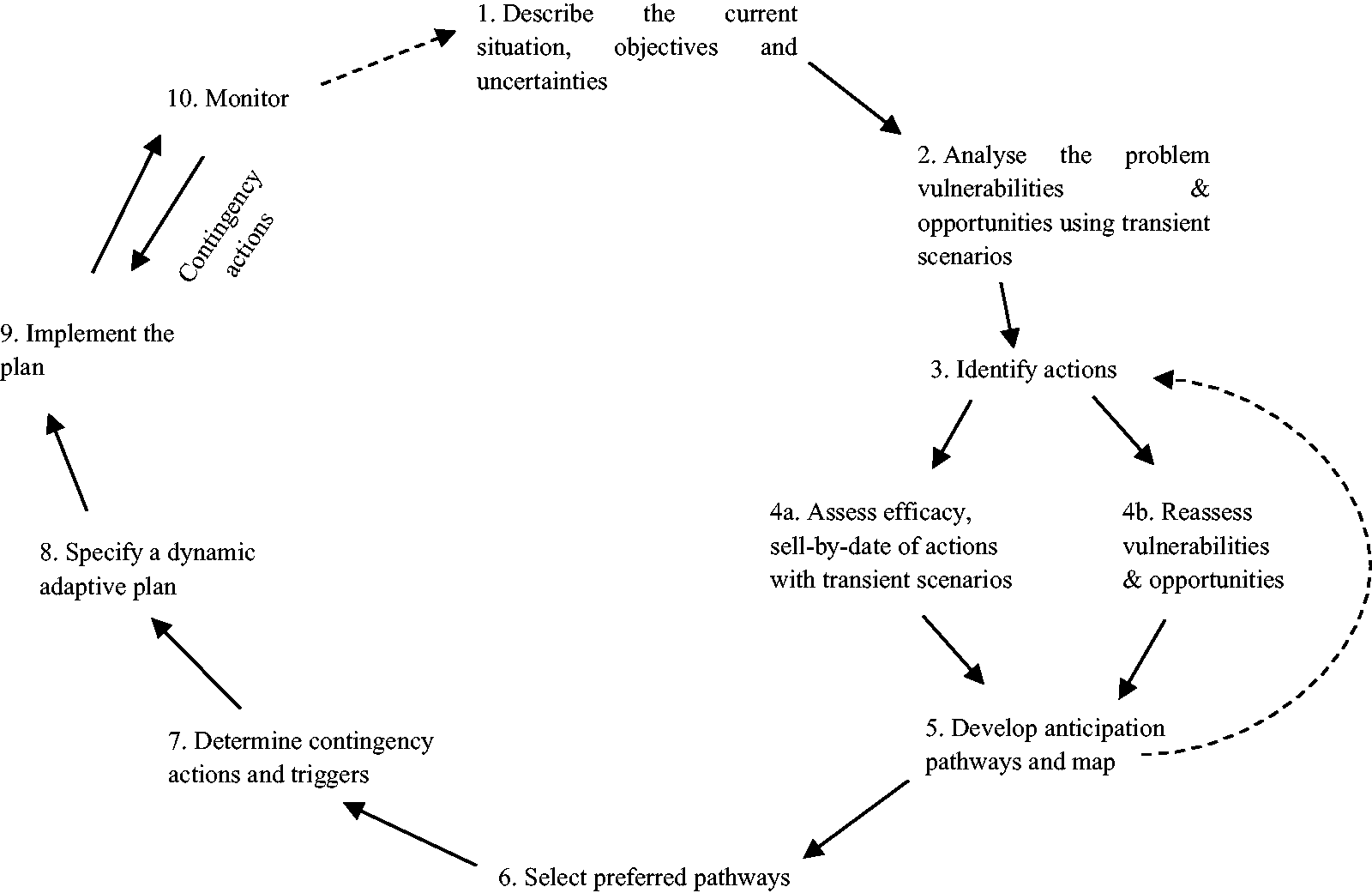
Development cycle of a Dynamic Adaptive Policy Pathway (DAPP).*
The early stages of DAPP consider so-called sell-by dates, which are points at which the current policy is no longer expected to work because reflexivity has negated the actions initially undertaken. These early stages employ computational methods to identify where there are gaps in terms of achieving stated objectives, indicating a requirement for action (Kwakkel et al., 2015). In stage 3, possible actions are identified that might assist in closing these gaps. In stage 4, ineffective actions are screened out over time, resulting in a winnowing down to those that exhibit most promise. In stage 5, new actions are initiated when previous actions are no longer fit for purpose (Haasnoot et al., 2013). Essentially, in DAPP, the policy is able to jump tracks in anticipation of a problem up ahead. DAPP’s ‘adaptation map’ details many such pathways and summarises all the potential routes through which success might alternatively be achieved if an initial route is blocked. In stage 6, these alternative routes are further winnowed to a manageable number using ‘social robustness’ as one criterion, meaning the identified pathways are able to withstand reflexivity in the form of behavioural changes initiated over time. The seventh stage is one of contingency planning designed to keep the policy on track in the event of surprises. The eighth stage makes explicit the targets, problems and potential and preferred pathways identified in the previous stages in the form of a dynamic adaptive plan. In stages 9 and 10, this is then initiated and monitored. Actions are triggered, altered, stopped or expanded, and the policy is adapted over time in accordance with identified actions and preferred pathways, in order to keep it on track.
DAPP identifies actions that can take an intervention onto a very different path from that which it was initiated on, so as to harness ontological uncertainty in the form of contingency, both that induced by the policy itself in the form of reflexivity and that related to unknowns and surprises that may occur over time. While such an approach still requires ex ante enumeration of actions and paths that can overcome or make positive use of all eventualities, thereby requiring some conception of what these eventualities might be based on the present, crucially for DAPP’s ability to deal with ontological uncertainty, the pathways can themselves also change over time as new knowledge about future states of the world becomes available (Maier et al., 2016: 159).
Another computational scenario tool known as Robust Decision-Making (RDM; Lempert et al., 2010) grapples with ontological uncertainty by simulating many plausible futures and then identifying strategies that are robust across a very wide range of them. These are identified through a series of computational experiments that systematically explore the potential future consequences of alternative sets of assumptions related to highly uncertain factors of import within a focal system (Kwakkel et al., 2016). RDM has already been widely used for decision support in disciplines allied to geography such as climate change (Kwakkel et al., 2015), and consists of four main steps (Kwakkel et al., 2016).
The first step is a decision-structuring activity designed to conceptualise the system under study and its key uncertainties, main policy options and outcomes of interest. The second is case generation, in which the behaviour of the focal system is systematically explored across identified uncertainties, and the performance of candidate strategies assessed. In the third step, machine-learning algorithms are used to assess the performance of candidate strategies and to reveal the conditions under which they perform badly in relation to the desired outcome (‘scenario discovery’). This reveals the alternative strategies’ potential vulnerabilities, allowing for their modification. In the fourth and final step, a ‘trade-off analysis’ takes place; the performance of different strategies is compared across a set of outcome indicators, highlighting the way elements of alternative strategies might be combined to arrive at one that is robust across all scenarios. These steps can be iterated until a satisfactory robust strategy emerges. RDM thus provides for a broad exploration of the potential futures of a focal system.
RDM does not use the type of probability-based approach, in the form of empirical testing and validation, which Fusco et al. (2017) refer to as being traditional in geography research. However, it does typically employ a type of stochastic modelling in the form of Latin Hypercube Sampling (LHS) in order to generate ‘states of the world’ against which to test the robustness of considered strategies (Kwakkel, 2017). LHS is an approach to sampling that ensures the sample space, representing possible combinations of parameter values for the system of interest, is evenly sampled. Yet, this sample space must still be defined ex ante. Indeed, any simulation-based approach such as RDM requires a researcher to decide what (presently) exists and is important enough to represent in the simulation, and what to leave out (O’Sullivan, 2004). The breadth of the exploration RDM facilitates is therefore still dependent on the present framing of the focal system under study in its first stage.
In fact, a problem central to the efficacy of any scenario exercise, whether computational or otherwise, is how to frame the space of possibilities governing the futures to be given consideration. Such framing inevitably impinges upon the robustness of the exercise by determining those futures lying ‘in bounds’ and worthy of consideration, and those deemed ‘out of bounds’ and unworthy. A too-restrictive bounding will leave out important possibilities. On the other hand, incorporating too broad a range of possibilities can lead to implausibility and therefore a loss of credibility in the eyes of decision makers. Essentially, this is a problem of balancing necessity and contingency in the framing of the future (Simandan, 2010a). For this reason, we turn finally to Feduzi and Runde’s (2014) Baconian scenario algorithm. It is designed to assist with this framing of the future.
The Baconian scenario algorithm transforms what are presently unknown unknowns into known unknowns in order to incorporate them into plans. It does this through a process of variation and elimination, in which extreme possibilities are considered one by one and either incorporated or eliminated until the bounds of plausible extremity have been reached. This process ensures the framing of the future is sufficiently broad that possibilities distant from present empirical circumstances are considered, while at the same time ensuring that considered futures have some present evidential basis. This is a difficult balancing act. Considered futures must not be mere figments of imagination. Yet, the scenario exercise must not be overly encumbered by the requirement for present evidential foundations. Otherwise, futures very different from the present will be overlooked.
The Baconian scenario approach assists in achieving an appropriate framing of the future by having those tasked with considering futures that presently appear extreme attempt to prove their possibility through consideration of their causal unfolding. By using it, a decision maker expands the space of future possibilities, gaining an impression of its bounds and giving consideration to futures that would otherwise be overlooked as they do so. Suppose a decision maker does not know all the possible states of the world of relevance to a decision, such as whether to go ahead with a particular project, policy or investment. However, she is able to order considered future states of the world in terms of how favourable they would be to it, running from least to most favourable, representing a space of future possibilities. This space is initially populated on the basis of what she knows already, which she now wishes to expand through a more formal process of consideration.
The Baconian scenario algorithm starts from any base-point state within this existing personal space of known possibilities that enjoys at least as much evidential support as any other. This base-point state becomes the departure point from which alternative states of the world are generated and tested for inclusion in, or elimination from, the space. This is achieved by the decision maker imagining a state of the world, however unlikely in probabilistic terms, consistent with but not currently supported by her personal stock of evidence, which, if it were deemed part of the space, would lie as far as possible from the base-point state on either the negative or positive side of favourability (it does not matter which, as the algorithm alternates between sides). The decision maker then looks for additional evidence for this newly considered state that, if found, would lend support for it at least as high as that enjoyed by the base-point state. This involves considering the logic of the causal unfolding of the newly considered state and is not merely an empirical exercise.
The evidence acquired might lead to the inclusion or rejection of the newly considered state from the space or the elimination of the base-point state and other members of the original space, or it might suggest entirely new states not before considered. Once the new state is appropriately included, or eliminated, the process then continues, and a further state as extreme as possible in the same direction of favourability is imagined and given consideration for inclusion or elimination. The process continues until either a newly considered state receives such strong support that it supplants the current base-point state on that side of the favourability scale or imaginable states consistent with the current stock of evidence are exhausted. At this point, the process switches to the other side of the favourability scale, and is conducted in the same way for that side.
Through this process, the decision maker is required to destroy and remake anew the state space of future possibilities by expanding or contracting it, eliminating some possibilities and adding others, according to what is implied by the increasing stock of evidence accumulated through assessment of each newly considered state. The process alternates between sides of the favourability scale and stops when all imaginable new states have been considered and incorporated into the space, or eliminated as a possibility, and its bounds are therefore known.
The requirement to evidence each considered future’s possibility ensures that futures radically different from the present will be given full consideration, and counteracts the tendency for decision makers to dismiss extreme futures tautologically on the basis they are presently extreme. The Baconian scenario algorithm can be combined with RDM to assist in the appropriate framing of the future by incorporating into it what are presently unknown unknowns and rendering them known unknowns amenable to computer-assisted exploration and scenario discovery. The ability to combine different aspects of alternative scenario approaches in this way, so as to achieve a framing of the future that balances necessity and contingency, is an important point to emphasise in concluding this review of scenario methods. By mixing and matching different elements of the various outlined approaches, any tendency to overemphasise necessity or contingency in one can be compensated for by another. There may be particular value in combining some of the narrative-based, qualitative approaches presented earlier with those that are more computational and simulation-based, reviewed latterly, so as to encompass both the social, behavioural and reflexive aspects of ontological uncertainty, and that related to surprises from what are presently unknowns. In so doing, computational scenario approaches can finally provide ‘simulations as geographical narratives’ (O’Sullivan, 2004), which take account of ontological uncertainty, and describe how a transformed world might be, not just how to withstand variations to how it is presently.
Conclusion
This paper has shown why improved data analysis and statistical modelling can only ever assist in overcoming uncertainty in a limited way, and even then only the less problematic type of uncertainty that is epistemological. To summarise the outlined argument very simply: the world is constantly changing, and so improved knowledge of the world as now does not necessarily equate to improved knowledge of how it might be in the future, including after the implementation of a new policy. Herein lies the distinction between epistemological and ontological uncertainty. The former is related to the accuracy of our present knowledge about the world. The latter stems from the changing nature of reality, arising from surprises in the form of what are presently unknowns, but also from the cascades of reflexive responses stimulated by new developments, such as a new policy. This latter aspect of ontological uncertainty is perhaps its most vexatious. Because of it, policymakers must attempt to anticipate the response of agents who are themselves attempting to anticipate the responses of other agents, in a complex, multifaceted and multilayered feedback process. The result is multiple reflexive changes to behaviour, the aggregate effect of which is to enable, alter or negate a desired policy outcome, causing it to happen under circumstances in which it otherwise would not have, or vice versa.
Yet, something more than just this has been argued herein. Not only does increasing emphasis on data analysis and statistical modelling not lead straightforwardly to improved policymaking, it can contribute to a retrenchment into short-termism that sees emphasis placed on the present rather than the future, thereby acting against our reconciling with ontological uncertainty as a potential source of positive and transformational change. The tendency for geographers to fall back on short-termism in the face of ontological uncertainty was highlighted some time ago in this journal, and the creation of a scenario-informed geography suggested as a means to combat this. The availability today of new scenario tools better able to grapple with ontological uncertainty makes such a scenario-informed geography and spatial planning – one that has a truly long-term, strategic and visionary core – more realisable now than ever before. It is time to put ontological uncertainty at the heart of geography in order that it becomes a discipline that can assist in meeting the considerable societal challenges we now face, many of which are geographic or spatially related, and all of which require a long-term perspective. This can be achieved through use of new and emerging scenario tools, some of which have been presented herein.
Footnotes
Declaration of conflicting interests
The author(s) declared no potential conflicts of interest with respect to the research, authorship and/or publication of this article.
Funding
The author(s) received no financial support for the research, authorship and/or publication of this article.