



Abstract
In this paper, we argue that it is generative to link struggles around access to, control over, and the transformation of urban energy systems to the imaginary of the right to the city; and we explore the conceptual, empirical and political contributions of this connection. Our paper starts with two main questions: (1) what do we learn from reading attempts to reclaim urban energy systems from a right to the city perspective? (2) What can this analysis add to debates around the right to the city? We make two main arguments from our empirical engagements with initiatives seeking to remunicipalise urban energy systems in Berlin and London, each of which is premised upon calls for more just, democratic and ecologically sustainable forms of energy supply. First, we argue that these struggles need to transcend concerns around energy infrastructure to raise broader questions around the democratisation of urban space. Second, we contend that appropriating long-lasting urban infrastructure requires the creation of new and durable forms of democratic institutions, providing insights into the notion of self-management (autogestion) beyond more spontaneous and fleeting forms of protest and uprising addressed in much of right to the city literature. Overall, the paper hopes to put the question of autogestion and related strategies at the centre of conversations around right to the city moving forward.
Introduction
Henri Lefebvre’s (1968) concept of the right to the city (RTC) has a long legacy of inspiring urban social movements, critical urban scholars and even national governments (Brenner et al., 2012; Harvey, 2012). Given the myriad ways that this slogan has been deployed – from a clarion call for anti-capitalist struggle to a formally enshrined constitutional right – the question of what RTC entails and how it could be realised is still an important matter of political and scholarly debate. Lefebvre posed the right to the city ‘as a transformed and renewed right to urban life’ (1968: 158). This does not imply a narrow conception of a legal or individualised right but, rather, expresses an ‘intention to struggle’ situated at the beginning and not as the result of emancipatory politics (Purcell and Tyman, 2015: 1133). As a major point of reference for critical responses to neoliberal urbanism, RTC has been an entry point for studying urban conflicts across a variety of issues. Yet linking RTC to struggles around urban infrastructure is a rather new development (Corsín Jiménez, 2014; Beveridge and Naumann 2016), despite the fact that attempts to reclaim infrastructure systems such as water and energy provide an important terrain for struggles against neoliberal urbanism (Becker et al., 2015; Sultana and Loftus, 2013).
In this paper, we argue that it is generative to explore how struggles around access to, control over and transformation of urban energy systems can be linked to the concept of the RTC, and we highlight what this connection can contribute conceptually as well as empirically and politically. Thus far, energy research and critical urban theory mostly appear as distinct fields (for an exception see Silver, 2015). Yet we believe that flourishing debates on energy justice (Jenkins et al., 2016; Sovacool and Dworkin, 2015) and, in particular, energy democracy (Becker and Naumann, 2017; Hess, 2018; van Veelen and van der Horst, 2018) could benefit from a stronger grounding in debates around the production of urban space more broadly; and, equally, that debates around the right to the city might be developed further through engagements with urban energy contestations. Our paper starts with two main questions: (1) what do we learn from reading attempts to reclaim urban energy systems from a RTC perspective? (2) What can this analysis add to debates around the right to the city?
To answer these questions, the paper draws from our empirical engagement with initiatives seeking to remunicipalise urban energy systems in Berlin and London – the Berliner Energietisch and Switched On London campaigns – both based on calls for more just, democratic and ecologically sustainable forms of energy supply. Our argument is twofold. Firstly, we argue that the ways in which these struggles transcend concerns around energy infrastructure raise broader questions around the democratisation of urban space. This aligns these struggles with a RTC agenda and, accordingly, RTC provides an analytic frame that can deepen the emancipatory potential of attempts to theorise and enact urban energy transformations. Secondly, we suggest that these contestations around energy infrastructure can yield innovative insights into debates around the RTC: while spontaneous and fleeting forms of protest and uprising are often seen as the route towards enacting the RTC; in line with Harvey’s (2012) approach, we contend that appropriating material infrastructure such as power plants and electricity networks requires the creation of new and durable forms of democratic institutions. In making this second argument, the importance of the concept of self-management (autogestion) within Lefebvre’s work (1968, 2003[1970]; Brenner 2008) is emphasised as an often overlooked conceptual consideration regarding the RTC. By both spelling out approaches to autogestion for one specific sector and discussing the concept as such, as well as its implications for spatial strategy, we hope to put the question of autogestion at the centre of conversations around RTC moving forward.
The paper is structured as follows. First, we develop the concepts of the right to the city and autogestion that the paper starts with. We then introduce the agenda of energy democracy and its place within current debates around energy transition, and discuss the ways in which initial theoretical connections between energy democracy and RTC might be made. Next, we turn to struggles around energy democracy in Berlin and London and discuss their relevance for RTC. We conclude by reflecting on the potentialities and limitations of connecting energy democracy with critical urban theory.
From the Right to the City to energy democracy?
This section connects two continuously growing, but so far rather disconnected strands of literature: firstly, urban debates around RTC and autogestion and, after that, attempts to introduce questions of democracy and justice into current research on energy systems. Here, we introduce both sets of debates and formulate preliminary suggestions about their possible linkages.
The Right to the City
The Right to the City plays a major role within critical urban research as well as within urban activism. For Harvey the term is ‘both: working slogan and political ideal’ (2008: 43). A vast body of literature has emerged around RTC, touching on different urban issues, among them housing (Aalbers and Gibb, 2014; Schipper, 2015), neighbourhood development (Balzarini and Shlay, 2016), information (Shaw and Graham, 2017) and urban gardening (Pierce et al., 2016). Furthermore, attempts to link RTC to other conceptual debates relate to urban citizenship (Blokland et al., 2015), culture and identity (Rosen and Shlay, 2014), refugee rights (Lyytinen, 2015) and food security (Passidomo, 2014; Purcell and Tyman, 2015). The concept’s analytical focus has also been extended beyond the city as traditionally conceived, for instance through the right to the suburb (Carpio et al., 2011) and the countryside (Barraclough, 2013). Against these many fields of application, some scholars criticise the vagueness and radical openness of the concept, which is even said to risk potentially reactionary approaches (Purcell, 2014). Indeed, a current strand of research on RTC focuses on the question of how processes of institutionalisation, for example, through national government programmes, might lead to ‘a loss of the originally radical content of the right to the city’ (Belda-Miquel et al., 2016: 321).
For Lefebvre, RTC is not seen as a legal form granted to individuals by the state, rather, it is grasped as ‘a demand’ and denotes an initial claim, a starting-point for struggle (Attoh, 2011). What is at stake is not the right to visit or access the city in its present or historical form but, rather, the right to partake in a transformed future city. This city to be fought for is conceived as a ‘site of desires’ (Lefebvre, 1968: 109), a place for play and encounter, with the city itself a work of art made and remade by its creative inhabitants. This implies ‘the priority of use value’ (Lefebvre, 1968: 158) over alienated commodity exchange. RTC thus enables difference and emancipation from the heterogeneity of capitalist social relations and state bureaucracy within the production of space. Purcell (2002) here distinguishes two aspects to Lefebvre’s vision: (a) appropriation: the right to use, occupy and produce urban space in ways that satisfy needs and wants; and (b) participation: the right to ‘the full engagement of inhabitants in decisions relevant to spatial production’ (Lyytinen, 2015: 597). With the city conceived of as the intermediate level between the social totality and ‘the contradictory level of everyday life’ (Kipfer et al., 2013: 119), RTC implies claims for changing society in general.
The deliberate openness in Lefebvre’s thinking allows different practices and forms of realising RTC. Andy Merrifield, for example, reformulates the right to the city around what he terms ‘the politics of the encounter’ (2011: 473). The Lefebvrian encounter, for Merrifield, is about people coming together, connecting, forging solidarities, and gaining a newfound yearning for the democratisation of everyday life, with the spectacular occupations of urban space that occurred in 2011, from Tahrir to Wall Street, perhaps prime examples here. By way of contrast, Harvey (2012) links the right to the city to the creation of urban commons via the transformation of the state. He proposes a two-pronged strategy for doing so: firstly, force the state to extend its role in social reproduction and to provide basic social infrastructures; secondly, struggle to transform state provision along fully democratised and de-commodified lines such that urban inhabitants take centrality in state decision-making. These two alternative positions also hint to the problematic of durability within debates on the right to the city. Indeed, a question in the wake of urban uprisings such as Occupy and 15M, is how emancipatory desires might be spatialised and maybe even institutionalised in more long-term forms of political expression and change (García-Lamarca, 2017; Swyngedouw, 2014).
Autogestion
For assessing these questions of durability, we propose that Lefebvre’s thinking around the notion of autogestion offers a useful entry point. Taken from debates about worker-owned factories in 1960s and 1970s France, the concept was extended by Lefebvre to also include social sectors beyond the ‘economy’ as traditionally conceived (Dikeç, 2007). Autogestion translates as self-management, in a sense distinct from forms of participation based on ‘a more or less elaborate pretence at information and activity, [after which citizens] they return to their tranquil passivity and retirement’ (Lefebvre, 1968: 145). Instead, autogestion portends the general claim for ‘new forms of decentralized, democratic political control’ in ‘various sectors of social life – from factories, universities and political associations to territorial units such as cities and regions’ (Brenner, 2008: 240). Hence, the direction of political strategy for Lefebvre is clear, and yet open to different sets of concrete tactics, or technologies: it lies in the ‘optimal use of technology (all technologies) for solving urban questions to improve everyday life in urban society’ (Lefebvre,2003[1970]): 143). It is important to note that autogestion is not conceived of as a vision implying a ‘fully formed post-capitalist institutional framework, but rather as a process that has to be “enacted”, and that produces its own conflicts and contradictions’ (Brenner, 2008: 240).
Particularly contested here, is the role of the state – in between the poles of being an agent of capital (and bureaucracy) and a possible bulwark against an ever-increasing economisation of the everyday. Lefebvre does not fully clarify the relation between the state and autogestion when he terms the ‘economic and political revolution’ as ‘planning oriented towards social needs and democratic control of the State and self-management’ (Lefebvre, 1968: 180); thus leaving open whether autogestion was to occur through and with, or beside and beyond the state. Taking the latter position, Purcell and Tymann argue that autogestion would need to turn ‘inhabitants [into] such capable managers of urban spaces that the state becomes obsolete’ (2015: 1144), and possibly would ‘wither away’. Others suggest that autogestion would imply a transformation (not abolition) of the state, away from being ‘an instrument for capital accumulation, bureaucratic domination and everyday violence’ (Brenner, 2008: 240), and towards a vehicle for facilitating direct democracy. However, there is a common understanding that neither autogestion nor the right to the city should be ‘‘fixed’ in state-centred ways: operationalised in pragmatic-empiricist fashions and translated, for purposes of legal reform or policy evaluation’ (Kipfer et al., 2013: 128). This still, though, leaves questions open as to how autogestion translates as a strategy for actively pursuing urban self-management.
Lefebvre, characterised by his time of writing, was referring to a variety of approaches and struggles ranging from the US-American civil rights movement, anti-apartheid struggles in South Africa, South American guerrilla insurgencies, and at his doorstep, the 1960s student uprisings in Paris – all of which are directed against a perceived ‘totality’, but were diverse in the spatial imaginaries at play. We believe that recent struggles towards contesting and envisioning alternative futures for urban energy systems can provide some productive insights into the analytical potential and political strategy around the right to the city and autogestion today. Thus, we now turn to the concept of energy democracy.
Transforming energy systems for energy democracy
Both historical materialist and post-structuralist scholars highlight how the infrastructure and value chains constituting energy systems are entwined with formations of state and corporate power. Anthropologist Dominic Boyer (2014: 325), for example, targets the ‘genealogy of modern power … through the twin analytics of energy and fuel’ as linked with historic processes of state formation, expert rule and different biopolitical regimes. Materialist approaches depict the discovery and use of fossil fuel resources as the physical condition for the development of industrial capitalism, replacing traditional sources of power such as human, water or horse power and providing the material basis for ever-increasing accumulation and acceleration (Huber, 2009). Mitchell (2009: 407) links shifts between different sources of fuel, from coal to oil, with different expressions of statehood and international relations: while workers’ power within coal-based power systems paved the way for Western welfare states, the physical capacities of oil, ‘its lightness and fluidity’ and its transport by pipelines implied different routes of transport, and likewise a more competitive and global arrangement linking resource extraction and the centres of industrial production and consumption. Others have stressed the deep entanglement between state power, industrial capital and imaginaries of technological progress necessary to develop and run nuclear energy (Jasanoff and Kim, 2009). Throughout history, then, it seems that the quest to construct and control energy resources and provision was inevitably linked to those bureaucratic or economic formations at the heart of Lefebvre’s criticism.
Both in the past and today, the way energy systems are socially organised and technologically operated has been contested. Mitchell (2011) provides a historical account of various labour and geopolitical struggles in the Western world and the Middle East. And also today we can find contestations along the energy value chain: from resource conflicts around extractivism and the quest for local control of resources (Burchardt and Dietz, 2014), to conflicts around new oil pipelines (Kipfer, 2018), the siting of facilities, both fossil and renewable (for the case of wind energy: Devine-Wright, 2005), and around the question of who has access to what kind of energy services at what price (Walker, 2015). Current controversies around energy systems draw from different ecological or social issues – that is, the coercive character of extracting and burning fossil fuels in the face of climate change (Hughes, 2016), discourses of human rights and sustainable development (Tully, 2008), issues around uneven access and poverty (Bouzarovski, 2018), plus the overall question of civic participation in energy systems (Fuller and Bulkeley, 2013). And despite the often crystalline structures that developed around the state, energy corporations and relations of international dependence, emancipatory energy initiatives worldwide claim the right to, and democratisation of energy systems (Abramsky, 2010).
The notion of energy democracy originated in the German climate justice movement around 2012, and has since gained international recognition in activist contexts as well as in academic debate across human geography, sociology and other social sciences (Becker and Naumann, 2017; Hess, 2018; van Veelen and van der Horst, 2018). The term has since been taken on by a broad range of activist networks, trade unions and left-wing political parties, largely but not exclusively in Europe and the USA. The concept is framed loosely, incorporating an array of diverse political perspectives, from anti-capitalist de-growth claims towards more Keynesian arguments for green jobs (Angel, 2016). Broadly speaking, proponents of the term tend to advocate energy systems that are ecologically sustainable, socially just and democratically controlled. Thus, a range of demands are made under the umbrella of this concept, from transitions to 100% renewable energy and measures to reduce ecological degradation across the energy supply chain to policies to tackle energy poverty, social tariffs, and a ‘just transition’ for energy sector workers ensuring unionised, well-paid and secure low-carbon jobs (Newell and Mulvaney, 2013). Importantly, appeals to energy democracy span different spaces and scales in practice, ranging from small-scale renewable energy projects, community-owned schemes and nation-state policies in different contexts (Creamer et al., 2018; van Veelen, 2018; Burke and Stephens, 2017).
With a certain strategic openness reminiscent of RTC, many authors focus on the normative nature of energy democracy as it expresses ‘demand for increased accountability and democratization of a sector that was previously not seen as requiring public involvement, and was (is) most often depoliticized’ (Szulecki, 2018: 27). Building on that, Becker and Naumann distinguish two key dimensions that are carried with the term energy democracy: ‘first, we refer to democratisation as a political call to open up energy systems to participation. Second, we engage with concurring efforts to institutionalise democratic principles in lasting organisations’ (2017: 4). From the plethora of struggles and conflicts for democratising energy systems worldwide, we are here focusing on calls for establishing collectively controlled public urban energy utilities, as they epitomise the overlap in calls for energy democracy and the right to the city. As an emerging imaginary, debates around the content of energy democracy are still unfolding, rendering the term open-ended and ambiguous in a manner analogous to RTC.
The Right to the City and energy democracy: seeking the connections
Conflicts about the aims, ownership and technologies of urban energy provision occur worldwide (Luque-Ayala and Silver, 2016). Often, calls for urban energy democracy are linked to a critical interrogation of the structures and effects of neoliberal energy systems, and a critique of capitalist development in general. Whereas energy democracy is frequently discussed as a concept closely linked to the political struggles of urban social movements (Angel, 2017; Bulkeley et al., 2014), links to RTC are often alluded to in research, but not yet spelled out conceptually. For seeking the common grounds between RTC and claims for energy democracy, three points are of importance for us here.
The first one refers to the claims and visions implied. We contend that both concepts, the right to the city and energy democracy, imply a dual framing of a specific political claim and the more general question of how to organise, or even institutionalise, alternative imaginaries of energy and society. Here, a number of scholars warn us that ‘[t]urning the ‘right to the city’ into sectoral rights may be useful to translate concrete movement demands into tangible reforms, but if such tactical moves come at the expense of a broad, transformational perspective, they may become cases of misplaced concreteness’ (Kipfer et al., 2013: 129). Therefore, it is important, as Marcuse reminds us, that the right to the city is ‘the right to a totality, a complexity, in which each of the parts is part of a single whole to which the right is demanded’ (2009: 192f.). Thus, a matter of concern is how energy democracy initiatives are connected to other political issues and struggles. Whether energy democracy can serve as part of a wider RTC, depends on whether a fundamentally different energy system is imagined as one part of a future urban society.
Secondly, and striking the chord of autogestion, we need to consider what tactics and forms of organisation are put forward; and, crucially, how they address the role of the state. Autogestion retains its drive and legitimation from being directed against enclosures of the currently-thinkable and the practically possible by bureaucratic governance as well as the increasing importance of economic rationalities in neoliberalism, united in the ‘generalised terrorism of the quantifiable’ (Lefebvre,2003[1970]: 244, Merrifield, 2005: 697). At the same time. there is a deliberate, even slightly ambiguous openness as to which strategic approach to these aims could be considered fruitful. Two questions are of particular interest here: a) which instruments and organisational suggestions are expressed to foster autogestion in the field of energy provision, characterised by traditional links between economic and state power? And b) connected to that, how could these address the role of the state in an alternative setting?
Thirdly, it needs to be taken into account that energy systems by their nature build connections beyond single cities. Following Gilbert and Philipps, who argue that urban energy systems are important for RTC as they navigate the production of socio-natures (2003: 328), it becomes clear that the spaces produced by energy infrastructure are bound by economic and technological links, but not necessarily administrative territories. Angelo and Wachsmuth (2015), accordingly, warn against a ‘methodological cityism’ in much work on the political ecology of urban metabolisms paying rhetorical service to spatial connections beyond one city but not featuring these aspects in their analysis. Hence, the spatiality of claims to urban infrastructure is crucial: do political claims in one city fall into a ‘local trap’ favouring local institutions per se (Purcell, 2006), or do they work in the direction of challenging the overall totality of global capitalist energy systems?
We argue that simultaneous debates on RTC and energy democracy can enrich each other in two different ways: the concept of RTC can provide a deeper contextualisation for the claims of urban movements in the field of energy; and energy democracy projects can provide insights into situated strategies, and practical and organisational suggestions for autogestion. The following section uses the examples of Berlin and London to illustrate how urban struggles for energy democracy could be understood through the lens of RTC, and how urban energy systems could provide an integral element of an organisational approach to the right to the city.
Urban energy struggles in Berlin and London
Our theoretical endeavour rests on the empirical analysis of urban energy initiatives in Berlin and London that articulate calls for more sustainable, just and democratic forms of energy provision. Both cases are situated in a European energy landscape that was recently reshaped by two major trends: marketisation, mainly through liberalisation and privatisation, and an increasing share for renewable energy sources. Interestingly, these two processes enabled new forms of organisation to thrive in the energy sector. As the growth of renewable energy initiatives was significantly advanced by smaller-scale often community-owned schemes, this development has resulted in the creation of a ‘civic energy sector’ in different countries such as Germany, Spain, the US and the UK (Creamer et al., 2018, Hall et al., 2016). In particular, Germany has gained attention for a ‘wave of remunicipalisations’ meaning the re-establishment of public ownership at the municipal scale for previously privatised utilities in more than 200 communities (Wagner and Berlo, 2017). More recently, the UK has also seen the development of new local energy service companies, run through a number of different public, private or mixed business models, defined by the narrow constraints of urban austerity policy (Webb et al., 2016).
Our analysis in this paper relies on intensive fieldwork by the authors undertaken in both cities from 2013 to 2017, which was updated consequently thereafter. Research methods involved interviews with key stakeholders in both urban administration and citizen initiatives for public energy ownership (a total of 19 in Berlin, and 13 in London), as well as participant observations at meetings, events and protests. This was complemented by a comprehensive media analysis continued until today. Our insights on the Switched on London campaign, in particular, build on three years of focused scholar-activist ethnographic research. For the primary and secondary analysis of our original material, data has been reordered to meet the analytical dimensions of this paper. Hence, we first give an introduction into the background conditions and genealogy of the initiatives, before we discuss the claims, the strategies and the spatiality of these urban energy struggles.
Remunicipalising energy
To understand ongoing struggles and developments around urban energy politics, it is necessary to embed current events into longer-standing context conditions evolving from past conflicts and grown constellations of actors and power (Paul, 2018). In Berlin, long characterised by failed hopes of urban growth, a debt crisis and the privatisation of communal assets (Krätke, 2004), energy had not been a core topic of public discourse and policy, either for state or for social movement actors. Local authorities were reluctant in developing policies targeting climate change mitigation and a transition to renewable energies, while the operation of core services was outsourced to private providers around the turn of the millennium (Monstadt, 2007, Moss, 2014). Activism around RTC mainly focused on the pertinent issues of housing and opposition to large-scale urban development projects (Novy and Colomb, 2013). That is, until 2006, when a campaign emerged to contest the contracts underlying the privatisation of the Berlin Water Company, thereby putting privatisation and access to infrastructure services back on the political agenda. Here, a coalition of social movements, tenants' associations and opposition parties forced and won a referendum to make these contracts transparent, eventually leading to the remunicipalisation of the city's water company (Beveridge and Naumann, 2016).
Inspired by this success, a coalition seeking to replicate a similar campaign for energy formed out of various initiatives in 2011. Originally initiated by the alter-globalisation network ‘attac Berlin’, the small NGO ‘PowerShift’ and the Citizen Initiative ‘Climate Protection’, the campaign was soon widened to also include other actors from the environmental sector, as well as groups active in housing and other infrastructure struggles, and various local branches of the Left and Green parties. The so-called ‘Berlin Energy Roundtable’ (Berliner Energietisch) was formed as the network supporting the campaign. The Energietisch expressed a twofold demand to the municipality: to table a bid to remunicipalise the city's electricity distribution network, given that the contract with incumbent distribution network operator Vattenfall was soon expiring; and to create a new energy utility company which would invest in renewable generating capacity (mainly wind, solar and biomass) and supply energy to households in the city.
Following the precedent of the water campaign, these demands were translated into a draft law to be put to a referendum, combining the outlook of public ownership with instigation of a more ecological, socially just and democratic energy system. The outcome, in November 2013, was that despite winning an overwhelming 83% majority of votes in the referendum (about 600,000 votes in favour), the initiative narrowly fell short of the 25% voter quorum required for the result to be valid. Beyond the failure in the referendum, the campaign was successful in instigating public debate on the future of the city's electricity grid, rewriting the dominant discourse around public ownership and the quality of services after privatisation (Becker et al., 2015). After elections in 2016, bringing to power a Social Democrat – Left Party – Green Party government and two of the campaign's spokespeople into the city’s parliament, the remunicipalisation agenda gained new pace. The government decreed in early 2019 that the concessions for the city’s electricity grid should be awarded to a newly formed public utility – Berlin Energie itself founded as a reaction to Energietisch’s claims in the first place – while the final legal ruling on the matter is still pending as of October 2019.
Even though its success was rather indirect in nature, the Energietisch became a role model for similar initiatives in other European cities, among them London. London has positioned itself as a pioneer city engaging with the challenges of climate change and a low-carbon transition, mainly through the creation of arms-length agencies and intermediary organisation such as the London Climate Change Agency (Hodson et al., 2013). Yet, in practice, progress in reducing emissions, accelerating renewable energy capacity and reconfiguring the city's energy system has been limited. In this context, the ‘Switched on London’ (SOL) campaign was launched in 2015, taking inspiration from the Berlin example. The main target was to push the Greater London Authority (GLA) – the regional governmental body – to establish a new, fully public municipal energy supply and services company. SOL is supported by a plethora of groups from divergent political backgrounds: major trade unions, environmental NGOs, and small grassroots campaigns and community organisations. Like the Berlin Energietisch, SOL’s support extends to urban struggles beyond energy, with the group endeavouring to work alongside those fighting gentrification in London. In 2016, the campaign secured a commitment from recently elected London Mayor Sadiq Khan to explore the establishment of a new municipal energy company, and for the following year, SOL focused on building pressure to push the GLA to create a company that was as aligned as possible with the campaign's radical vision.
However, instead of setting up a new independent municipal energy company, the GLA announced in late 2017 it would be engaging in a so-called ‘white label’ partnership with an existing supplier, which at the time of writing has not been announced. Under this scheme, the GLA will merely front a business selling energy provided by a third-party commercial supplier – a decision taken on account of the GLA’s desire to minimise costs and ‘risks’. SOL is left frustrated by this decision, arguing that this partnership will be unable to incorporate its demands, due to the existing organisational imperatives of the partner organisation, rendering it unlikely to introduce radical measures around renewable generation, fuel poverty and democratic control.
Positioning claims for an alternative energy system
In what sense might these struggles to remunicipalise energy utilities in London and Berlin be read as enacting a right to the city? The key question here entails the ways in which these struggles, ostensibly oriented around the transformation of urban energy networks, transcend this particular materiality to portend the broader dynamics of appropriation and participation within the production of urban space, as denoted by RTC.
As Switched on London was directly inspired by the Berlin Roundtable and the groups share much in the way of political orientation and demands, we will analyse their political claims and prospects together in the subsequent sections. Both campaigns are oriented around a specific set of reforms expressing possible conjunctures between energy governance and wider reforms towards ecology, social justice and direct democracy. First, much of the ecological ambition still pertains in the generation of electricity. In Berlin, the initiative’s law made an ‘ecological orientation’ mandatory, meaning that the utility would aim to use 100% renewable energy sources. Additionally, public ownership was seen as a condition for promoting the reduction of energy consumption as a ‘central business objective’. Similarly, in London, the goal is to establish a new energy supplier that would supply 100% of their energy from renewable sources only, and would provide support and investment for new renewable energy capacities in London and beyond.
Yet despite the tendency of discourse and practices pertaining to climate change to retain a narrow focus on depoliticised technological claims (Swyngedouw, 2010), these remunicipalisation initiatives endeavour to resist such ‘post-political’ framing by positioning the demand for moves to renewable energy within a broader framework premised upon social justice and participatory democracy. Beginning with the question of social justice, the Berlin campaign strongly articulated social aims such as creating employment and developing a tariff policy including ‘social arrangements’ for universal access. Likewise, and due to the high traction of energy poverty as a political issue in the UK (Boardman, 2009), fighting fuel poverty is one of the main campaigning orientations of Switched on London which advocates ‘a non-profit company that cuts bills, and cuts pollution’. In both cases abidance with these aims would be ensured through specific funds for social purposes. Accordingly, like the London campaign slogan ‘for a company under public ownership, selling energy for the common good, not for profit’ (quotes from its webpage) implies, the future utilities imagined would prioritise the human needs and use-values of inhabitants of the city. Tariff systems based on the level of consumption and/or the income of users would break with the dominant market-logic in the energy sector.
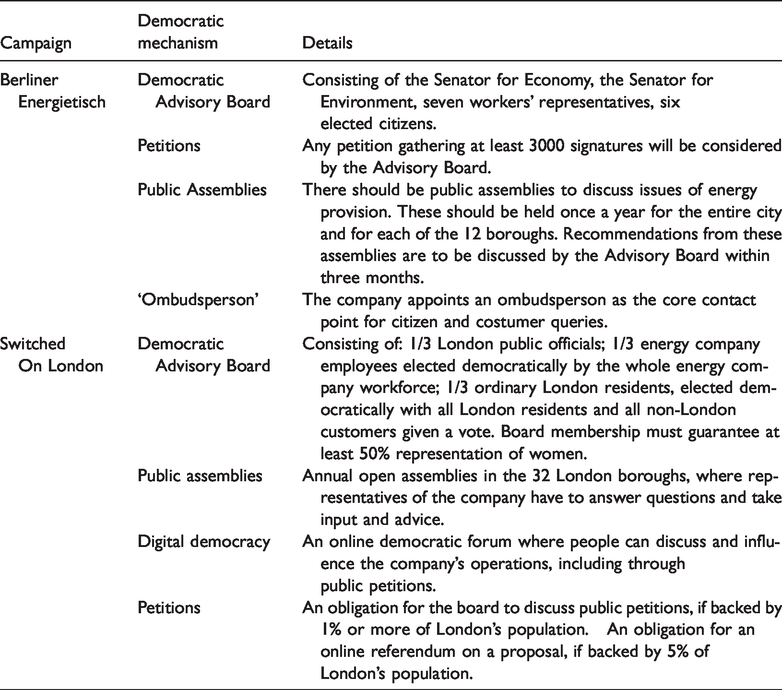
Crucially, the above aims would be achieved through a new organisational model, namely that of a ‘citizens’ utility’ or a ‘people-powered energy company’, that would combine state ownership with explicit instruments of citizen control. Table 1 shows the different forms of democratic control considered across both cities, among them public assemblies on the borough level, an elected advisory board and the right for public petitions and referenda to shape the policy of the utilities. Both campaigns also demand transparency on the companies’ operations. The intention is to enable citizens to exert influence on the guidelines and practices of the utility. It is these entitlements of citizen control and a redefinition of social aims for the companies that create a departure from traditional models of public ownership.
Democratic mechanisms demanded in Berlin and London.
As impressive as these proposals for social justice and democratic control might be, they exist within the constraints of energy sector regulation and governance. Yet, our contention here is that demands for change within the energy system are imagined as a means of expressing a political agenda for redistributing and taking control of resources that goes way beyond this one infrastructural network. In the words of one activist who co-founded SOL: You know, it isn’t just about redistribution of wealth, but redistribution of resources, and taking control of resources … suddenly here’s a way to talk about these socialist ideas in an energy context … being really popular for lots of people, even people who weren’t even that into energy. (Interview, London, July 2017)
More than that, this reading pushes against the risk of developing energy democracy as an agenda for transformation of the energy sector alone, disregarding the entanglement between energy, other socio-ecological relations and the case for wholesale societal transformation. Indeed, reflecting their orientation towards RTC, the London and Berlin initiatives made connections between energy and other issues and struggles fluently. Both found allies and drew in housing organisations, trade unions and faith groups who have not typically worked alongside environmental and energy-based campaigns in these cities. Anti-gentrification campaigners are members of the Berlin Roundtable and it has set out to connect to other ‘roundtables’ working in other fields of public infrastructure such as transportation. The SOL campaign also linked up to an array of urban struggles. Its launch event in 2015, held in a community centre of the recently redeveloped Myatts Field North estate in South London, saw local residents' grievances around gentrification and displacement put into conversation with wider transformative criticism and struggle. Therefore, if energy democracy struggles are understood as interventions towards the appropriation of, and participation within the production of urban space more broadly, the political stakes of these struggles are sharpened; and the potential for new alliances stretches beyond those working on ostensibly ‘energy’ issues enhanced.
Autogestion and the state
Having argued that the RTC lens is productive in broadening the political horizons of the energy democracy imaginary, our second argument is that struggles around energy democracy can, in turn, advance debates around RTC, in particular, through sharpening our understanding of the concept of autogestion and the role of the state therein. Energy democracy – both in activist and academic debate – develops claims for an alternative energy system, but also includes ideas of how this system should be organised (Becker and Naumann, 2017). We think energy democracy – as spelled out by the two urban initiatives in London and Berlin – is instructive for advancing debate about autogestion in two ways: energy democracy provides a vision for durable structures for appropriating energy infrastructure, and suggests positioning strategies for achieving these.
Both campaigns make proposals for citizen control and management within the energy sector, conducted through state institutions. The initiatives thereby depart from more autonomist approaches to autogestion and RTC, which favour the creation of prefigurative liberated spaces or fleeting ‘cracks’ within capitalist social relations, rather than seeking an active engagement with state institutions. Yet, as a Berlin roundtable spokesperson argued ‘you cannot ensure the subscription [of politicians and managers] to the public interest by legal means. Only control can secure it’ (Interview, Berlin, August 2013). Driven by the need to meet formal requirements, the initiatives have developed a coherent concept of principles and provisions – in the form of a ‘legally watertight document’ (same spokesperson), going beyond collating bullet points of imaginaries for alternative futures in the form of lists (Appel, 2014). Thereby, initiatives did not put their faith in the state naively; rather they see the state as a strategic terrain of struggle for urban autogestion, one that could be transformed or at least subverted to serve their alternative imaginaries of democratic control.
For this, a conscious strategic engagement with given institutional structures was deemed necessary. While the initiatives were internally organised as grassroots campaigns devoted to principles of balancing different positions through consensus, their strategies rendered discourse around policy issues and formal political architecture as windows of strategic opportunity (Hess, 2018). In the UK, there appeared to be an emerging agenda of municipal and community energy (Creamer et al., 2018; Webb et al., 2016), adding to the longer-standing controversy of energy poverty (Boardman, 2009). Activists saw a need to push these discourses and practices in a more radical direction, particularly with regard to the democratisation of new municipal companies. The London mayoral elections of May 2016 presented an opportunity to shape the political debate in the capital, with likely knock-on effects for the national political climate. For Berlin, the Germany-wide ‘wave of remunicipalisation’ in the energy sector, and the success of referenda on the city’s water contract mentioned above, created an important grounding for the Roundtable campaign (Beveridge and Naumann, 2016).
Against this, the initiatives did not have a significant reach into local state institutions. Hence, in Berlin, the organisation of a referendum was deliberately chosen as a strategy to involve as many people as possible: the referendum itself was a means of social mobilisation, involving a number of tactics to target the wider public, for instance regular demonstrations in front of the Berlin city hall, gathering signatures and (social) media campaigns. Finally, the decision of two of the Roundtable's spokespeople to stand as local MPs has seen the campaigns’ demands taken inside state processes in a particularly direct fashion. In this sense, then, remunicipalisation campaigns in London and Berlin have explored the potential for working inside, or at least alongside state processes to begin transforming these such that mechanisms of autogestion can be developed.
In doing so, the contradictions and pitfalls of this approach were highlighted. In Berlin, the referendum was foiled by the decision on the part of the then government to move the date of the vote away from the general election – when the voter quorum would likely have been guaranteed – to an isolated independent date, a direct attempt to undermine the referendum's success. In London, despite intensive lobbying from SOL, the GLA ultimately decided to abandon its plans for an independent public energy company and instead to pursue the far less ambitious ‘white label’ partnership. As Angel (2017) understands these experiences, it is indicative to think these through the lens of Bob Jessop's strategic relational theorisation of the state, according to which the state should be understood as a contested set of processes that are selective in the sense of tending towards reproducing the broader sets of relations within which they are embedded. The implication here is that attempting to introduce processes of autogestion into state institutions will likely be held back by the ‘strategic selectivity’ of those institutions which, under present social arrangements, runs counter to the logic of self-management. This is not to say, however, that forms of contestation around state processes cannot push autogestion forward, provided this is understood as an ongoing dynamic, even experimental, back-and-forth struggle without an obvious endpoint.
What, then, are we to take from this discussion for broader debates around autogestion? Certainly, nothing that has been said here is intended to detract from attempts to realise RTC through non-institutional forms of protest and association. Nor have we attempted to carve out a binary between state and non-state approaches, or between prefigurative and institutional forms of activism. Both campaigns traversed a path between these non-dichotomous strategic trajectories, for instance, combining protests and community-based organising with lobbying and institutional interventions. Our contention, in short, is that the energy initiatives considered help us acknowledge that autogestion’s aim of self-management and participation for improving everyday life does not preclude engaging with the state as a potential terrain for strategic transition beyond economic and bureaucratic imperatives. Retaining Lefebvre’s point for the openness towards different tactics and technologies, we argue that the energy initiatives discussed help us to think through how RTC might translate as endeavours to create new durable democratic institutions capable of governing and transforming networks of urban infrastructure and beyond.
Strategy and scale
The last point we are raising targets the relationship between scale and strategy on both autogestion and energy democracy. Conceptually, problematising the links between the right to the city, autogestion and broader scales is rooted in Lefebvre’s (2003[1970]: 16ff., 57) key distinction between the city as a somewhat bounded object and ‘urban society’ as a globally emerging set of relations, underpinned by material exchange between different places and sites. This question touches upon a complicated linkage, implicit but seldom spelled out in relation to autogestion and energy democracy: how can locally based struggles in one context be linked, not only to a broader alliance of social movements locally, but also to struggles across spaces and scales? How can it be transformative beyond one place in time? Claims for remunicipalisation here appear limited in their scope and scale, as they target the local state to develop pockets for a non-commodified and participatory mode of providing energy to cities. So, what difference does this claim make in an internationalised energy system defined by uneven resource trade, the externalisation of emissions and other ecological costs, and power structures running through international connections that ‘make it possible to translate one set of resources and power into another’ (Mitchell, 2009: 401)? What is the appropriate scale of action, and how can emancipatory political practice avoid the ‘local trap’ of favouring initiatives built on positive imaginaries around locality only (Purcell, 2006)? Not intending a definite answer to these questions, this perspective enables us to focus on whether and how the initiatives think beyond the local scale; in terms of their visions, their strategies and their links with each other.
First, and similar to the connections beyond energy sought by the initiatives discussed, they shaped their problem horizon to include issues beyond the local scale. Most obviously, claims for remunicipalisation do problematise the internationalised relations of ownership characterising today’s energy sectors. Even though the Berlin Roundtable was wary of providing a shorthand criticism scapegoating grid-owner Vattenfall, the general image of the company as an externally controlled corporation active in disastrous coal extraction south-east of Berlin was most pivotal for the campaign’s appeal to the public (activist interview, Berlin, August 2013). Hence, climate change was an important point of reference in the campaigns. Local ownership should pave a way for moving away from – especially in Berlin – coal-fired power plants, to building up local renewables as an alternative, eventually reducing carbon emissions. Events organised by SOL, for instance, discussed London’s legacy within the colonial past and present as a financial centre for the flow of fossil capital. Though energy-specific, these points showcase how the problematisation of the initiatives linked local activism to broader issues, and also to broader spatial scales.
Second, however, the solution for tackling these issues was seen in direct action on the local scale, and was, hence, defined by local political constellations and power geometries. Seizing concrete policy opportunities, the decision was taken to focus efforts on the scale of just one city in both contexts. In London, this flows from using the mayoral election to advance a bold vision of democratic municipal energy with the aim of gaining transformative thrust locally, while at the same time shaping national and international debate, and emerging municipal energy initiatives across the UK. For Berlin, the mere opportunity to organise a referendum at city level has shaped the political room to manoevre, together with the overall discussion about local ownership in energy grids and the history of a successful referendum in the water field.
Lastly, there is an obvious connection between the projects discussed, as SOL was directly inspired by the events in Berlin, epitomising how political imaginaries and strategies may emanate, translate and mobilise across place and scale (Peck and Theodore, 2010). Thus, the initiatives’ approaches follow the dictum of thinking globally while acting locally; however, there are larger strategic questions immanent in the quest for both energy democracy and urban autogestion in general.
Questioning the linkage between scale and political strategy refers to both the issues of who (which group of an overall population should be considered the ‘demos’), and where, as to which are the appropriate scales and territories for action; and how to strategically navigate these towards the aim of autogestion. Our point here goes beyond single cases, by raising the question of what can and should be the ‘subject’ and the ‘scale’ of autogestion. In our view, every quest for autogestion and energy democracy needs to consider and start from its ‘really existing context’ defined by those affected and by the given political-institutional configurations, even more so those that are directed towards concrete projects involving and seeking to transform the state in some way. Just as Staeheli (2010: 394) notes that ‘‘actually existing citizenship’ cannot be detached from broader currents and processes shaping societies’, we uphold that the approach for ‘solving urban questions to improve everyday life in urban society’ (Lefebvre,2003[1970]: 143) needs a tangible entry point to forge lasting projects for urban autogestion. Retaining the strategic openness of Lefebvre’s original concept without washing out its strategic core and direction, we conclude, requires alternatives to the global commodified energy system to grow from one place.
Conclusion
This paper brings together two related, yet hitherto unconnected debates: (a) the debate on RTC and urban autogestion after Henri Lefebvre, and (b) the emerging discussion on energy democracy. Drawing on the experiences of campaigns to remunicipalise energy in London and Berlin, we have made two interconnected arguments. Our suggestion, firstly, is that the ways in which these campaigns had political purchase beyond the energy sector and portended a broader vision of urban transformation allows us to read these struggles as attempt to enact RTC – a reading that is generative by virtue of its provocation to understand energy democracy as one aspect of a broader process of democratisation. Secondly, we have contended that considering these energy democracy struggles helps expand our thinking on RTC, illuminating that process of urban autogestion described by Lefebvre that can be applied to the complex process of infrastructural transformation through strategies centred around the commoning of local state institutions.
Democratised municipal energy utilities, as demanded in Berlin and London, could become part of ‘the creation of a new urban common, a public sphere of active democratic participation’ (Harvey, 2003: 941). If the right to the city can work as a ‘“wakeup call” for democratic forces to endorse participation, challenge existing inequalities and injustice, and seek to repair the city’ (Rosen and Shlay, 2014: 949) energy democracy can do just this for transforming an energy sector still characterised by a rigid melange of state and economic power producing an array of social and ecological problems. One implication of this paper is that attempts to appropriate such obdurate infrastructure as a basis for the right to the city and to ensure participation in the governance requires longer-lasting structures and procedures alongside the temporary assemblies and protests often referred to in the debate around RTC. What is needed is a long-term perspective on self-organisation, one that as far as possible guards against attempts to capture and reintegrate these new structures back into the neoliberal market economy – meaning, how to set RTC on more durable feet, in other words, how to institutionalise alternative imaginaries of urban autogestion. Again, the intention was not to rigidly counterpose institutional and non-institutional approaches to RTC. Rather, we sought to show that in light of the question of durability, the RTC debate would benefit from an increased openness to the kind of institutional interventions the energy democracy struggles considered here have enabled.
The question of autogestion in our perspective may be closely connected to the state and its changing institutional form. The processes of autogestion under way in London and Berlin do not assume that the state can be avoided or will wither away but, rather, seek to exploit entry points and loopholes within existing state processes. What is needed is a narrative about alternative imaginaries of social organisation in-against-and-beyond the state (Angel, 2017; Cumbers, 2015), and a strategic approach based on an analysis of promising anchor points for such an endeavour. This also implies not rejecting the local scale as the legitimate and feasible entry point for political projects for transforming wider social and technological systems; but surely while linking local issues to broader scale processes and not constraining action or thinking to a mystified local level.
One pitfall with engaging the state for RTC and autogestion is that any sense of institutionalisation could potentially foreclose the rich open-endedness in Lefebvre’s work. Open questions regarding whether different issues and struggles surround the right to the city – that is, housing, public space, energy infrastructure – though if not to be isolated, require different kinds or strategies and organisation. This is linked to potential differences in the material politics of each sector, defining how alternative aims and visions may translate into infrastructure transformation. Similarly, it needs to be further reflected how our approach can be spelled out for energy democracy projects in rural areas and struggles along other parts of the energy value chain. Yet, we think that the approaches for opening up energy provision and the state we have analysed here – which connect RTC and energy democracy via particular strategies of autogestion – could provide a first step in the dialectics of urban change. ‘Energy for People not for Profit!’ presents not only a demand for a transformation of the energy sector in one place, but also for changing our cities and the role that state processes play in their production across urban and rural spaces, across global urban society.
Footnotes
Declaration of conflicting interests
The author(s) declared no potential conflicts of interest with respect to the research, authorship, and/or publication of this article.
Funding
The author(s) received no financial support for the research, authorship, and/or publication of this article.