



Abstract
In this paper, votes registered by parties with a high anti-elite and anti-European salience are mapped, in order to identify potential geographical patterns in European regions.
In the wake of the Global Crisis, various European regions experienced ‘a combination of job loss, declining labour-force participation or declining per-capita income relative to national averages’ (Martin et al., 2018: 9). The emergence of these facts is likely to have partly fuelled a general feeling of resentment that brought about a mistrust of the population in the political class and a decline in the identification in mainstream parties.
Our aim is to map the regional votes registered by parties with high anti-elite salience and Euroscepticism in the latest National Parliament elections of the 28 EU countries. Today, the anti-elite rhetoric is increasingly associated with – and is a part of – the definition of populism (Mudde, 2004). Indeed, the anti-elite and anti-European rhetoric is used in the language of populist parties as a means to protect common people from the political elites (Acemoglu et al., 2013).
We collected data from national sources at regional level, which is generally the most important subnational political and decisional centre for national and European policies. We chose the last National Elections that span from 2015 to 2019. In order to select parties with anti-elite and anti-European orientation, we relied on the classification of the European political groups and their ideological positioning (for details, see: https://en.wikipedia.org/wiki/Political_groups_of_the_European_Parliament#Current_composition_of_the_9th_European_Parliament). In particular, we sum up the vote shares of the parties belonging to the following groups: Europe of Freedom and Direct Democracy (EFDD) (classified as Eurosceptics), European Conservatives and Reformists (ECR) (classified as Eurosceptic Conservatives), Identity and Democracy (ID) (classified as Far-right nationalists) and European United Left-Nordic Green Left (EUL/NGL) (classified as Communists/Socialists). The map is shown in Figure 1.
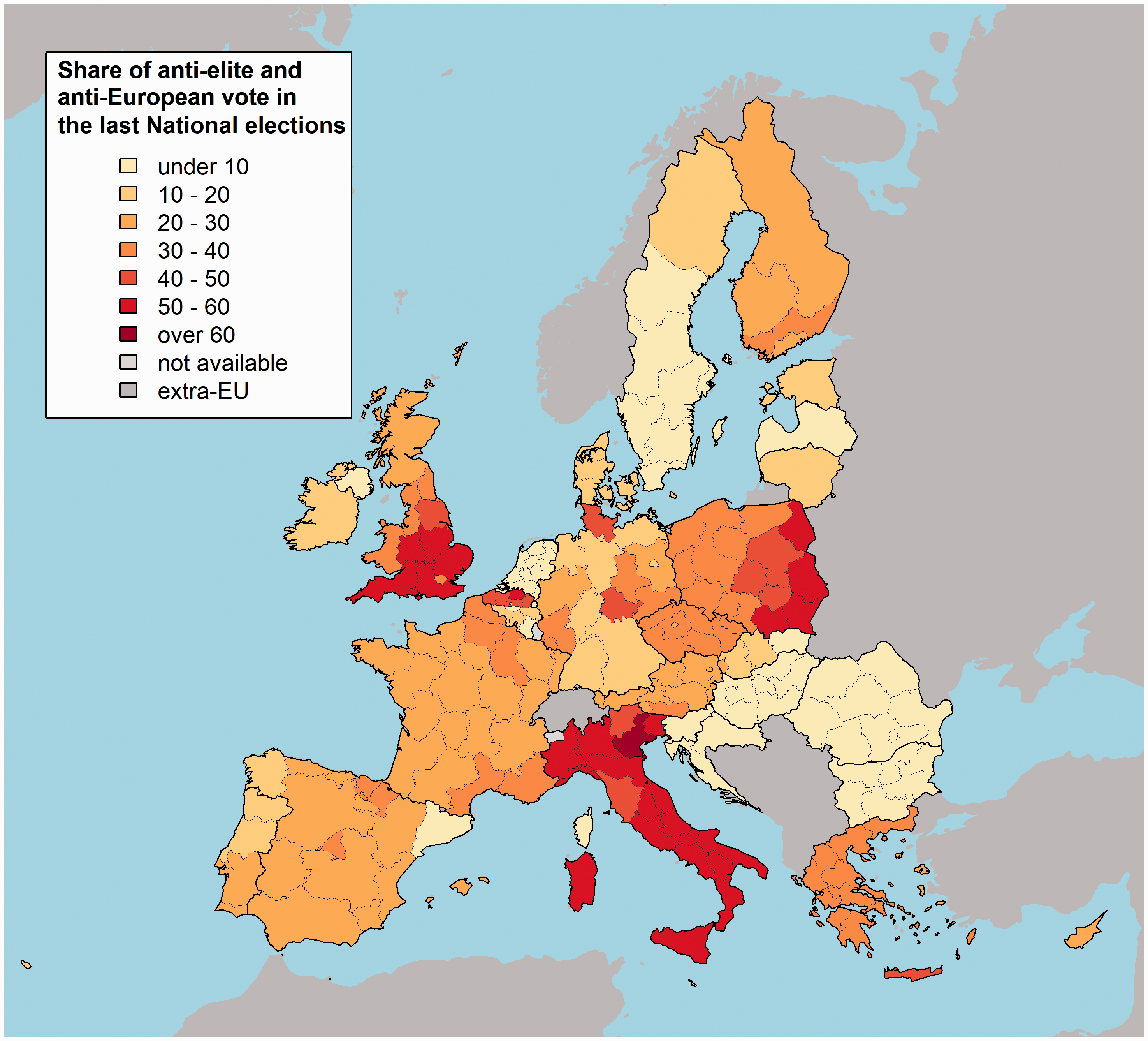
Map of anti-elite and anti-European vote in Europe. The following parties are included, by group: the members of “Identity and Democracy” are the FPÖ (Austria), VB (Belgium), Freedom and Direct Democracy (Czech Republic), AfD (Germany), DF (Denmark), Conservative People's Party of Estonia (Estonia), Finns Party (Finland), National Front (France) and Lega Nord (Italy). The members of the ECR, are N-VA (Belgium), IMRO (Bulgaria), ODS (Czech Republic), Greek solution (Greece), VOX (Spain), Fratelli d'Italia (Italy), LLRA (Lithuania), LNNK (Latvia), SGP and FvD (Netherlands), PiS (Poland), SD (Sweden), SaS (Slovakia), Conservatives (United Kingdom). Members of the EFDD are Free Citizens Party (Czech Republich), DLF Debout la France (France), Five Stars Movement (Italy), TT (Latvia), KORWiN (Poland), UKIP (United Kingdom). Members of the EUL/NGL “European United Left-Nordic Green Left” are PTB/PVDA (Belgium), AKEL (Cyprus), KSCM (Czech Republic), Linke (Germany), EL (Denmark), Syriza (Greece), PODEMOS (Spain), EH Bildu (Spain), IU-UPeC (Spain), VL (Finland), La France Insoumise (France), SF (Ireland), PvdD (Netherlands), PCP-PEV (Portugal), BE (Portugal), VP (Sweden).
We take as a reference the EU average, equal to 25%, and we identify four groups of countries. In the first one Bulgaria, Hungary, Latvia, the Netherland, Croatia, Slovenia and Sweden, have parties with anti-elite and anti-European orientation which registered between 0 and 10 percentage points. The second group, with countries where parties with anti-elite and anti-European orientation obtained between 11% and 20% of votes, includes Denmark, Estonia, Ireland, Latvia, Portugal and Slovakia. In countries like Austria, Cyprus, Germany, Spain, Finland and France the share of votes is around the EU average. Finally, support higher than 30% for parties with anti-elite and anti-European orientation is found in Belgium, the Czech Republic, Greece, Poland, the United Kingdom and Italy.
It is worth mentioning that the Hungarian party Fidesz, although it has a right-wing nationalistic ideology (Polk et al., 2014), is affiliated to the European People’s Party which does not belong to any of the groups of Eurosceptics, Eurosceptic Conservatives, Far Right nationalists or Communists/Socialists.
Analysis of the dynamics within countries shows that in the last group, Italy has homogeneous territorial dynamics, where the Northern League and the Five Stars Movement registered a very high level of approval in all regions. However, the United Kingdom exhibits a strong dichotomy between England, where Eurosceptic parties won 40% of votes, and the rest of the country, where the vote share was less than 30%. In Poland, Euroscepticism was led by the Prawo I Sprawiedliwość party which commanded the strongest support in the eastern regions, with more than 45% of votes. In Greece and the Czech Republic no relevant territorial variation is observed, while in Belgium support for parties with anti-elite and anti-European orientation was well above 40% in Flanders and less than 6% in Wallonia. The other three groups of countries seem quite homogenous, with few exceptions. Worth mentioning is that in Spanish regions support for Vox and Podemos, the two parties belonging to the Eurosceptic Conservatives and Communists/Socialists, respectively, was between 20 and 40 percentage points, except for Cataluña where Podemos gained no support due to the significant prevalence of regional parties. In Germany, finally, regions behave quite heterogeneously. In some, such as Thuringia, Saxony and the northern Schleswig-Holstein, parties with anti-elite and anti-European orientation registered between 35% and 40% in the last elections, with rising approval for Linke and Alternative für Deutschland.
Figure 2 shows the percentages of anti-elite and anti-European votes mapped into the voter cartogram. Regions with the highest number of voters are in Italy, the United Kingdom and Germany. In the first two countries, we observe a high share of votes for anti-elite and anti-European parties, while in the latter support is low. Madrid, Paris, Athens are in regions with a high number of voters too, as for most of metropolitan cities. In Polish regions, where support for Eurosceptic and anti-elite parties is strong, the number of people voting is low. Scandinavian and Baltic regions have a low number of voters too.
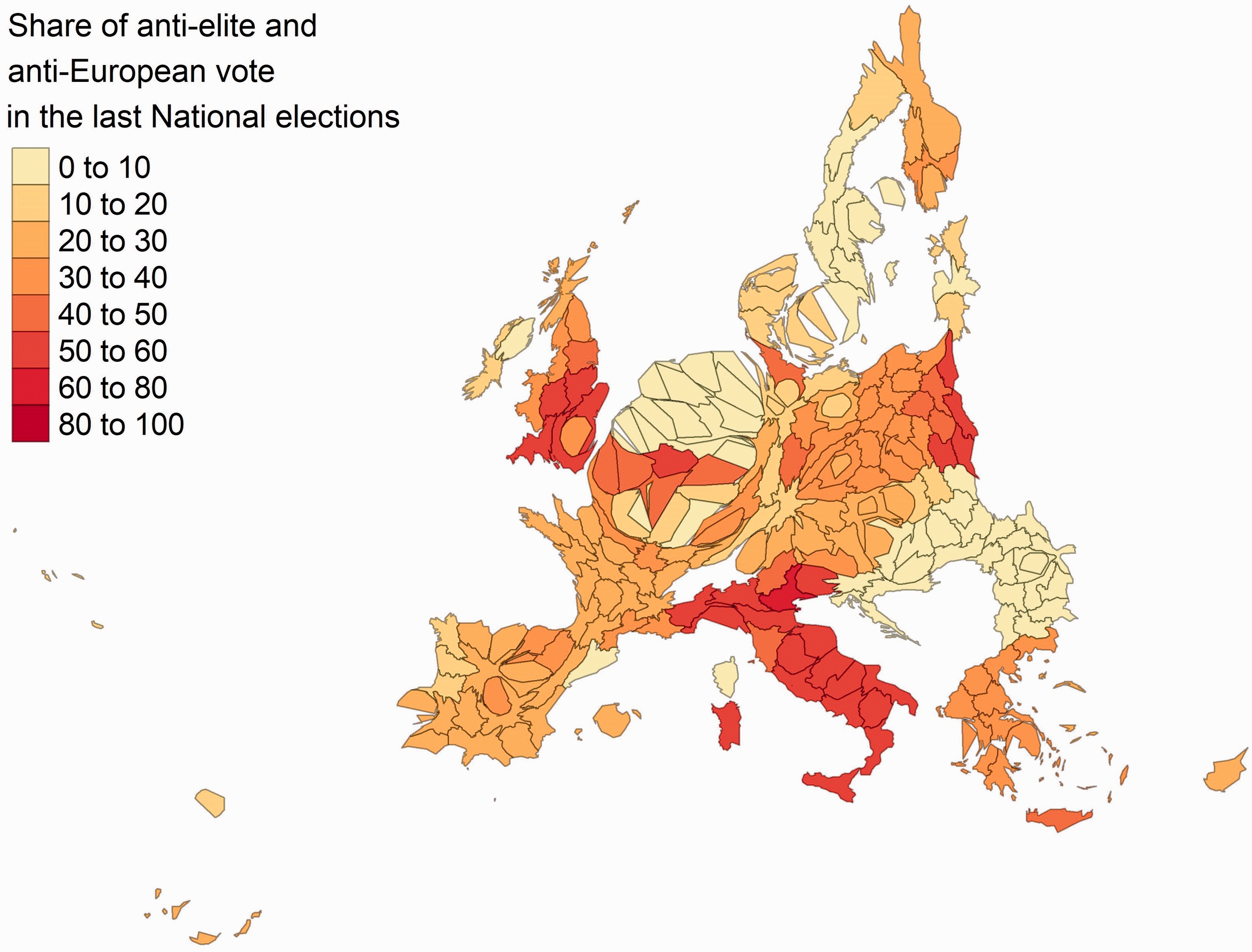
Cartogram of anti-elite and anti-European votes over voters. Area of each region is proportional to its number of voters on the cartogram.
Overall, we observe that Eurosceptic and anti-elite parties have gained quite strong support across Europe, with some countries more affected than others, and with some interesting territorial patterns. Although in various countries the national average is a good approximation of what is happening at a regional level, in others they hide some aspects like strong regional heterogeneity in Germany or the territorial dichotomies in Belgium, Poland and the United Kingdom.
This analysis calls for closer attention to the territorial context and to its analysis in relation to the electoral outcomes.
Footnotes
Declaration of conflicting interests
The author(s) declared no potential conflicts of interest with respect to the research, authorship, and/or publication of this article.
Funding
The author(s) received no financial support for the research, authorship, and/or publication of this article.