



Abstract
Financial management of resettlement funding has always been problematic for governments and development agencies trying to mitigate the negative effects of moving people from one location to another. In China, Poverty Alleviation Resettlement attempts to rectify the shortcomings in policies designed for distributing compensation and ensuring funds reach their intended use with apparatuses of security. Governance technologies take the form of reimbursement subsidies, which mitigate the risk that funds will be corrupted or households misuse money, by reimbursing expenditures already made on village construction. These technologies convey the contradictory nature of Chinese rural development, as they employ neoliberal discourse to direct fiscal transfers from the central government to enterprising individuals, but also attempt poverty alleviation of rural societies’ most marginalized households. Resettlement technologies are therefore leading to uneven development while simultaneously claiming to adhere to transnational poverty alleviation norms. In this article, the Party-state applies a cultural fix to resolve contradictions in the development apparatus. The Party-state draws on historical governance norms to change the meaning of the corrupt official that receives disproportionate government assistance into the “ideal” all villages should emulate. In this way, the Chinese bureaucracy appropriates the power of local elites to guide conduct and achieve broader political economic goals.
Introduction
Resettlement is a popular strategy directed by national governments and transnational development agencies such as the World Bank that pursue broad scale capitalist development. China, in particular, has a history of resettlement for purposes such as infrastructure construction, to clear communities from reservoir and conservation areas and for poverty alleviation (Heggelund, 2004; Merkle, 2003; Yeh, 2005). The outcomes for affected people have most often been impoverishment, despite various strategies and policies aimed at improving the target population’s wellbeing (Lyall, 2017). As a result, the governance of such projects has been the subject of intense scrutiny by resettlement scholars and development agencies. Research has identified a number of shortcomings in the design and implementation of projects, which can include underfunding, poor planning and indiscretions in governance that lead to corruption and mismanagement (van der Ploeg and Vanclay, 2018). Local officials and elites have commonly been identified as the instigators of these indiscretions (Cernea, 2008).
This article expands our understanding of the strategies employed by government bureaucracies and local elites to further their interests, as they circumvent or align with state-directed goals that are often at the expense of local people’s goals. During development, the vested interests of actors are legitimized through appeals to development ideologies that justify desired outcomes (Ekers and Prudham, 2017). The technologies enlisted to implement goals reflect this ideological power. Tensions exist when the development apparatus appeals to discourse such as equitable development and poverty alleviation to gain legitimacy but implements political economic goals based on capital accumulation and state-directed land use planning. These tensions produce vulnerability that actors (local or otherwise) can exploit by maneuvering the contradictions implicit in the development apparatus to suit their own ends.
There are a number of modes of Poverty Alleviation Resettlement (PAR), including forms of urbanization, but the current mode is short distance migration in which households build a house in a settlement on their administrative land that is partly subsidized by county government. The partial nature of subsidies ensures households contribute money and labor to project implementation. This article argues that poverty resettlement is a spatial fix to mobilize a latent rural labor force. Harvey’s (2001) spatial fix has commonly been applied to resolve crises in development by moving surplus people and capital to more productive ends. While the micro-politics of resettlement is to motivate rural people to engage in self-directed increases in material wellbeing, they must also make way for the expansion of rural industrialization. Governance that is designed to direct resettlement funding to its most cost-effective end must overcome contradictions between objectives of equitable development and neoliberal discourse that favors competitive investments in individuals that can drive greater profits.
It is this conflict and contradiction between poverty alleviation and entrepreneurialism where definitions of crises (corruption) and legitimacy (smarter investments that yield more development) are questioned. In its efforts to institutionalize rural corporate governance guided by neoliberal ideology, but under the guise of poverty alleviation discourse, the Party-state situates its technologies for governing resettlement funding. I argue that the Party-state employs a cultural fix (Layne, 2000) to change the meaning of the corrupt official and legitimize its neoliberal agenda. The Party-state assumes cultural techniques derived from historical governance (Socialist and Confucian) to obfuscate obligations to ensure the wellbeing of its most marginalized and channel resettlement funding to suit their agenda.
The argument is articulated through the following sections. The next section positions the research within the context of previous work on compensation governance in resettlement studies. This is followed by a presentation of the analytical framework of governmentality and spatial fixes. The article goes on to contextualize resettlement compensation governance within the context of Chinese rural governance and analyses the evidence from the two case study villages. The final section makes concluding remarks.
Resettlement compensation and governance
Resettlement is a complex process in which people and communities are wholly or partially displaced from their land and livelihoods. Recompense for the disruption of migration is calculated and allocated using various methodologies that are distributed by transnational development agencies (see ADB, 1988; World Bank, 2004). Contradictions are implicit in theories for recompense that are derived from liberal ideology for economic growth but draw on discourses of distributive social justice and equitable development to align broader political economic goals with affected people’s needs (Kirchherr et al., 2017). Globally disseminated policy guidelines for governments undertaking resettlement for various purposes succumb to failings in governance due to these contradictions and mismatches with local governance norms. Despite transnational development ideology insisting adequate funding and consultation with local people will enable fair and appropriate compensation, resettlement still leads to impoverishment in most cases (Lyall, 2017). Literature from scholars that design social safeguards to be included in policy prescriptions tend to focus on the inability of various stakeholders to implement methodologies (Owen and Kemp, 2016).
The idea of compensation implies economic calculations of losses or harm and payments to offset these. Cernea (2003) in particular, has been influential in identifying common failings in calculations that lead to mismatches between losses incurred and amounts provided. Processes may fail to take into account unforeseen outcomes of development such as in the case of degraded water quality and fisheries after construction of the Bui dam in Ghana (Siciliano and Urban, 2017). Cernea’s (2003) assessment of limitations includes undercounting of lost assets such as land and housing or the inaccurate valuation of assets and therefore non or only partial replacement. Economic value is a product of ideology, critique of which is elaborated in literature that measures non-material losses or non-market income or costs that render economic calculations problematic. For example, during the Limpopo National Park resettlement in Mozambique, extra material losses included local knowledge systems associated with resource use and social norms and cultural values such as status and identity associated with resource ownership (Witter and Satterfield, 2014). As Green and Baird (2016) have found in Laos, resources not previously accounted for by markets can be subsumed under expanding capitalist relations in the interests of compensation (such as land and crops). Alternatively, resources not amenable to conventional markets for cultural or material reasons (such as forest products) are de-commodified and made invisible through accounting processes.
The critique of power extends beyond economic valuation to include the role of social difference. The literature has identified the lack of sensitivity to social difference as leading to the reproduction of inequalities between various actors, including between government departments, developers and society (Siciliano and Urban, 2017) as well as between villages and between households (Thapa-Karki, 2013; Witter and Satterfield, 2014). In the Bardia National Park in Nepal, Thapa-Karki (2013) found that compensation impacts villages differently due to differences in infrastructure and their relative location, as well as involvement of communities in planning. Likewise, inequalities between households are exacerbated by their differing characteristics, capabilities and access to assets, which can lead to the degradation of social cohesion. In addition to this, misuse of funds by recipient households that are not used to handling large sums of cash and spend irresponsibly, has led to governments extending their control over the use of funds (Vanclay, 2017).
Some of the most significant abuses of power are experienced as corruption of resettlement funding. There is a considerable body of literature that documents how local officials mismanage, siphon or extort allocated funding for personal use and at the expense of the poorest resettlers (Cernea, 2008; Heggelund, 2006; van der Ploeg and Vanclay, 2018; Vanclay, 2017; Wang et al., 2013). In Mozambique, van der Ploeg and Vanclay (2018) found that coalitions of project staff and local elites made claims on cash payments through fraudulent means (double counting or making up assets). During the Xiaolangdi resettlement in China, village leaders benefited disproportionately while omissions and mistakes during calculation of losses resulted in inadequate compensation for marginalized households (Chen et al., 2004). Favoritism by local officials who allocate funds based on personal relationships (Thapa-Karki, 2013) or sabotage by providing information that is limited, vague or unclear, undermines the confidence of villagers (Chen et al., 2004). Vanclay (2017) further explores power imbalances between actors that manifest as payments to government officials to ensure corporate governance standards are not rigorous. In India, too, bribery is institutionalized and considered a norm when interacting with local officials (Ramakrishnan, 2014). During the Three Gorges resettlement, Jackson and Sleigh (2000) documented financial mismanagement in the form of companies offering bribes to local officials for construction contracts.
Despite these limitations, governance often lacks mechanisms for feedback on technologies for assessment or design and procedures for dispute resolution (Plummer and Taylor, 2004). It is for this reason that there is strong sentiment among development organizations that participatory methods will improve planning, oversight and transparency of financial management and mitigate the threat of corruption (Cernea, 1988, 2000; Owen and Kemp, 2016). The growing trend in the use of participatory methods to gain relevant information about losses and hence plan for asset and livelihood reconstruction, is well documented in the literature (Cernea, 1992; Goulet, 2005; Torres and Carte, 2014). However, this literature too is critiqued by several governmentality scholars who argue technologies of participation are also implicated in power. For these scholars, participatory processes are used to legitimize state-directed political economic goals by conforming beliefs and desires or manipulating, coercing or persuading local people (Lestrelin et al., 2011; Li, 2007; Singh, 2009; Yeh, 2005).
While this article further demonstrates the use of modes of consultation in pursuit of transparency of financial management, governance that ensures the intended use of resettlement funding is primarily examined as “apparatuses of security” (Foucault, 2009). Instead of inclusion to encourage oversight, apparatuses of security structure the temporal and spatial flow of finance to villages and households. These governance structures are embedded in local histories and geographies of China and contend with an adaptive governance environment in which ideas, culture and power relations structure institutional change (Wang et al., 2013). This article explores these themes of power as they manifest through contradictions in resettlement governance ideology and discourse and are reconciled by the Party-state through references to historical governance.
Fixing contradictions in resettlement governance
The objective of government during resettlement is to efficiently re-establish homes and livelihoods in the destination, so as to mitigate the detrimental effects of migration, while ensuring the efficient implementation of governmental or industry goals. Foucault (1991) defined government as a specific, albeit complex, form of power that has population as its target, political economy as its primary form of knowledge and apparatuses of security as its technical means. Apparatuses of security regulate the causal, temporal events in a given space to minimize risk and maximize the positive functioning of the governmental technology (Foucault, 2009). During resettlement, financial mismanagement is a risk to the governmental technology and apparatuses of security regulate flows of project funding through corporate governance.
PAR is designed to mitigate the risk of financial mismanagement through apparatuses of security in dual ways. Technologies include meetings for information dissemination and a reimbursement subsidy system which ensures funds reach their intended use by repaying households and villages for expenses already made on housing and infrastructure. Fiscal transfers from the central government only provide a portion of the cost of building a house; therefore households are expected to invest their own money and labor. This technology has the effect of mobilizing a latent rural labor force and consumer market that is made legible and calculable through poverty alleviation selection criteria and the application process (Li, 2007; McConnell, 2012). PAR thus exercises diffuse power through governmentality (Rose, 1996). PAR recipients are expected to be responsible and autonomous to maximize their wellbeing (Rose and Miller, 1992). Reimbursement subsidies thus mitigate the risk that government subsidies make the peasantry too reliant on the bureaucracy. For Foucault (2004) neoliberalism is governance through enterprising individuals and in the current case one individual in particular is the arm of Party-state-directed technical land use planning.
Current expansion of neoliberalism in rural villages accentuates the dialectical nature of Chinese development in which egalitarian objectives of poverty alleviation are balanced, if not obscured, by the entrepreneurial state development plan. Lim (2013) suggests contradictory forces are implicit across China, as the central government balances spatially differentiated processes of free market liberalism with direct state intervention to curb uneven development. He refers to this balancing act as a spatiotemporal fix. Harvey’s (2001) original spatial fix conceptualized the export of surplus capital and labor to more productive purposes to avert crises of overaccumulation. In China, it has been useful for understanding how the central government resolves crises and contradictions in the capitalist system (Zhan and Huang, 2017). For example, in Shanghai cultural spaces have gentrified dilapidated industrialized areas, paving the way for entrepreneurial governance to fix further capital (He, 2017). In other contexts, Gopakumar’s (2015) developmental fix institutionalizes urban renewal through neoliberal governance but at the expense of the local political culture in India. A common theme in current literature is the institutionalization of the capitalist commodification or neoliberal marketization of nature through a range of environmental (Castree, 2008, 2009) and ecological (Bakker, 2009, 2010; Cohen and Bakker, 2014) fixes.
Crises can include social and environmental conflicts that various interventions of capital or technology are applied to resolve (Ekers and Prudham, 2015, 2017; Narsiah, 2013). In Loughran (2018), social conflict is resolved through the cultural fix of parks and cultural spaces that produce the ideal urban subject in Chicago. Parks and green spaces lead to gentrification, increased property prices and provide the dominant landscape aesthetic for white middle class women and their families to engage in bourgeois cultural practices and be protected from social problems of racialized crime. His case reveals that the externalities of cultural production and social expectation lead to uneven development and inequality by marginalizing certain races, classes and genders (Loughran, 2018).
Layne (2000) argues that externalities are an implicit side-effect of cultural productions based on linear pathways of social progress. In her study on the cultural impacts of unemployment, contradiction is implicit in development, as the capitalist system periodically creates types of unemployment, but liberal ideology glorifies upward mobility, rendering individuals failures if they are unable to meet expectations of career and living standards. Layne (2000) introduces a cultural fix to change what it means to have a meaningful life course and career path. She uses a number of alternative storylines to expand the discursive repertoire and accept marginalized economic subjectivities of the poor and unemployed. Layne’s cultural fix is essentially a discursive tool that drives social change by alleviating the burden of norms of expectations of upward economic mobility.
In the current case, a new village, like a park, acts as fixed capital through which the ideal subject is produced. However, contradictions between developmental and poverty alleviation objectives lead to conflict during subjection. PAR’s narratives of poverty alleviation and egalitarianism, supported by subsidies for the poorest villages and governance of funds to ensure its equitable distribution, are displaced. A capitalist-neoliberal system in which poverty alleviation is itself an externality of the entrepreneurial activities of individuals (trickle-down effect) replaces them. These conflicts, which epitomize the corrupt official, need to be resolved by the Party-state if it wants to establish durable class relations through which development can perpetuate and form identities and subjectivities for control (Shapiro, 2014). For Shapiro (2014) this is done by eroding existing class relations (old cultural fix) in favor of the competitive and enterprising individual (new cultural fix). In the current case, the Confucian ideal or model subject bridges this transition by enabling elites to guide the conduct of the peasantry to achieve developmental objectives (Oakes, 2012). While Layne (2000) applies a cultural fix to relieve social pressure for upward mobility, I argue the Party-state embellishes the discursive repertoire of development policy with historical technologies to subvert the corrupt official.
Further evidence of the use of historical socio-cultural relations to fix governance and smooth the development pathway is documented in the global south. In Anthias and Radcliffe (2015) an ethno-environmental fix engages indigenous land rights to configure local forms of development, biodiversity conservation and ethnic culture into territorial governance; governance that facilitates the extractive industry by providing an entity to negotiate directly. Similarly, in Moore’s (2005) ethnic spatial fix and Finley-Brook’s (2016) territorial fix, ethnic stereotypes of culture and identity fixed in place and bound to certain forms of development facilitate planning of local resources. While the current case reiterates themes of assuming historical identities, historical governance resolves tensions expressed through competing ideologies in the development apparatus.
The cultural fix of the Confucian ideal broadens the discursive repertoire to engage elite power as a historical norm and therefore overcome resistance from villagers who challenge the integrity of resettlement funding governance and implementation. Through a cultural fix, the corrupt official that receives disproportionate assistance from the local state is legitimized because he mobilizes latent labor and resources to avert crises tendencies. The local state effectively legitimizes investment in more enterprising villages at the expense of poverty alleviation objectives.
Chinese rural development policy and governance
In addition to PAR, there is another rural development policy relevant for understanding resettlement governance in the current case: Building a New Socialist Countryside (BNSC). BNSC reflects trends in corporate governance in response to entrenched corruption in the Chinese bureaucracy. According to Nie et al. (2008) BNSC increases oversight of project funding through performance benchmarks, appraisals for cadre and oversight of financial management. The Cadre Responsibility System is the primary tool for assessing the performance of officials. Measurable performance targets are set for cadre who compete against their peers (Edin, 2003). Criteria, such as levels of economic and infrastructural development, are set to judge performance horizontally within bureaus and vertically between levels of the hierarchy (Ahlers and Schubert, 2009). These criteria are then subdivided into indicators such as the number of constructed new villages (Schubert and Ahlers, 2011). In this system, positive performance earns privileges and poor performance earns sanctions from higher levels of government (Schubert and Ahlers, 2011).
Examination of the hybrid nature of governance under BNSC reveals the re-emergence of historical means of guiding conduct. “Models” are a Confucian technology through which the moral example is disseminated throughout society. Model villages are constructed to act as a guide for all other villages to emulate. They serve the purpose of governing behavioral norms and the social order through moral regulation (Bakken, 2000; Oakes, 2012) as well as physical and social structures that organize rural life (Yeh, 2013). “Improvement” through aspiring to the example, mobilizes people and hence drives the success of the governance system. Models are therefore used in image building and as a propaganda tool to depict an envisioned future for rural China (Ahlers, 2014; Yeh, 2013). Ahlers (2014) and Smith (2009) have found that BNSC models elicit a resurgence of Communist style “showcasing” in which favoritism guides policy implementation. In this way, they provide opportunities for various actors (Ahlers, 2014; Heilmann, 2008b; Thogersen, 2011) such as promotion, embezzlement or preferential treatment as a result of qualification of model status (Ahlers, 2014; Smith, 2009).
In addition to the prototype village, BNSC defines a new direction in the application of models to include practical tools for the emulation of local “best practice” in rural development (Ahlers and Schubert, 2013). Officials experiment with policy implementation to identify successful local systems to be emulated across the county (Heilmann, 2008a). Resources are then allocated to priority regions that have a comparative advantage, which stimulates competition between villages for funding and thus facilitates effective policy implementation (Ahlers and Schubert, 2013). The current research site, Zhang Zhen (Zhang Township) is on the banks of the Yellow River and is undergoing a transformation to become a model township in Pinglu County, by building an industrial agglomeration in combination with environmental management, such as Grain for Green (Pinglu County Government, 2012).
Funding for works comes primarily from the central government through fiscal transfers that serve to centralize power (He, 2007; Tan, 2010). A competitive process guides distribution of funds to villages. Villages apply to the township or county government to fund a particular project; in response the government evaluates villages’ qualification against set criteria (Ahlers and Schubert, 2009). This step represents participatory engagement with villagers during project implementation under BNSC. The Party-state foresees that some degree of participation and project ownership is necessary to induce households to contribute funds to the projects they apply for (Ahlers and Schubert, 2009; Schubert and Ahlers, 2012). Under governance reforms, upfront costs to initiate projects are contributed by villagers, which ensures money reaches its intended use. These are then repaid through a system of reimbursements by the county, after proof of payment is provided (Lin and Wong, 2012). However, the system implies wealthier households are targeted at the expense of poorer ones who cannot afford the initial outlay (Dai et al., 2011; Lin and Wong, 2012; You and Kobayashi, 2009). The process also prevents local cadre from claiming financial support for projects that are not sanctioned by the township or county or embezzling money for personal use.
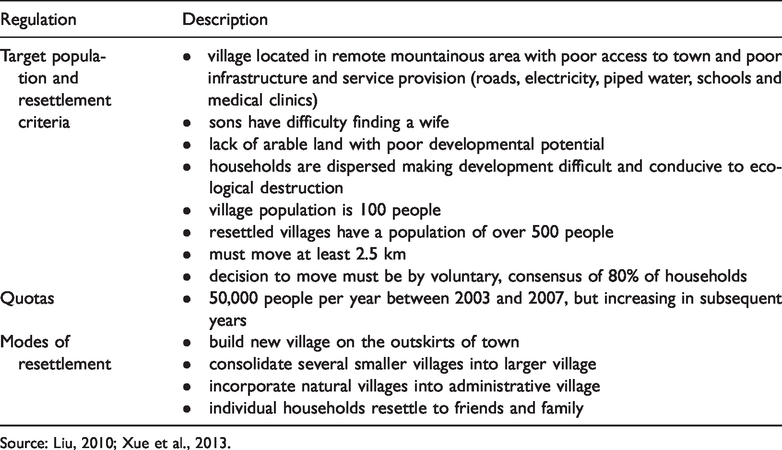
In comparison with BNSC’s corporate governance platform, PAR policy sets out simple criteria for making visible and calculable the rural population targeted for resettlement. A summary of key points for selecting villages for PAR in Shanxi Province is presented in Table 1.
Key points of Shanxi Province PAR policy.
Source: Liu, 2010; Xue et al., 2013.
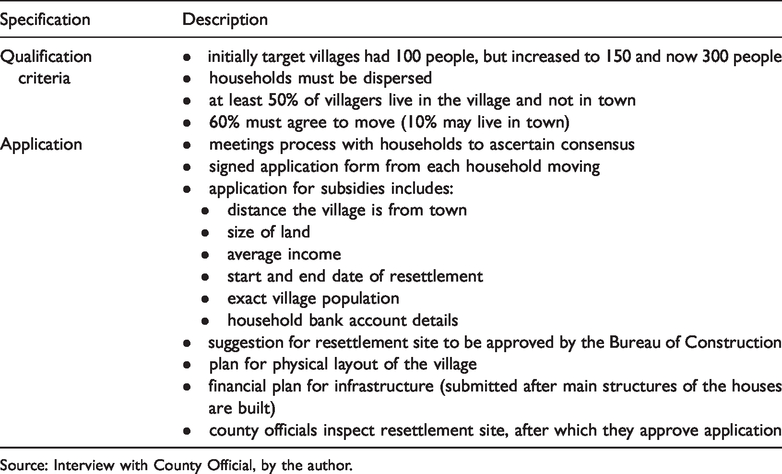
The policy description in Table 1 reveals that the Provincial Government is identifying small remote villages from marginalized areas to resettle. The aim of the policy is to increase villages’ access to infrastructure and services and also connect the rural labor force to towns and cities where they can access employment and schools. Despite competitive targets being set for cadre in the form of increasing quotas, the process provides opportunity for agency as consensus of 80% of the village is required to qualify for funds. The general policy prescription provided by Shanxi Provincial Government is contextualized for local implementation by Pinglu County Government. Table 2 presents the key features of the county qualification and application process.
Pinglu County PAR criteria and application process.
Source: Interview with County Official, by the author.
The county policy in Table 2 reveals the pressure cadre are under to resettle villages as the consensus rate has been lowered to 60%. The broad nature of criteria suggests that all small villages will be moved. Table 2 shows where villages have discretion over the process, thus mobilizing them to begin construction, despite not yet receiving subsidies. The county Chief of the Poverty Alleviation Office explained in an interview that once villages have been selected, construction is essentially the responsibility of the village committee. The village committee is the seat of administration for a cluster of natural villages and is responsible for economic and social affairs in the village. The remaining layers of the village political hierarchy include the group leaders and the village representatives that represent the natural villages. Meetings are held between these layers of village governance and information is disseminated to households by the village representatives. Generally, all positions on village governance are held by Chinese Communist Party (CCP) members. This article will not discuss the participatory process undertaken but shows how governance is implicated in transparency of financial management given BNSC and PAR policies.
The research was conducted in the catchment of the middle reach of the Yellow River in Pinglu County. Two villages were chosen for the study: Yen and Tao. In both villages, households lived in caves prior to resettlement, which are considered to be a primary cause of erosion in the catchment. During resettlement, the natural villages in each administration were concentrated into rows of semi-detached brick houses on paved roads (connecting to a main road) and with streetlights, piped water and electricity. Villages also have a medical clinic, but no school. Yen is situated on the banks of the river and is closer to Pinglu County town where residents access employment. Tao is further up in the hills of the catchment where access to town is limited, ensuring daily commutes are not possible and weekly or longer outmigration is the norm. These differences in access to town and employment plus differences in geography formed the basis for comparison of the two villages. Yen benefits from well-irrigated plains, whereas Tao residents cultivate rainfed crops on terraced hillsides, limiting production relative to Yen. The relative wealth of villages influences their qualification for PAR and ability to commit upfront costs for housing and infrastructure construction. The research was undertaken during April and May 2014. Data was collected through 48 semi-structured interviews, 112 questionnaires and observation that gathered information on the resettlement process, the financial situation of both villages and systems for transparency of financial management. Interviews were undertaken with members from each layer of village governance as well as ordinary households and one interview was undertaken with the head of the Pinglu County Poverty Alleviation Office. All houses that had people living in them at the time of the research were surveyed.
Resettlement technologies and the cultural fix
The rationale of PAR prescribes criteria for equitably selecting recipients for assistance based on remoteness and lack of access to resources and services. These criteria also make a latent rural labor force visible and calculable to a state apparatus engendering a neoliberal governance regime (Li, 2007; McConnell, 2012). Tensions were evident in Tao during the selection process due to the contradictory nature of policy implementation. Of the two villages, Tao is the most marginalized in terms of its socioeconomic status. A woman in Tao recollected that some households had wanted to move prior to the current application, but were advised that the village was not eligible for subsidies. It was not until a storm destroyed some cave dwellings that the village qualified for PAR in 2002. However, other residents complained about the cost of building a house as they had little savings. Meetings were held with a representative from each household that was reluctant to move to convince them that the process was inevitable. The county government argued that life in a house would be more convenient than in a cave. Many complained that the subsidy was not enough and didn’t want to give up the per person infrastructure subsidy, instead using it to build their own homes (see Table 3). They were informed that households have no control over how the infrastructure money is to be used. The process took two to three months to convince everyone to move.
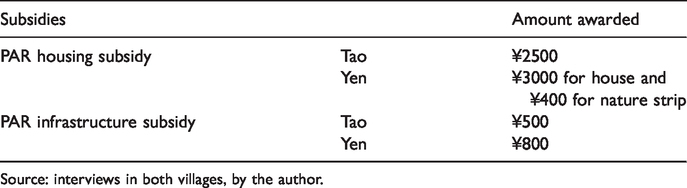
Rural subsidies available for households.
Source: interviews in both villages, by the author.
The village leaders in Tao, too, were concerned about the costs of moving. Village governance mobilized a form of Scott’s (1989) everyday resistance to present their own financial plan for village infrastructure, against what they perceived as the unfair government determined plan that is dispensed uniformly across the county. The village accountant, who held the position during the initial phase of resettlement, submitted the plan with the application that was sent to county government. This plan included calculations of costs required to do all the work in the village and was valued at ¥195 per m2. However, the county government rejected it and simply allocated the standard ¥3000 per head, of which ¥2500 is the private housing subsidy and ¥500 is for public infrastructure construction (see Table 3). Tao is a poor village, which does not have sufficient revenue to cover costs above the infrastructure subsidy allocated under PAR.
The apparatus of security that governs village accounting in Pinglu County is a reimbursement system, in which the village accountant pays village invoices on the 25th of each month and submits receipts to the township for reimbursement. Tao’s expenses are capped at ¥30,000 annually. Both villages pay expenses for infrastructure maintenance including for water pipes, electricity distribution, roads, streetlamps and waste management (hiring people to collect rubbish and sweep the streets), social welfare benefits (pensions etc.) and wages for village administrative positions. As allocated funds to Tao do not cover all their expenses, the village earns additional revenues from renting out collective administration land. This can equal anywhere between ¥70 and ¥100 per mu (1/15 hectare) annually, depending on soil quality. In addition, villagers pay ¥1.5 per person annually to cover the costs of infrastructure maintenance, labor for which is provided by the natural villages. The village committee does not have additional funds to spend refurbishing the village and households took on debt to cover outstanding costs of housing above the allocated subsidy. For this reason, despite attempts to financially support the poorest villages, PAR cultivates subjects that take responsibility for their development by mobilizing them to contribute their own money and labor (Rose and Miller, 1992). Partial, reimbursement subsidies thus mitigate the risk that the peasantry is too reliant on the bureaucracy.
Initial meetings for resettlement in Yen date back to the second half of 2006 when the village head made the decision to move and the application to county government. Group leaders interviewed reported attending about 10 meetings with the village committee, starting in 2006. Village representatives and other CCP members reported attending approximately five or six of these meetings, but these did not occur until 2008, at which time the first households were ready to begin moving. Levels of attendance in resettlement meetings by village representatives reflect their preference to move. Those in favor attended all meetings and those that weren’t in favor, did not. Resistance to migration became evident through everyday resistance such as foot dragging (Scott, 1989). One village representative in Yen reported opting to attend meetings later in the process once he had determined that the move was inevitable.
The selection of Yen as a recipient for PAR funding accentuates the subversive nature of rural policy that obfuscates objectives to support the most marginalized. For Foucault (2004), neoliberalism is governance through enterprising individuals and in the current case individuals and villages compete for government funding. Yen’s village head is an urban entrepreneur who gained power a year before the resettlement process began. To drive local development, Yen has several investments including revenues from the sale of trees harvested on its land, which raised ¥1.6 million. This money was loaned to a factory in town and continues to earn a further ¥190,000 annually in interest. The village head in Yen is also industrializing agriculture by selling the rights to land to an agricultural company that will upscale production. To complement intensification, county government will build a factory near Yen to process the produce harvested by the company. Like Tao, Yen receives revenue from the rent of irrigated administration land of ¥400–500 per mu annually (a total of ¥120,000 in 2013). These investments are additional to the government subsidies the village receives to cover operating expenses.
The village head in Yen mobilizes a “model” of rural industrialization in his village that earns him access to financial support from the county Poverty Alleviation Office. The female member of the village committee in Yen illustrated the Party-state’s creative expansion of the discursive repertoire when she stated that as the model village, Yen “acts as an example for development and modernization that other villages [in Zhang Township] should emulate. Therefore, Yen’s qualification for the PAR subsidy is a function of its status in the county” (interview by author). Historical norms and identities legitimize the corrupt official that receives disproportionate government assistance to invest in enterprising villages that will generate greater returns. The cultural fix embellishes the development discourse and subverts poverty alleviation storylines by signaling to villagers the role of elite power in the social order and that support from the government is contingent on economic success (Layne, 2000). The Party-state wishes to transform the traits of villagers by bridging local social relations to the enterprising individual through the guidance of the ideal entrepreneur (Oakes, 2012; Shapiro, 2014).
Qualification of model status ensures privileged access to government funding. According to Yen’s accountant, “the village committee covers all maintenance costs in the village through government finance, which includes additional funding as the “model village” under BNSC” (interview by author). Yen’s regular monthly expenses for reimbursement are not capped—they submit all receipts to county government. It has one additional expense than Tao and that is for irrigation maintenance. Comprehensive subsidy support from the government to cover operational expenses frees Yen to invest its own revenues as it pleases. Yen is therefore more disposed to provide upfront finance for resettlement, which is subsequently reimbursed. With the extra finance, the village has made additional plans to improve the aesthetic value of the village by landscaping nature strips in front of every house, to which households contribute with some of their housing subsidy (see Table 3). Residents of Yen built more expensive houses than in Tao, but like residents of Tao, took on debt to cover costs, despite increased housing and infrastructure subsidy rates.
The apparatuses of security enlisted under PAR policy are designed to regulate the temporal flow of finance through the resettlement villages and are designed to mitigate the risk of financial mismanagement and corruption (Foucault, 2009). In Pinglu County, these include the reimbursement system that governs distribution of fiscal transfers from the central government by ensuring funds reach their intended use and are not siphoned off by local cadre for personal gain. However, with the village head in Yen able to have expenses reimbursed for even the most superficial improvement to village aesthetics (as in the case of the nature strip), it appears that the cultural fix situates social inequality by legitimizing the diversion of flows and subverting appropriate use and therefore good governance of resettlement funding.
Resettlement and uneven geographical development
The cultural fix of the model village incurs externalities from discourses of social progress and a micro-politics of uneven development, spatially and temporally in the two villages. Harvey (2006) defines the micro-politics of uneven geographical development as the unequal access to and control over resources (such as agriculture, land, money, labor, cultural artefacts, local customs or social networks) as a result of the discursive and daily-life practices that define power relations. In terms of the apparatuses of security that govern resettlement, access to financial information ensures equitable distribution of resources. However, in the two villages, this is tempered by social structures that shape power relations such as gender, class and political party affiliation (Gibson-Graham, 2006; Nightingale, 2006).
Interviews with village committee members in Yen revealed that financial information is normally disseminated through the village website and not explicitly discussed at village meetings. This would suggest that the poorer members of the community that don’t have access to the internet, either through computers or smart phones, do not receive information and are hence not kept well informed. During resettlement, the accountant had the additional responsibility of attending meetings with village representatives to explain the expenses associated with resettlement. He recounted explaining the housing costs, the cost of the small nature strip in front of the house and the infrastructure construction expenses that are part of the per capita resettlement subsidy. However, gaps in information dissemination are evident, as some of the households that moved in the later stages of resettlement claimed they found out about housing costs and subsidies via word of mouth from those that had already undertaken the process. These include from Party members that attended village meetings.
Financial management in Tao generally governs subsidies or agricultural expenses of some kind. It is a hands-on approach, in which the village committee responds to queries by actively engaging the villager in their respective problem. For example, a group leader explained that households were expected to pay for small trees for next planting season, but some were unhappy with the price of the seedlings. The village committee offered to take the villagers with them when they went to buy the seedlings. In this way, the village committee can prove they are not profiting from the purchase. However, during resettlement this robust system of transparency was absent. The retired village accountant, who held the position during the early stages of the process, claimed he was required to report financial matters to the village representatives. Initially, he was to do this every week but later every month, in order to keep them well informed of progress made or problems encountered with the build. Despite these claims, households stated they only received notification of housing costs through notices posted around the village. They reported not receiving information regarding the progress of infrastructure construction from village representatives.
In general, women from both villages were marginalized as they don’t attend village meetings but receive information if they are at home when the village representative visits the household head, or through secondhand information from him. Further, a female head of household in Yen stated that she did not know about the housing subsidy until the village committee told her after her house had been built. This shows that neither the accountant nor the village representatives were disseminating financial information to all households. Discrepancies in information flows led to villagers questioning whether attempts were made to conceal the real costs of the move or embezzle subsidies for other uses.
The apparatuses of security failed to regulate the timing of access to government subsidies between villages and equitably distribute infrastructure and services. Poor villages that struggle to gather funds together to move are disadvantaged, despite being the target population for resettlement. Subsidy rates are awarded at the time the resettlement application is approved and do not change with economic conditions (such as inflation), if construction extends over many years. Tao is the poorer village and began resettlement four years prior to Yen. During those four years, the resettlement subsidy grew from ¥2500 for housing and ¥500 for infrastructure per capita to ¥3400 for housing with additional ¥800 for infrastructure per capita (see Table 3). Due to Tao’s slow progress, the two villages constructed infrastructure simultaneously, despite receiving different levels of support. The accountant in Yen stated that Yen had been allocated a total of ¥600,000–700,000 in infrastructure subsidies which comfortably covered the cost of construction. Infrastructure construction in Tao was visible but incomplete, even after 10 years of construction. According to the accountant in Tao, the village received ¥250,000–300,000. This is partly due to Tao’s smaller population which limits allocation of funds relative to Yen.
Once the main structure of the house is constructed, households are entitled to claim their PAR housing subsidies from the county. The policy states that subsidies are distributed directly to households, ensuring good governance of resettlement funding by creating a direct link between the county and the household. Households described that subsidies are received in one of four ways: direct debit into an account on presentation of their Chinese ID card, by cash or by cheque at the county Poverty Alleviation Office. The fourth method in Tao constituted making a contribution to a bank loan if the household happened to have a debt. All households in both villages reported receiving subsidies in full. However, subsidies were received in bulk by the village and then distributed per head and not directly from county government into bank accounts. Interviews in Yen revealed households were concerned about the integrity of the process. If older people die or decide not to build a house and move to town with their children, do they keep the subsidy or does the village committee keep it for common use, or is it corrupted? Villagers felt there was no clarity about what happened to subsidies that were forfeited for some reason. In interviews, the villagers of Yen reported being suspicious of the village head who is generating considerable wealth from the various investments he has made in the village but have no idea what happens to the money.
Inequity in the distribution of housing subsidies between households was cause for concern in both villages. A householder in Tao complained that most households have five members and receive a larger subsidy than his, which only has three. Considering the houses are of similar size and the main structure does not vary much in cost, irrespective of family size, smaller households are disadvantaged. In response to complaints of this nature, the village committee offered assistance in the form of help to gain access to bank loans to compensate for inadequate funding. However, the householder complained this only incurs greater costs in interest repayments for small households, disadvantaging them further.
In Yen, the apparatuses of security neglected to regulate the temporal effects of demographic change over time. Families change in size, for example, young men get married and want to build a house of their own, couples have children, or a daughter-in-law moves in. Resettlement implementation is undertaken over a number of years (six years in Yen at the time of data collection), but the system does not take into account changes in population that may occur during this period. Overall, issues of equity are a recurrent theme that covers scales from inter-household to inter-village. The externalities of the historical and developmental discourses based on social progress that govern resettlement are leading to the marginalized position of households spatially and temporally.
Conclusion
Layne’s (2000) cultural fix best describes the Party-state’s maneuver to expand the discursive repertoire and change meanings to overcome the contradictions between competing neoliberal and egalitarian ideologies. Confucian era governance norms were introduced discursively to define the “cultural logic of crisis and legitimacy” (Ekers and Prudham, 2017: 5) and transform the corrupt official who receives disproportionate assistance from the Party-state into the ideal entrepreneur other villages should emulate. Unlike Moore’s (2005) ethnic fix, Finley-Brook’s (2016) territorial fix or Anthias and Radcliffe’s (2015) ethno-environmental fix that legitimize land use planning by drawing on ethnic stereotypes to situate governance, the cultural fix resolves dialectical tensions in the Party-state’s development discourse. This is achieved by engaging historical narratives to subvert socialist egalitarianism into showcasing (Smith, 2009) and enable the moral ideal to institutionalize entrepreneurialism through which poverty alleviation is a supposed externality of growing inequality. The cultural fix discursively bridges old and new class relations with historical and durable identities and subjectivities for control (Shapiro, 2014).
The “fix” embellishes poverty alleviation discourses, in which corruption or mismanagement of resettlement funds is mitigated through apparatuses of security, to regulate financial flows and mitigate risk. The primary governance technology, in this case, is the reimbursement subsidy system. The rationale of reimbursement is to ensure funding reaches its intended use and is not siphoned off by officials for personal use or used for alternative purposes. However, this rationale does not necessarily include mitigating uneven development. Reimbursement favors wealthier villages that generate their own revenues and can afford to initiate resettlement. The cultural fix incurs externalities from discourses of social progress as investments by the Party-state are directed towards villages that will generate greater returns, despite not qualifying for PAR subsidies. Reimbursement leads to further marginalization of poorer villages that are unable to fulfill expectations of progress and development. Likewise, reimbursement is unable to mitigate inequities caused by temporal changes in household demographics or size. Inequities remain on scales of inter-household to inter-village.
The cultural fix that expands the discursive repertoire of the Party-state and enables them to assume rural governance under a mandate that venerates elite capture was met with resistance by local people in both villages. Despite the cultural fix designed at nullifying discontent with mismanagement and inequality through respect for the historical social order, villagers articulated growing suspicion of corruption by local government. Village governance in both villages resisted unfair policies that cultivate neoliberal subjectivities, through forms of everyday resistance (Scott, 1989). Villagers resorted to tactics such as foot dragging to voice their discontent at the lack of transparency, including in Tao where the unfair financial plan implemented across the county was confronted with an alternative plan based on local estimates of costs and labor. In general, villagers express their discontent by articulating the micro-politics of uneven development, spatially and temporally; discontent that could lead to an alternative cultural fix to provide an alternative narrative to the dominant discourse of social progress.
Footnotes
Acknowledgments
I would like to thank the participants of the research for generously giving their time during data collection. I would also like to thank the anonymous reviewers for their meaningful feedback on previous drafts.
Declaration of conflicting interests
The author declared no potential conflicts of interest with respect to the research, authorship, and/or publication of this article.
Funding
The author received no financial support for the research, authorship, and/or publication of this article.