



Abstract
One of the possible consequences of the tightening of international borders during and after pandemic COVID-19 is what the World Economic Forum refers to as the ‘throttling’ of international (labour) migration. While this will have a profound macroeconomic impact on the global economy, the potential impact on remittances on families, communities and national economies could be equally marked. We present a chord diagram to visualize the latest inter- (and intra-) regional global data on international remittances. This graphic shows the degree of the interconnectedness of the ‘global economy of work’ and the extent to which negative health, economic, social or political changes for migrants in one territory will have profound consequences far across the world.
Pandemic COVID-19 has laid bare the multiple vulnerabilities which migrants face. The health of international migrant workers has largely been ‘neglected’ (Daniels, 2020), while both living and working conditions in some settings have meant they are especially vulnerable to infection (Han, 2020). The economic prospects of (labour) migrants become even more fragile under conditions of restricted travel and economic slowdown; while in some sectors the ‘dirty, dangerous and demanding’ work often performed by migrants is needed more than ever.
According to the World Economic Forum (WEF), ‘everyone from a migrant agricultural worker relying on a paycheck in Portugal to a foreign healthcare worker living in Sweden is potentially impacted by a dramatic tightening of borders’ (WEF, 2020). The consequences of this potential ‘throttling’ of international migration is usually measured in abstract, macroeconomic terms – for example, migrants contribute nearly 10% of global GDP (MGI, 2016; WEF, 2020).
Here, we introduce a chord diagram to visualize the latest inter- (and intra-) regional global data on international remittances using the circlize package (Gu et al., 2014) in R (Figure 1). While chord diagrams have been applied elsewhere to show migratory flows (for example, Qi et al., 2017), we believe this is the first time they have been applied to remittance data. We use the latest publicly available bilateral remittance (2018) from the World Bank (2020) and plot the international flow between (and within) UN geographic regions (UNSD, 2020). These data reflect first-generation remittances, and not the actions of second-generation diaspora, retirees moving back to their country of origin or ‘tax exiles’.
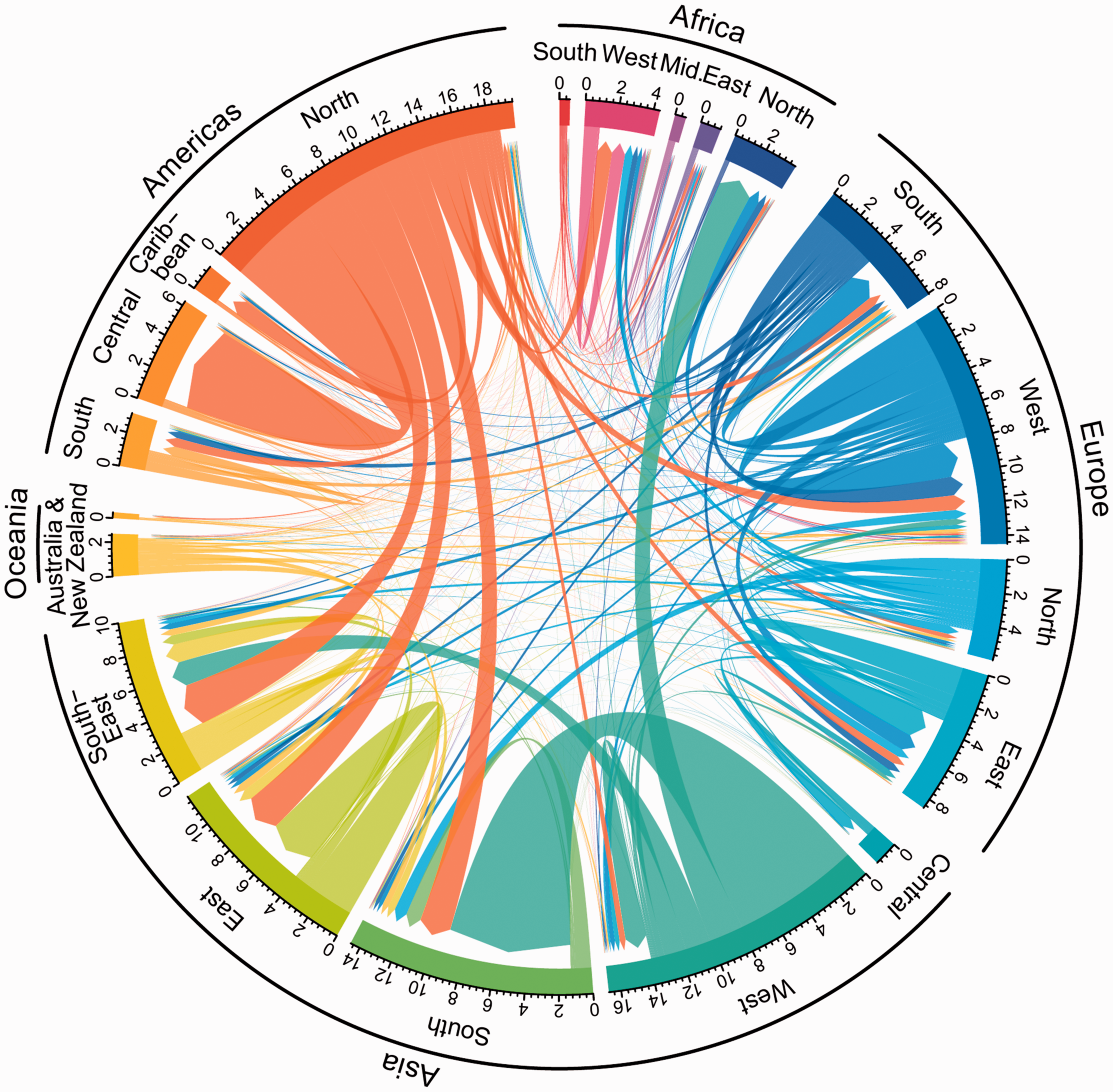
Circular visualization of bilateral remittance estimates for 2018 using migrant stocks, host/origin country incomes (millions, US$).
There are several important caveats to note for these data. They are not actual officially reported data; rather ‘analytical estimates based on logical assumptions’ (for further details, see the methodology in World Bank (2020)). Data from transit migrants and refugees are also likely to be significant undercounts. Finally, in our application, intra-national remittances from internal migrants are absent.
The graphic really emphasizes the interconnectedness of the ‘global economy of work’. The estimated total amount of remittances moving between countries in 2018 was US$68.3bn (up from US$46.4bn in 2010) (World Bank, 2020). Crucially, though, we must consider the main mechanisms by which remittances occur, namely within families. The ‘neglect’ of a migrant in one setting – New York, Singapore, Dubai – will therefore have profound economic and social consequences not just on the local economy, but on countries, communities and families around the world.
Footnotes
Declaration of conflicting interests
The author(s) declared no potential conflicts of interest with respect to the research, authorship, and/or publication of this article.
Funding
The author(s) disclosed receipt of the following financial support for the research, authorship, and/or publication of this article: Guy J Abel’s research was supported by the National Science Foundation of China, General Program (No. 41871142). Stuart Gietel-Basten’s research was supported by the HKUST School of Humanities and Social Science Digital Arts and Humanities Initiative.
