



Abstract
Since the mid- to late- 1980s, Laos and Myanmar (Burma) have gradually and unevenly opened their economies to capitalist relations of accumulation. Both countries have done so by granting state land concessions to private capital for resource extraction and land commodification projects, particularly since the early 2000s. Yet, resource capitalism has manifested in distinct ways in both places due to the ways in which capital has interacted with unique pre-capitalist political-economic and social relations as well as the diverse political reactions of Lao and Myanmar people to capitalist transformations. In this paper, we analyze such differences through a conceptualization of ‘variegated transitions’, an extension of the variegated capitalism framework, which investigates the political economic transitions towards capitalism in marginalized, resource extractive countries of the Global South. In Myanmar, the transition from military to democratic rule has been marked by protests and land occupations combined with center-periphery fragmentation and ongoing civil wars, all of which have led to a heavily contested process of land concession granting. In contrast, a stable, comparatively centralized political system in Laos that restrains popular protest has enabled an expanding regime of land concessions for resource extraction projects, albeit hemmed in at the edges by sporadic, localized forms of resistance and appeals to the state.
Introduction
Since the late 1980s, the socialist and command-and-control political economies of mainland Southeast Asia – Cambodia, Laos, Myanmar (Burma), and Vietnam – began adopting market reforms that facilitated a transition towards capitalist economic development. This market transition has attracted novel forms of domestic and foreign investment, particularly for the extraction of natural resources and commodification of land. Across Cambodia, Laos, and Myanmar, 5.1 million hectares (ha) of land have been granted to agribusinesses for plantation development (Ingalls et al., 2018). Land and resource investments have produced widespread dispossession and displacement across the Mekong region, intensive land grabbing that has been met with a range of political reactions ‘from below’ (Hall et al., 2015; Schoenberger et al., 2017). Legacies of state control or uneven ownership over land combined with repressive political apparatuses have facilitated such abrupt and violent transfers of land access and use (Hirsch and Scurrah, 2015).
Yet despite broad similarities in the political-economic transitions that have taken place and the Polanyian counter-movements that disruptive land investments have produced across the region, there are important differences that have emerged across national and sub-national contexts—particularly concerning how capitalism has taken shape in what are relatively recent transitions from socialism. These differences can be seen clearly when comparing the experiences of Laos and Myanmar. Laos’s economic transition has been accompanied by relatively stable and hegemonic political control by the communist party and state (St John, 2006). Resource extractive investments are largely driven by foreign investors, centrally organized by the Lao state (Barney, 2009), dispossessing peasants of their land with little opportunity for restitution (Kenney-Lazar, 2018). In contrast, Myanmar’s economic transition has been accompanied by several rounds of political crisis and uneven democratization, leading to the emergence of comparatively fragmented, pluralistic, and contentious politics over land and resources. Land investment projects are driven by a range of actors, not necessarily in coordination with one another, including the Burmese military (Tatmadaw), domestic crony companies, and ethnic armed organizations (EAOs), many of which have links with foreign partners (Scurrah et al., 2015). Despite the massive displacements that such projects have caused, the political transition has led to a flourishing of politics contesting how such land should be used going forward and challenging the prevalence of large-scale land investments in the country (Mark, 2016a).
In order to understand how these different forms of capitalism have emerged in what might be considered similar types of transitioning, resource extractive economies, we turn to the conceptual framework of variegated capitalism (Brenner et al., 2010; Peck, 2010; Peck and Theodore, 2007). Building on and spatializing the varieties of capitalism (VOC) approach (Hall and Soskice, 2001), variegated capitalism (VC) is concerned with the diverse ways in which late capitalism manifests spatially through various forms of uneven development, in ways that transform and exacerbate geographically embedded institutional differences. The framework is useful for examining differentiated political-economic transitions in Laos and Myanmar due to its focus on the ways in which general logics and patterns of capitalist accumulation and expansion interface with local politics, institutions, and even cultural structures and relations, leading to variegated local manifestations of globalized capitalism.
However, the VC framework has largely been employed to analyze late capitalism in advanced economies rather than political economies at the margins of global capitalism, such as in Laos and Myanmar. While such countries make up a small share of the global economy and are not the places where most capitalist value is realized, they are major sites of appropriation and extraction of capitalist value, especially in the form of natural resources that fuel global commodity networks and mass consumption elsewhere (Hornborg, 2011; Jorgensen, 2006). Not only are they important sites in terms of material inputs into the global economy, but they are also where some of the gravest social and economic abuses related to extraction have taken place (Bebbington et al., 2008; White et al., 2012).
Due to a focus on advanced economies, the conceptual approaches of VC and VOC have less to say about countries that are transitioning towards capitalism, including those with a socialist past where various forms of hybrid capitalism have emerged. The major exception is VC scholarship on China (Lim, 2010; Lim, 2014; Mulvad, 2015; Peck and Zhang, 2013; Zhang and Peck, 2016). Yet even this work has focused more on China’s current variegations of capitalism, rather than its transition towards capitalism. This is a missed opportunity, as the period of transition is when some of the most interesting and insightful interactions between logics of capital accumulation and the political, institutional, and socio-cultural legacies of pre-capitalist 1 political structures, processes, and relations. Additionally, VC and VOC approaches have predominantly focused on the interrelation between capitalist logic and regulatory institutions, which are much stronger in the advanced economies of the Global North than in the marginal, transitioning economies of the Global South. In the latter, due to a lack of regulatory protection from the abuses of capitalist resource extraction, affected groups of people and the public tend to resort to immediate and direct political reactions, such as protest and appeals to state power, in an effort to curb socio-environmental abuses. Thus, land and resource politics play an important role in shaping the development of resource capitalism in such places in ways that are not captured by VC’s focus on regulatory institutions.
In this paper, we show how the VC framework can be extended and applied to marginalized transitioning economies by analyzing the emergence of resource extractive capitalisms, especially related to issues of land, in Laos and Myanmar. These two countries are compelling sites for a comparative analysis of variegated capitalism in transitioning countries. As part of their post-colonial liberation and transformation, both countries have experimented with socialism and have built their economies on the extraction of natural resources (Barney, 2009; Bissinger, 2012; Steinberg, 1982; Stuart-Fox, 1997). However, while their political economies have transitioned away from hybrid forms of socialism towards hybrid forms of capitalism 2 in ways that appear similar, their political structures are quite different, linked to economic transition in unique ways, as noted above. We contend that how these political differences have unfolded historically is critically important for the variegated development of resource capitalisms in both places. Likewise, the variegated expressions of capitalism have shaped different opportunities for land and resource politics to emerge, demonstrating the dialectical relationship between land politics and new relations of extractive capitalist accumulation.
We develop these arguments as follows. In the next section, we review the VOC and VC literatures and identify their limits for analyzing marginalized resource extractive economies that have transitioned from colonialism to socialism and now towards hybrid forms of capitalism. This is followed by an exploration of different types of resource capitalism that have emerged in Laos and Myanmar, with a focus on the socialist period until recent events. Then, we comparatively analyze these different expressions of resource capitalism, with particular attention to the dialectical relations among national, regional and global capital, pre-capitalist political-economic and social configurations, political reactions to resource extractive investments, and emerging forms of variegated capitalism. Finally, we conclude the paper with additional reflections on its contributions to extending the VC framework to marginalized and transitioning economies of the Global South.
This paper is based on research that both authors have been conducting in Laos and Myanmar over the past decade on conflicts over land, with a particular focus on the contestation of state land concessions granted to domestic and foreign investors for the development of agro-industrial plantations. Considering the broad analytical focus of the paper, we do not provide detailed descriptions of our primary research, but rather cite and use it to shape our understanding and analysis of transitions towards capitalism. We employ a comparative analysis of our research on the political-economy of land-based capital accumulation and reform in both countries. Contrasts and comparisons across the two contexts provide fruitful and novel understandings of each, while expanding the application of the VC framework.
Variegated transitions
The varieties of capitalism (VOC) conceptual approach critically analyzes the ways in which different forms of capitalism have developed across the world due to institutional variation that alter the relationships between capital, labor, and the state. Political economists, particularly Peter Hall and David Soskice (2001), have argued that there are different forms of capitalism rather than just one undifferentiated global system. They distinguish between two major types of advanced capitalist economies: liberal market economies (LMEs) (the United States, the United Kingdom, Canada, and Australia) and coordinated market economies (CMEs) (Germany, Japan, and Sweden). In LMEs, firms primarily coordinate via hierarchies and market mechanisms, following neoliberal norms of regulatory practice. CMEs are more reliant on non-market forms of interaction for coordination among firms and between firms and other actors, like trade unions. A key difference between the two models is the role that institutions play in shaping how markets operate. Not only are these types of capitalism different, but they are also often in competition with each other, economically and for social-political legitimacy. The theory offers a powerful critique of neoliberal globalization rhetoric that assumes global economic convergence.
Economic geographers (Brenner et al., 2010; Peck and Theodore, 2007) have critiqued VOC for several reasons. First, it ignores the commonalities of capitalism as a system, albeit one that is unevenly developed and polymorphic. Second, VOC fails to take seriously the ways in which CMEs have been increasingly neoliberalized since the 1990s and the CME model is under threat. Third, the VOC approach is methodologically nationalistic, thus ignoring variation within nation-states, especially larger countries like China, or regional-based differentiation. Furthermore, capitalist variegation is reduced to two ideal types and it is overly focused on advanced, North Atlantic economies. Questions remain as to where other major, emerging national economies such as Brazil, Russia, India, China, and South Africa (BRICS countries) might be located within the model. Thus, VOC has only begun to scratch the surface of geographical differentiation pertaining to varied modes of capitalist development, given its lack of nuanced treatment of temporality and spatiality in capitalist development. There is a need for the recalibration of connections, as well as the documentation of differences in capitalist development paths.
In response, Peck and Theodore (2007) and Brenner et al. (2010) have developed a conceptual approach termed ‘variegated capitalism’ (VC), or ‘variegated neoliberalism’ 3 in certain cases, to address these deficiencies. Compared with VOC, VC is more concerned with explicating processes and forms of uneven development within, and beyond, late capitalism. Variegation is invoked to ‘emphasize the constitutively incomplete, experimental and ultimately polymorphic character of neoliberalization processes, as well as their endemically path-dependent character during each successive wave of regulatory restructuring’ (Brenner et al., 2010: 217, original emphasis). VC is interested in how geo-institutional variegation is produced through processes of capitalist expansion and transformation, or ‘the demonstrated capacity of neoliberalization projects to exploit, transform and reproduce inherited geoinstitutional differences’ (Brenner et al., 2010: 207). It seeks to explain structural transformations at multiple temporal and spatial scales, particularly decisive moments of economic transformation, institutional restructuring, and regulatory change. The normative aim of the project is to reveal the internal (including spatial) contradictions of capitalist globalization, to seek out differentiation across contexts, and to identify alternative and progressive forms of local development.
The VC theoretical framework was developed with regard to North Atlantic processes of neoliberal capitalist transformation. More recently, however, it has been applied to transformations of capitalism in China (Lim, 2010; Lim, 2014; Mulvad, 2015; Peck and Zhang, 2013; Zhang and Peck, 2016). The case of China confounds the VOC approach because it fails to fit into the CME and LME models and it exhibits significant variation at the sub-national scale (Peck and Zhang, 2013; Zhang and Peck, 2016). Using a VC framing, economic geographers have argued that Chinese capitalism is highly differentiated into varied expressions of capitalism across different regions of the country (Lim, 2014; Mulvad, 2015; Zhang and Peck, 2016). Lim (2014) has shown how variegated capitalism operates in China as a result of uneven state spatiality across the country’s three belts (eastern, central and western) resulting in regional differences in the adoption of neoliberal reforms. He also considers how the Chinese Communist Party, in an effort to perpetuate its one-party rule, justifies the adoption of neoliberalism within a contradictory vision of Marxian socialism by emphasizing the role of neoliberalism in the party’s quest to achieve ‘common affluence’ for a ‘harmonious society’ (Lim, 2014: 222).
Lim’s (2014) work also emphasizes the unique political history of China in explaining how capitalism takes shape there, leading to an integration of neoliberalism with China’s development ideology of ‘socialism with Chinese characteristics’. He has further developed this argument to contend that ‘geographically variegated neoliberalization, driven and repurposed by the Chinese state through a range of intrinsically discriminatory policies, have become at once a precondition and an outcome of/for the CPC’s [Communist Party of China] long-standing attempt to secure perpetual rule’ (Lim, 2017: 256, original emphasis). Lim’s application of variegated capitalism to China is useful for extending the concept to transitioning economies outside of the North Atlantic, especially those with a socialist past. It shows how, in a political system where there is a wariness or even resistance to a full-scale transformation towards Western models of capitalism and liberal democracy and its perceived social ills, attempts are made to selectively incorporate market forces into the economy, even if these may ultimately be ineffective. Relatedly, the state may seek to generate economic wealth from the infusion of global capital and the emergence of a market economy for the purposes of bolstering the current political system and preventing its reform. This, in turn, leads to the expression of unique, localized forms of capitalism, such as ‘socialism with Chinese characteristics’, ‘market socialism’, ‘state capitalism’, and ‘crony capitalism’ that have been used to describe the various forms of capitalism emerging across the non-Western world.
Further conceptual work is needed, however, to extend these insights concerning Chinese capitalisms across a wider spectrum of global capitalisms that extend beyond the core of the Global North and major emerging political-economic powers. In particular, we are interested in economically marginalized contexts of the Global South that are in the early phases of transition towards capitalism, opening up their economies that were previously closed, whether due to socialist, nationalist, or postcolonial compulsions. Such contexts are important for studies of VC for two reasons. First, while they are much more marginal to the global economy in formal terms, they are often the most significant sites of contributions of raw material as well as where the negative social-environmental externalities of global capitalism are most prevalent (cf. Bebbington et al., 2008; Hornborg, 2011; Jorgensen, 2006; White et al., 2012). The economic transformations of emerging capitalism in such sites are disrupting livelihoods and environments in ways unseen in the global economic core. Second, they provide a window into how unique forms of VC emerge as they are at historical junctures in which capitalist and pre-capitalist political economic forces are interacting with one another and producing distinct hybrid and uneven outcomes. These are the sites of some of the most significant manifestations of VC because of the ways in which capitalist reforms map onto prior political-economic and social arrangements.
Thus, we approach the study of variegated capitalist transitions by paying attention to the dialectical ways in which capitalist transformations interact with pre-capitalist political-economic and social relations, which are variegated in and of themselves, thus shaping the forms of capitalism that emerge. There are two analytical moves comprising such an approach. The first concerns how the forces and relations of capitalism that are being imported or are emerging organically interact with and emerge from diverse forms of pre-capitalist political, economic, and social relations. Many socialist and post-colonial countries, for example, place legal limitations on foreign capital, particularly concerning land and property ownership. In response to these restrictions, new forms of property investment and ownership can emerge, such as long-term leasing arrangements.
The second element concerns the role of politics, particularly immediate and direct political reactions to exploitative and highly predatory forms of capitalism that emerge in places with little regulation in place. Lim (2017) has shown the importance of the Chinese state and its goals of achieving some sort of hybrid ‘market socialism’ for shaping the variegated manifestations of capitalism in China. As important as the regulatory role of the state for shaping variegations of capitalism, however, are political reactions to capitalist transformations: from those who are dispossessed, marginalized, excluded, exploited, and the general public. Capitalist development in places that have recently opened up can be highly disruptive and predatory, leading to rapid and unjust changes that create conflicts and civil unrest. Without regulation of new capitalist investment, the only option for citizens and disaffected peoples is to engage in direct forms of politics, whether protest or appeal to the government to institute moratoriums and provide compensation, among other measures of protection. Governments, in turn, may react with blunt policy instruments, such as moratoria on certain types of investment or the cancellation of projects, rather than finely tuned regulatory mechanisms more common to advanced economies. These political reactions in turn affect and modify emerging forms of capitalism.
Emerging resource capitalism in Laos and Myanmar
Beginning from distinct forms of socialism, Laos and Myanmar have undergone a rapid transition towards capitalist economic development as they have liberalized internal markets, reduced trade barriers, and opened their borders to foreign investment. However, such transitions have occurred unevenly both across and within their national spaces and are accompanied and shaped by varied political reactions. In this section, we demonstrate how the interaction between forces of domestic, regional, and global capitalism have integrated with distinct local institutions and politics to generate variegated transitions towards capitalism that are uneven, partial, hybrid, and diverse across and within both contexts. The two country cases are used to demonstrate the value of applying an extension of the VC approach to understanding countries in transition, but rather than go into an exhaustive elaboration of how capitalism interacts with all pre-capitalist relations, it highlights the ones we highlight the relations that are most salient to shaping resource capitalism in its current form. Likewise, rather than describe the two countries’ transitions in depth, this section highlights major junctures in the movement from centrally planned and closed economies towards the development of resource capitalism in each over time.
Laos
Prior to Laos’s market liberalization of the late 1980s, widespread and intensive capitalist forces and relations of production had not developed in the country. Market relations via barter and trade had existed in Laos for centuries before French colonialism (Walker, 1999) but were not organized into any major form of commodity production. French colonial plans of turning Laos into a resource hinterland for its Vietnamese territories largely failed to materialize due to geographical constraints posed by the harsh terrain and the Great Depression that dried up capital for investment (Stuart-Fox, 1997). The First and Second Indochina Wars (1945–1954 and 1959–1975, respectively) devastated rural areas of the country, limiting economic development. Market trade was largely limited to major cities like the national capital, Vientiane.
After the Pathet Lao (the Lao communist movement) took power and established the Lao PDR in 1975, a planned, Soviet-style centralized economy was put in place to ‘advance, step by step, to socialism without going through the stage of capitalist development’ (Lao News Agency quoted in Brown and Zasloff, 1977: 107). Private businesses were nationalized or replaced by state-owned enterprises and cooperatives. Controls were placed on entrepreneurial investment, commodity prices, and domestic trade and Thailand intermittently embargoed cross-border trade. Most members of the entrepreneurial and professional classes fled the country. Agricultural collectives were established by the government in 1978, but dismantled by 1979 due to low productivity and dissatisfaction by peasants forced to participate in them (Evans, 2003).
The combination of restrictive policies, war-time destruction, and international marginalization was devastating for the economy (St John, 2006). The failures of agricultural collectivization had a strong impression upon the revolutionary leader and then Prime Minister, Kaysone Phomvihane, who by 1979 had already announced that the country would begin taking the first steps towards a form of so-called market socialism (Yamada, 2018). In 1986, these sentiments were framed as Chintanakan Mai, or New Thinking, and crystallized in official policy with the development of the New Economic Mechanism (NEM), which abolished price controls, lifted internal barriers to trade, and allowed state-owned enterprises (SOEs) to access international markets, while requiring that they be efficient, accountable, and profitable. The NEM prompted further transformations of the economy in the late 1980s and through the 1990s. Market incentives for SOEs were particularly impactful upon state-owned forestry enterprises, leading to a logging boom in the late 1980s and early 1990s (Anonymous, 2000; Dwyer, 2011). Privatization of SOEs was pursued, reducing the number from 600 in 1986 to 24 in 2001, retaining those most strategic for the government.
The long-awaited Constitution was adopted in 1991, legally stipulating that the state would manage the economy with the use of market mechanisms, reflecting the ideological conviction of the Lao People’s Revolutionary Party (hereafter, ‘the Party’) that the market is a mechanism for the long-term construction of a socialist society (Yamada, 2018). The Constitution set the stage for the creation of new laws that would provide the legal infrastructure for a market economy, beginning a transition from a country ruled by decree to a ‘rule of law state’ (Vientiane Times, 2014b). In 1992, a decree was passed that allowed the granting of state land concessions to domestic and foreign investors for commercial use, followed by a law on the promotion and management of foreign investment (St John, 2006). In concert with the promotion of investment in land, the government and its major international donors created strategies for the development of hydropower and mining sectors, aiming to become the ‘battery of Asia’ (Middleton et al., 2009).
Economic reforms transformed the Lao economy, which grew at an average of 7 percent from 1992 to 1997, until it was disrupted by the Asian financial crisis that devalued the Lao Kip by 80 percent. Bailed out by China, which helped repair the previously strained diplomatic relations between the two countries and facilitate new trade and investment, Laos recovered from the crisis and its economy again expanded at an average rate just over 7 percent from 1999 to 2017 (World Bank, 2018). Due to this economic transformation, GDP per capita has increased from $1,964 in 1990 to $7,593 in 2018. 4 Thus, Laos has been quick to step in line with the Asian economic ‘miracle’.
The Lao economy became increasingly oriented toward resource extraction, built on concessions of state land to foreign investors, which accelerated since the early 2000s. Although the first state land concession was approved in 1991 (Baird, 2010), most were granted after the Land Law was amended in 2003, which created a land granting and allocation mechanism. Economic land concessions were further promoted by the Turning Land into Capital (TLIC) policy that the Lao government announced in 2006, a development strategy for exchanging land and natural resources for revenue, infrastructure, jobs, and economic growth (Kenney-Lazar et al., 2018b). By 2009, 1.1 million ha of land concessions had been granted to, although not necessarily developed, by domestic and foreign investors for agribusiness, tree plantation, mining, real estate, manufacturing, and infrastructure projects (Schönweger et al., 2012). Although it has often been presumed that the country’s land is under control, if not ownership, of the state, the granting of state land concessions has raised questions about where the boundaries between state, village, and household land are drawn.
Contentions over land ownership as well as social and environmental impacts plagued land concessions. Since 2007, the government has placed various moratoria on them, although they were weakened and modified over time. This drive toward regulatory reform was, in part, a response to the increase in political action from rural Laotians impacted by the worst effects of land investments: land dispossession, deforestation, loss of natural resources, chemical pollution, and limited labor opportunities (Baird, 2010; Barney, 2009; Dwyer, 2011; Kenney-Lazar, 2012; Suhardiman et al., 2015). Laos is not typically viewed as a particularly democratic country as its single-party political system did not change with the economic reforms of the 1980s. However, the Party emphasizes Leninist principles of democratic centralism, in which the concerns and ideas of lower-level officials and citizens are allowed to filter up and be used as part of the basis for making top-down decisions. In line with such principles, the National Assembly (NA) opened a hotline during legislative sessions, to which citizens could call in for free, which was particularly popular for those with complaints about land conflicts (Vientiane Times, 2012).
Oftentimes, popular action has led to heavy-handed and violent government repression. For example, those who spoke up about land conflicts at a joint Asian-European civil society forum in 2012 were harassed by government officials and the Lao organizer of the event, Sombath Somphone, was forcibly disappeared and has not been seen since (FORUM-ASIA and AEPF-IOC, 2014). In the southern province of Xekong, a group of villagers who cut down rubber trees on a plantation that had unjustly acquired their land were arrested (Radio Free Asia, 2017). More recently, the government has threatened those who make ‘inaccurate’ statements or criticize the government on Facebook, which has otherwise been a powerful venue for built-up political frustration among the populace (Baird, 2018; Palatino, 2014).
Yet, civil action not perceived as a threat by the government has at times been effective at diminishing projects and protecting peasant lands. In these cases, Lao people often appealed to government policy and used their political connections to make modest gains, such as protecting some plots of land or gaining better compensation, what several authors have referred to as ‘resisting with the state’ (Kenney-Lazar et al., 2018a; McAllister, 2015). For example, a particularly controversial case that generated backlash from citizens and even government officials, was the attempted concession of the entire That Luang Marsh on the edge of Vientiane’s downtown area to a Chinese real estate developer (Schuettler, 2008; Sims, 2012). Residents near the wetland and the city’s middle class were incensed by the prospect of a large, walled-off ‘Chinatown’ being located so close to the That Luang stupa, the cultural jewel of the nation. Although there were no visible protests, the public’s frustration was palpable, especially among the sapha khafe, or ‘coffee shop assemblies’, the groups of men who gather in the morning and talk politics at cafes around the capital. This led the then Deputy Prime Minister to take the rare step of explaining the project in a public press conference. Eventually, the initial deal was scrapped, but a smaller Chinese special economic zone was quietly granted on the same wetland, avoiding the alarm generated earlier (Vientiane Times, 2014a).
The combination of regulatory action and emerging resistance has made it increasingly difficult for foreign investors to access land via state land concessions, especially in the plantation sector. Despite the granting of large areas of land to foreign investors by the national government, provincial and district governments have found it hard to locate land that is not used by peasants, who increasingly will not concede such land without contestation (Kenney-Lazar, 2018; Lu and Schönweger, 2019). As a result, large-scale plantation operations have increasingly failed, leading to a flight from the sector (Baird, 2020; Schönweger and Messerli, 2015). At the same time, there has been a move toward smaller-scale forms of plantation development, such as private land leases in the case of banana plantations (Friis and Nielsen, 2016) or smallholder contract farming (Dwyer and Vongvisouk, 2019).
Myanmar
Following independence from Britain in 1948, Myanmar was governed by a parliamentary government until the military coup of 2 March 1962. That same year General Ne Win declared the ‘Burmese Way to Socialism,’ which articulated the three central concepts of the regime: ‘Nationalism, Socialism and Buddhism’ (Steinberg, 1982). As opposed to socialism in Laos, which was based on Marxist principles, Myanmar’s form of socialism was largely reflected by an autarkic system dominated by state-owned enterprises. After the military coup in 1962, the Burma Socialist Programme Party government passed the 1963 Enterprise Nationalization Law and nationalized businesses in key sectors. Furthermore, the 1963 Tenancy Act defined farmers as tenants on state-owned land and extinguished private property. A paddy procurement policy was adopted in 1974 to keep rice prices low to feed troops and the urban populace, but it placed excessive pressure on peasant farmers, many of whom lost their land for not meeting minimum paddy quotas (Hudson-Rodd et al., 2003; Thawnghmung, 2003). The removal of subsidies for basic goods in 1987, rampant unemployment, and economic stagnation (Brown, 2012) contributed to the uprising known as the 88 Generation Students’ Movement. Following violent suppression of the uprising, the State Law and Order Restoration Council (SLORC) took control with the declared intent of restoring ‘stability’ (Lintner, 2003).
The military soon initiated reforms to open Myanmar to foreign investment, liberalize agriculture, and encourage private trade. However, with lasting impacts on the way capitalism would develop in the country, they kept tight control of this transition to a market economy through what Jones termed ‘state-mediated capitalism’, characterized by ‘a state-linked business class and crony capitalism, and the emergent symbiosis between big business and the state’ (2014: 145; Ford et al., 2016). The emergent market economy was further shaped by the West’s sanctions imposed after the regime’s rejection of the 1990 election results. The military not only controlled the economy, individual members benefitted from military conglomerates created in the 1990s, concentrated in heavy industry and manufacturing (Maung Aung Myoe, 2009). Favored businesses were given joint-venture deals, trade licenses and land concessions (Jones, 2014).
At the same time, the regime promoted the export of industrial crops to secure foreign exchange (Srivinas and U Saw Hlaing, 2015). Under the 1991 ‘Wasteland Instructions’, domestic investors were favored for allocation of up to 50,000 acres of what the state deemed to be ‘vacant, fallow and virgin’ (VFV) lands, earlier defined by colonial law as lands to which no use rights had been granted by the state (Ferguson, 2014). The promotion of agri-business, coupled with the military’s rampant takeover of community land for defence and income-generation led to extensive confiscations across the country (Talbott et al., 2016).
In contrast to Laos, armed ethnic conflict has shaped Myanmar’s developmental trajectory since its independence in 1948. The 1962 military coup was carried out to prevent the perceived threat of union fragmentation by ethnic groups that demanded the creation of a federal system (Smith, 1999). In 1989, the SLORC initiated the first round of ceasefire agreements with EAOs not only for peace, but also to promote expansion of the market economy into border areas (Zaw Oo and Win Min, 2007). This period coincided with a decline in support from China for the Communist Party of Burma and a renewed relationship with the military in 1988 (Smith, 1999), facilitating a rapid rise of Chinese investments into the country and its dominance in Myanmar’s economy (Bissinger, 2012). Hydropower, gas, oil, and mining projects were concentrated in the ethnic borderlands, with Rakhine, Shan, and Kachin States having received 65% of approved FDI from 1988 to 2012 (Buchanan et al., 2013).
While large-scale investments went through formal channels, making it possible for the government to regulate them, in most cases a significant portion of investments also went through informal channels in partnerships with domestic entities (Scurrah et al., 2015). Reflecting the heterogeneity of actors who shaped the country’s path of capitalism, investors made deals directly with EAOs in areas where they exercised territorial control. EAOs relied on natural resources to fund their revolutionary activities, to pay for services for local populations, and sometimes to line individual pockets. In the ceasefire period in the 1990s, armed actors’ exploitation of natural resources, especially timber, reached detrimental levels and contributed to ‘ceasefire capitalism’ (Woods, 2011).
In the years leading up to the 2010 elections, the state faced a crisis of authority, which compelled it to adopt civilian rule (Egreteau, 2016). The regime was condemned by the international community, opposition and even religious leaders, many of whom participated in the 2007 ‘Saffron Revolution’ (a series of protests led by Buddhist monks). Due to years of autarky, the country was economically failing, as indicated by low levels of growth, employment, and industrialization. A 2014 report by the International Crisis Group stated that ‘Economic reform was seen as vital to the future of the Tatmadaw and the country by the military-political elites, and some loss of privilege was inevitable’ (145).
A quasi-civilian government was established after the general elections in 2010. However, the military retained control through clauses written into the 2008 Constitution, such as retaining 25 percent of seats for military in the parliament, which can only change the constitution with more than 75 percent of votes. Nonetheless, the early years of transition were accompanied by economic liberalization and elements of a democratic government. In this context, land reforms reflected two opposing aims. One promoted the adoption of more neoliberal policies, while the other expanded space for civil society to demand land-based justice (Suhardiman et al., 2019).
Soon after the formation of the new government, two new laws were introduced in 2012: the Farmland Law and the VFV Lands Management Law (hereafter, the ‘VFV Law’). The Farmland Law aligned with a private property model while repealing most socialist-era laws. Reviving the 1991 Wasteland Instructions, the VFV Law enabled investors to lease up to a maximum of 50,000 acres. This law was again amended in September 2018, instilling fear in farmers cultivating what the government deems to be VFV land. Many risk facing criminal charges without registration—not an easy process given a complex legal system.
In contrast to Laos, economic liberalization in Myanmar was accompanied by political reforms. The state tightened investment regulations in response to civil society activism expressed as formal and contentious politics (Mark, 2016a). A campaign centered on emotional and scientific messages about the Ayeyarwady River as the lifeline of the country pressured President Thein Sein in 2011 to suspend development of the Myitsone Dam, China’s largest investment in Myanmar to date (Kirchherr et al., 2016). Analysts speculate that the President wanted to demonstrate Myanmar’s autonomy from China and strengthen market integration with the West (Kempel, 2012; Mark and Zhang, 2017).
Speaking to liberal norms, the USDP-government initiated a process of land restitution that sought to build legitimacy among the rural base, on which it counted for an electoral victory in the 2015 general elections, but which the opposition NLD party later won by a landslide. In August 2012, a parliamentary commission was initiated to investigate confiscation cases from 1988 to 2010. The Commission received at least 35,000 complaints (Eleven Myanmar, 2014a). Reviving the ‘land to the tiller’ principle enshrined in colonial and socialist laws which had lain dormant during the military regime, some parliamentarians argued that original cultivators were entitled to either the return of confiscated land or compensation (Mark and Belton, 2020). The Commission in 2014 recommended the return of 512,204 acres of land (Eleven Myanmar, 2014b), but despite these mandates, the government has made little progress to date (Namati, 2015). As productivity is arguably the most important value assigned to land within a market economy, in 2016 the NLD government began reclaiming the unused land from concessionaires, part of which it redistributed to communities. Over two million hectares of land were allocated from 1991 to October 2016, of which 75 percent was VFV land (San Thein and Diepart, 2018). Of that, less than 15 percent was cultivated.
Moving forward, Myanmar is faced with the challenge of how to manage land that is governed by customary institutions attached to values distinct from those of a market economy (Franco et al., 2016; Mark, 2016b). Statutory protection of customary land remains weak, since recognition would limit the state’s ability to extract full market value from it. The planned Muse-Mandalay high-speed railroad, one of the projects prioritized under China’s Belt and Road Initiative, is projected to cut across the traditionally-held land of ethnic communities (Myanmar Times, 2019). Given the lack of legal recognition for these lands, communities will likely face difficulties in securing compensation or even to have a meaningful say in project implementation. However, demand for the control of ethnic territories features at the heart of the national peace process. This demand has gained momentum since the signing of the National Ceasefire Agreement (NCA) in 2015 between the government and eight (ten by early 2018) major EAOs. It remains one of the most contentious issues in land governance in Myanmar.
Comparative transitions
The complex transitions towards land and resource capitalism described in the previous section can be interpreted through the conceptual approach of variegated transitions outlined above. In such an approach we examine the dialectical interaction between globalized logics of capital accumulation and localized political, economic, and social structures, relations, and forces. In particular, we first focus on pre-capitalist political-economic and social relations that logics of capital accumulation must contend, compete, or integrate with. Then, we examine the role of political reactions to emerging dynamics of land and resource capitalism, which further shape the forms that capitalism takes in response. Figure 1 below shows the effects of these two dynamics of variegated transitions upon emerging dynamics of resource capitalism in each country. In the following paragraphs, these relationships are explained and interpreted in greater detail.
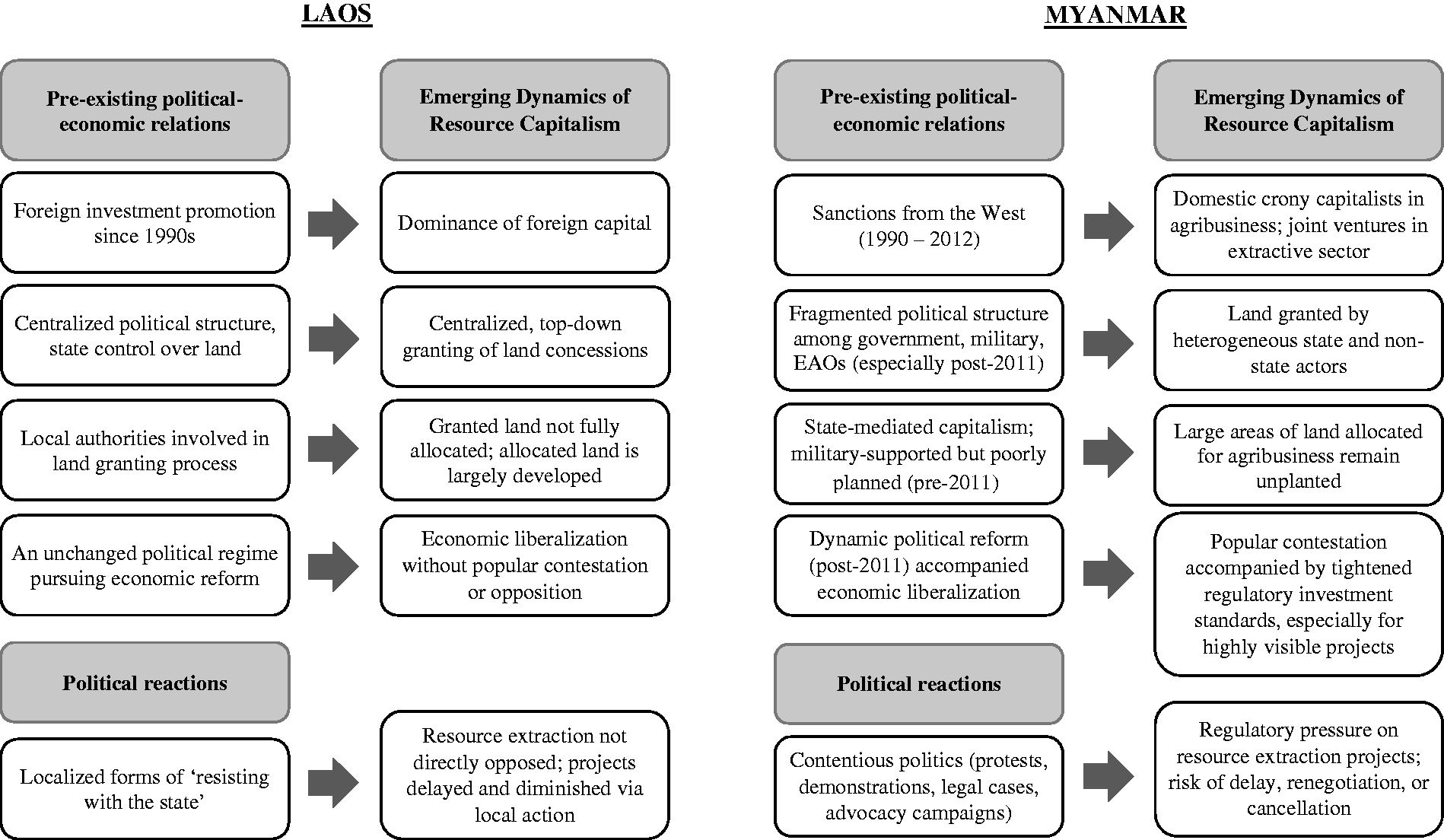
Comparison of key factors contributing to variegated capitalism in Laos and Myanmar.
There are a wide range of pre-capitalist political-economic and social relations with which domestic, regional, and global capital must interface in both countries, with important differences. First, the geopolitics of how each country has economically liberalized and opened up to international capital has had an important effect upon how national forms of capitalism have developed. In Laos, like China and Vietnam, the liberalization of the economy since 1986 has been celebrated by the West. Multilateral and bilateral donors encouraged the government to continue opening the economy to foreign investment to generate GDP growth. Without a domestic entrepreneurial class (having fled the country after the revolution in 1975), the government’s resource development strategy depended upon facilitating the lease of large areas of the country to foreign investors. In contrast, the West placed economic sanctions on Myanmar from 1990 until 2012, limiting the role of international capital just as the country was economically liberalizing. Thus, the military promoted the development of a domestic class of crony capitalists closely connected to the regime, particularly in the agri-business sector.
Second, there are important differences of political structure and centralization that affect how land and resource investments are approved, granted, and developed. In Laos, as the country was opened to foreign investment in the resource sector, investors had to work through a relatively centralized political structure in which the Party and state maintain a territorial monopoly. In Myanmar, the political structure has always been highly fragmented due to ongoing civil wars across the country. However, with the political transition towards a civilian government that began in 2011, it has become increasingly so, among the government, military, and EAOs, further exacerbated by the NLD coming to power in 2016.
Third, political relations among various factions of the state and investors have shaped how land is acquired and developed. In Laos, while large amounts of land have been granted to investors, they have not necessarily been allocated, secured on the ground, and developed. Although the central government approves large projects, investors must work through provincial and district governments, and even village authorities, to access and develop land, especially in the plantation sector (cf. Kenney-Lazar, 2018; Lu and Schönweger, 2019). Thus, they tend to use much of the land that is eventually allocated to them considering what they went through to acquire it. In Myanmar, crony capitalists were closely linked with the state before 2011 and their investment projects were poorly planned or regulated. As a result, large areas of land granted to companies were acquired through force by the military government, resulting in dispossession, regardless of whether or not the land was used. Large concession areas remained unused for decades, and some of these areas have recently been targeted by the NLD government for return to the original owners.
Fourth, while Laos and Myanmar both pursued economic liberalization at the same time, their political systems and reforms could not be more different. An unchanged political regime in Laos has meant that there is a lack of pluralistic actors in Laos that could provide counterweights necessary for holding the government and foreign investors accountable. Citizens affected or concerned by land investments by foreign companies have few pathways through which they can openly and contentiously engage in land politics. There are no other political parties they can join or vote for, domestic civil society organizations are strictly controlled by the state, any form of open protest is shut down immediately if people dare to hold such events, and the court system is controlled by the Party. In Myanmar, however, political reform since the transition to a civilian government in 2011 has taken place, and Myanmar citizens, peasants, and ethnic groups have a greater political voice than ever before, able to form political parties, participate in civil society organizations, protest and demonstrate, and file lawsuits, among other avenues of expression. This has created pressures to tighten regulatory investment standards, especially for large international projects that are increasingly prominent.
Differences in political reform between Laos and Myanmar show the importance of paying attention to the varied political reactions across diverse political contexts to understand how variegated capitalist transitions take place. In Laos, projects do not risk facing nation-wide protests while localized forms of demonstration, such as cutting down trees in a plantation, are quickly repressed. A lack of pluralistic, contentious political actors in Laos has also made it much easier for the Party to exert political hegemonic control over many rural areas of the country through longstanding propaganda campaigns and the extension of the mass organizations (e.g. Lao Women’s Union, Lao Front for National Construction, and the Party’s Youth Union) to the grassroots at the village level of government. Similarly, ethnic minorities have always been incorporated into the political project of the Lao PDR, even if their equal status has not been formally achieved in practice. Thus, there are multiple political webs of influence that keep Lao peasants from openly questioning political economic changes that threaten their livelihoods, and certainly from taking direct action. However, Lao peasants are able to voice their concerns and shape project development in more indirect ways by ‘resisting with the state’. This has, in certain cases, delayed and diminished or re-shaped the land acquired by certain projects and is part of the process by which the amount of land that concessionaires have been able to acquire in recent years has been limited.
In Myanmar, the various democratic eruptions since 1988 have shown that the military regime has failed to paper over its economic failings with political ideology among the general population. In many instances, the military ruled with fear and external violence rather than hegemonic control or what Guha (1997) aptly termed ‘domination without hegemony’. Thus, once the political transition was underway as of 2010, and fear of military repression began to subside, disaffected populations were able to openly express their frustrations and anger after years of repression. Since 2011, this led to the cancellation or renegotiation of terms for several large projects in recent years, including the Myitsone Dam.
Conclusion
Comparing the economics and politics of transition in Laos and Myanmar reveals the critical differences of how domestic politics, particularly in bottom-up forms, and institutions interact with economic reform and external forces of capitalist globalization, leading to variegated transitions toward hybrid capitalism. Within these hybrid capitalist structures the unique interactions of these forces have resulted in different responses from the state expressed in the ways that land has been governed. In Myanmar, the state acknowledges the plurality of actors that counter its power by reclaiming unused land, re-allocating part of this to smallholders, and – although slow-going – engaging with ethnic minorities in national dialogues about sharing power in the control of land and natural resources. In Laos, the state has at times given in to the demands of land users who have resisted, especially when their claims have appealed to state narratives of productive agricultural land use or forest conservation (see Kenney-Lazar et al., 2018a).
An extension of the VC framework outside of the sites of advanced capitalism to economies that are still under transition towards capitalism affirms that this can be fruitful for understanding the nature and pace of capitalist development in these countries. Doing so in a comparative way, between countries that share significant commonalities (including a former socialist past, high dependence on China and extraction-based market economies) and distinctions (particularly the presence of political regime change in one but not the other), further nuances this analysis. Finally, the consideration of popular politics in a dialectical relationship with economic transformation enriches the application of the VC framework. Taken together, this approach can result in important new insights into other similar transitions around the world.
Footnotes
Acknowledgments
We are grateful to the participants of the Land Governance and Rural Transitions in Southeast Asia and the Pacific Workshop at the Australian National University’s Crawford School of Public Policy and three anonymous reviewers for their valuable inputs on this paper. All remaining errors or omissions are our own.
Declaration of conflicting interests
The author(s) declared no potential conflicts of interest with respect to the research, authorship, and/or publication of this article.
Funding
The author(s) received no financial support for the research, authorship, and/or publication of this article.
