



Abstract
As a global city, Hong Kong directly connects more than 120 cities worldwide and transfers nearly 20 million passengers each year. The current COVID-19 pandemic has put the major transport hub in Asia under severe threat of potential imported cases. This Featured Graphic visualizes inbound confirmed COVID-19 cases to Hong Kong globally from January to June 2020, which could greatly help to assess risks from imported cases and improve air transport control policy for mitigating the global spread of COVID-19.
The COVID-19 cases have spread across 215 countries and territories with over 10 million confirmed cases and half million deaths worldwide as of the end of June 2020 (World Health Organization, 2020). As one of the major transport hubs in Asia, Hong Kong is currently suffering from the second wave of COVID-19 outbreak, in which its severity exceeds that of the earlier wave at the beginning of July (Wei and Tam, 2020). In effect, Hong Kong has enforced rigorous inbound travel restrictions as early as April 8, which requires all inbound travellers to be tested for COVID-19 (The Government of the Hong Kong SAR, 2020). Nevertheless, such stringent travel restrictions have not prevented the second wave of COVID-19 outbreak, which is very likely to be stemmed from the inbound transmission. Thus, the spatial-temporal dynamics of COVID-19 cases from inbound travel must be explored to greatly mitigate the potential risk of inbound transmission.
We systematically collected the travel information of confirmed COVID-19 cases released by the Hong Kong Department of Health and visualised the dynamics of Hong Kong’s imported cases from January to June, which may have triggered the second wave of the COVID-19 epidemic. The flights inbound to Hong Kong with confirmed COVID-19 cases are from 29 countries or territories. The sizes of these countries/territories are scaled to proportion to the cumulative total number of domestic confirmed cases. In Figure 1, the colour symbolises each month from January to June, and countries are rendered with the colour representing the month when the confirmed domestic cases’ peak appears. The routes from counties/territories to Hong Kong are also rendered with colours representing months, during which inbound confirmed cases are reported. Furthermore, the changing width of the continuous route denotes that the numbers of imported cases vary in each month from January to June.
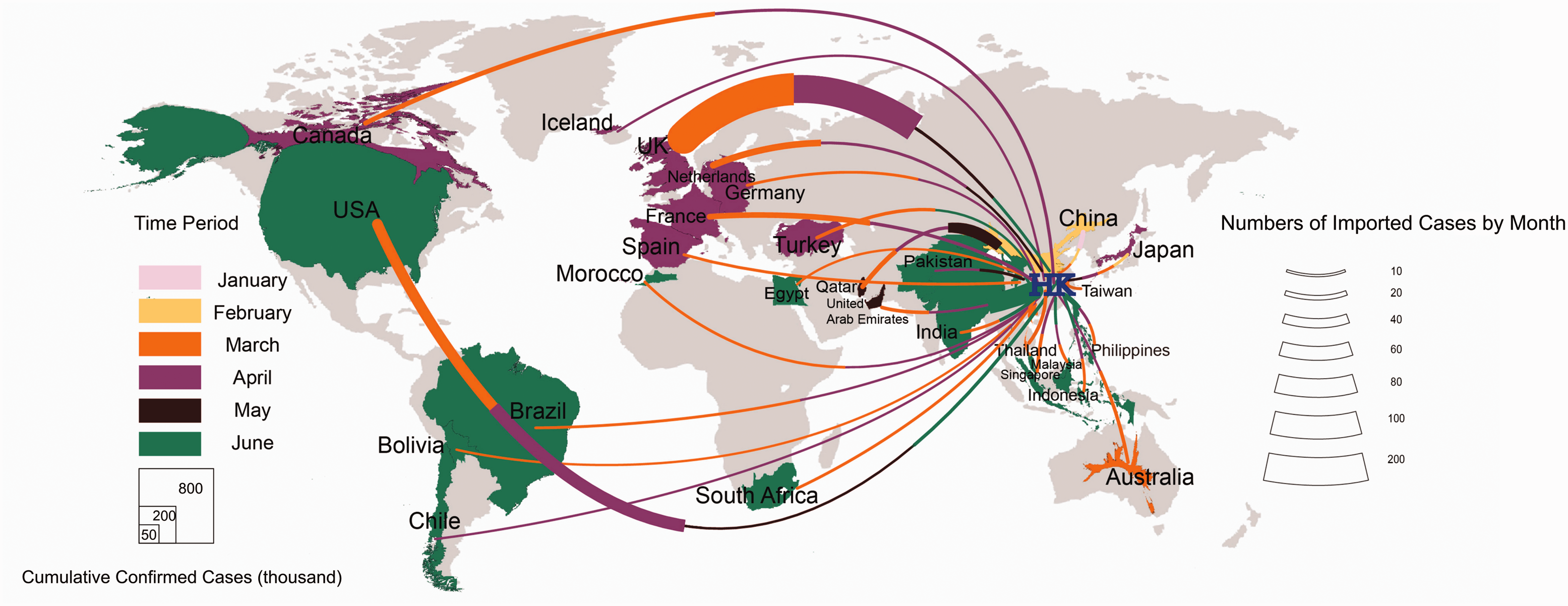
Visualisation of COVID-19 cases inbound to Hong Kong from January to June 2020.
Two novel findings are reflected in the spatial-temporal visualisation: (1) Geographic proximity is not a determining factor of potential risk from imported COVID-19 cases. Figure 1 shows that inbound confirmed cases to Hong Kong are more from long-distance, such as North America, West Europe (specifically the United Kingdom) and West Asia, than from its neighbouring regions. This finding also indicates that effective air transport network control policies might be the key to mitigating the global spread of COVID-19. (2) The imported cases from a country/territory generally come to its peak in March, which is earlier than the domestic peak occurring in April, May and June. For global cities, air transport control policies should be formulated in advance with the trending prediction of specific counties/territories to greatly mitigate the risk of inbound transmission.
Footnotes
Declaration of conflicting interests
The author(s) declared no potential conflicts of interest with respect to the research, authorship and/or publication of this article.
Funding
The author(s) disclosed receipt of the following financial support for the research, authorship, and/or publication of this article: This research was funded by the National Natural Science Foundation of China (No. 51708399), the Macau Science and Technology Development Fund (0039/2020/AFJ), the Macao Cultural Affairs Bureau Academic Research Grant (No. 2018), the Macao Foundation (MF 1921 and MF 1908) and the City University of Macau Foundation.
Acknowledgment
We thank Dr. Guoqiang Shen (University of Texas at Arlington) and Dr. Yu Liu (Henan University ) for providing technical assistance for this research.
