



Abstract
Guatemala City is racked by the practice of extortion: the act of obtaining goods and/or money through the threat of force. Transportation workers are a particularly vulnerable population, with a homicide rate four times the national average. While social scientists, policy experts, and asylum advocates rightly observe that extortionists control territory, lost in this literature is an appreciation for how these violent actors also govern victims’ experience of time and velocity. This article, in response, develops ethnographically the concept of terminal velocity to assess how the violent extraction of payments from transportation workers routinely presses these drivers up against the practical limits of Guatemala City. This includes the downward pull of extortion, which compels them to drive at ever-increasing speeds, and the upward drag of road congestion, poor infrastructure, and human fatigue that inevitably caps their acceleration.
Terminal velocity
Marcos saw two gunmen in the rear-view mirror of his microbus, but he couldn’t do anything about them. 1 He was stuck in traffic. So he watched them snake their motorcycle through idling cars until the one riding as the pillion pointed a pistol at Marcos’s head. Marcos quickly leaned back into his seat and threw up his hands, as if to stop a ball rather than a bullet. The gunman shot four times. One bullet pierced Marcos’s left hand. Another entered his right palm, traveled the length of his forearm, and then exited near his elbow. A third struck Marcos’s thigh, and a fourth grazed his throat. The last left Marcos choking on his own blood, but he survived the attack. Thousands of other drivers, however, have not been so fortunate. In Guatemala, violence against transportation workers carries a murder rate of 135 homicides for every 100,000 drivers (Mendoza, 2014). This adds up to more than 3,100 en-route killings since 2001 for an estimated $60 million a year in extortion payments (Clavel, 2019). Unbeknownst to Marcos, someone in his microbus collective had missed a payment, and the extortionists wanted blood. ‘It’s the speed of extortion that’s so difficult’, Marcos explained with his arm in a sling: ‘[The extortionists] always want more money. So we have to work faster just to stay alive’.
It is the speed of extortion in Guatemala City that this article engages, assessing how the violent extraction of payments from transportation workers routinely presses these drivers up against the practical limits of the city. ‘There comes a point when you can’t drive any faster’, Marcos added, ‘and you can’t make enough money to pay for the [microbus], the fuel, the employees [ayudantes], and the [extortion] payments’. To approximate the mounting impossibility of this predicament, in ways that appreciate the limits of not just space and time but also life itself, this article develops ethnographically the concept of terminal velocity. In the physical sciences, terminal velocity describes the maximum speed attainable by an object falling to earth. This speed is determined by the downward pull of gravity and the upward drag of air. As analogy, the concept helps to articulate how two opposing forces similarly affect the movement of transportation workers in Guatemala City. There is the downward pull of extortion, which compels drivers such as Marcos to drive at ever-increasing speeds, and there is the upward drag of road congestion, poor infrastructure, and human fatigue that inevitably caps their acceleration. Together, these two external forces provide a perspective on the precarious conditions under which a growing number of Central Americans live: at maximum velocity and zero acceleration, always at the edge – of not just breaking down but also crashing to earth.
Terminal velocity names the material limits that govern movement in Guatemala City while also highlighting the importance of temporality in a conversation that has been primarily concerned with territory. Today, social scientists (Fontes, 2016), policy experts (InSight Crime, 2019), and asylum advocates (Martínez, 2018) rely on a generally agreed upon understanding of extortion in Central America: Throughout Guatemala, El Salvador, and Honduras, a vast array of criminal actors, many of whom are gang members, obtain goods and/or money from households, stores, markets, service providers, and transportation workers through the threat of force (Saunders-Hastings, 2018a). Known colloquially as taxes (impuestos), rent (renta), and fees (cuota), these payments allow victims to live in, work on, and/or pass through vigilantly guarded patches of territory – street corners, alleyways, and market stalls. ‘Extortion is how criminal groups exercise control of their territory’, one report notes (InSight Crime, 2019: 35). Often lost in this literature is an appreciation for how extortionists not only dominate space but also exert control over victims’ experience of time and velocity. ‘We work as fast as we can’, Marcos explained. ‘And so I don’t know what will kill us first. The speed [of the work] or our inability to work even faster’.
Limitations on time and velocity are easily overlooked. Some of the most provocative scholarship in the humanities and social sciences details the overcoming of material limits to connect people and markets faster and more efficiently than ever before (Harvey, 1989). From nineteenth-century railways (Schivelbusch, 1977) to the increasing sophistication of global supply chains (Cowen, 2014), the world can sometimes appear to be ‘shrinking’ (Kirsch, 1995), so much so that critics could be forgiven for entertaining such hyperboles as ‘the death of distance’ (Cairncross, 1997), ‘the end of geography’ (O’Brien, 1992), and ‘a flat world’ (Friedman, 2005). 2 Implicit in all of this excitement is the waning relevance of the material world: With the rise of transportation and communication technologies, urban life can seem to race forward at ever increasing speeds (Virilio, 1977/2000). 3 It is an attractive argument, especially when applied to so-called global cities (Sassen, 1991), but Marcos and his colleagues disagree with it, and so do I. Given its thickening traffic, failing infrastructure, and regimes of extortion, Guatemala City renders visible the external forces that affect movement in Central America. These forces include the terror that these drivers experience while being stuck in traffic (Part two: Dead time), the tactics they deploy to further compress the time spent traveling from one location to another (Part three: Shortcuts), and the pharmaceutical lengths they reach to stay awake for just a few more hours of work (Part four: Speedbumps). All of which opens a conceptual space to reflect on the imbrication of time, space, and death in Central America (Part five: Chokepoints). But first, some context (Part one: City limits).
Part one: City limits
Guatemala is home to the highest rates of extortion in a region absolutely racked by the practice (InSight Crime, 2019: 3; UNODC, 2007). Residents of neighboring El Salvador pay an estimated 1.7 percent of the country’s GDP in extortion fees while those living in Honduras pay 1 percent (InSight Crime, 2019: 3). Victims of extortion include homeowners, small business owners, and sex workers, but transportation workers in Guatemala City are particularly vulnerable. The reasons are many: The most fundamental is the failure of the state to control extortion and protection rackets in the transport industry (O’Neill and Thomas, 2011; see also Gundur, 2019); in addition, Guatemala’s transportation industry is private, runs on cash, and comprises loosely affiliated associations (Clavel, 2019). 4 This means that there is very little government oversight, with municipalities selling bus routes to individuals (Dudley, 2012). These individuals then rent their routes, and often buses, to drivers. Marcos, like many other drivers, runs an independent microbus collective, which employs dozens of drivers, all of whom ultimately work nineteen-hour days to pay for the routes and vehicles as well as their extortion payments.
These extortion payments allow drivers to enter and exit territories as they transport their clients from the urban periphery to the city centre (International Crisis Group, 2017). Marcos, for example, makes five separate extortion payments on five different days of every week in order to pass through five distinct territories. The coordination of these payments is complicated, for sure, but the real hitch is that the extortionists operate independently from one another, without much concern for how the timing of one payment might affect another. ‘There are good days, and there are bad days’, Marcos admitted, ‘and the gang [I pay] on Tuesday doesn’t care if I didn’t make money on Monday. They also don’t care if I haven’t made my Friday payment’. This explains, at least in part, why the homicide rate for transportation workers in Guatemala is three times the national average (Mendoza, 2014). ‘I just work as fast as I can’, Marcos told me.
The downward pull of extortion constantly bumps up against the upward drag of the city, with Guatemala City presenting a thicket of obstacles for those racing to make their next payment. One obstacle is road congestion. Guatemala’s government over the last twenty-five years has restructured its economy towards the global free market, with aggressive free trade policies that have allowed an emerging middle class to meet a wave of affordable cars imported from Asia (Instituto Latinoamericano en Gestión Política, 2017). Used vehicles from Mexico and the United States have also flooded the market in ways that quadrupled the number of registered cars in Guatemala City (SAT, 2020). Another obstacle is the almost total lack of new roads. The government of Guatemala adds less than two kilometres of additional track to the capital every year (Comunicaciones Infraestructura y Vivienda, 2018) – largely because Guatemala City is not built for growth. Deep ravines known as barrancos make up more than 40 percent of the city’s footprint, creating problems for urban planners (Mazariegos, 2014). Many roads cannot be widened because they already butt up against a ravine, and this means that bottlenecks and chokepoints routinely bring the city to a standstill. A final obstacle is waning infrastructure. The roads that do exist are falling apart, with a dreadful combination of low tax revenues and government corruption resulting in not only a rash of potholes but also an inability to repair them. Drivers do their best to avoid these ruts, but in doing so they either slow down traffic or stop it altogether with flat tires. Together, these obstacles frustrate Marcos and his colleagues as they race through the city. And all this does not even account for the physiological limitations facing transportation workers: bodily exhaustion presents another hard limit on speed. Thus, terminal velocity as analytic connects the pull of extortion and the drag of the city to the mortal consequences of zero acceleration in Guatemala City.
Part two: Dead time
Marcos drives a used microbus (Figure 1). Salvaged from South Korea, with a sliding door that no longer closes, the vehicle is designed to seat fourteen passengers, including the driver, but Marcos can accommodate as many as twenty-six clients during peak hours. The vehicle is one of approximately 160 microbuses that connect Guatemala City’s most populated and poorest sector (Zone 18) to its city centre (Zone 1). A publicly funded service known as Transurbano also connects these two zones with buses that seat upwards of 60 passengers, but this option has its problems: it is significantly slower, far less frequent, and arguably just as dangerous as microbuses (Patzán, 2016). The two services also travel nearly the exact same routes, with microbuses often trolling their competitor in an effort to persuade clients that their time is worth a microbus’s slight upcharge of about $0.40 USD.
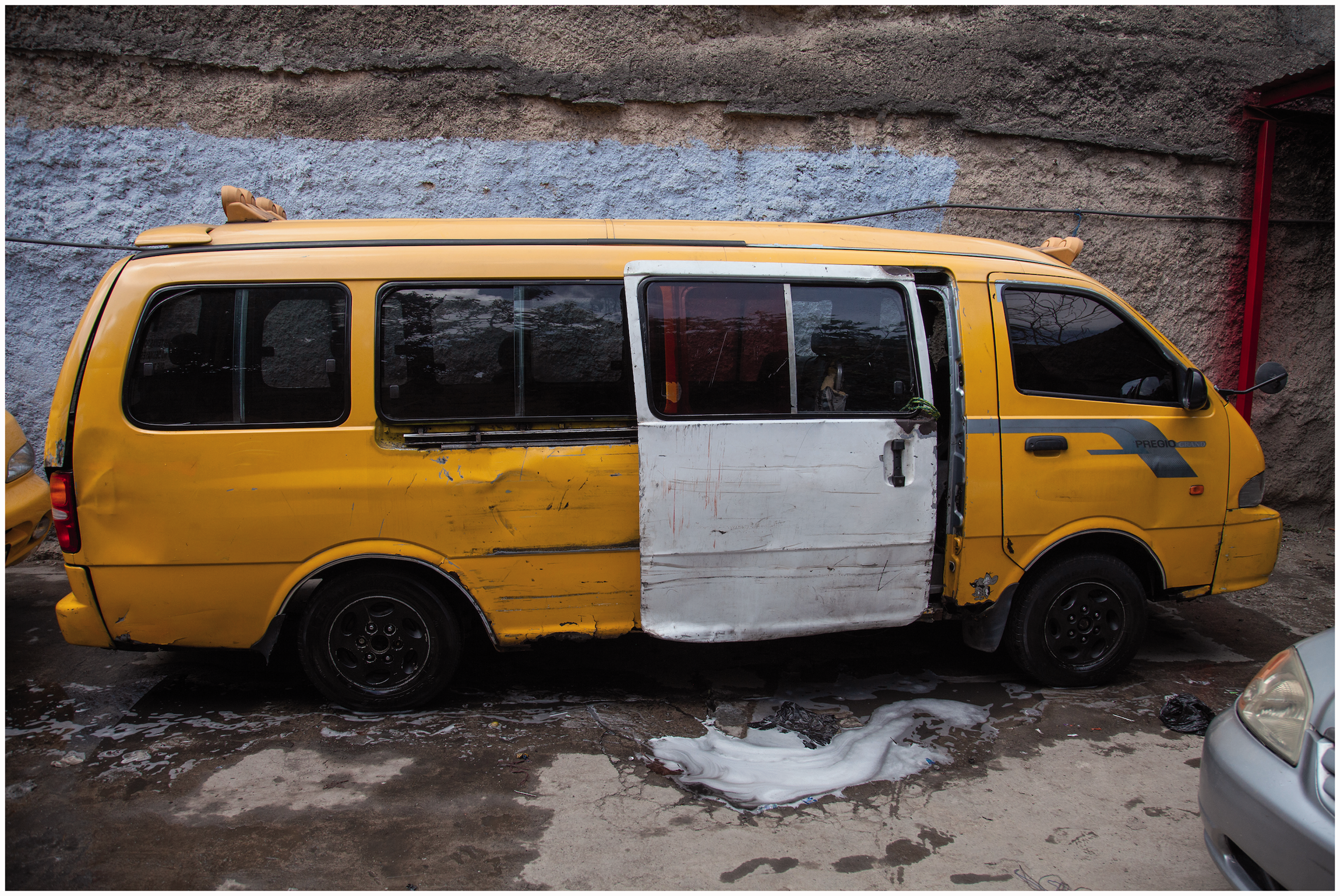
Microbus (August 2019).
A microbus’s business model is sustainable but not lucrative, and it hinges on the following equation: distance over time equals earnings potential. Thus, the more distance one can cover and the less time it takes—that is, the faster one travels—the more money one can earn. To explain: Marcos and his colleagues work from 4:00 a.m. until 10:00 a.m. and then from 1:00 p.m. until 11:00 p.m., with the most experienced drivers able to complete as many as sixteen one-way trips (each about 10 kilometers) between Zone 18 and Zone 1 on what these drivers call a good day (un dia bueno). On these good (meaning maximally profitable) days, Marcos averages twenty people for every one-way trip, and he charges each of them Q5 ($0.65 USD). This comes out to a one-day total of about Q1,600 ($207 USD).
But then Marcos has to cover his costs. Every day, he pays Q300 ($39 USD) to rent the microbus, Q200 ($26 USD) to rent the route, and Q250 ($32 USD) for the diesel. He also pays Q150 ($20 USD) for his assistants and Q100 ($13 USD) for their meals. These daily costs add up to about Q1,000 ($130 USD) for a one-day maximum profit of Q600 ($78 USD). ‘But I’ve never made Q600 in a single day’, Marcos insists. Why? The answer is hauntingly straightforward: As Marcos once sat in his microbus, a young boy passed him an inexpensive cellular phone. A few days later, a young woman handed him another. Three teenagers then gave him one more phone each over the course of the next week, for a total of five cellular phones. A different voice on the end of each device explained to Marcos that he needed to make a weekly extortion payment to travel through a particular part of the city. Each of the payments differ in value, but they average Q300 ($39 USD) per day, or half of Marcos’s earnings on a so-called good day. ‘And if I am late with a payment’, Marcos explained, ‘they will kill me’.
There is no reason for Marcos to fear for his life on good days. ‘The city feels smooth on good days’, he told me. Marcos describes the feeling with a constellation of terms that begins with ‘smooth’ (suave) but also includes ‘fast’ (rapido), ‘easy’ (facil), ‘free’ (libre), ‘fluid’ (fluido), and ‘liquid’ (líquido). ‘Nothing holds me back on good days. I’m able to run through the city’. But his margins are tight – not just between profit and loss but also between life and death. Marcos must service 260 clients every day to cover his costs. Anything under this total and he runs the risk of missing an extortion payment. Marcos has had incredibly successful mornings that have brought him to the brink of 260 clients by 10:00 a.m., but then something will happen, and he will find himself stuck in traffic for hours with only a dozen clients. During those moments, he says that he can feel his heart pounding like a ticking clock, which is why he and his colleagues call this inactivity ‘dead time’ (la hora muerte).
Dead time for transportation workers is a specific kind of terror for a country already familiar with what the Linda Green (1999) has called ‘fear as a way of life’. During Guatemala’s genocidal civil war (1960–1996), huge swathes of the country’s population lived in a constant state of emergency because a militarized government murdered hundreds of thousands of citizens, disappeared tens of thousands, and displaced a million more. 5 Today, in Guatemala’s turbulent postwar era, Anthony Fontes (2019) argues that ‘mortal doubt’ now defines the country’s existential condition: not only because rates of wartime violence have persisted well past the signing of the 1996 Peace Accords (O’Neill and Thomas, 2011) but also because no one knows for sure who is ultimately responsible for the country’s high rates of violence. Transportation workers’ articulation of dead time complements Fontes’s analysis of the material and temporal dimensions of postwar terror as men such as Marcos battle against the push and pull of the city. 6
The fundamental challenge is that sitting in traffic presents microbus drivers with a cluster of deeply interrelated limits, and all of them return Marcos and his colleagues to the limits of their own lives: to the bare fact of terminality. 7 ‘We call it dead time because you can’t do anything [while stuck in traffic]. So you sit there like a dead man, but we also call it dead time because [doing nothing in this city] will get you killed’. The anthropology of infrastructure (Larkin, 2013), with its attention to chokepoints (Carse et al., 2018a) and bottlenecks (Melly, 2016), echoes the insights of Marcos and his colleagues. The scholarship reminds social scientists that the networks built to facilitate the flow of goods and people have their practical limits. Conduits can become chokepoints. These are ‘sites where malfunction, blockage, or strategic pressure constricts – or “chokes” – the flows and connections upon which contemporary life depends’ (Carse et al., 2018b). When the limits of infrastructure meet the demands of extortion, transportation workers such as Marcos experience dead time – a state of zero velocity in which the drag of the city wins out over the pull of extortion. The observable consequence of which is a frantic effort to compress the time spent traveling from one location to another.
Part three: Shortcuts
Marcos is the first to admit that his experience of speed in Guatemala City is relative (Sheller and Urry, 2006). He may not articulate this as clearly as some scholars of mobility (Urry, 2003; Peter, 2006), but Marcos readily approximates the philosophical point that road traffic in Guatemala City is ‘only slow in relation to our time, to our body, to our rhythms’ (Lefebvre, 2004: 20). Or, as Adrian Mackenzie writes: ‘We have no experience of speed except as a difference of speed’ (2002: 122). The pertinent difference for Marcos and his colleagues is the difference of speed between his vehicle and Transurbano busses. ‘We make money because we are twice as fast as Transurbano’, he said. By twice as fast, Marcos means that he and his colleagues can travel from the periphery to the city centre in about 45 minutes while a Transurbano bus makes the same trip in over an hour and a half. ‘But we do not drive twice as fast as Transurbano’, Marcos observed. Instead he and his colleagues have identified a handful of techniques that allow them to provide a significantly faster service to their clients. Four stand out.
First, these transportation drivers fill their microbuses well past capacity: A row of three seats can fit five clients and a bench designed for four people can squeeze seven. Second, Marcos uses his vehicle’s relatively small size and comparatively rapid acceleration to his advantage by stopping and starting for clients with far greater agility than Transurbano buses. ‘It’s the little things that add up’, Marcos explained: ‘And I make sure the clients get in the [micro]bus as fast as possible’. Third, Marcos speeds as often as he can, cutting between cars at great risk to his safety and for what can sometimes seem like infinitesimal gains. Having jutted in front of a truck, only to have that truck directly behind him for the rest of the trip, I asked Marcos why he had made such an aggressive move only to arrive at the same destination at nearly the exact same time. ‘I always need to be aggressive’, he said. ‘Every little bit counts’.
The fourth technique is the most important: Marcos and his colleagues consider a half-dozen alternate routes every time they travel between Zone 1 and Zone 18 (Figure 2). With his finger once again tracing the map, Marcos explained, ‘[Transurbano] uses these main avenues, but those avenues have terrible traffic. Their buses can sit in traffic for hours’. Marcos and his colleagues, in contrast, duck in and out of this traffic by entering and exiting those main avenues. Marcos pointed to a latticework of streets that parallel the main bus route. ‘I pick up my clients and then I take these back roads’. These include parking lots, residential streets, and open-air street markets. One shortcut involves Marcos jumping a small curb to access a set of decommissioned railroad tracks. Uneven and unpaved, these tracks run alongside a notoriously congested intersection. ‘I can’t go much faster than 20 kilometres per hour [while I’m on the tracks], but it’s so much faster than sitting in traffic’. The effect can be electric. 8 ‘It sometimes feels like we’re flying because we know that the [Transurbano] bus is just sitting there’. It is an affect that echoes a powerful insight about the politics of movement: ‘some mobilities are dependent on the immobilities of others’ (Cresswell, 2001: 22). Marcos’s relative speed depends on Transurbano’s lumbering service.
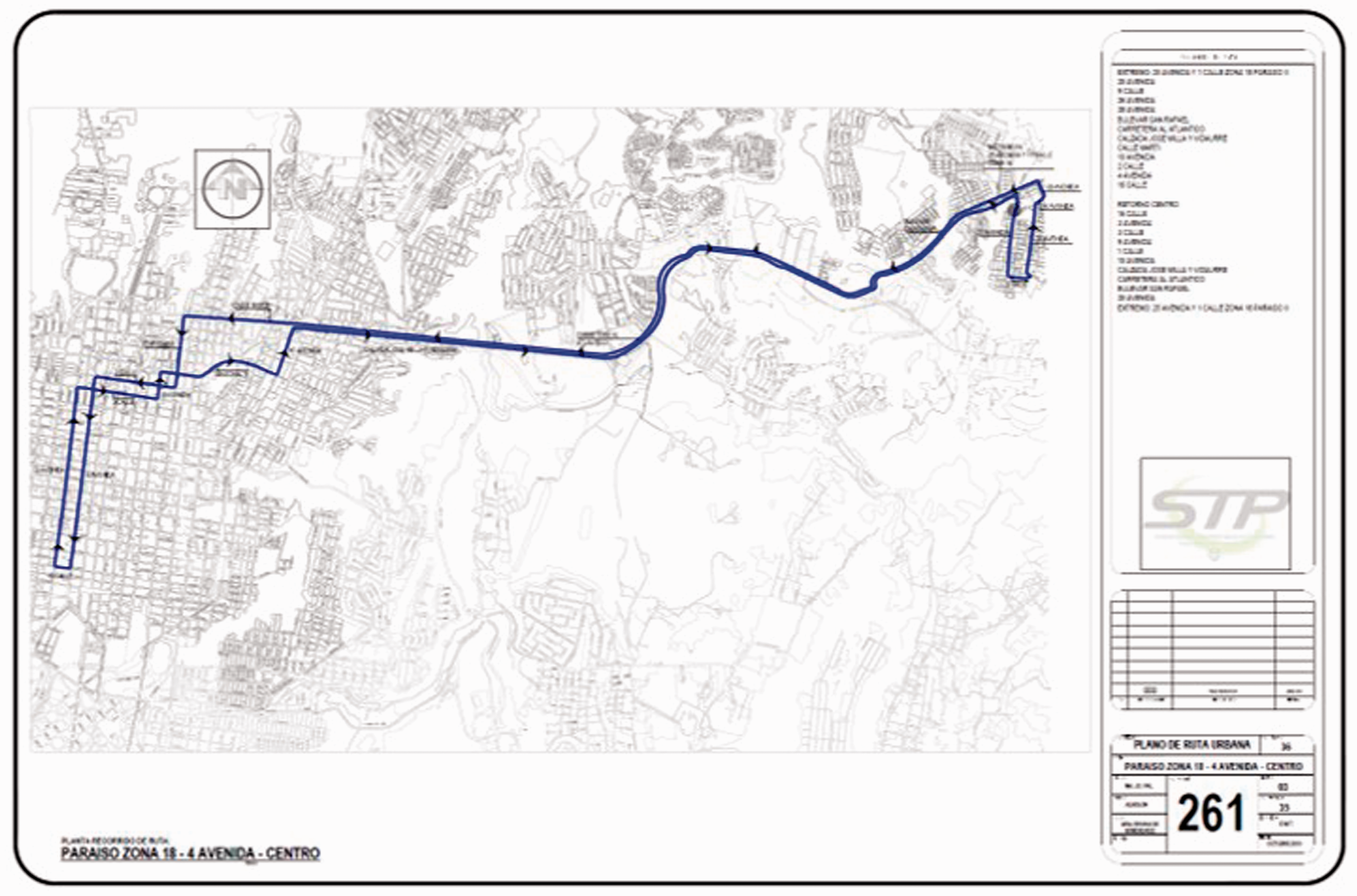
Transurbano bus route (August 2019).
Of ethnographic interest here is that speed is relative for Marcos and his colleagues until it is not. Marcos agrees that he might be able to improve his performance by finding a new shortcut, but the unit of innovation for Marcos and his colleagues is the completion of a full additional trip: ‘None of it matters until I am able to make a seventeenth trip’. At sixteen trips a day, Marcos is operating at terminal velocity.
Marcos has experimented with different itineraries. He has even abandoned the Transurbano bus route altogether in the hopes that he could cultivate a client base independent of the government service, but none of it has brought him closer to a seventeenth trip. All of this simply reminds Marcos of the material obstacles that limit him to sixteen one-way trips in a single day: intersections that trap him in traffic, a bridge that bottlenecks every morning and every evening, and foot traffic in the city centre that frustrates the last few hundred metres of every trip downtown (Urry, 2007).
To achieve sixteen one-way trips, Marcos must fill his microbus to absolute capacity, stop and start his vehicle with precision, race the straightaways, and calculate (on the fly) which alternate route will yield the greatest gains. In the abstract, the deployment of these techniques suggests a vision of almost cyborg-like efficiency: an amalgamation of man and machine exploring the limits of time and space. But ethnographically, when observed across a nineteen-hour workday, the experience of terminal velocity is far more harried. It is a visibly battered microbus with threadbare brakes and a failed suspension system tumbling (sometimes literally) downhill at twice the speed limit and with twice the number of recommended passengers. ‘[The extortionists] are obviously serious about killing people who don’t pay’, he said with his arm still in a sling: ‘That’s why you need to show up to work every day totally ready’. Constantly looping the city is repetitive work, and this is why Marcos and his colleagues often need some help to stay focused.
Part four: Speedbumps
The frantic experience of these transportation workers is not entirely new to the history of capitalism. Labour has long had to keep up with an ever-intensifying loop of production and consumption, with its efforts forever hitched to the limits of human capacity – in fields, factories, or cubicles (Rabinbach, 1990). 9 But this effort is an absolute imperative for Marcos because exhaustion is a constant drag for him: ‘I wake up at 3:30 in the morning to start driving at 4:00. We don’t drive between 10:00 [a.m.] and 1:00 [p.m.]. Sometimes I can take a nap in my bus but I usually have to do stuff, like work on the motor. I never want to pay for someone else to fix my vehicle. And then I’m just running until 11:00 at night’. Marcos generally gets to bed by midnight.
Transportation workers in Guatemala City deploy a half-dozen shortcuts to compress time and space, but they also engineer themselves to sleep less, work more, and maintain a piqued state of alertness across a brutal work week. To be clear: none of it increases the quality of their services. The experience of riding with Marcos is miserable. There are the sudden starts and stops as well as the unexpected jolts of acceleration, not to mention the spectre of gun violence. Clients are well aware that they risk their lives by riding with Marcos. An additional disturbance that these clients endure is the music. ‘It keeps me awake’, Marcos yelled over a hip-hop classic. A five-year-old child, her mother, and grandmother sat directly behind him: ‘I need this music to keep my energy up. I need it when I start driving [at 4:00 a.m.] and when I’m getting tired around 9:00 [a.m.]. I need it when I get hungry and when I get sad. I need it to keep my mind off my family [because I never see them]’. The music keeps Marcos as adrenalized as possible.
Music is not enough to sustain terminal velocity, and Marcos knows it. So too do an aggressive set of international beverage companies who target Central America’s millions of consumer citizens in desperate need of more energy. Marcos and his colleagues draw much of their endurance from an expanding constellation of energy drinks that promise (and often deliver) a heightened sense of awareness (Sedgewick, 2020). These drinks include classics like Coca Cola and Red Bull but also a constellation of other down-market options: Adrenaline, Monster, Amp, Raptor, Cocaine, Volt, Hyper, Speed Max, and Four Loko. The last offers a suspicious combination of sugar, caffeine, and alcohol, and often appears at the tail end of Friday night shifts. ‘But these drinks cost money’, Marcos explained while we did the math. He and his assistant drink as many as a dozen of them during the course of a day, with the less expensive brands delivering far less of a kick. And so Marcos and his assistant openly calculate the cost-benefit analysis of paying a little more for an energy drink that will give them a little more of a boost. The net effect of all this scheming is an additional line item that often approaches Q100 ($13 USD), or the average amount that Marcos grosses from a single one-way trip from the city centre to the urban periphery.
Marcos and his colleagues constantly worry about striking the right balance between the cost of energy drinks and their ability to cover the cost of the microbus, route, diesel, assistant, and, of course, the extortion payments. On good days, there is enough money for these men to pay for it all, but these calculations become far more complicated on bad days. ‘Sometimes the traffic in the morning is tight and we can’t complete as many trips as we need [to complete]’. Marcos continued: ‘And so we have to work faster and longer during the second shift [from 1:00 p.m. to 11:00 p.m.]’. In the hole from a slow morning, these plans for an aggressive afternoon often involve speculative investments in expensive energy drinks, with the goal of sleeping less, working more, and staying alert from 1:00 p.m. to 11:00 p.m. It is unclear whether these marginal differences in quality and dosage affect the balance sheets of these transportation workers, but it is readily observable that this strategy shifts the tenor of their work. At no other time is terminal velocity more obvious to the senses than during those afternoons when Marcos and his colleagues tumble through the streets of Guatemala City with even more of a caffeine-induced edge than usual. ‘It’s like I’m being chased’, Marcos explained when I asked him how a so-called bad day feels. He corrected himself: ‘Well, I guess I am being chased [by extortionists]’.
Adrenalized and paranoid, Marcos and his colleagues sometimes double down on their investments in energy. Late into an evening, on a day when none of the drivers seem close to clearing their costs, dealers will mill about bus stops, offering to sell these transportation workers different cocaine derivatives, such as crack, or methamphetamine. Marcos never indulges, but he can appreciate why his colleagues do: ‘A lot of times it’s because this job is really hard. It’s really hard to work all the time. And not see your family. And never sleep. And keep track of the money. And make the right decisions. And it’s really hard to think that you could get shot’. Marcos touched one of his scars. ‘They shot me. And I almost died. I have a family to take care of. It’s really hard to do all of this’. And so Marcos understands that sometimes his colleagues need a break, and this usually means a hit or two of an accelerant that makes them feel as if they are flying as fast they need to fly to stay alive. 10
Part five: Chokepoints
Dead time (part two), shortcuts (part three), and speedbumps (part four)—each opens an ethnographic window onto the speed of extortion in Guatemala City and how road congestion, failing infrastructure, and human fatigue govern the movement of transportation workers. With its attention to the dynamics of pull and drag, terminal velocity as analytic names the practical limits of not just acceleration in Guatemala City but also life itself. These limits are mostly material—canyons, potholes, and sheer exhaustion—but also existential, for these drivers must loop through the city on a route that pulls them past the sites of previous attacks. ‘It is really hard to see [the place where I was shot] every day’, Marcos admitted. Yet it is an economic necessity that these drivers maintain a relatively consistent route through the city. Shortcuts allow them to compress the time that it takes to complete a one-way trip, but clients need to know where they can find a microbus, and drivers need to know where they can find clients. This practical consideration means that Marcos and his colleagues return not just every day but (ideally) sixteen times a day to the sites of past attacks, be it their own or those of their colleagues and friends. The psychic toll of such a violently studded geography places one last drag on these drivers. ‘You wouldn’t know that this is where I got shot’, Marcos told me as we drove past an anonymous stretch of the city, ‘but I remember the attack every time I pass this place. That’s why I try to drive a little faster at this point’ (Figure 3).
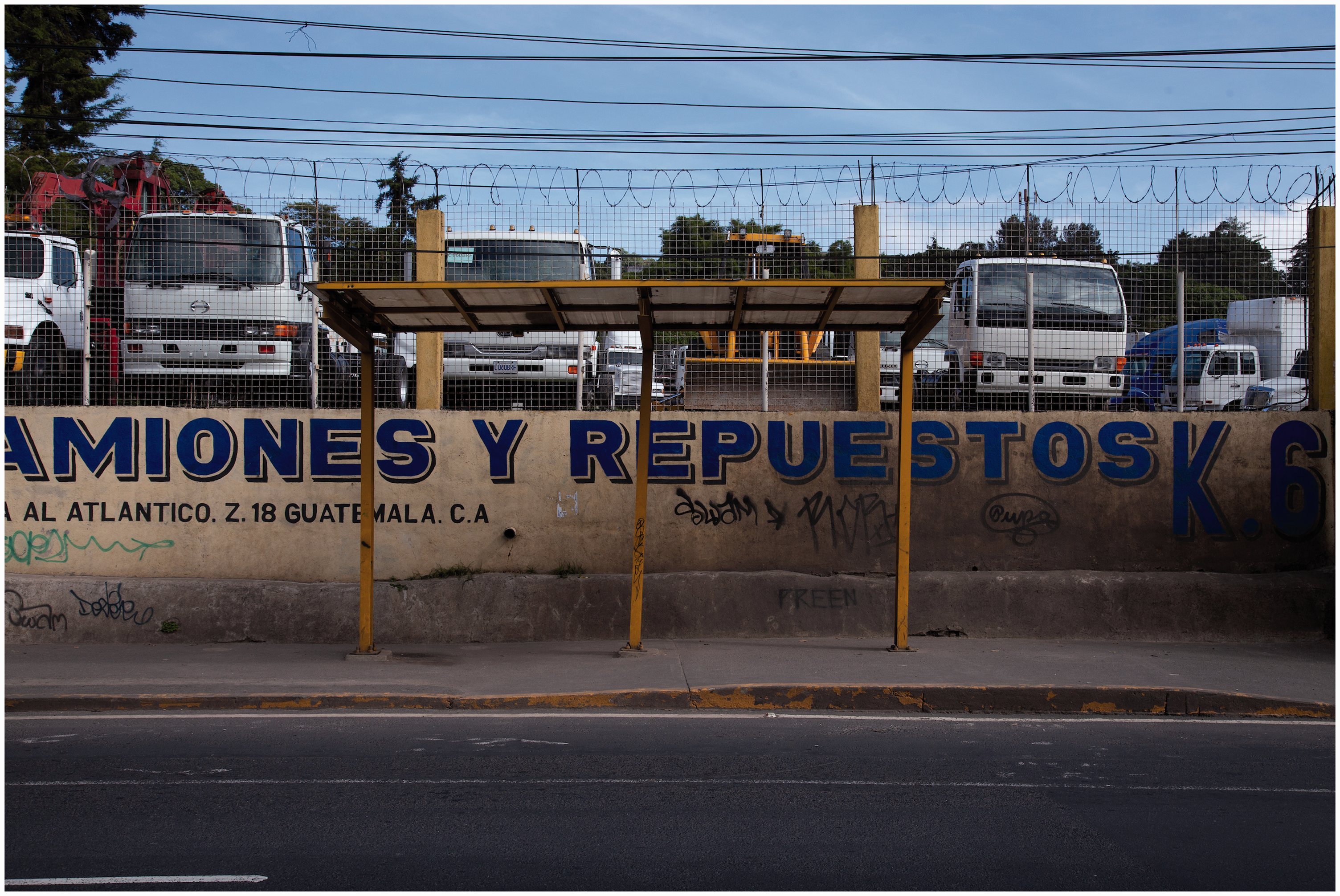
Site of Attack 1 (August 2019).
These sites of past attacks appear anonymous, but they are not random. Extortionists attack transportation workers at strategic points in the city. Marcos showed me one more time the map published by the offices of Transurbano. His finger settled on where he was attacked, and then it drifted towards a thicket of side streets. ‘They attacked me here [on the main road] because the traffic in the morning is bad’, Marcos explained. ‘I couldn’t go anywhere or do anything when I saw them coming up from behind’. The assailants stopped momentarily (‘for less than thirty seconds’), shot Marcos four times, and then accelerated into traffic, racing their motorcycle between idling cars until they exited the main road by jutting down a side street. The two gunmen effectively disappeared less than a minute after firing the first shot, and they were able to do so because the site of attack—like the site of most every attack—is a chokepoint that routinely brings traffic to a standstill, and because there is a nearby off-ramp that leads to a maze of side streets, alleyways, and backroads.
Most every transportation worker admits to being deeply affected by these attacks, not only because they remind everyone of the extreme precarity of these jobs but also because an attack can turn a good day into a bad day by shutting down the route for two to three hours. ‘It sounds terrible’, Marcos confessed, ‘but the margins are so tight. And we feel terrible when one of our friends gets attacked. But we also get really worried that we won’t be able to make our money for the day’. So when the crowd clears and the traffic thins, transportation workers press forward in ways that (understandably) fail to memorialize these acts of violence, even if the memory of these moments regularly surfaces.
On bad days, such memories can have a devastating impact on drivers. These transportation workers are already aware of the pressures that compel them to complete sixteen one-way trips. They are also completely familiar with the obstacles that ultimately limit their efforts. But when drivers slowly begin to realize that they may not be able to make enough money to cover their daily expenses, including their extortion payments, they begin to read their route differently. No longer do they describe their day as suave, rapido, facil, libre, fluido, or líquido. Instead, the city begins to constrict and to flood with memories of crowds, ambulances, blood, and the loud clap of gunfire, triggered by the sites of past attacks that they must revisit as many as sixteen times a day. Already positioned near material bottlenecks, these sites of previous attacks quickly become existential chokepoints for these transportation workers. It is a psychic stress that striates the city with violent memories. ‘I remember sitting in my [driver’s] seat,’ Marcos explained, ‘choking on my own blood and praying that I wouldn’t die’ (Figure 4).
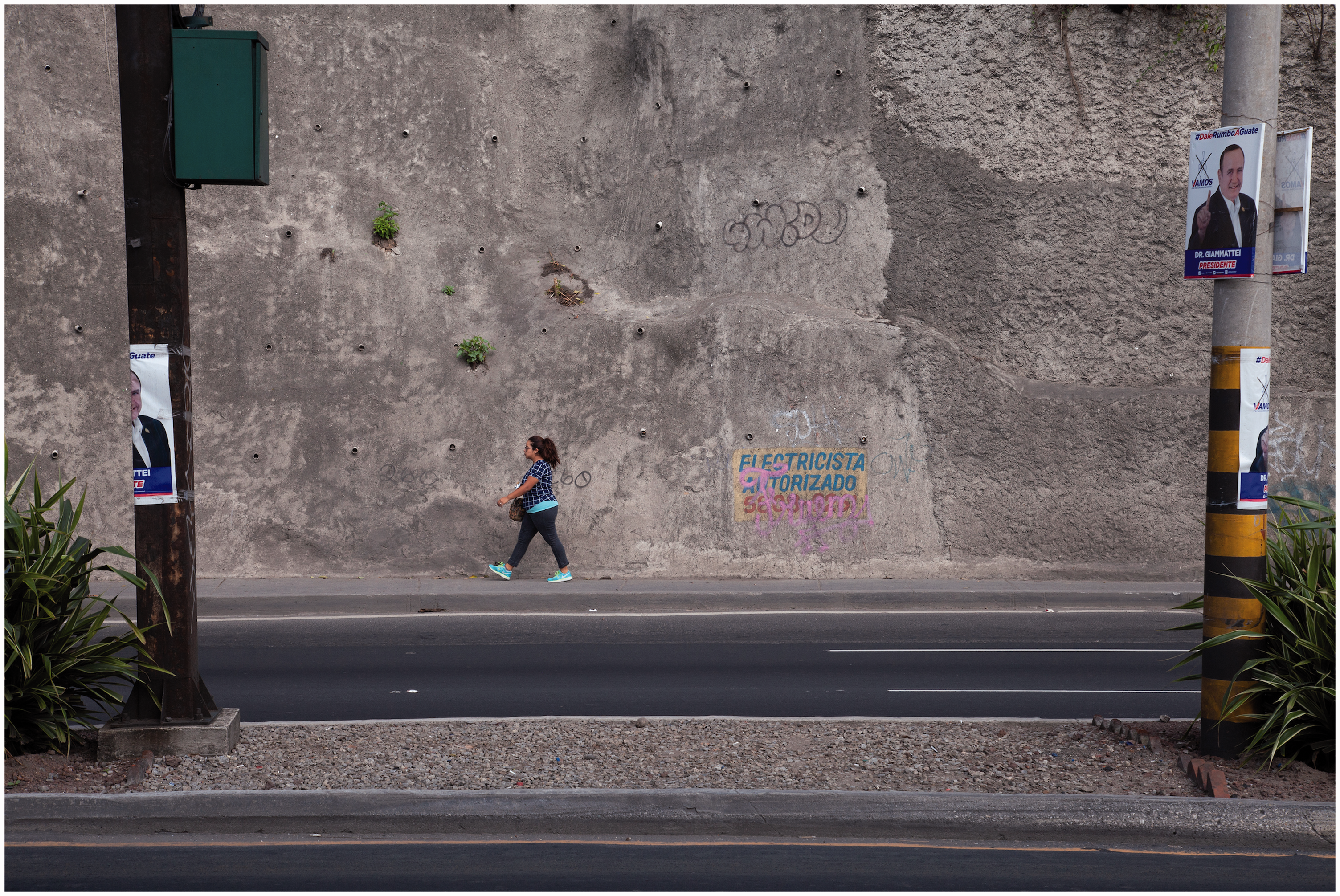
Site of Attack 2 (August 2019).
Terminal velocity, in the end, is a way of attending not only to the tension between extortion and the material limitations of Guatemala City, but also a way of detailing ethnographically the psychic toll this tension exerts. And Marcos, of course, is not the only victim. Transportation workers across Central America struggle to maintain lives lived at top speeds, as do homeowners, small business owners, and sex workers. Extortionists press each of them to pay their impuestos and renta on time for permission to work yet another day, in the knowledge that it all could come to a crashing halt. Marcos and his colleagues know full well that chokepoints can become dead ends in an instant. For it is ultimately extortionists’ control over not just territory but also time that makes terminal velocity such an important contribution to conversations about ‘extorted life’ (Fontes, 2016) and ‘red zones’ (Saunders-Hastings, 2018b) in Central America. The analytic invites social scientists, policy experts, and asylum advocates to appreciate how and to what effect a growing percentage of people throughout the region race through life with a gun to their heads. ‘It feels like I’m being chased,’ Marcos added after a lull in the conversation. We had just completed his eighth one-way trip of the day: ‘I just don’t know when it’s all going to stop’ (Figure 5).
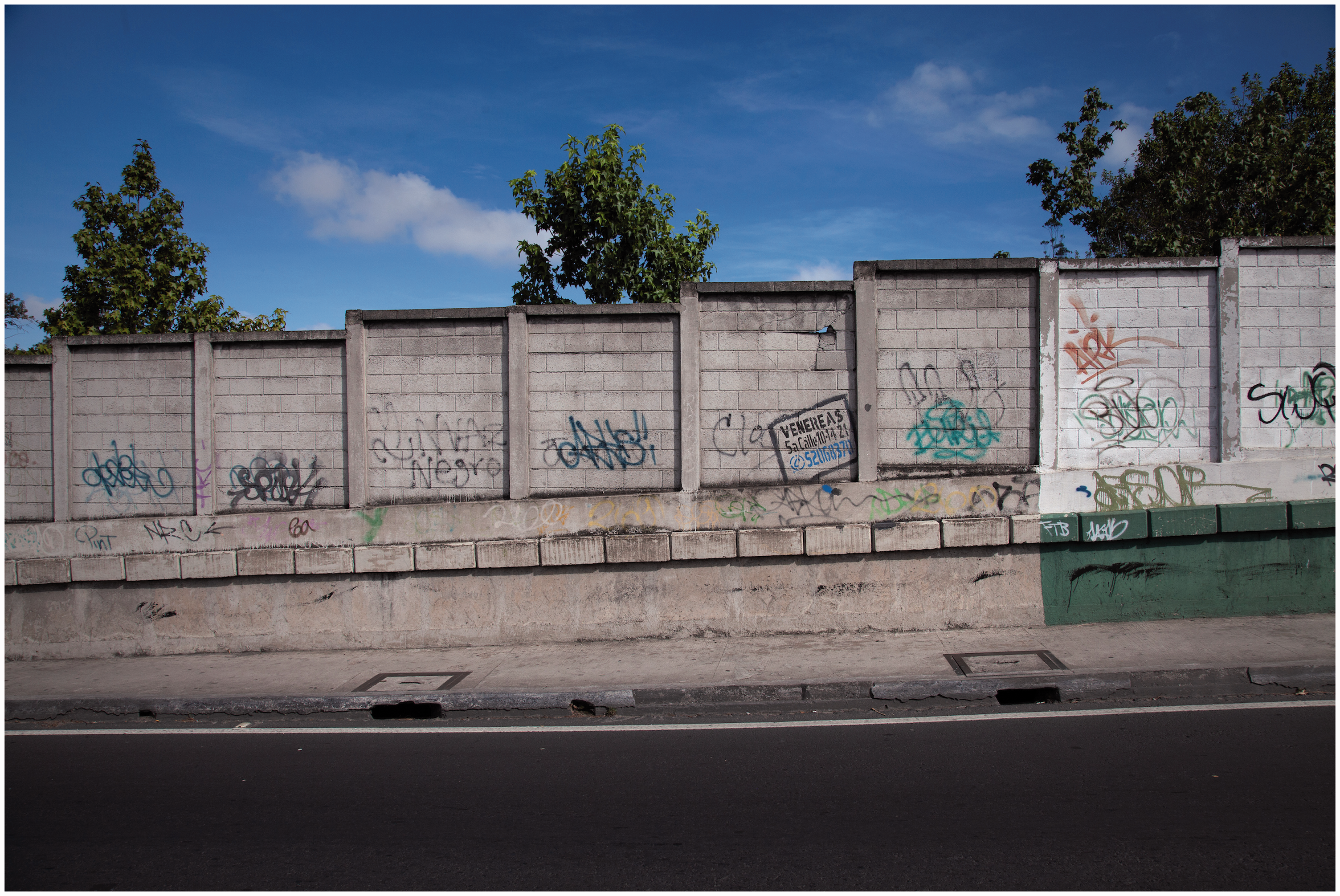
Site of Attack 3 (August 2019).
Footnotes
Declaration of conflicting interests
The author(s) declared no potential conflicts of interest with respect to the research, authorship, and/or publication of this article.
Funding
The author(s) received no financial support for the research, authorship, and/or publication of this article.