



Abstract
Since the onset of the Great Recession, austerity has become more common at the national and local levels throughout the OECD. As states pass expenditure responsibilities down to the local level, this causes a shift toward mandatory spending at the local level which may undermine discretionary spending for social and physical infrastructure. We use Census of Government Finance data from 2012 for all county areas in the continental US to model the expenditure gap between current operations and capital investment, and show how this crowd out affects growth. Our structural equation models find fiscal decentralization has direct negative effects on local growth and indirect negative effects on growth by increasing the local current-capital expenditure gap. This local expenditure gap is larger where decentralization of spending responsibility is higher and state aid is lower, especially in places with greater need (poverty, older infrastructure, and rural areas). In contrast to the theoretical claims of fiscal efficiency, we find fiscal decentralization may be undermining local economic growth by increasing the gap between local current and capital expenditure. We argue that fiscal federalism (decentralization) is “broken” in the US because states have structural incentives to shift fiscal responsibility downward to local government, and local governments face increased social and economic need, especially since the Great Recession.
Keywords
Introduction
Decentralization transfers fiscal responsibilities to lower tiers of governments, and theoretically, can bring about improved local efficiency of public goods provision, increased government accountability and economic growth (Oates, 1972). However, recent studies in OECD countries find that growing obligations for local redistributive responsibilities under decentralization shift local spending to current expenditures (e.g. Gonzalez Alegre, 2010; Rodríguez-Pose et al., 2009). As local spending is driven more by current expenditure on social needs, a potential crowd out of capital investment may occur, leading to lower economic growth. This dynamic interaction between decentralization, local government expenditure composition and local economic growth, is the core focus of this paper.
Since the onset of the Great Recession in 2007 austerity has become more common at the national and local levels throughout the OECD. At the national and subnational levels, we have witnessed state contraction in both the US and the UK (Donald et al., 2014; Peck, 2014), in a process that Peck (2014) terms “scalar dumping” as states pass expenditure responsibilities down to the local level. This causes a shift toward mandatory spending at the local level which may undermine discretionary spending for social and physical infrastructure. Streeck and Mertens (2013) argue this reduces the capacity of local government to meet needs, which in turn reduces citizen expectations of the state. This process has been documented among local governments in the UK, resulting in increased territorial inequality, especially for poor communities (Gray and Barford, 2018; Hastings et al., 2017). Studies in the US also find spatial inequality in local government expenditure (Jimenez, 2014; Lobao et al., 2021; Xu and Warner, 2016). Declines in state aid have increased fiscal stress in localities in the US (Lobao and Adua, 2011; Peck, 2014; Warner et al., 2021), but the greater fiscal autonomy of US local governments makes them more resilient to austerity than local governments in the UK (Kim and Warner, 2020). This greater local fiscal autonomy leads to a variety of responses across US local governments (Warner et al., 2021), and raises questions about the implications for local economic growth. In this paper we link expenditure composition to economic growth in 2012, the first year after the Great Recession for which comprehensive local fiscal data is available from the US Census of Government. We examine the local expenditure gap between current and capital spending under decentralization and the extent to which this crowd out undermines local growth.
There is contradictory evidence in the empirical literature on the growth impacts of current versus capital expenditure (Ghosh and Gregoriou, 2008). Capital expenditure is theoretically argued to have a positive impact on growth (Aschauer, 1989; Barro, 1991; Kneller et al., 1999; Rodríguez-Pose et al., 2009). Historically studies of US local governments find a positive impact of capital expenditure on growth (Aschauer, 1989; Easterly and Rebelo, 1993). In a comparative international study, Rodríguez-Pose et al. (2009) found growth promoting effects of local expenditure are more pronounced where there is greater local autonomy, as this leads to better investment choices. By contrast, some comparative international studies have found the opposite, that current expenditures have a positive impact on growth and capital expenditures have a negative impact (Ghosh and Gregoriou, 2008; Devarajan et al., 1996), possibly due to oversupply of capital goods and corruption (Tanzi and Davoodi, 2000). However, most of these studies are at the national scale and predate the Great Recession.
Empirical studies which examine the effect of decentralization on fiscal efficiency and growth in the US are scant, especially at the local level, and most are focused on urban areas (Hendrick, 2012; Pagano, 2014). Attention to rural areas is lacking. Moreover, despite the decline in state aid in the years after the Great Recession, US local governments have largely pushed their fiscal limits to maintain critical services, especially for redistributive responsibilities (Kim and Warner, 2016; Lobao et al., 2014; Lobao and Adua, 2011). Therefore, it is important to examine whether decentralization promotes local fiscal efficiency and economic growth, as traditional fiscal federalism theory claims (Oates, 1972), or if decentralization imposes fiscal stress on local governments which are already burdened by broader socioeconomic challenges (Warner, 2001).
Decentralization scholars argue that more attention needs to be given to the structure of governance, especially the role of the subnational state (Cox, 2009; Kim and Warner, 2018a). We focus on the subnational state and its impact on the local level because US states vary in the degree to which they decentralize fiscal responsibility to the local level. In the US, state decentralization (measured as the proportion of local expenditure in total state and local expenditure) has been shown to be more important than state aid in determining local fiscal effort 1 (Warner, 2001; Warner and Pratt, 2005; Xu and Warner, 2016). In this paper, we explore how decentralization contributes to the fiscal gap between current and capital expenditure and how this crowd out affects local growth. We find rising current expenditures have the potential to crowd out capital investment and thus undermine local economic growth.
The contribution of this study is a comprehensive model of decentralization and its impacts on local spending structure and growth. It covers all local governments and special districts in the continental US, using the county area 2 as the unit of study. We include state decentralization, intergovernmental transfers, local spending structure, local growth, local demographic, place and economic characteristics in a structural equation model (SEM) that estimates these relationships simultaneously. Our SEM model finds state decentralization has direct negative effects on local growth and indirect effects on growth by increasing the local current-capital expenditure gap. This expenditure gap is larger where decentralization is higher and state aid is lower, especially in places with greater need (poverty, older infrastructure, and rural areas), and is associated with lower growth.
This study gives new insight into how fiscal decentralization functions, especially after the Great Recession. This paper explores expenditure composition of local governments to show how decentralization may crowd out local capacity for growth and increase spatial disparity. In contrast to the theoretical claims of fiscal efficiency, we argue that fiscal federalism is “broken” in the US, because we find decentralization is undermining local economic growth by increasing the gap between local current and capital expenditure. The brokenness has two sources – inherent structural incentives for states to shift fiscal responsibility downward to local government, and local social and economic need which can crowd out capital investment. The paper includes a review of decentralization theory and evolving debates regarding austerity and state rescaling. Next, we present the structural equation model to systematically explore how fiscal decentralization affects economic growth, with a focus on the current-capital gap in local expenditure. Finally, we present new insights on how fiscal decentralization functions after the Great Recession and conclude by highlighting the important role of the subnational state in restructuring local fiscal responsibilities and the implications for local economic growth and citizen expectations of local services.
Decentralization and Austerity: Is Fiscal Federalism Broken?
Fiscal decentralization has been a trend across nations because of its theoretical claims of increased efficiency and economic growth (Rodríguez-Pose and Sandall, 2008). Fiscal federalism (Oates, 1972; Peterson, 1981) is built on the normative framework of public choice theory (Tiebout, 1956). The proposition that decentralization will lead to higher local efficiency and promote greater local growth has been widely accepted (Martínez-Vazquez and McNab, 2003).
However, the theoretical argument that fiscal decentralization will promote efficiency and growth is not well supported by empirical studies. The existing empirical studies are typically focused at the cross-national level or aggregated state level to examine whether fiscal decentralization leads to economic growth. The results of these studies are mixed with negative (Davoodi and Zou, 1998; Rodríguez-Pose and Bwire, 2004), positive (Iimi, 2005), or no relationship to growth (Woller and Phillips, 1998).
With respect to spatial disparity in economic growth, inequality is found to decrease under decentralization in richer nations and increase in poor nations in studies conducted at the cross-national level (Kyriacou et al., 2015; Kyriacou et al., 2017; Lessmann, 2012). Within the OECD countries, the results of decentralization on inequality in economic development are inconclusive with positive (Rodríguez-Pose and Gill, 2004), negative (Ezcurra and Pascual, 2008; Lessmann, 2009) and varied results by high- or low- income nation (Rodríguez-Pose and Ezcurra, 2010).
Studies at the local level in the US find increasing spatial inequality in local government finance when the degree of fiscal decentralization is higher (Lobao et al., 2021; Lobao and Adua, 2011; Warner and Pratt, 2005; Xu and Warner, 2016). Studies find communities with lower capacity and higher need (based on larger share of dependent populations, such as children, seniors, the poor and minorities), and those based in rural areas, metro core cities and older suburbs, are often caught in fiscal stress under decentralization (Johnson et al., 1995; Kelly and Lobao, forthcoming; Kim and Warner, 2018b; Lobao and Adua, 2011; Xu and Warner, 2016).
Why do we see the contradiction between theory and empirical studies of decentralization? Fiscal federalism was supposed to represent an optimal institutional design for local efficiency, with redistribution at higher levels of government and developmental expenditures at the local level (Peterson, 1981). These theories assumed a cooperative federalism with rational expenditure assignment across a multi-level governance system. They also promoted the idea that decentralization would lead to efficiency due to ‘fiscal equivalence’ (forcing local governments to cover more of their own expenditures) and thus “tame the Leviathan” of local spending (Oates, 1972).
In contrast to fiscal federalism theory, state rescaling theory provides a more political view, arguing that the benefits and returns will vary depending on the fiscal, administrative and political capacity of local governments (Lessmann, 2012; Lobao and Adua, 2011; Lobao, et al., 2014; Peck, 2012; Rodríguez-Pose and Ezcurra, 2010; Rodríguez-Pose and Gill, 2004; Warner and Pratt, 2005). Subnational state policy is especially important in constraining local governments and limiting inclusive growth (Kim and Warner, 2018a; Warner and Xu, 2021). Local revenue and expenditure requirements are largely mandated by the subnational state and these have been shown to affect counties more than cities (Wen et al., 2020). Local fiscal effort is a response to both local socioeconomic pressures and political will, as poorer communities offer fewer services (Jimenez, 2014). This also has a racial equity effect; as US counties provide fewer services per capita in response to minority populations’ poverty than white poverty (Kelly and Lobao, forthcoming).
While state rescaling recognizes increasing spatial diversity under decentralization, scholars such as Brenner (2004) have been criticized for giving insufficient attention to the role of the subnational state (Cox, 2009). Fiscal decentralization policy is set at both the federal and state level in US. While earlier waves of decentralization in the 1970s and 1980s were accompanied by higher federal aid to localities (Caraley, 1992; Ladd and Yinger, 1989; Nathan and Lago, 1990), in the more recent waves, the subnational state has become the more important actor as direct federal aid to localities declined. State level decentralization and aid have greater impact on local government than federal transfers due to their greater magnitude and the polity authority states have over localities (Cox, 2009; Kim and Warner, 2018a; Warner, 2001).
The political incentives embedded in the structure of fiscal responsibilities cause states to vary greatly in the nature and level of state fiscal decentralization and intergovernmental aid. Variance in state policy across the 50 states (Kim and Warner, 2018a) has led to divergent impacts on local economic growth in times of recession (Xu and Warner, 2015). While some states target aid to localities with more need, others target aid to those with more growth. This leads to divergence across localities as those with more local capacity to invest for development are reinforced by state aid and decentralization in a virtuous cycle, while those with less capacity receive less aid – leading to a vicious cycle of under investment (Warner and Pratt, 2005; Xu and Warner, 2016).
Intergovernmental transfers can be either redistributive or growth promoting depending on the context, and this helps determine whether the fiscal efficiency promise of decentralization can be realized or if greater spatial inequality of local government fiscal capacity may result (Ezcurra and Rodríguez-Pose, 2013). Empirical studies have found both substitutive (negative) and complementary (positive) responses of local fiscal effort to state aid (Warner and Pratt, 2005; Xu and Warner, 2016). The divergent responses can either ameliorate local fiscal stress or further exacerbate disparity. Since the Great Recession, local governments in the US have seen cuts in state aid (Kim, 2019b; Peck, 2014), which increase local fiscal stress. In addition, the mortgage foreclosure crisis, which fueled the Great Recession, hit a primary source of local revenue, the property tax (Pagano, 2014; Justice and Scorsone, 2013), and pushed local governments to explore alternative revenue sources (Kim, 2019b; Warner et al., 2021).
In addition, states have shifted expenditure responsibility to local governments. State expenditure mandates on local government under decentralization are often concentrated in areas where costs are more driven by redistributive goals. Rising local redistributive responsibility may cause a substitutive effect on local expenditure, crowding out local economic development and the ability to adjust spending in a growth enhancing way (Rodríguez-Pose et al., 2009; Rodríguez-Pose and Ezcurra, 2011). This is especially true for US counties, which are the main actors to administer social welfare programs for the US states (Benton, 2002; Lobao et al., 2014). Unfunded mandates and fiscal stress may limit the ability of local government to adjust its budget to invest in capital expenditures to pursue growth, resulting in reduced local fiscal policy space under a “fend for yourself” fiscal federalism (Pagano and Hoene, 2003). This scalar dumping by the state (Peck, 2014) is justified with an austerity narrative (Fuller, 2017; Hastings et al., 2017; Kim, 2019a). Thus, the optimal institutional design of fiscal federalism is “broken” by the structural stress inherent to the multilevel nature of the decentralization (e.g. “scalar dumping”), and fiscal stress exacerbated by the Great Recession. This may contribute to the gap between current and capital expenditure at the local level and further undermine growth.
This local expenditure gap is also affected by broader economic restructuring, demographic changes and spatial disparities in local capacity (e.g. Lobao et al., 2014; Xu and Warner, 2015). These demographic shifts challenge local budgeting and finance to address poverty (Lobao et al., 2021), education and child-related services (Wallace, 2012; Warner and Zhang, 2020), and the needs of an aging population (Wolf and Amirkhanyan, 2010). Low income and minority communities have greater need, but decentralization may limit local government ability to meet that need (Donald et al., 2014). In addition, the economic shift to knowledge and service industries (Kay et al., 2007), which are exempt from property taxation (Sherman and Doussard, 2019), has been linked to greater local government fiscal stress (Aldag et al., 2019). Finally, underinvestment in physical infrastructure has become a major concern, especially in the US where bridges, roads, water and sewer systems are aging. Underinvestment in infrastructure was a growing problem even before the Great Recession, as state and federal support for infrastructure reinvestment has declined even as the need for investment has risen (ASCE, 2013). As localities attempt to balance budgets within increasingly stringent constraints from current operations and social service mandates, short term needs often take precedence and infrastructure investments may be deferred (Aldag et al., 2019). Economic growth depends on a balance between current expenditures and longer-term capital investments, but our concern is that with devolution, the balance could be shifting away from capital investment.
In this paper, we decompose local public expenditure into current spending and capital expenditure to measure the expenditure gap (crowd out) under decentralization. We build a structural equation model (SEM), which integrates demographic, economic and structural factors across different types of localities. We simultaneously model the associations among decentralization, the expenditure gap (crowd out), and local growth, while controlling for intergovernmental aid, local need, and spatial features. We expect a larger gap between current expenditure and capital spending in places with higher decentralization, less aid and higher need. This crowd out is expected to undermine local growth.
Data and Methodology
Study Unit and Region
To understand the effect of state decentralization on local expenditure composition and local growth, we assemble data on all county areas in the continental United States. We use county areas because they aggregate all local fiscal data within county boundaries. This unit of analysis addresses problems with local government fragmentation because it captures all spending and revenue collection for all jurisdictions within county boundaries: county, city, town, and village governments, and all special districts, including school districts. Thus, it provides a complete picture of local finance. The county area is also a useful unit of analysis because it covers the entire range of political and economic landscapes in the US, from rural to urban places. County areas are a commonly used study unit of analysis, especially for scholars interested in spatial inequity, due to their more stable boundaries and the ability to capture full fiscal information of local governments.
Data Sources
We use Census of Government Finance data in 2012 to capture state and local public finance in the post-Great Recession period. These data include all local government and special district expenditures 3 in the county area. Demographic and socioeconomic data are retrieved from the American Community Survey (ACS) 2009–2013. The prior period American Community Survey (ACS) 2005–2009 is used as the reference to calculate the change in local employment, population and income in the post-Great Recession period. We also differentiate localities into urban metro core and rural places based on Office of Management and Budget 2013 metropolitan status code and percent of urban and rural population information in the 2010 Census.
Structural Equation Model
Figure 1 shows the structural equation model conceptually. The model (Equation I) examines if decentralization affects the local current-capital expenditure gap while controlling for intergovernmental transfers, local demographic stress and place characteristics. The second part of the model (Equation II) tests whether this expenditure gap undermines local growth. Equation II also includes the direct effects of decentralization, intergovernmental transfers, local demographics, economic structure and place characteristics on growth. Thus, our SEM model not only examines the direct effects of decentralization on growth but also how decentralization affects growth through local expenditure composition.

Diagram of the structural equation model.
For our growth equations we use population growth, employment growth and per capita income growth drawn from the American Community Survey (ACS05-09 to ACS09-13) as our dependent variables. These are the three most common indicators used to measure growth (Carlino and Mills, 1987; Partridge et al., 2008). Despite the growth-promoting claims of fiscal federalism, our hypothesis is derived from empirical literature of decentralization in more recent years that finds decentralization may negatively affect growth and result in uneven patterns across space (Lobao et al., 2021; Lobao and Adua, 2011; Rodríguez-Pose, et al., 2009; Xu and Warner, 2015, 2016).
In the current-capital expenditure gap equation, we use the difference between current expenditure share
4
and capital expenditure share
5
in total expenditure (based on Census of Government Finance definitions) to measure the potential “crowd out” effect of decentralization on growth.

In Figure 2 and Figure 3, we see that current expenditure accounts for 84% of total local government expenditure in 2012, while the capital expenditure share is 12% on average. According to the distributions, 89% of county areas have a current expenditure share greater than 80%, and 57% of them spend more than 90% on current needs. Figure 3 shows that most county areas spend less than 20% on capital investment. The gap between current and capital spending is illustrated in Figure 4. At the left end of Figure 4, where the gap is 0, county areas spend equally on both categories. The mean of the gap between current expenditure share and capital expenditure share is 76%. For most county areas (62% of our sample), the difference between current expenditure and capital investment share is 80%. In 27% of county areas the gap is greater than 90% between the two types of spending shares. These places are of special concern in our analysis.
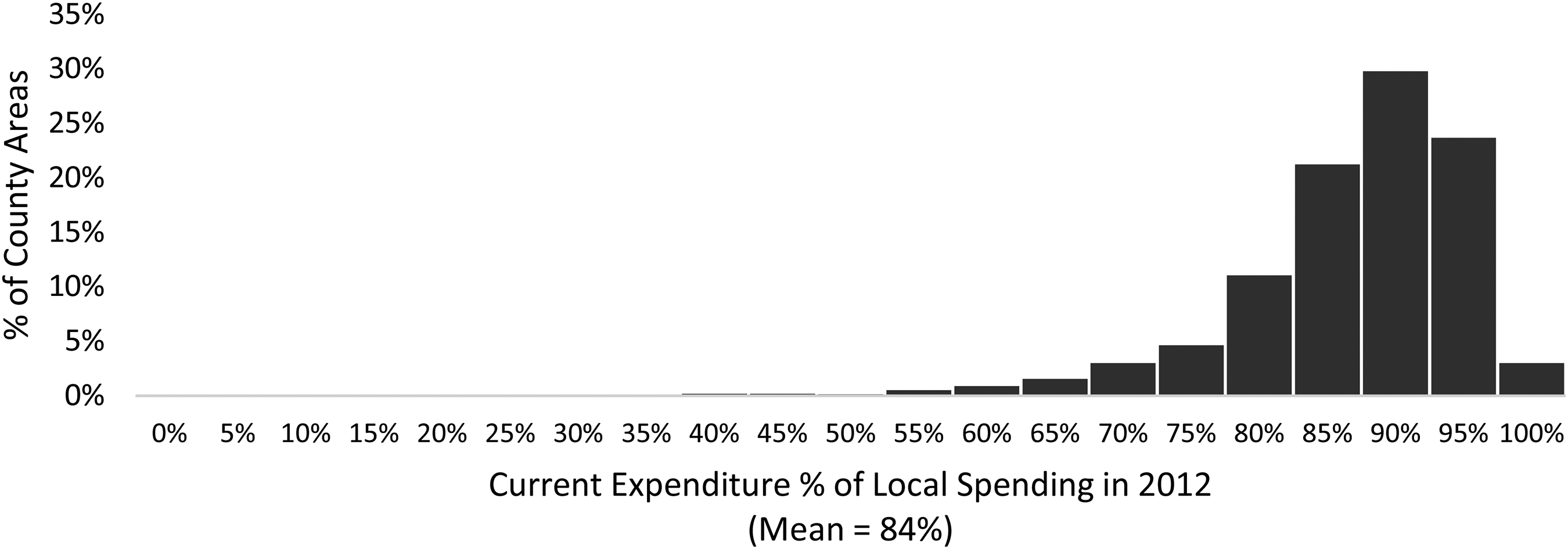
Distribution of the current expenditure share, US county areas, 2012.
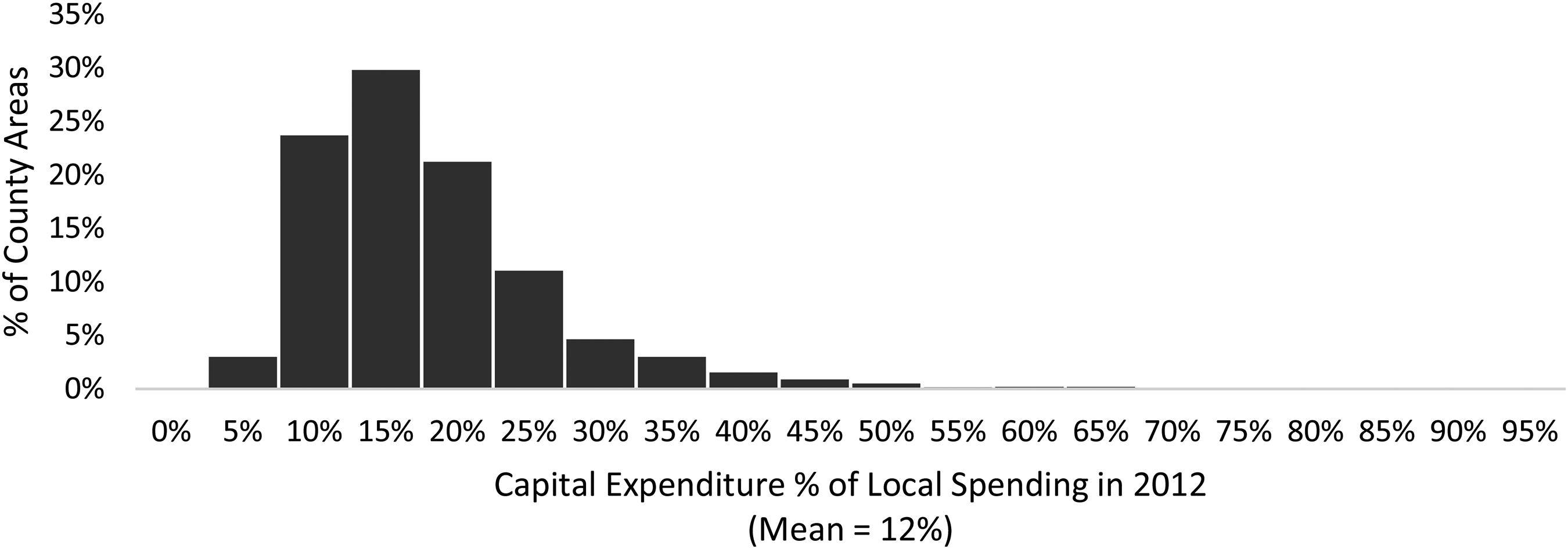
Distribution of the capital expenditure share, US county areas, 2012.

Distribution of the Gap between current expenditure % and capital expenditure %, US county areas, 2012. Source: US Census of Government, 2012.
Independent Variables
We consider four sets of independent variables: state policy, demographic, place and economic structure characteristics. The descriptive statistics of model variables are shown in Table 1.
Descriptive statistics: US local govt. Expenditure Gap and Growth.

N = 3098, U.S. County Areas excluding Alaska, Hawaii, Washington, D.C.
1Census of Government 2012.
2American Community Survey 2005–2009.
3American Community Survey 2009–2013.
4Office of Management and Budget 2010 Standards and its 2013 Code.
5 US Census 2010.
Intergovernmental transfers are another critical measure of state policy, including state aid per capita and federal aid per capita. State aid to local government is more important than federal aid due to its larger magnitude. According to Table 1, state aid per capita is $1490 on average, while federal aid is only $171 per capita in 2012. Theoretically, intergovernmental transfers should have a substitutive effect to reduce the gap between current and capital expenditure, so that localities are fiscally capable to match public goods and services to local needs in a growth-enhancing way. But in the world of “broken” fiscal federalism, this may not be the case.
Demographic Characteristics
With respect to demographic composition, places with a higher percent of dependent population, which are elderly (over 65) or young (under 18), are expected to have higher crowd out effects, as these two age groups require more local government services (Warner and Zhang, 2020; Wolf and Amirkhanyan, 2010). A higher percent of people in poverty will also increase local need and require more current spending by localities (Donald et al., 2014), but this response may be lower in communities with more minority populations (Kelly and Lobao, forthcoming). These measures of demographic need are expected to be negatively associated with local growth. The percent of residents with a bachelor's degree measures the human capital of localities and is assumed to be positively associated with local growth (Reese, 2012).
Place Characteristics
We also consider spatial dimensions of local places. Urbanized counties and rural places are expected to be more likely to experience fiscal stress and thus, have higher crowd out under decentralization. Urban places have higher concentrations of poor and other groups in need. Tax base and fiscal resources are limited in rural places, but the cost of service delivery is higher due to low density (Warner, 2006). We use the Office of Management and Budget metropolitan code in 2013 to delineate urban metro core counties and the percent of rural population to capture places with more rural settings.
In addition, we use the share of postwar housing built in the 1950s and 1960s as a proxy for communities with old housing and infrastructure (Lucy and Phillips, 2000; Xu and Warner, 2016). These places would be especially hurt by crowd out, as their needs for infrastructure replacement are high. The GINI coefficient of income inequality is included to capture places with high inequality. Places with higher inequality may have lower crowd out effects because elites may push for more capital investment despite high local need for current expenditure.
Economic Structure
In the growth equations, we also control for local economic structure 7 , using the percent of representative occupations in the local economy, such as mining, manufacturing, F.I.R.E. (financial, insurance and real estate), services (education, health and social services) and public administration.
The structural equation models are listed below. Equation
where:
Model Results
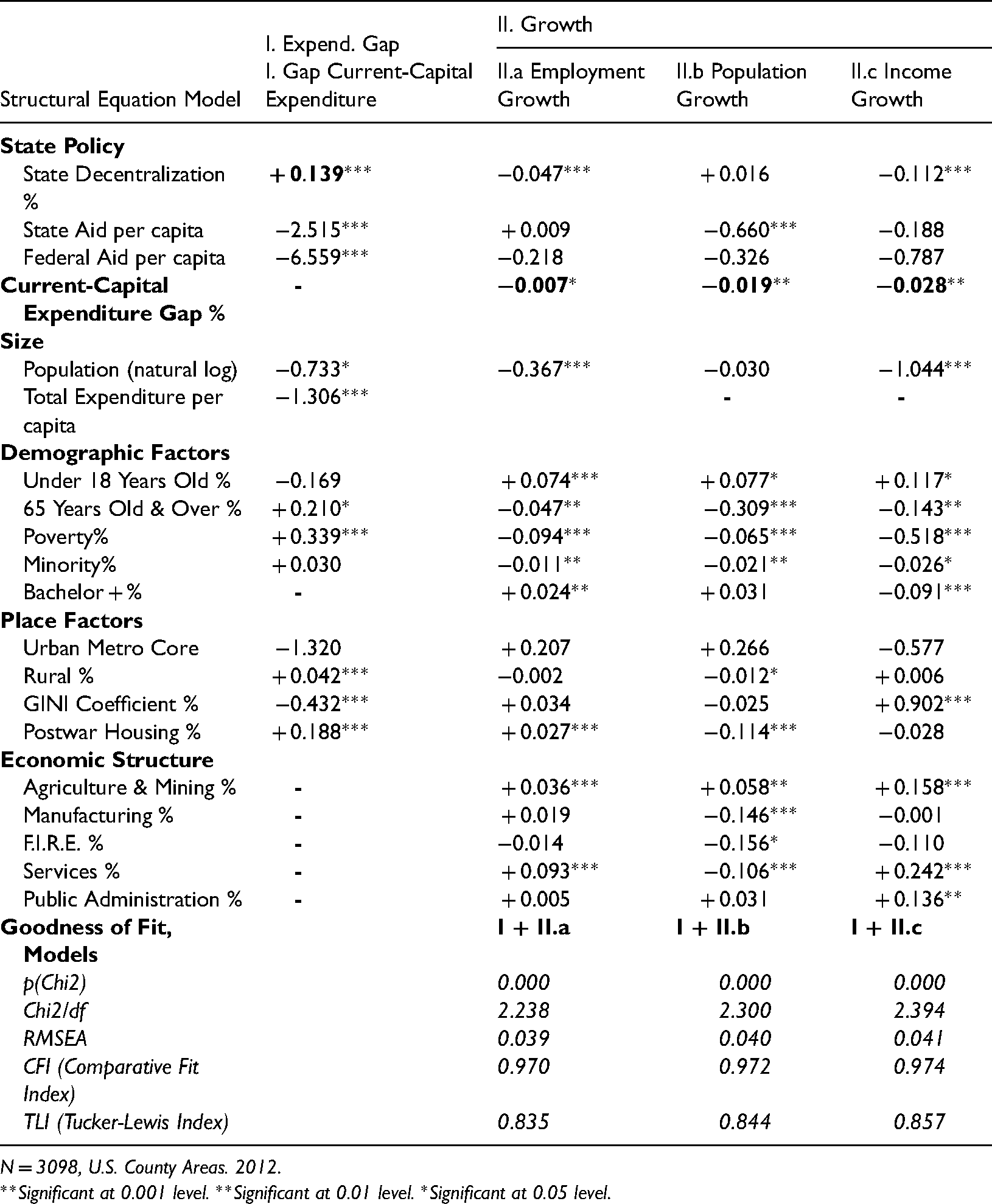
In STATA, we ran our SEM model of Equation I and II three times with different economic growth measures for Equation II. Model results are shown in Table 2. We ran the goodness of fit test (McDonald and Ho, 2002) to examine the validity of our SEM models 8 . We also ran the models using robust standard errors and found results are robust (see Appendix). This model gives a more comprehensive picture of the effect of fiscal decentralization on growth, by modeling the effects of decentralization on local expenditure structure (Equation I), and the effects of decentralization and expenditure gap on growth (Equation II).
Structural equation model results, US local govt. Expenditure Gap and Growth.
N = 3098, U.S. County Areas. 2012.
**Significant at 0.001 level. **Significant at 0.01 level. *Significant at 0.05 level.
In Equation I, fiscal decentralization is associated with a higher expenditure gap between current and capital spending (crowd out). County areas in states with higher decentralization have higher expenditure gaps. In Equation II, this gap negatively affects local growth. From Equation II, we see the direct effect of decentralization on local growth is also negative. Therefore, decentralization has both direct and indirect negative effects on growth. Rather than promoting developmental expenditure, decentralization leads to more crowd out of capital expenditure and this leads to lower growth.
From Equation I we see that intergovernmental transfers reduce crowd out. Both state aid and federal aid reduce the gap between current and capital spending. Although the impact of federal aid on the expenditure gap is almost 2.5 times the impact of state aid, the magnitude of state aid is almost 10 times that of federal aid, which makes local fiscal stress more sensitive to the volatility of intergovernmental transfers from state government. Equation II shows intergovernmental transfers do not directly affect local growth, except that state aid is lower in places with less population growth.
Our measures of size show county areas with more total local government expenditure per capita have lower current-capital expenditure gaps. Places with larger populations also have lower expenditure gaps, but these larger places have less employment and income growth.
Equation I also shows the expenditure gap (current-capital) is driven by local demographic need. The gap is greater in places with more seniors and more poverty, but not in places with more children and more minorities. This could be because counties with more minority poverty do not spend more to serve them, a racial inequity effect found in other work by Kelly and Lobao (forthcoming). In Equation II, we also see that higher need (seniors, poor and minorities) has direct negative effects on all measures of local growth as expected. Places with more children under 18 have higher growth (all measures), and places with higher education have higher employment growth but lower income growth.
Place characteristics show the local expenditure gap is higher in county areas in more rural settings, but not in the metro core. Counties with older infrastructure (as measured by higher postwar housing share) also show a greater gap between current and capital spending. In Equation II, these “old” communities and rural places are also associated with lower population growth. County areas with more inequality have less crowd out in Equation I, as expected, since elites in such places may be able to argue for greater investments in capital expenditures, which are assumed to be growth promoting. Places with higher inequality also have more income growth (equation II.c).
Equation II also includes the direct effects of economic structure on local growth. Agriculture and mining are positively related to all growth measures. This reflects the resource boom in the post Great Recession period (Betz et al., 2015). By contrast, counties more dependent on manufacturing and finance, insurance and real estate (FIRE) have lower population growth, but no effect on income or employment growth. Service employment is negatively associated with population growth, but positive on employment and income growth. Education and health services have been leading economic sectors in the post Great Recession period (Sherman and Doussard, 2019). Finally, localities with relatively more employment in public administration have higher income growth, but not higher employment and population growth.
Discussion
Our analysis challenges the notion that decentralization promotes growth at the local level. Specifically modeling the role of the subnational state and unpacking the mechanism of crowd out in local expenditure structure helps to understand why decentralization undermines growth. Our cross-sectional county level analysis captures the spatial diversity of these effects and their implications for local economic growth.
Our models reveal the mechanism of potential crowd out under decentralization, where higher local current expenditures reduce local capital investment for growth. While redistributive responsibilities are critical in times of recession, capital investment for infrastructure and growth is important as well. Local governments need a balanced fiscal policy space, as argued by Pagano and Hoene (2010), but they are caught in a multilevel fiscal system where the subnational state has the power to shift expenditure burdens.
The subnational state is of increasing importance under decentralization - for its policies on decentralization of expenditure responsibility, as well as its policies on intergovernmental aid. Our results confirm the negative effect of decentralization found by Rodríguez-Pose et al. (2009), and show the importance of subnational state aid, and local context. Under decentralization the burdens on localities to fund service mandates are rising, particularly for current spending for social responsibilities (Kim and Warner, 2018b; Lobao et al., 2014). Localities may defer investment in infrastructure and other capital expenditure, but they cannot defer expenditures to meet social service mandates from the state. This is especially challenging for counties with larger aging populations, older infrastructure and in rural areas. A balanced portfolio of current and capital expenditures is needed to enable local governments to invest in both infrastructure and services, to further promote their growth and ensure social welfare.
This perspective may help explain how socioeconomic stress challenges local growth by shifting local spending composition toward more current expenditure. Future research could look longitudinally to see if this process has deepened since the Great Recession. However, Rodríguez-Pose et al. (2009) found the negative effects of decentralization on growth predated the Great Recession. It could be that the political pressures to shift expenditure responsibility from higher to lower levels of government, as chronicled by Gray and Barford (2018) in the UK and Kim and Warner (2018b) in the US, are now a core characteristic of decentralization. If so, fiscal federalism becomes a framework for scalar dumping, as suggested by Peck (2014), not a framework for fiscal efficiency as claimed by the earlier theorists (Oates, 1972; Peterson, 1981), nor a framework for “taming the Leviathan” of local government spending (Oates, 2005). Our models suggest local level governments are forced into expenditure choices by state policy, a result also found in other studies (Aldag et al., 2018). This shift toward mandatory expenditures undermines local capacity and may ultimately undermine citizen expectations of the state, a concern also raised by Streeck and Mertens (2013) and Gray and Barford (2018).
Our work contributes to the debates in both fiscal federalism and state rescaling theory. We enrich the theories by explaining why the potential economic growth benefits promised by decentralization have failed to materialize. Rodríguez-Pose et al. (2009) argue that the legitimacy of state and local government helps determine whether decentralization is driven by scalar dumping or by fiscal efficiency. Our models emphasize the role of the subnational state, and the differential needs and capacity of local governments. Subnational state policy has been shown to reduce the potential for inclusive growth (Warner and Xu, 2021) and limit local government power (Kim and Warner, 2018a). The differential spatial effects of state austerity impose fiscal burdens on local governments, which do not have institutional and collective power to push back (Gray and Barford, 2018; Kim, 2019a; Lobao, et al., 2018; Warner and Clifton, 2014). The OECD recognizes decentralization should be asymmetric to account for these differences in local capacity and growth (OECD, 2016; Allain-Dupré et al., 2020).
Conclusion
This study gives new insight into how fiscal decentralization functions, especially after the Great Recession. In contrast to the theoretical claims of fiscal efficiency, we argue that fiscal federalism is “broken,” because we find decentralization is undermining local economic growth by increasing the gap between local current and capital expenditure. The brokenness has two sources – the structural part (scalar dumping) is inherent to the multilevel nature of decentralization, and the socioeconomic part is driven by inequality. Both pressures are present after the Great Recession –scalar dumping by the state and rising local need. Thus, decentralization, rather than increasing the legitimacy and efficiency of local government, could become a tool to delegitimize local government as it becomes the face of declining services. This is the theme argued by austerity urbanism theory (Gray and Barford, 2018; Peck, 2014) and by a range of state rescaling scholars who see the state shrinking (Donald et al., 2014) and reducing citizen expectations for services (Streeck and Mertens, 2013).
Our contribution is to show the spatially varied nature of state rescaling and the critical role played by the subnational state. By identifying places with higher decentralization, higher expenditure gap (current-capital) and lower growth, our paper provides an empirical response to Rodríguez-Pose's (2018) call to focus public finance research on “places that don’t matter”. To build economic resilience we need to understand where and how decentralization results in crowd out rather than growth-promoting local fiscal policy. This perspective can help us better understand the connections between changing political and fiscal dynamics, local spending structure and socioeconomic context.
Our focus on intergovernmental aid, state level decentralization and the local tradeoffs between redistributive functions and capital investment under decentralization provides a fiscal lens through which to view the role of both the subnational state and local government in a multilevel governance system. Traditional fiscal federalism and decentralization theories give insufficient attention to the role of the subnational state. State rescaling theory offers a more dynamic and nuanced understanding of decentralization. State policy is critical, as crowd out is more common in states where decentralization is greater and state aid is lower. Not only are fiscal responsibilities shifted downward, but the results are spatially varied by local need and capacity. Crowd out is higher in rural places and those with more poverty and older populations. By undermining growth, crowd out leads to a vicious cycle of under investment, so decentralization leaves these places further behind. Fiscal federalism is broken. What is needed is more adaptive and spatially targeted state fiscal policy to support local governments in the post-Great Recession environment.
Supplemental Material
sj-docx-1-epn-10.1177_0308518X211053643 - Supplemental material for Crowding Out Development: Fiscal Federalism after the Great Recession
Supplemental material, sj-docx-1-epn-10.1177_0308518X211053643 for Crowding Out Development: Fiscal Federalism after the Great Recession by Yuanshuo Xu and Mildred E. Warner in Environment and Planning A: Economy and Space
Footnotes
Acknowledgements
This research was supported in part by funding from the Agricultural and Food Research Initiative Competitive Program of the United States Department of Agriculture (USDA) National Institute of Food and Agriculture (NIFA), grant number 2017-67023-26226.
Declaration of Conflicting Interests
The author(s) declared no potential conflicts of interest with respect to the research, authorship, and/or publication of this article.
Funding
The author(s) disclosed receipt of the following financial support for the research, authorship, and/or publication of this article: This work was supported by the National Institute of Food and Agriculture (grant number 2017-67023-26226).

Supplemental material
Supplemental material for this article is available online.
Notes
References
Supplementary Material
Please find the following supplemental material available below.
For Open Access articles published under a Creative Commons License, all supplemental material carries the same license as the article it is associated with.
For non-Open Access articles published, all supplemental material carries a non-exclusive license, and permission requests for re-use of supplemental material or any part of supplemental material shall be sent directly to the copyright owner as specified in the copyright notice associated with the article.
