



Abstract
Our contribution aims at providing a return on experience by describing and theorizing the tactics we developed to poach time, space, and resources in order to write. A series of neoliberal measures in French higher education during the last 20 years shape the context, and have consequences for the political and material economies of scholarly writing. We use de Certeau's concept of poaching, because the strategies that our institutions deploy exert immense pressure on our ordinary scholarly life. Consequently, writing economies have to resort to poaching tactics. We present some of the devices and fixes we have developed in this regard in terms of our teaching, supervision, and research activities.
We start by introducing our co-author Camille Noûs (Camille “We”); we don’t breach this person's anonymity by adding that they are affiliated with the Cogitamus (“We think”) research lab. Camille is a fictional, gender-neutral author created by French scholars and activists during the 2019 university strike movement to symbolize the collective and collegial nature of research, scholarship, and writing. This character was specifically designed to counter neoliberal, individualistic metrics in publication and university rankings, all binds endangering universities worldwide (van Houtum and van Uden, 2022). The latter two are crucial drivers of recent higher education reforms in France, which, for example, use mega-mergers (visible in our incredibly long and complex institutional affiliations) to climb international rankings. As a political statement, scholars are called to add Camille Noûs as a co-author. Consequently, Camille has now become one of the most cited French authors in all disciplines, ranging from STEM and health, to the humanities and social sciences. 1
Our work, and therefore our writing, is entangled in multiple binds. First, it is embedded in the multiple reforms that neoliberalizing French universities have been experiencing over the last 20 years. These reforms have related effects on scholarly work, daily routines, and collective operations. Second, French human geography and planning's provincial condition in terms of language, cost, and resources constricts our writing. This context weighs heavily on work time and practices, as well as on scholarly writing's material and political economies.
Our contribution aims at providing a return on experience by describing and theorizing the tactics we developed to poach time, space, and resources in order to write. We use de Certeau's (1980) concept of poaching, because the strategies that our institutions deploy exert immense pressure on our ordinary scholarly life. Consequently, our writing is only made possible by devising material trickeries, finding temporal interstices, and making space for our agendas, namely teaching and research. One of these tactics is the yearly informal writing workshop that we organize in the French Alps for our PhD students.
Neoliberalizing universities, French fashion
We cannot sustain a system where higher education has no cost for almost all students. (E. Macron, President of the French Republic, 13/01/2022) 2
The ongoing extensive changes at French universities have made writing as poaching a necessity. Universities in France, which are mostly public ones, are generally known for delivering good quality higher education at a bargain price, as part and parcel of the French welfare state. Fees usually range between EUR 350 and 1000 per year, and include social security and health coverage. This has led to a student body that is socially relatively diverse. However, since the mid-2000, these public universities have been targeted by a “carpet bombing” policy—a train of institutional reforms (Ravinet, 2012) that have affected their functioning and principles as public services profoundly. These reforms, applied by mostly right-wing governments, have implemented well-known new public management and neoliberalization devices (van Houtum and van Uden, 2022), with developing spatial inequities between universities as well as between regions (Baudet-Michel et al., 2020). The collision of two antagonist logics (public service vs neoliberalization) has produced a rather original case of resources-strapped, research-intensive community colleges (our first double bind), while some mega-mergers were undertaken to supposedly compete with Harvard, MIT, and UC in respect of international rankings (Table 1).
A summary of recent French higher education (2005–2021) reforms.
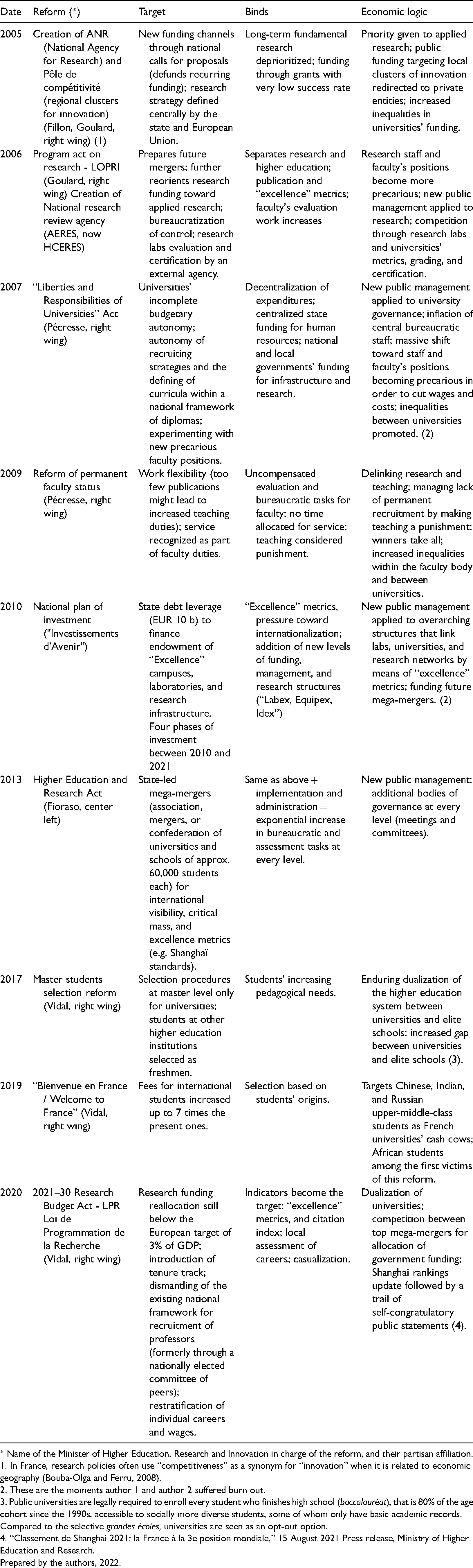
* Name of the Minister of Higher Education, Research and Innovation in charge of the reform, and their partisan affiliation.
1. In France, research policies often use “competitiveness” as a synonym for “innovation” when it is related to economic geography (Bouba-Olga and Ferru, 2008).
2. These are the moments author 1 and author 2 suffered burn out.
3. Public universities are legally required to enroll every student who finishes high school (baccalauréat), that is 80% of the age cohort since the 1990s, accessible to socially more diverse students, some of whom only have basic academic records. Compared to the selective grandes écoles, universities are seen as an opt-out option.
4. “Classement de Shanghai 2021: la France à la 3e position mondiale,” 15 August 2021 Press release, Ministry of Higher Education and Research.
Prepared by the authors, 2022.
The second key contextual aspect is austerity, leading to institutions bleeding staff (faculty and departmental support): there are no new job openings and staff members who retire are not replaced. This situation weighs even more heavily in the context of increased enrollment (the 2000 class). The situation that Gossa and Noûs (2021) describe is dire: Between 2012 and 2021, the number of opened associate professors positions in all disciplines and in the whole country has declined from 2099 to 1189 (−43%). About 710 full professor positions have also been defunded during the last 10 years (Academia, 2021). Finally, expenditures on students have decreased, since “the number of students increased by 25% in France between 2008 and 2021, while total higher education budget increased by less than 10% (in constant euros), hence a 12% fall per student expenditure” (Piketty, 2021). Again, the consequences have been spatially unequal, the Paris region and metropolitan universities being favored against more peripheral ones.
These intense systemic changes have far-ranging consequences for the work academics do, including writing. They have led to relative pauperization, 3 increased work hours, 4 and heavier administrative duties. Our work is spatially and functionally constrained by highly hierarchized, though multilayered clusters (Baudet-Michel et al., 2020; Bouba-Olga Ferru, 2008). We end off shouldering high transaction costs in extremely complex organizations, instead of benefiting from the intended economies of scale of mergers and restructuring. The fragmentation of work, with generalized overwork (Le Goix, 2020), related health issues and the subsequent cognitive load should not be underestimated. A report for the Higher Education and Research ministry by a collective of 23 societies from all disciplines identified the lack of research time unambiguously (Sociétés savantes académiques de France, 2019). Further, the when, how, and what we are allowed to write (and where we publish it) are also changing rapidly, suffering all kinds of structural, institutional, and political pressures and binds.
Another set of binds arises from the provincial nature of French—not Francophone—human geography. 5 Once dominant (a past that not many peripheral geographies share), it is now situated at the margins of the hegemonic, Anglo mainstream, although it still considers itself a center of Francophone geography (Houssay-Holzschuch, 2020; Houssay-Holzschuch and Milhaud, 2013). This provincial condition shapes our economies of writing in very specific ways, because writing in French for Francophone audiences is still valued, including for career purposes, while writing in English has become more common and desirable. Writing in two languages doubles, if not squares the work (Curry and Lillis, 2014). It is not only a question of the necessary linguistic skills, but requires mastering a double set of writing norms. These norms differ on how to structure a paper or even a paragraph (there are no topic sentences in French), how to deal with referencing, how to combine theory and empirical analysis, etc. In fact, writing in both languages entails deliberate, reflexive, and time-consuming work to unpack the French scientific writing norms into which we have been socialized since the first grade, in order to learn Anglo ones.
This last writing issue is profoundly embedded in material economies. Our institutions across the world tend to ignore the material economies of writing (space, time, financial resources, etc.) if not actively erase them. Publication metrics rule while the institutional responsibility of providing the material conditions and funding to reach that target disappear (van Houtum and van Uden, 2022). It is especially true of provincial or marginalized institutions in an Anglo-dominated world: writing is indeed “spatially contextual.” 6 In our French context, schooling, teaching, thesis writing, and methods courses are available in French. However, there are few similar resources to learn how to write in English, bar the few days of training that graduate schools offer, which are nowhere near enough. Accessing international literature and the editing of non-native speakers’ English are additional needs that are either ignored or simply not met. A 2014 AAG paper in a session on “Publishing for Non Native Speakers of English” by Brazilian scholar Joseli Maria Silva addressed this issue of publication costs. She found that the cost (translations, access to references, etc.) of writing one publishable paper in English (comprising only two versions) was 4000 reals (circa USD1700 current). 7
Under austerity, France's wealth does not trickle down to universities, making the cost of publishing in English an important hurdle for French human geographers. Translating, proofreading, and editing consume a substantial part of research budgets. Access to international journals can also be an issue. Ten years ago, neither of the authors, while tenured at prestigious institutions, had legal access to journals such as Environment & Planning, Urban Geography, or Antipode. In such material conditions, it is even more difficult to get to know, learn, and practice the norms of writing that Anglo editors expect.
Last, the recent and violent political attacks on critical scholarship in France (by French President Macron, Minister for Education Blanquer, Minister for Higher Education and Research Vidal, and by the right-wing media and the extreme right) have produced a new double bind. We are required to publish internationally, but engaging with crucial international issues, such as racial discrimination, gender issues, feminist epistemologies, decolonial endeavors, or intersectionality, all of which are decried as US imports, makes one a target. 8
There is no writing, only having written: Poaching tactics
Given the marginal time allocated to research, it is safe to say that our institutions do not care about our writing. They just want us to be published in ranked journals. Practicing “engaged pedagogies of writing” (Dufty-Jones and Gibson, 2021) requires acknowledging and working within these layered multiple binds. This entails carving an interstitial space for writing, collectively, and engaging in “poaching tactics” (braconnage, De Certeau, 1980) comprising poaching time, poaching space, and poaching resources. It aims at reframing writing from a metrics-oriented commodity, back into “an exchange free-for-free economy” of mutual aid. 9 Expliciting these ways of doing, showing students the messiness of our (senior faculty) writing processes are important parts of such engaged pedagogies. Since 2018, we have jointly organized an annual week-long writing retreat for our current and former PhD students, and mentored younger colleagues (Houssay-Holzschuch et al., 2022). A prerequisite for joining this retreat is that everyone, including the supervisors, needs to write a text, for which they have already done the preliminary work (bibliography, coding, selection of empirical materials, etc.). We use this experience to exemplify how our poaching tactics work.
Time
We all struggle to find sufficient writing time. Having some requires actively taking it from other duties, and, due to institutional pressures, constructing collective and discrete shelters to first reclaim and then protect colleagues and students’ writing time. This requires proactive time management: Every year it is a year-long struggle to find the five days for our writing retreat, and, once scheduled, to fiercely guard them against bureaucratic assaults on our time (seasonal committees, last minute meetings, another spreadsheet reporting, etc.).
These retreats have proven remarkably effective for writing, including our own. They occur despite the institution. Although the retreats are dedicated to supervision work, and are productive in terms of publications, they are neither recognized as teaching duties, nor as legitimate academic work time. Although our absence from office is official and authorized, bureaucracy does not consider this as legitimate as traveling abroad for a conference. Every year, administrative staff and colleagues call each of us almost every day over our personal cell phones to request ancillary tasks even though our working day starts 2 h earlier than the students’ to tackle such tasks.
Within this poached, suspended bubble of time, writing time becomes highly structured, even ritualized. We reorganize time in an almost monastic manner. The way we structure daily work is part of teaching time management in academia, but, crucially, on our terms. For five days, the daily work follows the pomodoro principle, that is, a series of 25 min sessions with a break of 5 min after each one (Cirillo, 2018), which maximizes efficiency, but leaves room for informality. The typical 8 h writing day begins with 10 min of free writing, which allows people to start filling the blank page but also to start loosening the form of academic writing and reach “authorial freedom” in spite of class, race, gender barriers, or professional status (hooks, 1999). Thereafter, we state our daily goals (refining the objectives of what can be realistically achieved). A leisurely lunch break interrupts this writing. The end of the day is dedicated to providing feedback on each other's writing, before starting a last pomodoro devoted to implementing these suggestions: the retreat thus provides donated, shared, and mutual readers, to paraphrase Butler’s (2005) “rented” ones found in workshops. We give mini-lectures, often over lunch, during which we frame writing issues, such as publication and career strategies, how to build an argument, the principle of peer-review, how a journal works, techniques for submission and review, the meaning of gatekeeping, etc. Students are always given an opportunity for one-on-one discussions with their supervisor in order to tackle a specific issue they encountered during their writing, which therefore provides individual mentoring within the communal rhythm (usually during a pomodoro). Evenings are free but collective, and we emphasize the need to take care of the bodies that write with physical activity, healthy food, and rest. Collective tasks are undertaken in turn. Rituals (free writing, goal setting, each pomodoro, feedback, and eating together) frame the day. Writing therefore becomes a habit that is entangled with everyday life (Butler, 2005).
Space
Pacheco-Vega (2021) insists that there are links between “developing a structured daily routine for writing” and the place or spots this is done. This begins with material office space (a luxury not all faculty has) that often needs to be openly reclaimed for writing. Van Every (2016) suggests that we hang a “do not disturb, I’m writing” sign on our doors to make writing time visible in our workspace. Within or outside our institutions, other spaces can also be temporarily claimed for writing.
Our retreat is a pop-up, extra-territorial space, a temporarily repurposed family vacation house in the Haute-Savoie countryside of Menthonnex that accommodates a dozen of scholars. A garden, a large kitchen, communal rooms, and large tables comprise the amenities on which the collective work is based. Writing takes place in these communal spaces, where the presence of others sustains and witnesses it. Internet bandwidth and access are scarce. In these multiple, shared spaces, personal writing spots are set up, to which the scholars return ritually throughout the retreat. Conversely, the shared bedrooms are not a work space. Computers are spontaneously left sleeping in working spaces. This extraterritorial, poached space that we create is an enclave, sustained from afar, by similar international experiences, and the references we share with these students, as well as by earlier social networks discussions, and local relays : here again, writing is spatially contextual.
Resources
In our cashed-strapped institutions, we also need to provide, channel, and reinvent resources to offset the cost of writing, through solidarity, redistribution, and mutual aid. We provide know-how and skill building (including how to poach). We teach how to access international literature, relying on open archives’ versions (institutional archives like ArXiv or HAL, or illegal ones like sci-hub and libgen). We share books, references, and online resources we deem essential for formalizing writing practices. Some are classic geography papers (Eyles, 1988; Johnston, 1988), others recent books on analyzing writing as a process (Belcher, 2019; Blunt et al., 2015); and yet others are blogs comprising unique resources and practical advice (Cayley, 2021; Pacheco-Vega, 2021). Alas, there are very few French language resources, but this lack stimulates discussions of provincialism and hegemony in terms of writing, publishing, and norms.
Other resources need to be channeled toward this retreat, which operates without dedicated funding, because there is no institutional budget. When possible, we do, however, use “Robin Hood” funding by redirecting leftover grant money toward travel costs. The accommodation is free of charge thanks to family solidarity. Food costs are shared, and kept to a minimum, without affecting the quality, with the supervisors regularly offsetting some of the costs. We have also invited English-speaking colleagues and friends to the retreat, depending on opportunities to do so (e.g. traveling by), which allows for more in-depth explanations of English writing norms, and editing. Poaching is therefore required and a practice. It is also a choice: Running a more institutionalized workshop would mean obeying institutional rules and accommodating all of the graduate school's students; therefore foregoing the freedom and collegiality with our PhD students. Our writing retreat's quality arises from its exclusivity and the interpersonal trust relationships built over the years. Poaching doesn’t happen en masse.
Last but not least, during the retreat, we refashion the collective as a resource, thereby going against the grain of existing hierarchies, individualized careers, and competition between institutions and between researchers by socializing our students into more communal ways of writing and doing research. Horizontal relationships and mutual aid are foremost—not only do the students provide one another with feedback, but they also read our (their supervisors’) texts and provide feedback at the end of each day. On several levels, our own shitty first drafts are very educational, ranging from the writing craft's revealed difficulties and traps to the political gesture of revealing our vulnerability to our students. Thus, we also smuggle back and normalize the emotional dimension of writing—fear, discouragement, or “rapture” (hooks, 1999).
Conclusion
Our poaching practices for “engaged pedagogies of writing” (Dufty-Jones and Gibson, 2021) are not limited to the Menthonnex retreat, as we also try to open up other spaces for writing. Our tactics are collective, embedded, and opportunistic. They start by making writing and writing time visible to colleagues, students, and institutions. The tactics are collective, not only because individual efforts often fail given institutional pressure, but also because our respective writing is made possible by our discussions and the support of some of our colleagues. The tactics are embedded in our respective contexts—rapidly changing institutions with heavily regulated teaching and the State supervising agency HCERES formally approving each course every five years (Table 1). For instance, Renaud inherited a pre-existing graduate writing course that his PhD advisor established (this is intergenerational capital), in turn transforming it into an officially approved writing workshop for students. Such tactics are opportunistic, as they use every possible interstice. At Grenoble, Myriam, the head of the “Social Justice” research group, started a weekly writing workshop for colleagues and PhD students. Such opportunities expand as we grow in seniority, if not wisdom, and reach relative positions of power.
Writing costs money, takes time, and requires space. We have therefore forged devices to foster and teach writing, because our institutions do not recognize writing as legitimate work. Nor do they provide the resources required for writing. Nevertheless, many institutional career incentives are designed to recognize successful publications through career promotion, recruitment procedures, awards, “excellence” bonuses, and, obviously, research funding. Camille Noûs was specifically born to fight this system. However, we, as academics, also collectively fail to recognize writing as work embedded in practices, teaching, and working time. It remains invisible to our institutions, funders, managers, and colleagues. This is why one element of our tactics is not poaching—or is it? We brag about our poaching, including here, making it visible. Uncovering writing's material and political economies is necessary so that, as scholars, we can collectively reclaim writing, and teaching about writing, as work and craft.
Footnotes
Acknowledgements
We wish to warmly thank the editors of this special theme for inviting us to the conversation. We thank the reviewers for the kindness and accuracy of the review, and the elegance of their wording. We gratefully acknowledge Ilse Evertse's language editing, and IUF's funding thereof. Warm thanks to the #Menthonnex team: “We have opened the space for writing. Let's make it hospitable.”
Declaration of conflicting interests
The authors declared no potential conflicts of interest with respect to the research, authorship, and/or publication of this article.
Funding
The authors disclosed receipt of the following financial support for the research, authorship, and/or publication of this article: This work was supported by the Institut Universitaire de France.
