




Abstract
The domestic work sector in India has been absorbing an overwhelming proportion of workers who migrate from rural and semi-urban spaces to cities for employment. The supply of workers is driven by multiple unregulated intermediaries, which expose them to multiple modes of exploitation before and after the point of placement. We compare digital platforms, which have recently entered the sector as intermediaries, to traditional placement agencies as pathways to livelihood opportunities in the domestic work sector. We shed light on the placement routes for domestic workers in the platform economy by comparing it with the larger informalised domestic work sector. We also compare the impact of different types of digital platforms and traditional intermediaries on migrant workers and the supply chain of migration.
The analysis is based on qualitative inputs provided by domestic workers in two Indian cities – Delhi and Bengaluru as well as inputs from platforms, unions and government agencies. This primary data when situated in the context of traditional modes of intermediation presents the inadequacies of platforms in overcoming the challenges of the institutional ecosystem for migrant domestic workers. We conclude that the histories of intermediaries and work arrangements in domestic work continue to shape the position of migrants in the platform economy.
Introduction
Rural–urban migrants have been one of the groups most vulnerable to economic shocks during the COVID-19 pandemic in India. Surveys on the impact of the pandemic have highlighted the dire straits that migrant workers, especially women, have found themselves in (Ghosh and Kaur, 2020; Menon, 2020). Migrant workers who have lived in cities for decades have been excluded from essential social protection measures. State support has been severely lacking due to the absence of systematic understanding of and data on migration in the country. In the aftermath of the first strict lockdown, domestic workers, who form a bulk of migrant women workers, reported a steep decline in income, lack of access to government relief schemes due to poor official registrations, water scarcity and poor health services (Ghosh and Kaur, 2020; Menon, 2020). In the absence of work, women migrants were forced to return home in distress, even as they remained invisible in public discourse (Sapra, 2020).
Domestic work absorbs a large majority of women workers migrating from rural to urban geographies in search of work or after marriage. We define domestic work as cleaning, cooking and child and elderly care – reproductive activities performed inside the home (Wadhawan, 2013). The sector has remained outside the scope of most legal protections, despite the poor conditions of work and unsafe recruitment pathways (ibid.). Women workers are recruited directly from villages through a tightly networked group of unregulated intermediaries or ‘placement agencies’ situated between workers and employers (International Labour Organization, 2015). Workers’ migration is often tied to these unregulated contractors, placing them at risk of trafficking and other forms of exploitation, including wage theft and bonded labour (International Labour Organization, 2015).
Digital platforms have entered this landscape with claims of formalising the intermediation process, by aggregating information on the demand and supply side as well as providing value-added services such as background checks or payroll management. The number of digital intermediaries in the sector has grown substantially over the last few years, with increasing appetite among customers for short ‘giggified’ and professionalised personal services (Kadakia, 2016). Recent literature has also pointed to the predominance of migrant workers in the platform workforce (van Doorn and Vijay, 2021).
Platforms operating in the domestic work sector in India have claimed that their models are more transparent and accountable than traditional placement agencies (Rathi and Tandon, 2021). Platform models indeed contain components that could introduce elements of formalisation in the sector, such as facilitating digital payments which can act as records of financial transactions (and therefore the work relationship), and digitally recording the granular tasks to be performed by workers. However, this is a selective form of formalisation that focuses on financialisation rather than the security of work or social security, as noted in ride-hailing and delivery work as well (Ticona and Mateescu, 2018; van Doorn, 2020). Nevertheless, domestic workers working with on-demand platforms have better incomes and more ‘professionalised’ jobs than those placed in the traditional economy (Rathi and Tandon, 2021).
Comparing digital platforms to placement agencies for domestic workers, Flanagan (2019) argues that the former are a historical continuation of the latter in fulfilling a matching role between workers and employers. She also finds other similarities, particularly the amplification of exploitation and worker profiling; the only shifts are in the modalities of data-driven management and surveillance. What remains to be understood in the literature on the platform economy is the potential digital platforms hold in impacting the ‘supply chain’ of domestic work, which depends on intermediaries controlling rural–urban migration corridors to recruit and place workers. Given the notoriety of traditional placement agencies in India and elsewhere as facilitators of unsafe migration, digital platforms could offer a viable alternative as intermediaries for migrant workers. It is also critical to understand how, if at all, platforms impact migrant domestic workers once they reach the ‘destination state’ in the migration corridor.
While there has been an undoubted creation of a rich body of academic literature on various aspects of the gig economy, the intersection of gig work and labour migration has been left relatively underexplored. This has been the case despite it becoming increasingly clear that globally, the growing dominance of gig economy platforms is being built on the back of mobilities and precariousness of transnational and domestic migrants (Bandeira, 2019; Barratt et al., 2020; Chen and Qiu, 2019; Das and Srravya, 2021). A lack of this orientation perhaps explains another blindspot in the academic literature on the gig economy – that of not exploring the recruitment pathways to gig work. Most scrutiny in academic work has been applied to the technological, economic and sociocultural factors leading to the growth of the gig economy, as also to the experiences and outcomes of doing gig work. Far less is known about the routes leading to doing gig work, and gig workers’ initial interactions with gig work platforms. While other literature on the platform economy has focused on formalisation and other outcomes of work after the point of placement, we shed light on the placement routes for workers into the platform and non-platform domestic work.
This paper seeks to fill these knowledge gaps by (i) comparing digital platforms with traditional placement agencies as intermediaries placing migrant domestic workers, (ii) the impact, if any, digital platforms have on placement pathways and outcomes for migrant domestic workers and (iii) how existing forms of discrimination and exploitation are impacted by the entry of digital platforms as intermediaries. Even though we focus on the Indian context, this paper can also throw light on the impact of digital platforms in the placement of migrant domestic workers in other contexts since unregulated intermediaries are key to global ‘care chains’ (Tayah, 2016).
The rest of the paper is structured as follows. The next section details the methodology of the study, followed by a background section discussing the evolution of intermediation of domestic work in India. The findings are structured thematically, comparing the extent to which migrants are able to access work provided by traditional and digital intermediaries, the variances in outcomes around wages and social security, and finally, shifts in risks of discrimination and exclusion tied to workers’ characteristics including migration status. The final section discusses the implications of the findings on the impact of digital platforms on migration in the domestic work sector.
Methodology
We undertook a literature review and primary data collection for this research. We reviewed literature discussing the growth of digital platforms in the domestic work sector, the impact of platforms on migrant workers, and the historical role played by placement agencies in matching and intermediating domestic work. We focused on literature from India for the role of placement agencies, particularly rural–urban intra-national migration and interstate migration corridors (rather than international migration from India). This is because digital platforms are primarily growing in the segment servicing domestic customers. Literature reviewed included academic sources such as peer-reviewed papers, and book chapters, reports from think tanks and international non-governmental organisations, and grey literature such as newspaper articles.
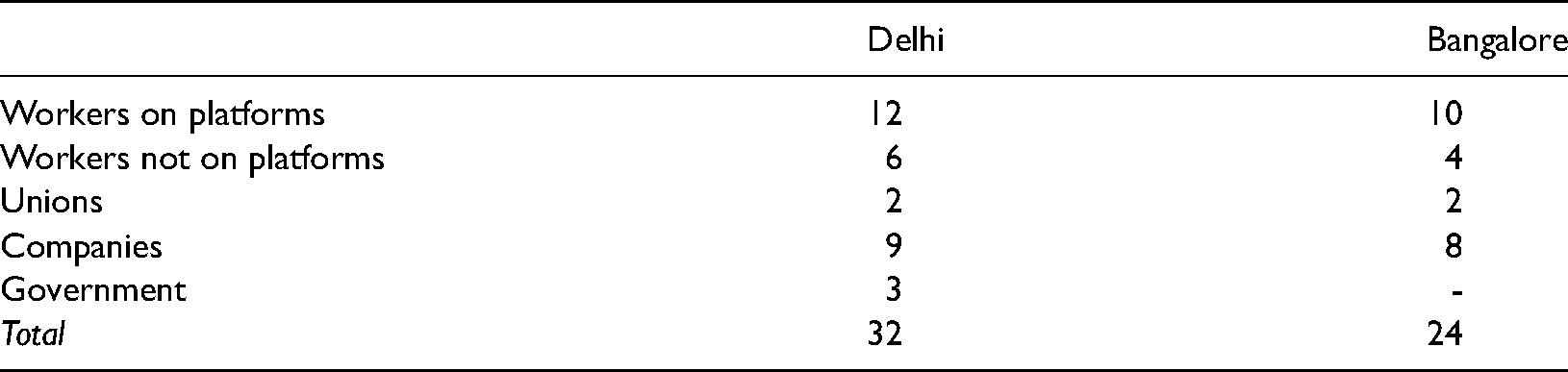
We also undertook 45 in-depth interviews with domestic workers, of which 22 were with migrants. The data included in this paper is drawn from the latter. We conducted interviews in two Indian cities – New Delhi and Bengaluru, both of which are prominent destinations for migrant domestic workers in northern and southern India, respectively. They have also been the sites for the concentrated growth of digital platforms offering domestic work services. The fieldwork was conducted in Hindi, Kannada and Tamil over a period of 5 months from June 2019 to October 2019 using semi-structured questionnaires. Most interviews were conducted in participants’ homes to ensure that the environment was comfortable for them. When this wasn’t possible, we conducted interviews at public sites such as tea shops or bus stops. The objectives, outcomes and data use and storage policies were verbally explained to participants, along with obtaining consent for voluntary participation in the study which can be revoked at any time. Oral consent was recorded in audio and when possible, written format.
Our field sites being metropolitan cities limited our findings to workers who had already relocated to cities before being recruited by digital platforms. The workers we interviewed were all first-generation long-term or regular migrants who had been living in the city for 1 year or above, as opposed to seasonal migrants who frequently move between cities and villages in the span of a year. Migrant workers interviewed in New Delhi were from Bihar, Uttar Pradesh or Haryana, while those in Bengaluru were from Andhra Pradesh, rural Karnataka, Tamil Nadu or Assam. We were unable to include workers in rural areas who might be seeking to migrate to cities in search of work. We address this limitation using interviews with representatives from workers’ unions to learn about challenges faced by workers when they first migrate to cities, and from companies to gauge their familiarity with and response to challenges faced by such workers.
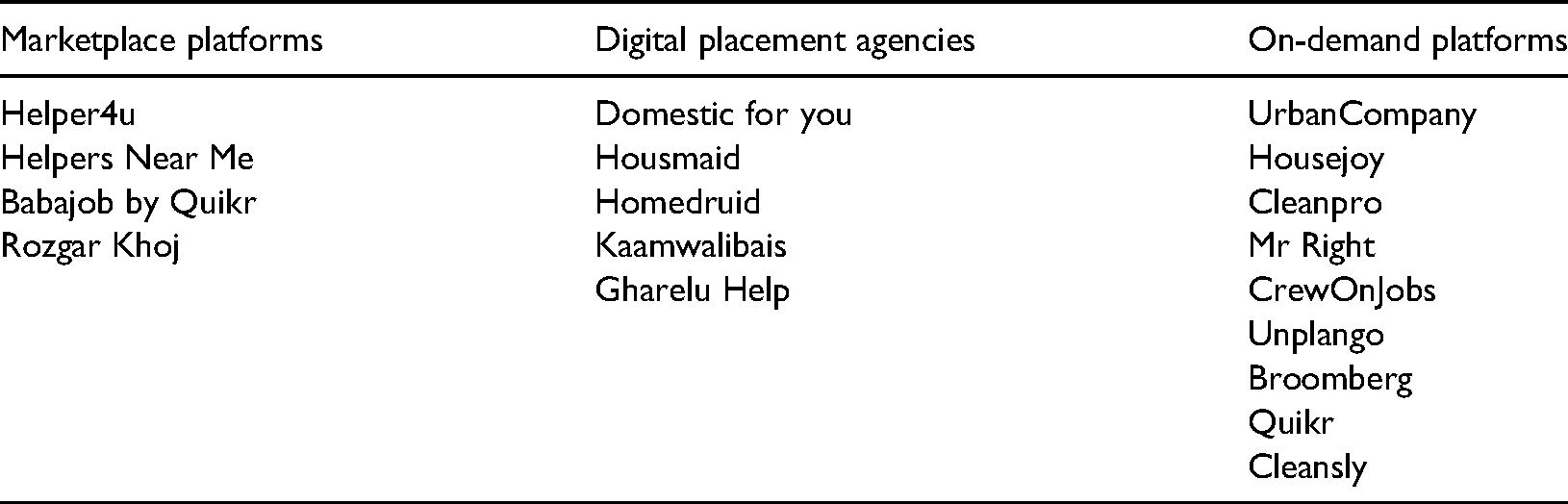
The primary focus was on workers who had been searching for (rather than necessarily been successful in finding) work on at least one digital platform. We also spoke to workers who had found work through traditional placement agencies and word of mouth referrals to undertake a comparative analysis of different recruitment channels. We interviewed representatives from 17 companies, 4 labour unions, 1 government-affiliated skilling agency and 3 officials from the government's labour departments for a holistic understanding of the challenges facing this ecosystem. The detailed break-up of the interviewees and names of platforms is provided in Tables 1 and 2. Through our interviews with platforms and workers collectives, we were able to identify challenges faced by migrant workers who might be looking to migrate to cities.
Distribution of survey respondents.
Digital platforms in our sample.
The interviews in New Delhi were conducted by the authors, while the interviews in Bengaluru were conducted by members and campaigners of the Domestic Workers Rights Union, a domestic workers union in the Indian state of Karnataka. We aimed to align our study with principles of Feminist Participatory Action Research such that women-centred and participant-driven knowledge production is emphasised, in which information comes from the community and is based on the lived experience of migrant women (Gatenby and Humphries, 2000). This approach also helped build evidence on the structural causes of power disparities that affect migration patterns and livelihood of marginalised workers.
Background: Domestic work in India and the evolution of intermediation
Offline placement agencies supplying full-time domestic workers to urban households have been predominant intermediaries. While the origins of placement agencies have been traced to church-backed initiatives, these quickly proliferated into very heterogeneous organisational patterns varying in scale, commercial outlook and service offerings (Neetha and Palriwala, 2011). Largely unregulated and informal in nature, it has been difficult to arrive at reliable estimates of their numbers.
Existing literature has explored the impact private labour market intermediaries have had on vulnerability and exploitation in the sector (Neetha and Palriwala, 2011). Placement agencies are associated with malpractices such as fulfilling customer demand for vulnerable workers who can be made to work in especially exploitative conditions, including bonded labour (Shakti Vahini, 2012). They are also known to traffic girls and women from rural parts of India to urban centres, where the demand for paid domestic workers is high (Andrees, Nasri and Swiniarski, 2015). This is enabled by a complete absence of regulatory oversight on recruitment and placement practices.
Domestic workers in India have not benefited from the prosperity of different intermediary groups and recruitment agencies that charge registration fee and/or commission from domestic workers and employers, and frequently engage in wage theft. A survey (Tandon, 2012) of 18 domestic workers in the National Capital Region revealed that those directly employed by a household, that is, without the intervention or facilitation of a placement agency earned an hourly wage that was four times higher than that for workers appointed through an agency.
Digital platforms have entered this market of intermediation which continues to be dominated by informal networks and unregulated placement agencies (International Labour Organization, 2017). Their attempt is to formalise recruitment for domestic workers by addressing information asymmetries arising from recruitment practices that rely on informal networks and word of mouth; and correct the classic demand–supply mismatch by providing employers ‘verified’ and vetted workers, and the workers with better paid opportunities. Several digital platforms such as UrbanCompany, BookMyBai, MyChores, Helper4u, MrRight.in and Bookmychotu. have sprung up in urban India.
Three predominant models of domestic platforms are identified (Rathi and Tandon, 2021). Each model had different implications on the risk and reward structure for workers. Two of these, on-demand and marketplace, have also been identified in literature (Ticona et al., 2018) in this and other sectors globally. Much like other sectors in which digital platforms have entered, platforms in domestic work claim to be market disruptors bringing efficiency to the demand–supply of workers. On-demand platforms exercise control over the recruitment process by algorithmically automating the matching of workers and employers. They also exercise control over tasks to be performed, wages and conditions of work. They place workers under extensive surveillance to monitor the quality of service. On the other hand, marketplace platforms create databases of workers’ profiles and provide tools such as sorting and filtering to customers. They do not intervene in setting tasks, wages or monitor conditions of work.
The third model of domestic work platforms operating in India is digital placement agencies. Perhaps unique to India and some other countries in the global South, digital placement agencies operated in ways akin to traditional, offline placement agencies. These platforms aggregate demand by soliciting customised demands of potential employers. The aggregated demands are then matched algorithmically or manually, or through a combination of both, with a domestic worker to identify the best fit. These platforms guarantee employers a worker that meets their precise demands, and provide a fixed number of replacements within a contractually stipulated time period if employers are unhappy with workers. Online placement agencies exercise control over several aspects of employment, including wages, hours of work, tasks to be performed, etc. They are very similar to offline placement agencies but use digital tools and algorithmic processes to enable recruitment, matching and placement. Additionally, unlike traditional placement agencies that demand payment from workers, registration with digital placement platforms is free of cost for workers.
Findings
Operational transparency
We begin by comparing the extent to which digital platforms and traditional placement agencies register and exist as formal entities, which impacts their visibility to the state and regulatory actors. Formality also manifests in the operational transparency of their business models.
Placement agencies have become notorious for exploiting workers and engaging in illegal activities such as human trafficking and wage theft. As a result, they also aim to evade identification by state authorities and employ tactics such as mislabelling their shop fronts (Tiwari, 2017), frequently changing locations and contact information and setting up small offices in inconspicuous locations (Neetha and Palriwala, 2011). Given the extent of operations in the state, the state government in New Delhi aimed to regulate these agencies through the Delhi Private Placement Agencies (Regulation) Order 2014, which mandated the registration of private agencies under the Shops and Establishment Act. Although 1650 agencies have been registered under this Act, it is estimated that thousands more continue to operate illegally (Tiwari, 2017).
Most digital platforms we surveyed operate with more transparency than traditional placement agencies. Fifteen of 17 platforms have been set up as digital-first, which implies that they have been set up as technological intermediaries offering matching and placement services. In other words, their business model, and subsequently marketing and brand identity, focuses on their role as technologically innovative aggregators rather than traditional digital intermediaries. This includes a mix of bootstrapped companies and those that have secured funding from venture capital firms.
The model of digital-first companies is thus very different from traditional placement agencies. The former, much like other Big Tech companies, aim to profit by providing domestic services at scale, while the latter's source of profit is largely the one-time fee they charge employers and workers. This difference also affects their transparency and engagement with workers, employers and the state–digital platforms aim for hypervisibility and market dominance, while placement agencies aim to fly under the radar. Accordingly, platforms invest in digital marketing strategies to reach workers and customers, while agencies use an intricate network of agents to connect to both sides of the market. For digital platforms, particularly on-demand companies, having a functioning office is useful for housing white-collar staff including developers, managers and business affairs personnel.
The remaining two platforms that we do not define as digital-first are examples of entities that started off as traditional agencies and then pivoted to include digital recruitment although offline operations remain their primary mode of functioning. As such, their investment in developing a digital identity and branding is also much lesser, and they continue to function as traditional placement agencies. Their similarity to placement agencies is also evident in such platforms aiming to fly under the radar – they maintain offices that are difficult to locate and have little to no information on their financial statements on their website or corporate filings.
Accessing opportunities through digital platforms
We find wide-ranging strategies employed by traditional agencies and digital platforms for recruiting and mobilising workers, which determines the extent to which migrants are able to access work through the two types of intermediaries.
Traditional placement agencies in the domestic work sector have deep networks in villages, where ‘local agents’ recruit young women and children and bring them to cities with the promise of finding work (Tiwari, 2017). Most traditional agencies depend on a wide network of paid agents who have roots in villages from where they recruit young women (International Labour Organization, 2015). Workers often migrate without having any prior networks in or knowledge of the language or culture of the destination city, leaving them completely dependent on agents (Neetha and Palriwala, 2011). Some agencies provide lodging and food to workers when they first reach the city for a brief period before they are placed (ibid.).
Workers who migrate without prior networks or through agencies find it very difficult to find work. When asked how newly migrated workers look for work, Asha, an office holder at a registered union in Delhi described the difficulties migrants face when they first arrive in the city, ‘They face a lot of problems. They ask domestic workers to help them find work, but if they don’t know anyone it will be very difficult. They first have to familiarise themselves with other workers then only they can ask for work. In the meantime, they have no support in the city.’ Another member from the same union corroborated this, ‘It can take anywhere between two to seven months for newly migrated women to find work. Workers don’t want to refer people they don’t know to employers, even if they know of openings. Only those people who have relatives in the sector find work quickly.’
Even though digital platforms’ models of algorithmic matching would be instrumental in providing a possible path to placement for rural–urban migrants, most do not fulfil this potential. Sixteen of 18 digital platforms we surveyed do not have networks or presence in rural geographies, despite a large proportion of domestic workers being first-generation short or long-term rural–urban migrants. All of these platforms focus their recruitment on workers from urban cities. Larger platforms tend to operate in multiple cities of varying sizes, and could offer opportunities to workers to migrate across these depending on their preferences. Smaller platforms are more likely to have localised models, wherein workers are recruited from within the city from which the platform operates.
Prateek, the founder of Housmaid, one of two platforms with a network in rural areas, told us that they primarily recruit from ‘Local villages where most workers are located. We are building a mechanism where you make…shopkeepers which are located in local villages a partner. We are making them our official partners and not workers. We incentivise shopkeepers to register workers. We have a network in every village nearby from where we directly source workers.’ The platform thus actively enables rural–urban migration. The other platform in our sample to source workers from rural areas is Domestic for You, a social enterprise founded by an activist who had previously worked with domestic work unions. The platform provides support to recent migrant workers by offering them temporary lodging and food, in a similar vein as traditional placement agencies. Unlike the latter, however, Domestic for You ensures timely payment of all monthly wages without charging a fee or commission.
All other digital platforms in our sample can be characterised as passive actors in the migration chain for domestic workers since their recruitment strategies rely on workers having existing networks or long-term presence in the destination city. This is in contrast with traditional placement agencies, which actively facilitate migration through a network of intermediaries from source to destination. We find that digital platforms can even directly benefit from this migration chain because it facilitates the movement of workers that they are then able to recruit.
The primary recruitment model of digital platforms is to recruit workers through their websites, although some adopt offline methods as well. The gender gap in internet use in India in 2020 was 40.4% (Nikore and Uppadhayay, 2021), with women in rural areas least likely to own mobile phones (NFHS-5, 2021). Union members we spoke to felt that low levels of digital access among women migrating from villages would prevent them from learning about or registering on digital platforms. Limited access and poor digital literacy indicate that women migrants would face significant barriers in registering themselves on platforms, even after relocating to cities.
Various platforms in our sample did adopt recruitment strategies accounting for the absence of digital access, even though online registration remains the primary mode of recruitment. Offline strategies are especially key in the initial stages of the launch of a platform since workers are unlikely to organically discover the platform without diffusion of information in workers’ networks.
One of the most popular offline recruitment strategies used by digital platforms is conducting onboarding camps in urban informal settlements that are known to have a high concentration of working-class communities, including domestic workers. In such camps, company representatives physically visit residential areas and manually collect details of workers and add them to their database. Another commonly used approach is advertising through pamphlets, billboards and other materials in and near informal settlements. A large proportion of workers we spoke to in these neighbourhoods were long-term migrants who had been living in the city for at least a year. We did not encounter any recent migrants, because the more permanent neighbourhoods targeted by platforms are more likely to be populated by workers who have a longer presence or existing networks in the city. This was the case in both New Delhi and Bengaluru, although more prominent in the former.
Some recruitment strategies employed by platforms have the potential to overcome these challenges and offer greater opportunities to workers when they first migrate. These include manual recruitment in peri-urban areas or a wider variety of neighbourhoods, ads in newspapers encouraging workers to register, going through middlemen such as watchmen and shopkeepers with networks across rural and urban areas. The latter strategy, being used by a marketplace platform in Delhi, had been particularly successful in registering workers. Another strategy is adopting referral systems, wherein new workers seek work through a platform only upon being referred by an existing worker. While for platforms this is a way to minimise background verification costs, two of the workers we spoke to had migrated to Delhi through these referral chains or because a relative was working for a platform.
The following section deals with the role played by digital platforms and placement agencies in the context of migrant workers, after the point of recruitment. As we argue, the limited role platforms play in the migration journey of workers also limits their intervention in formalising the supply chain of domestic workers.
Models of intervention
Traditional placement agencies are ‘distant’ intermediaries. Their role is to recruit workers from rural areas and facilitate migration through a network of agents. When workers first arrive in the city, placement agencies provide them support in the form of lodging and food for an interim period, and then place them in exchange for a one-time fee. The work arrangement could be ‘live-out’, wherein workers do not live with their employers and have relatively defined tasks and hours, or ‘live-in’, wherein workers live with their employer and are expected to be available at all hours and perform a variety of domestic tasks (Neetha and Palriwala, 2011). Placement agencies enter into standard 11-month contracts with employers, in which duration they are expected to provide ‘replacements’ for workers up to three times (ibid.). The agency negotiates workers’ wages and leaves per month. They might even be directing employers to pay them workers’ monthly wages instead of sending them directly to workers, which opens up opportunities for wage theft. Asha, from the Delhi-based union, told us that ‘Agencies are not regulated. I know a girl from Orissa who was brought here when she was 12. She has been working here for five years and was never given any money, everything the agent took.’
Marketplace platforms and digital placement agencies perform similar functions as their offline counterparts, by matching workers with employers on the basis of specifications provided by the latter. They are less directly exploitative than traditional agencies – all platforms in these types place workers free of cost, and do not charge any commissions from workers. As a result, even though the wages and conditions of work remain the same, workers are more likely to keep a higher proportion of their wages when placed through the marketplace or digital placement agency platforms. Sapna, a worker from Assam searching for work in Bengaluru, said that an agency she spoke to had asked for INR 3000 (USD 40.49) for finding a placement for her. ‘I told them I only have INR 1000 (USD 13.50) right now, you can take the rest later from my salary if you find me a job. They refused. I spoke to another agency, they also wanted Rs. 3000, and also will not give any salary for the first 15 days. They said if I tell the employer they will make sure I don’t get any work in Bengaluru ever again. Then I started with that other company for free [Helper4u, a marketplace platform].’
Marketplace platforms and digital placement agencies create easy systems of registration to maximise their reach since their model is contingent on creating large databases of migrant and non-migrant domestic workers and offering matching services customised to employers’ demands. Their systems are thus designed with relatively lower barriers to entry. Workers are only required to have intermittent access to basic phones for registration on the platform, and communication through regular call or SMS regarding placements.
On-demand platforms, on the other hand, disrupt the historical arrangement of domestic work relationships by breaking down domestic work into short professionalised tasks. Platforms market their workers as highly skilled and the hourly tasks they perform as being of higher value than those performed by ‘regular’ domestic workers. Hourly placements through on-demand platforms also ensure higher monthly wages than regular-term work domestic work. However, migrant workers face several barriers to accessing work through this platform type.
A prerequisite for working with on-demand platforms is regular access to smartphones, and high digital literacy to perform complex tasks. Several workers we spoke to faced difficulties in initially navigating the software interface, in addition to navigating the terms and processes of work. The learning curve for navigating the technological interface and complex systems of task allocation and price setting is smoothened by new or pre-existing networks of workers who are also working through similar platforms. Here again, migrant workers face immense challenges, often lacking the networks to effectively participate on on-demand platforms.
Nevertheless, regardless of platform type the benefits, risks and trade-offs of platform-based work are very different for workers that have low levels of digital literacy. Workers without digital skills have a lower understanding of the way in which platforms function or find them work, increasing the opacity of platforms for workers. They have lower levels of information about placement processes, the conditions of work to be expected and implications of ratings for their work.
Simra, one of our interviewees, was a Delhi-based domestic worker who had been registered on a marketplace platform by a relative. She told us that ‘One day a woman came to our [residential] camp. She said she will give us jobs, and registered over 100 workers, men and women. They said we will get work by getting a call, so most people registered. I don’t remember her name, or anything else about the company. I didn’t even remember them till you called…These people come and ask us questions and take photocopies of our Aadhaar cards. I am illiterate. I can easily be fooled by anyone who comes and pretends to register workers but is going to misuse my documents and personal information’. According to her, these information vacuums created trust barriers between workers and platforms. Simra told us that some workers in her locality had refused to provide their information and did not trust ‘outsiders who came with promises of jobs’ as their functioning is completely opaque to them.
In the absence of effective grievance redressal mechanisms, information gaps between workers and platforms are worsened due to the low levels of digital literacy among migrant workers in this sector. Workers without digital literacy are at a heightened risk of being excluded from opportunities in the platform economy due to the difficulties in grappling with platform modalities.
Reorienting formalisation
Migrants in urban India are initially exposed to opportunities in informal labour markets, including domestic work (Shonchoy and Junankar, 2014). However, they express a clear preference towards seeking work in formalised labour markets, largely owing to the security and rights associated with formalised work (Shonchoy and Junankar, 2014).
Digital platforms claim to push domestic work and other sectors in the informal economy towards formalisation, albeit without the protections typically associated with formal employment. For instance, on-demand platforms and digital placement agencies mandate the creation of bank accounts for workers which are used to make hourly or monthly payments, respectively, creating a record of financial transactions. This is particularly useful for migrants, as it allows them to create a record of domicile in the city, as well as a work history which, according to union members we spoke to, could increase their bargaining power while negotiating wages. Shanti, a member of an unregistered domestic work collective in Delhi, told us that ‘If we find work through online platforms, we will know that we have to do predetermined work for a specific number of hours and pay. Having these things in writing is very useful.’ At the same time, finding work through on-demand platforms with the legal status of independent contractors also makes workers eligible for the payment of requisite taxes that they are otherwise exempted from when not working through a digital platform (Sikarwar, 2017).
Another aspect of on-demand digital platforms that is much touted is its flexibility. If this had manifested in the form promised by platforms, flexibility would be particularly useful for long and short-term migrant workers. Four migrant workers we spoke to in Delhi and Bengaluru had lost their jobs because they took month-long leaves to travel home as opposed to taking regular weekly leaves. They informed us that this was the practice with other workers as well, as they chose to take leaves to visit home for festivals and social events. For instance, Pobhit Ram, a worker from Assam who was working with a cleaning company in Bengaluru, told us that he lost his previous job because he took a month-long leave to travel back home along with friends who were also working in Bengaluru. Upon his return, he found that he had been replaced although he had informed the employer about his arrival. He was then forced to find other work. Short-term hourly gigs provided by on-demand platforms, while relying on these vulnerabilities of migrant workers, could also relieve some of these pressures. However, dominant on-demand platforms such as UrbanCompany and Housejoy do not meet these expectations of flexibility as they penalise low acceptance rates and dormancy through measures such as deactivating workers’ accounts.
Some more elements of platform operations lead to marginal gains in bringing in elements of formality. Urban Company, a dominant on-demand platform, provides accident and disability insurance to a select category of partners who meet certain conditions such as high ratings; Housmaid, a digital placement agency ensures that all workers are paid their monthly wages on time by paying them out-of-pocket if the customer causes delays; and several marketplace platforms nudge customers towards meeting minimum wage standards in their state. However, this is the extent of formalisation – the nature of work continues to be precarious, and most companies do not provide other forms of social security or even paid leave. On-demand platforms exercise tight control over all aspects of the work relationship, including allocation of work, wages and performance assessment. Despite this they label workers as self-employed contractors, offering no income or social security.
Digital placement agencies and marketplace platforms do not shift the nature of domestic work arrangements at all, placing workers in traditional regular or part-time live-in or live-out work. Their functioning is similar to traditional placement agencies, as they primarily fulfil a matching function with no interest in mediating conditions of work for an elongated period.
Interview findings also point to another trend – migrant workers are placed more often as live-in workers in single households, as opposed to live-out part-time workers with multiple employers. Placement agencies have also historically been sought out by high-income employers particularly to seek live-in workers, and digital platforms continue this trend (Neetha and Palriwala, 2011). Live-in work arrangements are feudal in nature, almost completely unstructured with no predetermined hours of work or tasks to be performed (Ray and Qayum, 2009). Live-in workers also earn lower monthly wages compared to workers who perform part-time work in multiple households. The founders of two digital platforms, Gharelu Help and Helper4u, told us that because of these reasons, local workers are reluctant to take up live-in work, which means that platforms actively recruit migrant workers for such jobs. One of them further told us that, ‘[Live-in] jobs are in the greatest demand, and those are the ones that get hired the fastest from our website because it's so cost effective. An agency will charge you so much more for the same service. 95 percent [of] migrants are placed in this category.’ The ability of migrant domestic workers to negotiate wages and determine the nature of work then continues to be limited even when recruited through digital platforms.
Some platforms across types facilitate access to social security such as insurance covers or cash transfer schemes being offered for workers in the informal sector by central or state governments. As such they merely register workers for schemes they are already eligible for, but this also becomes a source of support for workers who tend to face a range of challenges in availing these (Alfers, 2020). However, complete reliance on state-supported programmes poses additional challenges for migrant workers, as they are often excluded from the purview of these schemes that rely on state-level domiciles (Bakhla et al., 2020). They also face additional challenges in securing necessary documentation for availing these schemes as they have identification documents from their home states rather than the ones they migrate to (Alfers, 2020; Abbas and Varma, 2014). For instance, two respondents, both migrant women from Andhra Pradesh working in Bengaluru, said that they chose to travel four hours to their village every time they needed medical assistance because Karnataka state medical centres and hospitals refused to give subsidised treatment without a domicile certificate from the state.
The conditions of work and long-term outcomes for migrant workers remain similar when placed through traditional agencies or digital platforms. Marketplace platforms and digital placement agencies in particular simply substitute human recruiters for a data-driven approach using algorithmic matching. This makes little difference to workers’ wages, nature of work or bargaining power. This is most evident in the continuation of the feudal live-in work relationship through platforms. As Flanagan (2019) finds in the context of Australia, on-demand platforms shift the nature of domestic work relationships by introducing worker fungibility for short hourly tasks. As such, although on-demand work offers higher wages than other placements, it also reduces workers’ bargaining power by maintaining tight control over all aspects of work.
Migrant workers face additional challenges while gaining access to and navigating platformised work, implying that outcomes of work are also determined by migration status. The following section showcases the ways in which this difference manifests in workers’ experiences.
Amplification of power imbalances in the digital economy
Feeding off domestic danger
All platforms in our study require identification documents to register workers, which excludes workers without documentation or with erroneous documentation at the stage of recruitment itself. Verification or background checks involve any or all of the following: verification through Aadhaar cards or other government documents, mobile phone numbers and home address, and criminal background checks or police verification. Some platforms also offer verification as a value-added service to be paid for separately in addition to the matching service. The deeply debated Aadhaar infrastructure, despite its failures in including migrant workers (Khera, 2018), is mandatory for verification on several platforms, and could lead to exclusion of workers who face challenges in updating details on the database (ibid.). Most migrant workers we spoke to have documents from their home states which may not work for address verification. Sumathi, an office holder in a Bengaluru-based union, informed us that ‘Even people who have been living in the city for decades find it difficult to get address proof. Certificates from the landlord or local political leaders count towards address proof, but these can be difficult to get. People might be discriminated against as well. I live in an area with lots of Bengali migrants, who are always under suspicion as illegal immigrants from Bangladesh. So they can’t get address proofs.’ Some have documents with errors in phone numbers or spellings, or need to update their details, which can be a cumbersome process. A worker at a slum in Delhi had been forced to make multiple visits to the registration centre, stand in line for hours, and when the official process was proving too time-consuming, was forced to pay a third-party agent INR 500 (USD 6.75) to get the errors fixed. Sumathi said that workers often resort to paying unauthorised agents to update their documents for exorbitant prices because of the inaccessibility of government offices.
Another common form of verification among platform agencies that is exclusionary towards migrant workers is procuring references from local relatives, landlords or prominent members of communities such as Members of Legislative Assembly to verify home addresses or testify good character. Acquiring such verifications can be difficult for most workers, but is particularly exclusionary for migrant workers as they may not have networks through which to procure such references due to their transient presence in the city.
Through such extensive processes of verification, digital platforms amplify exclusion in their design, often justified as a result of the non-negotiable demand in the sector to verify workers before they enter the intimate space of employers’ homes. Workers informed us that such requirements of verification are not as prominentin other more informal recruitment routes, despite being pushed by placement agencies and the state. These are now being specifically monetised by platforms as they present themselves as a source of ‘verified’ and ‘trustworthy’ workers (Rathi and Tandon, 2021).
The importance placed on verification and background checks in the domestic work sector in India contrasts with what has been found in the global North in the transportation sector, where undocumented migrant workers are encouraged to join platforms as a result of lower identification requirements (van Doorn et al., 2020). This speaks to illustrative differences in the nature of work in these sectors. Trust is key to employability in the domestic work sector due to its intimacy and its performance in the ‘private’ sphere of the home. The transience of work and interaction between customers and workers’ transportation and delivery work implies that trust is not as critical a factor. In India, domestic workers entering the homes of employers, who tend to belong to savarna or oppressive castes, are placed under a lens of distrust and surveillance.
In a highly stratified urban environment, domestic work is one of the most intimate interactions between people across class and caste hierarchies. Domestic workers enter the homes of upper and middle-class residents to perform intimate tasks including care work. In this context, workers have often been accused of coveting material possessions of employers, or posing ‘domestic danger’ (Waldrop, 2004). Such rhetoric is also aggressively pushed by the spectrum of digital platforms, with the exception of a few with a stronger rights-based orientation. For instance, Helper4u, a marketplace platform offers managerial advice to employers warning them that nannies will ‘be in your house when you are not around’, and recommends reviewing references, verification through social media profiles and caller ID apps to confirm that ‘there is no criminal tendency lurking in the background’, and interviewing workers to affirm the ‘kind of family’ the worker comes from (Helper4u, 2020). This suspicion leads to heightened surveillance, and further adds to the vulnerability of workers. Marketplace platforms and digital placement agencies leverage a rhetoric of inefficiency and risk around informal practices of hiring domestic labour, such as through word of mouth networks. Workers are then subject to two layers of surveillance – from the platform and the employer. This rhetoric is similar to historical patterns of workers’ surveillance – Waldrop (2004) explains how gates and other security measures around urban middle-class residential enclosures were directly related to the entry of domestic workers, who were the most regular ‘outsiders’ in such a space.
The rhetoric around domestic danger disproportionately impacts workers from regions that either share a fraught political relationship with urban metropoles, or send a high influx of migrant workers causing anti-immigrant sentiment. Union leaders informed us of the precarity of workers from West Bengal, who are discriminated against and stereotyped as undocumented immigrants from Bangladesh.
In addition to excessive verification and surveillance, intersectional factors could also impact the wages workers are offered. For instance, workers from Adivasi belts in Jharkhand and Chattisgarh have been documented as being offered lower wages than local workers from urban centres (Agrawal, 2014). The platform economy offers technological tools to replicate these forms of discrimination. All marketplace platforms and digital placement agencies allow employers to filter workers by demographic characteristics such as caste, religion and state of origin. According to company representatives we spoke to, these filters are critical because all employers demand workers with specific characteristics. Matching in the domestic work sector relies in large part on the demographic profile of individual workers, rather than their experience or skills. This form of discrimination has been prevalent in the sector traditionally, and is hard-coded into the technological affordances of digital platforms.
Discussion and conclusion
Situating gig work within domestic work genealogies
Placement pathways for domestic workers have historically been dotted with intermediaries, functioning as a layered matrix of unregulated placement agencies and middlemen that are notorious for highly exploitative practices. Migrant and non-migrant domestic workers in our sample interacted with these differently. For first-generation migrants with weak or non-existent social networks in destination sites, navigating the web of exploitative intermediaries is often the only route to earning a livelihood. Digital platforms do not offer any viable alternatives to escaping this nexus of agents. Platforms only exist at the end point of supply chains of workers – that is only in the destination cities, as opposed to traditional placement agencies which have deeper networks to bring workers from home states to destination cities. Digital platforms are unwilling to intervene in the exploitative networks that precede the safe arrival of workers, limiting their potential to enable safe and fair migration for workers.
Labouring in the platform economy has been the subject of intense, often polarising, social, legal and political debate. While the platform economy will have implications for the future of work, it still represents the latest manifestation of the ‘fissuring’ of the workplace and with it the erosion of standard employment relationships (Weil, 2014). These have been brought about by globalised modes of production and consumption (Stone, 2005). In other words, platform work is a salient aspect of a more familiar phenomenon – that of outsourcing labour-intensive tasks to poorly paid workers in the global South.
Parallelly, domestic work in India has also been characterised by socio-historical stratification at the intersections of gender, caste, class and race. The availability of migrant women's fluid labour has been central to the development and reproduction of capitalist and neoliberal societies, and domestic work has increasingly become an all-migrant occupation (Wadhawan, 2013). The platform economy continues to exploit the feminised labour of migrant workers. The sociopolitical history of the domestic work sector will continue to deeply inform the systems deployed by digital platforms. This is most evident in the variety of platform models that have witnessed growth in the mediation of domestic work services. While the on-demand model is closest to models that are more commonly associated with the platform economy, the marketplace and online placement agency structures are indicative of how the fungibility of workers is not typical to all platform work. Workers’ identities remain central to their access to work in the platform economy.
The study of platformisation of domestic work specifically, and care work broadly, has far-reaching implications on the understanding of labour in the platform economy. Most of the work on the subject of platformed labour has been conceptualised from the experiences of ‘crowdworking,’ ride-hailing and food delivery (De Stefano, 2016). These occupations are characterised by relative simplicity in their task compositions (Stanford, 2017), and their study has been insufficient in grasping the implications of platformisation of reproductive labour such as domestic work.
Intersectional policymaking and research on the gig economy
The introduction of digital platforms holds potential to professionalise domestic work and integrate piecemeal aspects of formalised work employment choices. Domestic work, especially within the platform economy, offers migrant workers an avenue to secure a livelihood in the absence of other choices (Mehrotra, 2018). However, similar to other sectors in the platform economy (van Doorn et al., 2020), this employment continues to be precarious and disadvantages migrant workers further in securing livelihoods and protecting their rights.
We find that access to the platform economy varies across categories of platforms and types of workers. Access to digital platforms as a potential recruitment channel is differently available to migrant and local domestic workers.
This is further problematised by the requirement of not just digital access, but also digital literacy in order to be able to effectively use digital platforms.
Marketplace platforms and digital placement agencies place workers at significant risk of discrimination, in a context where migrants are treated as ‘outsiders’, often ethnically and racially profiled, and seen as a threat by ‘local’ domestic workers as well. While filtering mechanisms codify discrimination at the stage of recruitment, one-way rating mechanisms imply that racial and ethnic biases can threaten workers’ wages and ability to continue finding work through the platform.
Digital intermediation of domestic work falls squarely at the intersection of several piecemeal legal frameworks and legislative vacuums. Labour and socio-economic rights of domestic workers, migrants and gig workers in India are either lacking or poorly implemented. Already relegated to a tertiary citizenship status, migrant domestic workers on digital platforms face further legal exclusions flowing from the requirement of identity documentation such as the Aadhaar becoming increasingly necessary for accessing citizenship or labour in India.. However, the historical continuities between offline placement agencies and digital platforms does not imply that migrant domestic workers don’t face any new risks. The comparison we draw here, between digital platforms and offline placement agencies, hopes to reiterate the need to broaden the demand for gig workers’ rights beyond their reclassification as employees. Formal employment need not necessarily be the panacea it is expected to be, and has for long evaded migrant workers and domestic workers in India. For example, as Ticona and Mateescu (2018) point out, formal employment is a surveillance institution making employees visible to the employer and state in new ways. These tendencies are further amplified by the financial and data-hungry logics of digital platforms.
Research on the gig economy going forward will need to engage with the experience of migrant workers generally, and migrant domestic workers specifically, in the global South through the entire supply chain of migration. An important line of analysis questions the implications that digital intermediaries claim to have on offering easy access to flexible work. We anticipate that this can aid in developing a language of collective action that can include workers across the gig economy. The material realities of paid domestic work have been characterised by similar kinds of drudgery, precarity and marginalisation that platform workers experience. Studying the strategies adopted by domestic workers historically, then also seeks to further crystallise solutions and responses to the challenges being posed by the supposed ‘disruption’ of labour in the platform economy.
Footnotes
Acknowledgements
This work is hosted at the Centre for Internet and Society, India, and supported by the Internet Society Foundation. It builds on primary research supported by the Association for Progressive Communication and the International Development Research Centre, Canada. The views expressed herein do not necessarily reflect those of the donors. Mansi Kedia contributed to an early version of this paper.
Declaration of conflicting interests
The authors declared no potential conflicts of interest with respect to the research, authorship, and/or publication of this article.
Funding
The authors disclosed receipt of the following financial support for the research, authorship, and/or publication of this article: This work was supported by the ‘Labour Futures' grant of the Internet Society Foundation, and the Feminist Internet Research Network project of the International Development Research Centre and Association for Progressive Communications.