




Abstract
Tax increment financing (TIF) is a mechanism used by municipal governments throughout the United States to fund public and private urban development projects. This paper examines the trajectories of TIF in the state of California and the City of Chicago, where the expansion of TIF as a mechanism for publicly financed development is inextricable from disinvestments in social reproduction and the transformation of public funding for K-12 education. Taking seriously the divergent paths of TIF in each case, we argue that the framework of social reproduction helps expand the scope of TIF as a “policy in place,” bringing into view other path and place-dependent factors that shape the adaptation and implementation of public finance mechanisms. Bridging the literature on urban policy and feminist political economy, we suggest that scholars must investigate the place-specific entanglements of social reproduction and public finance if we are to understand how mechanisms such as TIF are adopted, expanded, or curtailed within the broader framework of neoliberal urban governance. In making such an intervention, we expand on calls to attend to the ways public finance can heighten or mitigate economic inequality.
Introduction
Scholars have substantiated how internal crises within capitalism are resolved through spatial-temporal (Harvey, 2006 [1982]), institutional (Jessop, 2013; MacLeod, 2001; Peck and Tickell, 1994), and socio-ecological (Ekers and Prudham, 2015) fixes. Recent work has further emphasized that the stabilizing function of social reproduction is in crisis (Dowling, 2021; Fraser, 2016; Kunz, 2010) due to the neoliberal rollback of state and municipal support for education, childcare, health care, and housing. These crises in social reproduction are also a product of the neoliberal rollout of state support for private development and the financialization of both state and non-state resources. Extending this work, we offer here that examining public finance mechanisms as “policies in place” requires attending to the perpetuation and contestation of the ongoing crisis in social reproduction. To illustrate these claims, we examine the trajectories of tax increment financing (TIF) in the state of California and the municipality of Chicago, Illinois, with close attention to TIF's imbrication with education and other terrains of social reproduction. TIF, an urban development mechanism which draws on future property tax revenue, has become an important public financing source for municipalities. California was upheld as an early adopter of TIF, but in 2011 the state dismantled its Redevelopment Agencies after years of increasing school budget shortfalls, while the City of Chicago continues to be a controversial leader in TIF use. Examining the divergent trajectories of TIF in California and Chicago reveals the imperative of locating neoliberal urban development tools in relation to social reproductive processes.
Our analysis pulls on TIF to knit together the material transformations of urban property, social reproduction, and the structural transformations of municipal governance and finance. TIF is often presented as the quintessential example of entrepreneurial urbanism, involving real estate-led development aimed at boosting property markets to sustain wider economic growth (Hall and Hubbard, 1998; Harvey, 1989; Jessop and Sum, 2000; Ward, 2003). While this is a useful framework, in this article we engage the literature on urban policy mobility (Anderson and McFarlane, 2011; Clarke and Bainton, 2015; McCann and Ward, 2013; McFarlane, 2011; Peck, 2011) and social reproduction (Andrucki et al., 2017; Bezanson and Luxton, 2006; Bhattacharya, 2017; Katz, 2008; Meehan and Strauss, 2015; Mitchell et al., 2004) to better locate TIF as a contested “policy in place” at the intersection of social reproduction and urban development. TIF is a revealing public finance tool in this regard precisely because it functions as a critical interface, brokering the reallocation of tax revenue from social reproductive services to property development under the directive of neighborhood improvement. Our analysis of TIF illuminates how state disinvestment in social reproduction enables state investments in urban development as an accumulation strategy.
Leveraging the insight of feminist theories of social reproduction does more than illustrate how TIF articulates state-mediated relations of social reproduction and production; in other words, it does more than simply help us better understand the nature of TIF as a public finance mechanism. It also allows us to locate public finance within a wider terrain, showing how policies like TIF are shaped by contests over the provision of social reproductive services in addition to contests over economic policy. Such a move necessitates examining both how TIF and other public finance mechanisms act on city residents, programs, and infrastructure, and how they themselves are shaped by political struggles over social reproduction. In California, for example, TIF was abolished and transformed not because of its innate financial qualities as an economic development tool but because it became politically enrolled in the crisis in public education funding. In taking this approach, we counteract a tendency within TIF research to represent TIF as a one-way arrow that impacts communities, instead of as a relational mechanism that is also impacted and produced by urban politics.
Methodological approach
This article draws on Hart's (2018) notion of relational comparison to offer a comparative engagement with TIF in the state of California and the municipality of Chicago. Building on a Gramscian tradition of political economic analysis, Hart (2018: 375) argues for relational comparison as an examination of “how key processes are constituted in relation to one another through power-laden practices in the multiple, interconnected arenas of everyday life.” Relational comparison differs from comparative methods that employ a priori geographic bounded units of comparison and treat political, economic, and social forces as discrete billiard balls, colliding and ricocheting in distinct policy spheres. In this study, rather than approaching TIF as a fixed, stand-alone object of inquiry or presuming in advance that a city-city symmetrical comparison would be the most fruitful, we engage TIF relationally, asking how TIF brokers the articulation of state-sponsored capitalist development and the provisioning of social reproductive services in different places and at different scales. A relational comparative approach also highlights that scholars cannot presume the scale at which urban “policies in place” are produced and that there is much to gain from questioning a priori scalar assumptions and methodological structures. In our study, the scale of the comparison emerged in response to our research questions, which asked how the economic and political development and implementation of TIF policies were shaped by social reproductive practices and vice versa. We therefore problematize the idea that similar territorial units and scale are the “natural” basis for policy comparison. Doing so led us to compare Chicago (a municipality) to California (a state) because those were the jurisdictional scales at which the tensions between neoliberal urban development policies and crises in social reproduction were most visibly constituted and contested.
Comparing the municipality of Chicago and the state of California is compelling for other reasons as both are emblematic of the inflated successes and failures of TIF. Through this comparative study, the two divergent trajectories of TIF sharpen our understanding of the importance of public finance mechanisms in the conjunctural articulation of state-supported social reproduction, urban development, and real-estate-led accumulation. It further reminds us that urban policies are not only made across translocal urban networks but through the relational construction and negotiation of multi-scalar government agencies, financial organizations, consulting groups, social movements, and other actors. In sketching this relational comparison, this article draws on primary and secondary research including municipal and state legislation, agendas, development data, and other records from municipal, county, and state agencies, news articles, presentations, and reports from consulting and development companies, and materials and studies from nonprofit organizations and think tanks located in California and Illinois.
The mechanics of TIF
Tax increment financing is a mechanism that enables municipalities to use expected increases in tax revenues to finance initial and ongoing development costs in locally designated areas. Although the mechanism can be applied to sales and utility tax revenues, TIF is primarily used in relation to property tax collection. The basic operation for capturing revenues occurs as follows: when a TIF district is designated, the value of properties in that district is assessed and recorded as a baseline assessed value. Over the next 20 to 30 years, taxpayers continue to pay tax on the baseline property value as well as on any subsequent increases in property values. However, any increase in property tax revenue from growth in assessed value above the baseline, known as the increment, is diverted into special funds for development projects. Although TIF development policies vary depending on state legislation, most include a designation process for new districts and an outline of permitted expenditures (Weber and Goddeeris, 2007). Typically, the legislation necessitates that areas slotted for TIF must prove a level of “blight”—vacant lots, overcrowding, sanitation issues, deterioration, etc.—as well as evidence that the area in question would not develop “but for” 1 the help of TIF intervention (O’Neill-Kohl and Weber, 2013). Once the TIF district is established, developers can apply for funding from the local government or development agency.
One of the primary benefits of TIF advertised by local governments is that the mechanism can fund new development and infrastructure without raising taxes. Central to this claim is that TIF districts are self-financing. Yet because TIF districts (1) are often renewed before the original end-date arrives, (2) have some ability to shift funds from one TIF district to another, and (3) often do not make complete information about the revenue and expenses related to their management available to the public, it can be very difficult to evaluate whether a TIF district is performing as expected. A review of studies published over the last 15 years suggests that, in general, TIF districts are not in fact self-financing (Greenbaum and Landers, 2014). In addition, most contemporary TIF usage is debt-financed, as cities provide cash upfront by securitizing expected future increases in property tax revenues and floating municipal bonds (Pacewicz, 2013; Weber, 2010). Consequently, TIF allocations are often used to service the existing debt taken on to fund past projects. The failure of TIF to properly self-finance brings into greater relief the relationship between financialized urban governance and the redistributive nature of many TIF projects, in which tax revenue is channeled towards private actors and development is subsidized at the expense of other state services.
Literature review
TIF as a contested “policy in place”
In our study of TIF, we answer recent calls for a renewed study of public finance (August et al., 2022), fiscal geographies (Tapp and Kay, 2019), and the role of government in shaping inequity through the economy, with a specific focus on taxation “as a major mechanism by which the state can exacerbate and mitigate political and economic crises” (Tapp and Kay, 2019: 575). We read this as a call to attend to the imbrication of public finance with political and social forces. In this article, we contribute to these efforts by engaging with TIF at the intersection of finance, urban development, and social reproduction, enlisting productive debates within the urban policy mobilities literature to animate our adaptation of the social reproduction framework from feminist political economy.
As noted, TIF is often presented as an archetype of entrepreneurial urbanism, involving place-based, property-led, development aimed at boosting property values to sustain wider economic growth (Hall and Hubbard, 1998; Harvey, 1989; Jessop and Sum, 2000; Ward, 2003). Surfacing the ideological and fiscal connections between entrepreneurial urbanism and the roll-out of TIF is an important task. However, we contend that too narrow a focus on TIF as an urban development tool elides the crucial role that public finance mechanisms such as TIF play in shaping the broader politics, practices, and ideologies of social reproduction, while also being shaped by them in turn. Building on our relational comparative approach, we insist on the need to attend to “actually existing” TIF policies as emplaced relational practices constituted in part through the state mediation of urban development and social reproduction, rather than seeing them as local variations of a fixed or universal financial tool (Brenner and Theodore, 2002). In doing so, we demonstrate the importance of social reproductive processes for understanding how mechanisms such as TIF become contested “policies in place.” Our intervention thus underscores how state-led accumulation through disinvestment in social reproduction is central to TIF's success and failure as an urban development tool. With this framing, TIF becomes a compelling site to examine how the state facilitates capital accumulation through the dual strategy of disinvestment and investment through one singular finance mechanism.
The importance of engaging TIF as a relationally contested “police in place” is further revealed in the literature on policy mobilities, which rightly raises the tensions between the translocal character and place-specific territoriality of urban policies. Over the last ten years, scholars of urban policy mobility have unsettled the “methodological territorialism” (McCann and Ward, 2012: 43) of urban studies through research that moves beyond single-city case studies to explore the relational construction of urban development and policy across multiple sites, institutions, and actors (Michel and Stein, 2015; Peck and Theodore, 2012; Wood, 2014). Whether through the framework of assemblages (Anderson and McFarlane, 2011; Clarke and Bainton, 2015; McFarlane, 2011), mobility and mutation (McCann and Ward, 2013; Peck, 2011), or fluid spaces (Prince, 2012), recent literature on urban policy emphasizes the contingent co-production of policies, cities, and actors, as each is transformed in turn through their constant movement.
Despite this focus on relationality and fluidity, there is persistent territoriality to policy, shaped as much by local incentives and constraints as by translocal flows (Temenos and McCann, 2012; Ward, 2006). However, researchers suggest that this seeming tension between territoriality and relationality is not a theoretical problem but a methodological invitation; in the face of this contradiction, Cochrane and Ward (2012: 7) prompt researchers “to explore the ways in which the working through of the tension serves to produce policies and places, policies in place.” Responding to the methodological invitation this tension poses, we apply a relational comparative approach to urban development policies such as TIF, as this allows for a consideration of how TIF is economically and politically constituted as an interface between state support for urban development and social reproduction. In this sense, we do not see “relationality” applying only to processes of translocal and global policy circulation in opposition to the “territoriality” of place-specific processes. Methodologically, we approach relationality as an essential feature of the formation of TIF within particular municipalities, counties, and states.
TIF exemplifies this tension, with Baker et al. (2016: 460) observing that TIF “has an uneven geography of implementation, speaking to the continued importance of local institutional context and place-specific politics in the circulation of policy models.” Scholars of TIF have explored how financial and calculative logics (Weber, 2021), expert consultants and planners (O’Neill-Kohl and Weber, 2013; Pacewicz, 2013; Teresa, 2017), local developers (Leroy, 2008), resident organizing (Harris and Metzger, 2018), and the funding of social services (Weber, 2003) at multiple scales have driven local and state TIF adoption and implementation. Of particular interest to us is work chronicling how TIF interacts with other financial schemes that serve to remake cities through public education, particularly in relation to school consolidation, closure, and rehabilitation (Cohen, 2020; Lipman, 2011; Saltman, 2018). Because TIF impacts and redistributes municipal tax revenue in the United States, the mechanism itself can inform the availability and distribution of public school funding (Weber et al., 2008); a recent study estimates that school districts in Cook County, Illinois, receive $76,000 less in annual revenue for each additional TIF district located within the school district boundaries (He et al., 2022). 2 Meanwhile, TIF adoption is often part of urban restructuring predicated on the privatization and disinvestment of public services. Cities orchestrate school consolidation to facilitate increased property value, while incoming middle-class residents organize the extension of publicly funded, privately run charter schools (Hankins, 2007). Schools themselves come to serve as the “third leg” of gentrification (Lipman, 2011), with developers competing to remodel public school buildings into private condos, complete with aesthetics heralding their former status as classrooms (McFadden, 2023). This scholarship reveals a critical connection between the material and discursive formation of TIF and the material and discursive formation of public education, suggesting a need to better theorize what counts when thinking about the politics of TIF as a “policy in place.” While tracing the mobility of TIF is beyond the scope of this paper, we draw on the policy mobilities literature as a provocation to consider how TIF is relationally constituted both at different scales and in conjunction with territorially embedded social reproductive practices and politics.
Social reproduction
We therefore argue that adopting a framework of social reproduction is necessary for understanding how TIF can serve as a hinge between investments in urban development and disinvestments in social reproduction. In calling for such a move, we draw on the theorization of social reproduction that emerges from feminist political economy. Social reproduction encompasses processes of biological reproduction, generational reproduction, and the provision of life-making necessities including housing, food, clothing, and health care. While early scholarship focused primarily on domestic spaces in the Global North, contemporary scholars have expanded their conceptual and geographic scope, extending social reproduction to include both waged and non-waged work and reaching beyond immediate household and kinship units to include the reproduction of communities, neighborhoods, and societies (Andrucki et al., 2017; Bezanson and Luxton, 2006; Bhattacharya, 2017; Katz, 2008; Meehan and Strauss, 2015; Mitchell et al., 2004).
Recently, social reproduction scholars have mobilized the notion of “merged spheres” to capture the spatial and temporal convergence of production and reproduction (Meehan and Strauss, 2015; Mitchell et al., 2004). One effect of this convergence has been the financialization of social reproduction and everyday urban life (Federici, 2018), which includes increasing government reliance on financialized policy tools for revenue generation and distribution as well as increasing household reliance on consumer debt and payday loans. Critically, the financialization of everyday life does not touch all people equally; instead, urban neoliberal debt “act[s] on earlier forms of racial and colonial subjugation” (Chakravartty and da Silva, 2012: 369), triggering crises in social reproduction that often impact those already marginalized through colonial, racial, and gendered exploitation (Ponder, 2022). Given that today's urban crises are “simultaneously path-dependent and particular,” Ponder (2022: 278) posits that the challenge for scholars is to “understand austerity urbanism in a way that is sensitive to both the longue durée of racial capitalism and the conjunctural dynamics of municipal financialization.”
Entering into this debate, we suggest that public finance is an important place to look when considering how financialization shapes social reproduction and vice versa. We argue that TIF offers unique insights into the ways public finance mechanisms facilitate disinvestment in social reproduction as an accumulation strategy. In doing so, we draw on Katz's (2011: 50) notion that “disinvestment in social reproduction is a key mechanism of accumulation by dispossession.” Thus, while many studies highlight the relative success or failure of TIF as an economic tool in generating new tax revenue and higher property values (Greenbaum and Landers, 2014; Lester, 2014), we focus instead on how TIF-led public investment in urban development can also be a function of state-led public disinvestment in social reproduction. Our comparative study of California and Chicago highlights in particular TIF's politically contested entwinement with education as a social reproductive infrastructure. The failure and reconfiguration of TIF in California and the continued resilience of TIF in Chicago are in part a feature of ongoing political struggles over the provisioning of public education. Taking seriously the divergent paths of TIF in our two case studies, we argue that we cannot contend with TIF as a “policy in place” without considering social reproductive politics. In making such a move, we highlight the broader stakes of how TIF as a mechanism for publicly financed urban development is inextricable from a sharpening crisis of social reproduction and how this crisis is likewise tied to evolving tactics for state-mediated real estate-led accumulation. This intervention is critical as scholars collectively work to understand the financialization and marketization of social reproduction as well as the importance of public finance in shaping geographies of inequity.
California: crisis in the cradle of TIF
History of TIF in California
California was the first state in the United States to allow the use of TIF districts for development, passing legislation in 1945 to create Redevelopment Agencies (RDAs) and in 1952 to enable RDAs to use TIF. Not only was California an early adopter, but it was also a leader in generating TIF development projects and long dominated the national TIF bond market. Between 2000 and 2013, 59 municipalities in California provided over $100 million in bonds to the TIF securities market and California accounted for over two-thirds of all TIF bond market activity (Luby and Moldogaziev, 2014). TIF projects in California were allowed to divert all tax revenue above the baseline from other tax entities without their consent, and that included school districts. This meant that any increase in property tax revenue, whether it could be demonstrated to be due to the TIF district or other causes, would not go towards the city school budget. Testing whether property values would have increased “but for” TIF districts is difficult, but Swenson (2015) suggests that the economic impact of California RDAs was mixed at best. Doubts around the effectiveness of TIF combined with chronic budget woes put pressure on the state's RDAs, and in 2011 the governor and legislature dissolved all RDAs and their attendant TIF districts. In the lead-up to the vote, Governor Brown's administration aggressively positioned RDAs as a direct threat to K-12 education funding and described their dissolution as a vote for public schools and against wasteful spending. One state official argued that “if it comes down to a choice between schools and a golf course, we need to choose schools,” cementing a political discourse circulated by state administrators, school officials, and parents that effectively linked TIF to the inadequate provision of education in the state (Orlov, 2011). 3
The history of TIF in California reveals that the assessment and implementation of TIF as an economic tool was entangled with the political question of its impact on the equitable and full funding of schools. The downfall of TIF in California cannot be explained through an evaluation of TIF as an economic tool alone or reduced to a squabble between cities and the state over limited resources. Instead, the story of California and the contentious nature of TIF reveals how the mechanism functioned as a hinge that articulated new avenues of revenue generation for development with the ongoing struggle to resource social reproduction within the context of successive crises of capital accumulation.
TIF, education, and urban redevelopment in California
In the 1970s, strengthened racial justice movements (e.g., The Chicano Movement, The Black Panther Party) in California targeted the racial inequalities of state social reproductive support in education, housing, and health care, while challenging state institutions of racial control, including police and prisons. Simultaneously, California fostered a new conservative movement, starting with grassroots support for Barry Goldwater's 1968 presidential campaign and blossoming into the pro-business, pro-religion, anti-immigrant, and anti-tax wave that swept Ronald Reagan into the Governorship (1967 and 1971) (McGirr, 2015). Though couched in the race-neutral language of traditional values, this movement was also a reaction to the civil rights gains of the 1960s, passing ballot measures to prohibit forced school desegregation (1972 and 1979) and establish English as the primary language (1984) (HoSang, 2010).
These movements drove two statutory changes that contributed to the take-off of TIF districts in the 1970s, launching a political contest over property tax revenue between RDAs and school districts and between local governments and the state which would later contribute to TIF's demise (Barbour, 2007). The first statutory change was a response to the 1972 Serrano v Priest court case, which emerged from Mexican American organizing efforts to address inequalities across labor, housing, and schooling (Chávez, 2002). Frustrated by his child's poor education in Los Angeles County, John Serrano worked with the Western Center on Law and Poverty to sue the state, charging that the funding mechanism for public education violated the equal protection clause of the Fourteenth Amendment. Schools were primarily funded through local property taxes, and disparities between the property tax base and expenditures between districts meant that poorer districts would have to tax themselves at a much higher rate to match expenditures of wealthy districts. In reality, poorer districts spent less per pupil; for instance, the Baldwin Park School district spent $577.49 per pupil while Beverly Hills spent $1231.72. The California Supreme Court held that existing school funding mechanisms violated the federal and state constitution, prompting the state legislature to pass SB 90, which increased the amount of state foundation aid to schools (Jimenez-Castellanos and Picus, 2022). 4
Six years later, the grassroots conservative movement in Southern California flexed its strength by successfully passing Proposition 13. A key win in the conservative “tax-payers revolt,” Proposition 13 fixed the tax rate for residential property to 1% of purchase value or an increase of no more than 2% per year, whichever was less, reducing the property tax revenue available to all levels of government and preventing municipalities from increasing tax rates to pay for large-scale infrastructure and development projects (O'Sullivan et al., 1995). 5 In 1977, property tax revenue made up 58% of all school district revenue—a year after the passage of Proposition 13, it had fallen to 27%. The loss of property tax revenue due to Proposition 13 forced the state to significantly increase its support for school funding (McKinley, 1984), which rose from 23% in 1977 to 53% by 1979 (Sonstelie et al., 2000). Thus, the scalar wrangling over property tax revenue generation and distribution between municipalities and the state resulted fiscally in decreased local funding availability for public schools and politically in an increased perception that urban property development and public education were antithetical to each other.
Together, Serrano v Priest and Proposition 13 set up competing constraints on the state—a court mandate to fund public education equally and a hard cap on property tax revenue—that helped drive the municipal turn to TIF as a new and important revenue stream (Citrin, 2009). In 1976, there were 229 RDAs; by 1988, two decades after the passage of Proposition 13, there were 594 (Blount et al., 2014). Yet the rise in RDAs did not resolve the scalar struggle between municipalities and state entities over local property tax revenue and fiscal responsibility for funding schools and development projects. Ten years after the passage of Proposition 13, California per-pupil funding had dropped to well below the national average ($419 less) (California Budget Project, 2006). This triggered a two-decade-long political battle between developers and municipalities, on the one hand, and state agents, schools, and school supporters on the other, over the distribution of tax revenue between different government jurisdictions and state and local agencies.
Thus, in 1988, the California Teachers Association, California State Parent Teachers Association, and the Association of California School Administrators passed Proposition 98, which amended the California Constitution to ensure a minimum of kindergarten to associate degree school funding (EdSource, 2009). To fund this mandate, the state legislature enacted the Educational Revenue Augmentation Fund (ERAF) in 1992, shifting local property tax revenue from cities, counties, and special districts into ERAF which was then allocated by the state to schools to meet the minimum funding requirements.
Local and county governments were incensed, and in 2004 Governor Schwarzenegger and the League of California Cities crafted a proposed constitutional amendment to resolve yet another budget crisis and conflict between municipalities and the state. The ballot measure, Proposition 1A, prohibited the state from using local property tax proceeds except under limited circumstances. This allowed the legislature to temporarily fix a budget hole by shifting $1.3 billion in property tax revenue to schools while preventing an easy transfer of funds in the future (Barbour, 2007). In 2010, yet another budget crisis pushed the League of California Cities to contribute $3 million to pass a ballot measure prohibiting the state from redirecting property tax revenues from local jurisdictions, even in the case of a fiscal emergency (Citipac, 2011) in an attempt to preempt additional tax revenue redistribution. These seemingly bureaucratic tussles reveal how TIF became a politically contested tool, as it was enrolled in both a scalar contest over tax revenue distribution and a political contest over the state provisioning of social reproductive support in the form of adequate public schooling. Thus, when the legislature and governor finally acted in 2011 to dissolve all RDAs and their TIF districts, they did so due to the complex economic, political, and social relationship that had evolved between TIF and public education over the past 30 years.
New articulations of TIF and social reproduction in California
The legal dissolution of RDAs hardly ended publicly financed development in California. Pressure from municipalities led to the passage of SB 628 in 2014, producing a cluster of redevelopment and affordable housing funding options, including Enhanced Infrastructure Finance Districts (EIFDs). These come closest in spirit and function to TIF districts in the former RDAs, with a few key changes. In addition to not being able to appropriate revenue from school districts or other tax entities without their permission, EIFDs do not require proof of “blight,” and any bonds they issue must be put to voters. The inability to access school district funds means that EIFDs must recruit new partnering tax entities, including counties, municipalities, and special districts, allowing them to bundle revenue streams and potentially make up for loss of access to the school districts’ portion of property taxes (California Economic Summit, 2014; League of California Cities, 2014; Targ and Golub, 2014). Though major consulting firms specializing in municipal development finance herald EIFDs as “Tax Increment Financing … Round 2!” (Kosmont Companies, 2018), adoption is still relatively slow (Stephens, 2015), with cities acknowledging that “the biggest barrier to forming an EIFD” would be convincing counties “to see the value in giving up tax increment for the long-term benefit of a district” (City of Burbank, 2018). The advent of EIFDs is interesting not because of their bounded role as a new economic development tool, but because EIFDs herald a potential reconfiguration of the political, social, and economic relations and scalar negotiations that constitute public finance as an interface between state-mediated urban development and social reproduction.
EIFDs not only open new multi-scalar relations across multiple tax jurisdictions, but they also engender new political relations and alliances. Though we have focused on the entangled relationship between school funding, property taxes, and TIF, the relationship between new EIFDs and social reproductive services remains open and contested. For instance, there is potential for EIFDs to expand low- and moderate-income housing in the state. A recent report from the California Governor's Office of Planning and Research prepared by Strategic Economics (2020) found that the limited revenue potential of EIFDs remains a barrier to using the mechanism to increase affordable housing and suggested that the state do more to facilitate multi-jurisdictional partnerships and contribute funding to affordable housing projects. Yet once again, funding is not the only barrier; the League of California Cities opposed a recent slate of bills passed to address the housing shortage because they ostensibly removed local control over housing (Tobias, 2021). This suggests that many cities may continue to use public finance mechanisms to subsidize private development, thereby continuing a cycle of disinvestment in social reproduction as a form of accumulation via dispossession.
Despite these barriers, there is some interest in TIF-funded housing development. The city of Oakland is considering an EIFD with 35% of increased revenue set aside for new housing projects, which one council member explicitly framed to redress a history of “redlining, segregation, and the extraction of resources from Black communities during urban renewal” (Orenstein, 2022). The movement for increased public housing may also put more pressure on the state to ease the use of EIFD and other tax increment finance tools to support affordable housing. As we have suggested here, state-led disinvestment in infrastructures of social reproduction helps us explain the trajectory of RDAs as a redevelopment tool in California. It remains to be seen whether future EIFDs will continue to serve primarily as a tool for commercial and infrastructure development or if other state and non-state constituencies can successfully organize to contribute increased tax revenue to affordable housing and other forms of social reproductive support. Rather than reading the future of EIFDs as just another scramble over resources between distinct policy spheres, we must instead attend to the contingent co-production of urban economic policy through and alongside social reproductive policies. The collapse and replacement of TIF in California were presaged by decades-long budget shortfalls at the state and municipal level and precipitated by the financial collapse of 2008, reminding us that both urban development policies and public education are produced and shaped in part through the crises of neoliberalism. What comes next for EIFDs will be, in part, a result of the ongoing efforts of multi-scalar state forces working to both generate and mediate the shifting terrains of capital accumulation and attendant changes in the configuration of social reproductive practices and demands.
Chicago: an extreme case of TIF
History of TIF in Chicago
While in California, the dynamic politics of social reproduction led to the abandonment of RDAs in the state, political contestations over TIF in Chicago have not yet been successful in ridding the city of its dependence on the development tool. In Chicago, TIF is mobilized to pursue development that exacerbates existing spatial inequities in the city. This is true, generally, but also notably in regard to education and housing where TIF subsidizes school construction and luxury housing developments that align with neoliberal visions of the city. Yet, despite the mechanism's continued use, Chicago's TIF program is far from unchallenged, and the mechanism is shaped by political contestations around TIF's relationship to divestment in social reproduction and its role in reproducing inequity.
Chicago adopted TIF in 1984, over three decades after its inception in California, and is often hailed as exceptional in its use and manipulation of the mechanism. The first wave of TIF in Chicago aimed to attract prominent corporations and a new class of elite workers as part of Chicago's race for “global city” status (Lipman, 2004; Sternberg and Anderson, 2014). The second wave of TIF, beginning in the late 1990s, continued those efforts but involved a geographic expansion of TIF districts across the city and the use of TIF for a broader set of development goals. The third wave, marked by the 2011 election of Mayor Rahm Emanuel, involved a renewed pro-development orientation toward TIF, particularly for large-scale development projects, as well as an increasing politicization of the mechanism. TIF plays an outsized role in the overall public finance landscape in Chicago. In 2018, Chicago had 144 active TIF districts in operation, representing 30% of the geographic area and 40% of the property tax base in the city (City of Chicago, 2018b). Roughly $675 million in tax revenues were directed into TIF funds in 2018, representing 18% of Chicago's total revenues (City of Chicago, 2018a). Despite consistent annual TIF surpluses, the city reports that most funds are reserved for already agreed-upon payments to TIF projects or existing debt.
While the state of Illinois technically requires a “but for” test for TIF, TIF is most often used in Chicago to subsidize ongoing development in areas that are already marked by significant private investment and real estate activity. Figure 1 illustrates the allocation of TIF projects across the city from 1989 to 2020. As evidenced, areas that have received the most TIF funding are concentrated downtown in the Loop and, to a lesser extent, in the West Loop, Lake View, and Hyde Park neighborhoods—all affluent neighborhoods with relatively high populations of white residents. This pattern of TIF amplifies racial and economic inequality in Chicago by prioritizing resources for urban development in wealthier and whiter areas. This use of TIF is made possible by the subjective construction of “blight” in the state of Illinois. While state law mandates that TIF can only be used in “blighted” or “deteriorating” areas, Illinois’ legal designation only requires that five of 13 outlined blight factors be met to establish a TIF district. Under this system, the designation is so fluid that virtually all neighborhoods in Chicago could be constructed as blighted depending on the factors used. This highlights how legal TIF requirements can be manipulated such that the mechanism channels development investments in neighborhoods already experiencing growth while destabilizing social reproductive terrains across the city.
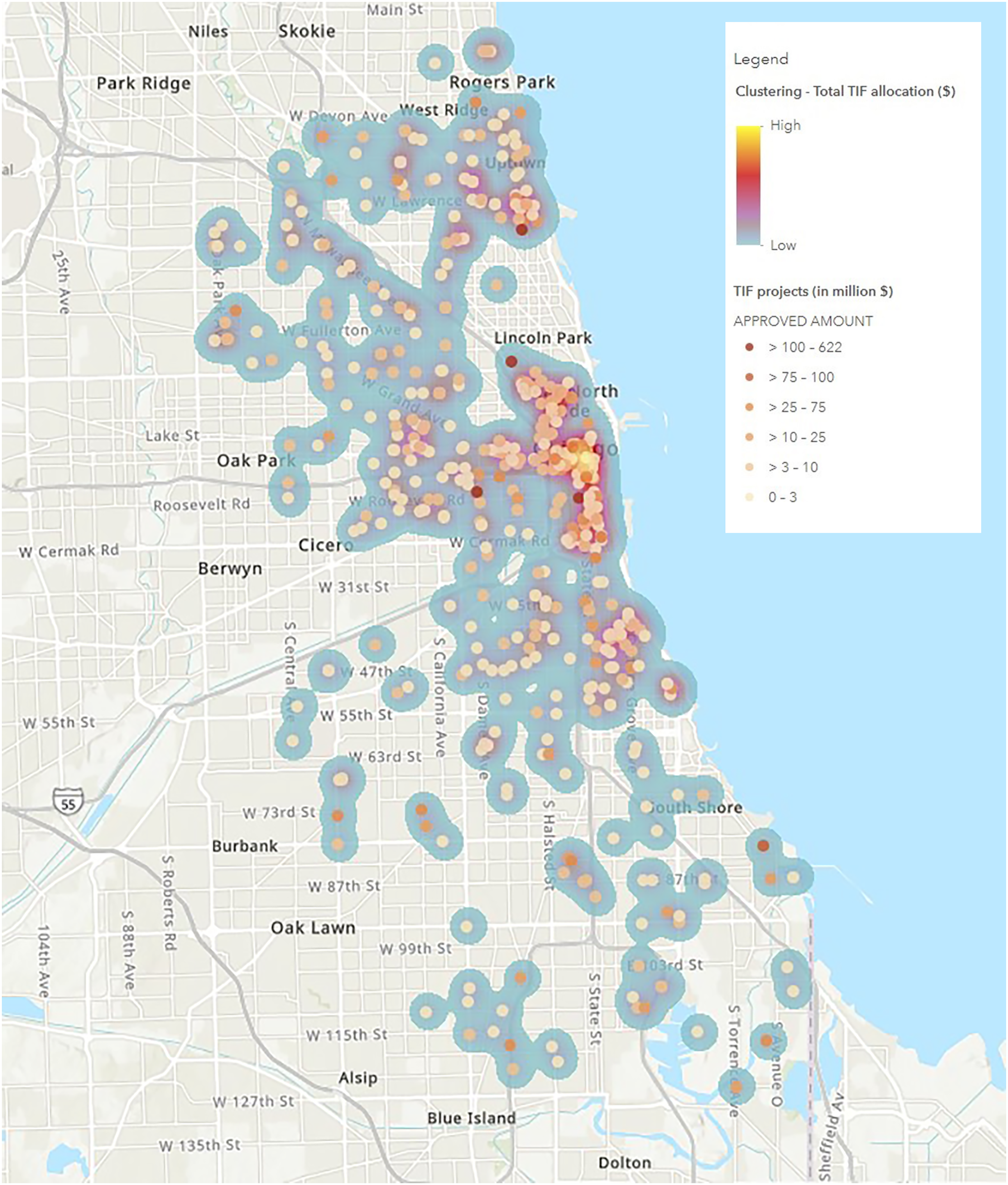
TIF-funded projects, excluding large-scale public infrastructure projects, 1989–2020. Data: City of Chicago 2020.
Throughout TIF's reign in Chicago, community organizations have challenged this contradiction. For example, Grassroots Collaborative, a coalition of labor and community organizations, campaigned against the approval of a $15 million TIF allocation to the Chicago Mercantile Exchange in 2010. The Chicago Mercantile Exchange, the largest futures trading exchange in the world, was awarded the funds from Chicago's TIF program to renovate the bathrooms at the Chicago Board of Trade, build an employee cafeteria and gym, and build a state-of-the-art conference room. Activists protested the approved deal, challenging the use of TIF for corporate downtown development, and arguing that TIF funds should go towards public resources such as parks, schools, and social services, particularly given the large budget deficits facing both the City of Chicago and Chicago Public Schools (CPS) at the time. Political demonstrations eventually persuaded the Chicago Mercantile Exchange to pull out of the TIF deal and “return” the money (Patel, 2022). This victory for community organizations was followed by other high-profile corporate returns of TIF funds including from CNA Group, Bank of America, and United Airlines. This set a precedent for the release of TIF funds back to CPS and other jurisdictions. While Grassroots Collaborative typically runs campaigns related to housing, public health, and schools, their campaign against the use of TIF arose from the contradiction of the city's support for private development alongside its simultaneous disinvestments in social reproduction.
TIF, education, and urban redevelopment in Chicago
In Chicago, the tensions between TIF, education politics, and school funding illustrate why it is essential to examine broader politics of social reproduction to understand how TIF is produced as a “policy in place.” Scholars studying Chicago have demonstrated that TIF mechanisms reduce direct municipal revenues in the city, diverting funding streams away from public education and towards urban development projects (Weber, 2003). Unlike in California, select TIF funds are used to finance school projects in Chicago. However, as we will outline, they are primarily used to subsidize school construction and renovation that aligns with neoliberal urban development and education reform, contributing to the destabilizations of the education landscape. In addition, studies have shown that CPS school closures from 2003 to 2013 were often near-promising areas for development (Weber et al., 2020), further highlighting the interplay between the provision of social reproduction and development goals.
While Illinois state law generally limits the use of TIF revenue for school construction, some TIF funds have been allocated towards capital improvements for CPS facilities, primarily through intergovernmental agreements between the City of Chicago and CPS. Many of these intergovernmental agreements began with the Modern Schools Across Chicago program which issued municipal bonds and TIF-backed bonds for school capital improvements. This program started in 2006 and arose on the heels of criticism of the amount of revenue that was flowing to private developers through TIF. Following this, TIF-funded school construction and renovation became increasingly popular in the face of falling state funds and CPS budget shortfalls. However, the majority of TIF-funded school projects have been completed in charter schools (privately owned schools that receive public funding) and selective-enrollment schools (public schools with admission-based rather than neighborhood-based attendance). For example, although selective-enrollment schools comprise only 1% of the district, they receive 24% of all TIF funds allocated to education, and the development of these schools often coincides with other indicators of neighborhood gentrification (Farmer, 2012; Farmer et al., 2020). These schools are more exclusive than neighborhood-based schools, often cater to affluent residents, and support the broader school choice agenda. Thus, TIF money that does make its way into education is disproportionately reinvested in facilities that embody neoliberal education reform and urban development. In addition, the majority of TIF funds allocated to school capital improvements are concentrated geographically on the north side of the city (Farmer, 2012), reproducing historic inequities and geographies of investment.
The transfer of TIF funds to choice-oriented schools such as selective-enrollment schools contributes to an overall landscape of education in Chicago that functions as an accumulation center based on private commodities. This is partially facilitated by the depoliticization of TIF which enables investments in neoliberal development and simultaneous disinvestment in social reproduction. For example, because developers apply directly to the city and important allocation details are determined without the oversight of the full City Council or without elected officials altogether, decisions that affect public education are transferred from elected bodies towards closed-door development panels. Encouraged by structures that position the mechanism as a depoliticized, technocratic instrument, TIF serves as a conduit for the increased entwinement between education policy and urban development policy in the service of neoliberal restructuring and real estate-based accumulation.
Chicago's TIF use has implications for social reproduction beyond the city itself, as the mechanism has been shown to negatively impact state education funding. Prior to 2018 and the implementation of evidence-based funding, a new formula for state education allocations that ostensibly prioritizes school districts with the most need, state funding for education in Illinois came from the General State Aid (GSA) fund. GSA allocations were made when a school district's available local resources, a function of locally generated education revenues, fell below a certain threshold. Like California, as property tax revenue was diverted to TIF projects, revenue for school districts fell, forcing the state to increase funding through the GSA fund. Since 40% of Chicago's property tax base falls within a TIF district, CPS relied heavily on the GSA to offset lost revenue, causing the state to effectively subsidize urban development in the city (Weber, 2003). Here, it is notable that Chicago contends with relatively less competition with the state over property tax revenue in comparison to California due to Proposition 13. This means that any political pressure on TIF in Chicago is likely to come from local, rather than state, sources. While in California this pattern prompted the termination of TIF programs statewide, in Chicago this pattern increased local dependence on both state aid and TIF funds to support schools. As Chicago continues to mobilize TIF, the city exacerbates the crisis of social reproduction by undermining equitable education provision and putting pressure on the multi-scalar budgetary and policy infrastructures that support the education landscape.
New articulations of TIF and social reproduction in Chicago
While we have illustrated how social reproductive politics inform the trajectory of TIF through a focus on education and school funding, many other social reproductive terrains also impact TIF as a “policy in place.” In Chicago, TIF is also imbricated with housing, policing, and public services, and these tensions have further put pressure on the mechanism. For example, recent challenges to TIF from community and activist groups have ignited over controversial megadevelopment projects such as Lincoln Yards. Lincoln Yards is a $6 billion luxury residential and commercial project that will redevelop a 55-acre parcel of industrial land along the Chicago River, partially funded through TIF (Sterling Bay, 2020). Community organizations and unions such as Grassroots Collaborative and the Chicago Teachers Union have argued that TIF dollars should instead go to schools, mental health clinics, and parks rather than subsidizing luxury developments (Grassroots Collaborative, 2019). Organizers and activists highlight that Lincoln Yards sits between two wealthy, highly developed neighborhoods and that the TIF district will funnel public dollars away from public goods to serve an area that is hardly in need of public investment relative to other areas in the city.
Despite important political pushbacks, Lincoln Yards is under construction and has benefitted from the TIF program. The continued use of TIF by the City of Chicago concentrates property value increases at the expense of infrastructures of social reproduction such as schools and maintains the uneven geographic distribution of investment across the city. Yet, political contestations stemming from social reproductive politics made TIF a key issue in the 2019 mayoral election and have dragged TIF away from its status as a technocratic terrain of experts to a more democratically contested arena. While the future norms for TIF's use in Chicago remain uncertain, broader public conversations around the public provision of social reproduction have put pressure on the mechanism and its future. The Chicago case further illustrates the imperative of understanding how TIF can function as an indirect mechanism for disinvestment in social reproduction as a form of state-led accumulation via dispossession.
Conclusion
Our comparative analysis of TIF in California and Chicago demonstrates the imperative of examining TIF as a multi-scalar, relational public finance scheme that operates in conjunction with the negotiation of state-supported social reproductive services. We demonstrate how state- and non-state actors have mobilized TIF as a vehicle for promoting private accumulation while disinvesting, or selectively investing, in public support for social reproduction. In both California and Chicago, municipalities mobilized TIF districts to subsidize development projects, satisfying the entrepreneurial growth imperative while limiting direct tax increases. While in California this trend led to stark opposition between public schools and RDAs in the political arena, Chicago's TIF program has strikingly dovetailed with neoliberal education policy, as it is used to fund selective investments in choice-oriented schools. Many of these schools serve higher-income families in gentrifying neighborhoods, resulting in a patchwork of high-quality exclusive public schools and lower-quality open enrollment public schools (Farmer and Poulos, 2015). In California, it is this inequality in school funding that led to repeated efforts by the state to reclaim property tax revenue from municipalities, which in turn sought to protect economic development dollars—all while both city and state actors scrambled to mediate their role in both fostering capitalist development and weathering capitalist crises. The devolution of fiscal responsibility to local governments has only increased municipal dependence upon the continued accumulation of capital via land rent, prompting a cycle in which the funding for social reproductive services is dependent upon rising property values, which in turn exacerbates urban inequality and increases the need for state support.
Yet, the impact of TIF on urban development projects and the fiscal and political negotiation of public education is provocatively divergent in California and Chicago, revealing the necessity of examining TIF not as a stand-alone economic tool but in relation to place-specific political and social forces. Taking a relational comparative approach illustrates how in both places, TIF was enrolled in public debates around public education funding and, more broadly, around state support for social reproduction. In California, this eventually led to the Governor calling for the dissolution of RDAs as a direct response to education budget shortfalls, while in Chicago activists successfully challenged a proposed TIF-funded investment in the Chicago Board of Trade building, arguing that public funds should be spent instead on public education and other public services. Thus, this article does not solely seek to address whether TIF has a fiscal impact on public school budgets; instead, it also asks how TIF as a public finance tool is economically and politically imbricated in contestations over equitable and adequate public education funding. As the case of California so starkly attests, TIF districts were dissolved not only because of their perceived fiscal threat but because they were politically positioned as a primary cause and solution to the budget shortfalls, over and against other expenditures at the municipal and state level. Our relational comparative approach also problematized the naturalization of a city-to-city comparison of urban finance mechanisms, as it instead revealed how different political landscapes led to the state of California is a more significant scalar actor than the state of Illinois in shaping the expansion and assessment of TIF districts.
As both economic and political terrains shift across and between multiple scales, the articulation of TIF with urban development practices and social reproduction will also likely transform. For example, the rise of new EIFD districts in California coincides with increased attention to the crisis of affordable housing and the long-standing need to address racial disparities in the state, meaning these districts may come to be fiscally and politically entangled in the struggle to expand public housing. In Chicago, activists have challenged new TIF projects that, among other things, finance luxury development and commercial spaces over public schools and other social reproductive supports. This dynamic has been heightened by recent economic shifts, as the Great Recession of 2008 and the COVID-19-related slump put further stress on local and state capacity to fund social reproduction even as the necessity for such support increased. Our analysis serves as an invitation to consider how TIF, and other public finance mechanisms, can serve as empirically and theoretically compelling entry points for understanding the state mediation of capitalist accumulation and social reproduction.
The cases of California and Chicago show how TIF selectively re-invests, redirects, and otherwise restructures funding for K-12 education and puts pressure on multi-scalar budgetary and policy infrastructures. Following this, we argue that the terrain of social reproduction is a necessary component when investigating the politics of TIF as a “policy in place.” While our relational comparison demonstrates how TIF can lead to underinvestment in social reproductive services such as education, we do not argue that is always the case. Bridging the literature on urban policy and feminist political economy, we suggest that scholars must investigate the place-specific entanglements of social reproduction and public finance if we are to understand how mechanisms such as TIF are adopted, expanded, or curtailed within the broader framework of neoliberal urban governance. In doing so, we expand on calls to attend to the ways public finance can heighten or mitigate economic inequality, suggesting that scholars of urban policy and finance must also attend to the ways TIF articulates with racial justice, disability rights, and working-class movement demands for social reproductive support.
We further call on scholars to theorize the role of education, and social reproduction more broadly, in the production of urban space and urban life. Mobilizing Katz's (2011) suggestion that disinvestment in social reproduction functions as a form of accumulation, we invite scholars to consider how public finance mechanisms may facilitate the transfer of state funds from social reproductive services to private individuals and corporations. This includes attention to shifts away from direct state provision of social reproduction, but also to how public finance can facilitate the privatization and financialization of social reproductive services. TIF is thus a critical mechanism as it arranges the reallocation of tax revenue from social reproductive services to property development through the narrative of neighborhood improvement. We, therefore, suggest that more scholarship is needed to understand the contingent and place-specific nexus between urban development, social reproduction, and public finance.
Footnotes
Correction (October 2024):
The article has been updated online to correct the order of the authors and to add location details to their affiliations.
Declaration of conflicting interests
The authors declared no potential conflicts of interest with respect to the research, authorship, and/or publication of this article.
Funding
The authors received no financial support for the research, authorship, and/or publication of this article.
