




Abstract
Workforce housing does not reproduce all workers equally. So, what kind of workers does “workforce” housing reproduce? Whose reproduction is prioritized, whose is devalued, and how? A case study of housing access and design in three elite Vail Resorts enclaves in Colorado shows that workforce housing prioritizes the reproduction of a young, flexible androcentric workforce who can be cheaply and easily housed. Extending McIntyre and Nast’s theorization of racial subsidies, I argue that resort capital awards unearned gendered subsidies to privileged workers and instantiates what Susanne Soederberg calls “displaced survival,” or recursive dislocation, for women workers and those with dependents. I detail how twin processes of displaced survival and gendered subsidy emerge in resort communities using data from interviews, survey, ethnographic observation, autoethnography, and municipal records. By attending to the lived experiences of workers in this niche industry, this paper contributes to literature on geographies of exclusion and expands scholarly understandings of how the gendered political economy of labor is sedimented in housing regimes.
Introduction
The hotel room was sparsely furnished with a microwave, miniature refrigerator, coat closet, and a double bed. Skiers dotted the slopes, visible from the balcony at the rear of the room. Its resident, Micah, had recently moved to Crested Butte, Colorado and worked as a line cook at the resort hotel restaurant. The resort hotel offers subsidized housing for 32 employees at a cost of $600 per month. Micah was happy with his housing but was aware of the limitations of this arrangement: “it’s great for me and the guys. But it definitely would not work for lots of people.” Sadie, hospitality worker Breckenridge, Colorado, is one of these people. Unable to live in Vail employee housing (the webpage states that employee housing is not available for families), waitlisted for income-restricted rentals, and unable qualify for a mortgage to purchase an “affordable” deed-restricted home, 1 she rented a small apartment on the outskirts of town: “I spend most of my time at home, whereas if I lived somewhere else I could get out more easily.” She hoped to raise her daughter in a community where she could walk to services and socialize, but the dream of an idyllic mountain life gave way to isolation and insecurity.
Workforce housing does not reproduce all workers equally. So, what kind of workers does “workforce” housing reproduce? Whose reproduction is prioritized and whose is devalued, and how? Extending McIntyre and Nast’s (2011) theorization of racial subsidies, I argue that workforce housing also awards unearned gendered subsidies to privileged workers and instantiates what Susanne Soederberg calls “displaced survival,” or recursive dislocation, for others. A case study of housing design and access in Vail Resorts enclaves shows that workforce housing prioritizes the reproduction of a young, flexible androcentric workforce who can be cheaply and easily housed. Even before contemporary rental housing shortages, resorts’ longstanding use of dorm-like workforce housing evidence a structural preference for disposable young male labor. Women workers and those with dependents are equally indispensable to resort economies but are more expensive to reproduce because their housing needs extend beyond most existing housing stock. Due to the Vail Resorts’ dominance in Colorado ski country, workers with dependents have few options for employment, and are therefore compelled to absorb the cost of their own reproduction or face abandonment entirely. By attending to the lived experiences of workers in a small, elite enclave, this paper expands scholarly understandings of how the gendered political economy of labor is sedimented in housing regimes.
I begin with a discussion of my positionality, field sites, and research methods. The second section theorizes housing as a site that not only disciplines and exploits racialized labor, but that awards unearned gendered subsidies. I then orient this research within literature on exclusionary geographies and racialized exclusion in the ski industry. The fourth section illustrates how gender shapes experience displaced survival using data from interviews, surveys, and autoethnography. The fifth section examines the ways in which gendered labor regimes are spatialized in housing design and policy in Colorado ski country. I conclude with a discussion of the significance of these findings for understanding the broader impact of industry giant Vail resorts, the relationship between labor subjectivities and housing access in the United States, and how this research can inform labor struggles in resort enclaves across the American West.
Methods and field sites
This research project emerged from nearly a decade of work as a ski industry employee and graduate student worker. Between 2012 and 2018 I worked as a ski instructor at the flagship Vail Mountain Resort in Vail, Colorado to pay nearly $10,000 in graduate student fees. I lived in a tent on railroad land for 4 months in the fall of 2012, then shared a 400 square foot duplex with a stranger from Craigslist in Minturn—a small town several miles outside Vail, Colorado. Between 2017 and 2019 I lived for 4 days a week in a windowless apartment inside the Vail mountaintop lodge. This apartment houses a mechanic and an electrician, who receive free housing to serve as both emergency repair labor and provide human collateral to fend off possible “ecoterrorist” attacks. The practice was implemented after Earth First! activists burned down Vail’s Two Elk Lodge in 1999.
Vail Resorts is valued at 6.3 billion dollars. As a multilateral corporation, Vail Resorts comprised of three subsidiaries: mountain, lodging, and real estate. The company owns 42 ski resorts around the country and operates hundreds of hotels under both the Rock Resorts luxury hotel holdings and through operator contracts with other hotels near their resorts. This study focuses on three of the most famous Vail-owned resorts and their surrounding towns: Vail Resort, Breckenridge Resort, and Crested Butte Mountain Resort. Vail Mountain is located in the town of Vail, Colorado, along the Interstate 70 corridor at the eastern end of Eagle County. Breckenridge mountain resort is also located near the Interstate 70 corridor at the base of the Ten Mile Mountain Range, which rises to the west of Summit County’s largest town, Breckenridge. Breckenridge is 35.7 miles east of Vail and is extremely popular among Colorado Front Range residents and out-of-state tourists alike. Southwest of Vail and Breckenridge by 166 miles, Crested Butte Mountain Resort is a remote mountain located near the eponymous town. Once a small enclave known for eccentric seasonal celebrations, Crested Butte has become one of the state’s most exclusive and expensive mountain towns. These field sites were chosen based on my own experience working at Vail Mountain Resort and my life-long community connections in each location. Studying three different resorts located in different counties and in towns of varying size offers an added benefit of widening the generalizability of a relatively small dataset (Figure 1).
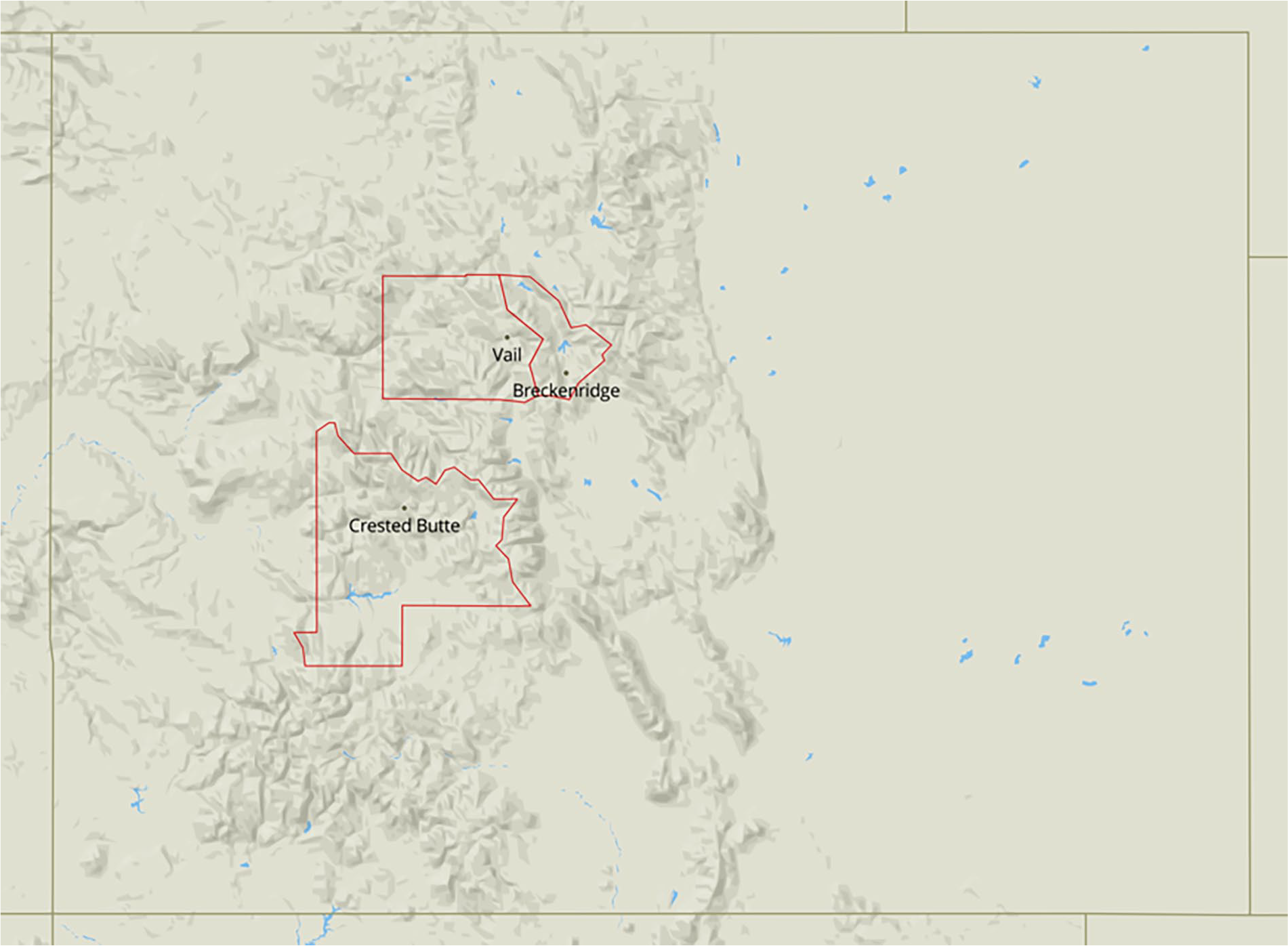
Vail Resorts-owned ski resorts in Eagle, Summit, and Gunnison Counties. Courtesy of Kylen Solvik.
Beginning in 2015, I used qualitative methods of ethnographic observation, autoethnography, survey, poll, and semi-structured interviews. I used Facebook and email to distribute a survey with five open-ended questions about housing access, ski industry work, and gendered experiences of housing. I received a total of 82 survey responses. Respondents were recruited through Summit, Eagle, and Gunnison County community Facebook groups, as well as snowball sampling among Vail Resorts employees. Between 2015 and 2023, I conducted a total of 36 semi-structured interviews with 30 Vail Resorts employees and residents of Vail, Breckenridge, and Crested Butte, as well as four employees of city and county housing authorities. I interviewed a government permitting officer and property assessor with extensive knowledge of Summit, Eagle, and Gunnison County housing landscapes and Vail Resorts developments. While I was able to access total affordable and employee housing occupancy data from city and county level governments, no official demographic data was available.
I filed a formal request for employee demographic data and employee housing occupancy data and received no response. Data related to Vail Resorts employee demographics and housing occupant demographics was compiled through interviews, long-term ethnographic observation, and an on-mountain poll of 50 lift operators, ski patrollers, lift ticket scanners, and dining workers. In January of 2023 I spent a day traversing Vail mountain, counting workers who reported living in employee housing.
My position shaped my interactions with other workers and community members, who were majority white and middle-class. This whiteness is reflected in survey respondents (all white) as well as interview subjects. Four of 36 interview respondents identified as persons of color. This data is far from exhaustive but offers a glimpse into the lives of a highly visible white population of ski industry workers and the political economy of housing and labor in Vail-dominated resort towns. In so doing, I move beyond market-based explanations of housing shortages to critically examine workers’ varied housing access in some of the most desirable communities in the United States.
Housing, secondary exploitation and gendered subsidies
In The Housing Question Engels and Dutt (1935 (1872)) observes that housing is a special commodity that both generates surplus value and reproduces labor power. Even at the outset of the industrial revolution, Engels argues, housing shortages enabled capitalists to extend exploitation beyond the factory floor. Posing a new housing question, Susanne Soederberg (2018, 2020) queries displacement from rental housing as a process that simultaneously exploits workers through credit and rents and reproduces a standing reserve of disposable surplus labor. Displaced survival—or “the continual and frequent dislocations of low-wage tenants [underemployed or unemployed] from their places of survival [rental homes]” (2020, p. 51) —enables the surveillance and discipline of working poor such as immigrants and refugees.
At the same time, warehousing racialized workers in inadequate rental housing also enables secondary exploitation as workers’ income (or government benefit) is “modified through monetary payments for survival” (Soederberg, 2018: 116). For instance, fees or rents are deducted directly from wages and tenants are subject to forced participation in low-wage jobs (2020, p. 113). We can also understand secondary exploitation as the “company store” phenomenon (Stanford-McIntyre, 2013), wherein workers are subject to monopoly pricing in expensive workforce housing schemes. In the context of Colorado ski country, workforce housing enables surplus accumulation by extracting rents and binding residents to low-wage resort jobs that condition housing access. However, not all workers who experience secondary exploitation experience displaced survival.
Seen through the lens of racial capitalism, secondary exploitation is an expression of racialized labor hierarchies that enable value extraction from an ever-increasing reserve of racialized surplus populations (Bhattacharyya, 2018, McIntyre and Nast, 2011). Drawing on Mbmembe and Foucault, McIntyre and Nast argue that capitalism is animated by a dialectical relation between privileged classes and racialized workers who respectively inhabit the imagined biopolis and necropolis. The two reproduce each other: for the biopolis to exist, the necropolis must also exist. As racialized workers absorb the external costs of reproduction, privileged classes accrue unearned wealth and benefits—termed “racial subsidies.” For instance, wealthy families who hire undocumented workers to provide childcare or do home improvements save money by underpaying racialized labor. The poverty and suffering of racialized populations subsidizes the wealth and prosperity of privileged classes, or “biopolitans.” In the context of housing geographies and studies of Colorado ski country specifically, where the experiences of so-called necropolitans has been well documented (see Park and Pellow, 2013), the subjectivities and experiences of privileged workers are less well understood. By examining the politics of workforce housing access in a relatively niche enclave, I sketch out a framework for understanding how housing works as a site where even privileged labor subjectivities are unevenly reproduced along gendered lines. In so doing, I theorize housing as a site that not only disciplines and exploits racialized labor, but that awards unearned gendered subsidies.
The political economy of labor and housing in Colorado ski country is characterized by a curious reversal of secondary exploitation, which is helpfully understood as process of awarding gendered subsidies. Ski resort capital awards these subsidies to a specific group of privileged workers through access to workforce housing. Flexible young, mostly white men who rent cramped, dorm-like employee housing receive higher overall wages because they pay roughly half the local market rate for housing. Those who cannot reproduce themselves in dormitories pay higher rents. 2 Those who fall between the cracks of employee housing and “affordable” home ownership programs are excluded from the subsidies that accompany a privileged form of secondary exploitation that would otherwise provide low-cost housing. This enables Vail Resorts and other multilateral resort corporations to offload the full cost of reproducing its workforce by selectively extracting rents from young, mostly white workers densely warehoused in cheaper housing units. Young men who live in employee housing have rents deducted from their paychecks, creating additional surplus value for Vail Resorts, but they also pay roughly half the cost of market rate housing. If Vail Resorts were to pay the full cost of reproducing workers like Sadie by providing family-friendly housing units, the cost of labor would rise considerably because the cost of constructing this kind of housing is so high. Workers like Sadie and the industry’s sizeable Latinx workforce, who require different housing that can also accommodate dependents, face displaced survival at the margins of resort towns.
While racialized exclusion features prominently in geographical literature on housing and resort enclaves, gendered experiences of housing inclusion and exclusion have received considerably less scholarly attention. This research is therefore concerned with understanding how the gendered political economy of labor influences wider landscapes of housing access.
Exclusionary geographies of ski industry capital
Human landscapes are landscapes of exclusion (Harrison, 2013; Sibley, 2002). Geographer David Sibley argues that process of erecting invisible boundaries around physical space exerts social control, “[relegating] weaker groups in society to less desirable environments” (1995: ix). Exposing the opaque exclusions that shape the physical landscape requires an examination of the ordinary routines that reproduce power relations in capitalism (p. xiv). For instance, Sibley shows that seemingly public spaces such as shopping malls are designed to engender consumption by white nuclear families while scrubbing non-consuming young interlopers from the environment.
Social relations of racial exclusion are also the spatial relations of capitalist labor regimes. In his landmark study of segregation and housing in Philadelphia, Du Bois (2010) argues that there is a “peculiar connection between dwelling and occupation,” (p. 295) wherein employment relations are sutured to housing geographies. Black workers in 19th century Philadelphia were forced to rent substandard housing at a higher cost in order to maintain their employment in city centers, while white workers’ reproduction was subsidized through access to affordable cottages on factory property. Beyond a visibly racist sociality, the racial organization of employment worked as the invisible scaffolding of segregation—Du Bois (2010) showed that factory schedules also enabled workers to live in desirable suburbs further from workplaces, while Black workers’ employment required greater flexibility and availability to work at a moment’s notice (p. 294).
Racialized and gendered patterns of spatial exclusion are well-documented in studies of resort enclaves and tourism labor. Caribbean enclave resorts and Colorado’s ski resorts work in similar ways to provide amenities for leisure-oriented guests by appropriating water rights, land rights, electricity, and road infrastructure while many locals remain poor. Known as “gilded ghettos,” resorts in the Caribbean operate as: segregated spaces that exclude [nonwhite locals] while providing luxury accommodations to foreigners. . .they represent foreign, exclusive spaces that keep tourist from seeing the local poverty that might make them uncomfortable and keep them from wanting to stay in the country. (Cabezas, 2008: 29)
Though similar in their geographies of exclusion, as resorts are widely inaccessible to racialized bodies unless they come as low-wage labor, ski resorts are unique in that their housing and labor geography is intimately tied to a single sport. Termed the “Aspen effect” by Cornell economist Robert Frank, ski resort towns became sites of vast social and spatial inequality where wealthy residents and second homeowners occupy the town center nearest resort slopes while low-wage, racialized workers commute from neighboring towns upwards of 50 miles away. In their landmark study of anti-immigrant conflicts in Aspen, Colorado, Park and Pellow (2013) expose the bizarre logic of environmentalism that justifies the exclusion of mostly Mexican immigrant workers. Ironically, immigrant workers blamed for polluting Aspen’s air and land perform the labor of manicuring the utopian landscapes where the wealthy recreate and reside.
There is also a wealth of critical literature on racialized exclusion in the sport of skiing itself (Boggs, 2017; Coleman, 1996, 2003; Harrison, 2013; Park and Pellow, 2013). Fresh from the battlefields and Bavarian villages of World War II, veterans of the Tenth Mountain Division injected their postwar business ventures—famously, Vail ski resort—with both masculine zeal and nostalgia for the European Alps. The built environment of American ski resorts were built to embody both European refinement and the soldier’s quest for outdoor challenge and adventure. Ski resorts are also shadowed by a long history of segregation in North America—Jewish people and African Americans were relegated to separate lodges and denied access to services (Harrison, 2013). The legacy of segregation is readily visible in ski resort geographies today, as evidenced by the enduring dominance of whiteness as the “unspoken norm” in skiing (Kusz, 2004, cited in Harrison, 2013) and the careful imposition of invisibility that shrouds and excludes a large immigrant workforce (Stoddart, 2010).
The “unbearable whiteness of skiing” (Coleman, 1996, 2003) is also the unbearable androcentrism of skiing, with the sport evolving through the 1990s to center an extreme ski culture. Despite leaps and bounds made by women athletes, resort spaces still relegate women forever as ornamental “ski bunnies” and mark nonwhite people—especially African Americans—as interlopers. There is, in fact, a political economy to these exclusions. As Anthony Kwame Harrison (2013) notes, masculinist risk-taking ideology is at the heart of commercial ski product and resort campaigns, while real estate practices in resort communities are invested in maintaining white exclusivity by excluding Black people (p. 320). Notably, the closure of urban ski resorts in the Midwest and East had the effect of foreclosing skiing as an outdoor pastime available to Black people marooned in urban America. The consolidation of Vail Resorts and the Epic Pass, which offers access to 50 resorts worldwide, is designed to capture white American and Mexican leisure habits. Meanwhile, Black Americans’ aversion to wildlands and preferences for community-endorsed vacation destinations with more landscaping has the added effect of reinforcing their exclusion (2013, p. 326).
These studies offer valuable understandings of ski resorts as spaces of racial exclusion; however, ski industry capital and gendered geographies of exclusion are broadly absent from these analyses. Moreover, the political economy of exclusionary ski resort enclaves—and their effects—is understudied. This study addresses gaps in the literature on geographies of exclusion and housing in the American West by showing how the gendered political economy of Vail Resorts labor shapes housing type, design, and access in Colorado ski country.
Cowboy up: Displaced survival in Colorado ski country
The stairwell carpet was no longer visible under a pile of blankets, clothes, and equipment. The stairwell did not just house these items, however, but a person as well: its resident was a ski shop tech at Vail resort ski resort, whose temporary stay in the townhouse had become permanent in the absence of other viable housing options. The stairwell divided the two sets of stairs that linked the upper and lower levels of the townhouse. It was admittedly larger than the average stairwell but a stairwell nonetheless. A few doors down, a night gondola operator lived on the exact same stairwell. Down valley in Avon, a line cook at a Vail restaurant maximized space in the apartment he shared with three other people by hanging a single bed from the ceiling of a closet-less room using industrial shackles. During the winter of 2016, a fellow ski instructor lived in a converted minivan, without heat, which he parked in various locations throughout the Vail Valley. Young men’s use of unusual and uncomfortable spaces like these are well documented in media accounts of ski town life and labor (see DeRiso, 2023; Vice News, 2021). A 2021 Vice News special followed one Crested Butte restaurant worker to his illegal camp site on private land adjacent to National Forest, whereupon he crawled into a sleeping bag next to a mountain bike in the bed of a truck.
Experiences like these originally escaped my analysis because I set out to study labor hierarchies in ski towns. Yet young male resort workers’ odd housing situations, including homelessness, reflect a taken-for-granted and understudied facet of exclusionary housing geographies. While young men interlocutors highlighted high rents and crowded conditions, women’s experiences pointed to exclusion from employee and workforce housing and highly gendered experiences of exclusion from a brutal housing market. These findings also shed new light on women worker’s different experiences of displaced survival, which often sharply contrast from those of young men.
In the span of a decade, Rita was the only other woman I met who had slept rough in Colorado ski country. In December of 2022, she was living with her fiancé in a truck camper outside of Durango, Colorado. They had worked at Vail-owned Kirkwood Mountain Resort in California for several years, then drove out to Colorado in November to get on their feet and start a new life together. I met Rita’s fiancé, Sean, at a local bar where he was waiting for her to finish her shift waiting tables. I asked if he had any thoughts on women’s experiences of housing in ski towns and he shook his head: “it’s tough. There’s a lot of bullshit with living, with making it up here for women. It can be risky. If women are going to make it, they got to cowboy up. Rita is tough, she made it by not taking shit, being strong. Being smart. You have to live with strangers or out in the woods, and men know that. They will take advantage. The housing shortage makes women vulnerable.” When Rita clocked off, Sean held out a worn Carhartt jacket and she slipped her arms into the sleeves. We walked out into the zero-degree night and I asked what she thought of Sean’s perspective. She nodded: “yep, I cowboyed up. It worked out.” We talked about the ways that the practice of “cowboying-up” by channeling toughness, resilience, wits, and tenacity enabled women resort workers to survive challenging and at times dangerous housing situations in ski towns.
Though uttered with humor, the phrase “cowboy up” conjures the rugged individualism and idealized masculinity that cowboys have come to symbolize in the whitewashed mythology of the American West (Arosteguy, 2010; Blair, 2022; Bonnett, 2016; Reimer, 2014). Indeed, our matching Carhartt outerwear betrayed our own internalization of Western mythos that glorifies certain kinds of outdoor manual labor (cowboy stuff) and not others, while the masculine cut of the heavy duck fabric obscured our bodies. Women like Rita and myself saw ourselves as tough enough to navigate the uncertainty and risk that came with living rough in Colorado ski country. My own experience living rough as a 24-year-old woman in the Vail Valley not only reflects the masculinist ethos of “cowboying up,” but also highlights the very different ways that men and women ski industry workers can experience displaced survival.
I arrived in Vail in the fall of 2012 to be a ski patroller and ski coach. In the months before the resort opened, I lived in a tent outside of Minturn, a former mining town just south of Vail Resort. A friend showed me a camping spot on railroad land at the edge of town. I descended a steep bank into the meadow and parked near the forest edge, my old SUV loaded down with an insulated platform I had built to elevate my tent off the ground. There was a rusted trailer and a truck at the South end of the meadow—I learned that a young local mechanic lived there. For a month or so I didn’t see much of him, but when I did see him drinking in a lawn chair outside his trailer, I waved. I went about my routine, waking early and cooking over a propane stove, returning in the evening and doing the same. I shared the tent with my German Shepherd dog, Mack, and a .22 rifle. My main concern was mountain lions and bears, and late one night I thought an animal was prowling around. Mack growled and I peeked one eye through a gap in the tent fabric. I saw men’s boots. Every few nights the man would come and sit outside my tent until the dog growled. I would stay in the tent, quiet. I left the campsite at the end of November when my first paycheck came. I did not apply to live in employee housing because even then it had a reputation for being overcrowded, dirty, and filled with hard-partying young men. I moved into a tiny A-frame house in town with Matt, a Vail ticket sales employee I met on Craigslist. One evening I returned from work to find the door ajar. My roommate and two friends were pacing in the living room, Mack was barking. I learned that the man from the meadow had been in the house, visibly inebriated, when they had arrived. He had found out where I lived and was looking for me. I shook off the incident as strange example of quirky ski town life. I didn’t see the man again after that. I heard he left town.
Interviews with women ski resort employees revealed that my experience was not unique, and that women’s strategies for navigating housing in Colorado ski country involved gendered risk. For example, women often live with boyfriends, exes, and strangers when unable to secure affordable housing alone or with other women. Interviews with women ski industry workers in Summit and Eagle counties added a troubling dimension to survey results. Not only did a dozen women interviewees report moving in with men to resolve housing needs, all interlocutors (male and female) cited domestic violence as a serious issue that stemmed from women being unable to leave abusive relationships due to a lack of housing options.
“It happened to me.” Kim took a sip of her coffee and leaned forward onto her elbows. Now in her early 30’s and working at the Vail Hospital, recounted the events that led to abuse by a boyfriend.
I moved here in 2013 to work for Vail and found a place at Middle Creek [apartment complex in West Vail] with a guy from Craigslist. It was a nightmare. He would come home from work and drink a case of beer and eat two frozen pizzas. He would eat one right when he got home and put another in the oven for later. He would then pass out and the pizza would burn and set off the fire alarm—it happened more than once—and at Middle Creek, if you don’t get to the fire alarm in the apartment in time the whole building will go off. So I went to the manager and explained the situation and was able to move to a studio for a while. Then I found better housing in Edwards with a guy who owned the house and another guy who rented. It was great. But one day the guy told me I had to move out at the end of the month—I only had a couple weeks to find someplace, and it was November. Good luck trying to find anywhere to live at that point in the season. Turns out the landlord’s girlfriend told him she didn’t want me living there. I had been dating a guy for a couple months and didn’t have another option—so I moved in with him. He was controlling and jealous, and ended up attacking me one day. I had to file a restraining order and get out of there. I called the domestic violence shelter but there are no beds in Vail—they refer everybody to Summit County. But I ended up lucky. I had a girl friend who had an extra room, so I moved in with her and my parents helped me with deposits and moving costs. I was so lucky to have help—so many women don’t. It’s a huge problem up here—moving in with boyfriends and getting stuck with an abuser. People are like, why don’t they leave, but I understand why. There’s no other option.
Though no less risky than “cowboying up” and striking out alone in a wilderness camp, Kim’s ordeal highlights a feminized strategy for accessing rental housing and avoiding displaced survival. By moving in quickly with boyfriends they don’t know well or living with ex partners out of necessity, women do what they can to secure adequate housing to reproduce themselves and their dependents. As one interviewee from Summit county put it: “it seems like everyone I know has lived with an ex or a bad boyfriend. I have, it’s so common here. It’s honestly a huge problem that nobody talks about.” The increased risk of experiencing domestic violence that women described is made worse, I argue, by the exclusionary geography of Vail Resorts employee housing and gendered subsidies that prioritize the bodies of flexible young male workers.
Gendered subsidies
Historically, United States housing policy has promoted the nuclear family and the single-family home (Fritz, 2009). The Better Homes Movement under Hoover and the Federal Home Loan Bank Act of 1932 subsidized the nuclear family in the U.S., while excluding single women from FHA loans (Fritz, 2009). Subsequently, the Housing Act of 1990 strengthened private control over housing aid and housing vouchers. Crucially, source of income is not protected under the fair housing act. This allows landlords to discriminate based on employment type and employment status, which disproportionately harms single women and female headed households (Fritz, 2009). As interviews with government housing employees shows, the artificial separation of “workforce” and “family” populations is sedimented in the built environment through housing policy and design. Deed-restricted single family homes house upper-middle class workers, while dorms warehouse low-wage resort employees.
Public housing and workforce housing design in Colorado ski county reflect both the American history of androcentrism and the labor-obsessed character of U.S. affordable housing policy (Bhagat, 2021; Fritz, 2009; Goetz, 2013). For instance, both Vail Resorts employee housing and government-led subsidized housing developments explicitly discriminate according to employment type, location, and family status: the Vail Resorts employee housing webpage clearly states that employee housing is not available for families. At each resort, employee housing is allocated to individual departments, including lift operations, ski and snowboard school, and mountain dining. Lift operations receives the lion’s share of beds, while “tipped employees,” ski shop technicians, retail workers, ski instructors, ticket scanners, and off-mountain hospitality employees do not receive employee housing. In a full day of traversing Vail Mountain, all 38 lift operators polled lived in employee housing. Only one ticket sales worker lived in employee housing. I asked a 37-year old male hospitality worker why lift operators had priority over employee housing, while the majority of Vail workers are actually in other departments. He explained: “because Vail doesn’t pay them enough to live anywhere else, and they need a lot of lifties for the mountain to run. They’ll live in shitty employee housing, they don’t care.” As survey and interview data shows, other workers very much do care about the limitations that employee dorms impose.
Like Vail Resorts, government housing programs in Colorado ski country award priority housing based on employment type. The town of Breckenridge approves tenants for affordable housing based on several qualifications. In 2016, the town’s affordable housing website defined affordable housing as the following: Affordable housing units are homes that are within financial reach for Summit County’s middle class—teachers, firefighters, small-business owners, government employees, newspaper reporters, day care providers, young professionals, ski patrollers, bartenders, restaurant managers—the people who keep the wheels turning in our community. These are the people who, in many other communities could afford housing, but because of the supply-squeeze, find themselves priced out of the home market here. (townofbreckenridge.com)
Workforce housing deed restrictions specify that potential tenants must be “key employees” approved by the town. Key employees are defined as “a resident who is also an employee of a business, private organization or government entity providing essential services in the county as determined by the Town, including, but not limited to: municipal employees, school district employees and emergency and medical personnel.” (Town of Breckenridge 2013, 2019). This is a clear message that outlines who counts as members of “the workforce” whose reproduction is ensured through admittance to subsidized affordable housing.
Public-private affordable housing developments also separate “workers” from “families,” stating—in no uncertain terms—who workforce housing is designed for. Housing designed to reproduce young, dependent-less employees has effect of multiplying exclusions and processes of secondary exploitation for workers with dependents. The head of planning and development for Summit County housing explained the county’s strategy by differentiating between the different needs of ski resort employees’ families: “we purchased several hotels and are renovating them to house workers. In an ideal world the county would love to build more family housing. The challenge is that it’s become so hard to build any kind of housing. The county is hardly building any housing at all.” He added that some of the old hotel suites could be suitable for families given their multi-room midcentury design. There are only a handful of these units in one rundown motel that the county purchased—the vast majority are studio-style rooms like those inhabited by Micah and his colleagues at Crested Butte. Of course, roadside hotels equipped with bare-bones kitchens evoke Micah’s observation: “it certainly doesn’t work for everyone.”
In Summit and Eagle Counties, Vail Resorts is required to house 50% of its employees. There are 2262.5 Vail Resorts employee beds in Summit County, 212 beds in Eagle County, and zero official Vail employee beds in Gunnison County. 3 According to the head of Summit County housing, the .5 likely refers to a bunk bed. This housing is generally grim. Even in the stylish and newly constructed First Chair apartments, employees share small rooms furnished with the same industrial furniture found in many college dorms and prisons. Notably, Vail employees can only live for one season in First Chair, which has an extremely coveted location near the center of Vail Resort. When a colleague lived at First Chair during the 2014/2015 ski season, he lamented the limited the one-time rental limit, the noise, and the low wages, eventually leaving the industry altogether.
The much larger Timber Ridge apartment complex, located on the north side of Interstate 70, is notorious among employees and local residents. The complex is known for hard-partying lift operators and crowded conditions that produce a yearly outbreak of respiratory illness glibly referred to as “lifty plague.” Half of Timber Ridge was torn down in 2014, replaced with new market-rate townhouses. The remaining buildings are shabby and are rumored to be headed for demolition. In a turn of events reminiscent of Aspen’s exclusionary immigration ordinance, the town of Vail thwarted Vail Resorts’ plans to construct new employee apartments in East Vail. The town rejected the development on account of its threat to bighorn sheep habitat. Proponents of the 172-bed project were quick to note that the town approved construction of a multimillion dollar mansion in the same habitat zone.
The director of Summit County Housing had an interesting perspective on Vail Resorts’ employee housing programs: “housing is just hard to build up here. It’s expensive, there isn’t much land and zoning can be a problem. Vail needs to house its employees, but there are issues getting the developments approved. One thing is that as Vail automates more of its jobs, it has to house fewer workers.” Indeed, Vail Resorts moved all its Human Resources employees to Broomfield, Colorado or outsourced the jobs to call centers in 2022, while some of its resorts moved automated ticket scanners and turnstiles. This reduction in workers does, indeed, reduce the total number of units the company is responsible for. However, the type of available housing and the workers who can live in it does not change, especially as the resort offloads middle-class administrative workers and retirees. I asked the housing director whether the reduction of retirees and college kids might lead to more even distribution of housing among other categories of Vail workers, or whether this move enabled Vail to more effectively house the young workers that it already prioritized. He conceded that it was likely the latter.
Notably, Vail Resorts also continues to grow by buying other ski resorts and by adding infrastructure, including a new chairlift at its flagship resort, but change in workforce composition is not at all reflected in the design of new employee housing. By moving administrative workers and certain operations workers off-site without changing its employee housing plans, the corporation doubles down on subsidies for its pool of young, flexible labor. The new Wintergreen employee housing in Summit County and the doomed East Vail development would provide a total of 24 beds and in shared units.
In Gunnison County, Vail Resorts is not required to house any percentage of its Crested Butte Mountain Resort employees. Yet the pressure and controversy over employee housing that has plagued Vail Resorts in Summit and Eagle counties has not emerged in Gunnison County. According to Meg, a Gunnison-based wilderness permitting officer who manages Vail Resorts’ national forest permits, this is because Vail employs students from Western Colorado University: “here Vail has the students, who work part-time as lift operators or ski instructors to get their passes. And there is a steady stream of new ones every year. They already live in dorms, so Vail doesn’t have to house them.” Yet these young, mostly male lift operators, including Meg’s brother-in-law, are only a portion of the workforce of Crested Butte Mountain Resort.
Hospitality workers comprise a less visible yet significant portion of the Vail Resorts workforce—recall that over half of all Vail Resorts revenue originates in hotel holdings. Most hospitality workers are women and many are undocumented. Ski instructor and hospitality worker Lisa explained: The hospitality workers are 90% women. And 90% of those are undocumented from Mexico. They all have families and live in multifamily groups in mobile home parks. I was hired through a temp agency, but the agency hires mostly undocumented women, that way Vail can dodge immigration status and pay workers less. Of course none of these workers get employee housing. Just a few young people who don’t mind living in bunk beds.
County government officials are very much aware that Latina women comprise a large portion of the resort workforce. Yet in response to the question of why so few immigrant families live in subsidized workforce housing and affordable housing, a government housing employee cited language barriers, the insular nature of immigrant communities, and a lack of awareness as explanations for the lack of diversity in these developments.
Immigration status, race, and age certainly structure the exclusion of many women resort workers from subsidized housing; however, family status more broadly is also key feature of housing privilege and precarity in Colorado ski country. Among survey respondents and interviewees, women with dependents and female-headed households, especially, voiced acute concerns over housing access. One hospitality worker from Breckenridge shared her experience searching for housing as a single mother: I need something clean and safe, ideally with a washer and dryer. I am a single mom of a 3-year-old and it just needs to be suitable for her. I can barley afford anything up here, and finding something safe, clean and affordable is nothing but STRESS.
Another worker shared a similar experience in Eagle County, where she has struggled to find suitable housing as a low-wage resort worker: I almost left last fall. I was so frustrated trying to find housing and being so pregnant and worried we couldn't find anything I was fed up with this place. I want to make my life here but the housing shortage creates so many problems. I know some HOA’s won’t allow the same renters to stay more than one year which I'm sure is also a headache for the home owner.
Other respondents noted the similar trajectories of Summit county towns and Aspen, cogently observing that housing limits who can live in desirable areas near the resort: Soon Summit county will be just like Aspen, a bunch of rude stuck up people being served by employees that have to live 30 miles outside of Aspen to afford it. Raising a family in this environment is impossible so all this county really supports is young partiers that don’t mind living in dorms and squeezing 5 people into a one bedroom. Very sad. I personally am moving out of Breckenridge in May because I cannot find housing with kids for a reasonable price and can no longer spend all of my salary on housing.
The experiences of white residents and Vail resorts workers make aged and gendered patterns of exclusion more visible in the landscape of Colorado ski country. They suggest an insidious process of secondary exploitation that lead to higher overall wages for young men and more acute experiences of displaced survival for women with dependents. The design, provision, and worker experience of workforce housing is shaped by the political economy of labor, wherein Vail Resorts awards gendered subsidies to the most free, pliable, and easily reproduced bodies.
Conclusion
The lives of workers in Colorado ski country reveal something novel about the gendered relationship between labor and housing in capitalist economies. Not only is housing a site of labor discipline and secondary exploitation, it is a key site where privileged labor subjectivities take shape through gendered subsidies. The case of workforce housing in Vail Resorts enclaves reveals that capital has a vested interest in reproducing valuable workers by awarding privileged access to housing to young men and people without dependents. I show that young white men are valuable to Vail Resorts because their bodies are the most available to capital—they can be rested and reproduced in stairwells, sparse hotel rooms, vans, dorm rooms, and couches. A fresh group comes every year. Women resort workers, who are less likely to be able to rest at ease on couches and in vans, do not have access to (and don’t want) the housing subsidies that are designed to serve college-aged men. Understood through the twin lens of displaced survival and gender subsidies, ski resort capital—like all capital—becomes visible as a social relation that extracts more surplus from women workers. Absent the subsidies awarded to unattached young, mostly male employees, women and people with dependents earn less. They are also more likely to experience displaced survival as capital prioritizes the reproduction of more flexible workers. By critically analyzing the case of Vail Resorts workforce housing, we can see more clearly how gendered labor relations mediate contemporary housing access—and the outcomes of workforce housing programs—in the United States and other locations where workforce housing is being developed.
Vail Resorts workers are certainly aware of their exploitation, both direct and secondary. A class action lawsuit brought against Vail Resorts in 2020, naming wage theft and unsafe working conditions among the illegal behaviors Vail engaged in. I am named in the lawsuit: my payout is estimated at $7. The brittle grip that low-wage ski resort workers have on rental housing in resort communities has also been the catalyst for their organization. In 2015 ski patrollers at the Vail-owned Park City resort in Park City, Utah voted to unionize. In 2020 they locked Vail Resorts in a months-long battle over wages and benefits, eventually securing a $2 increase to base wages. Ski patrols at Breckenridge and Crested Butte have since followed, citing the stagnant wages that have led patrollers to lose their housing, as well as deteriorating working conditions in a rapidly changing industry. In a December, 2022 Breckenridge Ski Patrol Union meeting, the newly elected president of the United Professional Ski Resorts Union of America CWA Local 7781 spoke passionately about the need to maintain pressure on Vail Resorts. When a senior patroller pleaded for a more measured approach to negotiations, in which the patrollers were one spouse seeking balance in a marriage, the president shot back: “I am not married to Vail Resorts. I sell myself to Vail Resorts for wages.” The meeting was a stark contrast to the pervasive anti-union sentiment I observed among more privileged workers in the 2010s. Lift mechanics have joined the union, and the Breckenridge Ski Patrol continues to conduct outreach through events and an Instagram page awash in witty anticapitalist memes. The president was enthusiastic about the future as the union hopes to expand to all Vail Resorts workers.
This will no doubt be an enormous undertaking. Few workers in the ski resort industry have high social status awarded to ski patrollers in mountain communities—their specialty skills as mobile medics, terrain specialists, and risk managers makes them indispensable to resort operations and provides them with a strong negotiating position. Ski patrols are almost entirely men, and despite advanced understandings of exploitation and labor, few patrol members thus far see the housing problems that I describe here as labor issues. Yet gendered exclusion that occurs off the ‘factory floor’ is nonetheless a serious concern for labor unions. Patrol unions are acutely aware of the racialized exclusions that form the everyday landscape of labor and housing in their communities, as well as the inseparability labor struggle and the struggle for affordable housing. Yet closer attention to the gendered dimensions of housing access will surely strengthen union efforts to achieve a broader base of membership. Given their progress thus far, there immense hope for future solidarities between more privileged workers such as patrollers and the diverse groups of workers who feed, clean, and operate resorts.
Footnotes
Acknowledgements
Very special thanks to Jennifer Fluri—this project emerged alongside years of collaborative research on affordable housing. Thanks to  for reading a both the previous version of this paper and for generous feedback on the revised version. For bringing the radical spirit of labor to the ski patrol union and to me. Thanks the folks in Summit and Eagle county and in the online community for their time and enthusiasm about the project.
Declaration of conflicting interests
The author declared no potential conflicts of interest with respect to the research, authorship, and/or publication of this article.
Funding
The author received no financial support for the research, authorship, and/or publication of this article.