



Abstract
There are many theories as to what form good-quality parenting should take. Attachment theory emphasises providing a secure base through sensitive responding at times of emotional need. Social learning theory outlines the need for firm limits in addition to the promotion of positive interchanges. These theories are supported by numerous quantitative research studies investigating which parenting styles are associated with better outcomes for children in general and for those with additional needs due to prior abuse or emotional and behavioural difficulties. However, there have been few systematic qualitative studies asking children themselves about their care experiences, particularly with abused or neglected children who are now safe in foster care. Using an adapted version of the Child Attachment Interview, we interviewed 12 children aged 13 to 15 years, who had been taken into care due to abuse and fostered for at least six months, with the aim of exploring their attachment to their birth parents, foster carers and attitudes to different parenting styles in general. Transcripts were analysed using the qualitative technique of Interpretative Phenomenological Analysis. Overall, the abused children spoke more positively of foster care than the care provided by their birth parents. Parenting techniques mentioned in positive terms were a clear disciplinary style, setting firm boundaries, nurturing care, enjoyable time together and mentoring further development. Negative themes included angry or inconsistent disciplinary styles, failure to set appropriate boundaries, rejecting and neglectful behaviour, a lack of joint activities, a chaotic lifestyle and parental illness.
This study provides a unique perspective on parenting, as the children studied have experienced both poor parenting and reasonably normal care. The findings are applicable to care provided for fostered children and could be relevant to the upbringing of children in general.
Introduction
What is the right way to bring up children, in particular, children who have suffered serious abuse? There are numerous research studies linking parenting styles to child outcomes (Baumrind, 1991; Hetherington, Henderson and Reiss, 1999). This knowledge informs the content of generalist intervention programmes used to guide parents of all children and specialist programmes to support those looking after children with particular needs. Complementing these with subjective, qualitative accounts of children's experiences may provide a test of our theories of parent–child relationships and be useful in guiding parents and the practitioners who support them to develop better relationships with children.
Abused children who have been taken into care have wider experience of different parenting styles than most, so from the safety of a foster placement they may be able to relate their experience of poor care and contrast it with a hopefully more nurturing milieu. From this we may learn what children experience as both constructive and unhelpful parenting and apply this knowledge to parenting for children more generally.
However, abused children are also likely to have their own particular needs as a result of noxious or neglectful care, so there may be important differences in the type of care they require. For example, repeated episodes of negative parenting can overwhelm children's ability to respond appropriately in an organised way. At a psychological level, it can lead to fear that cripples the child from taking appropriate action. At a physiological level, animal (Plotsky, Thrivikraman and Meaney, 2007) and human studies (Ruttle, et al., 2011) show that it leads to enduring abnormal patterns of secretion of stress hormones, such as cortisol, that contribute to poor regulation of emotions. Consequently, some abused children may be particularly sensitive to being shouted at and quickly lose control of their emotions. If they report this sensitivity, then it could be important to make greater use of calm, non-emotive disciplinary strategies than might be the case with children who have not been abused.
In this article, we outline prevailing theories in our current understanding of parenting styles before giving an account of salient aspects of foster care, including the role of attachment, permanence, training programmes and children's views of foster care. We then outline the aims of our study and the method we used to achieve this – the qualitative analysis of a series of 12 interviews with fostered children using the Child Attachment Interview. The results section summarises the interviews and our interpretation of the children's responses. In our discussion we examine the findings of the study, their meaning and importance and in conclusion, we consider how this area might be developed further.
Prevailing theories
Two theories are especially influential in this area: attachment theory (Bowlby, 1973) and social learning theory (Bandura, 1977).
Attachment theory
Bowlby (1973) described how children build mental representations or ‘internal working models’ of their own worthiness from experiences and perceptions of the caregiver's availability, ability and willingness to provide care and protection. These are a set of beliefs and expectations that influence behaviour. Infants are biologically programmed to seek proximity to attachment figures for their care and protection. The available and sensitive caregiver then provides a secure base that liberates the child to explore and learn (Schofield and Beek, 2006). Eventually, the child can carry the symbolic representations of attachment figures inside them to feel secure even without the physical presence of the caregiver.
The over-riding parenting style needed to promote secure attachment is sensitive responding to the child's signals (van IJzendoorn, 1995), especially by providing care when they are distressed. Stayton, Ainsworth and Main (1973) define maternal sensitivity as the mother's ability and willingness to try to understand behaviours and emotions from her baby's point of view. Attachment theory thus defines sensitivity not only as a matter of feelings but also as a matter of thoughts. It is only through understanding and thinking about the child that parents can be truly sensitive (Schofield, et al., 2000). If sensitive responding is lacking, there is a risk the child will develop an insecure attachment, or if early care is grossly deficient, an attachment disorder (Lieberman and Zeanah, 1995).
When children who have suffered abuse are fostered, they experience a complex emotional journey in being removed from their birth parents and placed with foster carers. The care children receive after such a severe disruption will help shape their future relationships and lives.
Social learning theory
In social learning theory Albert Bandura (1977) states that behaviour is learned from the environment through the process of observational learning. Children will imitate the behaviour they observe around them and then repeat it later, depending on whether they receive reinforcement or punishment. Reinforcement can be external or internal, positive or negative. If a child wants approval from parents or peers, this approval is an external reinforcement, but feeling happy about being approved of is an internal one. A child will behave in a way which he or she believes will earn approval because this is what is desired (McLeod, 2011).
Social learning theory-based parenting programmes have a strong evidence base (Lundahl, Nimer and Parsons, 2006; Maughan, et al., 2005). A randomised controlled trial (RCT) by O'Connor and colleagues (2013) showed that social learning theory-based parenting interventions can change broader aspects of the parent–child relationship quality, increasing sensitive responding and positive behaviour in parents.
Foster care
A study of the views of foster carers towards children in their care found major issues that needed addressing, including the carers' perception of the child's needs (Bourgie, Ricard and Pelchat, 1998). This is important because a poor understanding of these needs may result in inappropriate caregiving and poor relationship development, which could be detrimental to the foster arrangement.
Schofield and colleagues (2000) showed that fostered children have often lacked consistent adults who are interested in their thoughts and feelings, can see the world from their point of view and provide comfort and reassurance. As a result, children may find it very hard to manage their feelings and behaviour, which foster carers should reflect on and try to make sense of. They must attempt to tune into their child, stand in the child's shoes and try to imagine what he or she might be thinking and feeling.
Foster carer sensitivity is crucial to fostered children's progress and requires an ability in carers to think through the child's behaviours and their own responses. This allows carers to use flexible explanations of a child's behaviour, to make sense of connections between past and present, to have empathy with the child and to see the needs behind the behaviour (Schofield and Beek, 2006). This was supported by Coco (1998) who found that the quality conditions in foster homes predict change in child functioning in terms of attachment, affection and acceptance.
Permanence
A sense of permanence is thought to be of paramount importance for fostered children and can only be achieved when a placement is stable (Rosenfeld, Pilowsky and Fine, 1997). Aldgate (1990) showed that children in foster homes where there was a plan for permanence performed significantly better in reading attainment and levels of current behavioural problems than children who were uncertain about their futures. Despite this, in their longitudinal study of 249 looked after children, Ward and Skuse (2001) found that less than half of the children remained in the same placement. Although age, behavioural difficulties and the absence of mental health support may have contributed to placement breakdowns, the majority of moves were planned transitions from one temporary setting to another.
Training programmes
Several studies have assessed the efficacy of formal training interventions on outcomes related to foster carers and the children in their care. One study found that foster carer training reduced the incidence of aborted placements and increased the probability of desirable placement outcomes (Boyd and Remy, 1978).
Two meta-analyses by Bakermans-Kranenburg, van IJzendoorn and Juffer (2003) and van IJzendoorn (1995) have shown effectiveness for parenting programmes based on attachment theory, particularly shorter and more focused programmes. Results relating to foster carer(s) outcomes with cognitive-behavioural training interventions showed no evidence of effectiveness in measures of behavioural management skills, attitudes and psychological functioning (Turner, Macdonald and Dennis, 2007).
Rushton and Monck (2009) noted that only a handful of studies exist focusing specifically on preparation for adopters of children placed from care. These revealed improved knowledge of behavioural approaches but very little improvement in parenting techniques. Rushton and colleagues' (2010) subsequent RCT demonstrated that it is difficult to make changes to family emotions and dynamics. Ian Sinclair and colleagues showed that this was something that children value, but recognised this was difficult to plan and influence (Sinclair, Wilson and Gibbs, 2001).
The child's voice
The UK Children's Commissioner expressed a commitment to gaining the views of children and young people, particularly those whose voices are least well heard such as those who have experienced foster care (Children's Commissioner, 2010). There are, of course, some limitations in taking children's views; they may be unaware of factors that are important in their parenting or they may not have the cognitive or emotional development to articulate their feelings into words. However, children are the clients or ‘service users’ of caregiving and it will profoundly affect them, so eliciting their views is highly desirable.
Sinclair, Wilson and Gibbs (2001) analysed 150 postal questionnaires from foster children to establish their requirements. They found five main preoccupations: the care they received from their foster families; the relationship between their feelings for their foster and their birth families; their contact with and prospects of return to their birth families; the predictability of their care careers and their own say in them; and the ‘ordinariness’ or lack of it of their lives. Despite these common preoccupations, the children varied widely in what they wanted, such as whether they wanted to return home or not (Sinclair, Wilson and Gibbs, 2001).
Several studies have shown that fostered children view their placements and foster carers positively (Chapman, Wall and Barth, 2004; Johnson, Yoken and Voss, 1995; Wilson and Conroy, 1996). Interviews with 1100 children in out-of-home care (primarily family foster care) in Illinois demonstrated that their satisfaction with their living arrangements was high, as was satisfaction with the persons caring for them (Wilson and Conroy, 1996). Similarly, a study with 95 children aged 11–14 in foster care in the same US state found that many of them viewed placement in family foster care positively. They missed their families and would prefer not to need care away from home, but indicated that placement in family foster care had helped them by interrupting the cycle of abuse or neglect, and by providing them with protection and some respite while parents worked on their problems (Johnson, Yoken and Voss, 1995).
In his report informed by a survey of 1888 young people in care and discussion groups, Morgan (2010) found that 8 out of 10 young people in care thought their placement was the right choice for them. A higher proportion of children in foster homes than in residential care believed this. The main reasons were that children were happy and settled there, they felt safe and well looked after and had kind and supportive carers (Morgan, 2010: 52). In their longitudinal comparative study of children in care in Northern Ireland, McSherry, Malet and Weatherall (2013) found that for children in kinship, foster and residential care, and in adoptive homes, their carers were invariably specified as being the closest and most important to them. Rarely were their birth parents specified with the same degree of closeness or importance. Green and colleagues (2014) also found support for Multidimensional Treatment Foster Care in their recent qualitative study of interviews with children.
In their literature review, Minnis and Walker (2012) summarised that children generally reported that they thought the decision to take them into care had been the right one, but they wanted to be more involved in decisions about their care and needed better information. The impression from across a number of studies is that children and young people are desperate to be heard, but that the process developed to ensure this is not working for many of them. In terms of specific needs, research has shown that foster children place particular importance on being treated as part of the family (Heptinstall, Bhopal and Brannen, 2001). They also hope to obtain the care, concern and encouragement others get from their families and to feel they belong. They would like fair treatment, to get on with everyone in the placement, including other children, and to have adults who listen to their concerns (Sinclair, Wilson and Gibbs, 2001).
Aims
Research that helps to elucidate the needs and wishes of fostered children through the framework of attachment could potentially produce findings that enhance the relationship between them and their foster carers. These could be implemented into foster training programmes and ultimately improve placement success. We designed a qualitative study of fostered children's views on the aspects of their relationship with parent figures, what they viewed positively and what they viewed negatively. We also aimed to establish whether the children had more positive views of their foster carers or birth parents.
Method
The Local Research Ethics Committee approved the project and the local authority and all foster carers and children consented to the study in writing.
Participants
Characteristics of participants.

This sample was drawn from a larger study of 62 fostered adolescents who were randomly selected from an inner-city local authority's records (Joseph, 2010). The inclusion criteria for the larger sample were an age range of 10 to 17 years and placement for at least four months. Exclusion criteria were placement with the birth parent or a relative (kinship placement), a carer or child not speaking English, severe developmental disorder, clinically apparent generalised learning disability (or IQ<70) and severe physical disability. From the 62 adolescents, we randomly selected four black children, four white children and four mixed-race children, with two boys and two girls within each ethnic sub-group, so ensuring an even spread of ethnicity and gender.
Interview schedule
To gather the information, we used the Child Attachment Interview (CAI) (Target, Fonagy and Shmueli-Goetz, 2003), a semi-structured interview designed to access the child's mental representation of their attachment figures. Like the Adult Attachment Interview (George, Kaplan and Main, 1985) on which it is based, the CAI encourages children to relate specific episodes from memory, which support their descriptions of their relationships with their caregivers. Following consultation with the measure's developers, the interview was modified for the adolescents in the foster care group so that information about their relationship with their current foster carers, as well as with their birth parents, could be obtained. Adolescents in foster care were interviewed first about their foster parents and subsequently about their birth parents, about whom they all had clear memories and most had had contact with in the last year.
The CAI asks children to recall and describe their experiences with and perception of their attachment figures. It opens with a general question: ‘Can you tell me three words to describe your relationship with your foster mum, that is, what it's like to be with your foster mum?’ This is followed by probes for specific examples of what the adolescent said, i.e. ‘Tell me about a time when you felt [adolescent's words, e.g. happy, annoyed, etc.] with her.’ The interview then asks for accounts of emotionally important caregiving episodes, such as ‘What happens when your foster mum gets angry with you or tells you off?’ Questions ask about the foster father and mother as well as the birth parents.
Analysis strategy
The interviews were transcribed and the manuscripts analysed by two researchers using the qualitative technique of Interpretative Phenomenological Analysis (IPA) (Smith, 2004). IPA was chosen over other qualitative methods since it is concerned with trying to understand real life experiences and how participants make sense of them.
The process of analysis involved reading through each transcript and documenting emerging and ‘superordinate’ themes. The child's attitude to the parent figure was classified as either ‘positive’, ‘negative’ or ‘mixed positive and negative’. No effort was made to determine attachment styles based on the children's answers, as the aim of the study was to explore their views without assigning their feelings and attitudes to defence mechanisms or attachment styles.
Results
Prevailing overall attitudes
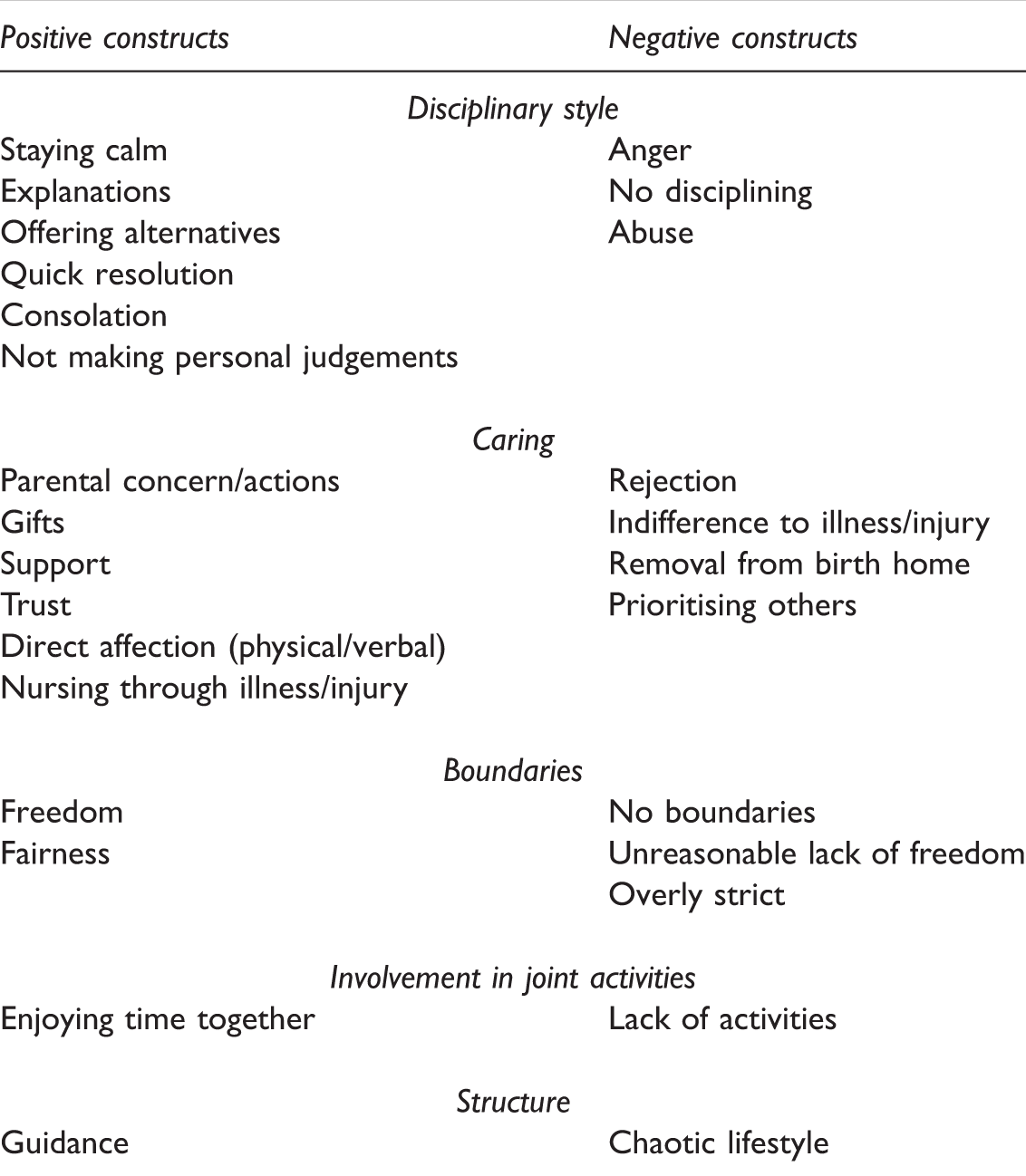
Superordinate themes about caregiving.
Adjectives describing relationships
When asked to describe their relationship using three words, terms such as ‘happy’, ‘fun’, ‘exciting’ and ‘caring’ were used for foster carers and birth parents. Other positive descriptions such as ‘trustworthy’, ‘smart’, ‘get along well’ and ‘strong’ were used in relation to some foster carers. Relatively few negative words were used to describe relationships with them (‘boring sometimes’, ‘upsetting’, ‘angry’ and ‘annoying’) and these were milder. However, some powerful negative adjectives were used in reference to birth parents (‘stressful’, ‘miserable’, ‘sad’, ‘worrying’, ‘scary’, ‘frightened’ and ‘insecure’).
Birth parents
Exploring the child's views on contact with birth parents was useful. When asked about her birth father, one girl commented: ‘I don't talk to him … I don't like him’ (Child 12). While this suggested negative feelings, the following was more positive: ‘I can just call her up like ra, can you see me innit and she'll come and see me innit’ (re: birth mother, Child 04). Similarly, questions about who they would like to live with gave a good idea of the child's feelings: ‘I really want to go back to my mum, I preferred living with my mum than anywhere else’ (re: birth mother, Child 10) was a contrast to ‘Q: What is it like to be living away from your parents? A: Great!’ (re: birth parents, Child 03).
Personal attributes the children felt they had in common with their birth parents were also explored. Generally, identifying with the birth parent suggested a more positive view, e.g. ‘I got my dad's coolness and mum's caring’ (Child 07). Some children with a negative view of their parents denied having anything in common with them, while others cited physical attributes only, such as ‘just the looks of my mum’ (Child 12).
The children were also asked ways in which they would want to be like and not like their birth parents: ‘I’d like to be like her, like fun, really fun, like her’ (re: birth mother, Child 10) was positive, whereas ‘I don't want to be like her because she [birth mum] has no education I don't think. She has got five children that were all taken away from her and are in care, that's it’ (Child 06), was negative.
The child's perception of why their birth parents could not look after them ranged from understanding that the care was inadequate – ‘she neglected me’ (Child 02) – to taking blame for their own behaviour: ‘It's not my mum's choice that I kept on getting nicked innit, so obviously, you're not gonna want someone in your house that keeps on getting arrested’ (Child 04).
The final question in the CAI asks what the child would wish for if they had three wishes. Some favoured living with the foster family: ‘To have a big mansion, have all my family who live with me [foster family] in that mansion’ (Child 01), whereas others yearned for reparation with the birth family: ‘For me and my mum to have a really good relationship for my whole lifestyle to be changed and … for me to feel like part of the family again’ (Child 11).
Disciplinary style
Positive aspects
Not arguing or getting angry were seen as positive factors that helped to form a closer bond with the carers: ‘Me and [foster father] never have arguments … it's just like, everyone's calm here, like’ (Child 04). Explaining the reasons why the child was being disciplined was equally important: ‘If [foster mum] is telling me off for a reason that I understand … it's fair because she always has a reason and it's not just for no reason at all’ (Child 05). Offering alternative behaviours or activities was also useful: He [foster father] might put a point across, like ra, you can't do this but you get me. But he'll always come up with something else you could do; everything he does is for the best. (Child 04)
Resolving arguments quickly rather than allowing the bad feeling to persist was also seen as a positive. One child (Child 09), after arguments with her foster mother, said, ‘In about ten minutes it's like nothing ever happened.’ Consolation after an argument was also welcomed: ‘Afterwards [foster dad] won't be angry anymore, he makes us feel better’ (Child 07). One child expressed appreciation for his foster mother not making personal judgements based on behaviour: ‘She might say, ah you did this, but, she's not gonna say like, ah you done this, you done that, you're bad, you're bad, nah, she just normal innit’ (Child 04).
Negative aspects
Anger and emotional outbursts were seen as particularly toxic: ‘It was hell to be with [birth] mum … she let all her emotions build up … and then it was really not nice’ (Child 03). However, shouting was not always seen as a negative form of disciplining. It may have been more acceptable if the child understood the reason behind it: …when I tore a paper thing up in Manchester … [foster mum] shouted at me and I said I was sorry. She said, OK, don't do it again. [It was fair] because I ripped the sheet and it's not even mine or Grandma's, it's other people's and she might have to pay for it. (Child 07)
On the other end of the spectrum, one child described how not being told off showed that their birth mother did not care: ‘She didn't really care, she didn't really tell me off … whenever I did something wrong she didn't really care’ (Child 02).
Being physically disciplined was not necessarily seen as excessive: ‘Mum would smack me but not like hit me … just when I needed discipline, like when I was rude’ (re: birth mother, Child 08). However, the children generally spoke of abuse in very negative terms. This child describes physical abuse by his biological mother's boyfriend which was made worse by his mother's lack of intervention: … he thought he could hit me and grab me up by my neck and throw me against the wall … Mum went in and looked and then walked back out the room and went and sat down and was doing her business. She did not really care. I felt scared, upset, worried, frightened. (Child 11)
Caring
Positive aspects
Many of the children described everyday acts of parenting and concern as evidence that their parent figures cared about them. These included ensuring they ate, giving them lifts, caring about their physical appearance – ‘When I’m going to school and I look trampy she'll take off my shirt and iron it’ (re: foster mother, Child 12) – and encouraging them to study: ‘She always makes sure if I don't have homework, then I still should do work so that I get good in my tests’ (re: foster mother, Child 05). Buying them gifts or giving them money was also seen as an important sign of affection: ‘[My foster parents] are caring because they gave me money to spend at Chessington’ (Child 07). Being supported by their parent figures in difficult situations also made children feel cared for: ‘When I had a meeting with my psychiatrist, my mum was defending me … and sitting there cuddling me through the whole thing so that was good’ (Child 11).
Mutual trust and being able to confide in their carers was a valued aspect of the relationship: She trusts me with loads of things, yeah, and I trust her; I was talking to her about my stuff and I know that if I didn't want her to tell anyone she wouldn't tell anyone. (Child 02)
Direct affection (physical or verbal) was also recognised as a means of communicating love, although it was not mentioned often: ‘I know that they love me basically as a daughter cos they tell me anyway’ (Child 02) and ‘[My foster parents care about me because] Chris gave me a cuddle and said it's all going to be OK’ (Child 01).
Assisting or comforting the child in times of need, such as illness or injury, was described positively by a number of children: ‘When ill, [foster dad] would give me something to help me breathe easily and rub my tummy with something and make me lie down and get me a drink or something’ (Child 07).
Negative aspects
Feeling rejected was a major factor in determining whether children felt cared for or not. This manifested itself in a variety of ways, such as being made to feel inferior because they were not the true biological children of their foster carers: ‘Sometimes she says I don't care cos you're not my daughter, when I won't do something’ was met with counter-rejection, ‘I just think you're not my mother you don't have to tell me what to do (Child 08).
Threats to the fostering arrangements were also seen as a sign of rejection: ‘She said that she should just wash her hands of that fostering bit … I felt annoyed that she would say that to me’ (Child 08).
Birth parents refusing contact with the child was seen in a similar light: ‘[I don't feel loved] by my birth mum, my mum doesn't want to see me, she thinks if she doesn't see me she doesn't have to worry about anything’ (Child 09). Contact with birth parents sometimes threw up difficult emotional issues for children and left them struggling to decide if their birth parents cared about them or not: I saw [my birth mum] and, ehm, it was just like she cuddled me, I felt like she cared about me, but when I went to see her she didn't even ask me how I was and how was school and stuff, so I don't know if she cares about me. (Child 02)
Children who felt let down by their carers described their lack of affection and caring in situations such as illness and injury: Q: What happens when you're hurt? A: She [foster mum] won't do nothing. I hurt my leg one time and they had to get an ambulance and the ambulance dropped me home after and she said not to talk to her about it. Q: How did you feel? A: Hurt. (Child 06)
Birth parents failing to look after the child, which led to the child's removal, was viewed as a sign of not caring in some cases. One boy (Child 03) said his parents couldn't look after him because they ‘couldn't be arsed, just couldn't be bothered’. Other children felt that their parents prioritised others over them: ‘My [birth] mum neglected me … she put her boyfriend and her cats before her children’ (Child 02).
Boundaries
Positive aspects
The parent figures' approach to setting boundaries was an important influence in the children's attitudes towards them. Boundaries that were seen as fair were even perceived as evidence of caring: [I feel cared for because] I wanted to go to a party and Mum said no … she did not really want me to go to that one because it was far away and she knows it was dangerous cos it finished late. (re: foster mother, Child 08)
Conversely, freedom was seen in a positive light: She's just nice innit. She [foster mother] never really, like, says no to me. Like, if I ask, I ask to have the internet on, she'll say, yeah, I'll turn it on, eat dinner, turn it on, innit. (Child 04)
Negative aspects
A perceived unreasonable lack of freedom and being overly strict were major grievances: I am not even asking to come home at 10 o'clock but three o'clock is not reasonable, so sometimes it really annoys me that everyone else is allowed to go out till late apart from me. (re: foster carers, Child 08)
However, the absence of any boundaries was perceived negatively: ‘She [birth mother] didn't really care, she didn't really tell me off, whenever I did something wrong she didn't really care’ (Child 02).
Involvement in joint activities
Positive aspects
Engaging in activities and having fun with parent figures was cherished by the children and featured heavily in positive passages. Some children described parent figures as ‘fun’ or ‘exciting’ due to the activities they did together. This included special outings to theme parks and tourist attractions: ‘[Birth dad] used to, like, go to London, like, to go Big Ben and go on, ehm, Eye, on the London Eye. It was really fun’ (Child 01). Other activities included parties, taking them to youth clubs, playing board games, watching TV together, shopping, going for walks and playing sports.
Negative aspects
On the other hand, a lack of activities was seen negatively: ‘She's boring sometimes, she don't do nothing, she just sits down in her room and eats and talks. I told her to go out and she said no. I felt upset’ (re: foster mother, Child 12).
Structure
Positive aspects
Some of the children appreciated their carers' guidance and advice, and viewed them more positively because of it: [Foster father] is smart … he shows me how, what examples I should follow and what examples I shouldn't. Like, he shows me what's right from wrong and what I should be doing, and he shows, he shows me how to live, innit. (Child 04)
Negative aspects
The chaotic lifestyle of some birth parents, particularly substance misuse, was a source of fear and insecurity for their children that created resentment: ‘He's an alcoholic junkie man. Yeah, I don't want to be an alcoholic’ (re: birth father, Child 12). The threat of being removed from their home due to their parent's substance misuse was a particular worry: She would get drunk and, like, the music was blaring and my brother would get out and then, like, the police would bring him home … and the police would, like, warn her … they would take us away or something. I felt scared and annoyed with my mum. (Child 02)
Discussion
In general, the fostered children in this study had more positive attitudes towards their foster carers than their birth parents. This result cannot be generalised to all fostered children, but supports previous findings that they do subjectively experience the benefits of being in foster care.
The aspects of caregiving which the children viewed positively and negatively can help us to understand the types of care that fostered children value. This was a small sample and so we cannot derive broadly generalisable conclusions. However, qualitative studies do usually look at small samples in depth and the findings of this study can help to inform our thinking on this topic.
As well as improving our understanding of the needs of fostered children, these findings could potentially be applied to parenting in general. Of course, there are important differences between fostered children and other children; the former have disproportionately high rates of physical, developmental and mental health problems (Costello and Angold, 1995; Sedlak and Broadhurst, 1996). Experiences of repeated abuse and/or neglect are known to affect the brain's development and the ability to subsequently participate fully in society (Silverman, Reinherz and Glaclonia, 1996; Wolfe and McGee, 1991). Abused and neglected children (in or out of foster care) are at great risk of not forming healthy attachments to anyone (Costello and Angold, 1995).
However, fostered children are in the unique position of having been exposed to more than one type of caregiving and may be better placed to say what was effective. It is striking that the children did want firm boundaries set, and that these insights were similar to the attributes of many parent training programmes, debunking the myth that a whole different set of approaches are likely to be needed for this group of children. These findings fit well with parenting strategies derived from attachment and social learning theory, and underline the need for programmes for foster carers to emphasise that firm boundaries in the context of warmth should not jeopardise the relationship from the child's perspective.
Bullock and colleagues (2006) asked the question ‘Can the corporate state parent?’, where they identified children in long-term foster care as a group where parenting issues are particularly salient. This study shows that parenting styles are also important for the children themselves and that they have definite views about what they want.
Interestingly, the views of the children are not that far removed from what we already consider to be good parenting strategies. A meta-analysis of parent training programmes found that programme components consistently associated with positive effects included increasing positive parent–child interactions and emotional communication skills and the importance of parenting consistency (Kaminski, et al., 2008), which is generally in keeping with the findings from our study.
Conclusion
As well as suggesting that fostered children have more positive views of their foster carers than birth parents, this study shed light on some specific aspects of foster children's relationship with their parent figures and the types of caregiving that they value and dislike. Remaining calm, explaining the reasons behind punishments, offering alternatives, quick resolution and consolation were seen as positive factors in terms of disciplining style. Anger and arguments were generally seen as counterproductive, although shouting was possibly more acceptable if the child understood the reasons behind it. On the other hand, not being told off at all was seen as a sign of not caring. The views of physical discipline were largely negative. The children considered everyday acts of parenting, buying gifts, offering support and providing security through trust to be evidence of caring. Direct affection and help in times of need were also valued. Factors that made the children feel neglected included rejection, lack of appropriate affection in times of need, being made to feel like an outsider, failing to care for them resulting in their removal and prioritising others over them. Fair boundaries with a good deal of freedom, spending time engaged in activities together and guidance were also valued, while a chaotic lifestyle was seen as damaging.
It is perhaps a strength of this study that by asking specific questions about the quality of care the researchers were able to get past reflex defensive positive representations of their parents, enabling the young people to provide more nuanced responses. This may have allowed us to access the positive views the children had of the care provided by their foster carers as opposed to their birth parents. Future studies may wish to further explore fostered children’s views on differing parenting styles that they have experienced with their birth and foster families. The aspects of caregiving we have identified could also be the subject of further study and ultimately help to inform training for foster carers.