



Abstract
This article draws on the findings from the qualitative phase of a New Zealand longitudinal study concerning vulnerable young people’s transitions to adulthood, the challenges they faced, their experiences with services and the factors that helped lead to positive outcomes. It reports on the experiences of foster parents and their perspectives on what contributed to meaningful support for these young people. The youth (aged 12 to 17 years at the time of their first interview) had experienced sustained exposure to harm, including abuse, violence, addictions, disengagement from school and mental health issues. They used multiple services (child welfare, juvenile justice, mental health and education support services). The study involved the administration of a survey (n = 593) and qualitative interviews over three years with a sub-sample of young people (n = 107). In the qualitative phase, they were asked to nominate a person whom they trusted to also be interviewed. Twenty-one chose a foster parent. Three thematic clusters emerged from the analysis of the foster parents’ interviews: the challenges in providing care to vulnerable youth; the provision of practical and emotional support; and foster parents becoming an enduring presence in their lives – holding hopes and dreams. The article concludes with a discussion that draws on ecological-transactional approaches and explores the key elements that enable foster parents to become an enduring presence for vulnerable young people.
Introduction
This article draws on the findings of a longitudinal study that investigated the experiences of vulnerable youth. It focuses on one aspect of the wider study: foster parents’ perspectives on the experiences of the young people in their care. The research investigated the factors that enabled young people who are vulnerable to poor outcomes to make the most of the resources that were available from services and from their own support networks, and the factors that contributed to positive outcomes. The study advances our knowledge of the experiences of these vulnerable youth and how services can more effectively respond to their issues and needs. From the perspective of foster parents, this article looks at the challenges in providing this care and the factors that contribute to successful foster care experiences. In particular, it explores foster parents’ views on what constitutes meaningful support for these young people and how, as their primary carers, they can become an enduring presence in their lives and help them to realise positive futures.
Foster parent experiences and perspectives
There is a large body of literature that identifies the negative aspects of the foster care experience, including placement breakdown, multiple placements, inadequate planning for transitions, behavioural and emotional challenges, and the difficulties that children and young people face in establishing secure attachments with significant adults (Courtney, et al., 2007; Cunningham and Diversi, 2013; Davis, et al., 2013; Fernandez, 2008; Schofield, 2002; Triseliotis, 2002). Another body of literature explores the contribution that positive foster care experiences can make to successful developmental outcomes and positive futures for vulnerable youth (Arnau-Sabates and Gilligan, 2015; Biehal, 2014; Gilligan, 2009; Harvey, et al., 2015). Young people who have positive foster care experiences report that they feel accepted and loved by their foster families; in supportive foster families they are able to develop a sense of belonging and form secure attachments. These positive experiences open up new opportunities and enable youth to mediate adverse circumstances and redirect developmental pathways towards better outcomes (Biehal, 2014; Blythe, et al., 2013; Schofield and Beek, 2005).
Research has explored the ways in which service imperatives impact on the foster parent role and consequently on the support available for young people in care. Positive outcomes for children and youth in foster care are more likely to be achieved when foster parents receive effective support. Foster parents take on multiple roles: they are required to provide emotional and practical support to children and young people who are dealing with complex issues and provide them with a sense of containment (Warren-Adamson, 2001). Children and young people come into foster care having left familiar surroundings and relationships and move into a public space where they are under scrutiny by strangers and their life is organised by public authorities; in this space they face an uncertain and ambiguous future (Christiansen, et al., 2013: 721). Given these complex issues, in order to provide effective support to vulnerable children and youth, foster parents themselves require appropriate support from social workers. This involves being included in decisions about those in their care. Foster parents report that when they are perceived as valuable team members and fully involved in decision-making they are better able to provide meaningful support (Blythe, et al., 2013; Schofield, et al., 2013).
Despite the challenges they have faced before entering foster care, the young people are often able to establish lifelong positive connections and form trusting relationships with foster families (Christiansen, et al., 2013: 721). Research shows that when young people experience stability in care and remain with a family for several years, they are likely to report better well-being and develop a sense of belonging (Biehal, 2014; Christiansen, et al., 2013). Reports from young people who have been in long-term foster care suggest that in order to engender this sense of belonging, foster families need to work intentionally to include the young person as part of the family. When foster parents, siblings and extended family members act as positive role models and involve young people in their activities, they feel part of the family. Foster parent accounts show that a sense of belonging enables young people to proclaim an affiliation with the foster family; at the core of this is enabling the young person to imagine a future where they will be supported to realise their dreams (Christiansen, et al., 2013). Establishing trusting relationships with foster parents enables the young person to manage feeling different from other young people, overcome conflicting emotions about their birth and foster family, and deal with the disruption of family life (Biehal, 2014; Madigan, et al., 2013; Sinclair, et al., 2005).
Positive foster care experiences are a key factor in enabling vulnerable youth to develop strong and resilient identities and remain hopeful about their futures (Fernandez, 2008; Munford and Sanders, 2015; Schofield and Beek, 2005). Research has shown that unconditional love, a healing environment and foster parents being ‘in it for the long haul’ (Blythe, et al., 2013: 1062) are conducive to healthy development and optimal outcomes. Young people’s accounts of positive foster care experiences indicate that they value foster parents’ advocacy and support in assisting them to understand and mediate their feelings about being different from other young people. These positive encounters support youth to make sense of their daily experiences and gain a sense of agency over their circumstances (Madigan, et al., 2013). Other research has asserted that healthy identity development is facilitated when young people retain a connection with their culture and family of origin. Knowing where they fit in the world engenders a positive sense of self (Munford and Sanders, 2011; Sharley, 2012); foster parents have a key role in supporting young people to maintain these connections with immediate and extended family members (Sharley, 2012).
The ideas explored here informed the theoretical foundation of the study. We were interested in learning about the challenges faced by foster parents but also the potential for positive change for vulnerable youth when their carers are able to provide meaningful support and form strong enduring bonds with them. Our study contributes to the recent research concerning the essence of foster care relationships that work well, that promote the resilience and strengths of youth, and help them to realise a positive future (Biehal, 2014; Fernandez, 2008; Schofield and Beek, 2005).
The study
The purpose of the study was to gain an in-depth understanding of the factors that influenced the developmental pathways of young people with complex needs and to identify those factors that influenced their capacity to achieve good outcomes in early adulthood. The research aimed to develop an understanding of the transitions of vulnerable youth focusing on identity development, education and employment. We were also interested in understanding how support from significant others, including social workers, youth workers, teachers and foster parents, contributed to the process of identity development and, in particular, how youth navigated to meaningful resources and support. In order to gain a deeper exploration of young people’s experiences, interviews were carried out during the qualitative phase with an adult (Person Most Knowledgeable – PMK) nominated by the young person. These included family members, foster parents, older siblings and friends, as well as service providers such as social workers, teachers and youth workers. This article draws on the interviews with foster parents.
Methods
The participants
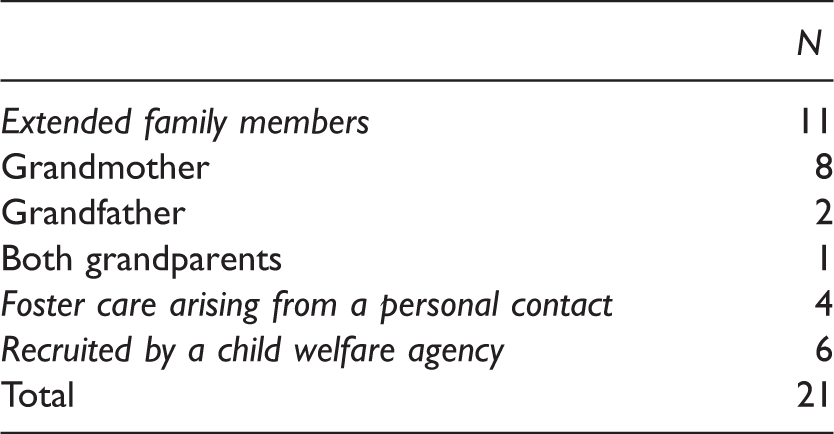
At the time of the first interview all the young people were aged between 12 and 17 years; they came from five geographical locations in New Zealand (n = 593) and were involved in one or more of the major service systems (child welfare, youth justice, mental health, education support services). The youth completed three annual surveys which covered patterns of service use, the risks they faced and the role of material, social and emotional resources in achieving desired outcomes (for more detail on the survey questions contact the authors). A sub-sample (n = 107) of young people (63 males and 44 females) participated in three further annual qualitative interviews. The greater number of males reflects youth justice service involvement among the young people in the study. At the time of the first qualitative interview young people were aged between 16 and 18. They were chosen because they had experiences across a range of services. Of those 74 who nominated a PMK to be interviewed, 21 chose a foster parent.
In New Zealand the statutory child welfare agency has legislative authority to oversee the provision of foster care services. The goal is to provide a ‘home for life’ for children and young people who cannot live with their families. However, the focus remains on enabling them to maintain contact with their birth relatives. All of those who chose a foster parent as their nominated adult to be interviewed (12 females and 9 males) had lived in foster care from a young age and 14 had resided in the same placement from early childhood. Of significance is that even if young people moved away from their foster parents for some time, they still returned; at the time of the interview, the youth were either back living with the foster family or were living independently and being supported by them.
Foster parents.
Recruitment and ethical protocols
Recruitment began with meetings with agencies to secure support for the research. Several meetings were held with agencies in the planning stages and throughout the project. While the researchers kept services informed of the overall progress, information about particular young people remained confidential. The youth chose the PMK to be interviewed and information given by the young person and the PMK were kept separate. The same consent procedures were used with both parties. Participants determined the time and location of the interviews, which began with a discussion about the research and secured informed consent.
Interviews
The findings reported in this article draw on the first two qualitative interviews with the foster parents. The semi-structured interview schedule included a range of questions that focused on young people’s experiences of service use, foster care experiences, family, school, community, resources and support networks, relationships, experiences of harm, health and well-being, their views on the foster care experience, what assisted them in addressing their challenges and achieving their goals and, finally, reflection on the young person’s transitions and critical moments.
The interviews lasted between 40 and 90 minutes and were recorded. Participants could stop the process if they were finding it difficult and ethical protocols included procedures for linking participants to support services. They were given a voucher of their choice to thank them for taking part and food was provided at each interview. We used trained interviewers who were skilled in building trust and rapport (Cunningham and Diversi, 2013). They had responsibility for a group of young people and the PMKs so that they would see the same person each year, creating an ongoing narrative with each participant. Foster parents reported feeling listened to and that they trusted the interviewer. Many commented on the respect they were shown and appreciated the efforts interviewers went to in setting up interviews and conducting them at suitable times and locations. They reported that they viewed the sessions as an opportunity to reflect on the young person’s experiences, challenges and achievements. As Joanna 1 stated: ‘It is good to look back, and think about how things have actually worked out for Miranda [young person].’
Data analysis
The reflexive strategies used in recruitment and data collection to ensure that research processes were rigorous were continued in the data analysis phase. In order to achieve trustworthiness of the data – that is to ensure that the findings reflected the meaning implied by the participants (Lietz, Langer and Furman, 2006: 5) – a range of reflexive processes including peer debriefing, shared analysis and review of disconfirming information were adopted. In addition, the iterative interview process, where each subsequent interview is built on understandings from preceding ones and where emerging analytical information is taken back to participants at subsequent interviews, added to this reflexivity.
Findings
Three thematic clusters emerged from the analysis of the foster parents’ interviews: the challenges in providing care to vulnerable youth; the provision of practical and emotional support; and foster parents becoming an enduring presence in their lives – holding hopes and dreams. These thematic clusters interrogate the essence of foster care from the perspective of foster parents. The focus here is on the carers’ accounts; those from young people are presented elsewhere (Munford and Sanders, 2015).
The challenges in providing care to vulnerable youth
The foster parents shared their perspectives on the nature of the care relationship and the challenges involved. Their reflections highlighted three key areas: having adequate information and support from social workers and services; concern about not having the knowledge and skills to provide the best possible care; and concerns about lack of planning for the young person’s future.
Information and support
The youth were aged between 16 and 18 at the time of these interviews and many of the foster parents had cared for them for several years. For example, Myra and Grant had been foster parents for Lincoln since he was a young child and had looked after several children from his family over the years. Lincoln saw them as his mum and dad and moved back and forth between their home and his birth family. Myra and Grant supported his relationship with his birth family, but one of the major issues they encountered was not being given enough information and support from the statutory agency responsible for overseeing the placement. At times they felt they were ‘in the dark’ and did not feel they were fully involved in decisions about Lincoln’s care plan and the strategies in place to support contact with his birth relatives. They and other participants talked of the heavy workloads of social workers and suggested that when foster parents were perceived as ‘doing OK’ they were left to ‘get on with it’. Also of concern were the difficulties that young people experienced in forming relationships with social workers.
Meghan had been Michaela’s foster parent for several years and had concerns that given the number of changes in social workers, Michaela had not been able to form a positive relationship with a social worker: I have tried to get kids and social workers together and the only way they’ll ever get together is if the social worker comes in and spends some time with the kids in their own home. It is the only way to get to know them, but they don’t and so they miss everything.
Knowledge and skills
All of the foster parents outlined their concerns about not being able to provide appropriate and targeted support. They worked hard to develop knowledge and skills in order to provide the best care. This entailed learning about the young person’s needs and dealing with their emotional issues such as feelings of abandonment. It also involved learning about the resources and services that were available for the individual young person. Given their past histories, young people were dealing with complexities such as mental health, attachment issues and substance misuse, and many were disengaged from school. Addressing these multiple difficulties could be overwhelming for foster parents, especially when they were unable to access appropriate support.
Derek, who had cared for his grandchildren for many years as both parents had spent time in prison, spoke of the trouble in finding the right help for his grandchild: You know I took some time off work to make sure she got the help she needed but it is still hard, she is still very angry and she can’t seem to find the right person to help. She did for a while but I think she needs it again.
Learning to work with birth families was a key concern for these foster parents. All spoke of the importance of maintaining connections between the young people and their birth relatives, and the need for support to achieve this owing to the complicated and often volatile nature of these families.
Being supported to understand developmental milestones, to differentiate between what could be seen as expected behaviour and what required more focused attention was also significant to foster parents. Several mentioned their desire for more education on substance use and on how to manage contacts with negative peer groups. In light of their histories, they were concerned that young people were particularly vulnerable to self-destructive behaviours and association with peers engaged in these activities.
Planning
Foster parents wanted to be part of a team who worked together to provide support for the young person. This included keeping communication lines open with them and others in their network, planning and setting goals with the individual, planning for the future and transition out of care. Inadequate planning was a major concern. Foster parents felt that they were often ‘left to their own devices’ when things were going well, but that more planning and resources were required to ensure that the young person had access to appropriate support and could engage in ordinary activities like others of their age, for example, going on school trips and engaging in sports and cultural activities. Lack of planning around the transition from care was a repeated concern. While they were prepared to support the young person when formal care arrangements ended, they felt that managing this transition period was also the task of the statutory organisation responsible for their care. As Myra put it: ‘I think they need a transition period, I think cutting it off at 17 is not right.’ Elaine, who had cared for teenagers for many years, had a similar view: ‘They [talking about the statutory organisation] don’t do transitions well in many areas, when they are in care and when they leave.’
Toni, who had cared for her granddaughter for many years, had this to say: When she’s 17 she’s out of care, they are just going to drop her and what happens then? Just cause the day has changed from yesterday, what’s the difference? There’s no difference, 17 is far too young.
Providing practical and emotional support
The foster parents spoke of managing multiple roles. They perceived themselves as parents, who were required to take on the usual nurturing roles expected of all parents while managing complex issues, such as dealing with mental health difficulties including understanding medication regimes and psychosocial interventions. Central to their roles as carers was the provision of both practical and emotional support, for example, being an advocate for the young person. This included pushing to get services and providing a bridge between the young person and social workers in order to help build trusting relationships between them.
Supporting youth to return to school also involved practical and emotional support. Foster parents worked hard to keep young people engaged with education and many spoke of how proud they felt when a young person was able to remain at school and keep focused on their studies. They provided study support and kept communication channels open with teachers so that teachers would work to keep the youth at school. As Vincent, a grandfather, pointed out, this required a daily commitment and practical tasks like transport to and from school.
Emotional support was focused on helping young people to understand and manage their feelings of loss and confusion. A significant task was supporting them to deal with their feelings of rejection while maintaining connections with their family. Sandra had become the foster parent for Glen when he had been involved in minor offending and was removed from his family for a short period. In the end he remained living with her for a much longer period than originally anticipated. During that time she worked to support Glen to repair his relationship with his mother and siblings.
Practical tasks involved supporting the youth to learn daily living skills, such as helping them to engage in family life by being present at mealtimes and carrying out chores. Foster parents created structure and routine. As Elaine described, ‘It was a matter of showing her what a family can be like as she had never experienced that – the normal stuff like discipline and respect.’ And Vincent: ‘We have a meal with the boys and I give them time to express their feelings, talk about what they are doing and want to do.’
The provision of practical and emotional support demonstrated the foster parents’ commitment to those in their care and over time enabled them to build strong relationships with them. This created a sense of belonging for the young people and enabled foster parents to become an enduring presence.
Becoming an enduring presence for youth – holding hopes and dreams
Foster parents had intentionally sought to support young people. They spoke of mediating the challenges and complexity of the young person’s issues and worked to constantly strengthen their relationship with them. They were in it for ‘the long haul’; all of the foster parents expressed their enduring commitment to the young person regardless of whether he or she had been with them from childhood or as a teenager. This applied equally to care provided by kin and by strangers. They had chosen the foster parent as their PMK because they trusted them, so it is not surprising that these carers had much to share about what constituted effective and enduring care.
Joanna and Robert’s story illustrates the essence of what an enduring presence means in a young person’s life. Miranda had come to stay when her placement had broken down and a mutual friend asked them if she could stay with them for a short period. Miranda was 15 at the time and Joanna and Robert had children of a similar age. Although they had been involved in youth groups, they had not previously taken on a formal fostering role. After Miranda had been with them for a few days, together with her they made a decision that she could not return to her foster care placement, so they worked with the statutory agency to take on the formal foster care role. As Joanna said, ‘That was it, the beginning of a lifetime relationship.’
It is significant that all family members made an intentional commitment to Miranda: Joanna and Robert’s children helped her with her schoolwork and encouraged her to stay at school; they connected her with health services and counselling so that she could work through her feelings of rejection from her family (she had no contact with her father and her mother, given her own issues, was not in a position to parent her children); and they encouraged her to participate in extra-curricular activities, such as attending the school dance, something Miranda had not previously done. They included her in special family events and she quickly became a valued family member.
A few months after coming to live with them Miranda announced that she was pregnant and planned to care for the baby with her older partner. Joanna and Robert listened and supported her, and while they knew that helping Miranda and her partner look after a baby was going to be a challenge, they were committed to supporting her. They held the view that people stumbled in their life journey; individuals make mistakes and ‘everybody deserves a chance’. Joanna and Robert told Miranda that she could remain living with them, a decision endorsed by their children and extended family members. At the time of the second interview they were still providing support to Miranda who was living with her partner and child (nearly two). She lived nearby and was enrolled in an educational course so Joanna and Robert often looked after the child. The support would be ongoing; Miranda would always be loved and always be a part of the family. Joanna captures this: ‘We always said to her, “We’re here if you need us, doesn’t matter what for, doesn’t matter what time of the day or night, we’re here.”’
Other foster parents also described the essence of an enduring commitment. Karen, Reuben’s grandmother who had cared for him from a young age, said that no matter what trouble he got into ‘the door was always open’. Similarly for Derek, Mariana’s grandfather; they provided a safe home when, as Derek said, ‘they hit trouble’. In Sylvia’s words: ‘This is not a job for us, we are in their life and they can always come home.’ Michaela wanted Meghan to experience the ‘finer points of life’, to enjoy all the ‘normal’ things like weddings and family parties and never to be lonely. She said that because of her past Meghan had no one except their family to make sure she was ‘OK’.
Diana had taken Brittany into her family when, as a teenager, Brittany asked if she could move from the residential care and protection facility where she had resided from a young age. Diana treated Brittany as another daughter, taught her daily living skills and supported her to stay in education so she could hope for a positive future. Like the other foster parents she had ‘unconditional love’ for Brittany and was there for her when she made mistakes. Myra and Grant described enduring support as being able to respond to the ‘rollercoaster’ of emotions experienced by young people. They needed to stand by them as they ‘sorted out their feelings’ and worked to make sense of who they were and where they fitted in the world. This support also involved encouraging them to understand their family connections and their cultural heritage.
These narratives illustrate that becoming an enduring presence for young people and holding their hopes and dreams requires tenacity and a determination to overcome impediments and often daily challenges. At the centre of support was the desire to open up opportunities that could redirect developmental pathways. Foster parents held a strong belief that these young people had a right to feel a sense of belonging and a connection to significant others they could trust. Moreover, in the same way as their more resourced and fortunate peers, they had a right to dream about and realise positive futures.
The next section explores the implications of these findings for foster care practice.
Discussion
Foster parents: an enduring presence
Findings indicate that foster parents created a sense of security and belonging for young people vulnerable to poor outcomes (Biehal, 2014; Christiansen, et al., 2013; Fernandez, 2008; Sharley, 2012) and over time became an enduring presence. To achieve this and to be available to provide meaningful support for young people requires resources to be arrayed around the foster parent and the young person. Social workers and others have a key role to play in removing barriers and making supports and resources available in a timely and responsive manner. In thinking about the implications for practice, we have identified the key elements that are present in effective foster care practice and that contribute to foster parents becoming the enduring presence for vulnerable young people. In this discussion we draw on ecological-transactional perspectives as they offer an understanding of the dynamic interplay between systems and the interaction between individuals and their environments (Brandon, 2010; Bronfenbrenner, 1977; Overstreet and Mazza, 2003; Pinkerton, 2011).
Of central concern in ecological-transactional approaches are the interactions and transactions between individuals and their wider contexts (Brandon, 2010). In seeking to understand social situations, these approaches shift the focus from a narrow reductionist and problem-focused perspective to a holistic solution-focused orientation. In the case of foster care, this enables an understanding of the complexity of the care experience and generates multiple understandings of the context of care for vulnerable youth. An ecological-transactional approach facilitates exploration of the interactions and transactions between individuals and system levels in order to identify the impact on each other and the factors that create opportunities, but also constitute barriers to effective and meaningful support. The important levels to consider are: the young person’s intra-psychic factors and how these are played out in their relationship with their family, the foster parent and other microsystem elements, such as interactions with school personnel and with peers; factors at the exosystem level include service systems and networks while factors at the macrosystem level feature elements such as social and economic resources and policies that determine family life and foster care provision, and at this level belief systems are also important. A multi-layered exploration of the foster care experience is likely to generate a more nuanced and focused understanding of what factors contribute to more positive and productive foster care practices and outcomes for vulnerable youth.
Each element presented here emerged from the findings and was a significant influence in the context of care and on the foster parent’s ability to provide the support and resources that opened up opportunities and enabled a young person to do well (see Figure 1).
Relationships
After the experience of disrupted and broken relationships, moving into foster care represented an opportunity to form a meaningful relationship with a significant adult. Foster parents conveyed their availability to meet the young person’s needs in the present and in the future. They provided a ‘cognitive scaffolding’, helping young people to make sense of and manage their experiences (Schofield and Beek, 2005: 1289). They enabled them to experience ‘day-to-day family life’ (Biehal, 2014: 964) and by becoming part of the family to develop a sense of belonging (Blythe, et al., 2013; Christiansen, et al., 2013). The key interactions here focused on the foster parents' relationship with the young person, but also with significant others, such as social workers, who had a key support role. Social workers who worked well with youth and foster parents were able to facilitate access to resources (including knowledge, skills and services) and support (see Figure 1).
Family
The young people had complex histories; they had disrupted attachments and were dealing with losing their family while needing to form connections with a new one, all of which was beyond their direct control. They experienced conflicting emotions (Biehal, 2014; Madigan, et al., 2013). Foster parents assisted them to make sense of their confusion and supported them to maintain contact with their relatives. These foster parents were simultaneously able to ‘express their clear commitment to being part of the child’s lifelong family network’ (Christiansen, et al., 2013: 736) while understanding the importance of supporting the young person to connect with his or her family of origin, among them extended family members such as grandparents.
Youth resources/identity
The youth had mediated challenging circumstances and had sought out resources to keep themselves safe (Munford and Sanders, 2015). Foster parents demonstrated respect and sensitivity for the young people and spent time learning about their experiences and how they had made sense of them. They focused on young people’s needs and over time supported them to develop a positive identity and to use their personal agency in positive and constructive ways (Madigan, et al., 2013). Foster parents drew on the young people’s natural supports and coping mechanisms to open up new opportunities and encouraged others, such as social workers and teachers, to address both their emotional and learning needs. All of this promoted resilience resources and strengths in the young people’s environments (Schofield and Beek, 2005).
Support networks
The ‘sensitive and responsive relationships’ (Fernandez 2008: 1299) that foster parents established with young people provided a foundation for building new support networks. All had experienced impoverished material and social conditions prior to entering foster care and this compromised their access to positive networks of support. Foster parents intentionally supported young people to strengthen their support networks; for example, keeping them engaged in education and learning which generated opportunities for establishing new connections and networks. Foster parents’ own family members also became part of the network of support around the young person. Also significant was supporting the youth to maintain connections with people who had been meaningful to them before entering care, such as grandparents.
Integrated services
Foster parents reported that they were better able to support the young person when they felt part of a team. They also said that when services did not work together, such as care and protection with mental health services and teachers with social workers, young people did not receive integrated and targeted interventions. This meant that valuable time and resources were wasted as young people waited for referrals or interventions to happen. Integrated approaches keep young people at the centre of the care process and allow practitioners and foster parents to work together to develop responsive interventions. These approaches recognise that to successfully respond to the complex needs of vulnerable youth requires teamwork, i.e. integration across systems and collaboration between practitioners that enable a targeted and timely response.
Education
The foster parents identified youth disengagement from education as a major issue. All of the young people had disrupted education histories and while some made it back into some kind of learning environment, this was generally not the mainstream education that would have enabled them to complete the school qualifications required for tertiary study. If young people did re-enter an educational programme, they required considerable help, both in terms of academic support and coping with the learning environment, for instance, understanding how to manage relationships with teachers and peers in constructive ways. The education setting brought both risks and possibilities and youth required support to mediate this environment. Foster parents saw re-engagement in education as a turning point that opened up opportunities (Fernandez, 2008). For this reason, they were prepared to spend considerable time and resources in assisting the young person to navigate their way back into a learning environment that was supportive and provided them with the resources to address their emotional issues and learning difficulties.
Resources
Foster parents provided practical and emotional resources and support; they contributed a place of containment (Warren-Adamson, 2001) and safety for the youth to address emotional issues. They held their hopes and dreams, keeping alive the possibility of a different and positive future. They took on advocacy roles such as pressing for a service or a return to education. In order for foster parents to provide positive support, resources such as learning materials so that the young person could return to school, or counselling services to deal with emotional issues, needed to be available and appropriate. Social workers have a key role to play here in advocating for resources that enable young people to experience the full benefits of living in a supportive and positive foster family.
Policy
Foster care is part of a wider system of care for vulnerable youth and organisational policies supply a framework for its provision. In order to offer an integrated approach to care, these policies need to align with other strategies that govern relevant services. One area of concern in the current study was the transition points while in care (for example, between placements) and, importantly, the transition out of care (Cunningham and Diversi, 2013). Foster parents explained that planning for transitions needed to take place well before the event so that young people were adequately prepared. Furthermore, contingency plans were required because circumstances could change or adults let young people down during these critical times. Foster parents were concerned that statutory responsibility for these youth ended when they reached the age of 17; while they were prepared to carry on offering support, they needed resources to ensure that the transition into independent living was a positive experience. Education policies were also an area of concern and in particular, when national policies did not translate into positive practices at the local school level; for example, the provision of adequate supports to make certain that a young person can remain at school.
Belief systems
Foster parents worked with youth to encourage them to learn about their cultural heritage and sought out others to support them to do this. Given their disrupted attachments, young people struggled to form a strong sense of self. Being able to reconnect with their cultural heritage enabled them to explore who they were and where they fitted into the world (Sharley, 2012; Ward, 2011). Again, foster parents have a key role to play in supporting youth to stay connected with their own family system, including extended family members who can become part of the wider support network.
The elements explored here are at the essence of effective and positive foster care experiences for vulnerable youth. An ecological-transactional approach enables focused attention on the factors that support foster parents to provide meaningful support, enduring care and a ‘lifelong family network’ (Christiansen, et al., 2013: 736).
Foster parents as an enduring presence.
Conclusion
This article has explored foster parents’ perspectives on what facilitates meaningful support for vulnerable youth. The young people in our study have faced challenging circumstances and have a history of disrupted family relationships leading to difficulty in forming secure attachments with significant adults. The foster parents were chosen by the young people as figures they could trust and with whom they had formed positive and supportive relationships. While this could be seen as a potential limitation of the study, in that young people were not likely to choose foster parents of whom they were critical, our findings reinforce the literature that underlines the key role of foster parents in providing meaningful support to vulnerable youth. The foster parents contributed practical and emotional support and ensured that young people felt they were an important member of the family and could experience the routines of family life. Together with other family members they engendered a sense of belonging. The article concluded with a discussion drawing on ecological-transactional perspectives and identified factors to consider when establishing successful foster care relationships. When foster parents are well supported, they are able to be an enduring presence for vulnerable youth, holding their hopes and dreams for positive futures.
Footnotes
Acknowledgements
The authors thank all the young people and their trusted others who participated in the research. We acknowledge the contribution of the Donald Beasley Institute, Kapiti Youth Support (KYS), Youthline Auckland, and all the researchers and organisations who helped with the research. We also thank the Ministry of Business Innovation and Employment for funding this study.