




Abstract
This study looks at the stories that foster carers and the young people in their care jointly construct as they engage in discussion about their relationship. The research aimed to explore both the meanings that they hold regarding the development of this relationship and the patterns of contributions they make as they engage in their conversations. Four dominant narrative themes emerged: talking being central; the relationship and placement being different to expectations; being included like family, now and always; and sharing laughter through normal experiences. Analysis of the conversations showed that the foster carers made extensive use of ‘imputation questions’ – speaking for the young person in an attempt to prompt them to talk. However, these questions typically had the opposite effect to ‘invitation questions’ that enabled more extended interactions and joint storytelling. The findings are discussed in terms of implications for future research on fostering relationships and foster carer training.
Introduction
The number of children and young people experiencing adverse environments and being removed from their birth families and placed in the care of the local authority is currently increasing (Department for Education, 2014). Early life experiences of harm, emotional deprivation and neglect are a reality for many of them (Crittenden and Ainsworth, 1989). Once in care, children and young people may continue to face a diverse range of difficulties, including anxiety, aggression, developmental delays, problems with social and peer relationships, distrust of adults, poor emotional regulation, hyperactivity and trauma (Dozier, 2005). This can make the provision of foster care extremely difficult to negotiate for all involved.
Placement stability is considered a central factor in enhancing the long-term educational, social and emotional functioning of children in foster care (Department for Children, Schools and Families, 2007). However, for some children stability is often not achieved and they experience multiple placements and placement breakdown (Shaw, 1998). This instability leads to young people having to renegotiate many new relationships during their time in care and repeated disruption to relationships creates difficulties in trusting new caregivers (Schofield, Beek and Ward, 2012). As a result, they can become hyper-vigilant of adults’ intentions (Dallos, Morgan-West and Denman, 2015).
Research suggests that the relationship between foster carers and young people influences care outcomes (Chapman, Wall and Barth, 2004). Facilitating the development of this relationship is therefore crucial for meeting the basic needs of the young person and working towards placement stability (Crum, 2010). Dozier (2005) suggests that foster carers need to hold a greater awareness of ‘relationships’ than do biological dyads although, encouragingly, evidence suggests that many children in care develop meaningful relationships with their caregivers despite these challenges (Hedin, Höjer and Brunnberg, 2011). To date, the research focus has largely been on factors impacting upon foster care placements, specifically exploring possible links to placement breakdown. Less research has addressed what contributes to successful foster care. At the same time, some key themes have started to emerge around experiences that may promote placement stability. These include a commitment to the relationship into adulthood, becoming part of the family and enjoying family-like relationships (Rock, et al., 2015).
The experiences that a child has with a foster carer are interpreted within their broader understanding about the world based on what has happened to them before. It has been argued that one of the most significant ways in which we make sense of events in our lives is through narratives or stories (Baerger and McAdams, 1999; Hirst and Manier, 1995; McAdams, 1993; Riessman, 2008). They help us to connect events, our sense of self and the key people who have featured in our lives. These combine to provide us with a story that also anticipates our future. Typically, children in foster care have experienced a variety of distressing or even traumatic events and hold negative and pessimistic views about themselves, others and their future (Biehal, 2014; Chapman and Barth 2004; Chen, et al., 2012; Crittenden and Ainsworth, 1989). These experiences become represented as stories that not only have negative content but that are also structurally fragmented, incomplete, selective and unresolved in terms of holding useful anticipations for their future. Watson, Latter and Bellew (2015a; 2015b) have examined the use of life story books in assisting children who have been adopted to develop coherent stories about their histories and relationships with their families. They found that a number of key themes – developing a story and a sense of identity and openness on the part of their adoptive parents to communicate about the past – were central features that promote the helpfulness of life story books.
Related to this, children need to develop the ability or ‘skill’ to be able to reflect on their experience and begin to hold alternative stories that help them make effective choices. They also need to learn ‘narrative skills’ in order to be able to communicate their stories to others. There is evidence that parent figures can assist children to articulate and consider different possible interpretations, which help them to develop coherent stories that they are able to hold in memory and use to anticipate future events (McAdams and McLean, 2013). But, children in foster care may need considerable support to develop skills in constructing narratives and can find it particularly challenging when memories trigger powerful and unpleasant feelings. In their conversations with the child, a foster carer is not only co-creating a shared story but also helping him or her to develop ‘narrative skills’ that are important for positive mental well-being (Baerger and McAdams, 1999; McCabe and Peterson, 1991).
Foster carers are obviously in a prime position to help children develop narratives but they also need to be able to monitor their own ability to assist the young person to develop these skills. This, in turn, may be linked to foster carers’ capacity to reflect on their own thoughts and feelings, those of the young person and the nature of their relationship – an attribute called ‘relational reflexivity’ (Burnham, 2005). This quality includes being able to monitor the relationship and assist the young person to express themselves and tell their own story. For adopted children, Watson, Latter and Bellew (2015b) comment that parents appear to hold clear views and have appropriate emotional reactions about what is beneficial for the children in terms of details about their past and their birth parents’ intentions. In some cases, they feel that certain aspects of children’s histories, such as rejection, would be destructive for them and in others, although the activity was well intentioned, they are worried about being over-controlling or even censoring the narratives available to the children.
Although the foster carer–young person relationship is considered to be a central factor in the outcomes of a placement, little research has focused on this or on the dynamics of the relationship (Storer, et al., 2014). Research that jointly incorporates the foster carer and young person dyad could therefore offer insights into the role of systemic and relational factors in the development and stability of foster care relationships.
Study aims
The study was based on the premise that narratives are a central way in which children make sense of their life experiences. These can be considered not only in terms of their content with regard to key events that have occurred in their lives and the meanings they attribute to them, but also the structure of their narratives, for example how coherent, elaborated and reflexive their stories are. Foster carers can play an important role in offering new and more positive experiences for the young people and also in helping them to construct the content and the building of narratives about their lives. Narratives that are coherent, elaborated and detailed help children to better anticipate and deal with future challenges and are generally associated with better mental health (Baerger and McAdams, 1999). Little is known about how this occurs in the context of foster care relationships.
The aim of the study, therefore, was to record foster carers’ and young people’s stories about the development of their relationship and explore how shared meanings and understandings of the placement and relationship are jointly constructed. The guiding research questions were:
What are the dominant narrative themes that are jointly constructed by the foster carer and young person about their relationship? What is the process of interaction whereby shared narratives about their relationship are jointly constructed?
Method
Design and methods
The study used a small group qualitative design. Since the focus of the first aim was on foster carers’ and young people’s experiences of the development and changes in their relationship, a narrative method was chosen. This invites consideration of the stories that people hold about the changes in their experiences over time. Further, since the interest was also on the content of these stories, a thematic form of narrative analysis was selected to consider the constellations of meanings intrinsic to their stories. Next, we were interested in how the stories and their meanings were jointly constructed. Conversational analysis (CA) was considered but rejected as it was felt that it overly focuses on the process of the conversations rather than the two main aspects that concerned us. An analysis that includes the joint construction of meanings has been developed by Veroff and colleagues (1993) and Hirst and Manier (1995) and although this method has been less widely employed than CA, we felt that it better suited our aims. This form of analysis is relatively novel and we took several steps in elaborating it for the purpose of this study, in particular adding a category capturing what might be called ‘meta’ conversational process, such as speaking for the other.
Eight pairs of foster carers and young people took part in conversational interviews. This comprised questions about the development of their relationship on a flip chart to prompt the young person and foster carer to have a shared conversation around the issues raised. The intention was to facilitate a more autonomous telling of their stories about the development of their relationship than would occur in responses in a structured interview (Veroff, et al., 1993). The role of the researcher was occasionally to encourage, where necessary, the pairs to engage in conversations relating to the prompts.
Recruitment
Recruitment took place through a private fostering agency. The researcher identified young people from the agency’s database who were over 14 years old and research information packs were sent to them and their foster carers. In total, 33 packs were posted. Phone calls were then made to the carers to discuss the study further. At this point, 25 foster carers declined to take part in the research or the researcher was unable to contact them by phone. The reasons for declining the invitation to participate included: a belief that the young person would not be interested or had refused; the placement had broken down; they recently had been involved in a research project; or they were about to cease employment with the agency. Despite this drop-out rate, the third author (the therapeutic lead for the agency) was able to confirm that the resulting sample was representative of all the foster carers in the agency, though with a slight bias towards the fostering relationships that were more successful.
Ethics
Ethical approval was obtained from Plymouth University. An information leaflet was supplied and all participants met with the researcher beforehand to discuss the research. Consent was obtained before the interview and the participants were reassured about the confidentiality and anonymity of the data that would be collected. It was made clear that the interviews could be halted at any time, and that those taking part could withdraw their information subsequent to the interviews. The nature of the interviews was discussed with the therapeutic lead and it was agreed that they were unlikely to prove distressing. Participants were also informed of the availability of support and debriefing following the research investigation.
Inclusion criteria
In addition to being over the age of 14, all the young people included had been the only child placed with their current carer for more than three months. It was felt that the task of engaging in such a joint conversation would have been more challenging for younger children and the agency was concerned to find out more about those in this age group as they were perceived as being more vulnerable to placement breakdown.
Participants
Participant information.*

(FC) Foster carer (YP) Young person (M) Male (F) Female
Conversational interview
The conversations were held at the agency’s offices or at the foster carer’s home, depending on preference and availability. Each conversation was video recorded and lasted between 33 and 70 minutes. The conversational interview constituted the following sections, which were written up as prompts on a flip chart to facilitate the discussion:
Tell me about your relationship …
When you first met: Expectations, first impressions, conversations about the past, connections with previous relationships. How your relationship developed: Examples of things that have gone well and things that have not gone well. What changed and why? Your relationship currently: How would you describe it? What supports your relationship? What have you learned from each other? The future: Regarding contact, how will your relationship influence you? What will you remember most?
Method of analysis
There are a variety of methods of narrative analysis. These range from an emphasis on the themes of the narrative, connections with dominant cultural narratives, their structure and the performative aspects – in short, what effects they are attempting to induce in the listener (Riessman, 2008). However, most forms of analysis focus on the themes or general content, and we chose this alongside a consideration of how these connected with dominant cultural themes, including the penetration of psychological concepts into general narratives that carers and children employ to talk about their lives and relationships.
The eight interviews were transcribed verbatim, then read several times to enable the researcher to identify emerging narrative themes as identified by Riessman (2008). The initial focus of the analysis was the content of the narratives and the expression of their shared experience of the placement and their relationship. This concentrated on aspects that indicated shared themes that were dominant throughout the conversation. The themes identified for each pair were then compared and coded across the eight interviews.
The transcripts were then analysed to identify the interaction processes of how the pairs told their stories. This used a form of analysis developed by Veroff and colleagues (1993) in exploring how married couples described how their relationship had developed and changed, and also the elaborations suggested by Dallos and Vetere (2015). Veroff and colleagues (1993) categorised each partner’s contribution to the joint telling of their story in terms of utterances offered. This interaction analysis and coding system consisted of collaboration (i.e. extending the idea presented by the other, questioning for information, answering questions that further the story or continuing the storyline that had been previously begun) and conflict (i.e. disagreeing or interrupting the other with a negative response). In the present study, this also included: offering fuller responses that contradicted the information presented by the other; confirmation (i.e. a statement of agreement; saying yes or um-hum); laughter; continuation (i.e. continuing the narrative without reflecting on the previous comment from the other); and non-response (i.e. explicitly avoiding responding to the other’s previous comment).
In the initial attempts to employ this framework, a further range of categories was evident. This concerned the use of questions which fell into two types. The first, we have termed ‘imputation questions’ – a question that effectively implies the answer, typically by assuming what the other person thinks or feels. These also have the quality of closed or rhetorical questions. The other style of questioning we have termed ‘invitational questions’ that are open ended and express a wish to know how the other person thinks or feels and invites a contribution to the conversation.
The process analysis then proceeded coding for each pair of foster carer and young person in terms of (1) the amount of each type of utterance in the conversation and (2) the sequential patterns of utterances in relation to question type.
Analysis
Narrative themes
Four superordinate narrative themes shared by the foster carer and young person were identified from the analysis. These were: talking being central; the relationship and placement being different to expectations; being included as a family, now and always; and sharing laughter through normal experiences. The themes featured shared narratives of the foster carer and young person’s experiences of their relationship and captured how the dyads expressed a shared dialogue of those experiences throughout their conversations. Each is now considered in turn.
Talking as central
This first theme featured the narrative of the importance of having conversations. Each dyad co-constructed, within their conversations, what talking meant to their relationship, their experience of it and each other. It was a theme that was referred to throughout and was presented in relation to many different examples. All of the dyads reported conversations as being central to their relationship.
The dyads discussed how they were able to have disagreements and express differing opinions and were supported to discuss them openly. This was suggested as a way of helping them to repair their relationship and to work through difficult times. This aspect of the theme was mirrored in their interactions in the interview, as at times they were able to present conflicting narratives and talk through and tolerate differing opinions. It was also demonstrated in the foster carers’ openness to invite the young person to hold and share a different perspective, to be ‘honest’ and to ‘not just agree’ with what they were saying.
The dyads showed how talking could support both carer and young person emotionally and how their conversations about the past were considered to ‘take a weight off’ and offer some ‘relief’. They also reflected on how, in time, they had both been able to share more about their past with each other, even if it had been ‘upsetting’ at first. Overall, this theme indicated their ability to be ‘open’ and ‘honest’ in conversation and the value they both placed on this, with it influencing the ‘respect’ and ‘trust’ they had in each other and in the relationship. The following excerpts illustrate this point.
1
Excerpt 1
Craig: What supports our relationship, ummm … Tom: Talking. Craig: Talking, yeah. Tom: A lot of talking.
Excerpt 2
Kim: Yeah. There’s nothing that we don’t talk about. You know, if there’s anything, whether it’s work, whether it’s boyfriends, whether it’s mates. We’re very open about everything, aren’t we? Kirsty: Very, yeah. Kim: And I’m not kind of afraid to say, actually, maybe you can look at it that way, or Kirsty could say, actually I don’t agree. So we’re quite, you know, we disagree, but that’s quite healthy. We kind of find that works for us, doesn’t it really? Kirsty: Yeah, it’s just a balance really. We just, yeah.
Excerpt 3
Joan: So how did you feel when you spoke about your past with me? Claire: Ummm, like sometimes a bit upset but sometimes a relief that I had told someone because otherwise I would have sat and balled it up and it just wouldn’t have got me anywhere. Joan: Yeah, and when you was telling me your stories about your past and what had happened it used to make me feel quite sad for you. Claire: Yeah.
Being different to expectations/other experiences
This second theme featured the narrative of the realisation that the relationship was different to how they had initially expected it to be. The young people and foster carers co-constructed how the former had held expectations about the foster carers and the placement based on their previous experiences, for example, expecting to be ‘pushed out’, ‘rejected’ and for the relationship to break down. The foster carers demonstrated awareness of the young people’s perceptions and an understanding of why they had them. This aspect of the theme was not evident for Pair 6, as Paul had been fostered with Dave from three years old and it was his first placement.
This theme of difference was also developed to emphasise the foster carers acting differently in situations to what the young person had been used to; for example, the foster carer did not ‘shout but instead talked’ to the young person. It also captured the foster carers treating them like a ‘normal teenager’, ‘not judging’ them or making assumptions about them but just showing them acceptance. This was again presented as different from their experiences with previous carers and other people/professionals. Within this theme, there was also the co-construction of both participants mentioning a concept of not giving up, that the foster carers would go the extra mile for the young people currently in their care and how hard a young person had worked or them ‘working together as a team’. This was again presented as that experience being different to others.
The theme of things being different also reflected how the background information initially received about the young person diverged from carers’ experiences of them and how their initial expectations often had been unsubstantiated. This aspect was evident for Pair 7 but reflected the other way around, with Keith’s behaviour being more difficult than the information had initially suggested. This exchange from Pair 4 shows how unexpected responses can help to foster mutual understanding.
Excerpt 4
Tina: There were reasons why you felt the way you did. Jen: Yeah. Tina: Understanding, having that information helped you … sort, realise why you did these things and how it helped when we reacted differently. You didn’t expect a hug did you? Jen: No. I just expected to be had a go at. And you know that didn’t happen …
Being included as family now and always
This third theme featured the narrative of how their current relationships and experiences were just like those of family relationships, even though they were not ‘blood related’. Some of the young people co-constructed their relationship as being like a ‘mother and daughter’ or ‘father and son’. This further included how the young people were also treated like ‘one of the boys’ (brothers) and being classed as a sister, ‘not a foster sister’. The dyads described how the young people were treated just the same as the foster carers’ own children. The majority of them talked of the young person being welcomed and accepted by all members of the family. However, two of the dyads presented this in a mixed view as they described one of their own children not accepting the introduction of a new person into the family.
This theme also emphasised how those familial relationships would continue post placement, with the dyads talking of continued contact and how this would mimic their adult relationships with their own children. This was suggested by the foster carers offering ‘practical support’ in the transition to more ‘independent living’ when the young person was ‘ready’, just as they ‘would with their own son’. It also represented the shared understanding that their home would forever be a place of support, with the ‘door always open’. The familial nature of their relationships was further strengthened by mention of the foster fathers being invited to walk the young person ‘down the aisle’ when they get married.
Pair 7 referred to an ongoing relationship of support but it was described more as one of friendship, as opposed to familial. It should be noted that Michelle and Jill were in the early stages of placement and this might have affected their comments. The following exchanges between Pairs 4 and 8 demonstrate their view that the relationship that developed was more like becoming a family.
Excerpt 5
Jen: I never look at her as my mum [birth mum] now. Whenever people say ‘your birth parents’, I’m like, who? What ones you on about? These are mine, even though we’re not blood related. Tina: It feels like it doesn’t it? So with you, with Kristen going out and shopping, umm it’s like you two are sisters. Jen: Going out with Jane? Tina: Yeah, and they call you my sister and Mike, my sister and Liam classes you as his sister. Jen: Yeah. Tina: Not foster sister, we’ve never taken you out and said, ‘Yeah, this is our foster child. Put you in a place, you’ve always been part of the family [yeah] when we’ve gone out together, it’s always as a family. And we enjoy that. We wouldn’t want you to be treated any differently to Liam. Jen: No. Tina: And he wouldn’t want that anyway. Jen: Nope.
Excerpt 6
Keith: Umm. Pretty much what Dan said … Even though, technically, I’m part of their family so even though I’ll leave, I’ll always be a family member. Dan: Oh yeah. Keith: So … Dan: You’ve been with me such a long time, yeah, you’ll always be considered family.
Shared laughter through normal experiences
A narrative featured in this fourth theme was the memories the dyads had built from the normal experiences they have shared and how much they have been able to laugh together. Laughter was central to their significance and the young people and carers had co-constructed events such as holidays as meaningful moments in their relationship and shared experience. These were moments they said that they valued and that would ‘stick with them’. Such experiences were considered to strengthen their relationship but also to rewrite and repair the young person’s early maltreatment. This was not only a narrative that was talked about but was also evident in the pairs’ interaction, with participants engaging in moments of laughter, humour and banter throughout the interviews.
Excerpt 7
Joan: When we go on holidays and camping and all that, they always go really, really well, don’t they? Claire: Hmmhm. Joan: And they are really quite fun, we have a laugh together. Claire: Mmm. Joan: We have a little boogie together. So they are always quite happy times aren’t they for us? Claire: Yeah.
Interaction process analysis
1. Utterances used in conversation
Numbers of different types of utterances across the eight pairs.*
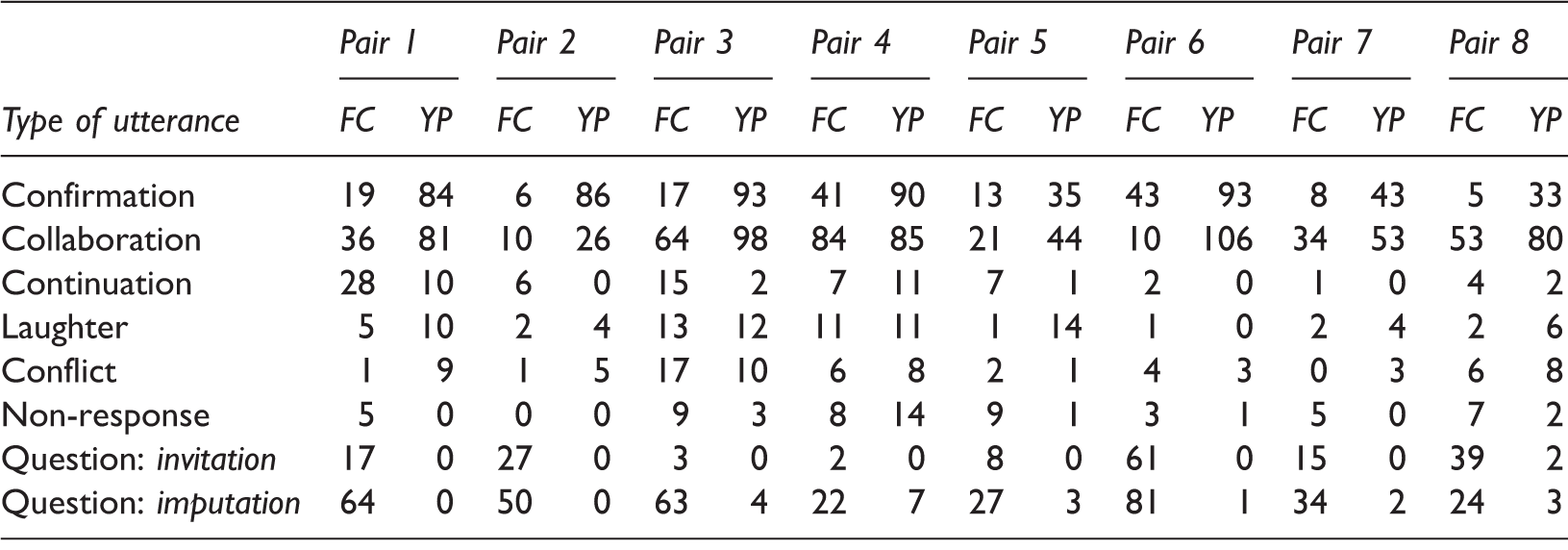
(FC) Foster carer (YP) Young person
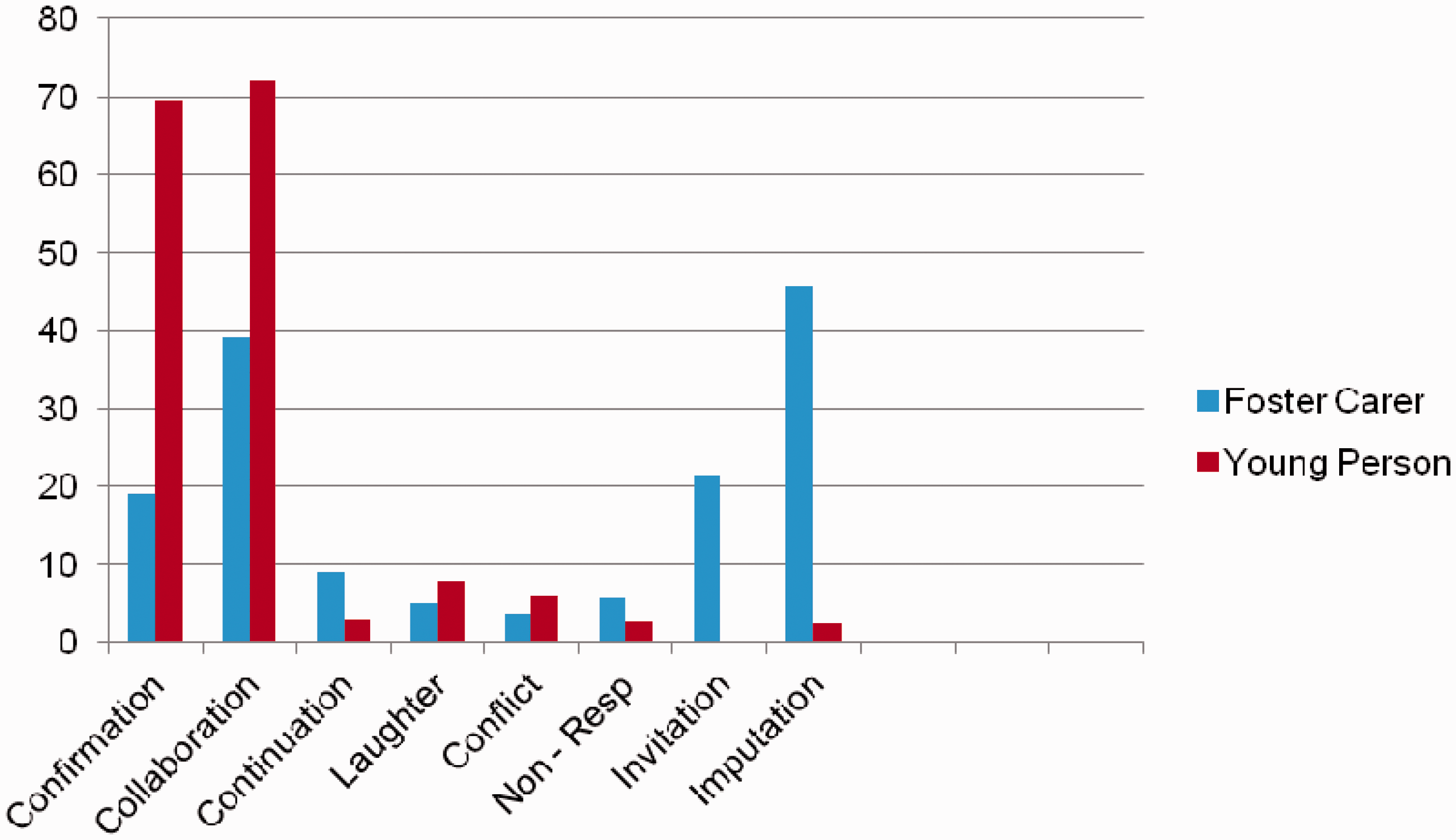
Summary of mean numbers of responses across the eight pairs.
However, the analysis also indicated that rather than generating new topics and areas of conversation, the young people were most likely to collaborate and build on the narratives which the foster carers had begun to present. Interestingly, Pair 4 was more matched in their collaboration in the telling of the narrative.
Although minimal, the analysis also demonstrated that the pairs, especially the young people, were able to express disagreement and to challenge the other if they were at odds with the story being presented. The analysis suggests, however, that the foster carers were more likely to avoid reflecting on what the young person had said and to move on to a new topic, or continue with their previous comment and not incorporate the contribution of the young person. This pattern was noticed for all of the pairs, apart from Jen and Tina (Pair 4). A response of laughter was present most in Pairs 3 and 4’s conversations, where the foster carers and young people were well matched in this way. Elsewhere, the young people were more likely than the foster carers to respond with laughter.
The evidence in Table 2 and Figure 1 also shows that imputation questions were far more frequent than invitational ones and that these were employed almost exclusively by the foster carers. This was an unexpected finding and suggested that the foster carers were attempting to help the young person to articulate their stories and possibly to help clarify events for the researcher.
2. The sequential patterns of question types
Numbers of imputation questions followed by confirmation.

Numbers of invitation questions followed by collaboration.

Discussion
The four narrative themes that emerged from the analysis were central to the dyad’s experience of their relationship. They support other research findings whereby becoming part of the family (Schofield, Beek and Ward, 2012) and family-like relationships (Biehal, 2014) have been identified as promoting placement stability and satisfaction. It also echoes previous findings of children in care being reported to appreciate the ‘little things’, such as being included in family rituals and holidays (Biehal, 2014). However, it also adds to the research in that the conversations of the ‘normal’ experiences and shared memories were spoken about as acting to replace and in some ways rewrite the young person’s previous experiences. The fun and laughter that these activities provided were considered to deepen the relationship and the connection, possibly in that a relationship is formed implicitly at an emotional, embodied level, as well as on what is explicitly spoken and discussed. The emotional warmth in the relationship indicated by having ‘fun’ together and laughter appears to be an essential glue that helps to cement the development of a positive relationship. This sense of emotional safety and acceptance was also central to the theme of the placement being different to expectations and previous experiences. Recognition of this difference appeared to be important for the young people’s ability to start accepting the support of the foster carers and benefit from the placement.
While these findings support much of the literature discussed in the introduction, they also extend knowledge in an innovative way since this study has gone beyond an individual perspective and considered interaction processes alongside narrative themes. We suggest that it is important to consider not just whether these young people say positive things about their relationships but also how this has come about. The analysis of the conversations between the foster carers and young people demonstrates how this positive relationship is built, although it also indicates some areas of concern. The foster carers took the lead in the conversations and generally offered a positive and validating space for the young people. The benefits were indicated by the positive emotions between them such as laughter and joking, and also the marked absence of hostility or withdrawal on the part of either participant. However, within the interaction the foster carers tended to rely on imputation questions in their attempt to engage the young person. Despite this being well intentioned, at times it appeared to be counter-productive, leading to monosyllabic responses of confirmation from the young person rather than collaboration. The result was interaction sequences based on the foster carer presenting extended independent monologues whereupon, perhaps unsurprisingly, the young people appeared to disengage and resorted to one-word utterances of confirmation. In contrast, when the foster carers utilised invitation questions to engage the young people in the discussion, this typically elicited elaborations of the narrative leading to a more balanced interaction and more equal co-construction of them. It seemed that when the young people were invited to or given the space to collaborate, they were willing and able to seize the opportunity.
Links can be made from this research to other literature on question types. For example, Heritage and Robinson (2006) investigated the use of different question types and their impact on the subsequent interaction between doctors and patients. They found that general inquiry questions produced much longer problem presentations from patients compared to questions that requested confirmation of their problems or details of specific symptoms.
It is possible that due to the conversations being conducted in a ‘public’ research setting, the foster carers may have considered it to be part of their professional role to manage the discussion and to meet the perceived needs of the situation. This may have led them to take more responsibility for what was said, which appeared to result in them taking on the role of translating the young person’s story for the benefit of the witnessing researcher. This possibility was manifest when they spoke directly to the researcher about the child in the third person or checked with them: ‘How are we doing?’ It could be assumed that this was due to their sense of professional responsibility in other settings where they were expected to present information.
A further reflection on the interactions between foster carers and young people was that when the latter contributed to the narrative and offered information, carers did not always take the opportunity to reflect or build on what they had said. This is noted as important due to the foster carer’s key role being to re-parent and support the young person to make sense of their experiences and to hold a meaningful account of their history. Chen and colleagues (2012) suggest that developing more coherent narratives of one’s life and experiences is linked to well-being and improvements in mental health.
Another striking point of the conversations was the way in which an image of the young person was presented and how this changed over the course of the conversation. The narratives began with an account and presentation of the challenging behaviours presented by the young person, such as running away or the relationship being generally ‘rocky’, very ‘up and down’ or ‘difficult’. There then appeared to be a turning point in the narratives as they moved to a more positive account of the relationship and, in particular, a focus on the young people’s achievements and pride resulting from their achieving beyond others’ expectations. This seemed to support the presentation of success stories and enabled the dyads to express and share the warmth in their relationship. It also supported the young people to express how they believed that being in foster care, and this particular relationship, had ‘saved them’. The placement offered them ‘opportunities’ and a different way of life that was ‘happier’ than it would have been if they had remained with their birth families.
It is important to note that the foster carers appeared in all cases to be acting on the basis of good intentions to try and facilitate the young people to express themselves. Possibly this included the idea that they were ‘modelling’ reflective talk for the child. This is supported by information regarding the content of training programmes for foster carers in the participating organisation, which is informed by ideas from counselling theory about the value of validation and support (Rogers, 1979) and concepts from psychodynamic theory on the importance of interpretation and the influence of ideas. Broadly, this appears to result in foster carers holding a belief that foster care is about helping young people to express themselves which, consequently, may have shaped this interactional pattern. However, there were some noticeable differences between the eight foster carers, with some apparently more able to be ‘relationally reflexive’ (Burnham, 2005) about what was happening in the moment of their conversations and explicitly made remarks, such as ‘I should let you speak.’
Hirst and Manier (1995) identify roles that are adopted in the process of conversations as an act of remembering and retelling stories about the past. Individuals are suggested to take on roles, acting as the narrator (the person who assumes a lead role in telling the story), the monitor (the person who adopts a role of correcting and adding to details) and the mentor (the person guiding others to tell the story). Observations across the eight conversations identified these patterns within the interactions studied. Across the interviews, there were extended interactions where the foster carer took the role of narrator and presented a story of the young person, themselves or the relationship. During such sequences, the young people’s lack of response suggested some disengagement from the narrative and they passively allowed the foster carers to talk for them. Another role the foster carer took on was that of mentor, where she or he engaged in prompting and guiding the young person and took a questioning position at points during the interview. Within this role, imputation and invitation questions were utilised by the foster carers to support the young person’s contribution and to attempt to engage them in the conversation. At times, young people actively invited the foster carers to take on this role and to support them in the conversation, saying they were unsure or giving the foster carer permission to share something on their behalf. The young people were, in contrast, observed to mostly take the role of monitor in the conversations, through confirming or questioning what the foster carer had said. The young people infrequently directed questions to the foster carers or took the lead in the generation of the narrative. They were observed to very much follow the carer’s lead. However, they were able to contribute to the narrative when space, support and encouragement were offered to do so and at these times a co-construction of the narrative was witnessed. This is an interesting area to investigate further and more formally.
Conclusions
The two primary research questions sought to identify first, the dominant narrative themes that are jointly constructed by the foster carer and young person about their relationship and second, the process of interaction whereby shared narratives about the relationship are jointly constructed.
Regarding the first question, the findings indicate that the young people and their carers displayed shared narratives about important aspects of fostering relationships. These featured the importance of developing a conversational rapport, being included as one of the family, the relationship and placement being different to prior experiences and therefore their expectations, and a sense of fun and sharing normal experiences.
The second question produced some interesting findings in relation to the conversational process whereby the two parties jointly constructed these narratives. The most striking finding was that the carers appeared to hold a well-meaning intention to assist the young people to articulate their experiences and hence offered ‘imputational’ contributions that presented suggestions about the nature and detail of the young people’s experiences. However, it seemed that these could have the effect of actually reducing the young people’s contributions to the process of jointly constructing narratives.
The research sample was self-selecting and it is possible that only foster carer pairs who were confident and secure about their relationship being ‘researched’ agreed to take part. If this is the case, there is the possibility of bias towards more positive experiences being presented. Therefore, the process discovered in this study may be less rather than more extreme in more problematic fostering relationships. Whether this is the case requires further research.
Our study focused on the relational themes and interaction processes across the dyads. Further research looking at how foster carers understand their role in conversations with young people, what they are trying to do and how aware they are of the processes in the moment would build on the current findings. There is also a need to identify if other methods yield more co-construction of narratives, such as asking dyads to develop their own stories and examples of a successful foster placement.
Clinical implications
The process of jointly telling stories allows the opportunity of the construction and celebration of a relationship (Duck, 1994). This research may, therefore, be considered therapeutically helpful in offering such an opportunity. This could be important in facilitating the development of meaningful relationships in foster care, particularly when they have been shown to be extremely vulnerable to breaking down. Indeed, there were moments when the pairs were ‘touched’ by some new information they were sharing with each other.
Foster carers are often approached to offer short-term, more practical support to the young people in their care. Therefore, their training may not prioritise the development of their relationship with the young person (Storer, et al., 2014). The current research could form the basis of an innovative training package for carers that includes:
Audio/video clips of dyad interactions that foster carers can deconstruct and reflect on in their communication with the young people they are looking after. This could help maximise these interactions, encouraging them to notice when they might be missing opportunities to engage the young people in conversation. This may, in turn, increase their awareness of ‘relational reflexivity’. Motivational interviewing and narrative therapy techniques. Such techniques might help the foster carers to balance situations when the young people require more support in conversation while also allowing them enough space and invitation to fully engage in their interactions with others. This would be beneficial in supporting the young person to develop coherent narratives of their experiences that will, in turn, support their well-being and transition to adulthood.
Footnotes
Acknowledgements
The authors gratefully acknowledge the foster carers and young people who participated in this study and the contribution of Claire Hennessy in making the research possible.