



Abstract
One major responsibility of social workers is to supervise and support foster carers. This exploratory study examines how practitioners perform this role. The social workers’ experiences, attitudes and beliefs were explored in a focus group comprising five participants working in one local authority children’s service in a city in the East Midlands region of the UK. Interpretative Phenomenological Analysis (IPA) was used to analyse the data and participants were invited to contribute to the analysis. The research design is collaborative and second order, with the researcher positioning herself as part of the research ‘system’, and the underlying epistemology is social constructionist. Three overarching themes emerged: difficulties and rewards in relating to foster carers, working with risk and uncertainty and working within a system, with professionalism and humanity identified as significant motivations for guiding practice. The themes are presented and their connection to the research literature and systemic theory is discussed. Narratives and hypotheses are also offered. The results suggest that practitioners experience discomfort when there is disjunction between their own values and objectives and those of the agency they work in and, conversely, that they enjoy satisfaction when these values and objectives cohere. Implications for practice are discussed with a suggestion that strengths-based and systemic practice models are the most likely to produce consensus and challenge the current shift towards a process driven welfare service. The study is idiographic in being specific to participants and context and provides a snapshot of the ‘lived experience’ of supervising social workers (SSWs) through a systemic lens. Despite its limited scope and the dearth of research in this area, the study provides a starting point for further investigation.
Keywords
Introduction
In recent years systemic theory and practice have contributed towards the concept of ‘relationship-based’ social work. Systemic approaches have been utilised as a model in child protection (Forrester, et al., 2013; Goodman and Trowler, 2012) and social work education (Frontline and Step Up training programmes). In some UK local authorities there is a drive towards embedding systemic practice as an alternative to a rigid and process driven approach which, it is argued, repeated enquiries and reforms have encouraged (Gibson, 2016; Higgins, 2016; Howe, 1998).
Written accounts regarding systemic practice in social work appear to be focused on frontline child protection work with little attention paid to systemic practice with ‘looked after’ children and their families. Theoretical models concerning attachment and trauma tend to dominate thinking (Golding, 2008; Golding and Hughes, 2012; Perry and Szalavitz, 2007; Siegel and Bryson, 2011).
Foster carers and social workers are likely these days to undergo training regarding the impact of trauma on child development and therapeutic parenting techniques, ideas that stress the circular nature of interactions. Other concepts, such as blocked care and secondary trauma, emphasise the long-term effects of earlier experiences (Hughes and Baylin, 2012). However, while these perspectives are illuminating, they seem to pay little attention to social work practice, offering few ideas in terms of social workers’ thinking, actions and relationships.
There is also a noticeable lack of research into the values, perspectives and experiences of supervising social workers (SSWs). Woodcock and colleagues’ study (Woodcock Ross and Crowe, 2010) provides some preliminary evidence and comments are offered by Grady and Cantor (2012) and Higgins (2016) on what life is like for social workers although neither asks the workers themselves. This dearth of information has led Brown, Sebba and Luke (2014) to conclude that although there are several studies of the impact of wider systems on the social work role (Gleeson and Philbin, 1996; Lymberry 2012; Odell 2008; Sellick, 2014), research into SSWs’ perspectives and experience is a major gap in existing knowledge.
Methods
In this study, information was obtained through discussions between the author and focus group participants. The aim was to generate rich descriptions from participants and obtain ‘experience near’ accounts (White, 2007). The method of analysis used is Interpretative Phenomenological Analysis (IPA) (Smith, Flowers and Larkin, 2009) and the study is ‘idiographic’ (Dallos and Vetere, 2005), meaning that the results cannot readily be generalised. This methodology recognises that ‘value-free’ knowledge is never possible and that there will always be intrinsic bias in the data collection and analysis.
The study design
Two focus group meetings were organised so that findings from the first one could be taken back to the group for scrutiny. This allowed the identification of themes to become a shared process or ‘dialogue’ between the author and participants (Arnkil and Seikkula, 2015). This method is ‘coherent with systemic values, ethics and theory’ (Simon and Chard, 2014: 23), taking the position of ‘doing with’ rather than ‘doing to’ participants. For the duration of the study, a ‘researcher’s diary’ was kept, tracking the author’s beliefs, assumptions and ideas, consistent with second order cybernetics where ‘the observer is circularly (and intimately) involved with/connected to the observed’ (Glanville quoted by Chard, 2014: 39).
Sample and setting
The sample was drawn from a local authority fostering service. All qualified social workers responsible for ‘supervising’ foster carers and kinship foster placements were invited via email to participate. Five of them (from a pool of 20) took part.
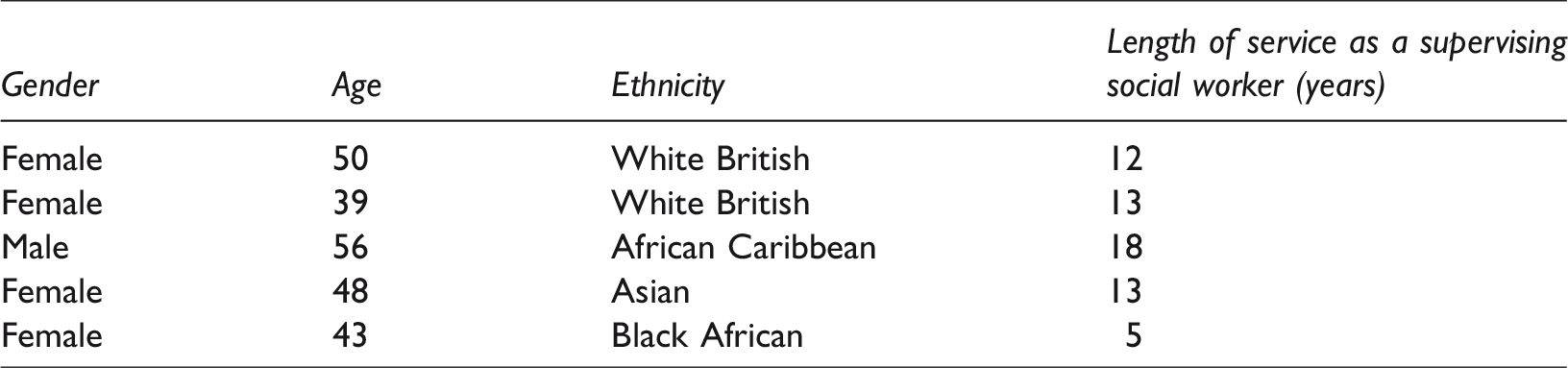
Participants’ gender, age, ethnicity and length of service as an SSW are described below (Table 1).
Participant information.
Data collection and analysis
The focus group provided an opportunity for participants to share ideas and build their social world, using the feedback loop between conversation and creation of experience, beliefs and action. It is consistent with social constructionism in its belief that there is no ‘true account’ of lived experience and that, in the words of Tomkins and Eatough (2010: 248): … until they debate and interact with other people on a topic individuals are often unaware of their own implicit thoughts or opinions… group interaction can bring personal experiences to light.
Data analysis
Analysis commenced by reading the transcript several times. Each participant’s contributions were highlighted, thereby allowing the researcher to follow an individual story over the course of the conversation. Keywords, phrases or summary of meaning were noted, as were participants’ aside comments. The researcher’s inferences, assumptions, reactions and connections with existing theory and research were also recorded. The emerging ideas were then clustered according to experience and theory knowledge. Each cluster was given a label to capture its essence (Smith and Dunworth, 2002: 610), creating a ‘group-level’ summary of themes. This process was repeated by a colleague as a means of validation.
Themes emerging from data analysis were then taken back to a second focus group meeting so that the researcher’s interpretation of participants’ ‘lived experience’ could be assessed.
Findings
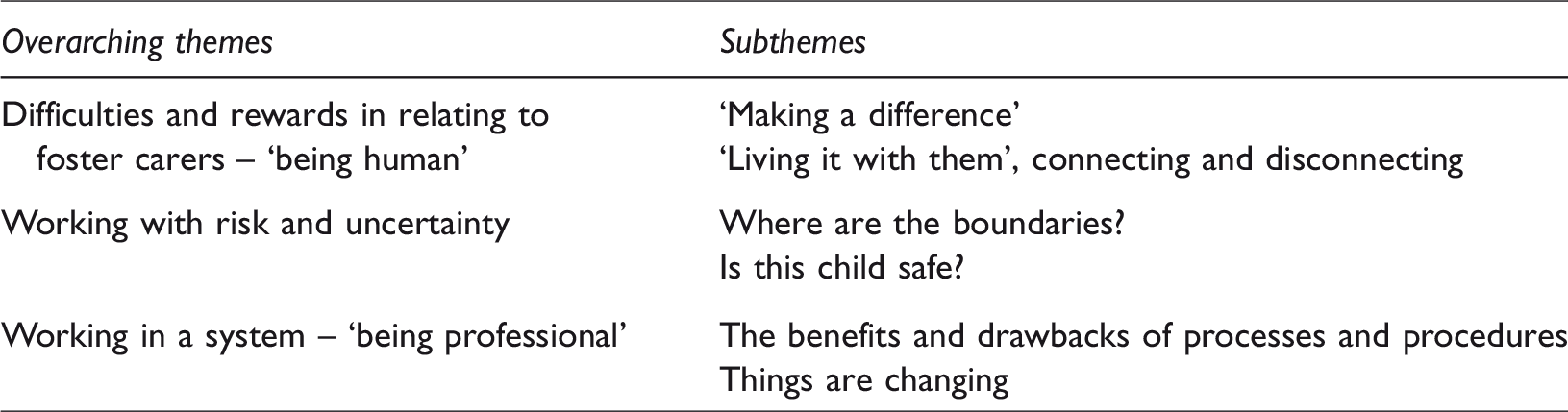
Three overarching themes and six subthemes were identified, as laid out in Table 2.
Resulting themes and subthemes.
Theme 1: Difficulties and rewards in relating to foster carers – ‘being human’
Participants were not reticent when asked to describe challenges and rewards in relating to foster carers. They spoke about their enjoyment of the role in terms of using their ‘people skills’ and ability to relate to others in order to connect with people. ‘Making a difference’ was also emphasised.
The phrase ‘it’s difficult’ was repeatedly heard during the discussions, as were details of the complexity of emotions and layers in the relationships required. Issues highlighted included feelings of responsibility and fear of being let down by foster carers or of letting them down. Participants also referred to their own and foster carers’ humanity, with concern for the carers’ well-being apparent in phrases like ‘feeling’ on their behalf, ‘living it with them’ and ‘being there’ for them: Although I wasn’t there with them, you’re kind of living it with them because you’re thinking, right, they’re at the police station now, I know [manager] is there, so you do, but you wouldn’t be human if you didn’t have that. (D) I think because you have that strength of a connection really with them, it is … I’ve said it before, but you do feel like you’re letting them down if you're not there when they have these moments when they really need you. (C)
Making a difference
When asked about the rewards of working in their chosen role, all the participants referred to ‘making a difference’ in the lives of others: I suppose you enjoy watching the children go on to adoption, go on to a long-term placement (D) I think I’m … um, my family is the most important thing to me and I think family generally is incredibly important to everybody and I think it’s probably no coincidence that I work in fostering where I’m trying to create families for children. (C) I guess – I do enjoy working with people, I’ve always really enjoyed working with people, making a difference in people’s lives and children’s lives, so I feel it does enable me to be able to do that and make a difference and not just being there. (E) I think it is about trying to make a difference for the child but also, with your carers as well so that child gets on well, and I think maybe, the positive is about that. It’s when a child goes for an SGO [special guardianship order] or something like that, that actually, that child’s been placed, it’s gone really well, and you’ve managed to do an SGO and that’s been a positive outcome for everybody, and why we enjoy doing that. (A) I think that particular day they just needed to speak to …(me) – I was listening and talking, and it was an hour phone call, last week Saturday and I took it and I’m glad I didn’t ignore it. (D) I think that’s difficult because we are their support and quite often we’re their only support. (C) …quite often, you know, a social – sorry a foster carer – will feel, well, you’re my only support. (B) I find it difficult when I am not available and they – so you know, like I’m going on leave for three weeks and I know someone’s got some difficulties now, and I feel like I’m almost abandoning them by just taking some leave, you know? (C)
‘Living it with them’, connecting and disconnecting
The SSWs talked at length about the nature, quality and effects of the relationships they enjoyed, stressing their emotional aspects: So if I’m working with a family that is a black family or ethnic minority group, I feel that – I’m hoping that that helps them feel they can connect as well, because I may understand, there’s certain things that we share – you share like a culture and I understand what they mean…but they have that African culture which I can relate to and it’s something that helps bring good conversation as well in terms of the shared identity of some sort in a way and hopefully makes them feel comfortable. (E) Again, it is about just being sort of … that sort of sociable side to you, because without that, you’ve got to be able to connect with carers’ families as well. (B) …that was because of what a lot of the black carers were requesting at the time. Wanting a supervisor who perhaps had more of an understanding of how their parenting is and what their approach is, and you know, just about their general background. (B) It’s not just about trusting that person to do their job, it’s about having a connection, feeling that they understand you, that when you say something they’re on the same page as you, you’re not always having to explain every single thing that you’re thinking or saying. They’re with you. (C)
At least two participants used the term ‘feeling with’ to characterise their relationship with foster carers: I will go home and I will still be thinking about it throughout the evening, thinking, I wonder what they’re going through? And you can’t – invariably help. And there’s times I will just think: 7, 8, 9 o’clock, I’ll just give them a quick tinkle – are you OK? (B) I had a situation two weekends back and I found myself ringing the carer, which I’ve never ever done, on the Saturday and throughout the Sunday, because I just felt, partly the seriousness of the situation, but it’s just a whole disconnection. You just couldn’t switch off. (B)
But relational social work also carries a burden and participants described the difficulties of ‘disconnecting’ from foster carers and achieving a balance between meeting their own needs and those of their clients: In regard to that sort of almost emotional sort of relationship, I think it’s very, very difficult to sort of, you know, detach yourself away. So, for example, you know, a carer tells you that, you know, they’ve just been diagnosed, or they’ve just had a bereavement, it’s very difficult then, even like you say, you automatically say, ‘Right, don’t worry, I’ll come out, I will come and see you, I will try and’, you know. (B) Sometimes when they behave in a certain way that you don’t want them to behave in, you take it sort of personally, I do – well, I do, I sort of feel a bit like – why are you behaving like that? You know you shouldn't do that. I sort of feel a bit like: why would somebody I know be like that? (C) I’ve said that to my carers sometimes, ‘I want to kick you under the table.’ Or for a hole to appear to put me in. (D) I sometimes feel I’m defending my carers at a strategy meeting because everyone is like, I’ve done this, and I’ve done that, and then so, you can feel that they’ve let you down. (A) I think if I’m perhaps a little cross with a carer because they’ve done something, if I don’t need to address it there and then, sometimes I’ll perhaps need to leave it for a few days and get back to them, because I need to process that myself. (A) I feel like, because we know them, we know the people, we know the whole family, it’s lovely when they ring you and they say, ‘My daughter has got engaged,’ or so and so is pregnant or has got a good job. You do think, aww, how lovely. It’s like hearing good news about your friends in some way. You do want to celebrate with them. (C)
Theme 2: Working with risk and uncertainty
The issue of uncertainty arose in relation to the boundaries between professionals and carers and the safety of the children. There was general agreement among participants about the duty and responsibility of the social work task but differences in how these should be applied. Some identified emotional support for carers as the primary task and two noted how this meant enhancing carers' ability to meet their children’s needs: …. if the carer is in a good place, regardless how difficult this young person is, they are more likely to sustain the placement. (B) Because we’re asking them to give a secure base, we have to give it. (D) But, we are also monitoring in a … um … I think we always have to be – we’re always child focused. I think, we have to be as well. So, the child I think is always the centre of our concerns… (A) … I think we do have to give a lot of emotional support to our carers. (A).
Where are the boundaries?
There was considerable debate among the social workers about the boundaries of their role in relation to working hours, their own and others’ professional responsibilities and the content of conversations with carers. One aspect of this is availability, as D describes: I actually took a phone call on the Saturday morning, would you believe, my personal mobile last weekend, because the carer rang, and I thought I could either take it or do I ignore it? And I thought: I have to take it because they wouldn't ring me unless it was something, that’s why they’ve been given the number. One of my carers tried everybody and anybody, and then rang me and said ‘I’m ringing you because I don’t know what else to do. I can’t get hold of anyone else’. I said ‘OK’ and we talked about something for about 15 minutes and that was enough, and she went off and did what she needed to do. (C) You think, actually, you should be ringing the child’s social worker, not me. But again, there’s this connectability, what they have with us where they feel, I can ring A, I can ring C, they will sort it, or, they understand. Or, you know the young person because you’ve seen them more times. (B)
The nature of the information learned in the course of supervision was a further problem, raising a boundary issue, as in these two statements: People tell me things and I’m thinking, actually, we’re at this fine line. Do I really want to know all this? Perhaps not. (B) I know more about my foster carers than I know about my best friends. I know what they earn, I know about their sex lives, I know about their health… (C) She’ll say, ‘See you later then, babe’… and I feel like, ‘No, not babe, thank you’. But I don’t – but she would say it to other people. And I feel a bit like, hmm. Am I getting a bit too close? I don’t know. (C) There’s some carers you get on better with than others as well, so you’re going to have more of a chit chat with them. So, there’s more of perhaps, a connection with some carers than there is with others. Others it can be quite – you go, you do what you need to do and then you go. Others, I don’t know, if you’re a similar age, you’ve got a similar interest or whatever, then you’ve got much more of a common ground, so you perhaps will chit chat. But I think you’re always aware of that line. (A)
Is this child safe?
The participants spoke about their experience of continually weighing up information and considering the range of factors influencing decisions about children: Because you’re balancing the – mainly the issues about remaining against the issues about not remaining, you know, what’s in the child’s best interests because actually moving them may not be. (C) You may – you have concerns. It’s like looking at the vulnerable areas and then looking at the strengths and you’re weighing those two and saying the benefits against are – you know, and sometimes it’s very close. (E) … come out of the meeting thinking, ‘God, why have we put this baby in this risky situation?’ (A) Am I safe, well, you’re thinking about the family as well in terms of how safe but then sometimes I think for me….How safe am I? (E) It’s quite hard to let that risk go, when you go home that’s when you’re thinking, what’s happening to that child? What’s happening to that carer? Because the risk might also actually be about the carer’s safety. (C)
Theme 3: Working in a system – being professional
Theme 3 concerned working as a professional in a bureaucratic system and how the benefits and drawbacks of processes and procedures affect this. It covers a range of areas, such as self-identity, how social workers are viewed by others, how they perceive their relationships with carers and what makes their relationship ‘professional’.
The benefits and drawbacks of processes and procedures
Participants found the agency context in which they worked and the procedures and policies that define their role as both a help and a hindrance.
The focus group gave them a rare opportunity to reflect on their own power and the context in which they are working. They were not asked directly about foster carers’ experiences but the question of carers’ vulnerability arose when social workers considered their own power in relation to those they supervised: Quite often the professional will ultimately make those decisions and sometimes a carer will think [makes scoffing noise], you know, they never listen anyway. So, you know, I hear that so often …(B) It is frustrating, because she is very good and in fact she’s done such a brilliant job with the two children that in fact, you know, why hasn’t the … and I need to do the email to the social worker to say, do you realise you should invite her to the PEP meeting? Because the carer has … I mean, she has spoken about this particular social worker or anywhere that she doesn’t feel like she’s being listened to. (D) We have recruited them, we have trained them, so they should be able to be that ears and eyes to say, is this person appropriate for this young person to go round and play with at their house or not? Because otherwise then, the whole process becomes so over processed. That is why we end up doing so many checks. … and it’s all taken above them, the strategy meetings they’re not invited to, the whole process, they’re excluded. We’re only allowed to give them certain information, that whole process they’re excluded from. And I think with social – the child’s social worker as well – I think that can be difficult. (C) Yes, we shut down and we’re like, OK, you’re over there, we’re here, we can’t really come and talk to you about this because we don’t want to influence – we’re not allowed to, you know. It’s an odd concept. I think it’s odd to us and it’s odd to the foster carers. (C) I went to the inquest with X and that did help, because everything everybody said there, the professionals about the carer’s care was all positive and she was there, and it was hard, because again you’re seen as the department and not that support any more. (D) I did go and see the carer afterwards and we had our goodbyes properly and she’s seen me since, she still talks to me. But I found it really hard. (D)
Participants spent a lot of time discussing the pros and cons of procedures, with some saying that meetings, supervision and the agency context was useful to them in terms of providing structure and support, despite the irritations of having to comply: And controlling it. And we have a care plan which says this child should remain there, and we go to professionals’ meetings. (A) … but I think ultimately, I think we have the power of the local authority and, you know, procedures and policies behind us, really, so – and actually when, you know, there is something hits the fan we’ve got a lot more support behind us than they have behind them. (C) Somebody will probably ask their team manager and decide to say, ‘Well actually I think it’s worth the actual risk’, that’s ultimately why we tend to go to supervision, because if we take concerns or risks to supervision, your manager will hopefully try to balance it out. (B)
Things are changing
Participants all identified a reduction in the last few years in their capacity to offer emotional support to foster carers: The support part of the job is what we’ve just identified as the significant part of our job, but actually it’s the bit that’s getting eroded more and more and more. (C) What’s hugely different is that probably back then they had more of our time, more of our attention, so therefore all those things, they could actually discuss with you, get it off their chest. (B) The threshold has dropped really, our threshold as fostering is up here, but threshold could … it feels like could as well, from the same teams it’s more crisis led where they place a child in what’s supposed to really be a temporary thing but then eventually it becomes a permanent thing. So, then you’re having a lot of issues and you can see that the threshold is – but also with just the volume of work. Our availability is less because the more work we get given the less time you have with them, but carers expect more of us because they’re not getting it from the childcare social workers. Social work is changing I think, and, that means that foster carers expect more of us. Knowing the carer, it actually helps you to be a little bit more informed, because sometimes, a lot of the time in fact, there isn’t any real concrete evidence, and sometimes it’s about how well you know the carer, the little things you tend to observe when, you know, you’re doing a home visit and then you’ll think to yourself, well, actually, is it likely this could happen or couldn’t it happen? Not necessarily our direct managers but more senior to that, I think they’re quite happy with it as long as it’s done, and it’s ticked in a box really. I think they are quite happy with that, how you get there they are not that interested in.
Discussion
All of the participants emphasised the importance of their relationships with foster carers in helping to make placements work, especially by providing emotional support and connecting with carers. This is encouraging because these perceptions echo a conclusion in Brown, Sebba and Luke’s (2014) research review that the elements which foster carers value from their social workers are emotional support, help in times of trouble, reliability and availability. Thus, there is considerable congruence in the views and wishes of both parties: they value the same things. But the challenge to this consensus comes from the uncertainty around the boundaries of professional conduct and the conflict between care and control. The participants held an underlying belief in a need for separation (rather than integration) of the personal from the professional, raising the fundamental question of whether it is ‘unprofessional’ to connect with foster carers on an emotional level.
But tensions apart, the overwhelming emphasis in the discussions was on relationships and what made them successful. Identity and culture were two factors identified as significant, with a recognition of practitioners’ membership of social groups (Falicov, 1995) and the impact of the worker’s ‘self’ on relationships with carers. Some participants spoke about how similarities and differences between themselves and foster carers had the potential to produce different kinds of relationships and understandings, a finding that has implications for supervision.
Much social work and psychological research has found that in many circumstances, the quality of the relationship between practitioner and family members heralds good outcomes for the foster child and family. One participant saw the relationship as a vehicle for change, seeing the emotional support offered as building the foster carers’ ability to look after and support the children in their care. In systemic literature ‘dialogical’ practice, grounded in the idea that change can come about through dialogue (Seikkula and Trimble, 2005), has received increased attention. Connections, understanding and ‘withness’ (Hoffman, 2007) can provide space for people to alter their perceptions and make different choices. Hence the stress participants place on the importance of dialogue between themselves and the foster carers they support, and the contribution of dynamics such as ‘feeling with’ family members and ‘understanding’.
All participants said that ‘making a difference’ to children and families was a main source of job satisfaction and a hypothesis suggested by this study is that this sense of reward from the work emerges when there is a good ‘fit’ between agency objectives (to protect children from harm, to minimise intervention and achieve permanency) and social workers’ personal values, beliefs and identity – the opposite being that difficulties arise when these conflict. Unfortunately, few studies have explored what SSWs do in their interactions with families (Brown, Sebba and Luke, 2014; Gleeson and Philbin, 1996) but it may be that a ‘strengths- based’ practice model can alleviate some of the uncertainty around roles and boundaries that has been identified here. Odell’s (2008) case study regarding strengths-based practice provides an example of how practitioners can utilise their relationships with families to facilitate change in the context of a system driven by legal mandates and policy concerns (Gleeson and Philbin, 1996).
There is a connection between this strengths-based approach and systemic practice, with much systemic theory and research exploring family members’ resources with the potential to create change by highlighting their strengths at every opportunity (Allison, et al., 2003; DeFrain and Asay, 2007; Walsh, 2003; White, 2007). By taking this empowering position in their interactions with foster carers, SSWs can reduce dependency and improve the fit between the agencies’ objectives and practitioners’ personal values and beliefs.
But no matter how auspicious the circumstances, crises will inevitably arise and participants described disconnection or a ‘cutting off’ of their relationship with foster carers when difficulties, such as an abuse allegation, arise. This abrupt cessation of dialogue was experienced as ‘de-humanising’ and damaging to their self-image and public standing. They rued the increasingly authoritarian approach that gives limited attention to the humanity of foster carers and undoes previous social work efforts. Indeed, Gibson’s (2016: 122) research described how the manipulation of pride, shame and humiliation is used by managers to construct institutionally acceptable boundaries: A person or number of people who have cognitive, emotional and/or moral commitments to existing institutional arrangements can police the boundaries of acceptable behavior through attempts to make someone feel shame or pride, thereby coercing compliance.
Eileen Munro’s report on child protection (2011; 2012) found that agency focus on safety to the exclusion of all else leads to an unhelpful process driven approach, ‘a defensive, rule bound culture’. She championed relationship-based practice, although Higgins has argued that four years later, a ‘narrow process driven model of child protection social work seems still dominant in the culture of contemporary social work’ (Higgins, 2016: 522) and that ‘the values and humane focus of social work has become lost’ (p. 523).
Implications for practice
The research findings and the ‘theory map’ of the researcher suggest several implications for practice:
Training in models of practice that bring alignment between agency objectives and practitioners’ beliefs and values may be fruitful. Examples are ‘strengths-based’ (DeFrain and Asay, 2007; Odell, 2008; Walsh, 2003) and systemic practice. Supervision could be utilised as a forum for conversations that support the integration of the personal and professional self, challenging the apparent dichotomy between human emotions and professional conduct. Practitioners may find it useful to clarify the context and the contract with foster carers in an effort to establish some ‘safe uncertainty’ as a foundation for practice. This would involve contracting with carers about the nature of the relationship at the outset and revisiting expectations via ‘mini-contracting’ at every face-to-face contact (Mason, 1993). ‘Relational reflexivity’ (Burnham, 2005) may be used as a technique for exploring expectations and experiences on both sides of the practitioner–foster carer relationship, opening space for conversation about how workers and foster carers are experiencing one another. This may have an additional benefit in terms of developing reflective capacity in foster carers that would benefit the children in their care (Bunday, et al., 2015). Given the changing context identified, specifically increased caseloads and reduced time for face-to-face engagement with foster carers, teams of SSWs would benefit from the opportunity to share, together with management, their perspectives about the nature of their role.
Conclusions
The aim of the study was to ‘paint a picture’ via a systemic research lens of the experience of SSWs and to begin to develop some understanding of how they experience their role. A space for dialogue and tentative understanding was created through the data collection, collaborative analysis and discussions about the interpretation and presentation of the results. It must be noted that this was a very small-scale exploratory study – examining only five participants' accounts and analysed by one researcher.
Further research scrutinising the nature, purpose and boundaries of the SSW role would be helpful in developing the practice of SSWs who are undertaking this complex task for local authorities that are accountable for the safety and best interests of children. Possible areas for further exploration are:
study of the content of practitioners’ conversations in their contacts with foster carers; exploration of team/service managers’ perceptions of the SSW’s role; study of foster carers’ experiences when an allegation is made against them; exploration of the guidance, policy and procedures that SSWs follow when an allegation is made against a foster carer – perhaps in a comparative study across local authorities; analysis of supervision and/or of practitioners’ and supervisors’ experience of supervision.
Footnotes
Acknowledgements
I would like to extend my gratitude to the participants for providing consent to participate in this study. I also thank my mentors in Systemic Practice.