



Abstract
This article describes how 27 foster children aged 12 to 18 years old, placed in Flemish long-term family foster care, experience life in their foster family and how they cope with their feelings. Evidence from a combination of the children's selection of visual images displaying different emotions (emoticons) and semi-structured interviews shows that they mostly express positive feelings, such as happiness and pride, but simultaneously experience difficult emotions like sadness, anger and confusion. Positive feelings are mostly related to being able to feel like an ‘ordinary’ kid and negative ones to strained relationships with birth parents. Investigations into how the children cope with these emotions distinguished two groups: those who talk about their feelings with friends and other supportive figures and those who hide them. The latter group needs to be provided with strategies to better comprehend and express their feelings; among those suggested were activities that offer tranquility, consolation or distraction and having a private place for themselves. More attention to the emotional experiences of foster children and the ways they cope with their emotions is recommended in policy, practice and research if children's well-being is to be enhanced.
Introduction
In Flanders (the Dutch speaking part of Belgium), which has a population of just under seven million, family foster care is the preferred choice for children requiring out-of-home care (Schryvers, et al., 2015). In 2018, 7567 children were so placed (Pleegzorg Vlaanderen, 2019), representing approximately 0.5% of the national under-18 population (Kind & Gezin, 2018). Familial problems, such as inadequate housing, poverty and domestic violence (81%) and parenting problems, such as neglect and abuse (68%), were the main reasons for placement, while child problems (13%) were less frequently cited (Vanderfaeillie, et al., 2015).
A policy distinction is made between short- and long-term family foster care. Thirty-five percent of entrants to the care system are placed in short-term placements and 65% in long-term ones. Short-term foster care lasts a maximum of one year and is renewable after six months. During this period, intensive efforts are made to improve the home situation and reunify children with their birth families. If it becomes clear that this cannot be realised, even after a short period, another option such as long-term foster or residential care, has to be considered.
Placement in long-term foster care aims to create permanency, although Flanders law allows for a return home to be considered at any time and adoption is not a permanency option. As in mainland Europe, the Nordic countries, Ireland and New Zealand (Thoburn, 2010), Flemish child welfare policy places a strong emphasis on maintaining links between separated children and birth parents, hence the achievement of permanence by severing parental rights is rare. However, children can remain in foster care until adulthood and, whenever possible, birth parents are involved in the placement and parent–child contact is facilitated (Vanderfaeillie and Van Holen, 2018). Two-thirds (68%) of the foster children in long-term foster care maintain regular contact with their birth families (Vanderfaeillie, et al., 2020).
Both short-term and long-term foster care placements can be compulsory (court-ordered) as well as voluntary. In 2018, 37% of all placements were compulsory, almost all of them because parents did not agree with the placement; only a few were the result of ‘sentencing’ the child (0.3%). Most foster children (61%) live in kinship care within their broader family (47%) or social network (14%) and 39% are placed with strangers with whom neither they nor their families will have had a previous relationship (Pleegzorg Vlaanderen, 2019).
The history of foster care is characterised by several enduring concerns. These include the separation of children from primary attachment figures and subsequent attachment problems (e.g. West, et al., 2020), the effects of early trauma (Steenbakkers, van der Steen and Grietens, 2016) and loyalty conflicts (van den Bergh, Weterings and Schoenmakers, 2011). These have been found to hinder children’s emotional development, ultimately making it difficult for them to adequately regulate their feelings (Fernandez, 2008; Jacobsen, et al., 2013). Difficulties with emotional regulation can manifest in behavioural problems (Hill, et al., 2006) which, in turn, are associated with an increased risk of reducing the foster carers’ parenting capacity (Vanderfaeillie, et al., 2012) and disrupting the placement in an unplanned way (Brown and Bednar, 2006; Vanderfaeillie, et al., 2018).
Although a considerable amount of research exists into the emotional experiences of foster children and the coping strategies they use to deal with emotional difficulties (e.g. Del Quest, et al., 2012; Grietens, 2011; Murphy and Jenkinson, 2012; Singer, Uzozie and Zeijlmans, 2012), this is not the case in Flanders, and there is an important gap in professional knowledge. Grietens (2011) points to major international differences in youth care systems and traditions of out-of-home-placement which inevitably influence the results of research based on the perspectives of the children. Comparative studies show that the way in which foster children cope with their emotional problems during the preparation of the care placement, and the support they subsequently receive, has a considerable impact on their psychological well-being (Johnson and Tottenham, 2015; Steenbakkers, van der Steen and Grietens, 2016). The perspectives of foster children on how they experience living in a foster family and how they deal with difficult feelings are therefore crucial to their healthy development, yet as far as we know, they have not previously been studied in Flanders.
Background
The focus of this study – children’s feelings, views and coping strategies – was initially informed by the large body of research from other countries. Particularly significant was the literature review undertaken by Grietens (2011) and research from the USA (Del Quest, et al., 2012; Hass and Graydon, 2009; Heyman, et al., 2020; Huffhines, Jackson and Stone, 2020; Ponciano, 2013; Whiting and Lee, 2003), Canada (Mitchell, et al., 2010), the UK (Ahmed, Windsor and Scott, 2015), Ireland (Browne, 2002; Murphy and Jenkinson, 2012), the Netherlands (Singer, Uzozie and Zeijlmans, 2012; Steenbakkers, van der Steen and Grietens, 2016), Norway (Ellingsen, Stephens and Størksen, 2012) and Sweden (Hedin, 2014; Hedin, Höjer and Brunnberg, 2012).
The emotional experience of foster children
In these studies, foster children indicate that the greatest care-related struggles occur on an emotional level (Singer, Uzozie and Zeijlmans, 2012). Living in a foster family often produces a complex mix of positive and negative feelings (Del Quest, et al., 2012; Grietens, 2011; Murphy and Jenkinson, 2012; Singer, Uzozie and Zeijlmans, 2012). Nevertheless, for the majority of children, living in a foster family is perceived as an improvement compared to life in their birth family. However, Whiting and Lee (2003) report that they frequently feel confused about the reasons for their placement and worry about the future. In addition, they often experience fears related to their birth family and feel resentful about being in care (Ellingsen, Stephens and Størksen, 2012). Other troublesome feelings include anger, sadness, guilt, dissatisfaction, the feeling that no one is listening, the experience of ‘not being in the right place', longing for the birth family, lack of a home and powerlessness (Del Quest, et al., 2012; Grietens, 2011).
Difficult feelings occur mainly in the early stages of a care placement (Singer, Uzozie and Zeijlmans, 2012), after which more positive ones such as gratitude, appreciation and happiness are more frequently reported (Hedin, 2014; Murphy and Jenkinson, 2012; Singer, Uzozie and Zeijlmans, 2012).
Coping strategies of foster children
Effective coping strategies are clearly important if children are to deal effectively with these conflicting feelings (Del Quest, et al., 2012; Huffhines, Jackson and Stone, 2020; Ponciano, 2013). One of those most commonly employed is to hide or suppress feelings and adopt an avoidant or inactive stance (Browne, 2002; Singer, Uzozie and Zeijlmans, 2012; Steenbakkers, van der Steen and Grietens, 2016). Some even consciously express feelings that do not correspond to what they actually feel (Singer, Uzozie and Zeijlmans, 2012), a response that Steenbakkers and colleagues (2016) explain as usually the result of not knowing how to express or articulate their emotions. Another coping strategy is self-comfort, for example, ‘doing fun things’ like playing video games, reading, walking, playing with animals, listening to music and meeting friends (Hedin, 2014; Mitchell, et al., 2010; Steenbakkers, van der Steen and Grietens, 2016) but if this does not have the desired effect, children will often withdraw and suppress or hide their feelings as just described. A third coping strategy is to openly express difficult feelings, a response known as active coping, and share them with others (Ahmed, Windsor and Scott, 2015; Hedin, Höjer and Brunnberg, 2012; Huffhines, Jackson and Stone, 2020; Mitchell, et al., 2010; Singer, Uzozie and Zeijlmans, 2012; Steenbakkers, van der Steen and Grietens, 2016). Here, children talk about their feelings (Singer, Uzozie and Zeijlmans, 2012), enjoy support from friends and carers and see social work as helpful (Del Quest, et al, 2012; Hass and Graydon, 2009; Hedin, 2014; Heyman, et al, 2020; Mitchell, et al., 2010; Singer, Uzozie and Zeijlmans, 2012).
While hiding and suppressing feelings are common coping strategies, they are not the most effective. Because some foster children inadvertently lose control of their hidden or suppressed feelings, there is a serious risk of developing externalising behavioural problems which can create further ‘secondary’ adjustment difficulties not only for them but also for the care system. However, such responses should not necessarily be viewed as totally negative as they can indicate self-reliance and pride (Singer, Uzozie and Zeijlmans, 2012).
Research questions
The two questions investigated in this study are:
How do Flemish children feel about living in a long-term foster family? How do they cope with difficult feelings associated with being placed in a new family?
The research is part of a broader study (see Clé, Van Holen and Vanderfaeillie, 2016) in which the experiences of foster children in nine areas were examined. These were: (1) family, (2) support needs, (3) the participation and perceptions of foster care of children as clients, (4) relationships with others, (5) feelings and coping strategies, (6) future perspectives, (7) school, (8) care pathways and (9) finance. This article reports on the fifth theme: feelings and coping strategies.
Method
Procedure
Once ethical approval had been obtained from the Commission of Human Sciences (reference number: ECHW_026), foster children were recruited in all five Flemish foster care services. The following criteria were applied: an age range of 12 to 18 years, being placed in long-term foster care for at least six months and fluently speaking and understanding Dutch. The sample was limited to young people over the age of 11 as the study covered a range of topics that required reflective capabilities. Children with a learning disability and unaccompanied refugee minors were excluded, as were unaccompanied minors not fluent in Dutch (Van Holen, et al., 2020).
Because foster children are a very heterogeneous group, a proportional stratified random sample was drawn (Kitchenham and Pfleeger, 2002) based upon possible combinations of the variables identified as likely to influence the children’s experiences. These were: gender, age at time of placement (before or after six years), type of placement (court-ordered or voluntary), type of foster family (non-kinship or kinship) and placement history (prior placements or not). This produced 32 profiles. By choosing such a sample, the insights obtained could be considered highly representative of the various experiences, opinions and ideas of all older children in foster care (Maso and Smaling, 1998).
In the recruitment procedure, every foster care service was randomly assigned a list of six to seven of the 32 profiles. The service administrators then made lists in alphabetical order of children who matched the profiles. Eligible foster children and their carers were then contacted in the same order by their social worker. Once consent was obtained, contact details were passed to the researchers. As soon as the interview was over, the profile was deleted. In cases of refusal, the next child/carer dyad on the list was selected. If certain profiles could not be completed by a particular service, the profile was presented to another one, with the procedure repeated in order to fill as many profiles as possible.
Sample details
In total, a respondent was found for 27 out of the 32 profiles. Fifteen children refused to participate; seven did not specify the reason, five did not want to be approached, did not ‘feel’ like a foster child or did not want to be confronted, and three indicated a lack of time. In addition, one child could not be reached and one refusal came from foster carers who were experiencing difficulties.
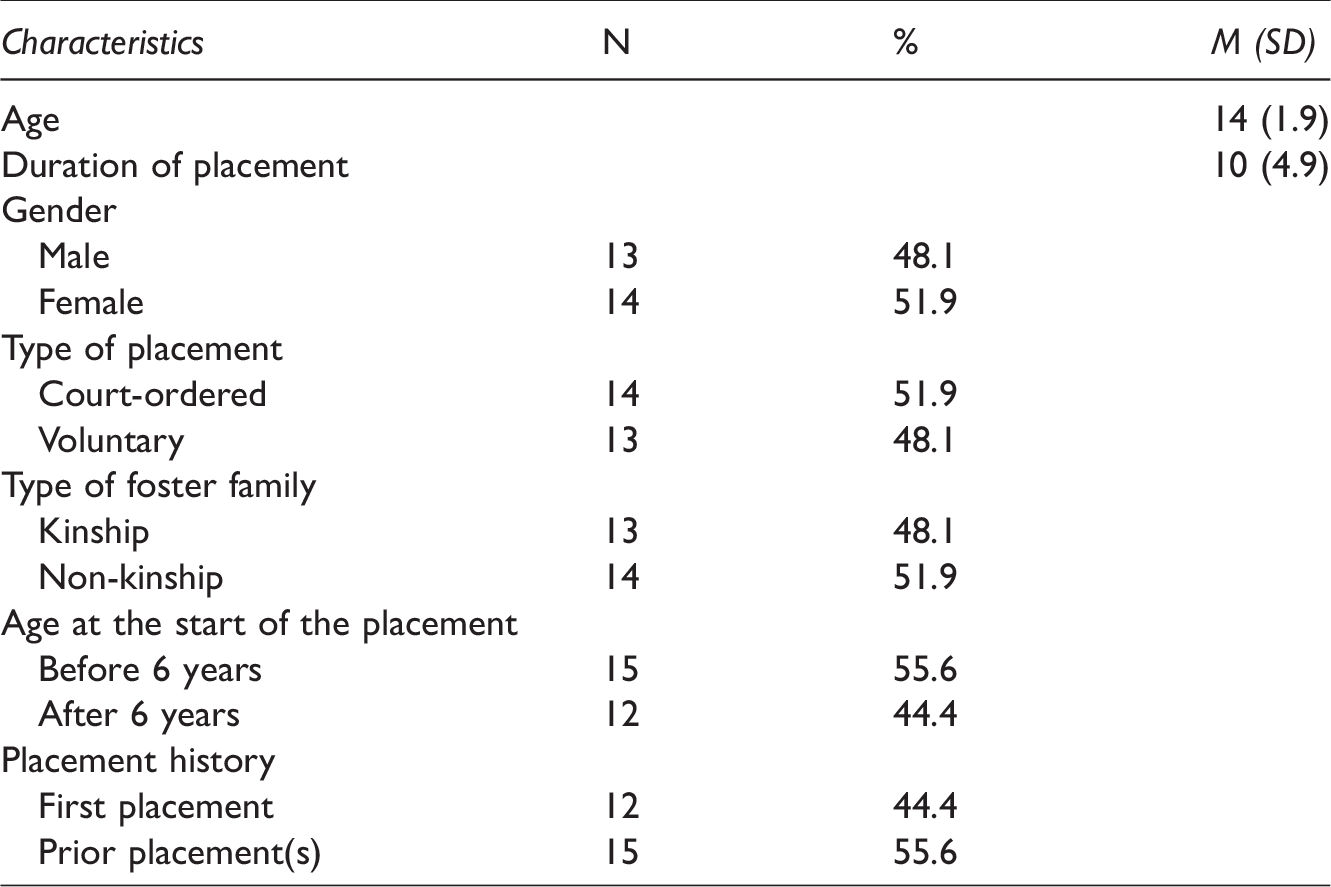
The main characteristics of the sample are presented in Table 1. More than half of the youngsters (56%) were placed before the age of six. The average age of the respondents was 14 years (min = 11, max = 18, SD = 1.9) and they had been living in their foster family for at least two years and on average 10 (min. = 2, max. = 16, SD = 4.6). Slightly more than half of the sample (52%) were placed on court orders because their birth parents did not agree with the placement.
Background characteristics of respondents.
Interviews
As qualitative research methods are generally recognised as the best way to chart and understand complex themes and sensitive issues in the experiences of children (Grietens, 2011; Maso and Smaling, 1998; Mortelmans, 2013), semi-structured interviews were used. The questions were formulated and compiled in an interview guide and the included themes were visualised with images that were put on the table in front of the child. All of the questions were written down on a questions card and respondents were asked to read these out aloud. During the interviews 10 emoticons (visual expressions of emotions), as developed by Okma-Rayzner (2006), were used, representing the following feelings: (1) scared, (2) happy, (3) angry, (4) pretending, (5) normal, (6) confused, (7) shame, (8) guilty, (9) proud and (10) sad. Subsequently, the following questions were asked:
There are different feelings presented. Can you indicate how you usually feel when you think about life in a foster family? Can you tell me when and why you feel this way? Are those all the feelings you sometimes have about living in a foster family, or have you forgotten some feelings? What do you do when you have difficult feelings, like when you are angry, anxious, worried …? Are there other things that bring you comfort, peace or courage during difficult moments?
The face-to-face interviews with the children were conducted in 2016, in the foster home without the carers present. They were undertaken by two female postgraduate researchers from psychological and educational sciences and were audio-recorded. Thereafter, with the child’s agreement, they were fully transcribed and included non-textual data such as silences, interruptions to the interview and audible emotions. After transcription, the audio-records were deleted. To ensure anonymity, fictitious names are used throughout this article.
Data analysis
The transcripts were analysed by two researchers who followed the thematic analysis prescribed by Braun and Clarke (2006). NVivo, a software programme for qualitative data-analysis, was also used for the coding and further investigation.
Results
First, we highlight the feelings children associate with being a foster child. Then, we discuss how they deal with difficult feelings.
Feelings linked to being placed in foster care
Table 2 shows how often each emotion was chosen by the respondents. It can be seen that their selection usually involved a mix of pleasant, troublesome and neutral feelings.
Feelings that foster children associate with being a foster child.
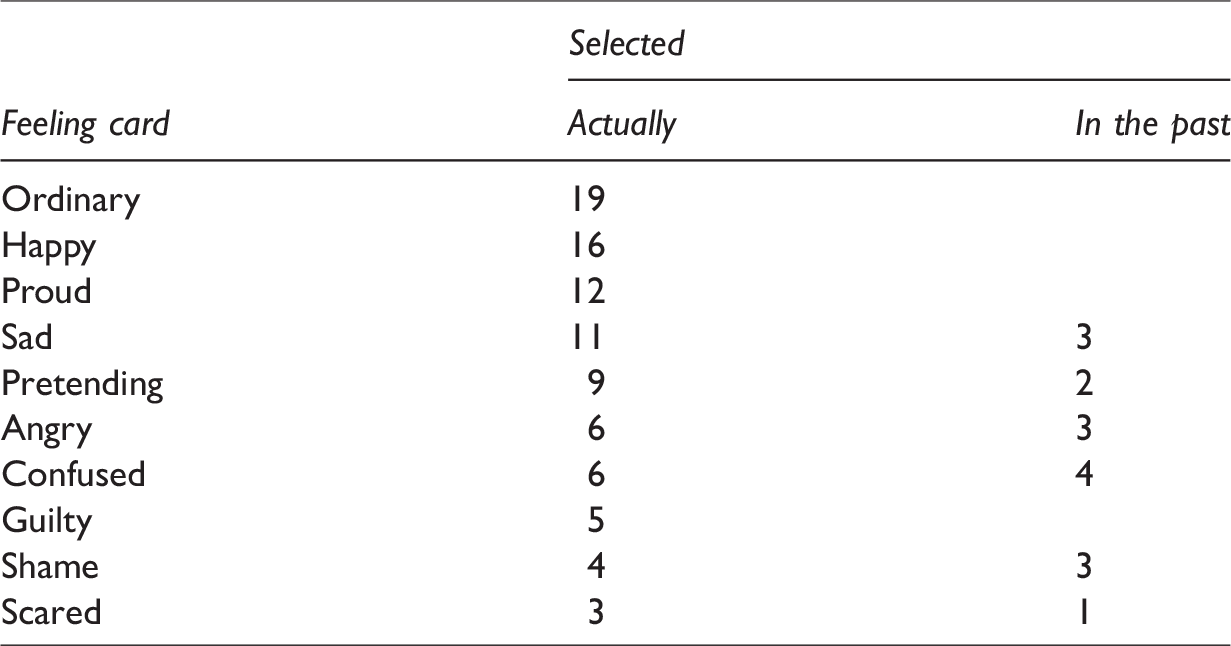
Since some of them explained that certain feelings had occurred in the past but no longer applied, these changes are shown in the right-hand column of the table. After selecting the feelings cards, the respondents were asked whether other feelings were important to them in the context of living in a foster family. Four children each added an extra one, namely ‘jealous’, ‘disappointed’, ‘powerless’ and ‘misunderstood’.
Most foster children feel ordinary
The card ‘ordinary’ was most often chosen. The children reported that this is how they mostly felt and elaborated this in the following statements: It just feels normal. Yeah, I never really realised I had been moved. Everything is really just normal for me, that’s how I feel. (Bert) Because yes, I am not treated differently, it is like a normal life … you are actually under the supervision of a judge, but you do not really feel that, so it just remains normal. (Cléo) Yes, I chose ‘ordinary’ because I live like any other child, even if it is not in my own family. (Shana)
Positive feelings
Although the cards showing difficult or troublesome feelings (scared, angry, confused, guilty, sad, shame) outnumbered those portraying positive ones (happy, proud), it is significant that positive feelings were selected more frequently. Indeed, four respondents selected only positive feelings.
The children were especially happy to grow up in a family where they felt accepted, were given opportunities and were well cared for: Yes, I am happy that I ended up in a family. And also, because they treat me like their own child even though I am not their child. I am happy for that. (Shana) I am proud that I live in a good family and that I can tell them everything about it, and that I, like the other children, am somewhat the same. I am happy about that. (Cynthia) I am proud because I have been able to kick it so far already. I am on the right path. I go to school. I have friends. It’s just normal (…). (Arne)
Difficult or troublesome feelings
Six children chose only troublesome feelings and ignored all the positive and neutral ones. In total, 14 respondents reported that being in foster care regularly made them sad, and this expression of grief was usually linked to the loss of birth parents or the fact they cannot be relied upon: Sometimes if we are not allowed to go to my mom, it makes me sad. If Mom doesn't have time for me or forgets about it. (Lisa) I used to have a hard time with that. I was sad because my parents didn’t care about me. But now? It doesn’t matter to me anymore! (Benny) I don’t like some things that happen in my foster home (…) that's why I'm sad too. (Mieke) That’s just madness, when you’re so mad about, ‘Why did he do that?’ and ‘Why did he put me away?’, or ‘Why can’t he take care of me?’. (Cynthia) Furious, that’s actually a better word (…). I’m furious because they have never shown respect for me, respect for their child. (Benny) I can’t forgive that, what happened in the past (…). We've seen enough. Beating my mother and so on. (Michael) I had behavioural problems, I often had problems at school, I was someone who got angry much too quickly. (Diego) Sometimes I am confused … Sometimes I think, ‘Why am I living in a foster family and not in another family?’. Sometimes I feel like that. (Larissa) I have also been ‘confused’, because yes, in the past when I was young, I didn’t realise why I ended up here, but now I know a little more. (Fiona)
The emoticon scared was chosen by four youngsters, one of whom referred only to the past. They indicated that they feared having to live independently in the future or replicating their birth parents’ lifestyles and had constant fears about conflicts with or between their birth parents and the welfare of their siblings and relatives they liked. They were also anxious about the reactions of others who might find out they had grown up in care. Some examples from the interviews are: I am afraid of the future, yes (…). I am depending on someone who does a lot for me and later on, I have to do all of this on my own. (Jordi) Sometimes I am afraid because I want to visit my dad more often and I want to see my mom less, and I’m afraid that my mom will be angry with me. (Diego) No, I'm still worried that my parents are going to argue. Because my daddy is a little angry because mom made a request for reunification. (Cléo) I sometimes feel ashamed about living in a foster family. Because that is different (…) because I’m not like other people. (Kimberly) Yes, when I meet my father, he usually has been drinking, or is standing with a bottle of beer in his hands, and then I think, ‘Avoid him as much as possible!’ (…). I’m afraid to meet him. I’m afraid he’ll act ridiculous, and then I just feel ridiculous too (…). That’s why I try to avoid him as much as possible. (Bert) Yes, sometimes I feel guilty because I went to live in a foster family. Because I know how Mommy feels about it. She thinks I don’t like her, or that I hate her, but I really don’t. And then, I sometimes feel guilty for being here. (Mieke) When my mom says it’s my fault that I'm in foster care, I feel guilty. (Jeanne)
And two other youngsters felt guilty about the problems their difficult behaviour were causing their foster parents: Hum, yes, if you’ve done something like that, you feel guilty anyway. If, for example, you have said, ‘I want to get out of here,’ then you really feel guilty. You should never really say that because then everyone there starts to cry and then you really feel guilty. (Cynthia)
Coping strategies
Respondents were asked how they dealt with difficult or unpleasant emotions and what relaxed, helped or comforted them. Two distinct groups were identified: those who prefer to talk about problems (‘talkers’) and those who hide troublesome feelings (‘silent ones’).
Talkers
Fifteen foster children said that talking helped them. When they were struggling, they first turned to their friends: I would tell my friends if I was having a hard time (…). Klaas is my best friend and I can really tell him everything. Others might laugh with me, but he doesn’t. He’ll take me seriously. (Bilal) I can always turn to my foster parents. Usually, they see when something is going on. I don’t know how they know, but they just see it. And then we talk, we have a drink and we talk about it. Sometimes I burst into tears. I am very sensitive in those situations. (Cléo) In case of difficult feelings, I tell my foster care worker. She tries to listen to me as much as possible. (Bert)
Silent ones
Ten youngsters said they preferred not to talk about difficult feelings. This group largely corresponded with those who selected the emoticon ‘pretending’.
These children hid difficult feelings such as sadness, anger or disappointment, citing two reasons for doing so: fear of unpleasant reactions and difficult questions and not wanting to hurt others: Especially on the days when I feel sad, I pretend being happy, I pretend nothing’s wrong, because I don’t want people to ask questions. (Anja) Sometimes I pretend that I don’t mind, I pretend I’ve forgotten my mom, so my foster mom doesn’t know that I still mind. (Laura) I am not the kind of person who works out feelings. I am someone who holds them. That is difficult for me too, because I am someone who has a hard time finding a person to turn to. (Diego)
Activities that offer ease, comfort or distraction
Both the ‘talkers’ and, albeit to a lesser extent, the ‘silent ones’ mentioned activities that offer them ease, comfort or distraction when they are struggling. Both groups named listening to music, sports, games, drawing and writing: Yes, then I take my headphones and listen to music. That makes me very calm. (Benny) I don’t know. I’m just going to box, to relax. (Arne) Then I lock myself in my room and start writing and doing all kinds of things. Until those feelings end. (Anja)
The importance of a place of your own
In addition to activities, the need for privacy was especially stressed. A private room is somewhere foster children can allow difficult feelings to sink in and process. Eleven spontaneously mentioned that they go there when difficulties arise as it allows them to let their emotions run wild without anyone noticing. Their own room is also the place where many of the activities mentioned above can take place and for many of those who prefer not to talk about difficult feelings, it offers them a chance to find peace: When I’m having a hard time, I go to my room. There I listen to music and cry. (Mieke) I have privacy in my room, so if I have bad feelings, I think I will be in my room (…). We came to live here because then I would have my own room. I used to share a room with my foster sister. But I thought it was nice to have my own room, that you still have a piece of privacy. (Shana)
Discussion
This study confirms earlier research showing that foster children are confronted with a combination of contradictory feelings, such as happiness and sadness, pride or shame (Del Quest, et al., 2012; Grietens, 2011; Murphy and Jenkinson, 2012; Singer, Uzozie and Zeijlmans, 2012).
However, the adjective ‘normal’ was the one most often chosen to describe what it feels like to be a foster child. Respondents indicated that being in care offered them the opportunity to grow up in an ordinary family and do the things that ‘ordinary children’ do. In addition, many also felt happy and proud of their situation, linking these feelings to the relatively ‘normal’ life they could lead. These findings echo previous research showing that foster children mainly have positive experiences and feelings and that placements improve their lives (Grietens, 2011; Hass and Graydon, 2009; Sinclair, et al., 2020).
The negative or troublesome feelings expressed by the children were mainly related to contacts and relationships with birth parents. The grief of being separated from their birth parents sometimes diminished or disappeared but remained actual for many respondents. Anger, often accompanied by grief, was also often directed to birth parents because of the poor care they had offered and their continuous unreliability. Some children described themselves as ashamed of their parents as well as their own situation, mainly because both deviated from the social norm. This, once again, confirms the desire of many foster children to go through life feeling as ordinary as possible. In addition, it reiterates the need for attention to be paid to children’s feelings of disappointment with parental shortcomings and strengthening their capacity to deal with them (Andersson, 2008). Complementing this must be efforts to reduce the risks to their emotional health and the security of their placement posed by poorly managed family contact arrangements (Farmer, 2010; Sen and Broadhurst, 2011; Sinclair, 2010).
The children also often felt confused. This was mainly linked to a lack of insight into the reasons for being in foster care, again emphasising the importance of giving them clear information about the reason for placement, who decided it was necessary, its likely duration and what will happen to them while they are there (Morgan, 2010).
Anxiety, too, has a prominent place in the life of foster children. Respondents talked about the haunting worries of being able to stand on their own two feet, following in their parents’ footsteps, negative reactions from others, conflicts with or between the birth parents, being unwittingly traced by relatives they no longer want to meet and concerns for the welfare of their absent siblings and birth parents. With regard to the latter, emotions are sometimes further complicated by also feeling guilty for ‘abandoning’ their birth relatives.
Zooming in on the coping strategies that foster children use in dealing with difficult feelings, two groups can be distinguished. The first and largest uses active methods. These were referred to as ‘the talkers’. They prefer to speak about their feelings and do this primarily with friends, followed by the foster carers and, in particular, the foster mother. For them, being able to share difficult experiences and feelings is clearly helpful (Steenbakkers, van der Steen and Grietens, 2016). The second group, noted in much previous research (Singer, Uzozie and Zeijlmans, 2012; Steenbakkers, van der Steen and Grietens, 2016), comprises taciturn children. They use inactive or avoidant coping strategies, hiding their troublesome feelings because they fear negative reactions or do not want to hurt anyone. Some of them also directly or indirectly indicate that they do not know how to express their feelings, and many describe how they ‘pretended’ in order to avoid ever revealing their true emotions.
A key issue in this is whether hiding and suppressing feelings are inevitably damaging coping strategies, as some researchers have suggested that they can also indicate resilience, self-reliance and pride (Singer, Uzozie and Zeijlmans, 2012). Indeed, for foster children who have experienced severe chronic abuse and neglect, hiding feelings and avoiding problems can be protective (Huffhines, Jackson and Stone, 2020). But clearly further research is needed to clarify the effects of this strategy. Does it escalate negative emotions, mask important support needs or is it simply functional for survival?
Finally, it is important to reiterate the value for children of having a place of their own and activities that offer peace, comfort or distraction. This echoes previous findings and applies mainly to the taciturn group. In this way, children try to let difficult feelings sink in and process them. But, as before, these strategies can be both adaptive and maladaptive. For example, seeking distraction can lead to a temporary decrease in stress level, but can also be a form of procrastination (e.g. Waugh, Shing and Furr, 2020). Several observers have pointed out that all children have to develop coping strategies to handle stress but for foster children, the histories of deprivation and trauma, experiences of separation from birth families and home communities and continual changes of living situation make this more difficult and prone to complications (Clarke, 2005; Morales-Rodríguez, et al., 2016; Browne, 2002).
Recommendations for practice and policy
More attention to the emotional experience of foster children is recommended by this study. Both foster children and carers must be emotionally supported during the preparation and duration of the placement and transparency about the reasons for it is essential to create a realistic life story for the child. In addition, foster care should be further normalised as much as possible so that children can feel ‘ordinary’, a need that is loudly expressed by the participants in this study. One way of achieving this is to make foster care known to a wider public.
Special attention also needs to be given to help foster children work through disappointing experiences related to their birth parents and to integrate the reality of shortcomings in ways that allow them to move on (Andersson, 2008; Farmer, 2010). Although foster parents are crucial in this, they cannot manage it alone (Andersson, 2008; Hiller, et al., 2020) and need to be participants in a wider plan to promote high quality birth family contact (Sen and Broadhurst, 2011).
Most foster children express their feelings by discussing them with important support figures. Social workers should monitor whether the children have a sufficiently large social network, comprising both reliable ‘formal’ individuals, such as therapists, and informal relationships with friends. Particularly worrying in this respect are the ‘silent ones’ who find it difficult to deal with their emotions and hide how they really feel. More research is needed into whether these children have hidden support needs and why they prefer this strategy. These children often want help, but this may need to be provided by sophisticated interventions which have been scientifically validated.
Some of the feelings and problems mentioned in this study relate to wider childcare policy rather than to care services or the parties involved. Examples are problems related to clarity about family membership, birth family links and future plans. Flemish childcare has created a paradox. On the one hand, long-term foster care aims at creating permanency but on the other, this cannot be assured as a return home can be considered at any time. This causes uncertainty and distress as it promotes permanency without developing the means to realise it. Transparent care plans of permanency, combined with appropriate support services, need to be strengthened (Schofield, Beek and Ward, 2012).
Strengths and limitations
The strengths of this study are the use of qualitative methods appropriate to sensitive research questions and the complexity of children’s lives, and the heterogeneous sample that was drawn from a proportional stratified random sample, thus covering the variety of experiences, opinions and ideas within the research population. The strict replicable recruitment procedure was designed to minimise the personal influence of gatekeepers and ensure a sample comprising all types of cases. Although 39% of the children approached did not wish to participate, in only one case was this the decision of the foster carer. A limitation is that it is a snapshot view and the ‘movie’ dynamics have not been incorporated. In addition, the possible over- or under-representation of certain factors reduces possibilities of generalisation.
Conclusion
Flemish foster children mostly express positive feelings, such as happiness and pride, about living in a foster family. These are largely related to being able to feel like an ‘ordinary’ kid. Simultaneously, living in a foster family also confronts them with difficult feelings. In order to deal with these, two groups were distinguished: foster children who prefer to talk about their feelings with support figures and those who hide them. Activities that offer comfort or distraction and having a place of their own were seen as especially helpful. More attention to the emotional experience of foster children and how they deal with emotions is needed in future research, policy and practice, particularly for the taciturn group, if children’s well-being is to be enhanced.
Declaration of conflicting interests
The author(s) declared no potential conflicts of interest with respect to the research, authorship, and/or publication of this article.
Funding
The author(s) received no financial support for the research, authorship, and/or publication of this article.