



Abstract
Adopted adults are presented in the psychological literature as being highly vulnerable to mental health issues. It is probable, therefore, that this vulnerability will affect many aspects of their lives. One such area is their romantic relationships but, to our knowledge, research on this is noticeably sparse, especially with regard to the significance for adoptees’ partners. The objective of the present study was to fill this gap by: (1) comparing the psychological profiles of adoptees’ versus non-adoptees’ partners and exploring their representations of the marital relationship, and (2) investigating the links between the psychological and relational variables in these two groups. To achieve these goals, scales measuring attachment, mental health, dyadic coping and co-parenting were administered to 104 partners of adoptees and 104 partners of non-adoptees. Results showed that there was no difference between the two groups on any of the variables considered. However, a correlation analysis did reveal that dismissing attachment was more closely linked to co-parental conflicts among adoptees’ partners: the more dismissive the non-adopted partner, the fewer the co-parental conflicts. This correlation comparison suggests that dismissing attachment might be a protective factor for co-parental conflicts with the adopted partner, which is in line with some previous studies related to the specificities of attachment among adopted adults.
Introduction
Studies of adopted adults
Adoption can undoubtedly be viewed as a lifelong process (Brodzinsky, Schechter and Henig, 1993) with adoptees facing events throughout their lives that reflect their history. Research carried out among adopted adults has primarily focused on their psychological health with many studies showing that they have poorer mental health when compared with the general population (Askeland, et al., 2015; Brown, Waters and Shelton, 2019; Westermeyer, et al., 2015). Although these results have mostly been observed in samples of young adults, they tend to be generalised and so fuel the stigmatisation of this population. However, as Palacios and Brodzinsky (2010) point out, recent studies have countered this view and highlighted adoptees’ resilience and the protective factors that promote it. This has allowed researchers to bring nuance to the views on adoptees’ vulnerability that have dominated the literature by showing that adopted children demonstrate considerable brain plasticity and make up for any developmental delay once adopted, especially if placed before the age of 12 months (van IJzendoorn and Juffer, 2006). Other studies have failed to show any difference between adoptees and non-adoptees in a number of other areas, such as life satisfaction (Ter Meulen, Smeets and Juffer, 2019), perceived physical and mental health (Sánchez-Sandoval, Melero and Jiménez-Luque, 2019) and psychological adjustment (Del Pozo de Bolger, Dunstan and Kaltner, 2018).
The results of studies carried out among populations of adopted adults are equivocal, therefore. It seems that although adoptees generally present with more psychological disorders, this observation should be nuanced in light of the considerable heterogeneity of the population (Palacios, et al., 2019). Any disparity could be caused by a large number of mediating and moderating variables, which include age at adoption, time spent in institutions, early trauma, age at discovery of adoption status and the quality of the child’s relationship with the adoptive family (Baden, et al., 2019; Farr, Grant-Marsney and Grotevant, 2014; Passmore, Feeney and Foulstone, 2007; Sonuga-Barke, et al., 2017).
Attachment security is a variable that is frequently studied in adoptees. This was initially developed by Bowlby (1969) and describes different relational patterns, called ‘Internal Working Models’ (IWM). These patterns enable an understanding of the relational dynamics of an individual and her or his attachment figure and facilitate the identification of insecure attachment styles. Three of these have been categorised as avoidant, ambivalent and disorganised. The finding that adoptees have a more insecure attachment than their non-adopted peers, whether in children or adults, is widely reported (Borders, Penny and Portnoy, 2000; Feeney, Passmore and Peterson, 2007; Howe, 2001; Passmore, Feeney and Foulstone, 2007). This combination of poorer psychological adjustment and insecure attachment seems likely to affect the interpersonal relationships of adoptees, especially the quality of their romantic relationships.
Importance of romantic relationships
As for any adult, romantic relationships are central to the lives of adopted adults. They are an important part of their psychosocial development in adolescence and adulthood (Collins, Welsh and Furman, 2009) and are closely related to their mental health; Braithwaite and Holt-Lunstad (2017) suggest that this link is bidirectional and that mental health and romantic relationships are interdependent. A variable likely to be significant in this process is early attachment, and several researchers have linked this to later romantic relationships (Chisholm, et al., 2005; Roisman, et al., 2005), marital satisfaction and social adjustment (Muraru and Turliuc, 2012). Some studies have examined these effects over time and charted potential changes in the nature of attachment produced by being in a relationship (Crowell, Treboux and Waters, 2002). For instance, Miljkovitch and Cohin (2007) conducted a longitudinal study linking their subjects’ attachment styles in childhood to those in adulthood and found that although participants showing insecure attachment had the closest correlation between the two measures, securely attached participants adapted their attachment style to that of their partner, suggesting that a modification can occur when their own attachment styles interact with those of their partners.
In addition to this dynamic, some research has suggested that there may be an element of choice and self-selection in this process. Insecure people might choose insecure partners, while secure individuals might choose those with a similar attachment style to their own (van IJzendoorn and Bakermans-Kranenburg, 1996; Nisenbaum and Lopez, 2015; Overall and Simpson, 2015; Owens, et al., 1995). This reinforces Bowlby’s concept of representational homeostasis whereby semantic memory preferentially chooses information that will consolidate the pre-existing relational model and deletes information that would undermine it. This mechanism allows individuals to dispel feelings of insecurity by preserving the model that has already been formed and which has so far enabled them to avoid frustration (Miljkovitch, 2001). The poor psychological health and insecure attachments faced by some adoptees could affect the dynamics of their relationship, therefore, and consequently the attachment and/or mental health of their partner. But an important feature of the context in which these variables interact is the quality of the romantic relationship, and it is well established that ‘good’ situations are associated with greater psychological and physical well-being in adults (Guner, Kulikova and Llull, 2018).
In the present study, we focused on two specific variables linked to the quality of romantic relationships: dyadic coping and co-parenting. The concept of dyadic coping has been widely explored since the 1990s, mainly from a systemic perspective (Bodenmann, 1995) which defines it as the set of strategies or actions undertaken by one or both partners to cope with the stress of family life. These actions can take the form of communications or behaviours intended to maintain or balance the relationship (Razak, et al., 2015). Stress affects both partners, either directly or indirectly (Randall and Bodenmann, 2009), and there is an interdependence in jointly managing this as a couple (Bodenmann, Meuwly and Kayser, 2011; Razak, et al., 2015). The quality of dyadic coping is an important predictor of the couple’s functioning and Bodenmann, Meuwly and Kayser (2011) have shown that it influences marital satisfaction, the persistence of the relationship and the well-being and mental health of each partner.
Co-parenting is another fruitful concept for describing how a couple functions when the partners are raising children. Feinberg (2002: 173) defined this as ‘the ways that parents work together in their roles as parents … support versus undermining in the co-parental role; differences on childrearing issues and values; division of parental labour; and management of family interactions, including exposure of children to interparental conflict’. This same author shows that certain variables, such as parental attachment, predict the quality of co-parenting. This raises the question of the specificity of this stage of life for adoptees. Becoming a parent frequently triggers a resurgence of past emotions relating to relinquishment and adoption and raises anxieties about one’s parenting capacity (Despax and Bouteyre, 2019; Despax, Bouteyre and Guiller, 2020; Field and Pond, 2018). These upheavals upon becoming parents may influence both subsequent parenting behaviour and the co-parenting relationship.
Adoptees’ romantic relationships
Although few in number, some studies have focused on adoptees’ romantic relationships. Feigelman (1997), for example, was the first to show that they have a lower level of marital happiness and Tieman, van der Ende and Verhulst (2006) found that adopted adults were half as likely as non-adopted ones to engage in intimate relationships, live with a partner or marry. It seems that when adoptees enter a romantic relationship, they may experience an intense fear of being abandoned, identity problems, a feeling of inner emptiness and difficulty trusting their partner. They may also worry that they will not be loved or lovable and have a visceral fear of separation, which can lead some to develop controlling behaviours in their relationships (Field and Pond, 2018; Verzuli, 2000).
Yet, as with adoptees’ adjustment and attachment, results regarding their romantic relationships remain inconclusive. Feeney, Passmore and Peterson (2007) asserted that there is no difference between adoptees and non-adoptees in terms of marital satisfaction, a finding confirmed by Despax, Bouteyre and Guiller (2020) and the meta-analysis by DeLuca Bishop, Claxton and van Dulmen (2019); adoptees and non-adoptees achieve similar scores on most of the variables related to romantic relationships. But Feeney and Despax and their colleagues also observed that difficulties experienced in adoptees’ recent relationships were determined by attachment insecurity and concluded that attachment style is more predictive of the quality of romantic relationships than adoptee status per se; it also mediates its effect. In the same vein, Winward (2005) showed that adoptee status has little effect on either satisfaction or violence in romantic relationships and that it is more fruitful to consider experiences of abuse or neglect prior to adoption. Most recently, the study by Despax, Bouteyre and Guiller (2020) has shown that variables related to marital relationships (such as dyadic coping) are important risk and protective factors for adoptees in the context of their parenthood. Indeed, not only do adoptees have lower dyadic coping scores than their non-adopted peers, but this variable also appears to predict parental stress. As with studies of adoptees’ adjustment, these contrasting results can be attributed to the large number of mediating variables shaping the adoption pathway and the heterogeneity of the adoptee population.
Studies of adoptees’ partners
To our knowledge, only one study to date has considered adoptees’ partners (Greco, Rosnati and Ferrari, 2015), highlighting the spouse’s perception of their partner and their views about starting a family. They acknowledge that living with someone who may be at risk in terms of relationships, attachment or mental health and who may experience stigma and prejudice and need support in the search for their origins is likely to be difficult to live with; considerable adaptation is needed. The researchers therefore studied the congruence and incongruence of adoptees’ and their partners’ representation of the adoptee’s adoption history and her or his relationship with their adoptive family. To do this, 34 couples comprising an adopted and non-adopted partner who were also parents were interviewed and completed a graphical instrument (the Double Moon Test). The results showed that the attitudes and opinions of the non-adopted partner influenced the views of the adopted one on her or his history and origins. In most cases, couples showed a common attitude in valuing both the pre-adoptive environment and the adoptive family but in a few cases, the views of the partners influenced or modified those of the adoptees in relation to their past, allowing them to promote their origins or move away from them. The focus was on the adoptees’ partners’ views of their relationship to their adopted partner’s history and not their psychological profile, however. This is a deficiency of the study, as knowing more about this would have helped to shed light on the relationship dynamic and clarify the type of influence exerted on the adopted person.
Two studies have partially addressed this gap, namely those of Quinton and Rutter (1984) and Mouhot (2001), who looked at the partners of former foster children. These studies highlighted two types of profile: ‘helping’ partners characterised by good social integration and a close relationship with their own families of origin, who help to protect their partner’s mental health; and ‘deviant’ or ‘mirror’ partners characterised by fragile social integration and an unhappy childhood, who potentially pose risk factors to their partner’s mental health. As many parallels are drawn between adoptees and foster children in the literature, it can be assumed that similar results might apply to the partners of adoptees.
It seems that the psychological and relational features of adoptees may affect their choice of partner and the relationships they have with them, therefore. Although one study has assessed the influence of partners on adoptees’ views of their adoption history, no research appears to have explored the profiles of the partners of adoptees. A comparison with partners from the general population would be useful, therefore, to find out whether the partners chosen by adoptees differ, for example, in terms of their attachment style or how they portray their marital relationship to others. Given this dearth of information, we believe it is important to find out more about the partners of adoptees for two reasons: they are potentially sources of support for adoptees, and they may also have support needs themselves.
Aims of the present study
The first aim of the present study was to compare the psychological profiles of the partners of adoptees and non-adoptees, together with their representations of their marital relationship. We formulated these profiles from the analysis of two variables: attachment and mental health. The relationship between these variables has been established in the literature by Darling Rassmussen and colleagues (2019). For representations of the marital relationship, we measured dyadic coping and co-parenting. The aim was to determine if being in a relationship with an adoptee is a risk factor for the partner’s adjustment and attachment.
As no quantitative study is available on the psychological profile of adoptees’ partners, this study is exploratory. Building on the fact that adoptees have a more insecure attachment style than non-adoptees and insecure individuals often choose similarly insecure people as partners, as established previously, we predicted that the partners of adoptees would also have a more insecure attachment style than those of non-adoptees and that they would score lower for dyadic coping and co-parenting. In addition, we hypothesised that attachment security would predict effective dyadic coping and co-parenting.
The second aim was to compare the links between psychological and relational variables in the two groups. The objective here was to better understand the functioning of adoptees’ partners and to find out whether the link between their psychological and relational variables was different to that of the general population.
Method
Participants
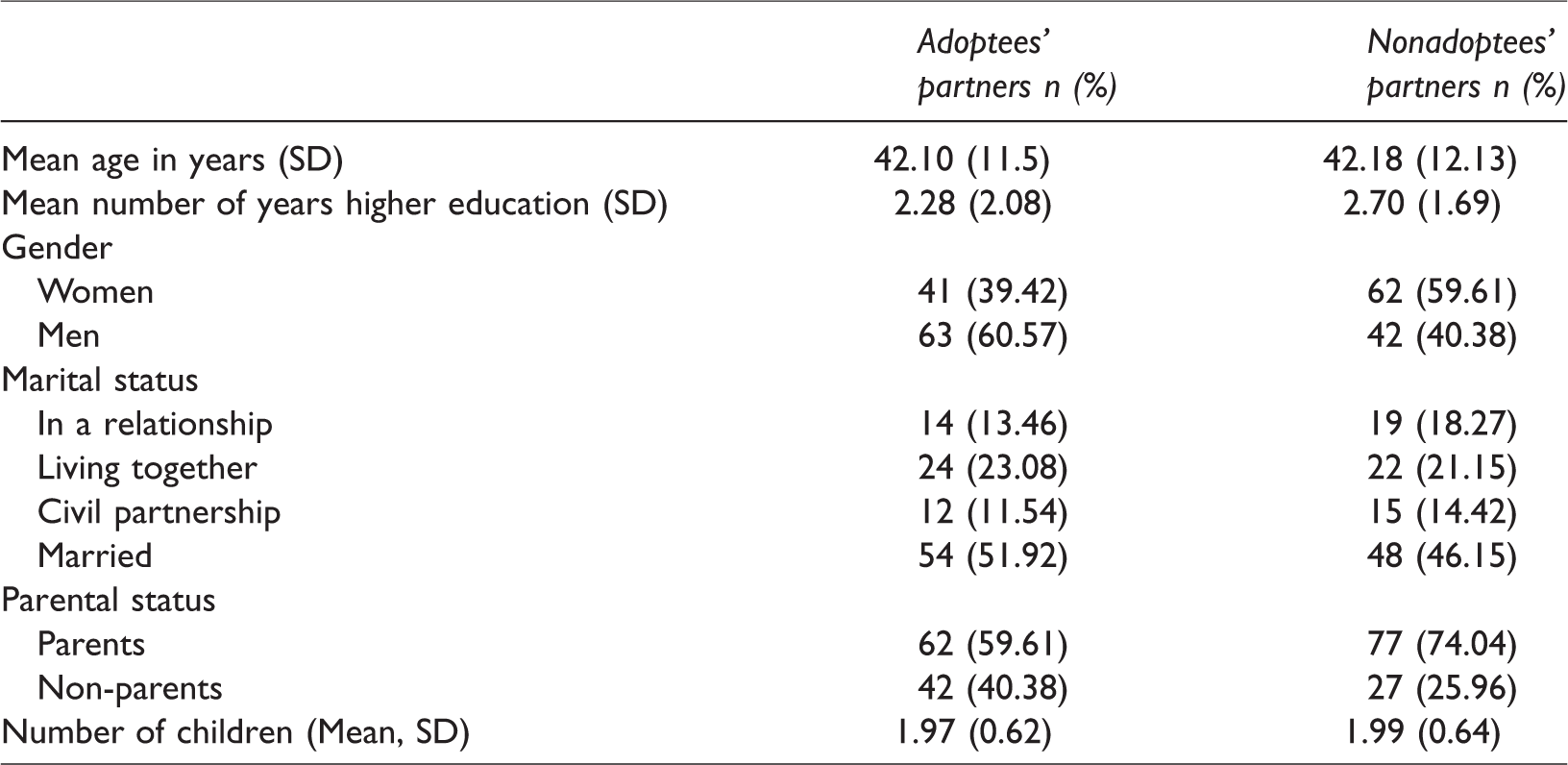
Two groups of 104 participants were involved in the research: adoptees’ partners (n = 104; 41 women and 63 men; mean age = 42.1 years, SD = 11.5) and non-adoptees’ partners (n = 104; 62 women and 42 men; mean age = 42.2 years, SD = 12.1). The study was conducted in France, and all participants were French speakers. Nearly all (91%) of them were born in the country they were currently living in, and none were adopted. Power analysis using G*Power software was performed to determine the appropriate number of participants for the study. The required number of participants was 118 (d = 0.40; power = 0.80; statistical significance threshold at 0.05), so 59 per group was the aim.
There was a significant difference between the two groups for gender (t(206) = −2.96; p < .01), parental status (t(206) = 2.225; p < .05), age of first child (t(135) = 2.217; p < .05) and age of the adult when giving birth to the first child (t(136) = −2.133; p < .05) but not for the number of children (t(137) = 0.129; p = .898). For those who were parents, there was a significant difference for gender (t(137) = −3.46; p < .001) with more mothers in the control group (n = 54) compared to the adopted partner group (n = 26) but similar numbers of fathers (n = 23 and n = 36).
To create two homogeneous groups, the control group was matched as closely as possible to the group of adoptees’ partners in terms of sociodemographic criteria (age, gender, marital and parental status and education level). Thus, mean age was virtually the same in both groups (42.1 years vs. 42.2 years), as was mean education level (2.28 vs. 2.70 years of higher education). Although the two groups had different gender ratios, when the effect of gender was controlled via a series of t tests performed on all variables, no difference was found between men and women in the experimental group (all ps > .05).
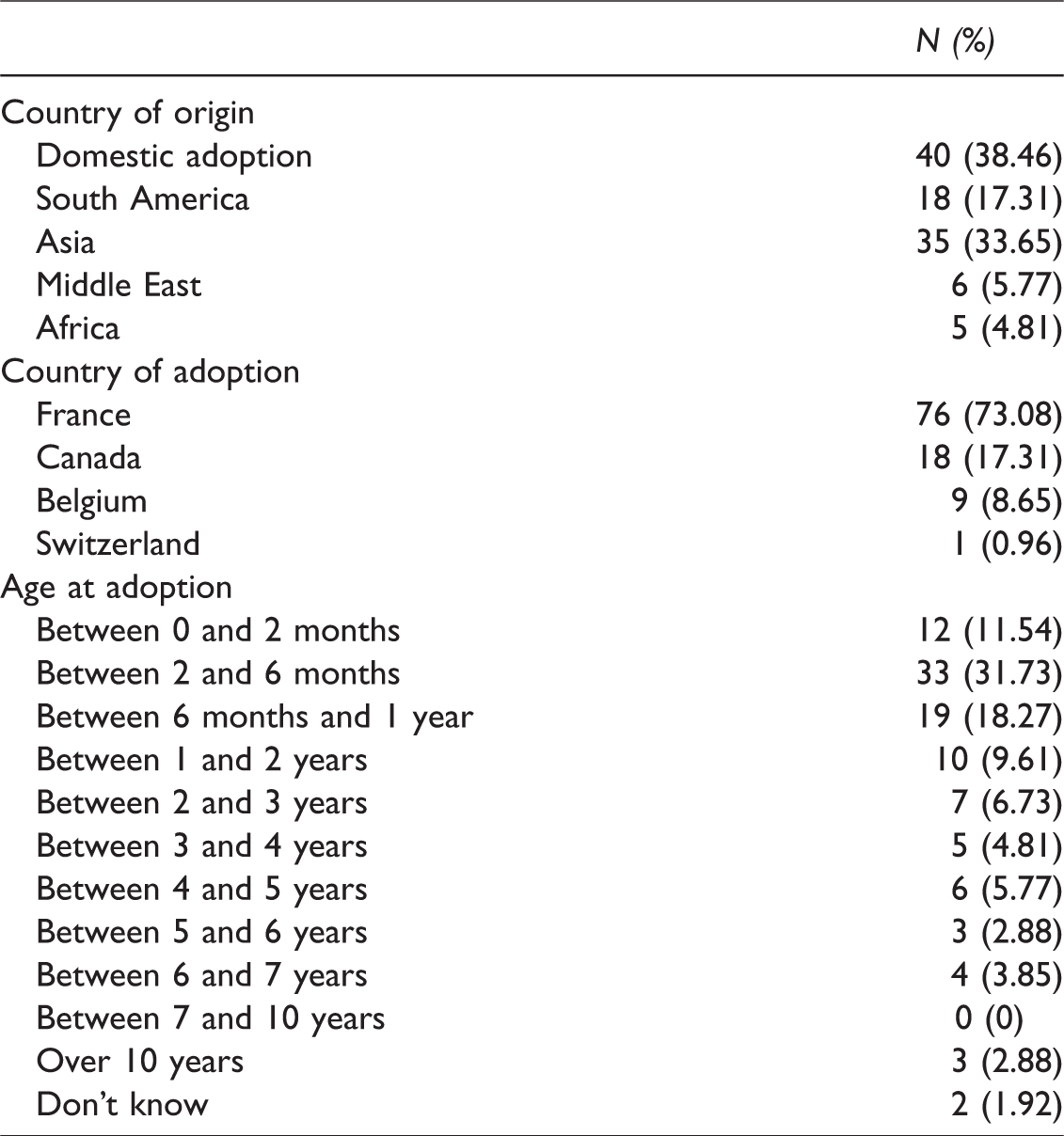
Table 1 shows the participants’ sociodemographic characteristics, and Table 2 sets out the characteristics of the adoptees’ adoption pathway. The participants’ ethnicity was not recorded as this is illegal in France.
Sociodemographic characteristics of the two groups.
Characteristics of adopted partners (N = 104).
Procedure
To ensure a sufficient number of participants, we decided to use an online questionnaire. Adoptees’ partners were contacted in several ways. Some were members of adoption charities, such as La Voix des Adoptés, Association Française des Orphelins de Roumanie (AFOR), Mouvement Retrouvailles or Racines Coréennes, and were contacted via social media groups and sent a link to access the online survey. Others who were known to members of adoption charities or members of social media groups were contacted by email and sent a link to access the survey. Thus, some partners accessed the questionnaire directly online, while others received the link to the questionnaire from their adopted partner. Due to experimental viability and research ethics, only the non-adopted members of the couple were asked to respond.
There were two criteria for inclusion in the research for the control group, which were that participants had to be at least 18 years old and in a relationship at the time of the study. The initial sample contained 627 participants, 585 of whom were women. To ensure the best match with the group of adoptees’ partners, we selected the 104 whose socio-demographic characteristics were the closest aligned. To avoid any bias, adoptees’ partners were told that they would be taking part in a survey but not that their results would be compared with those of non-adoptees’ partners. The online forms completed by the partners of adoptees and those of non-adoptees were the same except for questions that specifically concerned the adopted partner.
Before giving consent, participants were reassured that they could withdraw from the study at any time, their data would be stored anonymously and they would not be identified in any publications. This study received ethics committee approval from the University of Lille.
Measures
Psychological characteristics
Attachment was measured using the Relationship Scales Questionnaire (RSQ; Bartholomew and Horowitz, 1991), translated into French and validated by Guédeney, Fermanian and Bifulco (2010). This is a self-report questionnaire asking participants to respond while thinking about their close relationships. It features 30 items rated on a Likert-like scale ranging from 1 (Not at all) to 5 (Very), requesting a response to statements such as: ‘It is quite easy for me to be close to people’. The RSQ has two dimensions each on a continuum: secure/fearful and dismissing/preoccupied. This tool is therefore based on a conception of attachment comprising four styles and does not directly measure attachment disorganisation. We found satisfactory internal consistency for both dimensions (α = 0.722 for secure/fearful and α = 0.657 for dismissing/preoccupied).
Mental health was measured with the Brief Symptom Inventory (Derogatis and Melisaratos, 1983). This self-report questionnaire featuring 53 items is intended to assess the presence of clinical symptoms in adolescents and adults. It is the abridged version of the Symptom Checklist-90-Revised (SCL-R-90; Derogatis and Melisaratos, 1983). Items include statements such as: ‘I am easily annoyed or irritated’. Respondents rate the frequency of the onset of each symptom during the previous week on a Likert scale ranging from 0 (Not at all) to 4 (Extremely). The scale is composed of nine dimensions (somatisation, obsession-compulsion, interpersonal sensitivity, depression, anxiety, hostility, phobic anxiety, paranoid ideation and psychoticism) and three global indices of distress: global severity, positive symptom distress and positive symptom total. These indices take account of current symptoms, symptom intensity and the number of reported symptoms. Only the global severity index is used in the present study. The French version of the questionnaire was produced by the Swiss National Association for Quality Development in Hospitals and Clinics (ANQ; 2012), based on the German version (Franke, 2001). Satisfactory internal consistency was found for the total score in our sample (α = 0.947).
Relational characteristics
Dyadic coping was measured with the Dyadic Coping Inventory (DCI; Bodenmann, 2008) in its validated French version (Ledermann, et al., 2010). This scale takes the form of a self-report questionnaire featuring 37 items divided into six subsections. Each subsection is preceded by a question describing a particular stress situation (respondent’s stress, partner’s stress, shared stress, etc). Items are statements such as: ‘He does not take my stress seriously’. Answers are rated on a Likert-like scale ranging from 1 (Very rarely) to 5 (Very often). The DCI is composed of 11 subscales or five aggregated subscales (dyadic coping by oneself, dyadic coping by the partner, negative dyadic coping, positive dyadic coping, total score). Internal consistency was very good for the total score (α = 0.925) in our sample.
Finally, co-parenting quality was measured with the French adaptation (Frascarolo, et al., 2009) of McHale’s (1997) co-parenting scale. This consists of 16 items. For some questions, parents are asked to estimate the frequency of certain behaviours in specific situations. The answers are rated on a Likert-like scale ranging from 1 (Absolutely never) to 7 (Almost constantly, one to two times per hour). The items are divided into four factors: family integrity, conflict, affection and denigration. Internal consistency was satisfactory for integrity (α = 0.818), denigration (α = 0.678) and conflict (α = 0.677) but less so for affection (α = 0.510).
Participants without children were accepted in the sample as they could still complete the scales probing psychological and/or relational characteristics. Only those who already had children completed the co-parenting scale (n = 62 for adoptees’ partners and n = 77 for non-adoptees’ partners).
Data analysis
To attain the first objective (i.e., compare the two groups on their psychological characteristics and relational variables), a multivariate analysis of covariance (MANCOVA) test was applied to investigate the differences between adoptees’ and non-adoptees’ partners on the following dependent variables: attachment, mental health, dyadic coping, and co-parenting. We systematically controlled the effect of age, gender, educational level and parental status.
To attain the second objective (i.e., explore the links between the psychological and relational variables), a two-step strategy was followed. First, within each group a series of correlations was calculated to explore the relationships between the variables of interest. Then, correlation coefficients were compared with a Fisher’s r-to-Z transformation. These analyses were carried out using the medmod module of Jamovi software.
All these analyses were performed with Jamovi software, excluding any participants with incomplete data (e.g., participants without children for measures related to the experience of parenthood).
Results
Sociodemographic variables of adoptees’ partners
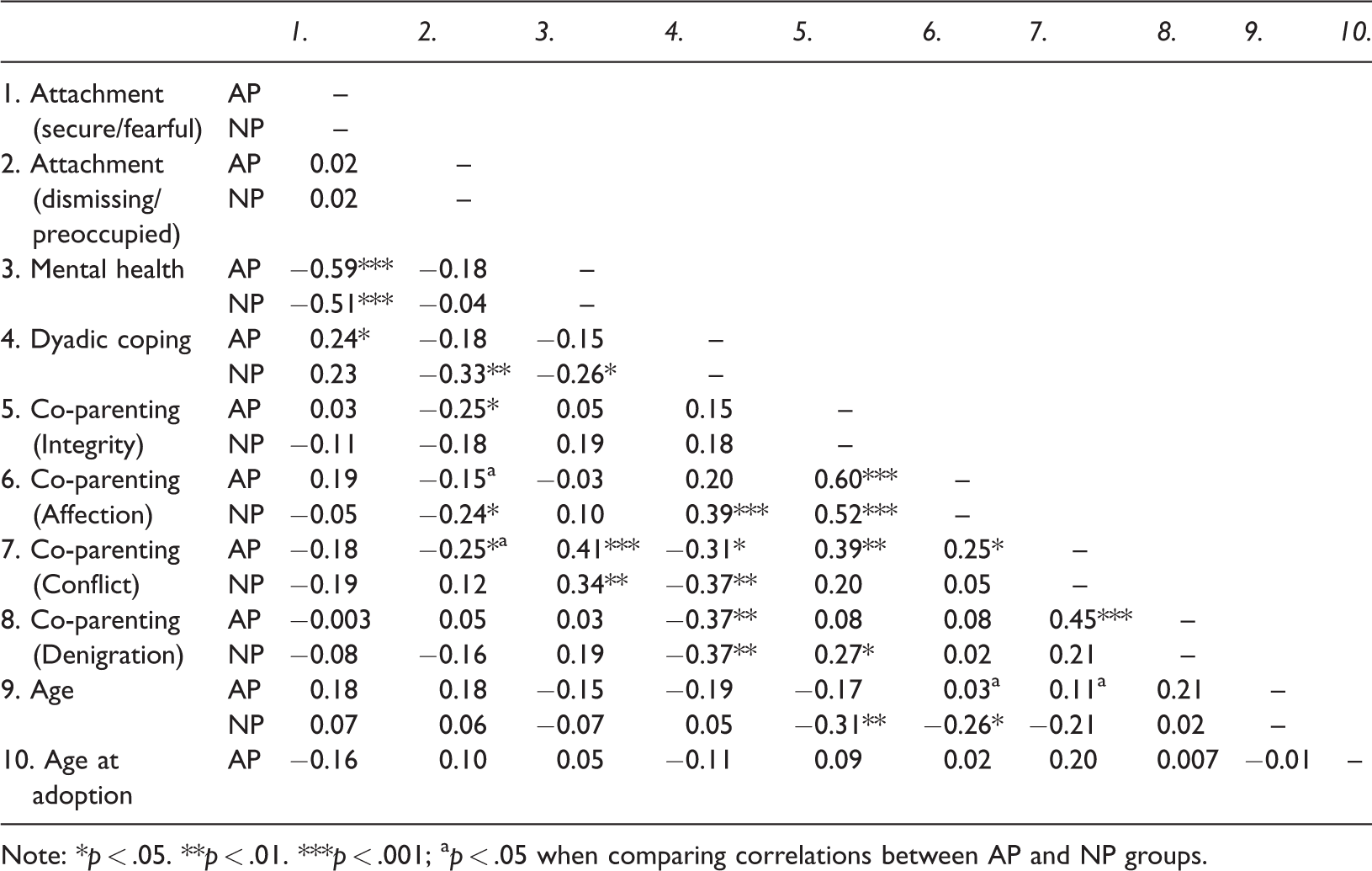
No difference was observed between male and female partners of adoptees on the variables (all ps > .05). Participants’ age was only weakly correlated with the variables. Age at adoption was not correlated with any of the measures (see Table 4).
Objective 1: Comparison between adoptees’ and non-adoptees’ partners
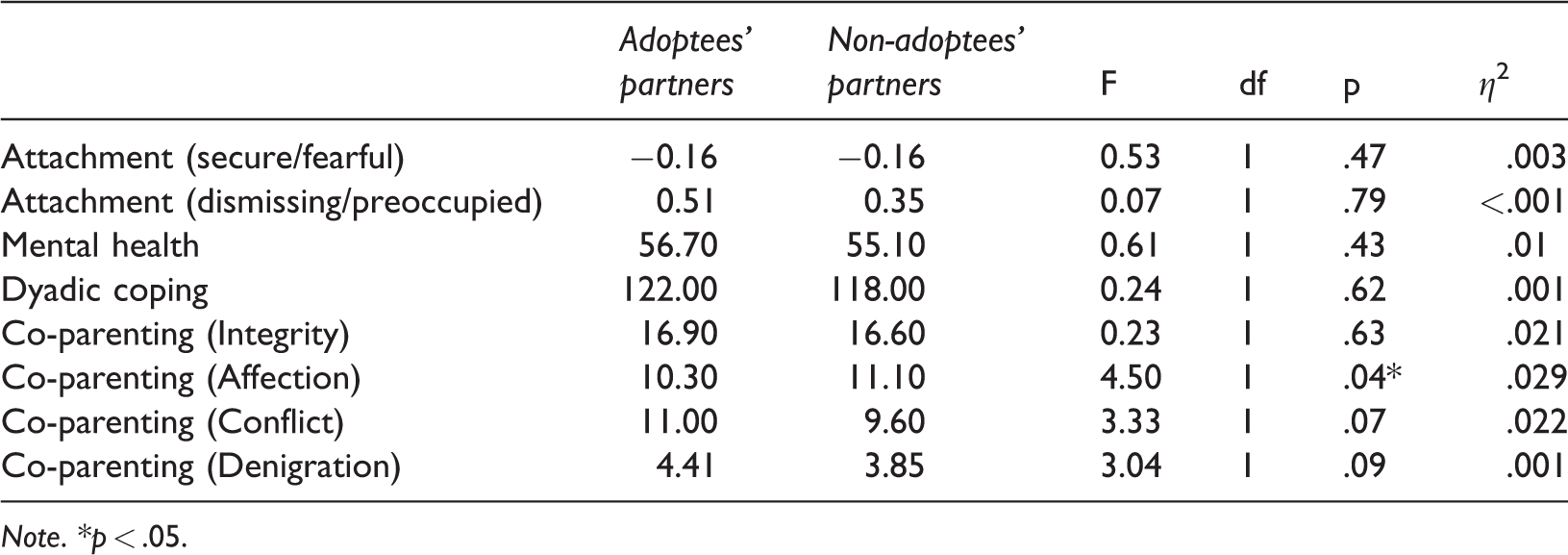
Regarding the first objective, Table 3 sets out the descriptive statistics for the dependent variables. For each of them, the results of the MANCOVA test showed that there were no significant differences between the two groups (all ps > .05) except for co-parental affectivity (p = .03), where non-adoptees’ partners presented significantly higher scores.
Comparisons between the two groups.
Note. *p < .05.
Correlation matrix for adoptees’ partners (AP) and non-adoptees’ partners (NP).
Note: *p < .05. **p < .01. ***p < .001; ap < .05 when comparing correlations between AP and NP groups.
Objective 2: Links between psychological and relational variables
We wanted to compare the links between psychological and relational variables in the two groups. To do this, we used a statistical method that measures correlations between each variable to check if these links were different between adoptees’ partners and non-adoptees’ partners.
We found that some correlations only appeared in one of the two groups (Table 4). Significant correlations that were specific to the group of adoptees’ partners (AP in Table 4) or that differed in intensity between the two groups included the correlations between attachment (dismissing/preoccupied) and the conflict (r = −0.25, p < .05 vs. r = 0.12, p > .05 for the control group) and affection (r = −.15, p > .05 vs. r = −.24, p < .05 for the control group) dimensions of co-parenting. Some correlations were only found in the non-adoptees group (NP in Table 4). Nonetheless, those correlations do not significantly differ between the two groups and suggest heterogeneity between participants. The aim of the study was to compare two groups on psychological and relational variables, and these results mean that even if no difference was found between the two groups while comparing their scores on our scales, there might be some differences in how attachment is linked to co-parenting between the two groups.
Discussion
The purpose of the present study was to learn more about adoptees’ partners by comparing them with those of non-adoptees and to explore their psychological and relational characteristics (attachment, mental health, dyadic coping and co-parenting).
Objective 1: Comparison between the two groups
The first objective of this study was to compare adoptees’ partners with non-adoptees’ partners on their psychological and relational characteristics. The aim was to better understand the psychological profiles of adoptees’ partners and to explore how they represented the couple they had formed with an adopted person. No differences were found between the two groups on attachment or mental health. Adoptees’ partners were therefore just as psychologically well-adjusted as people in relationships with non-adoptees. Regarding attachment, the existing literature on changes in attachment patterns within couples suggested that being in relationships with individuals who are on average more insecure could have a harmful impact on attachment. Secure individuals may become insecure if they enter into a romantic relationship with an insecure person (Miljkovitch and Cohin, 2007), while insecure people preferentially seek out partners with the same attachment style as theirs (Nisenbaum and Lopez, 2015; Overall and Simpson, 2015). However, we did not explore the attachment styles of the participants’ adopted partners who may have been mostly secure despite being adopted. The attachment of our adoptees’ partners did not differ from that of participants in the control group. One possible explanation for this result is that adoptees choose relatively secure partners (at least on average), as they may reassure and even help them to cope with their own potential attachment vulnerabilities.
Regarding representations of the marital relationship, in view of the existing literature on adoptees’ romantic relationships, we predicted that adoptees’ partners would have lower dyadic coping and co-parenting scores. However, the two groups obtained similar scores on both scales. Although adoptees are often presented in the literature as being more vulnerable in the context of their romantic relationships (Tieman, van der Ende and Verhulst, 2006; Verzuli, 2000), the present study found that this fragility does not seem to have any impact on their partners’ representations of their marital relationship and co-parenting. This result is in line with the meta-analysis carried out by DeLuca Bishop, Claxton and van Dulmen (2019) who concluded that, overall, adoptees were just as committed and well-adjusted in their romantic relationships as non-adoptees. These results are also particularly interesting insofar as they partly refute those obtained by Despax, Bouteyre and Guiller (2020) who observed that adoptees had lower dyadic coping scores than non-adoptees. Different results are obtained on the same measure depending on the perspective considered (that of the adopted partner or that of the non-adopted one). We hypothesise, therefore, that adoptees have a more negative view of their joint stress management, perhaps because the threat of stereotyping is activated (Désert, Croizet and Leyens, 2002) or because they have more difficulty feeling good in their romantic relationships due to potential anxiety or insecure attachment. In the present study, dyadic coping and co-parenting are not particularly affected by the adopted status of one of the two partners.
These results suggest that the experiences of relinquishment and adoption do not have more long-term effects on romantic relationships than the experiences of the general population. We might hypothesise that the potential insecure attachment of adopted partners may have been compensated for by the secure relationship to the adoptive parents or even the partner. According to Palacios and colleagues (2019), the fact that studies among adoptees have failed to yield consistent results can also be linked to the considerable heterogeneity of adjustment among adoptees. The lack of a difference between adoptees’ partners and those of non-adoptees may also reflect this heterogeneity of experience, leading to a certain balance.
This heterogeneity was highlighted by studies carried out on the partners of former foster children (Mouhot, 2001; Quinton and Rutter, 1984), which identified two partner profiles: helping partners and deviant partners, as we have noted. In the present study, the adoptees’ partners appeared to be generally helping, insofar as good psychological adjustment (mental health and attachment) appeared to be the norm. Our participants’ good dyadic coping and co-parenting scores also point in this direction. The relationship with a partner may therefore act as a protective factor for adopted people, promoting their psychological adjustment. Many studies have shown that dyadic coping influences the persistence of the relationship and even the well-being and mental health of each partner (Bodenmann, Meuwly and Kayser, 2011). In addition, a good level of dyadic coping may be particularly important for adoptees’ equilibrium, as relationship difficulties have a greater impact on their attachment than on that of non-adoptees (Feeney, Passmore and Peterson, 2007).
Finally, we found that the age at adoption of adopted partners was not associated with any of our variables. This is a surprising result, given that age at adoption is mostly presented as a determinant of the attachment and adjustment of adopted adults and therefore potentially of their dyadic adjustment. This result can be explained, at least in part, by the very low mean age at adoption of our participants: 61% of our participants’ partners were adopted before the age of one, which is an important protective factor.
Objective 2: Links between psychological and relational variables
The second objective was to study the links between the psychological and relational variables of the two groups to gain a better understanding of the functioning of mixed (adopted–non-adopted) couples and to find out whether it differs from that of non-mixed ones. Research has demonstrated the importance of attachment among adoptees, particularly in the context of their romantic relationships. We predicted, therefore, that attachment would be more related to relational variables (dyadic coping and co-parenting) among adoptees’ partners. Results of the analysis of correlation matrices pointed in this direction, as a significant correlation between attachment and co-parental conflicts was specific to the adoptees’ partners group. The more dismissing of attachment the partner, the lower the score on the conflict dimension of co-parenting. This link was only observed among adoptees’ partners. These results complement those of Feeney, Passmore and Peterson (2007), who found that adoptees’ attachment was the main predictor of their romantic experience, even more so than their adopted status. The partner’s attachment style seems to play a particularly determining role as well. This result is also in line with the observations of Despax, Bouteyre and Guiller (2020) who showed that among adoptees dyadic coping had a mediating role in predicting parental stress. Even if the results of our compared correlations should be replicated, these results underline the importance of relational variables as a risk or protective factor for this population. As with adoptees themselves (Feeney, Passmore and Peterson, 2007), attachment may therefore have a greater predictive power among adoptees’ partners than in the general population. Since a correlation can be interpreted in two directions, these results could mean that the quality of the marital relationship and co-parenting is more dependent on the attachment of the partner in couples where one person is adopted, or that a relationship with an adopted person has a greater effect on the attachment of the non-adopted partner.
This comparison of correlation suggests that emotional detachment (dismissing attachment) might be a protective factor in co-parental conflicts with the adopted partner. This detachment could therefore be a strategy used by adoptees’ partners to avoid conflicts about parenting. However, the fact that this effect was specific to adoptees’ partners suggests that adoptees may behave in such a way as to require the use of these types of strategies by their partners. In this regard, previous research has shown that adopted people frequently search for fusional relationships, both with their children, who often offer the first relationship with someone of the same blood (Moyer and Juang, 2011; Pinkerton, 2011), and with their partners (Verzuli, 2000). We can therefore assume that this need for detachment might be a strategy for adapting to the attachment style of the adopted partner. On average, adoptees have a more insecure attachment style, and insecurity of attachment has been linked to attitudes of parental control (Roskam and Mikolajczak, 2015) and an alteration of representations of the parent–child relationship (Rholes, et al., 1997). The partners’ need for emotional detachment may thus be linked to the fact that the adopted parent could have very marked attitudes of control in the context of parenthood or that s/he might need exclusivity in their parent–child or marital relationships. The emotional bond between the partner and the couple’s child(ren) might be perceived as a threat to the adopted person’s bonds with both their partner and their child(ren).
Strengths and limitations of the study
This was an innovative study as it employed a quantitative method to examine the psychological profiles of adoptees’ partners and showed that being in a relationship with an adopted person is not a risk factor either for the partner or for the marital relationship and does not impact either dyadic coping or co-parenting. From a clinical standpoint, these results offer a more positive view of the life prospects of adoptees and underscore the importance of providing support to partners if they need it, particularly by acknowledging the importance of attachment.
While encouraging, these results may have been affected by biases resulting from our recruitment methods, such as the gender ratio, parental status, and age of the children, as well as the fact that most partners were introduced to the study by their adopted partners. Participation may also have reflected a form of activism (like membership of an association) aimed at promoting the normality of adopted persons and conveying a non-stigmatising vision of this population. In addition, the internal consistency of some of the variables was weak, and other variables that might be significant, such as length of marital relationship, type of adoption (domestic versus intercountry) and ethnicity, were not included.
Future directions
From a methodological standpoint, a quantitative study that includes both partners, a qualitative study comprising interviews with adoptees’ partners and a sample of later adoptees would complement the data emerging from this study by including other variables possibly associated with the adopted partner’s adoption pathway and assessing the effects of age at adoption. Further analysis of the marital relationship would also highlight the diversity of experiences and the heterogeneity of the adoptive population. This would help to clarify whether the adoption pathway and the characteristics of the relationship affect the romantic relationship and the psychological well-being of non-adopted partners.
Conclusion
The comparison between the group of adoptees’ partners and the control group of non-adoptees’ partners revealed no difference on any of the variables measured. However, interactional differences between the two groups were found, particularly regarding the link between detached attachment and parental conflict among adoptees’ partners. These results confirm the importance of attachment as a determining variable of their marital and co-parental experiences.
Declaration of conflicting interests
The author(s) declared no potential conflicts of interest with respect to the research, authorship, and/or publication of this article.
Funding
The author(s) received no financial support for the research, authorship, and/or publication of this article.