




Abstract
Many adopted children face challenges at school and college which adversely affect their experience and attainment. Without effective post-adoption support, they are at an increased risk of being excluded from or opting out of education. While this has been confirmed by research, there has been less discussion of the problems children face and the services they find helpful. This is especially the case for those over the age of 16 (the statutory school leaving age in the UK). To explore this, semi-structured interviews were conducted with five adopted young people aged between 16 and 19. A thematic analysis of their responses identified four factors that help them continue in post-16 education: (1) a positive self-identity; (2) supportive people; (3) supportive approaches; and (4) supportive systems. Participants identified the benefits of staff appreciating the needs of adopted children and the features that promote an ‘adoption-friendly’ ethos in schools and colleges. The implications of these observations for understanding the educational needs of adopted young people, practice development and future research are discussed. Attention is drawn to the importance of multi-agency work and the role of adopted young people in steering and co-producing effective support in educational settings.
Introduction
Adopted children are considered to be a particularly vulnerable group in society as they are likely to have experienced abuse, neglect or trauma, the impacts of which may manifest in different ways (Langton and Boy, 2017; National Institute for Health and Care Excellence [NICE], 2015). As a group, they face increased risk of social, emotional and mental health difficulties compared with the general population and are more likely to be excluded from school, leave education without qualifications (Department for Education [DfE], 2016b) and face limited life chances (Adoption UK, 2018).
In the year ending 31 March 2021, 2,870 children were adopted, representing a fall of 18% from a 2015 peak of 5,360 (DfE, 2021). The most recent decreases are likely driven by the impact of the Covid-19 pandemic on court proceedings which caused cases to progress more slowly or to be paused (DfE, 2021). It is difficult to estimate the number of adopted children in the UK education system accurately as schools are not always aware of their pupils’ adoptive status, and national statistics often report figures representing only those known to have left care via an adoption order (AO), a special guardianship order (SGO) or a child arrangements order (CAO). The best calculations indicate that in England alone, schools are educating more than 42,500 children adopted from care (DfE, 2016b).
Educational outcomes for adopted children
A recent survey of nearly 2,000 adopted children and over 2,000 adoptive parents found that a significant majority of young people were struggling at school (Adoption UK, 2018). Four–fifths of adopted secondary school children agreed with the statement ‘Other children seem to enjoy school more than me’, two–thirds reported being teased or bullied because of their adoption status and three–quarters did not feel that their teachers understood how to support them. Similarly, almost 70% of the adoptive parents thought that their child’s progress in learning was affected by problems with her or his emotional well-being, and nearly half of those with children in secondary education had kept them off school because of concerns about their mental health or well-being. In addition, one–third said that their child had refused to go to school, run away or played truant. While these results may reflect an over-representation of families facing difficulties in the survey, the figures are sufficiently high to arouse concern.
Although it is recognised by many parents and teachers that education encompasses much more than achieving good academic grades, a plethora of studies has found that the attainment of adopted children in England is significantly lower than that of their peers and that this gap widens as they get older (Brown, Waters and Shelton, 2017; DfE 2014a; 2016b). Only 40% of previously looked after children recently reached the expected standard at the end of primary school, which is much lower than the 65% for those not looked after (DfE, 2019). Moreover, figures highlight that at the end of Key Stage 2 (ages eight to 10), 47% of previously looked after children have a special educational need (SEN) compared to 17% of children in the general population, and their attainment rates are much lower.
In a recent government report, at Key Stage 4 (ages 14–16), the average Attainment 8 score for children who left care through an AO, SGO or CAO was 31.1 compared to 18.8 for looked after children, 19 for children in need living in the community and 44.4 for non-looked after children (DfE, 2019).1 When SEN are factored in, there is a related pattern across the groups of previously looked after children. However, one exception for children with a SEN statement or education, health and care (EHC) plan was that those who were the subject of an SGO had better Attainment 8 scores than those who were adopted (DfE, 2019).
In the current UK educational climate of financial austerity, there is a sentiment that school and college staff prioritise pupils’ exam results at the expense of children’s well-being (Young Minds, 2017; O’Leary, 2017). Children who require additional staff time and attention or who are unlikely to attain the expected standard may be neglected and become a source of concern for more sympathetic teachers, pastoral staff and senior leadership teams.
Participation in education
A child’s educational journey in the UK typically involves experiencing several settings, starting with nursery or pre-school and progressing through primary and secondary schools and on to one or more post-16 and post-18 options, which include further (college) and higher (university) education. Following research showing that young people who ‘participate in post-16 education or training’ are more likely to be in employment at a later date (Department for Children, Schools and Families, 2007), the UK government raised the compulsory age for participation in education from 16 to 18 in 2013. Young people have a choice about how they continue in education or training after 16: they can opt for full-time study in a school or college or with a training provider; undertake work or volunteering combined with part-time education or training; or enrol for an apprenticeship/traineeship. Evidence suggests that it is necessary to offer a range of suitable post-16 pathways to ensure the availability of high-quality guidance and support and to provide alternative pre-16 provision that will engage young people and encourage them to want to continue learning (Thompson, 2011). Without effective post-adoption support, there is an increased risk of adopted young people being excluded from or opting out of education. Those who are ‘not in education, employment or training’ (or NEET) thus miss the opportunity to develop the skills and qualifications that will open doors to future employment, help them make the most of their potential and earn more over their lifetime (DfE, 2018), as well as gain from the psychological and social benefits of participating in a communal activity (Herd and Legge, 2017).
Although completed before the change in participation age, an analysis of data from the Longitudinal Study of Young People in England found that adopted children aged 13 to 14 were more likely than those in the general population or in care to see themselves in education after the age of 18. Yet at 18 to 19 years, only 14% of them were enrolled at a university, compared with 33% of the general population and 16% of looked after children (Wijedasa and Selwyn, 2011). This gap between aspiration and reality suggests that more effective support is required during school and further education to encourage adopted children to access and remain in higher education.
Post-adoption support in school
In recent years in the UK, there have been several reforms aimed at improving the educational support given to adopted children. In 2013, Pupil Premium Plus (PP+) funding was introduced in England to provide support for looked after and previously looked after children, including children adopted from care, thus acknowledging the possible effects of previous trauma and loss on their education. It enables schools to address children’s wider needs, not just academic attainment, and requires staff to fashion support interventions that are informed by robust evidence (DfE, 2014b).
Children in the UK are adopted at an average age of three years (DfE, 2016b) and services have traditionally been prioritised for three years after the AO (Stother, 2017). Post-adoption support is therefore more prevalent among children in early years or primary school settings. However, it is also recognised that young people’s difficulties peak at other times – at times of transition and in the teenage years when they experience a combination of physiological changes and a desire to establish an individual identity (DfE, 2014c; Stother, 2017). Parents of adopted teenagers commonly report increased aggression, child–to–parent violence, home placement breakdown, exclusion from school and challenging family relationships (Adoption UK, 2012; DfE, 2014c).
Adoption services in the UK are currently undergoing revision, led by the establishment of regional adoption agencies as outlined in the government publication, Adoption: A vision for change (DfE, 2016a) and subsequent legislation that has expanded the role of local authority virtual schools (UK government, 2017). A vision for change also emphasises that the views of adopted children should inform the design of local services and national policies. This is echoed in the NICE guidelines on attachment (NICE, 2015) which specifically mention their participation and consideration of their suggestions.
The conditions necessary for offering this support have been identified in several studies. Adoption UK’s report, Bridging the gap (2018), highlighted contexts where school staff have good knowledge, skills and understanding of adoption, and Langton and Boy (2017) showed that the effects of this could be transformative. But despite this encouraging evidence, a literature review by Stother, Woods and McIntosh (2019) concluded that relevant studies were few in number and often limited methodologically. Some did ascertain children’s views: for example, Cooper and Johnson (2007) explored their social relationships and views on teachers’ behaviour; the Children’s Workforce Development Council (2009) investigated difficulties of transition to secondary school and coping with peer pressure; and Crowley (2018) interviewed four girls aged 10 to 16 about their school experiences and identified the five key issues of identity and self, relationships, school, attachment and adoptive status.
Against this research background, this present study engaged with adopted young people to identify and share the positive experiences that had supported them to participate in post-16 education. We aimed to answer the following questions:
What helps adopted young people to remain in education? What should school staff be told about what helps and how should they be told?
Methodology
Design
An exploratory in-depth survey design using semi-structured interviews was chosen as most appropriate for the research questions (Jansen, 2010).
Participants
Five young people were recruited through purposive sampling using contacts in the researchers’ local authority workplace and the neighbouring local authority’s adoption team. The eligibility criteria required participants to be aged 16 to 25, participating in education, living with adoptive parents (full-time or during the holidays) and adopted more than three years previously. The background characteristics of the young people who participated are displayed in Table 1.
Participant characteristics.
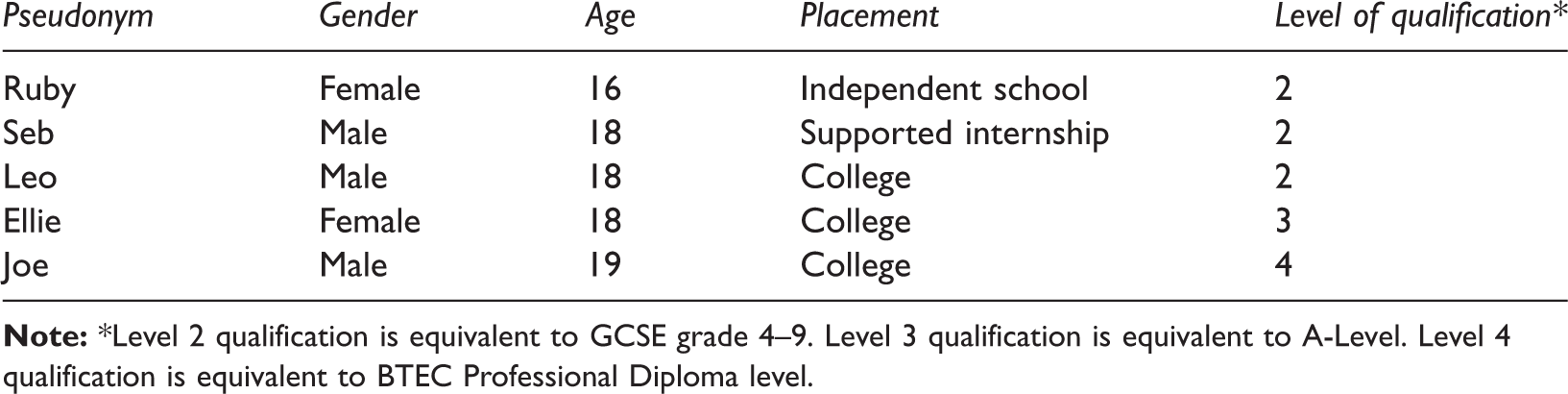
Recruitment through support services proved to be an effective method for identifying young people aged 16 to 19 but was a less successful approach for those aged 19 to 25. This was due to the cut-off ages for receiving children’s services and young people choosing not to self-identify as adopted and/or in need of a service. Participants were all currently receiving support. This study does not, therefore, capture the viewpoints of those no longer in contact with support services or who have never accessed them.
Following consultation with young people, posting on social media was considered as an additional recruitment strategy but rejected due to the difficulty of independently verifying participants’ identities and checking whether involvement would be in their best interests.
Data collection
Semi-structured interviews were deemed to be an appropriate method for gathering data as they allow individuals to talk about their lives in an open-ended and detailed way and for the researcher to ask follow-up questions which can vary depending on participant responses (Roulston, 2010).
Prior to the study, the intended research process and the interview questions were validity-checked with a group of 14 adopted young people and three workers from a post-adoption support group for teenagers; this group was separate to the sample and contacted via the first author’s professional network connections. Adaptations to the interview schedule were made accordingly.
Informed consent to share the data gathered in this research study was then obtained and single interviews, lasting between 24 and 52 minutes, were conducted between March and September 2018. Participants were offered a face-to-face meeting in their educational establishment or an alternative venue, such as a children’s centre or library, or, where geographical or time constraints applied, the option of a telephone or video discussion. Participants were also invited to be accompanied by their adoptive parent if they wished, and one participant (Joe) took up this option.
Data analysis
The interviews were audio-recorded and professionally transcribed. The data were then analysed to identify patterns, similarities and differences between the participants’ responses and the perceived impact that the experiences they reported had had on the continuation and success of their educational placements. Braun and Clarke’s (2006) six-stage approach for analysing qualitative data was followed, and the researcher and project supervisor independently checked a 5% sample of the transcript to establish a good degree of inter-rater reliability (>80%) before proceeding with the remainder of the analysis.
Ethical considerations
This research was guided by the Health and Care Professions Council’s Standards of conduct, performance and ethics (HCPC, 2016) and the British Psychological Society’s Code of human research ethics (BPS, 2014) and received ethical approval from The University of Manchester.
Findings
Thematic analysis of the data generated four interrelated themes concerning young peoples’ views on factors that have helped them to remain in education:
a positive self-identity; supportive people; supportive approaches; supportive systems.
Three further themes emerged, two relating to messages that should be conveyed to school staff and one relating to how to communicate such messages:
increased awareness of adopted children’s needs; knowledge of the features of adoption-friendly settings; ways of generating an adoption-friendly ethos.
These themes will now be discussed in greater detail.
Positive self-identity
All the young people interviewed acknowledged that they played a key role in determining their own continued participation in education. They explained that the effective support they received helped them to accept themselves as adopted young people and gain self-assurance that they could be successful students. Ellie, for instance, credited her increased confidence to support that included ‘making me feel alright about myself, like it’s okay to be adopted and just to accept myself for who I am’. As Leo was settled at college, he felt able to speak up about his needs as an adopted young person: Yeah, I was actually on about being angry with somebody [to a member of staff]. I said, ‘I struggle because I’m adopted’. And then she was like…‘Oh, I didn’t know’. So, then it kind of created a conversation.
Perseverance, a personal sense of responsibility and a positive outlook about the future helped the young people to get to where they are today. Seb explained that his family encouraged him to persevere and emphasised: ‘I try really hard because it’s not going to take long to get what I want, unless I don’t work, but I try to do my best’. Leo’s experience is that his positive outlook surprised people: A lot of people have said, ‘How can you stay positive about life even though you’ve been through what you’ve been through?’ And I [say], ‘Just because I’ve been through it and that was the past and now it’s [time] to focus on the future.
Empowering young people to help themselves clearly emerges as important. While reflecting on the support he received at college, Leo explained: ‘I think I still need a bit of support…but…I think I’m kind of learning myself how to do it now’.
Supportive people
Identities of supportive people. Family members were identified as supportive by all five participants; four identified valued support from school or college staff and three referred to help received from workers in their adoption support agency. Support from peers, whether or not adopted, was highlighted by everyone. Ruby described the support that peers can offer: I had someone in the year above…They decided to help me, and a couple still do and come and say, ‘How are you?’ and stuff and that’s good…And I don’t know why they did it, but it made things better.
Moreover, Ellie recognised that having an adequate peer support network can make the difference between coping and not coping at school: ‘I wouldn’t have called them friends. I had, like, acquaintances that I was civil with so that I could actually survive at school and, like, not be isolated’.
In addition to the benefits of friendship networks, special emphasis was given to support from other adoptees as they had been through the process. Ellie explained that she attends an adoption support agency group for teenagers: ‘I’ve got really close friendships through that group. We’ll stay in touch’. Leo highlighted that there are likely to be adopted young people at his college whose identity he is not aware of and that he could benefit from their support or help them himself: Leo: So, I know about three of us that are adopted, but there’s still…college is massive, it could be… Interviewer: There could be more couldn’t there? Leo: Yeah, so we don’t really speak to each other because…there’s not a thing that goes up: ‘You’re adopted!’
Qualities of supportive people
Participants defined ‘supportive’ people as those who had time, showed interest, were prepared to listen and were persistent about advocating for their needs. Ruby felt that the most helpful member of school staff she had encountered demonstrated a level of understanding that others did not, potentially identifying a need for wider staff professional development: ‘Some teachers would talk but not understand….whereas she would be like speaking my way…she had had some training to do with emotions and stuff’. Ellie agreed that feeling understood is important: Ellie: Hmm, so I felt like [the leader of an agency working with adopted teens] could really understand me…because she kind of knew where I was coming from. Interviewer: Yeah, and in school has anybody come close to that? Ellie: No. Interviewer: Or at college? Ellie: No.
Further, Joe was able to identify numerous members of school and college staff who were supportive while Ruby, Leo and Seb highlighted one or two. Ellie, by contrast, could not name anyone. She explained that it was the approach of professionals from the adoption support agency that provided her with the support she needed: They are so non-judgemental…they support you no matter what and they’ve always got, like, a caring heart and…they’ll always listen to you and give you their honest opinion…they won’t just tiptoe around something.
When reflecting on the qualities of the teaching assistants (TAs) who have provided them with individual support, Seb, Leo and Joe identified a friendly approach, and Seb and Leo highlighted a sense of humour. Seb felt the TAs who supported him well were good role models, shared his interests and got the right balance between support and respect for his developing independence.
Supportive approaches
Participants identified some general supportive approaches within educational settings, namely: being proactive, pupil-centred, responsive, flexible, respecting confidentiality, and providing space and time.
They stressed that educational settings need to be proactive in identifying their adopted students, including those who are showing no outward signs of needing support, and promoting the help they can offer. Ellie explained that although she achieved her expected grades and never got into trouble, her school and college did nothing to acknowledge her identity as an adoptee. Ruby felt the support she received was reactive and too late: ‘it only really got sorted, like, the bullying…once I’d had my lip stitched…it took two assaults to get actually sorted’. These comments emphasise the need for settings to be responsive and flexible with their educational provision, behaviour policies and support provision.
Leo preferred the work days to the study days of his internship, and his provider arranged his schedule to play to his strengths. Recognition of Leo’s individual needs meant that he benefitted from adaptations to institutional rules, did not always have to experience isolation and received individual adult support to help him ‘chill out’. Similarly, Joe’s school allowed him to opt out of lessons that could cause him distress and miss days altogether when he was particularly struggling. A recognition that adopted young people may need increased support after an incident requires flexibility from often stretched support services.
Supportive systems
When children move out of care and into adoption, the statutory Personal Education Plans which support looked after children are no longer required and should be replaced by an Education Plan for Adopted Children. These plans were positively evaluated by Syne, Green and Dyer (2012), but they found that the use of these (or similar) systems was not widespread; significantly, they were not mentioned by any of the participants in this study. The interviewees did, however, identify some other supportive systems which involve statutory requirements, funding and arrangements for communication and transitions.
Statutory and funding systems
Education, Health and Care Plans (EHCPs) provide a statutory framework to support adopted children with an identified SEN (DfE, 2015). An EHCP was a requirement to access Seb’s supported internship and the associated funding allowed Joe to attend an independent special school suitable for his needs. Joe’s experience was that the framework and funding attached to an EHCP supported him in school and college but ceased when he went on to university. His family found the change in system difficult to navigate and felt that the EHCP provided a flexibility that other systems did not. When discussing Disabled Students’ Allowances, Joe’s mum commented: ‘It’s more like one size fits all, you get a computer and software but not an attachment figure!’
Systems to facilitate communication
Communication within educational establishments is a common feature of effective pastoral systems. There was a recognition among interviewees that secondary schools and post-16 settings require a more creative communication system than primary schools, due to their large size. In contrast to accessing a one-to-one TA in school, Joe’s college provided varied options for him to communicate with staff: …so…I go in one day a week to have mentoring sessions… study skill sessions…and also at lunchtimes…they’ve got a room where I can go to…if I want a quiet lunch and chat…
It became clear that arrangements for communication between settings and families can also lead to young people’s continued participation in education, as illustrated by this exchange with Leo: Interviewer: And who persuaded you that it’s a good idea to…take up this opportunity? Because if you were just at home playing on your Xbox, not speaking to all the people who were ringing [you wouldn’t know about it]. How did it happen? Leo: It was when I was at college…and they went…‘Got a meeting for you’. Then this lady [from the hospital] came and talked to me about it [the supported internship]. So…I talked to the lady…and I went, ‘Yeah, I want to do it’. Interviewer: So, she gave you a different option? Leo: Yeah, and then my dad went, ‘Take it’. And I said, ‘I will’.
With regard to facilitating communication between young people, Ellie, Seb and Leo described a group brought together by a local adoption support agency as especially helpful: Well, not only do we just…not only do we come together to work, like, once every two months, there’s also activity days, so we can all bond with each other and have, like, a fun time. But also, at the same time, it’s not just for the [agency working with adopted teens] group, it’s branched out to other adopted teenagers, so we can meet anyone who’s adopted and just form bonds with them and just talk to them and try and help if we can. (Ellie)
Ellie had previously attended a similar group run by her social worker but what is significant is that none of the participants referred to one facilitated by educational settings, which could be easier for young people to access independently. In addition, although the value of face-to-face meetings for developing relationships cannot be underestimated, digital systems, such as websites and social media groups, provide a readily accessible alternative and a preferred method of communication for some young people: Ellie: …Yeah and if they’re [adopted young people] struggling then they can always be told about the [agency working with adopted teens] website…which they can go on and…rant to people if they need to. Interviewer: And do you think that [there are] those young people, say, at your college, who are adopted, but [who] don’t know about those websites? Ellie: Yeah…I’d say…we have tried to promote it.
It could be argued that it is not the role of educational professionals to set up these systems. However, whilst respecting confidentiality, they could feasibly put adopted young people within their establishment in touch with one other. Staff also play an important role in signposting young people to local post-adoption support groups.
Systems to facilitate transition
While many adopted young people experience sudden and unexpected transitions in their home lives, the transitions to post-16 and post-18 education are different in that they are expected and can be planned for. A structured transition system which recognises the potential difficulties of change and manages young people’s expectations can provide extra support at a critical time, not only to adopted children but also to their families.
Indeed, Ruby experienced a difficult transition from primary to secondary school: ‘I had the worst start, I think, to a secondary school…within the first few days I was an outcast already…it wasn’t great’. She expressed hope that the transition to further education would be more positive: ‘I started going to therapy and she’s [the therapist] really helping me with the transition between going from secondary school to college’. She recognises that future transitions are likely to be challenging: If you go to university and have to leave home and stuff. I think it’s going to be a very emotional rollercoaster…I think parents need support as well because sometimes they are more protective as they didn’t get to do it [protect you] when you were younger.
Albeit small in scale, this evidence suggests that if systems to support transitions are in place, more adopted children will continue to participate in education.
Increasing awareness of adopted children’s needs
A clear message from the interviews is that no ‘one package fits all’; adopted young people feel that it is important for school staff to recognise the individuality of their adoption journeys and needs. However, the participants unanimously endorsed a ‘whole-school’ approach where all staff are aware of the common needs of adopted children and the difficulties they can cause them. These can be categorised as related to attachment, belonging, early developmental trauma, learning and communication. They can lead to difficulties with emotional regulation, relationships, changes/transitions and conforming to school behavioural expectations and to feelings of blame, isolation and anger. While it is unrealistic to expect every member of staff to have specialist knowledge about these problems, they should be trained to recognise them, understand the serious consequences of ignoring them and know who to alert in the establishment.
But, even if sensitive to the issues, staff may be surprised about what young people see as meeting their needs, as illustrated by this extract from Seb’s interview: Seb: Yeah, I kind of get excited about college, so…unlike high school, I wasn’t excited. I didn’t want to go in…most of the time I would say, ‘I’m unwell’. Interviewer: So, you’ve got good things here that make up for the kind of…the worry about coming? Seb: Yeah, I think it’s also ’cause [of] the security here, so if anything did go wrong, the security that will always…help. Interviewer: Oh, you mean the security guys on the door? Seb: Yeah, I know all the security people, so I can talk to them if I see something…[I see] a lot of arguing and a lot of fights.
Features of adoption friendly settings
In addition to a general recommendation that every type of educational setting should be adoption-friendly, participants detailed the characteristics of schools and colleges that reflect such an ethos, highlighting the following features: identifying adopted students; helping them share their adoption story in their own way; generating a supportive and creative ethos; and identifying and accessing local external sources of support for them and the professionals who work with them. Competing priorities for staff time and resources were perceived as barriers to providing this environment, causing some groups to miss out. As Ruby and Ellie explained: It’s almost those kids that, like…have dyslexia or autism…seem to get support, but…I feel like some areas of kids who’ve got trauma and stuff should get that as well. (Ruby) Ellie: To be honest, because…teachers are so bogged down and [focused on] grades and everything and jumping through…I feel like they’re jumping through hoops… Interviewer: And not concentrating on the individual young people? Ellie: No.
Ways of generating an adoption-friendly ethos
The young people proposed numerous ideas for how school staff should receive information about supporting adopted children. These included awareness-raising in society, initial training for staff and ongoing staff support. Ruby explained: ‘I think there is a stigma about adoption’ and Leo suggested ‘a TV advert’ as a way of helping to dispel myths. As Ellie explained, adoption support agencies have a role in challenging stereotypes and disseminating the views of young people: We’ve created a film about adopted teenagers, I think it’s [also] a podcast. We went into the city and asked random strangers what their opinions were about adoption. … [the leader of the support group for adopted teenagers] asked me to talk to the board, at some awards and at a conference.
The film includes adopted teenagers discussing the views expressed by the general public. Leo, who was also involved in the production, suggested it should be sent ‘to all the schools and colleges…all the teachers and staff should watch it’.
Additional proposals included the use of a school training day for all staff where there was a session on adoption and attachment with the video and relevant literature used as training resources. After this initial input, further staff development could involve contributions from experts and meetings with adoptive parents. Joe’s comments about his attachment therapist speaking to school staff illustrated the potential value of this kind of intervention: Well, we have, like, sessions with her…so…we’ve known her for ages now, so we know her very well and she makes us very comfortable so, yeah, she knows a lot about her subject, but she also knows me very well.
Discussion
This research involved asking adopted young people to identify and share the positive experiences that have supported them to participate in post-16 education. It aimed to increase understanding about what helps adopted young people to remain in education by ascertaining their views about what has been beneficial for them and how this message might be conveyed to school and college staff. Although small in size, the study sought to explain some of the reasons for the educational difficulties and poor academic attainments of adopted children that have been revealed in more extensive surveys. As there has been a deliberate emphasis on positive narratives in this research, the factors identified should be considered as potentially ‘necessary’ rather than ‘sufficient’ for educational participation.
The young people interviewed stressed that adopted children experience specific social, emotional and learning needs which affect their adjustment to the education system and their achievements. But to address these issues effectively, a broad and complementary approach is necessary. The wide range of these needs has been recognised in legislation through the remit of PP+ funding, which is encouraging but is unlikely to be used creatively if school staff have limited awareness of children’s needs and their associated difficulties. Harrison’s (2017) research with care-experienced students in higher education, for example, charted a mixture of negative experiences in the early days that included: poor support from the local authority; difficulties in navigating changes; financial problems; personal, social and emotional issues; and a timeframe that was out of sync with individuals’ ability to cope. As a result, no single initiative is likely to be wholly effective. For example, individual staff may be anxious to help but will feel constrained and frustrated if they are working in a school or college which has differently aligned priorities or an ethos indifferent to pastoral care.
Adopted children also have a role to play. They can increase awareness of adoption and should be encouraged to share their thoughts and be listened to, perhaps by using video and digital technologies. Staff can help in this by supporting children to share their journeys in a way that suits them and by developing and monitoring plans that focus on individual needs. Expert input into staff training and the use of external post-adoption support services can also help.
Finally, it is important to emphasise that education is a central part of adolescents’ lives and that a ‘positive self-identity’ as an adopted young person and successful student will have benefits for many other areas: family and peer relationships; self-esteem and confidence; health and well-being; continued participation in education and work; and fulfilment in later life.
Implications for post-adoption support in education
Effective support for adopted children in education necessitates effective interdisciplinary working practices (Stother, Woods and McIntosh, 2019). The UK government has set an aspiration that: Every adoptive family has access to an on-going package of appropriate support with a right to a high quality, specialist assessment of need. This support is delivered from day one and continues throughout childhood, whenever it is required. (DfE, 2016a: 7)
In setting up regional adoption agencies, the UK government intends that improved outcomes for adopted children will be facilitated through new ways of working with them, their families and the professionals who support them (DfE, 2016a). This will involve helping educational professionals who are strongly motivated to develop ‘supportive approaches’ that are proactive, pupil-centred, responsive and flexible and which respect confidentiality and provide space and time. Many special schools are able to do this relatively easily, but the fact is that most adopted children are educated in mainstream schools which have to conform to national requirements and serve all children. They have to make special arrangements to develop provision that meets the needs of adopted children and increases staff expertise on ways of helping them, therefore. The young people’s suggestions in this study regarding communication between children, generating a supportive ethos and increasing knowledge about complementary services and resources offer a signpost to what is needed.
Implications for practice
The findings about the importance of proactive planning for educational transitions are in line with previous evidence emphasising the necessity of offering a range of post-16 pathways, high-quality guidance and flexible pre-16 provision if adopted young people are to be engaged in education and want to continue learning after age 16 (Thompson, 2011). Traditionally, post-adoption support is more evident when children are attending early-years education or primary schools, while it is recognised that there are other peaks of difficulty in the teenage years and at times of transition (DfE, 2014c). In accordance with the principles of early intervention (Allen, 2011), a universal education support package for adopted children in the UK could be offered through local authority virtual schools during Year 11 for the transition to post-16 education and Year 13 for the transfer to post-18 education. This could be enhanced by making other well-being or attachment-focused support programmes available in schools (e.g., Humphrey et al., 2016; Lyons, 2016). The cost of such interventions is likely to be offset through a reduction in the numbers of adopted children who present as ‘not in education, employment or training’/NEET.
Limitations
The small size and composition of the sample is a major limitation of this study. It has not been possible to make general and unequivocal statements about the educational experiences of all adopted children. Nevertheless, these limitations are offset by two features. Firstly, the study has focused on older adolescents and young adults, a group that has been largely overlooked in previous research. Secondly, the findings offer an explanation for the educational difficulties and under-achievements of adopted children and thus assist in helping childcare research move from investigations of risk associations to those of risk processes. It is important to bear in mind that research, even if limited, is a mediating artefact in activity theory (Greenhouse, 2013; Leadbetter et al., 2007) as it can provide an impetus for change.
Implications for research
This research provides a case for the importance of considering adopted children’s educational experiences in all types of settings, including mainstream, special and virtual schools, and outlines some features and benefits of effective support. To the authors’ knowledge, this is the first study to focus on the views of young people in identifying post-adoption support within educational settings. Needless to say, the significant factors highlighted need further investigation for different groups and contexts. But there are compelling arguments here for including the voices of young people and considering their views on what influences their educational success.
Footnotes
Declaration of conflicting interests
The author(s) declared no potential conflicts of interest with respect to the research, authorship, and/or publication of this article.
Funding
The author(s) disclosed receipt of the following financial support for the research, authorship, and/or publication of this article: This research was funded through England's Department for Education ITEP award 2015–2018.
Note
1. The Attainment 8 score is used by UK schools to measure academic performance at GCSE level, aggregating scores for eight subjects including Maths and English.