




Abstract
Adoption has a lifelong impact, with events such as parenthood reactivating adoption-related thoughts and feelings. English adoption generally falls into two eras: pre-1980s adoptions, typically secretive infant relinquishment due to societal views on illegitimacy and interracial relationships, and post-1980s adoptions, involving older children often removed due to abuse or neglect. This study explores how adults adopted before 1989, potentially raised with limited biographical and communicative openness as well as less post-adoption support, experience parenthood, a life stage affecting identity, mental health and relationships, areas notably complex for adoptees. Four English adult adoptees (two men and two women, aged 40–50), adopted domestically before 18 months old (three at birth), with two or more children predominantly in their teens and 20s participated in semi-structured interviews covering their parenthood journey. Interpretative phenomenological analysis revealed three themes: ‘Parenthood is an awakening’; ‘Adoption echoes on’; and ‘Moving forwards’. Communicative openness within the adoptive family had lasting effects on adoptees’ own parenting communication. Recommendations include training adoptive parents on adoption’s lifelong impact and promoting open and supportive communication with adoptees. Targeted psychosocial support for adoptees who become parents is also advised.
Plain language summary
Adoption can have a lifelong impact, and life events such as becoming a parent can reactivate thoughts and feelings related to being adopted. English adoption has changed over time. Before the late 1980s, infants were often adopted in secret because of negative views about unmarried mothers and interracial relationships. After the 1980s, more children were adopted from care due to neglect or abuse, as the stigma attached to interracial relationships and illegitimacy had declined. Parenthood is a major life event, reordering family relationships, changing a person’s identity and putting a strain on mental health – all of which are areas that are more complex for adoptees. This study looks at how four adult adoptees in their 40s and 50s – two men and two women – experienced becoming parents. The adoptees, adopted before 1989, were likely to have experienced less openness within their adoptive families, as well as less post-adoption support. We found that adoption impacted adoptees’ parenting styles and relationships with their children. The study recommends training for adoptive parents on the lifelong impact of adoption, how to support their child through life milestones, and how to be open and honest with their child. It also calls for ongoing psychosocial support for adopted people, especially those who become parents themselves.
Keywords
Introduction
Adoption has a lifelong impact, prompting periodic reassessments of identity, family dynamics and the adoption narrative (Brodzinsky et al., 1992; Howe et al., 2000; Penny et al., 2007). Parenthood can reactivate adoption-related issues, prompting new questions about birth families, identity and adoption (Brodzinsky et al., 1992; Gatzke, 2015; Pérez et al., 2016; Pinkerton, 2011; Sherr et al., 2019).
English adoptees fall into two broad populations: those adopted pre- and post-1989. Older adoptees were often relinquished as infants due to stigma surrounding illegitimacy or interracial relationships, with minimal knowledge of, or contact with, birth parents (Clapton and Clifton, 2016; Parker, 2010). In contrast, contemporary adoptees are commonly adopted from care after infancy, due to neglect or abuse, reflecting a change in societal attitudes to single parenthood and interracial relationships and an increase in child protection (Neil et al., 2023; Parker, 2010). By focusing on the experiences of people adopted before 1989, this study draws attention to the impact of a lack of openness, both communicative and biographical, as well as minimal post-adoption support, which characterised adoptions in this period, on the processing of being adopted, managing reunions with birth family and the adoptees’ parenting experiences.
The date 1989 is significant because the Children Act 1989 centred the welfare of the child in adoption, increasing rights to birth family contact and setting in motion a greater emphasis on pre- and post-adoption support and training (Parker, 2010; Welbourne, 2002). These changes in societal attitudes and legislation paved the way for more supportive and open adoption experiences (Jones, 2016; Neil et al., 2023).
Openness within adoption refers to communicative and biographical openness, with both being on a continuum. Biographical openness refers to the early disclosing of adoption status, sharing of identifying information within the adoption and the degree of contact between parties, whilst communicative openness refers to the extent to which adoptive parents enable adoptees to discuss their adoption, support dual connections with birth and adoptive families, and empathise with the adoptee and the birth family (Brodzinsky, 2006). Openness has been linked to wellbeing and adjustment (Brodzinsky, 2006; Hawkins et al., 2007), a positive sense of identity (Feast and Howe, 2003; Hawkins et al., 2007) and greater satisfaction with the adoption as an adult (Hawkins et al., 2007).
Adoptees face potential identity challenges due to the loss of birth family and biological ties, perceived loss of status (Brodzinsky, 2011; Grotevant et al., 2000), potential pre-adoption traumas (Grotevant, 1997), adoptive family dynamics (Grotevant et al., 2000) and reunions with birth families (Grotevant et al., 2000). Even those adopted at birth must overcome potential attachment issues due to factors such as prenatal or birth complications, adoptive parents’ role uncertainty (Edens and Cavell, 1999), and particularly the age and manner in which adoption is disclosed, with disclosure in adolescence negatively impacting trust and attachment security (Baden et al., 2019; Kenny et al., 2012). These struggles with identity and attachment can contribute to poor mental health, although responsive and supportive parenting can mitigate the impact (Simmel, 2007). Melero and Sánchez-Sandoval's (2017) systematic review found adult adoptees more prone to anxiety, personality and behavioural disorders, depression and neuroticism than non-adoptees.
Two systematic reviews into adoptee parenthood (Despax and Bouteyre, 2019; Field and Pond, 2018) showed that research has focused on female adoptees, the co-parent relationship and specific adoptee populations, like intercountry adoptees. To date, the only study to examine English male and female adoptees’ parenthood experiences – that of Neil and colleagues (2023) – focuses on the post-1989 population. This study therefore adds to, rather than replicating, the literature as it focuses on the pre-1989 population.
Parenthood often triggers an adoptee to begin the search journey (Field and Pond, 2018; Greco et al., 2015). Adoptees may also face fears of losing their children or of being predisposed to abandoning them, leading to anxiety and hypervigilance (Hampton, 1997; Horowitz, 2011; Pinkerton, 2011). Having a child gives an adoptee their first experience of sharing life with a biological relative, enhancing a sense of belonging and connection (Conrick, 2020; Hampton, 1997). Yet parenthood can also raise anxieties over unknown medical histories (Moyer and Juang, 2011; Pinkerton, 2011) or inherited traits that may emerge in their own parenting (Sherr et al., 2019).
Parenthood may shift adoptees’ relationships with adoptive parents, diminishing their sense of belonging (Brodzinsky et al., 1992) and creating conflicts over parenting styles (Horowitz, 2011; Moyer and Juang, 2011). It may reframe their views of their birth mothers (Despax and Bouteyre, 2019) and create struggles with the duality of having both a birth and adoptive family; for example, it may cause tension if their adoptive parents experienced infertility (Field and Pond, 2018). Yet, for many, parenthood provides a renewed sense of identity and healing (Gatzke, 2015; Pinkerton, 2011).
The study
In the context of the studies outlined above, it is evident that English adoptees’ experiences of parenthood remain underexplored. This present study focuses on the parenthood experiences of adoptees adopted before 1989, when infant relinquishments were more common and post-adoption support was limited. Openness within adoptive families was not the norm, with minimal birth family contact and little support or training for adoptive parents, especially with regards to openness (Neil et al., 2023; Parker, 2010). The study examines how this context has shaped their experiences of parenthood, particularly in the potential absence of post-adoption support, family biographical openness and communicative openness.
Method
Study design
This qualitative study utilised interpretative phenomenological analysis (IPA) (Smith et al., 2021). IPA was selected because it allows for an in-depth exploration of how individuals interpret and make sense of their lived experiences. It is particularly suited to this research aim, which sought to understand the parenthood journeys of adults adopted in England pre-1989.
The decision to use IPA was shaped by two considerations. Firstly, there is minimal existing literature on how adoption experiences pre-1989 shape later parenthood. Secondly, IPA’s commitment to idiography and detailed case analysis made it possible to explore the complex and often nuanced ways participants experienced parenthood.
IPA’s focus on depth rather than breadth meant the study drew on a small, purposively selected sample of four adoptees. This facilitated a detailed, case-by-case analysis of individual narratives, while also allowing for the identification of convergent and divergent themes across cases. The study design therefore prioritised generating rich, interpretative insights over generalisability, consistent with the principles of IPA.
Participants took part in semi-structured interviews covering their parenthood from pregnancy to the present, adoption-related communication within their adoptive families, their perception of their children’s views of their adoption, and their feelings towards both birth and adoptive families.
Given the limited research in this area, the research question was intentionally broad: ‘How do adult adoptees experience parenthood?’.
Recruitment and ethics
Participants were recruited via Facebook and the Post-Adoption Centre UK, an adoption support provider. Ethical approval was obtained from the Health and Life Sciences Ethics Committee at the University of Northumbria (approval number 52968). Participation was voluntary, with written informed consent following an initial information call.
Participants
Four participants (two mothers, two fathers), aged in their 40s and 50s, took part. All were biological parents of two or more children in their teens or older. All participants had met birth relatives only in adulthood.
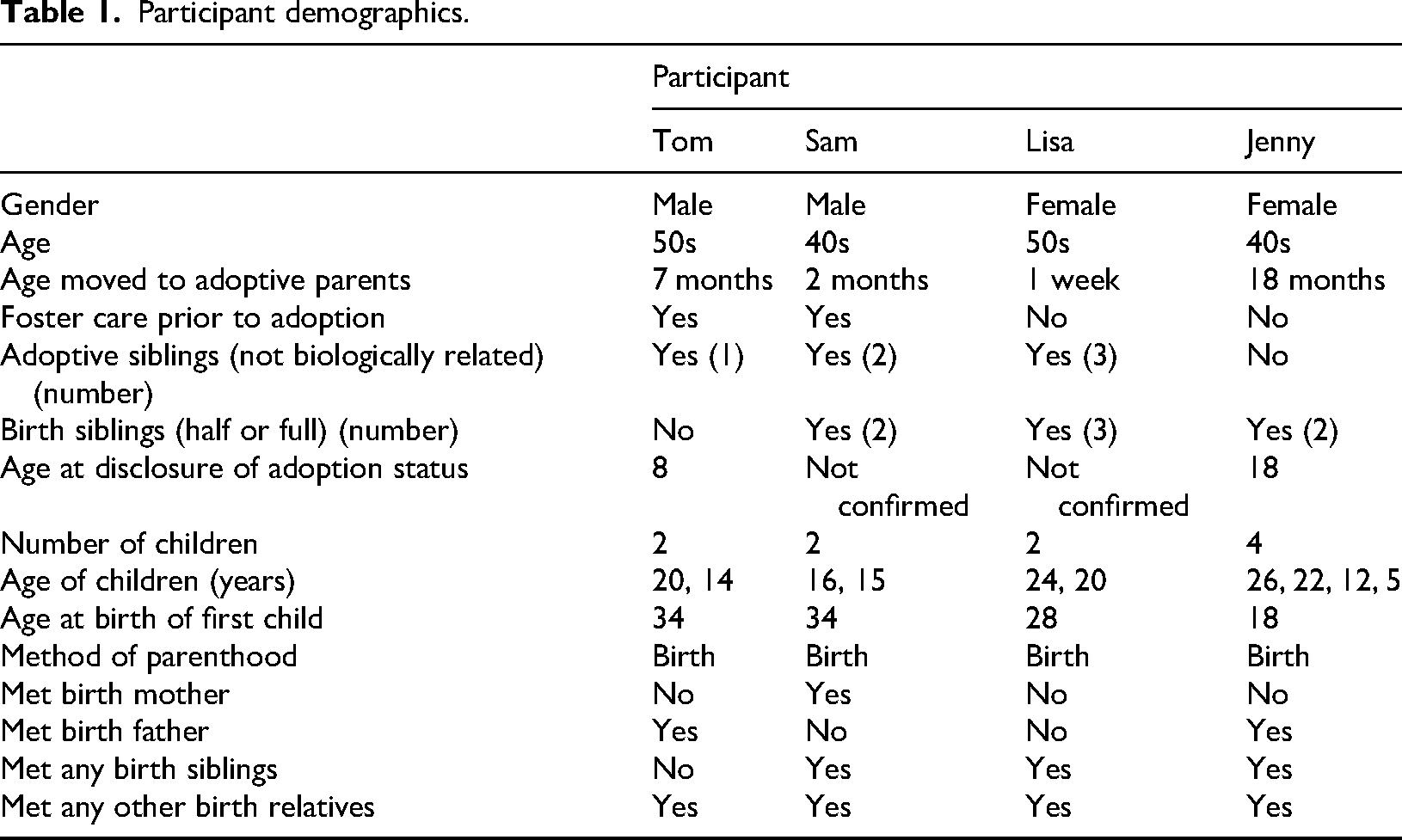
Whilst relatively homogeneous, participants’ backgrounds varied in the following respects (see Table 1 for full details):
Adoption age: three were adopted as babies (Lisa, Tom and Sam), one at 18 months (Jenny). Contact with birth family: Three participants (Tom, Lisa and Jenny) had birth mothers who died by suicide before reunions, limiting contact to birth fathers or siblings. One (Lisa) met only siblings. Another (Sam) was in reunion with his birth mother. Adoptive family structure: Three had adoptive siblings (Tom, Sam and Lisa); three had adoptive parents with biological children (Sam, Lisa and Jenny). Reasons for adoption: Two participants (Sam and Lisa) were relinquished due to stigma (illegitimacy, interracial relationships), typical of pre-1980s adoptions (Parker, 2010). One (Jenny) was removed due to abuse and neglect; her birth mother had herself experienced severe abuse in care. One participant (Tom) did not disclose his adoption circumstances. Interracial adoption: One participant (Lisa) was interracially adopted in a rural community.
Participant demographics.
Data collection
After providing consent and completing a demographic questionnaire, participants took part in one-to-one interviews with the lead researcher (TS), which lasted one to two hours and took place online via Zoom or Microsoft Teams. Interviews explored their parenting journey from pregnancy to the present, how adoption was managed within their nuclear families, and their relationships with birth and adoptive families within the context of parenthood. The interview guide was flexible, allowing new topics to emerge. Rigour was maintained by probing new topics where they related to the research question. Interviews were audio-recorded, transcribed verbatim and anonymised. All data relating to the study, apart from anonymised transcripts, have been destroyed. Transcripts are stored in a password-protected folder. Transcripts include all spoken words and significant non-verbal utterances (O’Connell and Kowal, 1995). Participants were identified using pseudonyms.
The lead researcher and author, TS, is a female doctoral researcher with a master’s degree in psychology. She is a parent and disclosed this where relevant. She believes that, as adoption is a state intervention in family life, it warrants ongoing research into its long-term impacts. A reflexivity statement is available upon reasonable request to the author. The study was supervised by MM, a male professor of psychology.
Analysis
IPA was employed to explore how participants made sense of their parenthood experiences in the context of their adoptions (Eatough and Smith, 2017; Smith et al., 2021). A critical realist ontology and a critical realist epistemology were utilised, acknowledging that while an objective reality underlies the facts and events experienced by a participant, access to these experiences is mediated by their beliefs, attitudes, perceptions and prior experiences and further interpreted by the researcher (Cuthbertson et al., 2020; Roberts, 2014).
Following Smith and colleagues (2021), each case was analysed idiographically before cross-case analysis began. Analysis involved:
Full immersion through repeated listening and then reading of the transcript. Annotations being made, focusing on descriptive, linguistic and conceptual comments, with each line being explored from the angle of what it means to the researcher and what it means to the participant (Smith et al., 2021). Data being reviewed for themes – Smith and colleagues (2021: 92) define a theme as ‘phrases which speak to the psychological essence of the piece and contain enough particularity to be grounded and enough abstraction to be conceptual’. A collated set of themes which reflect an understanding of the data being created. Connections between themes being identified, creating clusters of interrelated themes, leading to superordinate themes.
Each case was fully processed before moving to the next, preserving the idiographic focus. Once all cases had superordinate themes and subthemes, patterns across cases, including contradictions, were examined. The final set of superordinate themes and subthemes across cases was then collated.
Findings
Three superordinate themes were identified: ‘Parenthood is an awakening’; ‘Adoption echoes on’; and ‘Moving forwards’ (see Figure 1). These highlighted the complex interplay between adoption history and parenthood.
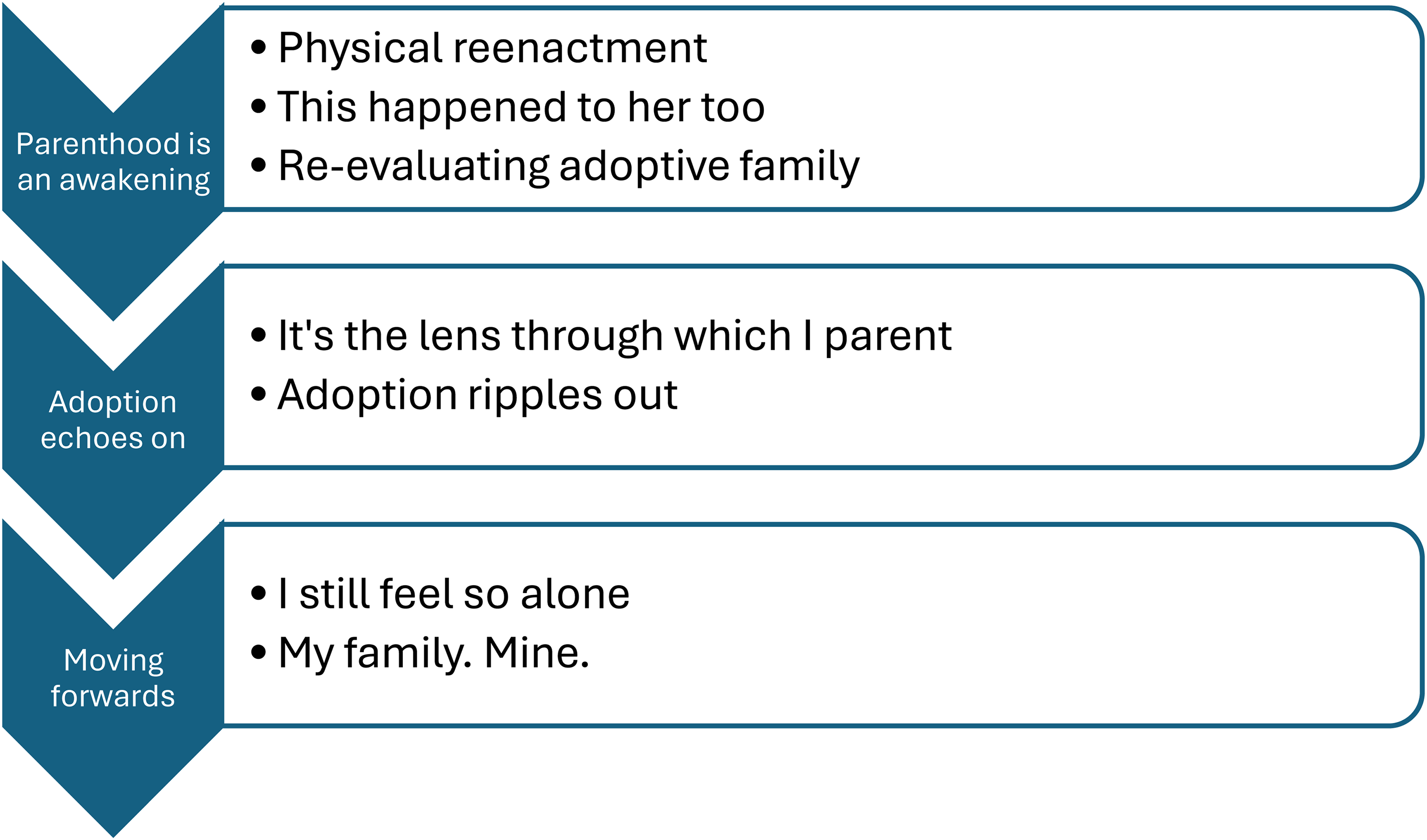
Superordinate themes and subthemes.
Parenthood is an awakening
Parenthood dynamically reshaped participants’ understanding of their adoption, intertwining with their adoption history and identity. Seeing their birth and adoptive parents through the lens of their own children offered new perspectives, lifting a metaphorical fog.
Subtheme 1: Physical re-enactment
Parenthood prompted all participants to relive aspects of their adoption. Milestones, such as childbirth or their children reaching certain ages, triggered reflections on their own early experiences, as well as the actions intrinsic to adoption. They became aware of the impact those actions may have had on them as a child and on their identity.
Childbirth stirred intense emotions for most participants – they imagined both their own infancy and their birth mother’s experience of relinquishment. It made their adoptions more ‘real’: ‘knowing what it’s like to suddenly give birth and to have… a child in front of you made it all seem so much more real what they’d given up’ (Jenny). Caring for a newborn deepened their perception of loss: ‘she was completely reliant on me for everything… we spent every waking moment together. She knew my heartbeat, she knew my voice… my smell’ (Lisa).
For most participants, their child reaching the age at which they were relinquished triggered strong feelings. They could visualise their own child being taken: ‘Imagine if I had to give her away now… wild horses wouldn’t have got that baby out of my arms’ (Lisa). The emotional impact was profound: Lisa ‘fell apart’, whilst Jenny felt it ‘hit really hard… I actually got upset’.
The actions of parenthood created a sense of the time and effort involved, giving greater weight to their relinquishment: You’ve been together a long time, you’ve gone through a lot of milestones, you’ve gone through sleepless nights, you’ve gone through laughter, you’ve watched them grow… when you look at how much they’ve come [through] from being a newborn to then. (Jenny)
Participants sometimes struggled with watching their children have childhoods unaffected by adoption, heightening a sense of the disruption to their own identity development. For example, Sam stated: ‘[I was] just taken and given to somebody else and just expected to… to fit’, becoming ‘this mouldable thing'. He felt ‘shock’ as he watched his children ‘become their own little people’.
For Tom, the actions of parenthood led to ‘anger towards them [birth parents]’, fuelling his determination to take ‘full responsibility’ for his own children. Jenny, who had experienced neglect, felt sadness as parenthood led her to ‘wonder how on earth you could let a child get to that stage’, amplifying the trauma she had endured.
Subtheme 2: This happened to her too
Insights into their birth mothers’ experiences fostered empathy and understanding. Participants came to see how adoption had also affected their birth mothers, sometimes helping them to form coherent narratives for their relinquishment.
Most had relied on documents and second-hand accounts to construct their adoption narratives. For some, parenthood fostered compassion, generating a ‘parental’ perspective towards their birth mothers. Participants often referred to their birth mothers as ‘a kid’ (Lisa) or ‘childlike’ (Sam), sometimes imagining ‘how that [losing her baby] must have made her feel and how tremendously heartbreaking… it was for her’ (Lisa). For Sam, whose birth mother was alive, he sought reunion to ‘make sure she was okay’.
They were struck by the emotional toll of relinquishment: ‘[to] be expected to hand over a child having been through pregnancy and the hormones and the bonding and everything else’ (Sam). Parenthood frequently triggered the search journey for birth families as it gave them insight into what being a parent is: ‘I don't think you can understand how a parent would feel in quite the same way until you’ve had your own children’ (Sam).
Understanding the reason for their relinquishment was important to participants. Sam found comfort in knowing ‘she had absolutely no choice’. Whilst Jenny found knowing her birth mother’s story helped her understand her neglect: ‘knowing what I know about her, I can completely understand why she did what she did because of what had happened and lack of support. And I 100% empathise with that.’ This understanding helped her build a coherent narrative and reassured her she wouldn’t repeat the cycle: ‘I wasn't in her mental state, so I know my kids would never ever be like that.’ However, recognising her birth mother’s trauma also triggered intrusive thoughts as her children reached the age her birth mother was when she was abused: ‘Once they hit that age of six, that’s… tough too, because you have vile thoughts in your head.’ The vicarious trauma adoptees who experienced abuse or neglect may also need to cope with was highlighted.
Subtheme 3: Re-evaluating adoptive family
Parenthood led all participants to reassess their adoptive parents, examining the parenting they had received and their adoptive parents’ role in their adoption. Many struggled to navigate dual family systems (adoptive and birth), especially in relation to their own children.
Participants often asserted boundaries with adoptive parents to protect their autonomy: ‘she [adoptive mother] wanted to control… us and, you know, the grandchildren’ (Tom). Some participants indicated that they felt their adoptive parents assumed rights to their children, perhaps even seeing them as ‘their second chance’ (Jenny). They frequently described struggles with their adoptive parents to prevent the repetition of behaviours or values they had not enjoyed as children. For example, confrontations over religion: ‘[churchgoing] wasn’t right for the boys’ (Sam).
Most participants had adoptive parents who had also had birth children. However, Jenny, whose adoptive parents had not, felt it limited their ability to support her as a new mother and generated guilt: ‘I felt guilty that I was getting to go through it and she hadn’t.’
Parenthood also led to more critical views of adoption: ... once you go through that process of realising… the impact that it [adoption] has had on you and how different you are and how you think… I don’t understand why legal guardianship, unless there’s… circumstances where it’s a danger… why any of it should happen in the way that it happens. (Sam)
Where adoptive parents had had birth children, some participants felt frustrated that it had not led them to also be critical of adoption: ‘Having had a child of your own… How can you take somebody else’s child? Knowing how that would feel [referring to her adoptive parents adopting again after having a birth child]’ (Lisa).
Adoption echoes on
Participants felt unsupported in handling the long-term impact of adoption. It influenced their parenting and had multigenerational ramifications.
Subtheme 1: It’s the lens through which I parent
Adoption profoundly shaped participants’ parenting. All experienced anxiety, self-doubt, mental health challenges and identity struggles. These were compounded by a lack of support. They felt they would have been better parents with help processing their adoption.
Many questioned whether they were ‘good enough’: ‘Am I good enough to bring up this child?… will that interaction with this child be good enough?… Will I be a good enough father?’ (Tom). There were also anxieties about being able to bond: ‘I think I was more concerned about the… emotionally… Are we going to be able to… [bond]?’ (Lisa).
Some participants struggled in forming their parenting identity, feeling torn between their instincts and what they had learned from adoptive parents: ‘I’m having to learn everything as if I had none [role models]’ (Sam).
Past trauma coloured parenting responses. Feelings of being unwanted could lead participants to interpret normal child behaviours (for example, preferring one parent or misbehaving) as being their ‘fault’ or as a rejection, leading to emotional withdrawal. Sometimes they lacked confidence: Sam described feeling ‘terrible for days’ and sometimes ‘not even being able to sleep’ due to guilt over perceived mistakes in parenthood. Meanwhile, other participants believed trauma shaped their parenting: ‘I have a trauma brain. I go fight, flight, freeze, fall and… my children aren’t immune to that’ (Lisa). Some described emotional volatility: ‘maybe I’ve lashed out and shouted at times because I feel low, at the kids… And it’s probably just because of how rubbish I feel rather than anything they’ve actually done’ (Jenny).
Loss anxieties emerged, sometimes as intense health fears: ‘If they were ill… I couldn’t sleep. I’d wake up four, five, six times in the night just to, to get up and check on them’ (Sam). Some participants managed their fears of loss by keeping their children physically close: ‘they’re the only people in the whole world that are related to you… that you know. And you’ve lost all that before and you don’t want to lose it all again’ (Lisa). There were also fears of intervention by social services: ‘everything had to be just… like it wasn’t… I don’t know… yeah like it could be taken away at any minute’ (Jenny).
Despite challenges, participants believed adoption made them more conscientious parents due to ‘the realisation of how important having a child is’ (Jenny). Participants placed pressure on themselves to parent perfectly, ‘doing things in a way that I thought you had to do’ (Sam) or being ‘obsessed with doing everything properly’ (Jenny).
Participants felt earlier understanding and support could have improved their parenting: ‘[support would have] changed the way that I behaved as a parent. I did my best, but I think it could have been better’ (Tom). Some participants felt that having greater emotional awareness via support would have helped them do a ‘better job’ (Lisa), stressing the need for mental health support during pregnancy: ‘it digs everything up’ (Lisa). All participants felt that therapeutic support would have had a beneficial impact on their parenthood: ‘if I’d have got therapy… when I actually needed it, it probably would have helped a lot with my parenting and home life’ (Jenny).
Many felt unsupported by those around them, noting an absence of enquiries about their experiences: ‘No, nobody, it doesn’t cross people’s minds. The assumption that adopted people generally live through is that everybody thinks you're lucky or it’s… you're just expected to be fine with it and what does it matter?’ (Sam). Other participants echoed this: ‘no one asked me “How do you feel about this? How are you coping? This is a big thing for you”’ (Lisa).
Subtheme 2: Adoption ripples out
Adoption’s legal severance of bloodlines creates immediate parenting challenges, as the absence of medical records ignites concerns about genetic conditions and childhood health risks. It also complicates family life through the need to disclose being adopted, managing the impact of reunions and the loss of genetic, cultural and ethnic identity.
Participants felt frustrated at a lack of medical records, especially when their children were impacted: ‘nobody even seemed to consider that adoption or lack of medical history would have anything to do with it’ (Sam). They navigated pregnancy and birth ‘blind’, with no NHS support for missing medical histories: ‘We don’t know about whether we’ve got a history of gestational diabetes, pre-eclampsia’ (Lisa).
Adoption and reunion shaped their family identity. They faced decisions about when and how to disclose their adoption to their children, and how to balance ties with both adoptive and birth families: ‘we did want to put them in the picture because of… you know they’re biologically related to somebody else’ (Tom). Reunion requires adoptees to manage multiple family systems: ‘I’ve got one family system and I’ve got another family system and now I’ve got my family system with my kids’ (Lisa).
They worried over the effect of reunion on their children: ‘over the last two or three years I’ve thrust a whole other family on them’ (Sam). Some prioritised adoptive families over birth families, worrying that reunion could disrupt grandparenthood for their adoptive parents. Jenny only told two of her four children about her adoption: ‘I don’t want… it put in the kids’ head[s] at young ages that my mum and dad are not of blood.’ Sam said his child initially feared he ‘was going to take his grandparents away from him’ when he began searching for his birth mother.
Lisa, the transracial adoptee, faced specific challenges as her children directly encountered her disrupted identity. A school family-tree exercise forced her children to: ‘explain to everybody, why everybody on the whole thing is white apart from mummy.’ Reunion with birth siblings helped restore cultural connection, allowing her children to access parts of their heritage: I get to learn a bit about Jamaica, the kids get to be told what it’s actually like in Jamaica, which… I can’t do for them because I haven’t, you know, it’s, it’s, I’ve had my cultural identity severed but so have my children. (Lisa)
Sam felt sadness at being unable to offer the same sense of heritage his wife could: ‘Why do you look like that? Where's your eye colour come from?… it’s difficult to see when you can’t input that.’
Moving forwards
Participants found fulfilment and belonging in parenthood but faced struggles, often due to their adoptive family dynamics.
Subtheme 1: I still feel so alone
Participants often felt isolated and struggled with physical and emotional intimacy in their relations with their children. They had to overcome shame and secrecy around adoption, challenges compounded by the lack of openness in their adoptive families, who themselves lacked support in parenting adopted children.
Participants frequently described having minimal openness within their adoptive families: ‘I apparently had asked when I was 13 if I could have help finding my mum and it got… ignored, shoved under the carpet’ (Sam). All participants had searched for birth family without adoptive family support. Searches were undergone secretively; for example, Tom called his search ‘a covert operation’ in which he hid correspondence to avoid his adoptive parents becoming aware. Participants described challenges in talking to their adoptive parents about reunion: ‘I was going… to find… out what I could and actually meet up, it was quite clear that it was not a conversation that they were emotionally able to cope with’ (Sam).
Conversations about adoption were rarely handled sensitively by adoptive family. For example, Jenny describes learning of her adoption when she was 18: ‘I was given a post-it note to meet my sister.’ Pregnant at the time, she processed the news alone: ‘there wasn’t any support. There never was any support. So I never expected any. I felt ashamed that I should be pitiful by bringing it up.’ Whilst biographical openness was present within some participants’ adoptive families, support was minimal: ‘I just remember growing up, having to deal and cope with everything on my own, that was the key thing. And that’s not easy when you’ve got all the adopted issues to deal with.’
The lack of support and openness around their adoptions sometimes led participants to view their adoptive status as shameful when they were young: ‘a source of embarrassment. It was something to keep quiet about… I wasn’t proud of it. It was something I was ashamed of’ (Tom). They frequently avoided disclosing it to others: ‘I really didn’t tell anybody unless I needed to’ (Lisa).
Some participants expressed frustration that their adoptive parents were not supported to understand adoption’s impact: I remember my dad turned around and saying, ‘Well, you know, we never treated you like you were adopted’… It's like, ‘No, you didn't’, which on the one hand was nice, and I understand why you did that. On the other hand, I was, I am. And you should have had support maybe to bring me up as an adopted person. It’s intrinsic to everything. (Sam) They should never have had Black children in their house and the more aware that I am of my cultural heritage and the more pride that I take in being a Black woman, the less I find that I want to be in their company at all. (Lisa)
The limitations of adoptive parents meant some participants were left with no role model for discussing sensitive topics, leading them to find open communication about their adoption hard: ‘My instinct initially when I get asked these things [about reunion and adoption] is just to shut it down, ignore it, push it away. I catch myself doing it and I try not to but… it’s so inbuilt’ (Sam). Jenny felt that sharing her feelings about her adoption would ‘burden’ her children and spoke of her trauma ‘like a third person telling it’. Sometimes their challenges with being open with their children led to worries that it would affect the relationship: ‘I can see he’s almost a bit hurt by the fact that I can’t just… answer him straight away or whatever, it's quite hard. I think he gets very frustrated’ (Sam).
Physical affection was also challenging. Sam had ‘learnt to force’ himself to hug his children, whilst Lisa, who described disliking ‘being touched’, made ‘conscious efforts’. Jenny described herself as not ‘a physical contact kind of person’, and closeness faded as her children grew: ‘it seemed to phase off when they all got older. I don’t know whether that's because I don’t, I don’t really cuddle with people at all.’
Despite appearing close to their nuclear families, both fathers described lingering detachment: ‘You can be amongst family, friends, whatever and still feel so individual, so on your own’ (Sam). Tom echoed this: ‘I do feel part of a group and part of some… a unit… but now and again, still, I also feel so alone.’ The mothers did not feel isolated with their children but described general loneliness.
All participants felt alone in their adoptee experience. Only connecting with other adoptees, via support groups and shared stories, helped: ‘[by] listening to people share their stories and [I can] think, I’m not alone’ (Lisa). This hinted at part of her identity she couldn’t fully share with her children. Sadly, for some participants, their experiences led to an enduring sense of unworthiness and isolation: ‘it’s a very lonely experience. It makes you feel very worthless… I don’t feel worthy and I don’t feel like I belong’ (Jenny).
Subtheme 2: My family. Mine.
Parenthood was healing for participants. Having a genetic relative gave them a sense of belonging, pride and the opportunity to create new family values. They cherished the reciprocal bond with their children and the accomplishments parenthood brought.
A genetic relative brought the joy of recognition: ‘finally seeing somebody that has some of my features… some of my behaviours… which I hadn’t seen in anybody else before’ (Sam). It also created a powerful sense of connection: ‘When she was born. That’s immediate. That was immediate. This is the only person biologically related to me in the world that I know’ (Lisa). The experience was often primal for participants: ‘Mine. My blood. Me. My family’ (Jenny). For all, parenthood brought a long-sought sense of belonging: ‘Belonging. I felt like I belonged somewhere’ (Jenny).
Parenthood also fostered pride, bringing ‘confidence and self-worth and self-esteem’ (Tom) and was ‘an achievement’ (Tom). Being able to break generational cycles of trauma brought a sense of accomplishment: ‘I remember being really proud of myself… I was also really proud that they hadn’t gone through any sort of trauma or problem. It was pride, pride and happiness for them’ (Jenny).
Children offered emotional support, reinforcing the reciprocal nature of the relationship. Tom’s child supported his reunion: ‘She’s been understanding, she’s asked questions.’ Jenny's child defended her during a conflict with her adoptive father: ‘He actually shouted at his granddad, which he’s never done before.’
Parenthood was healing for many participants: … adoptees don’t get a chance to co-regulate as babies because we’re taken away from our mothers. And I think that then when you’re co-regulating your baby there’s an element of it being beneficial to you as well because you’re learning how to co-regulate because you’re having to teach your child to. (Lisa)
Discussion
This study explored the experiences of adoptees as they navigated parenthood. Consistent with previous research, participants described how parenthood reactivated adoption-related issues, reshaped family relationships and prompted reflections on identity, belonging and loss. The findings extend existing knowledge by highlighting the intergenerational impact of adoption, particularly how openness within adoptive families influenced participants’ parenting practices and their ability to support their children in adoption-related conversations.
Adoptee as parent
Participants reported parenting challenges linked to their adoptive status, echoing prior research. They worried about being ‘good enough’ (Despax et al., 2021a), were concerned about bonding difficulties (Masso and Whitfield, 2003; Neil et al., 2023) and felt pressure to parent ‘correctly’ (Conrick, 2020; Masso and Whitfield, 2003; Neil et al., 2023; Pérez et al., 2016). Early losses contributed to heightened fears of losing their children (Phillips, 2009; Pinkerton, 2011), anxieties over their safety (Conrick, 2020; Phillips, 2009) and a need for physical closeness (Conrick, 2020; Phillips, 2009).
Parenthood also brought pride, purpose and belonging (Conrick, 2020; Despax et al., 2021b; Edwards et al., 2023; Egan et al., 2022; Hampton, 1997; Moyer and Juang, 2011; Phillips, 2009; Pinkerton, 2011; Sherr et al., 2019), helping participants heal from their losses (Chase et al., 2006; Gatzke, 2015; Hampton, 1997; Pinkerton, 2011).
Participants rejected their adoptive parents’ parenting styles, instead developing their own values (Brodzinsky et al., 1992; Despax et al., 2021b; Gatzke, 2015; Greco et al., 2015). These often emerged from a period of self-doubt and identity crisis, as they reconciled internalised adoptive models with imagined birth family models and personal ideals. Confidence appeared to grow as they integrated both families into their identity. Whilst the desire to parent differently to one’s own parents is not unique to adoptees (Szymańska, 2024), adoption amplified its significance.
Consistent with previous findings, participants valued having a biological relative (Brodzinsky et al., 1992; Edwards et al., 2023; Field and Pond, 2018; Horowitz, 2011; Moyer and Juang, 2011). A novel finding of this study was the intensified kinship created by their children’s emotional and practical support.
Although most participants were relinquished as infants, they described adoption-related trauma affecting their mental health and parenting. Whilst early separation is likely inherently traumatic (Verrier, 1991), those who had not endured neglect or abuse may have nevertheless experienced their adoptions as traumatic due to negative appraisals of being adopted, commonly seen in adoptees who received little empathy or support from significant others (Brodzinsky et al., 2022). Furthermore, adoption disclosure did not appear to occur sensitively or in infancy, potentially rendering the disclosure itself a source of trauma and damaging existing attachment security (Baden et al., 2019; Kenny et al., 2012).
Loss of heritage and family continuity was also central. The transracial adoptee discovered her ethnic culture with her children and needed to cope with racism without benefitting from any racial socialisation. Whilst the impact of a loss of ethnic heritage has been shown before for transracial adoptees (Ferrari et al., 2015; Wu et al., 2020; Zhou et al., 2021), a non-ethnic-minority participant also mourned the ability to share cultural or familial traits with his children, showing that heritage loss extends beyond transracial contexts.
Missing medical history, already well documented (Conrick, 2020; Green, 2016; Moyer and Juang, 2011), generated anger at poor access systems and the inadequate protocols used by medical staff, pointing to the need for reform.
New perspectives on adoption
Consistent with previous research, parenthood prompted renewed reflection on adoption (Conrick, 2020; Pinkerton, 2011), particularly at their children’s life stages that mirrored significant moments in their own histories. Post-1989 adoptees, especially those adopted due to abuse or neglect or those moved in and out of the care system, may experience more triggers due to the increased number of significant events in their adoption story.
Physical aspects of parenthood underscored the loss of the birth mother bond and revealed the embodied actions of adoption. These moments deepened participants’ understanding of the mechanics behind their perceived loss of identity, often leading to criticism of their adoptive parents’ roles. Participants whose adoptive parents had biological children struggled with their adoptive parents’ lack of similar reflection on adoption. Fathers were as affected as mothers, often due to witnessing their partners’ motherhood. Whilst this is a small sample, it remains an underreported finding that adds to the literature on male adoptees.
Parenthood often shifted participants’ views of adoption, prompting more critical perspectives on historical policies and social norms that led to relinquishments and then restricted access to biographical information. Whilst these findings may seem less applicable to post-1989 adoptees, systemic inequality remains present within adoption: Bywaters and colleagues (2018) found children in the UK’s most deprived neighbourhoods were 11 times more likely to be ‘in care’ than those in the least deprived, indicating these themes may resonate with contemporary adoptees too.
Reviewing family
In line with previous research, parenthood led participants to empathise with birth mothers (Conrick, 2020; Egan et al., 2022; Pinkerton, 2011), reassess adoptive parents (Brodzinsky et al., 1992; Conrick, 2020; Hampton, 1997; Neil et al., 2023; Sherr et al., 2019), and feel sympathy for adoptive parents’ infertility (Conrick, 2020; Masso and Whitfield, 2003; Moyer and Juang, 2011; Pinkerton, 2011). The study also reinforced the centrality of mothers in adoptees’ narratives, with fathers – both adoptive and birth – largely absent (Sherr et al., 2019).
Parenthood often intensified negative feelings towards adoptive parents, leading to emotional distance, consistent with prior findings (Brodzinsky et al., 1992; Conrick, 2020; Hampton, 1997; Horowitz, 2011; Phillips, 2009). In contrast, other studies reported strengthened bonds post-parenthood (Neil et al., 2023; Sherr et al., 2019); this was associated with adoptive parents being communicatively open and fostering belonging, qualities perhaps absent in the adoptive families of participants here, making their distancing expected. Nonetheless, participants maintained adoptive parents’ roles as grandparents, suggesting that emotional distance did not erase family structures.
For the transracial adoptee who took part in the present study, birth siblings helped her children connect with their ethnic heritage, pointing to the importance of preparation and support in interracial adoptions, as well as the role of birth family contact in these instances.
The need for support
The findings highlight the need for adoptive parent training to address adoption’s lifelong impact. Participants described discomfort discussing adoption with their children, poor handling of birth family information, secretive reunions and inadequate racial socialisation in interracial contexts. Although adoption training has improved significantly, many adoptive parents still fall short in providing openness (Jones, 2016; Neil et al., 2023). This underscores the importance of comprehensive pre- and post-adoption training and support.
Participants believed that greater self-understanding could have improved their parenting, yet none received targeted support for adoptee-specific challenges. Health professionals should be prompted to signpost support to adoptees as they enter parenthood.
Participants also noted a lack of interest in their adoptive identity from others, possibly reflecting a lack of understanding of adoption by those around them. Greater public recognition of the long-term impact associated with adoption is needed. All participants complained of the disenfranchised grief of being expected to ‘feel grateful’ for what they experienced as an enormous loss.
A unique finding was participants’ sense of isolation, even in parenthood, stemming from their adoptee-specific identity which set them apart from non-adoptees, even their children.
Communication
The most significant finding is the intergenerational impact of openness. Openness shaped participants’ understanding of their adoption, their birth mothers’ motivations and their ability to discuss adoption with their own children. Understanding their adoption, especially why they were relinquished, was vital to participants, shaping their self-concept and parenting confidence.
In the only comparable study of English adoptees as parents (focusing on post-1989 adoptions), by Neil and colleagues (2023), participants were grouped by their narrative categories. Those with a positive tone, describing mostly happy childhoods through to successful parenthood, were relinquished under two years old and experienced open, supportive adoptive families. Meanwhile, participants who described overcoming adversity to become good parents, emphasising adoption-related parenting issues, had been adopted from care after two and reported barriers to communication and a low sense of belonging within their adoptive families. Participants in this present study, though adopted under age two, had parenthood experiences that mirrored those of the latter group. This suggests that in both studies, despite looking at two different adoption eras, a lack of openness and belonging within adoptive families contributed to challenges in parenthood, irrespective of age at adoption.
A unique finding of this study was that, in not experiencing their adoptive parents role-modelling communicative openness, participants went on to struggle with offering emotional intimacy to their own children and faced challenges in managing adoption-related conversations. This indicates an intergenerational impact of family openness which, although seen in all families (Kitamura et al., 2009; Van IJzendoorn, 1992), suggests adoptive parents specifically benefit from training in openness.
Echoing Egan and colleagues (2022), participants benefited from understanding their birth mother’s story, with those who believed their birth mothers had no real choice feeling more empathy. One participant who experienced neglect was reassured that she could parent differently by understanding her birth mother’s childhood trauma. This is especially relevant to contemporary adoptees, who are more likely to have experienced abuse or neglect (Neil et al., 2023). While adoptive parents may struggle to disclose such painful histories, the participant’s key insight came not from the abuse itself, but from understanding ‘why’ it happened.
Participants also struggled to support their children through reunion. An open, supportive relationship with adoptive parents could have eased this process, with them playing a role in reassuring their grandchildren during the upheaval of reunion.
As a state intervention that severs a family line, adoption invites lifelong reflection. Adoptees may critically re-evaluate its meaning over time. Adoptive parents who foster ongoing open communication – personally and systemically – are better positioned to maintain strong relationships as adoptees’ views of adoption evolve.
Providing adoptees with full, contextualised histories, communicated sensitively, would be greatly beneficial and support identity development. Whilst earlier research has shown the importance of communicative and biographical openness (Brodzinsky, 2006; Grotevant, 1997; Grotevant et al., 2000; Grotevant et al., 2017; Le Mare and Audet, 2011; Von Korff and Grotevant, 2011), this study evidences its long-term, intergenerational effects.
Conclusion
Adoptees form their parental identity through understanding their relinquishment, adoptive upbringing and birth families. These factors profoundly shape their parenting and relationships with their children. Parenthood can be healing, offering belonging and opportunities to define family values, yet adoptees may struggle to provide the intimacy they desire and may feel isolated, understood only by fellow adoptees.
A central finding is the lasting effect of adoptive parents’ openness. It influences how adoptees share their adoption narrative, cope with missing genetic information, manage their children’s relationships with adoptive grandparents and navigate reunion.
Though based on pre-1989 adoptees, these findings have contemporary relevance. Recommendations include training adoptive parents on adoption’s lifelong impact, promoting open communication and supporting adoptees through parenthood. Maternity professionals should establish protocols for missing medical histories and offer psychosocial support referrals. Adoption organisations should consider peer-support networks for adoptee parents.
Strengths, limitations and future research
A strength of this study was that both genders shared insights across the parenthood journey. The pre-1989 adoption context allowed for an in-depth exploration of the impact of openness and support on family life.
The study’s small sample size and recruitment from adoption support groups limits generalisability, though this was a known element of the research design which prioritised rich phenomenological data.
Future research could use mixed methods to compare parenting outcomes across varying levels and styles of openness. Including adoptees’ children would add valuable depth, as would exploring the relationship between age at adoption disclosure and later parenting outcomes. The limited role of fathers, both birth and adoptive, merits further study. Finally, improving access to adoptees’ medical histories remains an area for development.
Footnotes

Funding
The author(s) received no financial support for the research, authorship, and/or publication of this article.
Declaration of conflicting interests
The author(s) declared no potential conflicts of interest with respect to the research, authorship, and/or publication of this article.