



Abstract
This study focuses on a statistical illusion created by the high number of so-called Psalms manuscripts that were found at Qumran. These manuscripts contain psalms that eventually ended up in the canonical book of Psalms, and they have frequently been used as solid evidence for the importance of the book of psalms during the Qumran period. This use of the manuscript evidence is highly problematic and the severe weaknesses in such claims is demonstrated in this article through the use of several different perspectives on the empirical material and its relation to other available evidence, such as the
1. Introduction
In this study some remarks will be offered on an issue that has needed addressing for some time now. The topic that will be explored here is a statistical illusion frequently used as solid evidence for the importance of the book of Psalms during the Qumran period. The problem relates specifically to the high number of manuscripts containing psalms that eventually ended up in the canonical book of Psalms that were found at Qumran. The number of these so-called Psalms manuscripts is truly high, usually counted between 35 and 39, 1 and these manuscript finds derive from eight of the eleven Caves. Thus, it is frequently asserted that, based on the number of preserved copies, Deuteronomy, Isaiah and Psalms were the three most important biblical books at Qumran. This is a very common claim even in basic introductions like James C. VanderKam's The Dead Sea Scrolls Today: ‘The book of Psalms is present in the largest number of copies (36)’. 2 Such characterizations have led others, perhaps not so familiar with the factual manuscript evidence, to base broad claims on these numbers. Numerous examples could be given, but just to give one illustration to demonstrate the point, Karel van der Toorn argues in his Scribal Culture and the Making of the Hebrew Bible that the ‘popularity’ of the three books, Deuteronomy, Isaiah, and Psalms, evidenced by their great numbers among the Qumran finds, is an indication of their position in the scribal curriculum that was used in the education of the Levitical scribes. 3
In this study it will be demonstrated through several different perspectives that such a use of the manuscript statistics is problematic and it is based on largely non-existing evidence. The topic of the study is wide-ranging and it touches upon many large and fundamental questions in Qumran and Psalms studies. Thus, this study is of necessity limited to some critical notes made from several different perspectives. They will show some of the problems with particular notions that assumptions relying on these statistics presume. The use of these statistics as evidence for the influence of a book of psalms assumes the manuscripts attest to an authoritative book of psalms with clear boundaries, otherwise the arguments would make little sense. Indeed the manuscripts that are counted by scholars as Psalms manuscripts are manuscripts that preserve one or more of the psalms included in the now canonical MT arrangement. 4 The problematic nature of this evidence is first analyzed by illustrating what these manuscripts actually contain and then showing how this material is different from the manuscripts preserving parts of Deuteronomy or Isaiah. The second perspective taken up here is the existence of a specific authoritative book of psalms during the Qumran period and particularly at Qumran from where the statistics used as evidence are derived. This question of a definable group of authoritative psalms as opposed to other less authoritative or secondary works is analyzed from the point of view of large collections of ‘canonical’ Psalms, i.e., ‘books’ of Psalms, and from the viewpoint of ‘non-canonical’ collections.
2. Manuscript Evidence of Psalms in the MT Psalter among the Qumran Finds
It is a distinct possibility that none of the so-called Qumran Psalms manuscripts actually contained as many psalms as are now found in the MT Psalter, viz., 150. Rather most of them were probably quite limited collections containing a small number of psalms or even just one psalm.
5
It is important to understand just how little is actually preserved in the actual manuscripts, especially in comparison with a large collection such as the
MT Psalms in Manuscripts from Qumran

These are the actual numbers of Psalms found for the most part only partially preserved in the 36 manuscripts usually counted as Psalms manuscripts, and they are to be judged scant evidence for a 150-psalm book of psalms. But why could the manuscripts not all have originally contained 150 psalms? First of all, the sheer number of manuscripts that only have 1–3 psalms strongly suggests that the manuscripts did not all contain 150 psalms. Such would be something of a statistical miracle. More likely is that all of these 25 or so manuscripts with 1–3 psalms contained only a few psalms. Furthermore, some of the manuscripts with parts of only one psalm may not have been psalm manuscripts at all, but compositions having a psalm or parts of it among other compositions. Examples of this might be 4QPsx, and certainly 4QPs122. 6 The three manuscripts only preserving parts of Psalm 119 (4QPsg, 4QPsh, 5Q5) further suggest that Psalm 119 was frequently copied alone, probably for meditational purposes. 7
From the manuscripts preserving two or three psalms comes some further evidence that many of the collections may have been rather short and made for liturgical purposes. For example, Flint suggests that 1QPsb originally contained only the MT Psalms of Ascents (Pss. 120–134), 8 and 2QPs preserves parts of both barkhi nafshi type hymns in the MT Psalter, Psalms 103 and 104, partly written with red ink, which may imply that the collection only had these two psalms in a liturgical arrangement. 9 Even the manuscripts that currently preserve more than three psalms were probably not complete books of psalms, at least as we know it, as evidenced by 4QPsb, which probably ended in Psalm 118. 10 Furthermore, even the largest extant arrangement of psalms preserved in 11QPsa is usually considered to have begun with either MT Psalms 90 or 101, and thus contained between 50 to 60 compositions. 11
Yet another important sign for the original size of these manuscripts is the material indicators preserved in the manuscripts themselves. For instance, many of these manuscripts have narrow and rather short columns, and/or the psalms are in a stichometric arrangement. 12 If all 150 MT Psalms were placed in such an arrangement the resulting scroll would be enormously long and very impractical if not altogether impossible to use. 13 In practical terms, in order to fit all 150 MT Psalms into a single scroll it would have to be a tall scroll of 30+ lines in a column, with broad columns written in prose format, and even then the resulting book of psalms would probably be close to ten meters long, i.e., comparable to the longest extant scroll from the Judean desert, viz. the Temple Scroll. It is not self-evident that any of the preserved Qumran Psalms manuscripts were originally of such size in column width and height.
Thus, it is undisputable that these manuscripts contained different numbers of psalms, with most manuscripts almost certainly containing relatively few psalms. The primary reasons for these variant numbers are the many different purposes for which the psalms were used. All the different functions of the psalms have probably not yet even been grasped (and they may well have changed over time), but during the first centuries BCE and CE the psalms were used both in private and in communal gatherings, and they functioned at least as prayers, sources of spiritual meditation, and as liturgies, but also as sources of historical knowledge, as prophecy and as ethical instructions. These different functions of psalms required collections of diverse sizes and in different material formats, and the Qumran psalm manuscripts are clear evidence of this plurality of use.
Therefore, these distinct collections cannot just be equated and grouped together only because they happen to preserve one or more of the psalms that later became canonical. They are not copies of a specific book of psalms and cannot be used as direct evidence for the existence of such an authoritative book. But could the manuscripts be used as more circumstantial evidence of the existence of a book of psalms that could have served as some kind of master copy behind all the different arrangements? This question is approached from different perspectives in the remainder of this study, but what the material evidence can reveal is whether the order of the psalms in the manuscripts follows that of a known larger arrangement and whether they mostly had psalms contained in that arrangement. Because most (though by no means all) scholars equate the book of psalms the Qumran Psalms supposedly give evidence of with the MT Psalter, the following table lists all the manuscripts where the MT arrangement of the preserved psalms in a manuscript would be possible, albeit in no way proven, and the manuscripts where direct evidence of a different arrangement is found. Only the manuscripts with parts of two or more psalms are included in the table.

What this table reveals is that the order of the psalms varied and was frequently at odds with the MT arrangement. Enough variance is shown in the manuscripts to demonstrate that there is no single order of psalms that all the manuscripts would follow. Regarding the MT arrangement, it is significant that so many of the manuscripts directly contradict the order of the MT Psalter. Furthermore, even among the manuscripts where no direct contradictions exist, only a few actual transitions from psalm to psalm are preserved that verify that the same order as in the MT was used for those psalms. Thus, none of the manuscripts gives strong evidence for the existence of a MT-type Psalter among the Qumran finds. Perhaps the best evidence of a partial collection conforming to the MT arrangement is 4QPsc from 50–68 CE. 14 Importantly, however, its stichometric arrangement suggests it was not a complete 150-psalm Psalter, and even in this manuscript only six transitions from one psalm to another are extant, meaning that it is quite possible that it too might have originally had a different order from the MT at some point. A further complication regarding these statistics is that if the 11QPsa-type arrangement, probably also found at least in 11QPsb and 4QPse, was originally a large collection comparable to the MT Psalter, there is no extant manuscript that would reveal the order of psalms in its beginning. If the arrangement of the beginning of the compilation was largely similar to the MT order, then manuscripts like 4QPsc that only preserve psalms from the first parts of the now canonical Psalter, might come from the 11QPsa-type collection instead of a MT-type compilation. In fact, only two of the Qumran psalm collections, viz., 2QPs and 4QPsm, may contain actual evidence of two psalms in the MT order rather than in the 11QPsa arrangement, but in neither is the actual transition point extant.
Thus, to use this manuscript data as somehow unified evidence for the importance of a book of psalms at Qumran seems to be rather questionable. To equate this supposed book of psalms with the MT Psalter makes the gap between the evidence and the theory even greater. There is no real evidence that would point towards the importance of a MT-type Psalter among the Qumran psalm manuscripts. Rather, some of the manuscripts even have psalms not found in the MT—note 4QPsf, 11QPsa, and 11QPsb—and arrangements diverging from the MT Psalter are well in evidence even among the partially preserved data. If there is evidence for a book of psalms in some of these manuscripts, it is not the MT book of Psalms, but perhaps another large arrangement ending in a sequence of psalms like that found in 11QPsa. But even if this were so, only a few of the Psalms manuscripts would be significant copies having large parts of such a book and probably none of them had the entire 11QPsa-type book of psalms, if there ever was one.
3. The Difference between a Book and a Collection
Before moving on to examine other evidence for the existence of a definable book of psalms during the Qumran period, it is necessary to offer an interpretation of where scholars could have taken the wrong turn when using the above statistics as evidence of a book of psalms. As noted at the beginning, the psalm manuscripts are usually counted rather similarly to manuscripts preserving parts of Isaiah or Deuteronomy. What is conceivably not recognized by scholars who equate these numbers is the difference between a more or less unified, but nevertheless clearly definable book, and a collection of more than one composition. Unlike the manuscripts of Deuteronomy or Isaiah, the psalm manuscripts are not parts of a particular book, but compositions that are arranged in collections of different sizes with quite varied purposes. Thus, whereas a fragment of Deuteronomy is fairly certain to come from a copy of the entire book even if it is from a slightly divergent form of the book, and a fragment of Isaiah from the book of Isaiah, the collections of compositions are different in this respect. A comparable example can be taken from the prophetic books. A manuscript made up of fragments containing parts of Amos does not automatically indicate that the fragments came from a scroll that contained the whole collection of twelve ‘minor’ prophets. 15 It only indicates that the fragments probably come from a copy of a book of Amos or in the case of a single small fragment also possibly from a pesher or some other text using Amos. Whether that copy of the book of Amos was originally in turn part of a collection of prophetic books numbering twelve or fewer is a question the evidence may not be able to answer, but it is not a necessary assumption. While a collection of twelve prophets was probably already extant during the Qumran period, it did not mean that all subsequent manuscripts of these prophetic books necessarily contained all twelve books. Rather, the individual books could be copied and used by themselves or combined in variant orders and in collections of different sizes. Similarly, a fragment of a particular psalm only means that the specific psalm or parts of it was certainly contained in that manuscript. What else may or may not have been included in the manuscript may never be known. Larger collections of psalms certainly existed, but not every manuscript containing a psalm is evidence for a particular book of psalms. Collections of compositions are much more fluid and easily adaptable to different uses than books in this respect. They also seem inherently resistant to a standardized collection form because the compositions in a collection can so easily be placed in different orders for diverse uses or emphases. Treating a single book in a similar fashion is much more complex.
In order to demonstrate the point further, it would perhaps be helpful to put the collections of psalms and other evidence of ‘biblical’ books on a comparable scale. As a collection, the psalms are more like the five books of the Torah or all the books counted among the Prophets rather than individual books like Deuteronomy or Isaiah. Who then would count all the manuscripts containing something now in the prophetic books of the Hebrew Bible and say that the Prophets as a specific fixed compilation were very important in Qumran? This analogy with prophets reveals something important about the psalms. Much as prophets as a group of books was considered authoritative, so were the psalms, i.e., a particular collection of psalms may not have held sole authority, but the psalms as a group of writings were considered authoritative. However, the analogy between psalms and other collections of compositions actually extends further. Just as the psalms manuscripts vary in size and content, so do the Torah and the Prophets. The manuscripts of the books of the Torah at Qumran did not contain all the books of the Torah every time, if at all, and it is debated whether the Reworked Pentateuch manuscripts or Jubilees should be counted among them and so forth. Similarly, there is not even a claim that all the books of the prophets would have been on a single scroll, but even if they were, what exactly would the collection have included? Nevertheless, the analogies only take one so far before differences arise, and the main difference between the psalms and, for example, the collection of the twelve prophets in my opinion is that the psalms had more diverse uses that were best served by different compilations.
The point that is well demonstrated by the Psalms manuscripts from Qumran is that, when dealing with manuscript evidence, fragments of parts of a collection cannot be used as direct evidence for the entire collection. A manuscript of Genesis is not automatically evidence of the entire Torah, a fragment of Jonah is not proof of the Twelve as a collection, and a psalm or several psalms are not a confirmation of the existence of a book of psalms. Importantly, however, neither can the evidence be used the other way around. A different sequence among some books also found in the collection of twelve prophets or among psalms is not evidence for the non-existence of the otherwise known arrangement or whether it was more original than the other arrangement. It only demonstrates that there was no single normative collection of those compositions that all other manuscripts should imitate. This does not in any way diminish the authority of the individual books of the prophets or psalms, but it does show that the order and exact content of these collections was not yet written in stone.
Therefore, while the above psalm manuscripts from Qumran do not testify to the influence of a specific book of psalms, they certainly reveal something of the importance of psalms in general. However, someone might still argue that even if the Qumran psalm manuscripts are not manuscript copies of a book of psalms, they nevertheless attest to the use of a book of psalms, i.e., people used this book as a reference work for compiling these various collections. Is there, then, during the Qumran period a definable authoritative book of psalms looming in the background from which individual psalms could be drawn to form compilations of different sizes that were by the status of these psalms somehow distinct from other lesser psalmody left outside the large ‘canonical’ compilation? This seems to be a frequent scholarly assumption that rarely surfaces in explicit arguments, but is perceivable in the choice and division of material in studies, and may in part be due to the classic view of the Psalter as the hymn book of Second Temple Judaism from which psalms could be drawn for various liturgical purposes. One exception where such an idea is actually voiced is in Eileen Schuller's suggestion that the manuscripts labeled as 4QNon-Canonical Psalms A+B (4Q380–381) might have been meant as supplements to the canonical Psalter. 16 But was there an authoritative Psalter in the Qumran period, and were there ‘supplements’ intentionally written for it? In other words, are there collections that excluded MT Psalms because they were somehow set apart by their authority/canonicity from the compositions included in a collection? These questions will be analyzed one after the other in the following.
4. Authoritative Psalter(s)
There are no unambiguous references to a book of psalms ascribed to David in the Qumran manuscripts, 17 and more obvious mentions are only found later in the New Testament. 18 Thus, there is no explicit evidence for an authoritative collection of psalms during the Qumran period, but if there still was one, what was its content? Before the Qumran finds the situation seemed quite simple. To be sure, the Septuagint Psalter had one more Psalm than the MT Psalter, but it was at the very end of the collection and consequently seemed like an addition. Similarly, the four further Psalms that were found in Syriac manuscripts after Psalm 151 were labeled as Psalms 152–155 (or Syriac Psalms I–IV). 19 Because these five Psalms were only found in translations and they were furthermore placed after the canonical 150-psalm arrangement, they appeared to be some sort of appendices to the canonical Psalter and were termed ‘apocryphal psalms’. Likewise the differences in the Septuagint Psalter's superscripts in comparison to the MT were seen as additions to an already authoritative Psalter.
But the Qumran finds drastically changed the situation, and made the tranquil picture into a much messier mixture of colors. Not only were multiple manuscripts with different orders of psalms than in the MT Psalter, even including previously unknown psalm compositions, found in the caves, but also there were what appeared to be remnants of another large arrangement of psalms differing significantly from the MT Psalter. After these finds, regardless of how the relationship between the MT Psalter and the Qumran material is evaluated as regards the status of individual manuscripts, there is no possibility of returning to the previous serene image, and scholars must be content with trying to make sense of a much more complicated development before one specific Psalter can be recognized as emerging as the authoritative book of Psalms. There has been a long debate among scholars concerning 11QPsa and whether it is a true Psalter comparable to the MT Psalter or a secondary arrangement. 20 The debate has become somewhat entrenched and too much weight has been placed on arguing about chronological primacy or whether one collection is directly dependent on the other. The question of chronological order appears relatively straightforward in the current research situation, as will be demonstrated shortly. However, the much more important question is what the existence of three different Psalters as well as the other Qumran psalm manuscripts means for a theory of the existence of a single definable authoritative book of psalms during the Qumran period. This question merits much more study and only some preliminary thoughts will be given on it after dealing with the chronology.
The three largest available collections of psalms are the MT Psalter, the Septuagint Psalter and the Psalter represented by 11QPsa. Of these the MT Psalter is virtually certain to have been chronologically the first, although it too continued to develop somewhat, as shown, for example, by a couple of the differences from the Septuagint Psalter in which the current MT arrangement is obviously secondary. The Septuagint Psalter is probably the second, but it is very difficult to evaluate the chronological order of the Septuagint Psalter and the 11QPsa arrangement. The two collections may have originated chronologically quite close to each other, but possibly representing the development of the Psalter(s) in different regions and/or groups. However, both the Septuagint Psalter and 11QPsa seem to be aware of the ‘final’ (proto-)MT arrangement or an arrangement very close to it.
Although there is very little that can be suggested as evidence for a specific Psalter, some scholars consider Ben Sira 14.20–15.10 to be a reference to the Psalter in its Masoretic order, 21 which would mean the MT Psalter was ready or near its ‘final’ form early in the second century BCE. A more unambiguous but substantially later link with a particular form of the collection is the Septuagint Psalter, which follows the order of psalms found also in the MT. Other evidence for dating the MT Psalter is more circumstantial, but most scholars date the MT Psalter somewhere between 200 and 100 BCE, 22 which seems plausible. 23 Alongside noting the number of Qumran psalm manuscripts, the growing use of psalms in other compositions, 24 the explicit use of psalms as authoritative texts in the Qumran pesharim, 25 and the New Testament's use of Psalms, which are frequently brought up as attestations of the existence and influence of a specific book of psalms, it must be admitted at this point that although these are all important aspects, they testify to the growing influence of psalms in general, not to a specific Davidic Psalter.
The Septuagint Psalter is chronologically secondary to the (proto-)MT Psalter and obviously dependent on it, because the translation has the same Psalms (plus Ps. 151) and in the same order as in the MT Psalter. Furthermore, there are altogether 37 superscripts in the Septuagint Psalter, which have either additions or expansions in comparison to the MT Psalter. 26 Many of these changes are additions of a Davidic superscription to a Psalm that does not have one in the MT Psalter (e.g., Pss. 33; 43; 71; 91; 94; 95, etc.), and others add liturgical notices to Psalms (cf. Pss. 24; 48; 81; 94). 27 Thus, the Septuagint Psalter is chronologically secondary to a slightly earlier form of the MT Psalter, but what makes it particularly interesting is that it shows that the existence of the MT Psalter did not mean a cessation of the editing process(es) of the large collections of psalms. Since the Greek translation was certainly not meant to be based on a secondary Psalter, it means the MT-type arrangement was not considered the one and only official and unchangeable book of Psalms at the outset. Indeed, with the addition of Psalm 151 and many of the superscripts, the Septuagint Psalter is more explicitly Davidic than the MT Psalter, which is a development also visible in 11QPsa. The dating of the Septuagint Psalter depends in large part on how scholars date the MT Psalter, but it is to be put somewhere between the second half of the second century BCE, 28 and the beginning of the first century BCE. 29
The dating of the 11QPsa Psalter and its relationship to the MT Psalter are connected and highly controversial issues. For example, Armin Lange suggests a date before 150 BCE, 30 but others, such as Ulrich Dahmen, 31 support a Qumran provenance of the arrangement and date the collection accordingly. All three manuscripts probably attesting to the 11QPsa Psalter (4QPse, 11QPsa, and 11QPsb) are dated to the Common Era, 32 but the collection in all probability derives from the first century BCE. 33 However, it is important to keep in mind that such a dating need not automatically mean a Qumran or Essene provenance for the 11QPsa collection. The relative chronology between 11QPsa and the (proto-)MT Psalter can be established by observing some of the differences between the two collections. It seems that there are three types of changes in 11QPsa in comparison to the current MT Psalter. These are the three scribal activities that are usually part of an intentional editing process—namely, adding, revising, and omitting. In the following some examples are given for each of the categories, but a more extensive treatment of the subject will have to be left for the future.
a. Additions
There are ten compositions in 11QPsa that do not appear in the MT Psalter. Naturally, they are only additions if the 11QPsa arrangement is directly dependent on the MT Psalter, which is most firmly indicated by the revisions, not these additional compositions. Nevertheless, these additional compositions demonstrate that 11QPsa is chronologically secondary to the MT-type Psalter. Some of the psalms not contained in the MT Psalter are probably quite early, such as the Hymn to the Creator, which probably dates to the third century BCE, but some of the others are to be dated to a time when the MT-type Psalter was in all likelihood already in existence. At least within the current scholarly debate, the piece most firmly dateable to such a period is Psalm 154, which is dependent on Sirach 24 and thus derives from the latter half of the second century or the early first century BCE. 34 Another significant difference is the ending of the 11QPsa compilation with Psalm 151. It seems rather coincidental that the Septuagint Psalter and 11QPsa both end with the same psalm, a psalm which the MT Psalter does not contain. The addition of this psalm is part of the Davidization of the Psalters, which is a feature both the Septuagint Psalter and the 11QPsa Psalter also attest to in other ways; it is also a clear move forward from the MT-type Psalter. It is hardly conceivable that a Psalter would later have been made less Davidic by omitting some of the more explicit references to David, such as Psalm 151, yet keeping the Davidic stamp on the first parts of the Psalter.
b. Revisions
11QPsa has a very different order of psalms from the MT Psalter. In many instances it is almost impossible to tell which would be a more original arrangement, and whether the changes in the Psalters show a direct dependence of one on the other. It is telling that many of the consecutive psalms in the MT Psalter typically referred to as ‘twin psalms’, such as Psalms 103–104 and 105–106, are separated in the 11QPsa Psalter. 35 This suggests that the MT Psalter has a more original arrangement of these particular psalms, but it does not show a direct dependence. However, Reinhard Kratz has recently explored Psalm 145 as part of the MT Psalter and 11QPsa, and he is able to show convincingly that the 11QPsa arrangement is in this instance chronologically secondary and directly dependent on an arrangement of psalms like that in the MT Psalter. 36 This recognition is crucial for the next category of differences to be pertinent at all, and it allows a movement forward in the Psalter debate with a new set of questions.
c. Omissions
Because the whole text of the 11QPsa-type Psalter has not been preserved, only speculative arguments can be made for intentional omissions and such a hypothesis naturally presumes that the compilers of 11QPsa really knew the (proto-)MT arrangement of the Psalter. There are several possible cases of omissions in the 11QPsa Psalter, but the best case can be made for Psalm 110, which is not found in any of the manuscripts exhibiting an 11QPsa-type arrangement of psalms. It is quite possible that the Psalm was in a completely different place in that collection, but it is striking that Psalm 110 is one of only three Psalms in the fourth and fifth book of the MT Psalter (Pss. 90–150) that is not attested anywhere in the Qumran scrolls. 37 Furthermore, no quotations of this psalm have been found among the Scrolls, which is remarkable given that Psalm 110 is the most quoted text of the Hebrew Bible in the New Testament. 38
Psalm 110 is perhaps the most studied psalm in the MT Psalter. Theories concerning it include those dealing with its date (ranging from early royal times up to Maccabean times), and its proposed functions from a royal enthronement ceremony to usage as a messianic psalm. 39 Psalm 110 is probably from Hellenistic times or even the Hasmonean era because it merges together the earthly power of the ruler with the power of the high priest in one person. Such a combination of offices is found especially in the Hasmonean dynasty and, regardless of the composition's date, it could have served as a text giving legitimation for the combining of the offices of king and high priest in that dynasty. However, if Lester Grabbe is correct and the high priest also acted as a provincial ruler during the Hellenistic period, 40 then it is possible to place the origins of the psalm in that context. In addition to the combination of the roles of high priest and ruler, the idea about ruling in Zion in the midst of enemies would fit such a situation remarkably well. Moreover, such a setting would fit in with such characterizations of Psalm 110 as Erhard Gerstenberger's description that Psalm 110 uses veiled language in order not to draw the attention of the Persian officials, 41 which fits as well during the Hellenistic period. Nevertheless, regardless of the actual dating of the Psalm, the complete absence of this Psalm at Qumran does raise the question of whether it was considered offensive for combining the roles of ruler and high priest and thus supporting the regime in power. In any group opposed to Hasmonean policies, Psalm 110 could have been interpreted in the same political way, and hence it is quite plausible that it may have been intentionally omitted from the 11QPsa arrangement of psalms in order not to provide ancient Davidic legitimation for the regime in power.
Putting this evidence together suggests that 11QPsa may represent a rearrangement of the psalms now in the last two books of the MT Psalter, perhaps for functional reasons and for the further Davidization of the Psalter, but this does not mean that it would have been considered any less authoritative. I share Kratz's point of view concerning 11QPsa that the literary composition (= 11QPsa) was for those who created and transmitted the Scroll as canonical as the (proto-)Masoretic Psalter that is the literary source of the composition of 11Q5. 42 Thus, although the (proto-)MT Psalter is the oldest of the Psalters preserved to us, this does not mean it was considered the one and only immutable canonical arrangement. Indeed, both the Septuagint Psalter and 11QPsa testify to still ongoing work on the large collections of psalms, and some differences between the MT and Septuagint Psalters suggest that some work was also done on the MT-type Psalter itself. It appears that for the Qumran movement 11QPsa might have been the most authoritative large collection of psalms, and that the Greek-speaking Jews in all likelihood embraced the Septuagint version. They are secondary to the MT Psalter much as Chronicles is secondary to Kings or Deuteronomy to the older law codes. In the case of the psalms, it is likely that the other arrangements only became secondary when the canon emerged. Even though there was no one true Psalter in the Qumran period, is it still somehow justifiable to make a division into canonical and non-canonical psalm material? Was there a dividing line and, if so, where was it?
5. ‘Non-Canonical’ Psalm Collections
This section will explore whether psalms not included in the large known Psalters were considered somehow secondary or less authoritative than the psalms in these collections. The key material in this respect consists of psalm collections where no now canonical psalms have been preserved. The exception to this rule is 11Q11, which contains Psalm 91 among other previously unknown psalm compositions. This manuscript is sometimes counted among the Psalms manuscripts and sometimes not, but already its official title 11QApocryphal Psalms shows that the psalms on the manuscript are considered different from the ones categorized under Psalms manuscripts. The collections of ‘apocryphal’ psalms explored here include 11QapocrPs (11Q11), 4QNon-Canonical Psalms A and B (4Q380–4Q381), 4QBarkhi Nafshi (4Q434–438), 4QShira-b (4Q510–511), the Hodayot (1QHa-b, 4QHa-f), and the Psalms of Solomon. Some further collections, such as the Songs of the Sabbath Sacrifice, might be included, but they would only strengthen the overall picture the other collections reveal.
The idea that the psalms in these collections should be somehow secondary to the psalms in the MT Psalter is not often voiced aloud, but is revealed, for example, by the nomenclature used for them. While 11Q11 and 4Q380–381 are said to contain psalms, they are given further anachronistic labels as somehow non-canonical or apocryphal. The psalms in the other explored collections are in turn usually called songs or hymns. The label ‘song’ is just another general label parallel with ‘psalm’, but its use makes a conscious or unconscious division between the earlier psalms and the later songs. The psalms designated by scholars as ‘hymns’ on the other hand should be form-critically definable as hymns, which is true for the barkhi nafshi type hymns, but does not fit the Hodayot. Thus, the recent edition of the Hodayot in DJD 40 encourages the use of the label ‘psalms’ for the Hodayot instead of hymns. But are there grounds for this type of evaluation concerning these psalms in comparison to the MT Psalms?
One indication of a lesser status would be that ‘apocryphal’ psalms were not quoted or alluded to in other compositions whereas ‘canonical’ psalms frequently have been. However, 4Q370 i 1–2 alludes to the Hymn to the Creator (11QPsa 26.9–15), 43 4Q448 quotes Psalm 154, 44 the psalm in 4Q380 1i–ii 8 is used in Psalm 106 and possibly in the CD as well, 45 the psalm in 4Q381 IV is apparently alluded to in two consecutive Hodayot psalms (15.6–25 and 15.26–33), 46 Josephus may have been aware of 4Q381 Penitential Prayer of Manasseh, 47 and finally the penultimate psalm in 11Q11 is referred to in several late texts 48 that show the psalm had authority even after the canon was closed and it was left excluded from it. Therefore, there is nothing that would indicate that these psalms had a somehow inherent lesser status than the Psalms in the MT Psalter.
However, there is a general difference in the age of these compositions. Many of the ‘apocryphal’ psalms are later than the now ‘canonical’ psalms, but there are exceptions that go both ways. For example, the Hymn to the Creator and the 4Q380 psalm are probably older than some of the MT Psalms, and some late ‘canonical’ psalms such as Pss 106 and 110 are probably younger than some of the ‘apocryphal’ pieces. But there are no age labels in these psalms, and already the data given above show that at least the ‘apocryphal’ psalms claiming to be works written by famous ‘biblical’ figures received authority quite equal to other psalms and sometimes in a surprisingly short amount of time. But there may be a difference in that the compositions probably deriving from the Qumran movement, that did not make such claims, were not treated as authoritative, at least outside the movement. The main reason why more of these ‘non-canonical’ psalms were not included in the canonical book of Psalms is that most of them are from the second and first century BCE and thus were not composed in time to be included in the MT-type arrangement that was later accorded that status, and they were also in many instances group-specific, which implies that they may not have initially disseminated outside the particular group that produced them.
In my recent extensive study of this ‘non-canonical’ psalmody, however, I explored the above collections in detail in order to determine the principles of their compilation. I investigated whether there is any indication that knowledge of a book of Psalms influenced the choice of material in these compilations. Some results of his study are given in the following table, but for the detailed analysis one is directed to the original study. 49
Features in Common among Individual Psalms in a Compilation 50
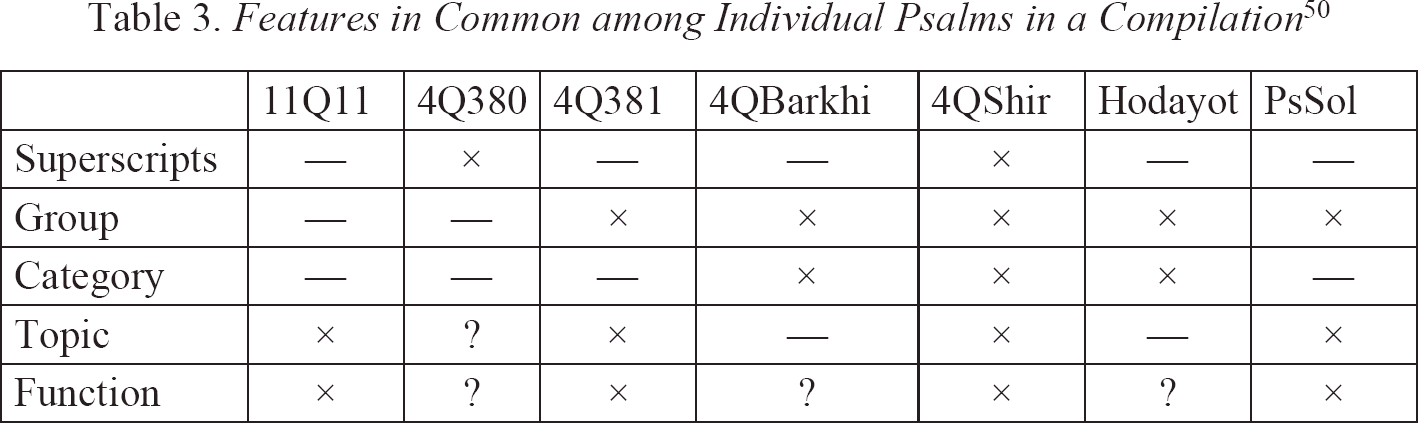
What my fuller investigation showed is that there were factors that united the individual psalms in a single collection and made them a purposeful compilation. It could be that all the psalms were ascribed to prophets (4Q380) or to the Maskil (4QShir), or the psalms were all written by and for a specific group (4Q381, 4QBarkhi, 4QShir, Hodayot, PsSol), or they might all be similar compositions in terms of their poetic category (4QBarkhi, 4QShir, Hodayot), or they might have a common central topic that all the individual psalms center on and explore (11Q11, 4Q381, 4QShir, PsSol), or they could have a common function as a collection that all the different psalms were a part of in the sequence in which they are now found—they could, for instance, have functioned as a ritual (11Q11, 4QShir) or as a lesson/admonition on a specific issue (4Q381, PsSol).
What can be concluded from these collections is that the label ‘non-canonical’ or ‘apocryphal’ does not do justice to them. The main reason why these collections do not have any of the now canonical Psalms is that most of these compilations are either the works of single authors and/or the compositions of a particular group. Thus, the ‘canonical’ Psalms would not have fitted in these collections or for their purposes, which are mostly group oriented. The Hodayot, the Songs of the Sage, the Barkhi Nafshi, 4Q381, and the Psalms of Solomon are all intended for a specific group. These collections connect with the identity of the intended group of addressees and shape it further in ways that the now ‘canonical’ Psalms would not be able to do. 51 This is shown in practice by the existence of the pesharim on the Psalms. In order to be meaningful for the specific setting of the Qumran movement and for their group identity, the Psalms needed to be reinterpreted from the group's own point of view. Thus, the ‘canonical’ Psalms were probably excluded from these psalm collections not because they were more authoritative, but because they were not as directly relevant for the group in the same sense as their own works were.
Two of the collections of ‘apocryphal’ psalms are different in this sense, and they are both most likely compilations made up of individual earlier psalms that have been secondarily collected together. For 11QapocrPs the designation ‘apocryphal’ is not really fitting because at least Psalm 91 of the now canonical Psalms was included in the scroll. Furthermore, the penultimate psalm apparently gained enough authority to leave its mark in later traditions, which means that it was probably not seen as particularly different in status from Psalm 91. The reason why there are no other ‘canonical’ Psalms in 11QapocrPs beside Psalm 91 is probably to be found in the collection's specialized ritual function as an exorcism. There are not many ‘canonical’ Psalms that would be fitting for such a function. The last collection is 4Q380, which seems to be made up of psalms of the prophets. Once more, the reason for compiling the collection was not the production of a ‘canonical’ Davidic collection of psalms. The psalm in 4Q380 1 was probably used as a source by the authors of Psalm 106 and the CD, which means that it evidently enjoyed some status and was in all likelihood no less authoritative than the now canonical psalms during the investigated time period. Collecting together psalms ascribed to different prophets may have been prompted by the exclusion of these psalms from the prophetic corpus or by a more general eagerness for psalms possibly composed by various prophets, as the additions of the names of the prophets Jeremiah, Ezekiel, Haggai and Zechariah in the Septuagint Psalter's superscripts illustrate.
Therefore, the designations ‘apocryphal’ and ‘non-canonical’ are not fitting for these diverse collections of psalms, and the distinguishing of now canonical Psalms as a distinct group is problematic. Thus, there is no evidence for a specific book of Psalms to be found in the Qumran psalm manuscripts. Likewise there was no generally approved official Psalter during the Qumran period, and finally, the division between the now ‘canonical’ Psalms and other ‘lesser’ psalms is not something that can find support in the sources. It can be noted that if the MT-type Psalter existed in something approaching its final form early in the second century BCE, it did not mean an immediate end to making new psalm compositions ascribed to David and other ‘biblical’ figures, and that these compositions eventually gained some authority at least in certain groups. This is shown by the ‘apocryphal’ psalms in 11QapocrPs, and some of the royal psalms in 4Q381, but also by at least a few of the ‘apocryphal’ psalms found in 11QPsa. Psalm 154 serves as an example of this, as it was evidently composed at the earliest in the middle of the second century BCE but was still accepted into a large Davidic arrangement of the Psalms as found in 11QPsa. If the MT-type Psalter had not been retained and spread by some faction of Judaism, there would in all likelihood be many more psalms in the book of Psalms.
Nevertheless, some sort of change, at least in attitudes, may have arisen from roughly the first century BCE onwards. The new psalm compositions from this period apparently no longer seek recognition as works of famous figures from hallowed antiquity. They do not appear to have had original pseudepigraphic superscripts to ‘biblical’ figures. None of the psalms of the Qumran movement has such a title and other psalms found in the literature of this time are similar in this respect. The phenomenon of pseudepigraphic attribution of psalms to ‘biblical’ figures did not stop at this point, as shown for example by the probably later added titles in Psalms of Solomon, and the ascribing of Psalms 154 and 155 to Hezekiah in the Syriac manuscripts. However, there is a significant difference in that this phenomenon is a continuance of a practice of giving old, already known psalms roots in ‘biblical’ traditions, a practice Moshe Bernstein has aptly termed ‘decorative pseudepigraphy’, 52 whereas some of the second-century BCE or slightly older psalms were specifically composed as psalms of David, Manasseh, etc. 53 This is of course part of a much larger question with many nuances to it, but it seems safe to say that at least the Qumran movement avoided making explicit pseudepigraphic attributions to ‘biblical’ figures in their own compositions. 54 Thus, if there is a need to make divisions among the psalm material preserved from before the Common Era, then something like this observation would be a possible place to start. Yet it is not a division into ‘canonical’ and ‘non-canonical’ material, but instead a separation of material intended for different discourses. The Qumran movement's own psalms were meant for the movement, not outside it. They did not seek recognition as authorities for a larger audience, but instead as a means to promulgate the identity of the group who produced them. Many of the other compositions from this period are similar in this sense. Thus, they are a reflection of the fragmentation of the society and also that fewer people were trying to extend their influence to the whole nation by their compositions; instead, they were nurturing the special character of their own group use.
6. Conclusions
Several openings for further discourse and ideas concerning Psalters and the collections of so-called non-canonical psalms have been offered in this article, but its main thrust has been to make scholars question the use of the statistics of the Qumran psalm manuscripts to argue for the importance of a particular book of psalms. The psalm manuscripts have enormous value in providing testimony for the importance of psalms. However, taking into account the so-called non-canonical psalms also affords a glimpse of the influence and varied usage of psalm compositions in this period. The arguments using the high total number of Psalms manuscripts as unified evidence fail to note the great diversity in these different collections and their functions. Also, the labeling and distinction made between Psalms manuscripts and other ‘lesser’ songs and psalms serves to cloud the overall picture that requires all of the psalm collections to be equally appreciated in order to gain understanding, for example, on the different functions psalm compositions had in the late Second Temple period. Therefore, each psalm collection should be studied individually and in the same way, regardless of whether it contains ‘canonical’ or ‘non-canonical’ psalms. Only then can it be truly evaluated how a book of Psalms came to be included in the later canon of Scripture.
Footnotes
1.
The differences in the numbers depend on whether scholars include all the Dead Sea finds or only the Qumran finds, and on how manuscripts that contain only one ‘canonical’ Psalm among other compositions are categorized.
2.
J.C. VanderKam, The Dead Sea Scrolls Today (Grand Rapids: Eerdmans, 1994), p. 31 (my italics). To be sure, VanderKam wrote this introduction before the official publication of the psalms manuscripts in the DJD series, but there were preliminary publications available of most of the manuscripts. Cf., e.g., J.J. Collins, Introduction to the Hebrew Bible (Minneapolis: Fortress Press, 2004), and C.D. Elledge, The Bible and the Dead Sea Scrolls (SBLABS, 14; Leiden: E.J. Brill, 2005), p. 88. But note also the more cautionary interpretation of the material, for example, by E. Schuller, The Dead Sea Scrolls: What Have We Learned 50 Years On? (London: SCM Press, 2006), pp. 38, 47–51. Naturally, studies dealing extensively with the actual manuscript evidence tend to be more nuanced; see, e.g., G.H. Wilson, The Editing of the Hebrew Psalter (SBLDS, 76; Chico, CA: Scholars Press, 1985); P.W. Flint, The Dead Sea Psalms Scrolls and the Book of Psalms (STDJ, 27; Leiden: E.J. Brill, 1997).
3.
K. van der Toorn, Scribal Culture and the Making of the Hebrew Bible (Cambridge, MA: Harvard University Press, 2007), p. 102.
4.
E.g. Wilson, Editing, pp. 96–115; Flint, The Dead Sea Psalms Scrolls, pp. 31–45.
5.
Cf. Flint, The Dead Sea Psalms Scrolls, pp. 47–48, E.M. Schuller, ‘Some Reflections on the Function and Use of Poetical Texts among the Dead Sea Scrolls’, in E.G. Chazon (ed.), Liturgical Perspectives: Prayer and Poetry in Light of the Dead Sea Scrolls. Proceedings of the Fifth International Symposium of The Orion Center for the Study of the Dead Sea Scrolls and Associated Literature, 19–23 January, 2000 (STDJ, 48; Leiden: E.J. Brill, 2003), pp. 177–79.
6.
Flint, The Dead Sea Psalms Scrolls, pp. 38–39.
7.
Cf. Flint, The Dead Sea Psalms Scrolls, p. 48.
8.
Flint, The Dead Sea Psalms Scrolls, pp. 33–34.
9.
For the category of barkhi nafshi hymns, see M.S. Pajunen, ‘From Poetic Structure to Historical Setting: Exploring the Background of the Barkhi Nafshi Hymns’, in Prayer and Poetry in the Dead Sea Scrolls and Related Literature: Essays in Honor of Eileen Schuller on the Occasion of her 65th Birthday (ed. J. Penner, K.M. Penner and C. Wassen; STDJ, 98; Leiden: E.J. Brill, 2012), pp. 355–76. The 4QBarkhi Nafshi manuscripts (4Q434–438) all apparently contained only hymns from this poetic category, which would point to their common usage and further imply that 2QPs may only have contained Pss. 103 and 104. For red ink as a sign of liturgical use, see Flint, The Dead Sea Psalms Scrolls, p. 32.
10.
See E. Ulrich et al., ‘4QPsb’, in E. Ulrich et al. (eds.), Qumran Cave 4, XI. Psalms to Chronicles (DJD, 16; Oxford: Clarendon Press, 2000), pp. 23–48.
11.
E.g. H. Stegemann, ‘Methods for the Reconstruction of Scrolls from Scattered Fragments’, in L.H. Schiffman (ed.), Archaeology and History in the Dead Sea Scrolls: The New York University Conference in Memory of Yigael Yadin (JSPSup, 8; JSOT/ASOR Monographs, 2; Sheffield: JSOT Press, 1990), pp. 212–13; Flint, The Dead Sea Psalms Scrolls, pp. 40–41.
12.
For the use of stichometric arrangement in the manuscripts from the Judean desert, see E. Tov, ‘The Background of the Stichometric Arrangements of Poetry in the Judean Desert Scrolls’, in Penner, Penner and Wassen (eds.), Prayer and Poetry, pp. 409–20.
13.
For instance, in 4QPsd parts of three psalms are preserved in a stichometric arrangement that takes up well over five columns. Fitting all 150
14.
For the date of the manuscript, see Flint, The Dead Sea Psalms Scrolls, p. 34.
15.
For a study dealing with similar problems as regards the manuscript evidence for the books included in the now canonical book of the twelve prophets, see H. von Weissenberg, ‘The Twelve Minor Prophets at Qumran and the Canonical Process: Amos as a “Case Study”’, in N. David, A. Lange, K. De Troyer and S. Tzoref (eds.), The Hebrew Bible in Light of the Dead Sea Scrolls (FRLANT, 239; Göttingen: Vandenhoeck & Ruprecht, 2012), pp. 357–75.
16.
E.M. Schuller, Non-Canonical Psalms from Qumran: A Pseudepigraphic Collection (HSS, 28; Atlanta: Scholars Press, 1986), p. 29.
17.
A book of psalms is mentioned in 4Q491 17 4, but because of the missing context it is not clear what to it refers. 11QMelchizedek (11Q13 II 10) mentions songs of David, but the songs plainly refer here to the Psalms quoted right after this mention (Pss. 7 and 82), and do not necessarily presume a larger collection. Thus, a Davidic authorship is claimed only for these two particular Psalms in this passage. In addition, there is a passage in 4QMMT that some scholars, such as Flint, The Dead Sea Psalms Scrolls, p. 219, read as a reference to a tripartite canon as ‘Book of Moses’, ‘Prophets’, and ‘David’. However, there are severe problems regarding this interpretation; see E. Ulrich, ‘The Non-attestation of a Tripartite Canon in 4QMMT’, CBQ 65 (2003), pp. 202–14; H. von Weissenberg, 4QMMT: Reevaluating the Text, the Function and the Meaning of the Epilogue (STDJ, 82; Leiden: E.J. Brill, 2009), pp. 204–205.
18.
See, e.g., Mk 12.36; Lk. 24.44; Acts 2.25, 34; 4.25.
19.
For the Syriac Psalms, see, e.g., H.F. van Rooy, Studies on the Syriac Apocryphal Psalms (JSSSup, 7; Oxford: Oxford University Press, 1999).
20.
A great number of scholars have already taken part in this debate, and they are too numerous to mention here. Some of the principal participants have been: James Sanders, ‘Variorum in the Psalms Scroll (11QPsa)’, HTR 59 (1966), pp. 83–94; idem, ‘The Qumran Psalms Scroll (11QPsa) Reviewed’, in M. Black and W.A. Smalley (eds.), On Language, Culture, and Religion: In Honor of Eugene A. Nida (Paris: Mouton, 1974), pp. 79–99; and P. Flint, The Dead Sea Psalms Scrolls, esp. pp. 202–27, who argue on behalf of 11QPsa being a true Psalter, and, for example, P. Skehan, ‘Qumran and Old Testament Criticism’, in M. Delcor (ed.), Qumrân. Sa piété, sa théologie et son milieu (BETL, 46; Leuven: Leuven University Press, 1978), pp. 163–82; H.-J. Fabry, ‘11QPsa und die Kanonizität des Psalters’, in E. Haag and F.-L. Hossfeld (eds.), Freude an der Weisung des Herrn. Beiträge zur Theologie der Psalmen. FS H. Groß (SBB, 13; Stuttgart: Verlag Katolische Bibelwerk, 1987), pp. 45–67; idem, ‘Der Psalter in Qumran’, in E. Zenger (ed.), Der Psalter in Judentum und Christentum (Herder's Biblical Studies, 18; Freiburg: Herder, 1998), pp. 137–63; U. Dahmen, ‘Psalmentext und Psalmensammlung. Eine Auseinandersetzung mit P. W. Flint’, in U. Dahmen, A. Lange and H. Lichtenberger (eds.), Die Textfunde vom Toten Meer und der Text der Hebräischen Bibel (Neukirchen–Vluyn: Neukirchener Verlag, 2002), pp. 109–23, who claim it to be secondary to the collection represented by the MT Psalter.
21.
Cf. J. Marböck, ‘Zur frühen Wirkungsgeschichte von Ps 1’, in Haag and Hossfeld (eds.), Freude an der Weisung des Herrn, pp. 207–22; Dahmen, ‘Psalmentext’, pp. 121–22; M. Marttila, Collective Reinterpretation in the Psalms: A Study of the Redaction History of the Psalter (FAT, 2/13; Tübingen: Mohr Siebeck, 2006), pp. 204, 229.
22.
Cf. F.-L. Hossfeld and E. Zenger, Die Psalmen I, Psalms 1–50 (NEB, 29; Würzburg: Echter Verlag, 1993), pp. 8–9; A. Lange, ‘Die Endgestalt des proto-masoretischen Psalters und die Toraweisheit. Zur Bedeutung der nichtessenischen Weisheitstexte aus Qumran für die Auslegung des proto-masoretischen Psalters’, in Zenger (ed.), Der Psalter, p. 108; Dahmen, ‘Psalmentext’, p. 121. For a list of features helpful for the dating of the
23.
The Septuagint Psalter is obviously based on a Psalter almost identical in form and arrangement to the
24.
The growing use of Psalms is especially prominent in wisdom writings, such as Ben Sira, 4Q185, 4Q370, and 4Q525. Cf. Lange, ‘Endgestalt’, pp. 101–36.
25.
For a list of Psalm passages cited in the pesharim, see Flint, The Dead Sea Psalms Scrolls, p. 264.
26.
For an analysis of the Septuagint Psalter's superscripts and the exegetical activity behind them, see, e.g., A. Pietersma, ‘Exegesis and Liturgy in the Superscriptions of the Greek Psalter’, in B.A. Taylor (ed.), X Congress of the International Organization for Septuagint and Cognate Studies, Oslo, 1998 (SBLSCS, 51; Atlanta: Society of Biblical Literature, 2001), pp. 99–138.
27.
For the liturgical additions, see, e.g., J. Schaper, ‘Der Septuaginta-Psalter. Interpretation, Aktualiserung und liturgische Verwendung der biblischen Psalmen im hellenistischen Judentum’, in Zenger (ed.), Der Psalter in Judentum und Christentum, pp. 177–80.
28.
J. Schaper, Eschatology in the Greek Psalter (WUNT, 2/76; Tübingen: Mohr Siebeck 1995), p. 41.
29.
Hossfeld and Zenger, Psalmen I, p. 9.
30.
Lange, ‘Endgestalt’, p. 108. Cf. Flint, The Dead Sea Psalms Scrolls, p. 169.
31.
Dahmen, Psalmen, pp. 313–18. Cf. Marttila, Collective, pp. 229–31.
32.
J. Sanders, DJD 4, pp. 6–9; Flint, The Dead Sea Psalms Scrolls, pp. 34–41.
33.
This rough dating of the 11QPsa collection depends on dating some of the psalms included in 11QPsa and not found in the MT Psalter, in the suggested relative chronology between the
34.
In addition to the dependence on Sir. 24, the overlaps between the fragmentary text in 4Q448 A 6–10 and the beginning and end of Ps. 154 demonstrate that some form of the Psalm was in existence at the time the composition in 4Q448 was written. For the editio princeps of 4Q448, see E. Eshel, H. Eshel and A. Yardeni, ‘448. 4QApocryphal Psalm and Prayer’, in E. Eshel et al. (eds.), Qumran Cave 4, VI Poetical and Liturgical Texts, Part 1 (DJD, 11; Oxford: Clarendon Press, 1998), pp. 403–25. Esther and Hanan Eshel, ‘4Q448, Psalm 154 (Syriac), Sirach 48:20, and 4QpIsaa’, JBL 119 (2000), p. 656, date a prayer for King Jonathan, which is also found in 4Q448, between 103 and 88
35.
W. Zimmerli, ‘Zwillingspsalmen’, in J. Schreiner (ed.), Wort, Lied und Gottesspruch II. Beiträge zu Psalmen und Propheten. FS J. Ziegler (FzB, 2; Würzburg: Echter Verlag, 1972), pp. 105–13.
36.
R.G. Kratz, ‘“Blessed Be the Lord and Blessed Be His Name Forever”: Psalm 145 in the Hebrew Bible and in the Psalms Scroll 11Q5’, in Penner, Penner and Wassen (eds.), Prayer and Poetry, pp. 229–43.
37.
The other two psalms are Ps. 111 and the short, two-verse Ps. 117.
38.
A. Lange and M. Weigold, Biblical Quotations and Allusions in Second Temple Jewish Literature (JAJSup, 5; Göttingen: Vandenhoeck & Ruprecht, 2011), p. 370, list one uncertain allusion to Ps. 110.4 in 4Q545 4 19.
39.
Compare, for example, L.C. Allen, Psalms 101–150 (WBC, 21; Dallas, TX: Word Books, 1983), p. 83; H.-J. Kraus, Psalms 60–150: A Commentary (trans. H.C. Oswald; Minneapolis: Augsburg Fortress, 1989), pp. 346–47; E.S. Gerstenberger Psalms Part 2 and Lamentations (FOTL, 15; Grand Rapids: Eerdmans, 2001), p. 267; Collins, Introduction, pp. 236–37, 468, 475. For an overview of scholarly theories concerning Ps. 110, see F.-L. Hossfeld and E. Zenger, Psalmen 101–150 (HThKAT; Freiburg: Herder, 2008), pp. 201–203. For an extensive bibliography on Ps. 110, see Gerstenberger Psalms Part 2, pp. 267–70.
40.
L.L. Grabbe, A History of the Jews and Judaism in the Second Temple Period. II. The Coming of the Greeks: The Early Hellenistic Period (335–175
41.
Gerstenberger Psalms Part 2, p. 267.
42.
Kratz, ‘Blessed Be the Lord’, p. 242.
43.
See C.A. Newsom, ‘4Q370: An Admonition Based on the Flood’, RevQ 13 (1988), pp. 30–31.
44.
Eshel, Eshel and Yardeni, ‘448. 4QApocryphal’.
45.
M.S. Pajunen, ‘The Textual Connection between 4Q380 Fragment 1 and Psalm 106’, in David et al. (eds.), The Hebrew Bible in Light of the Dead Sea Scrolls, pp. 186–202.
46.
M.S. Pajunen, ‘The Land to the Elect and Justice for All: Search for the Function and Setting(s) of 4QNon-Canonical Psalms B (4Q381)’ (PhD dissertation, University of Helsinki, 2012).
47.
M.S. Pajunen, ‘The Prayer of Manasseh in 4Q381 and the Account of Manasseh in 2 Chronicles 33’, in G.J. Brooke, D.K. Falk, E.J.C. Tigchelaar, and M. Zahn (eds.), The Scrolls and Biblical Traditions: Proceedings of the Seventh Meeting of the IOQS in Helsinki (STDJ; Leiden: E.J. Brill, 2012), pp. 143–61.
48.
G. Bohak, Ancient Jewish Magic: A History (Cambridge: Cambridge University Press, 2008), p. 109, notes a parallel to part of this psalm found in the Cairo Genizah, and he also imparts the information that there are apparently several even more direct parallels to the same psalm found in still-unpublished magic bowl texts.
49.
See Pajunen, ‘The Land to the Elect’. See now also M.S. Pajunen, The Land to the Elect and Justice for All: Reading Psalms in the Dead Sea Scrolls in Light of 4Q381 (JAJSup, 14; Göttingen: Vandenhoeck & Ruprecht, 2014).
50.
The ‘x’ marks a factor argued to be similar among the different psalms in a compilation. The use of ‘—’ means that the psalms are evidently not united by that factor. A question mark is used in cases where a factor cannot be accepted or dismissed due to the state of the manuscript or the current state of research, and in cases where variant collections of the psalms exist and a factor might be true for some collections, but untrue for others.
51.
Note Carol Newsom's influential study on how the Hodayot develop and nurture a group identity: C.A. Newsom, The Self as Symbolic Space: Constructing Identity and Community at Qumran (STDJ, 52; Leiden: E.J. Brill, 2004), pp. 191–345.
52.
M.J. Bernstein, ‘Pseudepigraphy in the Qumran Scrolls: Categories and Functions’, in E.G. Chazon and M. Stone (eds.), Pseudepigraphic Perspectives: The Apocrypha and Pseudepigrapha in Light of the Dead Sea Scrolls. Proceedings of the International Symposium of the Orion Center for the Study of the Dead Sea Scrolls and Associated Literature, 12–14 January, 1997 (STDJ, 31; Leiden: E.J. Brill, 1999), pp. 1–26.
53.
Examples of such psalms include Ps. 151, the Greek Prayer of Manasseh, and the five psalms in 4Q381 ascribed to different kings.
54.
Cf. Bernstein, ‘Pseudepigraphy’, pp. 25–26; J.J. Collins, ‘Pseudepigraphy and Group Formation in Second Temple Judaism’, in Chazon and Stone (eds.), Pseudepigraphic Perspectives, pp. 55–58.