



Abstract
This study presents indicators from the narrative of Exodus 5, which in their entirety may suggest the notion of Sabbath rest among the Israelite slaves in Egypt. One such indicator is the verb shabbat, ‘to cease’, a verb that marks the seventh day of the creation week with the quality of divine Sabbath rest. Its particular form and use in Exod. 5.5 entails various semantic notions, such as the indication that the Israelites ceased from their slave labors regularly. In addition, contextual, structural, and discourse elements allow for a reading that is indeed telling with regard to the Israelites’ social status and the impact of a possible Sabbath cessation under an oppressive regime. Finally, certain verbal expressions link with Sabbath texts of the Pentateuch such as Exod. 23.12, a Sabbath text that is embedded in the exodus narratives of slavery and freedom. All these indicators when taken together allow for a Sabbath-motivated reading of Exodus 5. The implications of such a reading tell of a world that longs for freedom, restored identities, and renewed relationships.
1. Introduction
Only those who have not ceased to be human in spite of dehumanizing conditions carry forth the vision of freedom into an enslaved world. The Hebrew Bible tells of Moses as such an individual. Right there in the midst of slavery he sets the ground marker for Israel's freedom trail: ‘Moses, why are you freeing the people? … You even made them rest (shabbat) from their labors!’ (Exod. 5.4–5), is the Egyptian monarch's bewildered question. Slaves who are free? For Pharaoh this is an incomprehensible thought. Moses knows of no limits. For him, Sabbath is the divine insigne for freedom founded in creation and reinforced in the redemptive event of the exodus (Exod. 20.8–12; 31.12–17; Deut. 5.12–15). To cease from work on the seventh day means to choose freedom over slavery, to master work time for the sake of divine time.
Pharaoh, on the other hand, in realizing that he lost control over his enslaved subjects and their time management, ordered an additional time-consuming workload to their labor. According to Exod. 5.5, the despot used language elsewhere found in texts of the seventh day when he charged Moses for having authorized the Israelite slaves to cease/rest (תבש) from work (cf. Gen. 2.2–3; Exod. 16.20; 23.12).
Interpreters of the biblical text have recognized the peculiarity of the term shabbat in the narrative of Israel's oppression in Egypt and have expressed their views either by linking the slaves’ resting from work to Sabbath rest 1 or by ignoring the language of the text and its undertones altogether. 2
In this article I will suggest that Exodus 5 contains more than the verb ‘cease/rest’ (shabbat) with its notion of Sabbath rest. Highly dramatized dialogue scenes combine with historical events of the exodus as well as theological overtones 3 of human dignity and freedom within the realm of oppressive powers. Could it be, then, that shabbat placed in the tyrant's mouth is most intent in the text of Exodus 5 to carry a concept that goes far beyond mere cessation from work?
2. Reading the Text of Exodus 5
Exodus 5.1–23 portrays Yahweh and Pharaoh in sharp confrontation with each other, with the latter as a resolute opponent, an anti-God who rejects acknowledging Yahweh and his command to send off the Hebrew slaves (vv. 1–3). 4 Pharaoh's explosion of speeches in vv. 4–5 establishes rest from labor under the control of Moses and Aaron as the root of the problem. What then follows shows the cruelty of Pharaoh's highly organized slave system: a sophisticated chain of command that singles out a group of slaves (Hebrew ‘foremen’) under the control of Egyptian supervisors, but then the seemingly privileged are held accountable for inevitable failure (vv. 4–19) 5 —even worse, they become traitors and turn against their own leaders with vicious resentment (vv. 20–21). History tells that the biblical story has always had its parallels. The atrocities of the Nazi concentration camps operating with similar efficiency will forever remain a heart-breaking memory.
From a text-critical perspective there are a few differences, mainly between the Masoretic text (
From a source-critical perspective Exodus 5 contains J and E sections
7
that have been merged in such a way that the narrative reflects unity, and the endeavor to divide the text is inessential for its analysis and understanding.
8
Propp settles on there being one source, ‘most likely the Elohist’.
9
Source-critical analysis relevant to this study pertains to what is regarded as redundancy in vv. 4 and 5: ‘But the king of Egypt said to them, “Moses and Aaron, why do you draw the people from their work? Get back to your labors!” Again Pharaoh said, “Look, the people of the land are now many, and you would have them cease from their labors!”’ (
With regard to Exodus 5 as a record of historical value, scholars have recognized that the text tells of the Israelites as doing the same work as the laborers who are portrayed in Egyptian inscriptions and relief scenes. 11 This involves labor relations that existed between masters and workers in terms of treatment of the workers by their taskmasters and foremen, rest days granted to the slaves, corporal punishment, etc. 12 Thus the use of the word ‘cease/rest from labor’ and the concept of rest for labor gangs in a biblical text that reflects genuine life in ancient Egypt is interesting and deserves to be researched.
A narrative reading of Exodus 5 shows its highly dramatized style in the emotionally laden discourses of the main characters: Pharaoh, Yahweh, Moses and Aaron, the taskmasters, and the foremen. The people, however, who are the focus of the actual events, are without words and voice. The conflict is about Egypt's methodically organized slavery system. The method, however, that is taken to tell the drama is intricate and complex in its use of rhetoric, structure, subversive language, and unexpected words that attract attention and create meaningful ideas. 13
3. Unexpectedness in Exodus 5
Propp comments about the rare harmonious situation between Israel, Moses, and Yahweh in Exod. 4.31: ‘The narrative rests there but for a moment’. 14 Yet it is this moment that provides the setting for Moses’ audience with Pharaoh (Exod. 5.1–5). Backed by a congregation bowing in faith and devotion to God, the leader voices Yahweh's explicit order to send Israel off into the wilderness. 15 Pharaoh's reaction to the divine imperative is not a response; it is not an inquiry; it is a provocative attack: ‘Who is Yahweh …? I do not know Yahweh’ (v. 2). 16 Moses and Aaron offer more detailed information: ‘The God of the Hebrews has called on us. Please, let us go a three days’ journey into the wilderness that we may sacrifice to Yahweh our God’ (v. 3). 17
Again, Pharaoh's reaction is not a response; it is an open affront: ‘And the king of Egypt said to them: “Why, Moses and Aaron, are you freeing (ןעירפת) the people from its work?”’ (v. 4). Note here, the expression ‘king of Egypt’ and not the title תערפ, ‘Pharaoh’. But when the king speaks he utters the verb ערפ (‘lead, act as leader’ / ‘let free, let go’) in the middle of his interrogative outburst: ‘Why, Moses and Aaron, do you act as pharaoh in letting the people go free from its work?’ The pun is obvious, 18 and in the brusque command ‘Go to your labors!’ it appears as if for a split second the king had recognized the ambiguity of his own words and must now demonstrate his dictator role.
Pharaoh continues with another unexpected expression, ‘Look, many already were/are the people of the land! And you made them rest (םתבשהו) from their labors!’ (v. 5). Does the despot refer to a previous record about the multitudes of Hebrew slaves in Egyptian annals (Exod. 1.9)? 19 Does he recognize Moses as the survivor of the cruel pogrom of the Hebrew male babies? Does he denounce Moses as a dissident who now controls the slaves by authorizing the ultimate stop to labor gangs? 20 Whatever the case may be, in the hearing of a Hebrew audience of the text, the day called תבש, ‘Shabbat’, resounds in Pharaoh's words. 21
4. Semantics and Syntax
Exodus 5.4–5 reports two speeches of Pharaoh. The first speech is the interrogative verbal clause ‘Why, Moses and Aaron, are you freeing the people from its work?’, which contains a hiphil imperfect, ןעירפת, ‘you let them go free’ (root ערפ). 22 This form simultaneously denotes past, present, and future in the sense that Moses and Aaron are responsible for letting the people go free from their work repeatedly or habitually (iterative) and were continuing to do so (durative). 23 The king then concludes with a strong imperative, ‘Go (ןכל, qal imperative) to your labors!’ The imperative enforces the time/aspect of the yaqtîl verb in the sense that Moses and Aaron have to get back to where they belong—to their labor gangs. 24
The second speech starts with an interjection highlighting a nominal clause: ‘Look, many already were/are the people of the land!’ 25 The deictic stress of the interjection bound to the adjective-adverb combination (התע םיברֿןה, ‘look, many already’, note the maqqef) signifies Pharaoh's emotional perception about the great number of people that has been a problem already during his predecessor's time (Exod. 1.9). 26 The nominal clause is then linked to a verbal clause with another hiphil verb, םיתבשהו, ‘and you cause them to cease, stop, rest’. 27 Several observations are in order for the syntactic and semantic use of םתבשהו:
(1) The hiphil םתבשהו is a perfect form of the verb תבש preceded by a waw. Grammarians identify this form as weqatal and hold that the perfect preceded by a waw is associated with two semantically distinct constructions, one with relative force mainly denoting future action (waw conversive or waw consecutive), and the other with coordinate force denoting past action (waw conjunctive). 28
When considering the weqatal םתבשהו under the waw conversive or waw consecutive theory, 29 the waw would relate the attached perfect verb to a previous verb and then represent a situation that is logically contingent on that previous verb and at the same time entail a temporal sequence, which would denote future action. 30 However, the relation of םתבשהו in Exod. 5.5 is not to a preceding verb but to the nominal clause ‘Look, many already were/are the people of the land’. There is no conditional, consequent or volitional relation between the nominal clause, and the weqatal with a future sense. 31 On the contrary, the nominal clause parallels another nominal clause found in Exod. 1.9 (‘Look, the people of Israel are many’) and refers to the past situation of the Israelite multitudes in Egypt. Thus the weqatal םתבשהו does not point to a future situation when Moses and Aaron would cause the Israelite slaves to rest; the weqatal relates to the great number of Israelites in the past (Exod. 1.9) and present (5.5) whom Moses and Aaron caused and are causing to rest.
When considering םתבשהו under the aspect of a waw conjunctive, grammarians take into account the narrative setting and note that the waw + perfect signals an action that is out of chronological order and is equivalent to the English pluperfect. 32 This aspect of the weqatal denotes a completed action in the sense that the leaders had allowed the people to cease/rest from labor in the past. 33 Such ceasing may have happened at least once when Exod. 4.31 mentions that the people bowed down and worshiped after Moses and Aaron had spoken to them about God's intention of deliverance. Thus, Pharaoh expressed his indignation toward Moses and Aaron, because they had authorized the Israelites to rest from their labors, and not because they will do so at some point in the future.
(2) The hiphil stem of the verb תבש in Exod. 5.5 is unique in the Hebrew Bible in that it has an accusative of the person ‘them’ (םתא) and is associated with a word for work with the preposition ‘from’ (ןמ). HALOT identifies this form as ‘to allow to rest from their forced labor’. 34 Nowhere else is the hiphil of תבש connected to rest from work. 35
(3) Of the 71 occurrences of תבש there are only two places where the Hebrew Bible associates this verb with a word for work with the preposition ‘from’ (ןמ), and this is in Gen. 2.2–3 and Exod. 5.5. On the seventh day of the creation week God rested ‘from all his work’ (ותכאלמ־לכמ). The Hebrew Bible identifies this day as the Sabbath (Exod. 20.8–11) and not as a mere interruption or an undefined cessation from work. By speaking of תבש as resting ‘from work’, Exod. 5.5 creates a direct link to the only other occurrence of rest from work, the creation Sabbath. 36 Elsewhere in the Hebrew Bible, when the meaning is to stop work or cause to cease work, the verb תבש is followed by a direct object, and not by the preposition ‘from’ (see Neh. 4.5; 6.3; 2 Chron. 16.5).
5. Discourse Linguistics
Robert Longacre's discourse-model approach contributes significantly to the understanding of םיבשהו as the only weqatal of a waw conjunctive + perfect in Exodus 5. 37 Longacre suggests that such an isolated weqatal in the middle of a narrative marks a climactic or pivotal event in the narrative flow. 38 When applied to the verb םחבשהו, the model suggests that Pharaoh spoke of the people's resting from work as a most significant and major event that had already occurred, an event that required him to take drastic measures.
6. Structural Analysis
The high significance of the verb םחבשהו in Exodus 5 together with its past and continuous or pluperfect meaning receives an even stronger emphasis when one considers the twofold structured speeches in vv. 4–5. The narrative introduces each of Pharaoh's speeches by an introductory line (‘The king of Egypt said to them’ and ‘Pharaoh said’) without any narrative comment in between the speeches. 39 Pharaoh's speeches are arranged in such a way that the two hiphil verbs correspond to each other and form a chiastic structure with the imperative ‘Go!’ in the center.
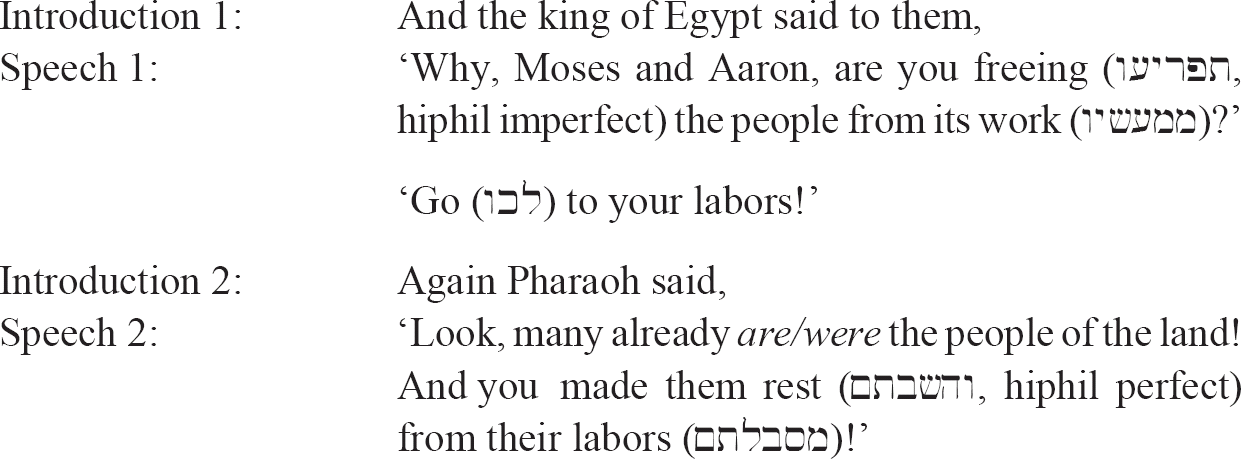
Note how both verbs express causative aspect, both have the accusative of person, and both are followed by a word for work with the preposition ‘from’. The chiastic structuring shows that Pharaoh's harsh command to Moses and Aaron—‘Go to your labors’—is thus issued in reaction to both hiphil verbs: first, in reaction to the urgent and immediate situation of regularly freeing the people from their work (v. 4); and, second, in reaction to having authorized the people to rest (תבש) from their labor gangs (v. 5). The second part of the structure indicates, by its highlighted reference to the past (Exod. 1.9) and by the unique use of the weqatal, that Pharaoh emphasizes the leaders’ powerful influence for rest as the major problem.
7. Intertextuality
A narrative, sequential, and holistic reading of the Hebrew Bible 40 shows that there exist intertextual links between Exodus 5 and various Sabbath texts of the Pentateuch over the use of the verb תבש in relation to slavery work. The narrator of the Pentateuch sets the reader up, right in the beginning of the Pentateuch, with the specific meaning of תבש as the Creator's rest from work on the seventh day, which is a day blessed and sanctified by his presence (Gen. 2.2–3). When the reader then continues in the pentateuchal text and encounters the word תבש again in direct relation to work, associations with the specific theme of Sabbath rest in creation times resonate. This technique is superfluous in texts where a direct statement is made about Sabbath rest, such as in Exod. 20.8–11, but it is all the more important in texts that seem to obscure the essential meaning of תבש in relation to work. Here, the subtleties of Hebrew narrative technique call for special attention.
The Sabbath rest denounced in Pharaoh's speech may indicate various ideas. The Israelite slaves had been motivated to keep a Sabbath rest from their labors. Pharaoh condemned Sabbath rest as an act that undermined his authority and hindered the economy of Egypt. 41 Furthermore, the language of Exodus 5 may testify to the subversive nature of Sabbath rest within a suppressive system. Moses and Aaron, identified as the driving force for Sabbath rest, do not use the word shabbat; further, they do not defend themselves, and they do not respond to Pharaoh's aggressive questioning. A superficial reading would thus hold that Moses and Aaron and the Hebrew slaves had surrendered to their hopeless situation. However, Pharaoh's word about Sabbath rest in the midst of suffering stands as a powerful testimony that in reality the slaves were masters—not masters over their workloads, but masters of time. The following intertextual links indicate that Sabbath rest in Exodus 5 means to live as free human beings even in the midst of slave-like circumstances.
a. Exodus 5.5 and Genesis 2.2–3
As noted in the analysis of Pharaoh's expression ‘you made them rest from their labors’, there is a unique link created, by the use of the preposition ‘from’ attached to a word for work, to the seventh day of the creation week when God ‘rested from all his work’, a day that the Pentateuch identifies with weekly Sabbath rest (Exod. 20.8–11; 31.12–17). 42
b. Exodus 5.5 and 23.12
Exodus 5 uses different words for work: השעמ, תולבס, and הךבע. It is the noun השעמ that is of significance for this study because it occurs in close connection with the verb חבש only in two places, Exod. 5.4–5 and 23.12. According to Exod. 5.4–5, Moses and Aaron caused the people to go free from their work (השעמ), even rest (םחבשהו). Verse 13 records that the taskmasters pressed the people to complete their work (השעמ), which had become heavier.
The Sabbath commandment in Exod. 23.12 is unique in that it is the only Sabbath commandment that uses the word השעמ for the work of the six weekdays in relation to the verb תבש. All other commandments have the word הכאלמ denoting work of the weekdays. Exodus 23.12 states that the Sabbath observer will do (השעת) work (השעמ) for six days, but on the seventh day he shall cease (תבש) so that the hard-working ox and donkey, the slave-woman's son, and the stranger may rest and be refreshed.
The verbal and conceptual links that exist between the Sabbath commandment in Exod. 23.12 and the exodus narratives in chs. 1–5 are stimulating. 43 Israel is regarded as Egypt's stranger (22.21). The people are oppressed and their cries to God become the trigger for the exodus event (2.23–25). It is, then, because the liberated Israelite knows the life of an oppressed stranger (23.9) that he is called to create the opportunity for the stranger and for the slave, as well as for animals, to have Sabbath rest.
c. Exodus 5.5 and Deuteronomy 5.12–15
While afflicted with additional hard labor because of going free and resting (םתבשהו and תבש), Israel receives the promise that God will bring them out of Egypt with a powerful and outstretched arm (Exod. 6.1, 6). According to the Sabbath commandment in Deut. 5.15, God liberated Israel ‘by a mighty hand and by an outstretched arm’ (cf. Exod. 13.9), and therefore Israel will always keep Sabbath rest (תבש).
Another link between Exodus 5 and Deuteronomy 5 is the word ךבע that is used for labor, to serve as a slave, and to be a slave. Exodus 5 uses the word ךבע seven times (vv. 9, 11, 15, 16, 18 [2×], 21) including in Pharaoh's cruel command ‘now go, work!’ (v. 18). The Sabbath commandment in Deut. 5.12–15 places similar emphasis upon ךבע, as seen in the chiastic arrangement:
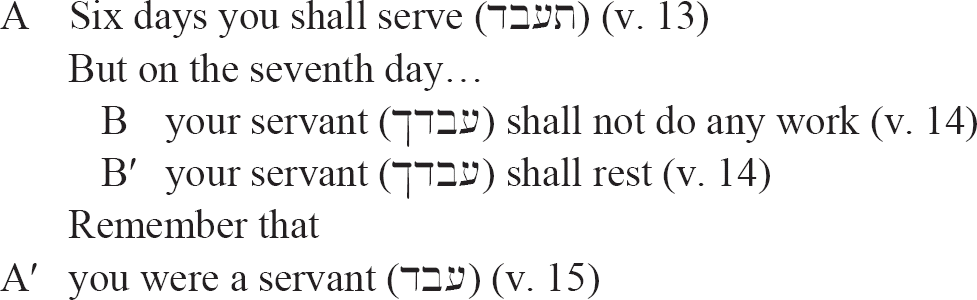
This arrangement is placed into the motivation clause of Deuteronomy's Sabbath commandment and carries the slave motif to demonstrate the significance of this day as a sign of deliverance from slavery. In other words, the Sabbath corresponds to the exodus. 44 The Sabbath keeper who has been a slave in the past will rest, and in resting he will be equal with the slave in his house.
d. Exodus 5 and Numbers 15.32–36
The Hebrew Bible creates a direct link between Exodus 5 and the story of the man who gathered wood on the Sabbath. The link exists because the verb ששק, ‘gather’, occurs only four times in the Pentateuch, twice when describing the toil and oppression of the Israelites in Egypt (Exod. 5.7, 12) and twice when narrating the offensive behavior of the wood-gatherer on Sabbath after his deliverance from Egypt (Num. 15.32, 33). 45 The telling link that the Pentateuch draws between the slaves who were forced to gather (ששק) straw without rest (תבש) and the man who defiantly went out and gathered (ששק) wood on the day of Sabbath rest (תבש) shows the importance that Sabbath rest carries with regard to freedom from slavery: the one who had been set free from slavery chose, in an act of open rebellion against God, to place himself back into the position of a slave in Egypt. 46
e. Exodus 5 and Genesis 11.1–9
The links that the Hebrew Bible creates between Exodus 5 and the tower of Babel story are intriguing as well. Pharaoh's building program is viewed under the perspective of all that is transient, fleeting, and without any stable and enduring substance. Brick making is the main work in Egypt (חנבל, vv. 7, 8, 14, 16, 18, 19; cf. 1.14) in order to build cities (Exod 1.11), just as in the land of Shinar (Gen. 11.2) when the people began to build the city and the tower of Babel (Gen. 11.3, 4, 5, 8). While the tower builders were eager to produce bricks of high quality by burning them thoroughly (v. 3), Pharaoh's bricks are made with straw, which, yes, is to provide strength and consistency, 47 but in the biblical text has the metaphorical connotation of frailness and transitoriness (Job 21.18; 41.27–29; Jer. 23.28); stubble is blown away by the wind (Isa. 40.24; 41.2; Jer. 13.24) or burned down by fire (Isa. 47.14; Joel. 2.5; Obad. 18; Mal. 4.1).
Another word that links the two texts is the verb ץופ, ‘scatter, disperse’, telling of the slaves who ‘scattered over all the land of Egypt to gather stubble for straw’ (Exod. 5.12). The result was incomplete work, punishment, distress, and resentment (vv. 13–19). The tower builders, however, were concerned with being ‘scattered over the surface of the whole land’ (Gen. 11.4) and began to build a city with its tower in order to stay together. But then Yahweh confused the language of their world and ‘scattered them over the surface of the whole land’ (vv. 8, 9), which brought to a halt the entire building project.
8. Conclusion
The reference to Sabbath rest in Exodus 5 is not intended to prove that this was an established weekly institution of Israel in Egypt. For, when the liberated slaves gathered manna for six days in the wilderness and did not find any on the seventh day, they still had to become familiar with the Sabbath's rhythmic and weekly recurrence (Exod. 16). On the other hand, scholars have noted that while the narrative of Exodus 16 does not depict the Sabbath as a new ordinance for the liberated slaves in the wilderness, its existence is assumed. 48
Sabbath rest in Exodus 5 forces one to link the weekly rhythm of the day with the essential meaning of the Sabbath. Sabbath rest in Exodus 5 is about destabilizing the very foundation of an autocratic system by means of subtle and unexpected language. Voiceless slaves caught in the middle of immense suffering are builders of cities destined for ruin. While overflowing the land to fetch stubble blown away by the wind, or scorched under the burning Egyptian sun, the old story of Babel stirs up visions of a transient empire. The oppressor's word about Sabbath rest portrays him as a defeated tyrant within his own powerful and still-functioning regime. This is the moment when Sabbath rest begins to disclose its transcendent and permanent quality: to master time is to be truly free.
Footnotes
1.
See Exod. R. 1.27–28, 32; 5.18; 17.3; b. Shab. 87b; Tur, OH 430; Sefer Shibolei Haleket, Seder Pesah 205; cf. Abraham Joshua Heschel, Heavenly Torah: As Refracted through the Generations (London: Continuum, 2005), p. 445. See also Morris Jastrow Jr, ‘The Original Character of the Hebrew Sabbath’, The American Journal of Theology 2/2 (1898), pp. 312–53; Frank Michaeli, Le Livre de l'Exod: Commentaire de L'Ancien Testament, II (Neuchatel: Delachaux & Niestlé, 1974), pp. 64–65; Patrick D. Miller, Jr, ‘The Human Sabbath: A Study in Deuteronomic Theology’, The Princeton Seminary Bulletin 6/2 (1985), pp. 81–97; Walter A. Elwell, Baker Theological Dictionary of the Bible (Grand Rapids: Baker Books, 1996), p. 697; William C. Propp, Exodus 1–18 (AB, 2; New York: Doubleday, 1999), p. 254; James K. Bruckner, New International Biblical Commentary: Exodus (Peabody, MA: Hendrickson, 2008), p. 58.
2.
See, e.g., C.F. Keil and F. Delitzsch, The Pentateuch (BCOT, 1; Grand Rapids: Eerdmans, 1952); Brevard S. Childs, The Book of Exodus: A Critical, Theological Commentary (OTL; Philadelphia: Westminster Press, 1974); Frank E. Gaebelein (ed.), The Expositor's Bible Commentary, II (Grand Rapids, MI: Zondervan, 1992); Walter Brueggemann, The Book of Exodus: Introduction, Commentary and Reflections (New Interpreter's Bible, 1; Nashville: Abingdon Press, 1996), pp. 725–31; Peter Enns, Exodus (NIVAC; Grand Rapids, MI: Zondervan, 2000); Douglas K. Stuart, Exodus (NAC, 2; Nashville: Broadman & Holman, 2006).
3.
Ryken has shown how biblical narrative combines what he calls ‘the historical, the theological, and the literary’. See Leland Ryken, ‘“Words of Delight”: The Bible as Literature’, Bibliotheka Sacra 149 (January 1990), pp. 3–15; idem, ‘“And It Came to Pass”: The Bible as God's Story Book’, Bibliotheka Sacra 149 (April 1990), pp. 131–42.
4.
Rolf Rendtorff, The Canonical Hebrew Bible: A Theology of the Old Testament (Leiden: Deo Publishing, 2005), p. 45.
5.
James K. Hoffmeier, Israel in Egypt: The Evidence for the Authenticity of the Exodus Tradition (Oxford: Oxford University Press, 1996), pp. 114–16.
6.
Durham and Propp discuss each case in point and suggest which would likely preserve the original reading; see Durham, Exodus, pp. 62, 67–68; Propp, Exodus 1–18, pp. 245–49.
7.
J and E sections are represented by the titles ‘pharaoh’ (see vv. 1, 2, 5, 6, etc.) and ‘king of Egypt’ (v. 4), and the seemingly redundant phrases in vv. 4 and 5. See B. Bäntsch, Exodus–Leviticus–Numeri (Göttingen: Vandenhoeck & Ruprecht, 1903); G. Fohrer, Überlieferung und Geschichte des Exodus: Eine Analyse von Ex 1–15 (Berlin: Alfred Töpelmann, 1964), pp. 45–49; Martin Noth, Exodus: A Commentary (OTL; Philadelphia: Westminster Press, 1962).
8.
Durham, Exodus, p. 63; Childs, The Book of Exodus, pp. 94–95; Propp concludes on one source, ‘most likely the Elohist’. See Propp, Exodus 1–18, p. 250.
9.
Propp, Exodus 1–18, p. 250.
10.
Propp, Exodus 1–18, p. 250.
11.
See especially Hoffmeier, Israel in Egypt, pp. 112–16; and Charles F. Nims, ‘Bricks without Straw?’, Biblical Archaeologist 13/2 (1950), pp. 22–28.
13.
Benno Jacob's masterful commentary on Exod. 5 calls attention to the stirring opening scenes between Israel's leaders and the king of Egypt and the dramatic force that this chapter conveys. See Benno Jacob, The Second Book of the Bible: Exodus (trans. Walter Jacob; Hoboken: KTAV, 1992), p. 112.
14.
Propp, Exodus 1–18, p. 258.
15.
Brueggemann comments that ‘[t]he conventional reading, ‘Let my people go’, sounds like a request or a plea. In fact, it is an imperative on the lips of Yahweh, as though Yahweh addresses a political subordinate (Pharaoh) who is expected to obey’. Walter Brueggemann, ‘The Book of Exodus: Introduction, Commentary and Reflections’, in The New Interpreter's Bible, I (Nashville: Abingdon Press, 1996), p. 726.
16.
Brueggemann, ‘The Book of Exodus’, p. 726. The word ‘to know’ Yahweh is a powerful Leitmotif in the exodus narration (Exod. 6.3, 7; 7.5, 17; 8.6, 18; 9.14, 29; 10.2; 14.4, 18).
17.
Later in the narrative, this clause will become a standard mocking by Pharaoh and the reason for calling the people ‘shirkers’ or ‘weaklings’ (vv. 8, 17).
18.
Propp, Exodus 1–18, p. 253. Martin Luther also recognized Sabbath rest in the expression and rendered it by the word ‘feiern’ (celebrate) in the German translation of the Bible (Revidierte Fassung von 1984).
19.
This is often understood as explaining the economic reasons for refusing to let the people go. See Nahum M. Sarna, Exodus (The JPS Torah Commentary; Philadelphia: The Jewish Publication Society, 1991), p. 28. ‘The sons of Israel’ (Exod. 1.9) are replaced with ‘the people of the land’ (Exod. 5.5), which possibly draws on a change in perspective regarding the status of the Israelites in Egypt over the course of their time of slavery. It could imply that ‘the sons of Israel’ had been integrated as slaves and had become in Pharaoh's eyes ‘the people of the land’ (Exod. 5.5) who are now regarded as Egyptians. See Propp, Exodus 1–18, p. 254.
20.
Houtman interprets Pharaoh's words in the sense that ‘Moses and Aaron are troublemakers who incite the people to shirk their duty and stop working’. Cornelius Houtman, Exodus 1 (trans. Johan Rebel and Sierd Woudstra; HCOT; Kampen: Kok Publishing House, 1993), p. 456.
21.
See n. 1; cf. Waldemar Janzen, Exodus (Believers Church Bible Commentary; Ontario: Herald Press, 1989), p. 398; Propp, Exodus 1–18, p. 254.
22.
HALOT, II, p. 970; T. Kronholm, ‘ערפ pâra˓, ערפ pera˓‘, in TDOT, XII, pp. 98–101.
23.
Paul Joüon and T. Muraoka, A Grammar of Biblical Hebrew (Rome: Editrice Pontificio Istituto Biblico, 2006), pp. 338–39. Cf. Propp, Exodus 1–18, p. 253.
24.
The NKJV and
25.
Cf. Sarna, Exodus, p. 28.
26.
The Masoretic accents tifha and merkha in the phrase ה֭תׇּעַ םיכִּדַ־ךהֵ highlight the exclamation and vividly convey the emotional aspect in Pharaoh's speech. See Arnold and Choi, A Guide to Biblical Hebrew Syntax, pp. 157–58; Raymond D. Hoop, ‘Stress and Syntax; Music and Meaning: The Purpose and Function of the Masoretic Accentuation System’, JNSL 34/2 (2008), pp. 99–121. The accents bind the words ‘many’ and ‘now’ together for stress, syntax, and recitation reasons. The accents may also graphically show corresponding hand gestures in the recitation of the Hebrew text in front of an audience. See the explanation given to the Masoretic signs for musical recitation,  , accessed 30 September 2012.
27.
The root תבש takes the meaning ‘to cease, stop, rest, stand still, remove, come to an end, take a holiday’. See HALOT, II, pp. 1407–12. For a discussion concerning the origin of the verb תבש and the relation to the noun תבש, see E. Haag, ‘תבַשׇׁ šābāt’, in TDOT, XIV, p. 385; Gnana Robinson, The Origin and Development of the Old Testament Sabbath: A Comprehensive Exegetical Approach (Bern: Peter Lang, 1988); idem, ‘The Idea of Rest in the Old Testament and the Search for the Basic Character of the Sabbath’, ZAW 92 (1980), pp. 32–42; cf. Niels-Erik Andreasen, The Old Testament Sabbath: A Tradition-Historical Investigation (Missoula, MT: Society of Biblical Literature Scholars Press, 1972), pp. 94–121; Gerhard F. Hasel, ‘Sabbath’, in ABD, V, pp. 850–51; idem, ‘The Sabbath in the Pentateuch’, in Kenneth A. Strand (ed.), The Sabbath in Scripture and History (Washington, DC: Review & Herald Publishing, 1982), pp. 21–43.
28.
Bruce K. Waltke and M. O'Connor, An Introduction to Biblical Hebrew Syntax (Winona Lake: Eisenbrauns, 1990), pp. 519–20.
29.
Waltke and O'Connor, Introduction, pp. 458–60.
30.
Thomas O. Lambdin, Introduction to Biblical Hebrew (New York: Charles Scribner's Sons, 1971), pp. 107–109; Waltke and O'Connor, Introduction, p. 525; Christo H. van der Merve, Jackie A. Naudé, and Jan H. Kroeze, A Biblical Hebrew Reference Grammar (Sheffield: Sheffield Academic Press, 1999), p. 164; Arnold and Choi, A Guide to Biblical Hebrew Syntax, p. 87. See, for example, the oracle texts, divine promises and others that contain the perfect form of תבש attached to a waw with the meaning of a consecutive (cf. Lev. 25.2; 26.6; 2 Kgs 23.5; Isa. 13.11; 17.3; Jer. 7.34; 48.35; Ezek. 6.6; 16.41; 23.27; 26.13; 34.10). Here, the perfect form always relates to a previous imperfect or a participle in order to follow consecutively and indicate future action.
31.
Waltke and O'Connor, Introduction, p. 534.
32.
Bo Johnson, Hebräisches Perfekt und Imperfekt mit Vorangehendem we (Lund: Gleerup, 1979), p. 41; Waltke and O'Connor, Introduction, pp. 540–42; Alviero Niccacci, The Syntax of the Verb in Classical Hebrew Prose (Sheffield: Sheffield Academic Press, 1990), p. 35; Arnold and Choi, A Guide to Biblical Hebrew Syntax, p. 93.
33.
See Douglas K. Stuart, Exodus (NAC; Nashville: Broadman & Holman, 2006), p. 162; Durham, Exodus, III, p. 64.
34.
HALOT, II, p. 1407.
35.
Elsewhere, hiphil occurrences of תבש have the meaning ‘to bring to a conclusion, put an end to, remove, put away, cause to disappear’ various things such as leaven (Exod. 12.15), grain offerings (Lev. 2.13), idolatrous priests (2 Kgs 35.5), the land (Jer. 36.29), pride (Ezek. 7.24), harmful beasts (Ezek. 34.25), the enemy (Ps. 8.2), strife (Ps. 18.18), sacrifice (Dan. 9.27), etc.
36.
If mere cessation from work were the intention of the text, the verb לדַחׇ would be a better fit (such as in 2 Chron. 16.5) than the verb תבש.
37.
Robert E. Longacre, ‘Discourse Perspective on the Hebrew Verb: Affirmation and Restatement’, in Walter R. Bodine (ed.), Linguistics and Biblical Hebrew (Winona Lake, IN: Eisenbrauns, 1992), pp. 71–91.
38.
Longacre, ‘Discourse Perspective on the Hebrew Verb’.
39.
Cynthia L. Miller, The Representation of Speech in Biblical Hebrew Narrative (Atlanta, GA: Scholars Press, 1996), pp. 235–97. Miller has observed adjoined direct speeches in biblical narratives that she labeled as ‘adjacency pairs’, which include successive speeches of a single speaker each introduced by a quotative frame. According to Miller, the structuring of the speeches signifies the speaker's twofold move to provide more detailed and thorough information (p. 241). Cassuto holds that the first speech becomes clearer because of the second one. See Cassuto, A Commentary on the Book of Exodus, p. 38. Conroy observes that the second speech often signals a point of major importance. See Charles Conroy, Absalom, Absalom! Narrative and Language in 2 Samuel 13–20 (Rome: Pontifical Biblical Institute, 1978), p. 130.
40.
Moshe Greenberg, Ezekiel 1–20: A New Translation with Introduction and Commentary (AB, 22; Garden City, NY: Doubleday, 1983), p. 21; cf. idem, ‘The Vision of Jerusalem in Ezekiel 8–11: A Holistic Interpretation’, in J.L. Crenshaw and S. Sandmel (eds.), Divine Helmsman: Studies on God's Control of Human Events Presented to Lou H. Silberman (New York: KTAV, 1980), pp. 143–64 (148); John Sailhamer, The Pentateuch as Narrative (Grand Rapids, MI: Zondervan, 1992), pp. 1–3, 24–30; James Watts, Reading Law: The Rhetorical Shaping of the Pentateuch (BS, 59; Sheffield: Sheffield Academic Press, 1999), p. 29. Robert Alter, while holding to the composite construction of the Pentateuch, asserts that there is a cohesiveness and continuity that allows for the Torah ‘to be read as a forward-moving process through time and theme from book to book yielding an overarching literary structure’; see also The Five Books of Moses: A Translation with Commentary (New York: W.W. Norton, 2004), pp. 42–43.
41.
Benno Jacob (Exodus, p. 131) understands Pharaoh's םתבשהו as referring to a holiday from hard work either in the sense of the Sabbath (Exod. 16) or the Passover feast (Exod 12.14), the only holidays before Israel arrived at Mount Sinai.
42.
Stephane A. Beaulieu shows further links to the creation account in Gen. 1 based upon the verb השע, ‘do, make’, in an unpublished paper titled ‘The Sabbath in Exodus 5:5’.
43.
See my dissertation on ‘The Sabbath in the Pentateuch: An Exegetical and Theological Study’ (Andrews University, 2011), pp. 170–82; also, ‘The Sabbath Commandment in the Book of the Covenant: Ethics on Behalf of the Outcast’, Journal of Asia Adventist Seminary 9/1 (2006), pp. 3–11; and ‘I Have Heard their Cry’, Shabbat Shalom 53/1 (2006), pp. 24–26.
44.
Jacques B. Doukhan, ‘Loving the Sabbath as a Christian’, in Tamara C. Eskenazi, Daniel C. Harrington, William H. Shea (eds.), The Sabbath in Jewish and Christian Tradition (New York: Crossroad, 1991), pp. 149–68 (161).
45.
Outside the Pentateuch the verb occurs in 1 Kgs 17.10, 12 and Zeph. 2.1.
46.
See Frey, ‘The Sabbath in the Pentateuch’, pp. 118–31.
47.
See Nims, ‘Bricks without Straw?’; Propp, Exodus 1–18, p. 255.
48.
Martin Buber, Moses: The Revelation and the Covenant (New York: Harper, 1958), p. 80; Childs, The Book of Exodus, p. 290.