




Abstract
Remembering is both common and indeed central in the Psalms: God remembers his people, and vice versa; the people remember their ancestors, and their ongoing relationship with God, in prayer. Prayer and memory are integral to the identity of God's people, passed down through the generations in worship as exemplified in psalm texts. The language of ‘remembering’, while common in the Old Testament in general, is widely found in the Psalms. This article examines the semantic field of ‘remember’ in the Psalms by applying a method developed out of the work of James Barr and Samuel Balentine, thus continuing to reclaim hermeneutic methods informed by linguistics. This carefully tabulated semantic analysis demonstrates the potential of such methods to contribute to theological understandings of a text, and in particular highlights something of the complex and rich nexus of what it means to ‘remember’ in prayer in the Psalms.
1. Introduction
The language of ‘remembering’ occurs throughout the Psalms. Both God and congregation are frequently called upon to remember, and the psalmist often describes his own remembering or that of others. In the Hebrew of the Old Testament, remembering is theologically important and semantically complex. 1 What does this mean in the context of prayer in the Psalter?
In this study I examine what it means to remember in the Psalms in prayer, employing a hermeneutic method informed by semantics.
2. Semantics and Biblical Hermeneutics
James Barr apparently delivered a blow to the use of semantic linguistics in biblical interpretation. 2 Yet his discrediting of much of the linguistics previously applied to the Bible rather refined the combination of semantics and hermeneutics. His pupil Samuel Balentine consequently developed semantic methods in biblical interpretation. 3 Balentine's work on the semantic domain of ‘hiding the face of God’ in the Old Testament provided an exemplar of how such semantics could be soundly applied, and what it might contribute to Old Testament study in general. It offers important findings in terms of both the particular content of his study, and also the general relevance of such methods.
3. A Study of ‘Remembering’ in the Psalter
To follow Balentine's method closely, a lengthy analysis of the general semantic field of words for ‘remember’ in the Old Testament would be required. Space prevents this here, and it has been treated elsewhere in other ways. 4 Suffice it to say, the Psalter is a major textual locus of the vocabulary of remembering and forgetting. I therefore deal here specifically with (a) the use of the central roots of remembering and forgetting in the particular context of the Psalms; and (b) semantic fields of ‘remember’-related words with reference to the Psalms. 5
a. The Use of ‘Remember’-Related Words in the Particular Context of the Psalter
Balentine's methods would highlight just two major roots for remembering and forgetting in the Psalter, רכז and חכש respectively (and their negations). 6 I treat each in turn.
Who Remembers Whom? רכז, Subjects and Objects in the Psalms
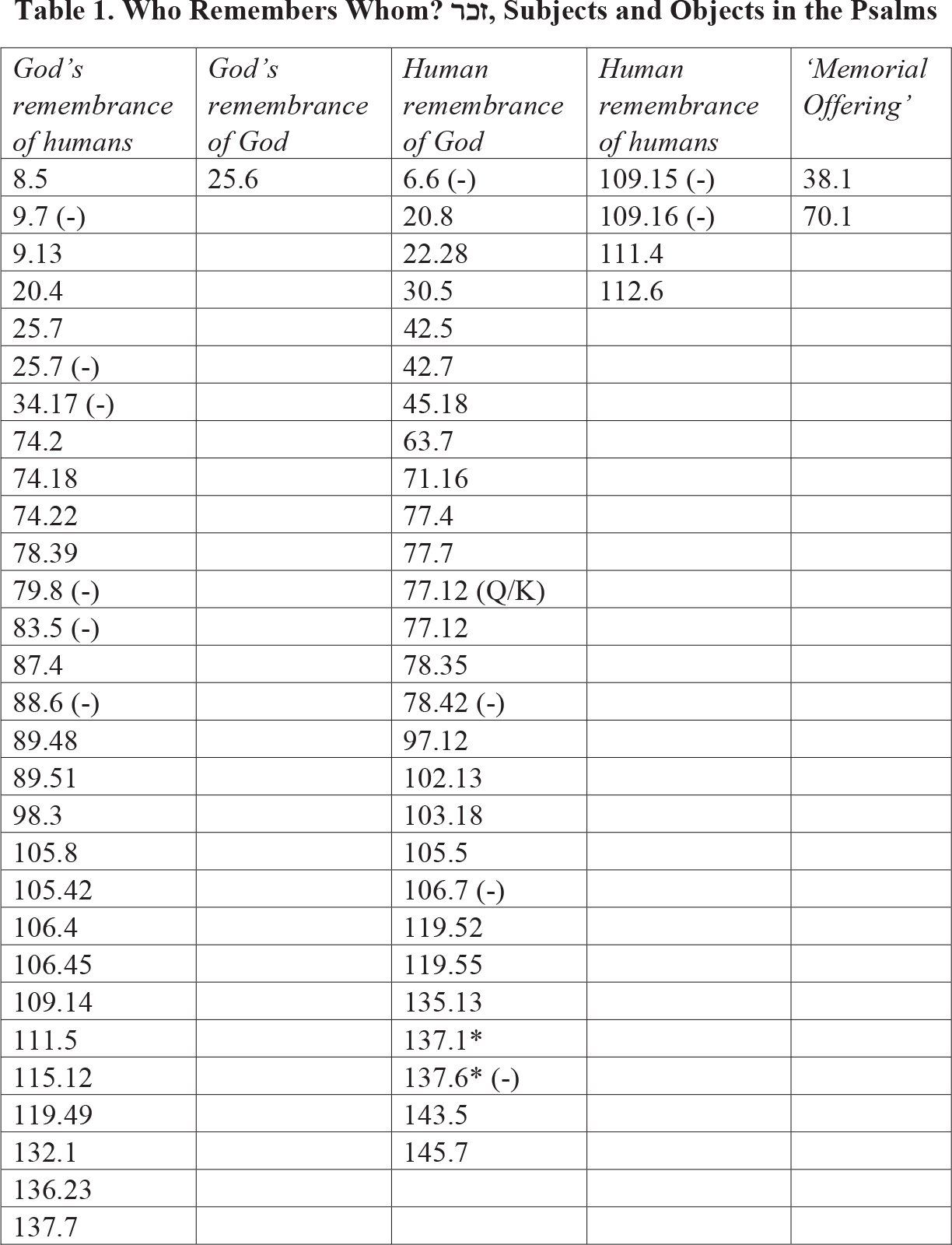
Of the 64 8 occurrences of the root רכז in 61 psalms, slightly more than half refer to God's remembering (or on six occasions not remembering) humans. Yet this is not significantly different: prayer is clearly the literary context where primarily humans are remembering God. 9
Only five psalms have both God remembering humans and humans remembering God side by side. In prayer, however, both the expression of hope in God's remembering, and the expression of worship in human remembering of God are almost equal in weight. Indeed, simply mentioning God's remembering or not remembering is an expression of human remembering of God, the divine agent of remembering. Therefore the very meaning of remembering points to how the semantic content is only the starting-point. Phrases of human remembering of God could even be superfluous: the very existence of mention of God in any capacity in prayer is an implicit instance of human remembering of God.
Just once (Ps. 25.6), God is called upon simply to remember himself. Only here is there a clause not requiring humans at the level of the text: God is both subject and object, remembering his own character. Yet at the level of the performance of the text, the text is written or spoken in a human voice: humans are calling upon God to remember himself and his goodness. It is difficult to conceive of God as entirely self-sufficient within a text: the text has been mediated and passed on by humans, and is now being read by humans. Thus God's remembering in a text, particularly in a prayer text, cannot happen by itself: its very existence in a text involves God being remembered by humans at least at the point of reading, and indeed at the point of writing and transmission as well. By mentioning God's remembering, the psalmist is himself somehow involved. Equally, insofar as the Psalms are a sacred text where God is either spoken of or spoken to, God is essentially involved in any instances of human remembering, regardless of whether the divine is grammatical object, direct or indirect, or not.
What of specific occurrences of רכז in the Psalter? From a canonical viewpoint the root occurs fairly regularly: there is no one book of the Psalter that appears to use רכז considerably more than another; this root occurs in all psalmic genres. A psalm in which we find the root רכז is more often than not alongside another such psalm: yet this relatively insignificant observation serves simply to suggest that sometimes psalms which were similar or related were naturally aligned. The root רכז does not influence the organisation of the psalter; at most it may only have affected the juxtaposition of some psalms.
Two psalms, 38 and 70, have the Hiphil infinitive construct in the superscription ריכזהל, commonly translated ‘for the memorial offering’. The differences between the two are simply that Psalm 38 is labelled as ‘A Psalm’ and Psalm 70 is specifically dedicated ‘For the leader’. Yet the subject, direct and indirect objects of ריכזהל remain unclear. ריכזהל itself does not specify; at most it conveys an intention, the goal of remembrance.
This instances how the semantic content of רכז is effective and functional: it does not simply mean something but it does something. 10 Fundamentally, the author of the superscriptions—presuming just one author of both—points out the importance of remembering. Both psalms are petitions for God to help the speaker, implying the function that the pray-er hereby reminds God of his human need. The speaker hopes that by his speaking, by his ריכזהל, God will remember. 11
Primarily, then, the intention is that God remember humanity: the psalmist in his distress, the enemy in their success. Psalm 38.2, 5–6 amount to confession; both texts convey the neediness of the speaker (38.7–9; 70.6). The psalmist appeals to God, reminding him of the speaker's neediness. The reminder of that neediness is also a persuasive reminder to God of both the speaker's human weakness and also God's attributes as one who remembers the poor and needy.
Perhaps the prayers were offered alongside a ritual offering; the superscription however does not necessitate this. A sacrificial object, whether a text spoken or written, or a physical offering, reminds God of his commitment to look after the poor and needy. It is also a reminder of former occasions of divine compassion. Such psalms are thus reminders not only to God, but also of God. The individual tone takes on communal significance. The text, passed on to future generations worshipping God, maintains the covenant. Future generations were to remember an individual's story as a communal response to suffering, a reminder of God's loving-kindness to the poor and needy.
There is no rubric indicating sacrificial actions within the psalms themselves. 12 More probably, the prayer itself is the memorial intending continued remembering. A spoken reminder is naturally repeated in time. 13 Both superscriptions claim Davidic connections; 14 whether or not David composed the psalms, their transmission indicates that they are to be repeated by others, and that David is an exemplar of one who was good at reminding God. Thus as the scribes and future pray-ers of these psalms repeat the prayers, so they also invoke the memory of David, the tupos of one reminding God of the things of which God apparently needed reminding. In reminding God, the addressee of both prayers, also of David, there is a double level of reminding enacted. As such, all Davidic psalms are effectively guiding future generations of Israelites in the way of worshipping God. Pray-ers of the psalms join a long line of God's people, observing ancestral wisdom in preserving their relationship with God. David is the spiritual leader, and renowned by the people.
Linguistically similar to Ps. 132.1, David is also to be renowned in God's eyes. To ‘remember for David's sake’ is also to call God to remember the covenant he enacted with David and committed to upholding if the people also upheld it. In remembering David's remembrance of God, the people are keeping the covenant. God is to remember David, and consequently also his descendants, all those who would speak the Psalms in future generations.
If the Hiphil infinitive construct superscriptions with רכז were so powerful, and central to Israelite prayer, it is perhaps surprising that they occur only twice. Space forbids a full comparison of Psalms 38 and 70 with the whole Psalter; intuitively, they will not stand out so differently from other psalms. Compare Ps. 100.1, with superscription labelling the psalm as ‘thanksgiving’: this clearly does not mean that only a psalm with such a superscription is a thanksgiving—other psalms, without superscriptions, also convey thanksgiving. Likewise, it is doubtful that Psalm 102 is the only ‘psalm of one afflicted, pleading before God’ or Psalm 92 the only psalm that would have been ‘sung on the Sabbath day’. Thus superscriptions, while informative, do not necessarily distinguish one psalm from another: the absence of a particular superscription does not mean that a psalm is not of a particular type or content. The repetition of the superscription, ריכזהל, indicates that this was not simply an aberration: it is possible that other psalms were implicitly understood under such a heading.
Analysis of the superscriptions (the only occurrences of the Hiphil infinitive construct of רכז in the Psalter) leads to broader grammatical examination of the occurrences of רכז.
Grammatical Analysis of רכז in the Psalter 16

The only other infinitive construct of רכז is the Qal in Ps. 137.1, with beth-prefix, ‘in our remembering you, Zion’. As one might expect, the Qal perfect and imperfect occur 14 times and 13 times respectively out of 64 instances of רכז throughout the Psalms. However, the Qal imperative occurs 12 times (notably negated only once) and of the Qal imperfects, seven have cohortative or jussive meaning. Clearly, reminding is a significant aspect of remembering in the psalms. Table 3 unfolds this further.
Exhortations to Remember: רכז in the Psalms 16
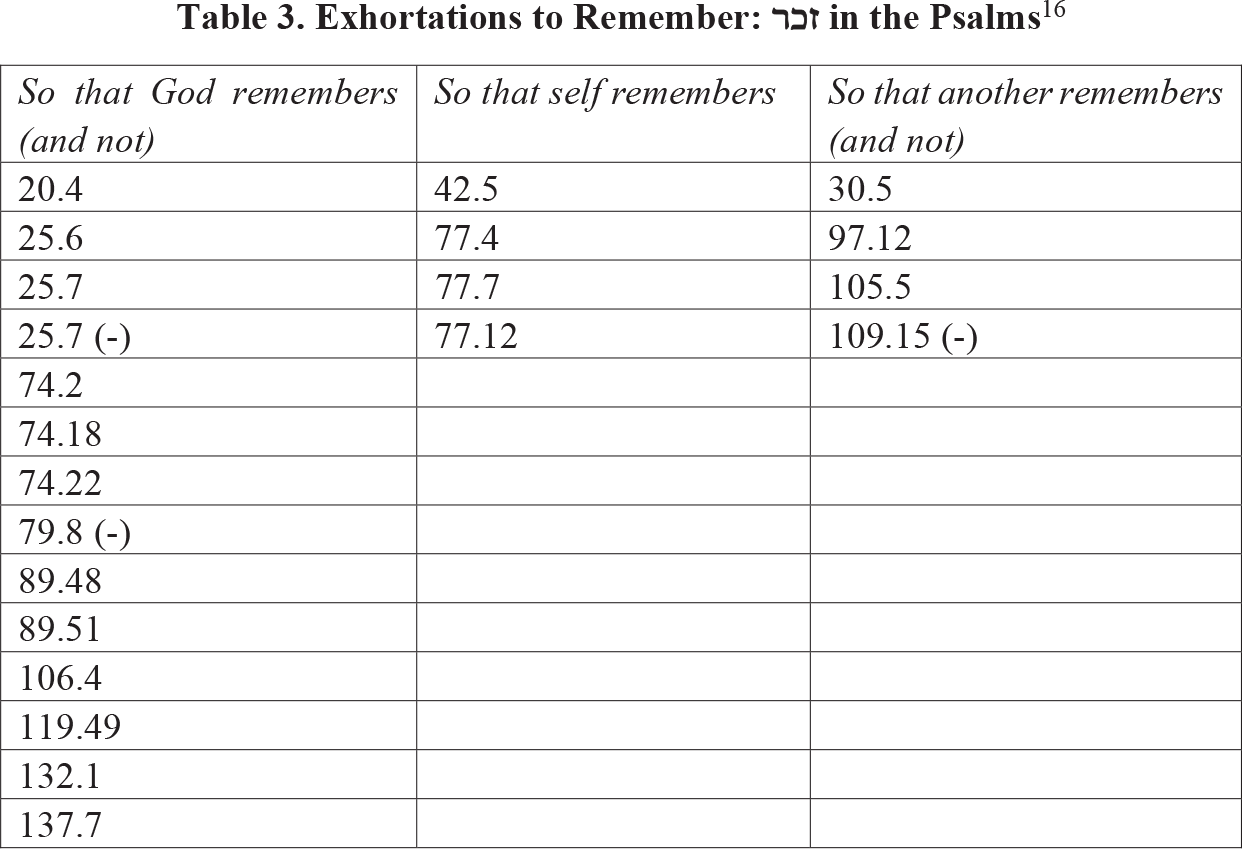
The addressee of the exhortations to remember (or not) is primarily God (11 times): the substance of the occurrences express desire for God to remember. Reference to self occurs four times (logically never negated), and other human addressees are directed to remember four times, three of which are noun clauses. 17
Verb forms of רכז occur more frequently than noun forms. With just 11 noun forms of the 64 occurrences of רכז, one participle, and three infinitive constructs, in most cases רכז is an action rather than an object. Thus remembrance in the psalms, while sometimes a ritual offering or memorial object, is more likely to be the action of the prayer itself. The use of רכז in the psalms indicates that the activity of prayer is the most powerful tool available to get God to remember.
A final grammatical observation is the somewhat surprising paucity of the waw-consecutive in the psalmic occurrences of רכז: only three times, and always with the Qal imperfect. Perhaps waw-consecutive forms do not regularly work in the particular language of poetic prayer; or perhaps רכז does not readily admit of formation with the waw-consecutive. 18
Who Forgets Whom? חכש, Subjects and Objects in the Psalms 19
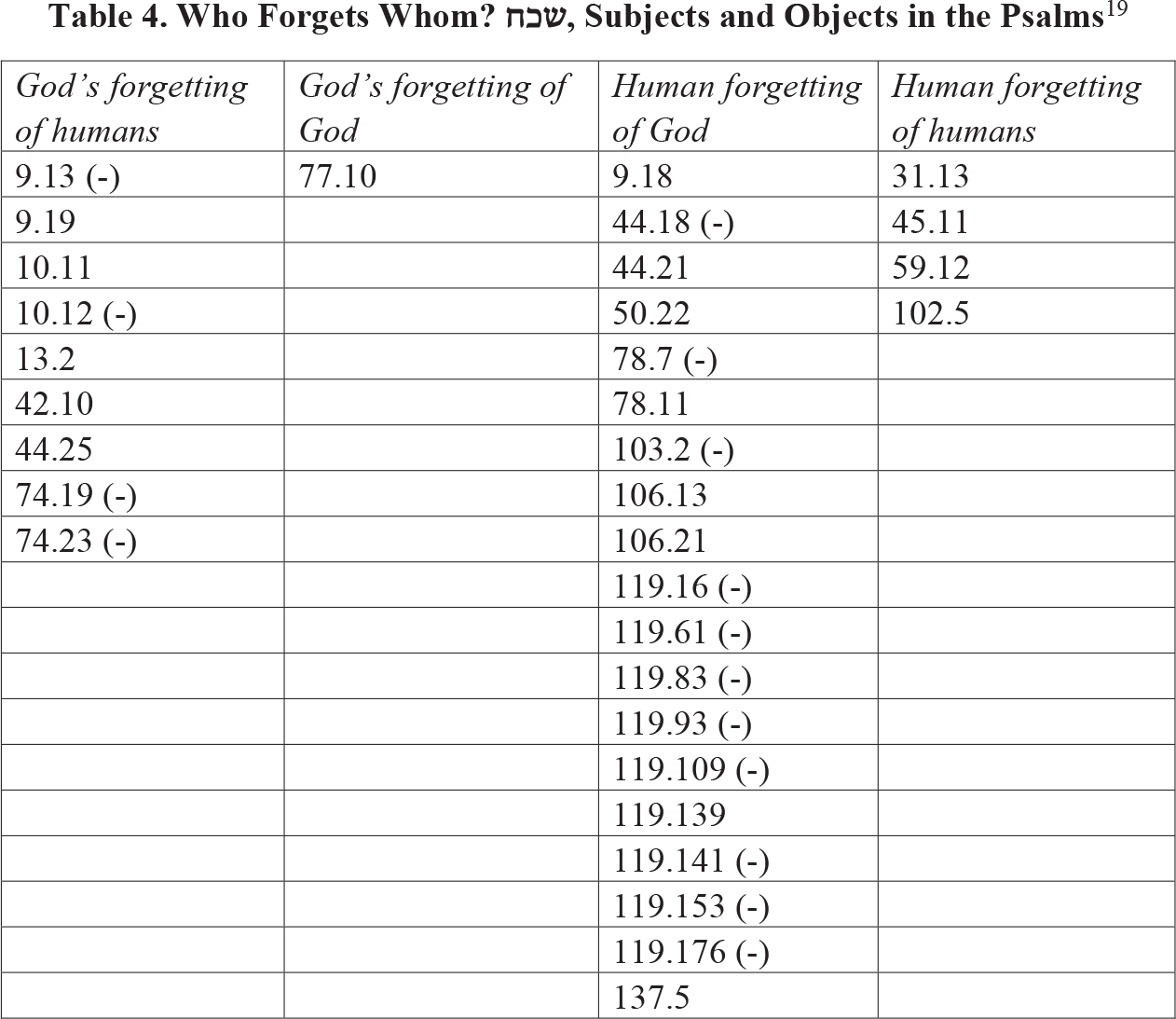
רכז was seen to occur negated twelve times out of the 64 occurrences in the Psalms: the proportion of רכז negated in the Psalter (19%) is little higher than the proportion of רכז negated in the entire Old Testament (14%). The majority of these cases are either descriptions of sinful individuals or people who do not remember God, or petitions to God not to remember sins. In contrast, the antonym חכש occurs 33 times in the Psalter, fifteen times in the negative. 20 This represents 45% of the occurrences of חכש that are negated in the Psalter, compared with 36% of occurrences of חכש negated in the whole Old Testament. Not-forgetting in psalmic prayer is thus notably more common than in other Old Testament literary genres. 21 The speaker reminds God that he himself never forgets, referring to God, his works, his commandments, his law: the act of reminding God of his not-forgetting is clearly akin to remembering God and thereby reminding God of the speaker himself.
Studying the negation or non-negation of חכש is however limited since, for instance, an imperative to remember or not to forget does not adequately convey at what point the subject may or may not forget or remember, and this may be crucial to the very meaning of the word in its context. Consequently I next examine subjects and objects of the verb, and then I turn to grammatical analysis.
Strikingly, forgetting (and its negation) much more frequently involves the agency of humanity rather than God. The most common context is that of the righteous not forgetting God, 22 or praying for help in not forgetting God. 23 Since not-forgetting God is necessary for prayer, so the very existence of the prayer distinguishes the righteous. Both remembering and praying are thus crucial aspects of being righteous: a further hint of the relationship of wisdom, prayer, and remembering.
Those who forget are either the sinful, 24 or—in the context of lament—God. 25 The sinful who forget God, his commandments and deeds, live without prayer, and without God's law. To forget God means not fearing him, not keeping the covenant, and not receiving God's covenant promises in return. It is hardly then surprising that it is only the sinful—the unwise who do not remember God and who he truly is—who think that God forgets their sins. 26
Language of God forgetting expresses such a fear, and thus functions as a complex reminder to God. The lament of God's forgetting is voiced in order that God does not forget. The dismay at the idea of God's forgetting is balanced by assertions that God does not forget: he does not forget the righteous or the needy. 27 Such a statement itself functions in prayer as a reminder to God of himself, a reminder that it is not in his nature to forget the righteous or the needy.
Thus prayer for God not to forget the poor 28 is effectively also a prayer that God remember himself, his own essence. Equally, the prayer for God not to forget his enemies and the enemies of his people 29 is likewise a prayer that God remember his covenant, and the special relationship he has with his own people. The psalmist even prays that God not destroy the enemy, in order that the enemy, in their continuing existence, can remind God's people of a contrasting way of life, the sinful life that the enemy live. God's destruction of the enemy would lead to them being forgotten, the worst possible fate; yet the psalmist fears that if the enemy were to be totally forgotten, God's people may no longer learn from their enemies' mistakes. 30 The existence of the downtrodden enemy can act as a reminder also of the greatness of God.
The psalmist fears either that he might forget God and the things of God, or that God might forget him. The root חכש may be translated as so physical as to allow a further play on words. In Ps. 137.5, the ‘withering’ of the right hand is the curse against forgetting Jerusalem. The mourning described in Ps. 102.5 leads to forgetting to eat, and hence to the psalmist's heart drying up and being parched like the grass. Forgetting can have physical effects. Just as forgetting food leads to bodily withering, so too forgetting the divine leads to both spiritual and physical withering.
Grammatical Analysis of חכש in the Psalter 32
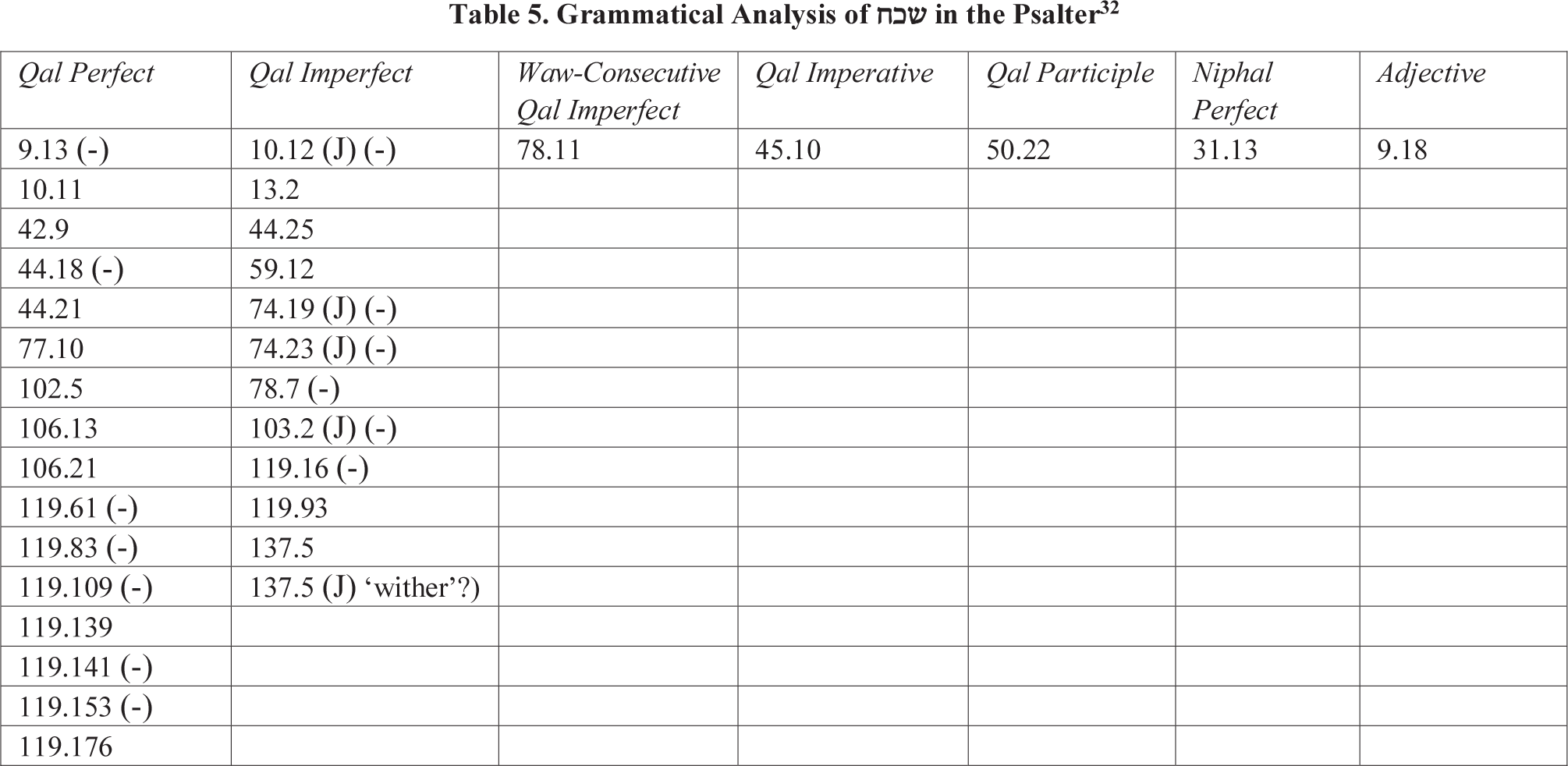
The language of forgetting is less easily employed as a direct petition: there are fewer jussives or imperatives of חכש in the Psalms than are seen of רכז. Indeed it is counterintuitive to command to forget: such a command paradoxically functions also as a reminder. חכש then is more naturally employed in narrative, where the action of forgetting and not forgetting together serves as a reminder.
The other salient point to make here is that in contrast to רכז there are no comparable noun forms. There are no infinitives and no equivalent antonym in חכש for the language of a ‘memorial’ or ‘remembrance’. Remembering is something concrete, while forgetting is an oblivion, obliteration, or indeed about consigning to nothingness or non-existence.
רכז and חכש are clearly the major verbal roots in the semantic domain of remembering/forgetting. However, as other scholars have pointed out, other vocabulary is related to these roots, even if the sense of ‘remember’ or ‘forget’ is not a primary meaning. Such semantic connections are made clear by their use with רכז or חכש in the literature. Therefore I consider the semantic fields of ‘remember’-related roots in the Psalter.
b. The Semantic Fields of ‘Remember’-Related Words with Reference to the Psalms
Three particular verbal roots are used in close connection with רכז or חכש in the Psalms: חיש, הגה, and דקפ. Given that the meaning of a word is highlighted by the company it keeps, and רכז does not keep company with חכש alone, I deal with each of these three connected roots in turn below. Each are found a number of times with רכז or חכש within a reasonable lexical span. Other verbs which are found in combination with רכז outside the Psalms are, for example, בל־לע םיש, ןיב, חלס, םחר; 32 yet given that they do not arise within the semantic field of remembering within the Psalter, or indeed the context of prayer, I do not consider them further here.
The use of חיש by contrast particularly highlights the overtones of lament and complaint. Occurring 19 times, 33 it overridingly expresses grief. It is found alongside all of רכז, חכש and הגה in Psalm 77; in Psalm 119 it is related to רכז and חכש; and in Psalm 143 it sits beside רכז and הגה. Such notable evidence of parallelisms demonstrates that חיש may take its place in this semantic domain, even though it could not be described by Balentine as a ‘major root’, and despite the fact that it largely has negative connotations. Both the Qal and noun form convey a sense of ‘muse’, or ‘complain’; the only other verb form attested in the Psalter is the single occurrence of the Polel, 34 communicating the more upbeat ‘meditate’.
The noun, ‘complaint’, or ‘musing’, occurs five times, 35 and each time with a personal suffix, admitting to the emotive burden of the word. Accounting for more than half of the verbal occurrences of the lemma, the cohortative is the most common verb form, 36 always the first person common singular. This fits with the context of prayer: it is suggestive of formally requesting permission or the ability to complain, while the complaint is itself voiced. It is perhaps a form of courtesy to the infinitely more powerful divinity, a mannerism that pays heed to the inherent power imbalance. 37 Yet the cohortative speech act in this context strikes the reader as felicitous only in a timeless sense, as the expression of the cohortative, and of the complaint itself, is one and the same. Moreover, the recurrent and exclusive use of the singular form here indicates that this is an individual, more private form of prayer.
A final observation on חיש: in the Psalms, it is used only of humans. 38 God is never depicted in the Psalms as musing, or complaining. Perhaps this too is a mark of the power imbalance; or perhaps there is a sinful connotation to the one who dares to complain before God. If the latter were true, then the shame associated with it would confirm its more common usage in the private sphere, making the Psalter as a whole a book that attests to individual human sinfulness, the need for God, and the need to confess one's sins and brokenness.
Like חיש, הגה too is only found with humans as subject in the Psalms. 41 God is not depicted either lamenting or meditating. In Ps. 115.7 this is specifically given as a mark of idols which cannot make a sound in their throats. This verse suggests that הגה is a mark of disdain for pretend divinities: the true God does not הגה but anthropomorphized idols lament as well as their human creators.
Furthermore, in Ps. 17.3 דקפ is used of God at night-time, and this clearly resonates with the notion of humanity and God communing in quietness, as seen above in Psalm 77 and 143.5 with הגה in the night setting. Prayer and meditation is a two-way process: it is not just humans who can be attentive to God at night-time, but God who also attends to humans. Humans are perhaps particularly aware of God's attention in the silence of night.
Of nine uses in the Psalms, דקפ is used only with negative connotations twice; otherwise it is simply beneficial to the object of attention. In Ps. 89.33 it refers to attention to punishment of transgressions; in Ps. 109.6 it concerns the enemies' wrongful treatment of the psalmist. Yet in the former there is the sense that anyone who is a wrongdoer needs attention in order to correct him—a loving act in the end, given that God will not allow this to break the covenant; and in the latter it may not benefit the direct object of attention, the enemies, but it will benefit the psalmist.
Contrary to הגה and חיש, דקפ is a verb which is overwhelmingly used to refer to God's actions in the Psalms. Only one instance depicts humans as the subject of דקפ, and this is in the context of committing themselves into God's care (Ps. 31.6), with humans committing themselves to God lexically paralleled with God's redemption of humanity. Thus דקפ is a divine action, a human hope for God's beneficial care. 42
4. Conclusion
This semantic analysis has demonstrated that God's remembering and humanity's remembering are inextricably intertwined in prayer in the Psalms. Indeed, where nouns of remembrance are used, this observation enriches their semantic content: humans as the readers or performers of the text are the agents of remembering, while God is the fundamentally most desirable agent of remembering. Prayer, then, involves both God and humans both as effective agents of remembering, and also as the objects of memory. Furthermore, the text itself is understood to function as a memorial object, causing both God and humans to remember. Such remembering is relational, involving not only God and an individual, but also those others who are of God's people who have gone before and will come after. Thus each prayer becomes an integral part of the chain of collective memory that defines a people in relationship with God. Memory then becomes integral to identity, both individual and communal. It is perhaps then unsurprising to find emphasis on remembrance as an act of reminding, for this is happening at multiple levels, on those of both text and performance.
Remembering, or not forgetting, is more common than not remembering, or forgetting. Moreover, while sinful humans may be expected on occasion to forget or fail to remember, for God—the primary agent of memory—to forget is truly striking and indeed lamentable. Prayer texts themselves inevitably seek to demonstrate present remembrance of God, whatever past failures there may have been, and to call God himself to remember. Texts of God's forgetting thus go against the remembered logic of God: as such, they are a heavy blow both to God's people and to their understanding of God, or in irony may be used by humans to awaken God's sensibilities. Prayer texts may be objects of remembrance, but they cannot be objects of forgetting; it is perhaps no surprise that in the Psalms there are nominal forms of remembrance but not of forgetting.
Other remember-related words help delineate the semantic field. Root חיש is a fairly negative member of the wider domain; a grief-stricken, often private action, it is something only done by humans, and not God. Root הגה is similar: again only used of humans, it too connotes a more individual lamenting tone. In contrast, root דקפ conveys an attending to, and is used overwhelmingly of God. These three roots, alongside רכז and חכש, thus highlight the breadth and centrality of the two major roots, the richness of their function and meaning, and emphasize the double-aspect of agency of רכז and חכש.
This semantic domain therefore covers mindfulness and attention through good and bad, remembering in praise and lament, and above all it signifies and plays a role in an indissoluble relationship. The covenant offers the theological convention from which humans understand their relationship with God; two-way רכז is a mark of the successful covenant and ongoing relationship between Creator and creature. The difficulty of separating out the agent of remembering is clear, while the theological richness derived from this is broadly relevant.
Remembering has a complex interaction with time which may be either implicit or explicit. Objects of remembering—records, memorials, and indeed texts in which acts of remembering are themselves passed down—prolong the act of remembering and thereby have ongoing effect. 43 The biblical texts are not only records of remembering and being remembered, but an ongoing reminder. It becomes clear that ‘remember’ and ‘remind’ and their antonyms are sometimes difficult to separate in terms of their wider context. The Psalms, as both text and object, both remember and remind simultaneously, and seem to have the power thereby to affect individuals, community, and God.
These methods of analysis, informed by semantic study, have thus been seen to be fruitful and a firm starting-point for examination of how ‘remembering’ functions.
Above all, this semantic field is relational and conveys something about the consequences of the act of remembering for all involved. The relational aspect of ‘remembering’ with reference to God is related to both prayer and identity. Inextricably connected, to ask God to remember is firstly to have remembered God. It is an affirmation of relationship, a recognition that relationship exists, and a recognition of the kind of relationship it is. Calling upon God is a form of remembrance, and making mention of a name in one's prayers is to call that person into God's remembrance, and thus to ask for good for them. Thus to ask God to ‘remember’ is not just to affirm the existence of the one calling upon God, it is also to express something of the nature of that relationship as well, as creator and redeemer to creature and redeemed. Past tales of salvation, the covenant, the contrasting natures of God and humanity, are all recalled. God and humanity together need to live up to what is remembered, and that happens not simply by individual acts of remembering, but also by a community remembering that is taught and transmitted and continues to be performed.
Footnotes
1.
Brevard S. Childs, Memory and Tradition in Ancient Israel (London: SCM Press, 1962); W. Schottroff, ‘Gedenken’ im alten Orient und im Alten Testament. Die Wurzel zäkar im semitischen Sprachkreis (Neukirchen-Vluyn: Neukirchener Verlag, 1964); P.A.H. de Boer, Gedenken und Gedächtnis in der Welt des Alten Testament (Stuttgart: W. Kohlhammer, 1962); C.L. Kessler, The Memory Motif in the God-Man Relationship of the Old Testament (Ann Arbor: Northwestern University Microfilms, 1956).
2.
James Barr, The Semantics of Biblical Language (Oxford: Oxford University Press, 1961). He was responding to works such as TDOT; T. Boman, Hebrew Thought Compared with Greek (London: SCM Press, 1960); and TDNT. The debate was furthered by D. Hill, Greek Words and Hebrew Meanings: Studies in the Semantics of Soteriological Terms (Cambridge: Cambridge University Press, 1967). Others took up Barr's insights: A.C. Thiselton, Thiselton on Hermeneutics: Collected Works with New Essays (Grand Rapids: Eerdmans, 2006); J.P. Louw and E.A. Nida, Greek-English Lexicon of the New Testament: Based on Semantic Domains (New York: United Bible Societies, 1989).
3.
S. Balentine, The Hidden God: The Hiding of the Face of God in the Old Testament (Oxford: Oxford University Press, 1983).
4.
Schottroff, ‘Gedenken’; Childs, Memory and Tradition; de Boer, Gedenken und Gedächtnis; Kessler, Memory Motif; Eising, ‘zākar, zēker, zikkārôn, azkārô’, in TDOT, IV, p. 66.
5.
For comparison of method, see Balentine, Hidden God, p. 16.
6.
See M. Daffern, ‘Prayers for Remembering in the Psalms’ (Ph.D. diss., University of Oxford, 2014), pp. 120–22.
7.
In the table, ‘remembering God’ and ‘remembering the things of God’ are grouped together, with respect to the poetic device of synecdoche. Likewise considering that an object to be remembered is prior to the one who (or that which) reminds, both remembering and reminding actions may also be conflated. I use the term ‘remembrance’ to refer to instances both of remembering and not remembering, and both of remembering and reminding; (−) denotes where the verb is negated. I use the term ‘human’ to refer to both God's people and God's enemies (by extension the enemies of God's people). * denotes instances where Jerusalem is remembered, and equated with God, hence the categorization. (Q/K) refers to kethib/qere variation.
8.
Two of these are a single pair of kethib/qere alternatives.
9.
Unlike other literary contexts where God remembers humans but humans do not remember God, e.g. Jer. 2.32 where God remembers humans (he is speaking to them through the prophet) but humans do not remember God.
10.
Thus recalling speech-act theory and linguistic pragmatics; cf. J.L. Austin, How to Do Things with Words (Oxford: Oxford University Press, 1969); J.R. Searle, Speech Acts: An Essay in the Philosophy of Language (Cambridge: Cambridge University Press, 1969). These foundations have been built upon in biblical studies by, e.g., Thiselton, Thiselton on Hermeneutics.
11.
The speaker is in the first person singular throughout; Ps. 70.5 refers to the third person plural of the righteous, but the speaker may number himself amongst these.
12.
At most, the repeated lamed-prefix in 70.2 indicates some material thing aiming at deliverance and assistance.
13.
For instance, to say ‘Will you remind me nearer the time?’ implies that one reminder may not suffice.
14.
V.L. Johnson, David in Distress: His Portrait through the Historical Psalms (London: T&T Clark International, 2009), p. 38. David (presented in the superscriptions as the petitioner of Pss. 38 and 70) may be not just a guide for individual prayer and spirituality, but an exemplar of remembering and remembrance.
15.
I use the familiar terms ‘Qal Perfect’, Waw-Consecutive' etc. in the understanding that these are limited but useful descriptions. Under the Qal Imperfect forms, (J) indicates a Jussive, (C) a Cohortative. (Q) denotes Qere, (K) denotes Kethib. As above, (−) denotes where the root is negated.
16.
These are all the cohortatives, jussives, and imperatives of רכז in the Psalms, and those nouns related to רכז in constructions with these verbal forms.
17.
Pss. 30.5; 97.12; 109.15.
18.
There is not scope here for discussion of whether or not some roots favour waw-consecutive forms.
19.
While ‘forgetting’ refers to instances both of forgetting and not forgetting (and both of forgetting and causing to forget), use of a negative is noted again by (−). ‘Human’ refers to both God's people and God's enemies (by extension the enemies of God's people). ‘Of God’ and ‘of humans’ includes also the things of God, and the things of humanity, respectively. Finally, it is notable that there is no ready equivalent in חכש of the noun forms of רכז.
20.
Pss. 9.13; 10.12; 44.18; 74.19; 23; 78.7; 103.2 and all but one of the occurrences in Ps. 119, that is, 119.16, 61, 83, 93, 109, 141, 153, 176.
21.
This calculation however is arguably swayed by the lengthy and non-representative Ps. 119.
22.
Pss. 44.18, 21; 78.7; 103.2; 119.16, 61, 83, 93, 109, 141, 153, 176.
23.
Ps. 137.5.
24.
Pss. 9.18; 50.22; 78.11; 106.13; 119.139, 21.
25.
Pss. 13.2; 31.13; 42.10; 44.25; 77.10.
26.
Ps. 10.11.
27.
Pss. 9.13, 19; 10.12.
28.
Ps. 74.19.
29.
Ps. 74.23.
30.
Ps. 59.12.
31.
I use the familiar terms ‘Qal Perfect’, Waw-Consecutive' etc. in the understanding that these are limited but useful descriptions. Under the Qal Imperfect forms, (J) indicates a Jussive, (C) a Cohortative. (Q) denotes Qere, (K) denotes Kethib. As above, (−) denotes where the root is negated.
32.
Childs, Memory and Tradition; Eising, ‘zākar, zēker, zikkārôn, azkārâ’.
33.
Like חכש it occurs a notable six times in Ps. 119. Unlike the other roots here considered, its earliest canonical usage is halfway through Book 2.
34.
Ps. 143.5.
35.
Pss. 55.3; 64.2; 102.1; 104.34; 142.3.
36.
Pss. 55.18; 77.4, 7, 13; 119.15, 27, 48; 145.5.
37.
On power dynamics in lament, cf. A.C. Cottrill, Language, Power, and Identity in the Lament Psalms of the Individual (London: T&T Clark International, 2008).
38.
Beyond the Psalms, however, it is worth noting 1 Kgs 18.27, where it is the action of Baal. There is a certain ambivalence expressed here with regard to Baal. While חיש therefore seems not to be the kind of thing that Yahweh does, one could accuse Baal of doing it and thereby express how un-divine he was.
39.
Pss. 35.28; 71.24.
40.
Ps. 90.9.
41.
The exceptions in the Old Testament where this verb is associated with God convey the rumbling of thunder (Job 37.2) and the blast of his wind (Isa. 27.8). Non-human agency is also expressed in Isa. 8.19, of the ‘familiar spirits’. These occurrences themselves suggest that חיש is associated with spirituality, akin to Rom. 8.26.
42.
It should however also be noted that the noun םידקפ is used of humans observing God's precepts, in a covenantal context (Ps. 103.18).
43.
The ריכזמ has the important role of causing names and events to be remembered by recording them in a book, a role which is even echoed today in the ‘Remembrancer’ of the city of London. Memorials themselves even prolong, as it were, the existence of a person after their death (e.g. 2 Sam. 18.18).