



Abstract
The account of the battle against the Amalekites in Exodus 17.8-16 contains several contested portions, including the interpretation of the raising of Moses’ hands, the significance of the staff of God, and the number of hands Moses holds up. This article will argue that the ambiguity surrounding the presence/absence of the staff and the number of upraised hands functions to portray the episode as a transition in the narrative (a high-level Janus parallelism) in relation to the role of the divine warrior in Israelite combat. The presence of the staff of God in the one hand raised by Moses recalls the great works of God in the exodus and emphasizes divine initiative in battle, while the raising of two hands signifies prayer (as supported by parallels in the Zakkur stela and Egyptian reliefs) and looks forward to Israel fighting at its own initiative in future battles.
The proliferation of literary, archeological, and iconographic data from the ancient Near East has proved a great boon to understanding warfare in the Old Testament. 1 However, many details of Israelite warfare remain obscure, among which is the significance of Moses’ hands in the battle against the Amalekites. After the Amalekites attacked Israel at Rephidim, Joshua gathered men for the army and led the troops in battle while Moses stood on a nearby hill. Whenever Moses raised his hands, Israel was victorious, but when he lowered them Amalek prevailed (Exod 17.8-13). What was Moses doing when he raised his hands? The question is complicated by his comment that he would stand on top of the hill with the staff of God in his hand, though the staff is never mentioned again. Furthermore, did Moses raise one hand (Exod 17.11) or two hands (Exod 17.12)? The frequent shifts mean that readers must continually reinterpret what Moses was doing as they read the text. 2 I propose in this article that Moses’ actions can be better understood when read in the broader context of the exodus, especially focusing on how Moses relates to YHWH. We will begin by briefly looking at warfare in the exodus narrative before moving on to study the battle against the Amalekites in more detail.
YHWH as divine warrior in the exodus narrative
In the exodus narrative (Exod 1-15), YHWH employed both psychological and direct attacks against Pharaoh and Egypt. As part of his psychological warfare against Pharaoh, he sought to reduce the Egyptians’ morale by threatening them, directly inducing panic, and employing cosmic enemies against them. He humiliated Pharaoh by showing Pharaoh’s lack of control over Egypt, his inability to maintain maat (order), and his ignorance. YHWH also caused the Egyptians to show favor to the Israelites when they asked for their goods. Alongside the psychological warfare, he attacked the Egyptians directly, using the full spectrum of natural forces, including bodies of water, earth, animals, and atmospheric forces, as well as disease and supernatural agents. However, YHWH did not employ a human army against the Egyptians. Although he could have sent the army of another nation (as he would do later when he sent the Assyrians against Israel) or have killed Pharaoh directly, this would not have accomplished as clearly his goal of displaying his power and glory to the world.
In spite of the lack of an Israelite army, YHWH ensured that Moses and Aaron were still active in YHWH’s attack against Egypt. Previously YHWH had communicated directly with foreign kings through dreams (Gen 20.6-7; 41.1-7), but in the exodus narrative he always spoke to Pharaoh through his prophet Moses, who acted as the mouth of YHWH. 3 Moses and Aaron not only acted as the mouth of YHWH but also acted as his hands. Usually YHWH brought the plagues on Egypt through the actions of Moses and Aaron with either their hand or their staff. 4 The hand symbolized the power that a god brought against his enemies. In the Old Testament, the staff (מטה) served several functions, each of which is significant for the context of the exodus. The use of a staff as a weapon makes Moses’ staff a concrete image of YHWH’s power in his battle against Pharaoh. 5 Its function as a symbol of royalty presented a concrete challenge to Pharaoh’s authority, as seen when Aaron’s staff swallowed the staffs of the magicians (Exod 7.8-13). 6 Finally, the identifying feature of a staff emphasizes again that the attacks on Egypt came through ‘the staff of God’ (Exod 4.20) as manifestations of YHWH’s power. 7 Throughout the exodus narrative, the hands and staffs of Moses and Aaron are consistently identified with YHWH, and they do not use their hands or staffs apart from YHWH’s command.
Although YHWH worked through Moses and Aaron in his attack against Egypt, their presence focuses attention on the centrality of YHWH’s role in the battle rather than distracting from it. Elsewhere in the ancient Near East, divine warriors announced before battle that they would give victory in generic terms, but did not detail beforehand the exact nature of their direct assaults against the enemy. However, the actions and words of Moses and Aaron before the plagues made clear that the mighty acts in Egypt were to be attributed to YHWH (Exod 7.17-18; 27-29[8.2-4] 8.17[21] 9.2-3, 18; 10.4-6; 11.4-8). 8 In the exodus narrative, YHWH fought his enemies on his own initiative by his own power apart from the Israelite army, demonstrating that he was the source of the attack through the words and actions of Moses and Aaron.
YHWH as divine warrior in the battle against the Amalekites
At this point, we can return to the battle against the Amalekites and examine it in light of the exodus narrative. According to the account in Exodus, after the Israelites crossed the Red Sea, they encountered the Amalekites in the wilderness, showing that even the defeat of Pharaoh would not bring them peace for long. 9 We will begin by examining whether this battle continues the trend of YHWH acting by himself on his own initiative against the enemy as displayed in the exodus, or whether it tends more toward a synergistic battle in which the Israelites fight the enemy alongside YHWH.
At a basic level, the battle is clearly synergistic. In what appears to be their first battle after leaving Egypt, Moses commanded Joshua to choose troops for the battle, implying that Israel did not have a standing army at this point (Exod 17.9). 10 The lack of a qualifier here on the word אנשים could mean that these were not trained warriors. 11 This story records the only example in the Torah of a true Israelite general: Joshua chose the troops and led the troops in battle (Exod 17.9-13), and the narrative depicts the victory in terms of the leader: ‘Joshua overwhelmed Amalek and his people’ (Exod 17.13), one of the few places where the Torah ascribes victory in battle to an Israelite leader in the style of an ancient Near Eastern inscription (although even this ascription is unusual because the general, not the king, won the battle).
However, YHWH was still involved in the battle. Moses built an altar and called it ‘YHWH is my banner’ (יהוה נסי, Exod 17.15). As a נס was often used in military situations by generals to give directions, the name reflects Moses’ recognition that the victory belonged to YHWH as the general of the army. 12 After naming the altar, Moses said, ‘for a hand on the throne of YHWH, YHWH will have war against Amalek from generation to generation’ (כי יד על כס יה מלחמה ליהוה בעמלק מדר דר) (Exod 17.16). While the exact meaning of the phrase is difficult, for the purposes of this article, it is sufficient to state that the phrase refers in some way to the involvement of YHWH in the victory. 13 In sum, while the details are unclear, it appears that the battle against the Amalekites was a synergistic battle in which Israel fought against their enemy alongside YHWH.
Moses’ hand, hands, and the staff of God
The interpretation of the Amalekite battle becomes more complex when Moses’ hands and staff are factored into the discussion. Before the battle, Moses told Joshua that he would stand on the mountain with ‘the staff of God in his hand’ (singular) (Exod 17.9). However, this is the last time the staff is mentioned directly in the story. During the battle, the tide of the battle correlated with the position of Moses’ hand: whenever his hand (singular) was raised (probably meaning that Moses was raising the staff of God), then Israel was winning, but whenever he lowered his hand (singular), Amalek was winning (Exod 17.11). The text then confusingly refers to Moses’ hands in the plural: Moses’ hands (plural) became heavy, so Aaron and Hur supported his hands (plural), ‘one on one side and one on the other side’, and ‘his hands (plural) were steady until the sun went down’ (Exod 17.12). 14 A difficult textual variant in verse 11 further obscures the situation, as the MT and 4QExodc read ‘hand’ (singular), but the LXX, Samaritan Pentateuch, Syriac, and Targums all read ‘hands’ (plural). 15
In sum, we see three possible objects being raised in the episode: the staff of God, Moses’ hand, and Moses’ hands. However, two of the three options can be combined together: the staff and the one hand. Not only does this text say directly that the staff was in his hand (singular) (Exod 17.9), but Exodus also commonly refers to the staff being in one hand (Exod 4.2, 17; 7.15, 19; 8.1[5] 13[17] 14.16; 17.5), but never in two hands. Furthermore, in several of these cases, Moses or Aaron performed an action with their hand which clearly involved the staff even when the staff is not mentioned again directly, similar to the Amalekite story. For example, YHWH told Moses to instruct Aaron to take his staff and stretch out his hand (presumably the hand holding the staff) over the water (Exod. 7.19); when Aaron acted he raised the staff (no mention of raising his hand) and struck the water (Exod 7.20). Later, YHWH told Moses to raise his staff and stretch his hand over the water (Exod 14.16), but when Moses followed the instructions the text records only that he stretched out his hand over the sea (Exod 14.21).
However, this still leaves us with two different objects being raised: the one hand holding the staff and the hands. Commentators have presented a variety of interpretations of Moses’ actions focusing on either the raised hand/staff or the raised hands and ignoring the other. We will begin by surveying the interpretations that emphasize the one hand raising the staff. A common view throughout the history of interpretation is that the staff was held in the air as a symbol. Early Christian exegesis regarded this as the sign of the cross, 16 though this Christological interpretation was complicated by the presence of Joshua in the narrative: how can the cross be on the hill while Joshua (Jesus) fought below on the plain? Others have suggested that it was a military standard giving commands to the troops (the raising and lowering instructed the troops to advance or retreat). 17 However, this seems to be an overly natural interpretation of the action, eliminating the divine association with the hand and staff of Moses that had been established in the exodus narrative. It also seems to be a somewhat foolish arrangement for Moses, given that he had trouble keeping his hands in the air.
Another suggestion is that the staff acted as a religious symbol, showing to the troops God’s power and involvement in the battle. 18 While this is certainly true, this suggestion is lacking in various ways. It does not explain why the Israelites began losing when the arms were lowered: surely the soldiers did not have that short a memory! Furthermore, the exodus narrative sets a pattern for the use of the staff, and it is used there as a way to show that YHWH was working in the events about to happen, not to offer encouragement to the Israelites.
Another common and attractive interpretation is that the raising of the staff was an act of magic. 19 Noth says that a ‘mysterious power seems to come from Moses which is focused in the direction of the Israelite force, visible from the hill and thus reachable in a straight line by the beam of power’. 20 However, the consistent condemnation of magic actions in the Old Testament makes such a suggestion unlikely (Exod 22.17[18] Deut 18.10; 2 Kgs 17.17). Even if those prohibitions are not taken into account, the lack of ancient Near Eastern parallels to this specific type of magic activity also makes it improbable. While their armies might march under the standards of their gods, even the bombastic annals of the great kings do not refer to magicians working in such direct fashion against the enemy. 21 It is possible that Moses’ act paralleled that of diviners who traveled with ancient Near Eastern armies, 22 but the connection between Moses’ act and divination is not clear, as he is influencing the battle, not gaining knowledge about its outcome. Curse acts were common in the ancient Near East, but raising hands does not seem to be associated with them. 23 Focusing on the staff rather than the raising of hands might make a link with magic stronger, but even that connection is tenuous in the ancient Near East. Although Jeffers includes the use of the rod in the Amalekite battle as part of a section on rhabdomancy (divination by throwing sticks), most of her examples focus on divination rather than magic. The sole examples of magic are the javelin of Joshua and the staff of Moses. 24 The picture of Moses shooting a magic beam into the valley seems to owe more to European notions of magic (seen in examples such as Merlin or Gandalf) than that seen in the ancient Near East.
However, viewing Moses’ actions as magic might still be possible if the definition of magic is reexamined. While magic was once defined as supernatural power contrary to religion or a perversion of it, recent work on magic in the ancient Near East has focused on understanding it within its cultural context and broadened the view of what could be included under the rubric of magic. Here are a few recent definitions of magic: Methods associated with the gaining of suprahuman knowledge and power or with influencing suprahuman powers. (J. K. Kuemmerlin-McLean)
25
Magic is the harnessing of cosmic forces, or rather it is cosmic consciousness based on a system of correspondences between heaven and earth. (Ann Jeffers)
26
Magie ist eine ritual symbolische Handlung, die durchgeführt in einer adäquaten Situation, durch Nutzung bestimmter göttlich enthüllter Medien (Symbol, Wort und Handlung) und kosmischen Wissens, ein bestimmtes Ergebnis vermittels symbolischer Antizipation der göttlichen Intervention erzielt. (Rüdiger Schmitt)
27
The attempt by a specialist to compel a deity (with or without the aid of incantation, ritual, objects or devices) to accomplish a desired or definite purpose. (Solomon Nigosian)
28
An act performed by a person (as opposed to theophany or direct acts of God), with or without attribution to God, that has no apparent physical causal connection to the (expected or actual) result. (Shawna Dolanksy)
29
Schmitt helpfully demonstrates the differences between the various views of magic when discussing Moses and the Amalekites. He says that many in the past have viewed the act of Moses magically as a kind of natural force: ‘Die symbolische Handlung des Mose wurde in der Vergangenheit zumeist im Sinne eines magischen Gestus gedeutet, dessen Wirkung in der besonderen Machtbegabung des Mose in dynamistishcem oder animistischem Verständnis gründe’. Based on his own broader definition of magic, he prefers to view it as more directly connected to the power of God working through Moses: ‘Ritualsymbolische Handlungen sind vielmehr als sichtbare, performative Realisierung einer göttlichen Intervention durch seinen autorisierten Mittler zu verstehen’. 30 If definitions of magic focusing on employing the power of God are followed, then it broadens considerably what could be considered magic. Under this rubric of magic, Moses’ raising his hands/staff could be considered ‘magic’.
While this description of Moses’ actions fits in some ways with definitions of magic, it does not quite conform to certain aspects of the definitions of magic that imply a standardized system of specialists who could pass on their methods to others. Rather than learning the skill of raising his hands/staff through trial and error or from previous specialists, Moses was instructed in the practice by YHWH and the Torah does not portray him passing this practice on to others. 31 The broader definition of magic also encounters problems when dealing with such cases as the plagues and prayer. An important part of magic for many definitions is compulsion or harnessing, coercing the supernatural being to act in a certain way. While most of the recent work on magic consider Moses’ actions in the plagues narrative to be magic, these were actions only undertaken at the explicit command of YHWH. Instead of compelling YHWH to act in a certain way, Moses was following the instructions of the deity. Prayer is not often included in the current discussions of magic, but it appears that it should come under this rubric of magic since it is usually associated with an action (such as raising hands) to convince a god to act in a certain way. The question of the level of initiative Moses undertook in the battle against the Amalekites will be returned to below.
Commentators have also adduced a variety of ancient Near Eastern parallels to clarify the text. Erich Zenger and Aaron Schart apply Othmar Keel’s understanding of Joshua 8.18-26 to the Amalekite battle by comparing the raised staff to reliefs depicting a god wielding a weapon while standing next to or behind the king, supporting the king in battle. Moses, playing the role of the god, empowered Joshua, playing the role of the king, to defeat the enemy. 32 Baal’s use of a cedar (KTU 1.4.vii.41) and Anat’s use of a rod (KTU 1.3.ii.15) as weapons support the idea of Moses’ staff acting as a divine weapon, 33 as does the use of a serpent staff in Egypt as a symbol of divine power. 34 The portrayal of Assyrian kings standing in the same position as Aššur above them (e.g. both of them holding a bow in exactly the same fashion) emphasizes that the motif of a divine weapon does not necessarily mean that the god actually used the weapon, but that when the human king used his weapon it was equivalent to the god fighting through him. 35
Moses defeated the Amalekites with the divine weapon, like he and Aaron had repeatedly used their hands or their staffs (7.9-10, 19-21; 8.1-2, 12-13[5-6, 16-17]; 9.22-23; 10.12-13, 21-22) to bring the plagues on Egypt or to move the Red Sea (Exod 14.16, 21, 26-27). The divine weapon showed clearly to everyone that the plagues were not random acts of nature, but were directed by YHWH. Seeing the staff as a divine weapon ties this narrative into the preceding exodus narrative where the staff and hands of Moses acted as the visible symbols of YHWH’s power against their enemies. This suggestion also fits well with the preceding narrative about hitting the rock to bring water for the grumbling Israelites (Exod 17.1-7). YHWH commanded Moses to strike the rock with his staff and specifically refers to the staff as the one that Moses had used to ‘strike the Nile’, connecting the power of God in the exodus with his power in contemporary actions.
However, this suggestion also encounters problems. Most prominently, if the focus is on the staff as the divine weapon, why does the narrative refer to two hands? The exodus narrative lacks any reference to two hands being raised. Some commentators have suggested that the reference to two hands refers to raising one hand until it became tired, and then switching hands. 36 But if this is the case, why were both Aaron and Hur needed to raise his hands? The staff is also not a central part of the Amalek narrative, occurring only once in Moses’ speech to Joshua. The absence of the staff in the rest of the narrative might be explained by a parallel to the parting of the sea; when YHWH commanded Moses to stretch out his staff over the sea (Exod 14.16), the narrative records that he stretched out his hand (Exod 14.21). While this parallel makes it possible that Moses held up the staff on the mountain top, its absence in the text places the focus on the raised hands, not the staff. Another argument against connecting this story to the exodus narrative through the use of the staff is that each time Moses acted in the exodus narrative he was following YHWH’s instructions. In contrast to the exodus narrative, though, the Amalek narrative is lacking any divine command to act.
Finally, we will look at prayer, a suggestion that has been proposed in both ancient and modern times and is the only suggestion that is based directly on the two hands rather than the one hand holding the staff. 37 Othmar Keel has proposed a parallel with Egyptian iconography. Several Egyptian reliefs depict the donor of the inscription (the one who paid for the inscription) in the relief itself with hands raised next to the Pharaoh, implying that the Pharaoh would now listen to the supplications of the donor. Keel speculates that the author of the raised-hand tradition in Exodus probably had in mind such a picture of the donor with raised hands and misunderstood it as a magical gesture. This tradition was then bound up with a historical memory of a hostile encounter with Amalek. Moses is the donor, while Joshua, the victorious commander, is the Pharaoh. The Israelite author misunderstood the figure by historicizing it and over-emphasizing the role of the donor. 38 While Keel’s conclusion that Moses was seeking help is most likely correct, his theory about the background of the motif depends on too many unlikely factors.
Prayer is commonly associated with raised hands in the Old Testament and the ancient Near East, 39 especially in warfare (1 Samuel 7.7-10). 40 In the Kirta Epic, Kirta raised his hands (nša ydh) in the presence of El before he departed for battle (KTU 1.14 IV 4). 41 The Akkadian phrase našu qātu often means ‘recite a prayer with hands uplifted’. 42 However, like many other aspects of this text, a reference to prayer here is not as clear as it could be. The common expressions for prayer, ‘spreading out the hands’ (כף/פרש יד) (Exod 9.29; 2 Chr 6.12; Ps 143.6) and raising the hands (כף/נשא יד), do not appear here. Although רום יד never refers to prayer elsewhere in the Old Testament, Exod 17.11 appears to be the only reference to raising hands (plural) with the expression רום יד.
Raising hands in the Old Testament.
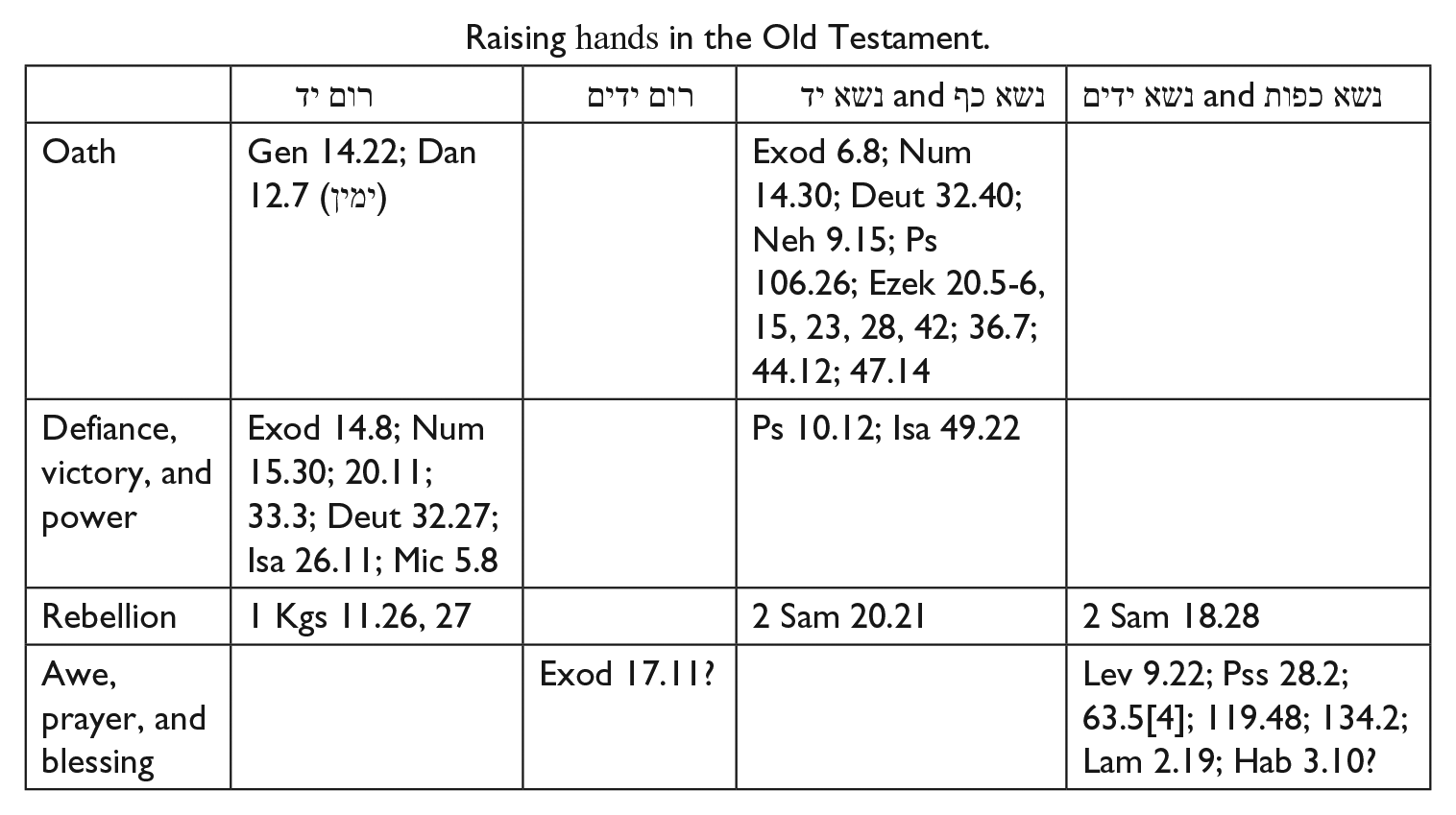
This chart shows how the expressions ‘raised hand’ and ‘raised hands’ are used throughout the Old Testament. Looking at the places where רום יד is used (in the singular) is not helpful for understanding רום ידים (in the plural), because as is clear from the use of the parallel term נשא יד, raising two hands is significantly different than raising one hand. It is more helpful to look at the parallel term נשא ידים as a guide for the meaning of רום ידים. If we do this, then we see that prayer is the best option for understanding Moses’ raised hands.
This understanding of raised hands in prayer can be supported by looking at two other examples of raising hands from the ancient Near East in a military context that have only rarely been connected with the Amalekite battle. The first of these is found in the Zakkur Stele, an Aramaic inscription recounting the preservation of Zakkur by Ba’lshamayn during a siege. 43 In the midst of the siege, when the enemy kings were about to breach the walls, the inscription recounts that Zakkur prayed: ‘Now I raised my hands to Ba’lshamayn and Ba’lshamayn answered me’([ן]ן ויענני בעלשמי[ימ] ואשא ידי אל בעלש). 44 The verb used in the Zakkur stele (Aramaic נשא) is different from that used in Exodus 17.11 (Hebrew רום), but the overlap between רום and נשא in Hebrew is extensive enough that the two words can be closely connected. 45
Reliefs also often depict defenders of sieges raising their hands. 46 One of the clearest examples is the relief at Karnak depicting the siege of Ashkelon by Merneptah. 47 During the last moments of the siege, the inhabitants of Ashkelon stood on the ramparts with their hands raised to heaven. 48 Some scholars have suggested that the Ashkelonites (and other defenders of cities raising their hands) were supplicating the victors for mercy. 49 The reliefs in which the victors have already entered the besieged city or in which the raised hands of the defenders are directed toward the victors encourage this interpretation. 50
However, the defenders in many of these sieges are most likely supplicating their own gods, 51 especially the reliefs that portray the defenders still fighting and directing their raised hands toward the heavens, away from the attackers. 52 Other ritual activity by the defenders supports this interpretation, including the men holding braziers and the possible child sacrifice depicted on the towers of some of these cities. 53 Aaron Burke highlights how the reliefs depict the besieged town in four different stages: before the siege begins, in the middle of the siege, just before the defeat, and after the siege. The motif of defenders raising their hands frequently occurs in the first three stages, but never in the fourth, where one would expect submission to Pharaoh. 54 The Egyptians included reliefs of their enemies worshipping their gods to demonstrate that the overwhelming power of Egypt prevails even over enemies who call on their gods for help. This is illustrated by an inscription next to one relief depicting a siege: ‘Said by the vile chief in exalting the Lord of the Two Lands: “(I) did not believe that there was no other like Ba’al, (but) the Ruler is his true son forever”’. 55 While some of these reliefs might depict the defenders supplicating the attackers rather than their own gods, others clearly depict the defenders calling out to their own god. 56 Having surveyed the various interpretations of the episode based on either the presence of the one hand holding the staff or the two hands, we will now move on to a proposed reading that combines these two interpretations.
A proposed Janus transition
As seen above, commentators tend to focus on either Moses raising one hand with the staff (with an interpretation focusing on the use of magic or the staff as a divine weapon) or raising two hands (leading to an interpretation such as prayer). I propose that rather than trying to decide which is primary, a potentially fruitful approach is to see both images of Moses as important for understanding the passage as a transition in the broader narrative. 57
The definition of a literary transition as a ‘passage in a piece of writing that smoothly connects two topics or sections to each other’ 58 shows that a transition connects with both the previous topic and the following topic. One specific kind of transition that has been studied in poetry in the ancient Near East and biblical literature is Janus parallelism (named after the two-headed Roman God Janus), in which ‘a middle stich of poetry parallels in a polysemous manner both the line that precedes it and the line which follows it’. 59 In general, Janus parallelism involves a case in which a poet takes advantage of a word that could be read two different ways by constructing the previous line to match one possible reading and the following line to match the other possible reading. For example, Scott Noegel identifies a Janus parallelism in Job 7.6-7: ‘My days are more trifling than a weaver’s shuttle. They go without תקוה. Remember, my life is but a wind, my eyes will see no more good’. 60 One meaning of the word תקוה, ‘thread’, connects with ‘the weaver’s shuttle’ in the previous line, while its other meaning ‘hope’ is reflected in the lack of hope in the following line.
The research on Janus parallelism has largely found it in poetry, but a few scholars have noted examples in narrative texts. While most of these are in quotations (such as Ruth 1.21 and 1 Kings 12.7), 61 in some cases the examples are in the narratives themselves. One example recently highlighted by Michael Carasik is in Job 1.21: ‘he rends his garments; he shears his head; he falls to the ground; and he prostrates himself’. 62 Carasik argues that the phrase ‘he falls to the ground’ is both a reflection of mourning (connecting to the previous lines) and worship (connecting to the following line).
I propose that the idea could also be applied at a higher level in Hebrew narrative in the Amalekite battle episode as the hands of Moses refer the reader both backwards and forwards. On the one hand, the one hand that holds the staff of God connects it with the power of God displayed through the plagues in Egypt. The victory against the Amalekites was a continuation of the display of YHWH’s power over the nations. Even after the defeat of the Egyptians, YHWH would still protect the Israelites against their enemies and grant them victory in their battles. Moses’ action is a statement that the power to defeat the enemy comes through the power of the divine warrior who had recently defeated the Egyptians.
On the other hand, the battle against the Amalekites also introduces a different way that YHWH would interact with his people in warfare. As noted above, every event involving Moses’ and Aaron’s hand or staff up to this point was preceded by a divine command. This discontinuity separates Moses’ action in the battle against the Amalekites from the previous actions in the exodus, although it does not entirely sever the connection. YHWH was still fighting for them, but no longer would the Israelites necessarily receive a direct command about what to do or a fresh divine promise that he would fight for them. Instead, they would need to intercede before their God. While it was still the divine power that would give them victory in the battles (as exemplified through the divine weapon), they could no longer simply wait for YHWH to explain to them what they were to do. They must act on their initiative and work with YHWH as they fought against their enemies.
YHWH had proved he was capable of defeating the enemy, but as the Israelites shifted from slaves of Egypt to the people of God he granted them greater responsibility. 63 He now expected them to trust him not by letting him do all the work for them, but by fighting the enemy themselves. 64 This pattern was followed again after the 40 years in the wilderness, when YHWH restarted his relationship with his people. At that point, YHWH began by employing mighty miracles and providing direct and detailed instructions for battle at Jericho, but then expected his people to play more substantial roles at their own initiative in the later battles.
One problem for this interpretation is that it still does not explain why the Israelites would lose while Moses’ hands were lowered. A helpful starting point in seeking a solution to this problem is the observation that Moses exhibited physical weakness in the story, requiring participation from others in order to succeed (Exod 17.11-12). 65 Syntactically, the peak of the story is the supporting of Moses’ hands by Aaron and Hur. 66 Moses no longer leads the people by himself, but with the support of other leaders with him. In the exodus narrative, Moses primarily led the people singlehandedly (Aaron had worked with Moses, but his role was minimal). Now, not only did he appoint Joshua as a military leader, but Aaron and Hur were required to help Moses fulfill his own role. This expansion of leadership fits well within the literary context of the Amalek battle, as the following narrative describes Jethro’s advice to expand the judiciary from Moses alone to the 70 elders (Exodus 18). After the exodus, in which Moses played such a major role, the leadership roles expanded. The battle against the Amalekites illustrates not only that the role of the divine warrior was changing but also that the entire leadership structure would be changing. 67
Beyond this observation, the broad definitions of magic provided earlier help to explain why Moses was required to raise his hands during the battle. The reason does not seem to reside in the picture by Noth of a ‘beam of power’ from Moses to the battlefield; as if the lowering of the hands of Moses would lead to a lowered trajectory of the beam rendering it ineffective. Instead, the focus is on a required visible demonstration of trust in YHWH expressed through prayer (the physical act that plays an important role according to a broader definition of magic); lowering the hands would suggest that they were winning the battle apart from divine power and claiming the victory for their own strength (as Moses later does with the water out of the rock in Num 20.10-12). Contrary to the modern western idea that ‘spirituality’ is largely disconnected from the body, the Old Testament emphasized a holistic view of humans in which physical actions played an important role in the person’s relationship with the divine. Similar to later stories in the Torah, such as the defeat at the hands of the Canaanites when the Ark of the Covenant remained in the camp (Num 14.44), a visible statement of trust in YHWH needed to be made at the battle. 68
This reading of the Amalekite battle is based on a synchronic reading of the text, in line with a number of works which have studied various topics in Exodus from a synchronic perspective and shown how the text is coherent. 69 Similar to the way that Scott Noegel argues that the presence of Janus parallelism enhances the arguments for the unity of the book of Job, 70 viewing the Amalekite battle as a transition in the larger narrative encourages less fragmented readings of Exodus. This reading of the Amalekite battle might also prove useful for more diachronic approaches, particularly those concerned with the overall shaping and redaction of the materials. If the Amalekite battle is indeed an important transition point in the story of Moses and the Israelites, bridging between the traditions of the conquest and the exodus, then further questions can be asked about its role in the formation and shaping of these traditions.
Conclusion
The battle against the Amalekites is a transitional story between the exodus, the supreme example of YHWH acting as a divine warrior against the Egyptians, and their future wars, when Moses and his staff would no longer be present and the people would be required to petition their god for help in the battle. The mixing of the motif of Moses holding the staff of God with the motif of Moses raising his hands in prayer signals continuity with the past along with change for the future. After the decisive defeat of the Egyptians by YHWH’s direct intervention apart from any human action, the battle of the Amalekites returns warfare to the human realm. But the focus on prayer in the narrative was designed to teach Israel that it could be victorious only with the power of YHWH.
Footnotes
1.
For a recent survey of the data on warfare from the ancient Near East, see Charlie Trimm, Fighting for the King and the Gods: A Survey of Warfare in the Ancient Near East, Resources for Biblical Literature 88 (Atlanta: Society of Biblical Literature, 2017).
2.
William H. Propp, Exodus 1-18: A New Translation with Introduction and Commentary, AB 2 (New York: Doubleday, 1999), 621.
3.
The identification of Aaron’s mouth with Moses’ mouth (Exod 4.10-16; 7.1) implies that Moses’ mouth was likewise identified with YHWH’s mouth when he spoke for him. This is further supported when it is noted that YHWH’s words came to Pharaoh either from the mouth of YHWH (Exod 7.14-18, 26-29[8.1-4]) or Moses (Exod 10.3-6), but not both. When Moses speaks, it is as if YHWH speaks.
4.
Moses was also the intermediary for removing several plagues (Exod 8.4-8, 24-26[8-12, 28-30]; 9.28-33; 10.17-18).
5.
1 Sam 14.27, 43; Isa 10.5, 15, 24; Hab 3.14. Isaiah said that YHWH himself used his staff against Egypt (Isa 10.26). Marduk crushed the head of Tiamat with a staff (Enuma Elish iv.130). For other staffs as divine weapons, see Propp, Exodus 1-18, 228; Samuel E. Loewenstamm, The Evolution of the Exodus Tradition (Jerusalem: Magnes, 1992), 149.
6.
Ps 110.2; Isa 14.5; Jer 48.17; Ezek 19.11-14. For the use of the staff as a symbol of royalty in Egypt, see James K. Hoffmeier, Israel in Egypt: The Evidence for the Authenticity of the Exodus Tradition (Oxford: Oxford University Press, 1996), 154-55; Erik Hornung, “Ancient Egyptian Religious Iconography,” in Civilizations of the Ancient Near East, ed. Jack M. Sasson, 4 vols. (Peabody: Hendrickson, 1995), 1726.
7.
See the staff of Judah (Gen 38.18, 25) and the staffs identifying the tribes (Num 17.16-26 [1-11])
8.
Remarkably, although they are usually similar, YHWH’s commands matched the execution exactly in only two plagues (boils and darkness), suggesting that Moses and Aaron were only required to follow the general idea of the command to indicate that the upcoming events were caused by YHWH.
9.
Terence E. Fretheim, Exodus, Int (Louisville: John Knox Press, 1991), 192.
10.
H. Y. Hamiel speculates that Moses commanded Joshua to choose warriors because he wanted to stay with the people. The people did not learn of the attack until after the battle was already over, explaining why they did not complain. See H. Y. Hamiel, “The Lord Has a War against Amalek (Hebrew),” Beit Mikra 35 (1989): 32-46. However, this speculation has too little data to support it.
11.
The word אנשים frequently refers to warriors (Num 31.21; Deut 2.14; Josh 6.3; etc.; cf. DCH, 1.222), but it is usually qualified with a martial term (אנשי מלחמה).
12.
C. Houtman, Exodus, trans. Sierd Woudstra, 3 vols., Historical Commentary on the Old Testament (Kampen: Kok, 1993), 2:390. In general, a נס was used to communicate with a group of people, such as in a military situation (Isa 5.26; 13.2; Jer 4.21) or the raising of the bronze serpent (Num 21.8-9).
13.
For discussion of this difficult phrase, see Roland Gradwohl, “Zum Verständnis von Ex 17:15f,” VT 12 (1962): 491-94; E. Noort, “Joshua und Amalek: Exodus 17:8-16,” in Interpretation of Exodus: Studies in Honour of Cornelis Houtman, ed. Riemer Roukema, Contributions to Biblical Exegesis and Theology 44 (Leuven: Peeters, 2006), 167; Houtman, Exodus, 2:391; Erich Zenger, Israel am Sinai: Analysen und Interpretationen zu Exodus 17-34 (Altenberge: CIS, 1982), 98; D. Horowitz, “כי יד על כס יה,” Dor Le Dor 14 (1985): 56.
14.
Exodus 17.16 also records that Moses had his hand (singular) on the throne of YHWH.
15.
See Propp, Exodus 1-18, 614.
16.
Justin Martyr, Dialogue with Trypho 90, 97 (ANF 1:244, 247); Cyprian, The Treatises of Cyprian 12.2.21 (ANF 5:524-525); Augustine, On the Trinity 4.15.20 (NPNF 1 3:80).
17.
Rashbam, Rashbam’s Commentary on Exodus: An Annotated Translation, trans. Martin I. Locksin, BJS 310 (Atlanta: Scholars, 1997), 183; R. A. Cole, Exodus, TOTC (Downers Grove: InterVarsity, 1973), 136-37.
18.
Fretheim, Exodus, 192; Douglas K. Stuart, Exodus, NAC 2 (Nashville: Broadman & Holman, 2006), 398.
19.
J. Philip Hyatt, Exodus, NCB (Grand Rapids: Eerdmans, 1980), 184; Josef Scharbert, Exodus, Die Neue Echter Bibel (Würzburg: Echter, 1989), 74; Ann Jeffers, Magic and Divination in Ancient Palestine and Syria, Studies in the History and Culture of the Ancient Near East 8 (Leiden: Brill, 1996), 186-87; George W. Coats, Exodus 1-18, FOTL 2A (Grand Rapids: Eerdmans, 1999), 141; Shawna Dolanksy, Now You See It, Now You Don’t: Biblical Perspectives on the Relationship between Magic and Religion (Winona Lake: Eisenbrauns, 2008), 61; Thomas B. Dozeman, Exodus, ECC (Grand Rapids: Eerdmans, 2009), 394-95; Rüdiger Schmitt, Der “Heilige Krieg” im Pentateuch und im deuteronomistischen Geschichtswerk: Studien zur Forschungs-, Rezeptions- und Religionsgschichte von Krieg und Bann im Alten Testament, AOAT 381 (Münster: Ugarit-Verlag, 2011), 85-86; Rainer Albertz, Exodus 1-18, Zürcher Bibelkommentare AT, 2.1 (Zurich: Theologischer Verlag Zürich, 2012), 292-93.
20.
Martin Noth, Exodus: A Commentary, OTL (Philadelphia: Westminster, 1962), 142.
21.
One possible parallel is Balaam, as suggested in Albertz, Exodus 1-18, 292. However, Balaam (and others who call down curses on their enemies) speak curses against their enemies away from the context of a battle (though Balak assumes that Balaam might be more effective if he sees the Israelites, the Israelites are not in the process of attacking the Moabites) and do not have this kind of direct and simultaneous correlation of action with the success of the battle.
22.
For example, a list of various individuals in the Assyrian army at Mazamua included scholars, who among many other tasks performed divinations. See SAA 5.215 in Giovanni B. Lanfranchi and Simo Parpola, The Correspondence of Sargon II Part 2: Letters from the Northern and Northeastern Provinces, SAA 5 (Helsinki: Helsinki University Press, 1990), 154. For the suggestion that Moses’ act here parallels the diviners, see Propp, Exodus 1-18, 617.
23.
For a survey of these curse acts, including such things as cutting an object, dissolving an item in water, pouring liquid on the ground, or slaughtering an animal, see Anne Marie Kitz, Cursed Are You! The Phenomenology of Cursing in Cuneiform and Hebrew Texts (Winona Lake: Eisenbrauns, 2014), 364-67, 427-71. For lists of magic acts from Egypt, see Robert Kriech Ritner, The Mechanics of Ancient Egyptian Magical Practice, Studies in Ancient Oriental Civilization 54 (Chicago: Oriental Institute of University of Chicago, 1993); Geraldine Pinch, Magic in Ancient Egypt (Austin: University of Texas Press, 1994), 76-89.
24.
Jeffers, Magic and Divination in Ancient Palestine and Syria, 181-96.
25.
J. K. Kuemmerlin-McLean, “Magic: Old Testament,” in ABD, 1992, 4: 468.
26.
Jeffers, Magic and Divination in Ancient Palestine and Syria, 3.
27.
Rüdiger Schmitt, Magie im Alten Testament, AOAT 313 (Münster: Ugarit-Verlag, 2004), 92-93.
28.
Solomon Nigosian, Magic and Divination in the Old Testament (Brighton: Sussex, 2008), 17.
29.
Dolanksy, Now You See It, Now You Don’t, 14.
30.
Schmitt, Der “Heilige Krieg” im Pentateuch und im deuteronomistischen Geschichtswerk, 85-86.
31.
Joshua’s stretching out of the javelin during the attack on Ai is a similar practice that Joshua might have learned from Moses, but in the context of the book of Joshua, YHWH commanded him to perform this action (Josh 8.18).
32.
Zenger, Israel am Sinai, 89-93; Aaron Schart, Mose und Israel im Konflikt: Eine Redaktionsgeschictliche Studie zu den Wüstenerzählungen, OBO 98 (Göttingen: Vandenhoeck & Ruprecht, 1990), 187-89; Othmar Keel, Wirkmächtige Siegeszeichen im Alten Testament: Ikonographische Studien zu Jos 8, 18-26; Ex 17, 8-13; 2 Kön 13, 14-19 und 1 Kön 22, 11, OBO 5 (Göttingen: Vandenhoeck & Ruprecht, 1974), 11-88.
33.
Propp, Exodus 1-18, 621-22; John B. Geyer, “Blood and the Nations in Ritual and Myth,” VT 57 (2007): 16.
34.
Robert K. Ritner, “‘And Each Staff Transformed into a Snake’: The Serpent Wand in Ancient Egypt,” in Through a Glass Darkly: Magic, Dreams and Prophecy in Ancient Egypt, ed. Kasia Szpakowska (Swansea: Classical Press of Wales, 2006), 205-26.
35.
For an example of such a relief of Ashurnasirpal II, see British Museum 124540 in Trimm, Fighting for the King and the Gods, 622.
36.
For a list of these commentators, see Propp, Exodus 1-18, 618.
37.
Targums; Philo, Moses, 1.216; John Van Seters, The Life of Moses: The Yahwist as Historian in Exodus-Numbers (Louisville: Westminster John Knox, 1994), 205-6; Umberto Cassuto, A Commentary on the Book of Exodus, trans. Israel Abrahams (Jerusalem: Magnes Press, 1997), 205; Heinrich Holzinger, Exodus, Kurzer Hand-Commentar Zum Alten Testament (Tübingen: Mohr, 1900), 60; H. C. Schmitt, “Die Geschichte vom Sieg über die Amalekiter Ex 17,8-16 als theologische Lehrerzählung,” ZAW 102 (1990): 335-44.
38.
Keel, Wirkmächtige Siegeszeichen, 89-109; Heinrich Valentin, Aaron: Eine Studie zur vor-priesterschriftlichen Aaron-Überlieferung, Orbis Biblicus et Orientalis 18 (Göttingen: Vandenhoeck & Ruprecht, 1978), 182-86.
39.
Othmar Keel, The Symbolism of the Biblical World: Ancient Near Eastern Iconography and the Book of Psalms, trans. Timothy J. Hallett (New York: Seabury, 1978), 308-23; Van Seters, The Life of Moses, 205; Mayer I. Gruber, Aspects of Nonverbal Communication in the Ancient Near East, Studia Pohl 12 (Rome: Biblical Institute Press, 1980), 22-89. For the Hebrew evidence, see the chart below.
40.
Schmitt, “Die Geschichte vom Sieg über die Amalekiter Ex 17,8-16,” 340-41.
41.
For an example of what this prayer might have included, see the prayer for a siege (RS 24.266/KTU 1.119) in Dennis Pardee, Ritual and Cult at Ugarit, SBLWAW 10 (Atlanta: Society of Biblical Literature, 2002), 53, 149-50. See also COS 1.88:283-85.
42.
CAD 11:106-107; Gruber, Aspects of Nonverbal Communication in the Ancient Near East, 60-84.
43.
For more on the background to Zakkur, see H. Sader, Les états araméens de Syrie depuis leur fondation jusqu’à leur transformation en provinces assyriennes (Beirut: F. Steiner, 1987), 185-230; K. Lawson Younger, Jr., A Political History of the Arameans: From Their Origins to the End of Their Polities, Archaeology and Biblical Studies 13 (Atlanta: Society of Biblical Literature, 2016), 476-86.
44.
“The Inscription of Zakkur, King of Hamath,” translated by Alan Millard (COS 2.35: 155); KAI #202; TSSI 2, 8. The Aramaic is technically ambiguous and could be translated as “my hand” rather than “my hands.” Since the context is clearly prayer and the idiom elsewhere associated with prayer is “my hands,” the reading “my hands” would be the expected translation.
45.
Both phrases are used with lifting up the voice (רום: Gen 39.15; נשא: Ps 93.3), lifting up the face (רום: Ezra 9.6; נשא:2 Kgs 9.32) and raising of the head (רום: Ps 3.4; נשא: Num 6.26). See E. Firmage, Jr., J. Milgrom, and U. Dahmen, רום, TDOT 13, 406-7.
46.
For Egyptian examples, see ANEP nos. 334, 344-346; Othmar Keel, “Kanaanäische Sühneriten auf ägyptischen Tempelreliefs.,” VT 25 (1975): nos. 2, 5, 9, 15, 18-19, 21-23; Hugo Gressmann, Altorientalische Bilder zum Alten Testament (Berlin: Walter de Gruyter, 1927), no. 105; Harold H. Nelson, ed., Medinet Habu 2: Later Historical Records of Ramses III, Oriental Institute Publications 9 (Chicago: University of Chicago Press, 1932), 87-90, 94; V. A. Donohue, “A Gesture of Submission,” in Studies in Pharaonic Religion and Society in Honour of J. Gwyn Griffiths, ed. Alan B. Lloyd (London: Egypt Exploration Society, 1992), 82-114. For Mesopotamian examples, see ANEP, no. 369; R. D. Barnett and M. Falkner, The Sculptures of Aššur-Nasir-Apli II (883-859 B.C.), Tiglath-Pileser III (745-727 B.C.), and Esarhaddon (681-669 B.C.) from the Central and South-West Palaces at Nimrud (London: Trustees of the British Museum, 1962), nos. 10, 37-38, 45-46, 50-51, 62, 90.
47.
Scholars formerly assigned the relief to Ramses II, as argued in ANEP, 288; Donald B. Redford, “The Ashkelon Relief at Karnak and the Israel Stela,” IEJ 36 (1986): 188-200. However, many now ascribe it to Merneptah, including Frank J Yurco, “Merenptah’s Canaanite Campaign,” JARCE 23 (1986): 189-215; Lawrence E. Stager, “Merenptah, Israel and Sea Peoples: New Light on an Old Relief,” ErIsr 18 (1985): 57-58; Peter J. Brand, “The Date of the War Scenes on the South Wall of the Great Hypostyle Hall and the West Wall of the Cour de La Cachette at Karnak and the History of the Late Nineteenth Dynasty,” in Ramesside Studies in Honour of K. A. Kitchen, ed. Mark Collier and Steven Snape (Bolton: Rutherford, 2011), 51-84.
48.
ANEP, no. 334.
49.
ANEP, 288-290, 293; Gressmann, Altorientalische Bilder, 35, 45; Barnett and Falkner, Sculptures, 14-15, 24, 29.
50.
ANEP, nos. 344-345, 369; Keel, “Kanaanäische Sühneriten,” nos 5, 15; Gressmann, Altorientalische Bilder, no 105; Barnett and Falkner, Sculptures, nos 37, 62. Keel argues that the religious iconography depicts the defenders of the city supplicating the Egyptian god-man Pharaoh, rather than their local deities. He supports this with other reliefs that show people supplicating Pharaoh with raised hands, holding a smoking brazier in front of him, and offering children to him. See Keel, “Kanaanäische Sühneriten.”
51.
Aaron A. Burke, “More Light on Old Reliefs: New Kingdom Egyptian Siege Tactics and Asiatic Resistance,” in Exploring the Longue Durée: Essays in Honor of Lawrence E. Stager, ed. J. David Schloen (Winona Lake: Eisenbrauns, 2009), 58, 61.
52.
ANEP, nos. 334, 346; Barnett and Falkner, Sculptures, nos. 10, 50-51; Nelson, Medinet Habu 2: Later Historical Records of Ramses III, 94.
53.
Ph. Derchain, “Les plus anciens témoignages de sacrifices d’enfants chez les Sémites occidentaux,” VT 20 (1970): 351-55; Anthony J. Spalinger, “A Canaanite Ritual Found in Egyptian Military Reliefs,” Journal of the Society for the Study of Egyptian Antiquities 8 (1978): 47-60. Against this view, V. A. Donohue argues that this child sacrifice ritual was done with Pharaoh as the intended object; see Donohue, “A Gesture of Submission.” Another possible interpretation of the children being lowered from the walls is that they were helping them to flee from the Egyptian army; see Burke, “More Light on Old Reliefs,” 60.
54.
Burke, “More Light on Old Reliefs,” 61.
55.
Spalinger, “A Canaanite Ritual Found in Egyptian Military Reliefs,” 51; Herbert Ricke, George R. Hughes, and Edward F. Wente, The Beit El-Wali Temple of Ramesses II, The University of Chicago Oriental Institute Nubian Expedition 1 (Chicago: University of Chicago Press, 1967), 13.
56.
One of the few who makes the connection between Moses and the raised hands of the besieged in Egyptian reliefs is Burke, “More Light on Old Reliefs,” 61.
57.
For a commentator that hints that the imagery includes both the symbolism of prayer and of God’s power as recently demonstrated in the plagues, see Stuart, Exodus, 398.

59.
Scott B. Noegel, Janus Parallelism in the Book of Job, JSOTSup 223 (Sheffield: Sheffield Academic, 1996), 12. For other works on Janus Parallelism, see David Toshio Tsumura, “Janus Parallelism in Nah 1:8,” JBL 102 (1983): 109-11; Gary A. Rendsburg, “Notes on Genesis XV,” VT 42 (1992): 266-72; Anthony R. Ceresko, “Janus Parallelism in Amos’s ‘Oracles against the Nations’ (Amos 1:3-2:16),” JBL 113 (1994): 485-93; Meir Malul, “Janus Parallelism in Biblical Hebrew: Two More Cases,” Biblische Zeitschrift 41 (1997): 246-49; David Toshio Tsumura, “Janus Parallelism in Hab. III 4,” VT 54 (2004): 124-28.
60.
Noegel, Janus Parallelism in the Book of Job, 50.
61.
Amos Frisch, “ועניתם (Reg 12,7): An Ambiguity and Its Function in the Context,” ZAW 103 (1991): 415-18; Noegel, Janus Parallelism in the Book of Job, 30.
62.
Michael Carasik, “Janus Parallelism in Job 1:20,” VT 66 (2016): 150.
63.
This transition could also possibly be seen in other parts of the literary context as the narrative shifts from Israel’s presence in Egypt to the giving of the law. For example, YHWH’s speech to Moses on Mt. Sinai both looks back at YHWH’s work in the exodus and then looks forward to the responsibility of the Israelites to keep the covenant (Exod 19.4-6).
64.
This dynamic is nicely illustrated in a scene from 2012’s Avengers movie in which Captain America orders several Chicago police officers to protect civilians in the city. They refuse to do so, asking what gave him the authority to give such commands. At just that moment, the aliens appear on the scene and Captain America handily defeats them, at which point the police officers quickly do his orders. Captain America’s prowess in battle showed them that they needed to do what he said.
65.
B. D. Lerner, “Could Moses’ Hands Make War?,” JBQ 19 (1990): 114-19; George W. Coats, “Moses versus Amalek: Aetiology and Legend in Exodus xvii 8-16,” in Congress Volume: Edinburgh 1974, ed. G. W. Anderson (Leiden: Brill, 1975), 39-41.
66.
The three previous clauses are very short (two words each) and do not mark two expected subject changes, leading up to this much longer clause (eight words). This clause is a X-Qatal, but since it is neither a contemporaneous action (as in 17.10) nor the introduction to a new subject, it most likely marks the clause as a peak in the story. For the theoretical basis of these observations, see Randall Buth, “Functional Grammar, Hebrew, and Aramaic: An Integrated, Textlinguistic Approach to Syntax,” in Discourse Analysis of Biblical Literature: What It Is and What It Offers, ed. Walter R. Bodine, Semeia (Atlanta: Scholars Press, 1995), 77-102.
67.
For a political reading of this episode in which Moses stands for either a prophet or the Torah and Aaron and Hur stand for civic, military, and cultic leaders in the post-exilic period, see Wolfgang Oswald, “Defeating Amalek, Defending the Constitution: The Political Theory of Ex 17:8-16,” in The Reception of Biblical War Legislation in Narrative Contexts: Proceedings of the EABS Research Group “Law and Narrative,” ed. Christoph Berner and Harold Samuel, BZAW 460 (Berlin: De Gruyter, 2015), 61-72.
68.
While a visible statement of trust in YHWH was needed, following a specific procedure exactly was less important. As demonstrated in the exodus narrative when YHWH commanded Moses to perform a series of actions but Moses did not always follow the commands exactly (in the plague of blood, YHWH commanded him to take the staff and stretch out his hand, but he raised the staff and struck the water [Exod 7.19-20]), the focus was not on performing a method precisely as prescribed to convince the deity to work.
69.
R. W. L. Moberly, At the Mountain of God: Story and Theology in Exodus 32-34, JSOTSup 22 (Sheffield: JSOT Press, 1983); R. N. Whybray, The Making of the Pentateuch: A Methodological Study, Journal for the Study of the Old Testament Supplement Series 53 (Sheffield: JSOT Press, 1989); John A. Davies, A Royal Priesthood: Literary and Intertextual Perspectives on an Image of Israel in Exodus 19.6, JSOTSup 395 (London: T&T Clark, 2004); Charlie Trimm, “YHWH Fights for Them!”: The Divine Warrior in the Exodus Narrative (Piscataway, NJ: Gorgias, 2014); Joe M. Sprinkle, The Book of the Covenant: A Literary Approach, JSOTSup 174 (Sheffield: Sheffield, 1994); Gordon F. Davies, Israel in Egypt: Reading Exodus 1-2, JSOTSup 135 (Sheffield: JSOT Press, 1992); William A. Ford, God, Pharaoh and Moses: Explaining the Lord’s Actions in the Exodus Plagues Narrative, Paternoster Biblical Monographs (Eugene, OR: Wipf & Stock, 2007); Dennis T. Olson, “Literary and Rhetorical Criticism,” in Methods for Exodus, ed. Thomas B. Dozeman (Cambridge: Cambridge University Press, 2010), 13-54.
70.
Noegel, Janus Parallelism in the Book of Job, 148-50.