



Abstract
Following my critique of Niccacci’s methodological stances, I establish a new interpretation of Biblical Hebrew word order derived from Harald Weinrich’s Tempus. Its word order mirrors the opposition between comment and narrative registers. I describe the reasons for attributing a narrative function to the wayyiqtol and wqatal (verb-first) sentences while reserving the comment function to xqatal, xyiqtol, and xparticiple (verb-second) sentences. The occasional occurrence of a comment sentence in indirect speech is, in most cases, the syntactic mark of the narrator’s addresses to the reader.
Keywords
My previous contribution revealed certain discrepancies between Weinrich’s methodology and its actual application to Biblical Hebrew (BH) by Alviero Niccacci. The goal of this contribution is to provide a reading of BH syntax that is more in tune with the original method of Weinrich. In the first section, I argue that verb-first sentences (wayyiqtol and wqatal) convey the narrative register. Subsequently, I argue that verb-second sentences (xyiqtol, xqatal, and xparticiple) represent the comment register. 1
BH syntax requires further clarification of the narrative forms. The classic work on narratology by W. Labov and J. Waletzky explains that a narrative sentence bears two types of functions: evaluative and referential. 2 The latter is connected to the place of one sentence in the plot (from orientation to coda or simply from beginning to end). Within the evaluative function, a sentence occurring in a story may perform different roles. This offers a new perspective for understanding how the foreground/background opposition works in Weinrich’s narrative register.
According to Labov and Waletzky, narrative sentences or clauses are divided into four types, according to their rapport with the ‘temporal juncture’. This temporal juncture prevents subsequent sentences from changing places, as the change would form a different story. The division is as follows:
The narrative clause: the position is fixed in the plot, the temporal juncture is present;
The free clause is able to move within the plot—the temporal juncture is absent;
The coordinate clauses can switch places with each other without altering the plot;
The restricted clause supposes another kind of constraint (contrast, correlation, etc.). 3
I discuss in the next section how these apply to the narrative wayyiqtol and to its background counterpart, the wqatal. Ultimately, the fact that wqatal displays some of the uses of wayyiqtol is evidence of their common narrative function in BH. Niccacci argued that BH word order is associated with the relievo dimension (the opposition between foreground/background). By contrast, I bring evidence that word order marks the difference between comment and narrative registers. The verb-first sentence represents narrative, and the verb-second sentence indicates comment.
1. The narrative register: foreground wayyiqtol and background wqatal
The overall role of wayyiqtol and wqatal as narrative forms is to establish the sense of a detached and uninvolved outline of events in the story. One should not be surprised that BH narrative resorts to background wqatal rarely: foreground and background are not meant to be equally distributed but to convey shades of narrative communication.
1.1. Wayyiqtol
The following analysis of Exodus 33–34 and Numbers 11 will look at the evaluative functions of several cases of wayyiqtol. According to Weinrich, the verbal tenses stage a ‘text time’. The sequence of tenses as they occur in a communication (oral or written) constitutes what can be called a ‘text time’. 4 While rejecting the relation ‘tense conveys time’, this embraces the idea that tense is a tool which signals the passage or stream of time from the beginning of the plot to its end. 5 The narrative foreground tense advances the plot towards the end more efficiently. This explains the other name Weinrich gives to foreground narrative—the presto narrative. The background tense contributes to the plot by providing details, so Weinrich allocates to background the alternative name of lento narrative. In addition, foreground and background narrative tenses induce the sense of retardation or a lengthening of time in the reading experience. I examine here sequences of wayyiqtol from Exodus 34: 6

1. The
2. The
3. The author may choose to introduce into the skeletal structure of the story events in wayyiqtol which do not come one after another. While the order of the events in writing is one, they could also have happened inversely or Exodus 34.4c–e: ‘[Moses] went up on Mount Sinai [. . .] and took in his hand the two tablets of stone’ (NRSV) versus ‘[Moses] took in his hand the two tablets of stone and went up on Mount Sinai [. . .]’; Exodus 34.6–7: ‘The LORD passed before him, and proclaimed, “[direct speech]”’ (NRSV) versus ‘[He] proclaimed, “[direct speech]” and the LORD passed before him’.
One cannot say which event happens earlier or whether the events occurred at the same time. In the case of wayyiqtol coordinate, it is not the function of the syntax to give any information about the order of the events in the reality described. The temporal juncture is missing between the two or more members of the coordinated formation, but it is present with those wayyiqtol forms preceding or succeeding it.
There is also the question of what makes the non-sequential and the coordinate wayyiqtol similar and different from each other. A trait that they have in common is that of listing: other events could be added to the existing ones and thus create a more extensive list or a longer story. For example, to the non-sequential events of Exodus 34:5bc (God stays with Moses and proclaims the name), one could also add other details (e.g. about the presence of other characters or sensory events—light, temperature, taste, smells, etc.); similarly, for Exodus 34.4c–e, to the coordinated events of Moses’ going up Sinai and the taking of the two stone tables, one could also add information about whether he had any food with him. The significant difference is that the lists are of incomplete events in the case of non-sequential wayyiqtol, while the coordinate wayyiqtol supposes complete events.
4. While the first and the third type of wayyiqtol forms are suggested by narrative phenomena discussed by Labov and Waletzky, the hendiadic arrangement of wayyiqtol forms follows the general principles proposed by Paul Hopper. Exodus 34.8ab is one such case of hendiadys. The translations vary their rendering offering either two (KJV), or one (NRSV) independent sentences.
The
5. Probably, the second most notable item in this list, after the narrative wayyiqtol, is the wayyiqtol of speech event (cf. 34.1a, 6b, 9a, 10a, and 27a). Syntactically, its importance derives first from the relation that is established between the wayyiqtol form of אמר as the supporting or the thematic part of the construction and the words of the character, which is the core or the rhematic part of the construction. The supporting thematic part incorporates the requisite information which connects the construction to the context (who speaks, where, to whom, and other circumstances); the message in direct speech is that which makes the communication worthwhile.
In terms of translation, the foreground narrative wayyiqtol should be translated in accordance with the tense proposed by Weinrich for modern languages: past simple, passé simple, or passato remoto.
1.2. Wqatal
The wqatal conveys the background meaning of the narrative register. The critical reader would ask how this analysis is different from that of Niccacci. While he would allocate the background function to wqatal along with xqatal, xyiqtol, and nominal clause (hence, the syntactic ambiguity), this analysis argues that the wqatal is the only background narrative form.
The following discussion of examples from Numbers 11 and Exodus 33 examines the features that wqatal and wayyiqtol share. The uses of the former display the presence of a temporal juncture and the possibility of coordination. The narration in Numbers 11 recites one of the complaints of Israel in the desert and how God answers it. I look more closely at verses 11.7–10.

After a wayyiqtol of speech event in 11.4d–6, the indirect speech resumes with two nominal sentences followed by a qatal and wqatal sequence in 8abcdefg. They describe the way in which the manna is prepared. This string of qatal in first position in the sentence advances the plot by recounting something that occurs every day in the life of an Israelite family during the Exodus.
Just like the wayyiqtol, these wqatal forms may be ordered on a timeline which reflects the advancing of the narrative towards the end: gather–grounding/beating–boiling/making it into cakes, the taste was like cakes. One cannot cook the manna before it is gathered, or taste it before it is cooked—a temporal junction is in place.
The Italian San Paolo Edizione and French TOB versions probably have this sense of background in mind when they render the wqatal forms in Numbers 11.8 with imperfetto and imparfait, respectively, both background narrative forms. The NRSV translates the wqatal with the past simple (foreground narrative)—the past continuous (the background form) is awkward in this particular case. Another possible rendering would be to employ Niccacci’s alternative with ‘he/she/they used to’
10
(following the wording of the NRSV): The people used to go around and gather it [the manna], [they] were grinding it in mills or beating it in mortars, then they were boiling it in pots and making cakes of it; and the taste of it used to be like the taste of cakes baked with oil.
Besides the temporal juncture, wqatal is similar to wayyiqtol in its use in a coordinated relation. I analyse the sequence of wqatal in Exodus 33.7–11:
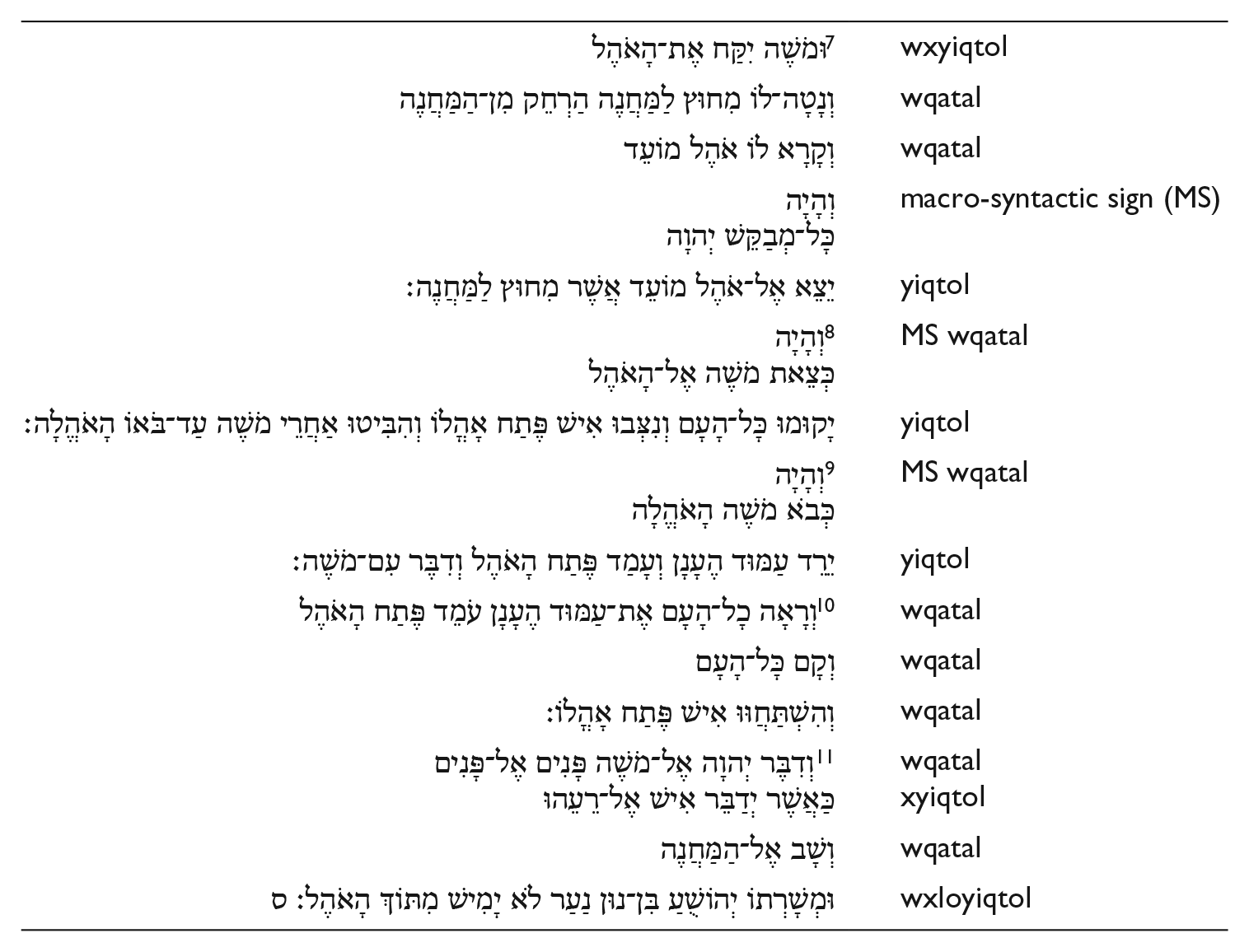
These wqatal forms represent a substitution of the wayyiqtol chain between 33.6—the people give up their ornaments in the wake of God’s anger—and 33.12, where Moses addresses God to intercede for his people. I focus on the following wqatal forms: 11
7d: the one who seeks God goes outside of the camp to the tent of meeting;
8a: the acts of reverence that the people do when Moses goes to the tent of meeting;
9a: Moses at the tent of meeting—the cloud descends;
10abc: what the people do when the cloud descends—they have their own liturgical movements;
11a, c: after the meeting with God, Moses goes back to the camp.
The wqatal forms in 7d, 8a, and 9a introduce the circumstances of the events related in 7e, 8b (and the following wqatal sentences in 8cd) and 9b (and the following wqatal sentences in 9cd). These are protasis/apodosis constructions headed by the macro-syntactic form of וְהָיָה 12 . The construction relates one single event and its circumstances.
The events inserted with wqatal depict a progression of the story from the general (where does one meet for worship?) to the particular. It charts how Moses goes to the Tent, the presence of the cloud, and how he returns. However, the temporal nexus in these wqatal forms is much looser as the overall meaning (what happens at the tent of meeting) really stays the same if one changes the order of events. To test this, I assume the author could have used this alternative order of events:
8a: what the people do when Moses goes to the tent of meeting;
9a: Moses at the tent of meeting—the cloud descends;
11a, c: after the meeting with God, Moses goes back to the camp;
10abc: what the people do when the cloud descends—they have their own liturgical movements;
7d: the one who seeks God goes outside of the camp to the tent of meeting.
As one can see, 7d may be moved to the end to act not as the introduction to what one does at the tent of meeting but as the conclusion. In addition, the above list shows that the events in 11a and 11c may be moved before 10abc with the story remaining largely the same. Both these changes do not affect the overall meaning of the passage, which answers the question, ‘what happens at the tent of meeting?’
The possibility of these permutations leads to the conclusion that the wqatal has the same ability as wayyiqtol to convey coordination of events. Because wqatal is an alternative narrative form, it is normal to suppose that it corresponds to the alternative narrative forms of passé simple/past simple in the modern languages, which is imparfait/past continuous or ‘he/she/they used to’.
Marking the presence of these evaluative functions of the pair wayyiqtol/wqatal 13 and re-asserting their presto/lento plot advancement constitute the main changes from Niccacci’s Syntax. Moreover, these foreground and background forms share the zero-degree feature (i.e. lack of retrospection and anticipation). I would strictly adhere to translating these wqatal forms with their equivalent background narrative forms in modern languages. 14
2. The comment register: xqatal, xparticiple, and xyiqtol (and its continuation form, wqatal). The xqatal of contrast narrative
This interpretation of BH syntax reflects a new methodological mindset that is distinct from Niccacci’s work. This is a re-evaluation of Niccacci’s meaning of narrative foreground and background: they pertain only to the two forms discussed in the preceding section.
A further point regards the implication that this outlook has for the remaining verbal combinations of xqatal, xyiqtol, and xparticiple. First, these are no longer considered background narrative forms in opposition to wayyiqtol, as Niccacci suggested. 15 Instead, the change in word order reveals the opposition between registers of narrative (of wayyiqtol and wqatal) and comment (of xqatal, xyiqtol, and xparticiple). The advantage is that one no longer has to deal with the question of how it is possible for four types of sentence to be syntactically synonymous with one another as background forms.
Second, evaluating these x-verb forms as comment opens the possibility of a more involved and implicated type of communication in indirect speech. In this comment register, the narrator is allowed to interject in what was previously considered in toto narrative.
Focusing on what comment means, it is strikingly difficult to paint a broader picture of Weinrich’s theory of comment beyond the rough brushstrokes found in his Tempus. 16 Indeed, the comment register needs theoretical development from the perspective of linguistics, and in the next part, I attempt to tackle this issue and that of what a text is in BH. An analysis of particular examples of x-verb follows: xqatal (narrative contrast and comment retrospective), the functions of xyiqtol and xparticiple (both comment), along with the combinations of xparticiple and xqatal (again comment register).
2.1. Comment and episode
The theory supporting the existence of comment forms in indirect speech has been developed at length in my doctoral work, focused on the syntax of the verb in Targumic Aramaic. 17 It became evident that a host of people examine the narrative register in a similar way to Weinrich (cf. Hopper, Reinhart, and Dry), but little effort was put into explaining the other register of comment.
On top of this methodological issue, translating the achievements of Weinrich’s work to BH syntax poses at least one major challenge—a fewer number of morphologic tenses than in modern languages, for instance. When faced with this issue in German, Weinrich puts forth word order as solution. The word order is responsible for the relievo opposition: verb in second position means foreground; verb in last position means background. 18 Effectively, the position of the verb or the word order in the sentence becomes a linguistic sign.
It makes sense for Niccacci’s Syntax to assume the same model and argue that BH word order conveys the same foreground/background opposition. However, I have outlined a number of problematic points with this stance. Therefore, all the more so, one is tempted to look at the alternative interpretation. BH word order may well reflect the comment/narrative opposition rather than the foreground/background opposition. So, what other language evidence is available to support the alternative contention that x-verb word order means comment?
Now, there is one neglected element in the syntactic discussion. Weinrich asserts that not only the presence of a mark but also its absence is of significance in establishing the value of a tense. In this vein, Weinrich adopts the binary model of language: zero-degree is the absence of perspective which is opposed by the recovered or anticipated information (the presence of one perspective or the other); foreground is also the absence of background; the comment register is the absence of the narrative one.
Based on this, I have proposed that the process of working out the function of a form should take into account not only the classic syntactic players (tense and word order) but also the other elements from context. I call each type of context element a trace, 19 which can be a trace of comment or of narrative. This trace marks a context element that inclines the balance of an ambiguous form in one direction or the other. Along these lines, I established an array of text-linguistic traces which corroborate the comment status of x-verb sentences in BH. This type of text-linguistic analysis includes the following details: 20
The presence of poetical devices (chiasmus, parallelism, etc.) is evidence in favour of comment register rather than narrative—
The presence of certain logical connections or lack thereof is a trace of comment. Here, one can list the following:
The information conveyed by comment is usually more prominent than other events in the episode— The presence of a ‘narrative head’ indicates that an x-verb sentence is of narrative register (cf. xqatal of contrast below); the absence of a narrative head means comment ( The x-verb repeats something already asserted previously or even later with narrative forms (redundancy)— The presence of comment particles like וְהִנֵּה—
The referential (cf. introduction) position that the x-verb sentence has in the episode is of significance: the naturally privileged places in biblical narrative are the beginning (Niccacci has called this prelude) and the end sentence of an episode. The position of x-verb sentences in these two places is further support of their comment nature: comment trace 8 (prelude position) and comment trace 12 (end-of-episode position). 22
With this last point, I have introduced the other important concept, the episode. The wayyiqtol is the normal prelude of an episode in BH, and this is because the episodes usually are arranged in temporal sequence in the biblical books. With the use of x-verb sentences in the initial position, the narrator means to alert the reader to the swift change from temporally sequenced episodes to a non-sequenced episode. The point of departure of the new non-sequenced episode may well be an event or a character that occurred somewhere else in the preceding episode but not at its end. These x-verb sentences are marks of the involved voice of the narrator signalling the change just described and telling the reader to react to it—one needs to be careful which narrative thread the story recovers or anticipates.
This point about the episode in biblical literature reflects that which Weinrich calls a text—‘a logical (i.e. intelligible and consistent) sequence of linguistic signs, placed between two significant breaks in communication’. 23 The stress in Weinrich’s definition is on the fact that a text is ‘intelligible and consistent’, that is, it makes sense by itself. 24
In the case of the biblical texts, I assert that such a text is called an episode, and it has the following properties: (1) a beginning, middle, and end part/sentence; (2) the identified text answers a simple question; and (3) it contains all the necessary concepts and relations within it—one needs no other information from a previous or subsequent episode to understand it. I illustrate the meaning of episode and its division, the panel, with the analysis of the episode of Genesis 18–19:
Panel 1—18.1–16ab: the promise of Isaac at Mamre; two visitors leave for Sodom;
Panel 2—18.16c–33: Abraham persuades God not to destroy Sodom if 10 righteous are found;
Panel 3—19.1–26: the destruction of Sodom and Gomorrah; Lot escapes;
Panel 4—19.27–38: Abraham learns of their destruction; the birth of Ammon and Moab from Lot’s daughters.
None of these panels can be considered separately as a proper ‘text’. This is because reading any of them separately exposes a missing concept and/or relation provided by one of the other panels. Panel 1 could be read by itself. Yet, the following panels would not make sense without it:
Panel 2: panel 1 provides a concept—it explains God’s assessment of Abraham in 18.18 (‘seeing that Abraham will become . . . nation’). God promised a child to the barren couple (18.10). In turn, panel 2 provides a connection to panel 3: it explains why the cities were not spared—the number of righteous people is less than 10 (18.32).
Panel 3: panel 1 provides the origin of the two men entering Sodom (they left Mamre earlier, cf. 18.16). Panel 2 explains that these two men are there to destroy the city (cf. 18.23–33).
Panel 4: Abraham looks towards Sodom because he was forewarned about the disaster (panel 2) which took place (panel 3). Panel 2 also explains the relation in 19.29 ‘God remembered Abraham’ because he interceded for these cities in panel 2.
2.2. The form xqatal as narrative contrast
In the next two sections, I examine the narrative xqatal of contrast in Genesis 19.6b, 10c, 11a, and 38a 25 versus the xqatal of comment retrospective of 22b–24 and 28b. The presence of the narrative head before (or after, in some cases) an xqatal sentence and their close bond is a sure sign of a narrative xqatal. The absence of the narrative head before the xqatal or a weaker connection is the first clue of an xqatal of comment (cf. comment trace 3).

The xqatal forms at Genesis 19.6b, 10c, and 11a 26 recount the events which occurred before and after Lot’s attempt to appease the crowd of angry men at his doorstep, who seek to harm his guests. Genesis 19.6b and 10c are in a mirror-like position, both narrating the closing of the door in contrast to their narrative head in 19a and 10b. The NRSV version rightly translates the wayyiqtol and its xqatal with the past simple of foreground narrative (cf. 19.6ab and 19.10abc). On both occasions, the narrative head shows what the subject does positively to defend himself (Lot goes outside to face them and the men bring him back) and then the further step taken to defend his family (he closes the door). The last example of 19.11a continues with the further contrast—the people inside the house are protected, those outside are harmed.
The xqatal in 19.38a is an example of a correlative relation (not contrast) between the wayyiqtol head of 19.37a and its xqatal (NRSV): ‘The firstborn bore a son, and named him Moab [. . .] The younger also bore a son and named him Ben–ammi’. In the framework of Labov and Waletzky, these instances of xqatal are compelling examples of restricted narrative clauses. The use of xqatal instead of wayyiqtol is due to the fewer semantic resources (i.e. contrastive particles or correlative forms) BH has available for this type of restriction.
2.3. The xqatal form of comment retrospection
The text of Genesis 19 presents xqatal forms of comment in 22b, 23ab, and 28c, with another ambiguous (narrative or comment) xqatal in 24a.

The comment quality of 22b derives in the first instance from its x-verb word order which is corroborated by the lack of a narrative wayyiqtol head (trace 3). Its content explains or comments not on the last words of the messenger in 21c–22a, but goes back to Lot’s repetition of the word ‘מִצְעָר’, an epithet meaning small or little attributed to a city that is never called by another name than Zoar (sharing the same root as מִצְעָר). The xqatal in 22b explains that the name of the city is derived from Lot’s description which already suggests that the place is unsuitable for his family. This is prominent information—comment trace 2. The consulted translations (KJV, NAS, NRSV, and LXX) use the past tense or aorist narrative foreground for 22b. However, this syntactical analysis leads to a rendering along these lines (following NRSV):
either: ‘Therefore the city has been called Zoar’ with present perfect of comment retrospection;
or: ‘Therefore the city is called Zoar’ with present of comment zero-degree.
***
Regarding 23ab, the xqatal forms indicate that Lot entered Zoar at sunrise, which brings about the beginning of the destruction of Sodom (prominent information—trace 2). There is no temporal juncture between 23ab and the nearest wayyiqtol, as either event (the sunrise or the entering into the city) could have come first—trace 3. These two traces successfully confirm the comment meaning of these two xqatal forms.
***
The following xqatal in verse 24 is ambiguous. On the one hand, it displays a second-verb word order and some of the traces mentioned above. It marks the beginning of the destruction (comment trace 2). There is no obvious temporal juncture (comment trace 9). Deleting it would not disturb the meaning of the preceding and subsequent wayyiqtol: the messenger accepts Lot’s request in 21–22 and destroys the city in 25a; both wayyiqtol share the same subject (‘the messenger’).
On the other hand, the xqatal in 24 might be continued by wayyiqtol in 25a, and they too could share a subject (יהוָה); moreover, they too could be in a temporal juncture: ‘God rained [. . .] and destroyed’.
However, I would favour the option that xqatal is comment on two accounts: the word order is indicating comment and the existing comment traces. In addition to them, the narrative sequence of wayyiqtol in 21–22 and 25a makes the xqatal in 24 redundant (comment trace 6). This is because the wayyiqtol forms tell the story of the destruction already—the messenger accepts Lot’s request (21–22) and then he destroys the city (25a). 27 Moreover, reading the angel as the subject of the narrative wayyiqtol in 25a (not God, as a connection 24–25a would have it) fits better, as he performs the act for which he was sent by God.
With the xqatal of verse 24, the biblical narrator suggests to the reader directly who the real actor (God destroyed the city) is and the tools used (rain of ‘sulfur and fire’—NRSV). This is not information belonging to the narrative plot but a comment register clarification for the benefit of the reader. The forms in 24 and 25a should be translated with comment and narrative equivalents, respectively.
***
Passing to the xqatal in 19.28c, the verb in second position and the presence of וְהִנֵּה—comment trace 7—are strong reasons for interpreting it as a comment form. Further indication is that there is no temporal juncture (comment trace 9). The wayyiqtol forms in 28ab do not have such a juncture with 28c because the smoke arising from these cities does not come in after Abraham sees it: the smoke rises anyway before and after; 28ab do not impose any kind of narrative restriction (contrast or correlation), so they are not narrative heads either (comment trace 3). In addition, the information is prominent in this panel (Abraham realises that Sodom and Gomorrah indeed have been destroyed)—comment trace 2.
The translation of Genesis 19.22b (see above) left open the question of whether this sentence has the syntactic function of comment zero-degree or that of comment retrospective. Now, I turn to the following question: which of the two functions is more appropriate for xqatal?
My analysis leads to the conclusion that xqatal is a comment retrospective form. To take the last example, xqatal in 28c is a comment communication of the narrator to the reader outside the line of narrative wayyiqtol. He aims at recovering the information that there was smoke and to make this statement closer to the reader. This involvement of the reader is achieved through a change in the deictic centre (cf. the lack of temporal juncture) which does not follow that of the passage of time in the narrative, advancing the plot, but that of the narrator–reader deixis, that is, this happens in our common past. In Weinrich’s words on comment retrospective, this type of xqatal acts as a ‘report’ or ‘as comment and retrospection in the same time’. 28 Consequently, the translation of the xqatal sentences should be with present perfect (following NAS): ‘the smoke of the land has ascended like the smoke of a furnace’. 29
2.4. The xyiqtol as comment form
It follows from the basis of this interpretation of BH word order that the xyiqtol is a comment form. I examine the occurrences of xyiqtol in Exodus 33.6; 34.34 and Numbers 11.9. I start with Exodus 33.6–7abc:

I argued that the wqatal forms of Exodus 33.7d–11ac are a sequence of background forms which specify how the people behave around the tent of meeting. The forms of 7abc precede these wqatal forms and follow a string of wayyiqtol narrative forms which end by recounting that the sons of Israel stripped themselves of their jewels as a result of God’s command in 33.5.
In this context, one could indeed see the stripping of jewels (verse 6) and the setting of the tent (verse 7) in temporal juncture, as they are told one after another, but they are not (lack of temporal juncture—comment trace 9): in 7a, the righteous Moses moves the tent outside the camp on his own accord and not by God’s command. The relation between 6 and 7a does not display a contrast, so wayyiqtol of 6 is not a narrative head for 7a (comment trace 3). Moreover, 7a is a one-off event. It presents prominent information (comment trace 2) as it is Moses’ way of reacting to the sinfulness of the people—taking the presence of God out of their camp.
After establishing the comment quality of the xyiqtol in 7a, one needs to evaluate what kind of comment is this (zero-degree or retrospective) and the role of the ensuing wqatal forms in 7bc—they have the same syntactic function as their xyiqtol head. To answer the first issue, because 7a is an xyiqtol sentence, it should differ in meaning from the comment sentence of xqatal. As xqatal has the function of reporting information, a retrospective form, the xyiqtol should be read as a comment zero-degree form. This is because two linguistic signs (here xyiqtol and xqatal) cannot have the same syntactic analysis without producing ambiguity. Sharing the same syntactic function between two or more forms is an exception, not the norm. The end of this section will provide more clarity about the status of xyiqtol in comparison with the xqatal and xparticiple forms.
Turning to the second question, the wqatal forms in 7bc have a close relationship with their xyiqtol head, as they share a subject (Moses) and an object (the tent), so they too are comment forms in this particular case. The sentences 7abc act as the narrator’s commentary on the narrative: in order to depict the gravity of their sin, the narrator substitutes his commentary with how Moses reacts to it: the people have sinned, so the camp is no longer a suitable place for God. The translation should follow the comment zero-degree present tense (following the wording of NRSV): ‘Now Moses takes the tent and pitches it outside the camp, far off from the camp; he calls it the tent of meeting’. 30
***
Similar to the preceding xyiqtol, the one in Numbers 11.9 31 is a comment zero-degree form containing an explanation: the manna is given early in the morning. Its placement is odd. The proper order of events would have been the following: receive, describe, and cook the manna. Instead, the wqatal narrative describes the manna and how it is cooked; only afterwards, like an afterthought, does the narrator introduce a xyiqtol with the time of receiving it. This means that this xyiqtol has no narrative head (comment trace 3) or temporal juncture (comment trace 9). The xyiqtol does have a certain degree of prominence (comment trace 2) attested by the fact that it states the time the manna is given and by its odd positioning. In itself, it fits the profile of incidental information that the biblical author wants to share in comment (following NRSV): ‘When the dew falls on the camp in the night, the manna falls with it’.
***
The xyiqtol sentence of Exodus 34.34a contains the noun מַּסְוֶה (veil), all of its three occurrences in the Masoretic Text (MT) being in verses 33–35. This is the exegetical key to this passage: no other person in the Bible has met God as Moses has, so only he wears this special veil.
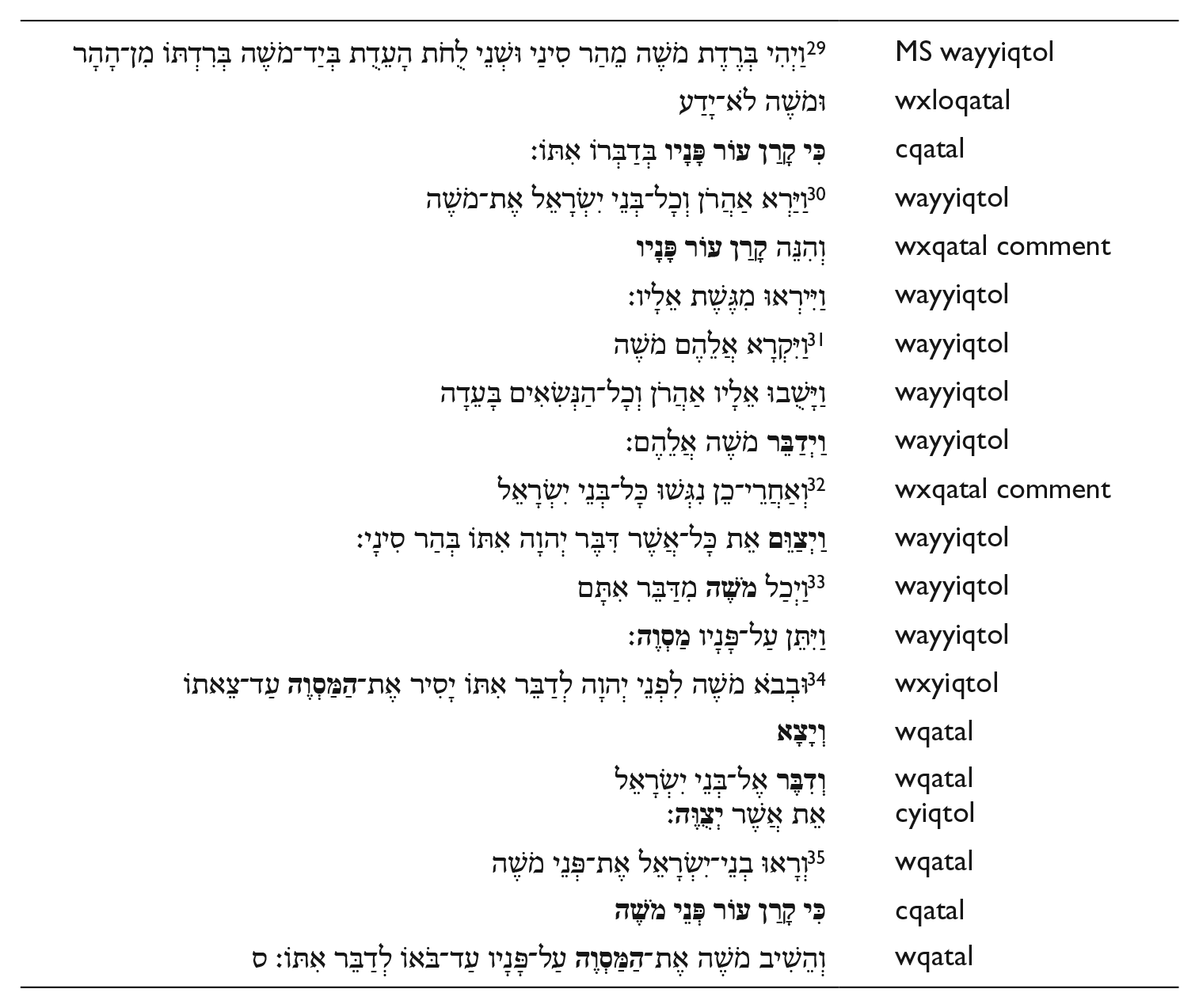
The multiple presence of this rare word in a limited space signals the redundancy that verses 34–35 display within the overall context (comment trace 6). The expression וְדִבֶּר אֶל־בְּנֵי יִשְׂרָאֵל אֵת אֲשֶׁר יְצֻוֶּה׃ was already inserted earlier in 31c and 32b (וַיְדַבֵּר . . . וַיְצַוֵּם—‘he spoke (to them) and . . . commanded’). These observations are only the tip of the iceberg—the passage 34.34–35 is redundant altogether as verses 34.29–33 have presented this information already. Compare the following:
Verse 34 with verses 31–32—Moses commands the people to fulfil everything God said on the mountain of Sinai;
Verse 35 with verse 33ab (Moses finishes his speech and puts the veil back on his face);
The repetition of 29c in 35c (כִּי קָרַן עוֹר פָּנָיו) again displays the latter’s redundancy (comment trace 6).
The necessity of the veil is prompted by Moses’ shining face, obsessively repeated in 29c (conjunction-qatal), 30b (xqatal), and 35c (conjunction-qatal). From a non-involved narrative register form in 29c (which is subordinated to the preceding narrative in 29b), the same idea progresses in 30b to being more prominent (comment trace 2) as it precipitates the fearful reaction in 30c (with wayyiqtol narrative). Its prominence and comment quality is amplified by the preceding וְהִנֵּה (comment trace 7) which turns 30b into a proper xqatal.
In conclusion, at the end of the episode (comment trace 12), 32 the narrator inserts a comment section in verses 34–35 where he interprets the events for his reader. The comment register starts with a xyiqtol of comment (34a) followed by a series of wqatal (34bc, 35ac). The wqatal seems to be the normal continuation form of xyiqtol.
The goal of the narrator is to pick one element which he thinks needs to be highlighted outside of the narrative. While the narrative register describes the reconciliation of God with the people, the comment insertions in 30b and 34–35 focus on the effect the meeting with God had on Moses’ face. With the xqatal sentence in 32a, 33 the author inserts the incidental information that the people came near so that they too saw Moses’ shining face clearly. The narrator obsessively repeats that his face shone, once in narrative (29c) and twice in comment (30b and 35b). It is meant to stress the fact that the meeting with God marks the person receiving his presence. The imprint of the divine light on Moses’ face is too strong for the sinful people. The sequence of xyiqtol–wqatal (in verses 34–35) conveys a comment zero-degree message. The effect is that the narrator talks to the reader using the present tense. Its overall meaning can be summarised by the sentence: ‘After going before the Lord, in order to protect the people from the shining divine light of his face, Moses is using a unique veil, the מַּסְוֶה’.
2.5. Comment forms of zero-degree: the xparticiple as comment form and its combinations
The analysis of xyiqtol argued that this form belongs to the list of comment forms of zero-degree. The analysis of xparticiple and of those combinations of xparticiple with xqatal will shed more light on the syntactical role of these three sentence types. The argument of this section is divided into two parts: the xparticiple and the combination of xparticiple–xqatal.
2.5.1. The xparticiple
Niccacci believes xparticiple is a simple nominal clause with the syntactic function of background narrative. 34 However, I argue xparticiple is a predicative sentence similar to xqatal and xyiqtol. The examination of examples from Genesis 18.1–23 supports its predicative status as a zero-degree form of the comment register.
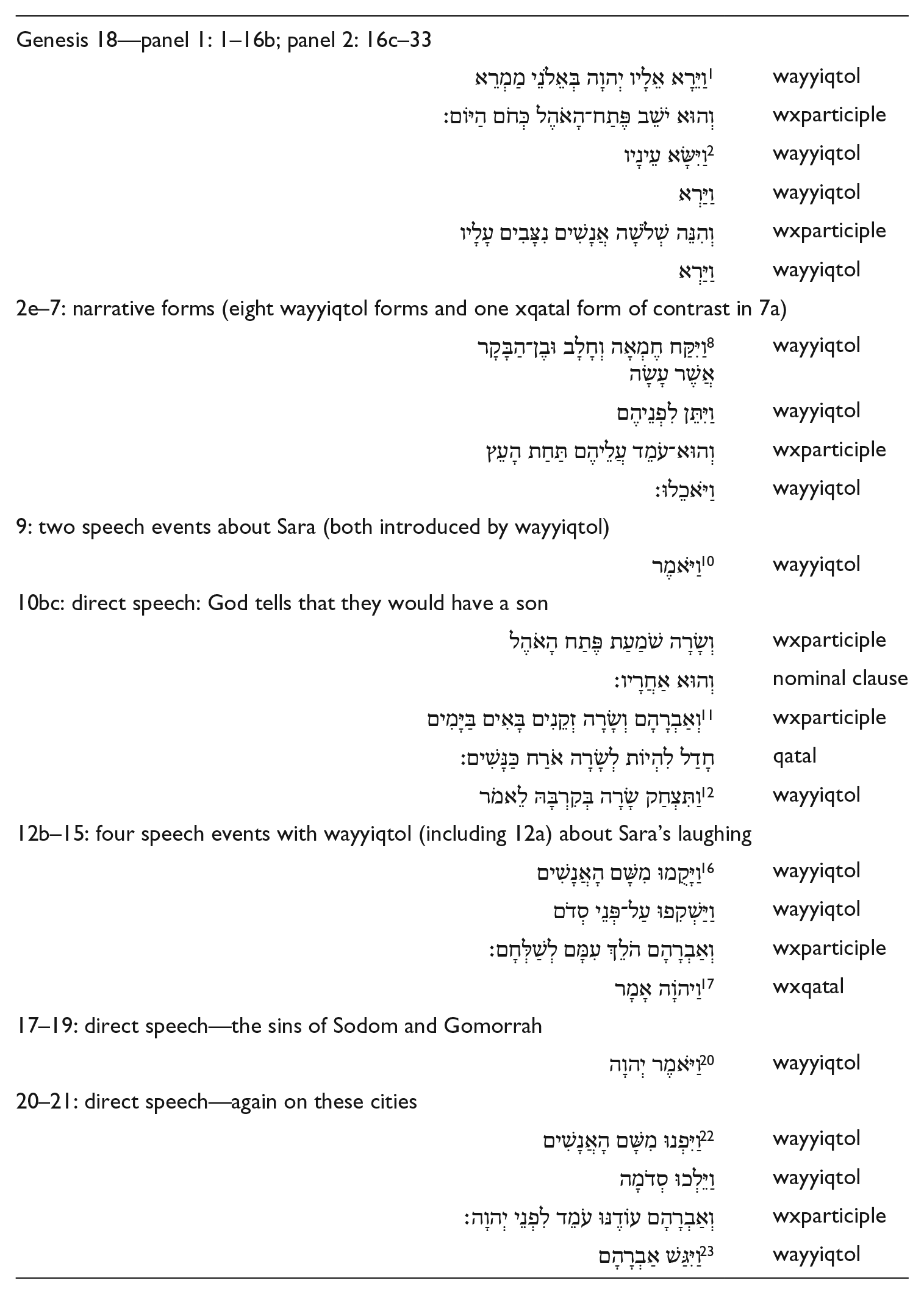
Between verses 18.1–23, the narrative register is interrupted by the voice of the narrator who gives indications concerning the circumstances of this meeting (cf. five xparticiple forms [1b, 2c, 8c, 10d, and 22c] and two combinations of xparticiple–(x)qatal [11ab and 16c–17a]). Each circumstance reflects a possible question of the reader requiring clarification as in the table below (the translation modifies the text of the RSV). They assist in the communication with the appropriate additional information in comment zero-degree.

In addition to their verb-second word order, these xparticiple sentences lack a temporal juncture and a narrative head (comment traces 9 and 3): in verse 1, Abraham stays at the door of the tent before the arrival of God and after, until the three men stand before him in verse 2. Similar argumentation applies for the other three cases. The xparticiple in verse 1 has a prelude position at the beginning of the episode (comment trace 8).
The biblical narrator uses the xparticiple to introduce little notes which supplement the picture one receives from the narrative. One could easily read these forms as scene indicators that a playwriter would employ to support the dialogues in a dramatic scene. Abraham sits at the tent door when they arrive (verse 1); they stand before him (verse 2); Abraham sits with them under the tree (verse 8); and then again he remains in the presence of the Lord (verse 22) when the other two men leave; Sarah sits at the tent door (verse 10) and receives God’s promise.
However, the xparticiple forms display the physical reality of the encounter between man and God—their very content attests to the prominence of their information (comment trace 2). They repeat that real people stand next to the Lord (Abraham and Sarah). The xparticiple forms could be read as only incidental but they occur too many times to be fortuitous. This means that the narrator is interested not merely in relating narratively what happened. The aim is to provide as much information as possible about the physical actions performed. Narrative too underlines that this was a physical act: Abraham and his household prepare fresh food (from sacrificing an animal to baking the cakes); he serves this food and his visitors are shown to be eating it. I clarify the zero-degree value of xparticiple (foreground or background) in the next subsection.
2.5.2. The sequence xparticiple–xqatal sentences
After asserting the comment function of xparticiple, I turn to its combinations with xqatal in Genesis 18.16c–17a and the less used variant of xparticiple with qatal in first position as in 11ab. I argued that xqatal is either a narrative contrast/correlative or a comment retrospective form (cf. 2.2 and 2.3). In 16c–17a, xqatal has a further function of comment zero-degree: the events recounted in the two forms are so closely knit that they converge towards one goal, so the xqatal too works as a comment zero-degree form. 35
In the case of 16c–17c, that goal is to make plain again the physical presence of Abraham before God (with xparticiple) when he informs Abraham about the punishment of Sodom and Gomorrah (with xqatal). With 11ab, the narrator produces a stark contrast. One the one side, God promises a son (verse 10); on the other, Abraham and Sarah currently are unable to have one due to their advanced age (xparticiple, 11a) and Sarah’s barrenness (qatal, 11b). With the two sides of this double structure, the narrator answers a ‘lack of relation or concept’ question that the reader may have (the translation follows NAS):
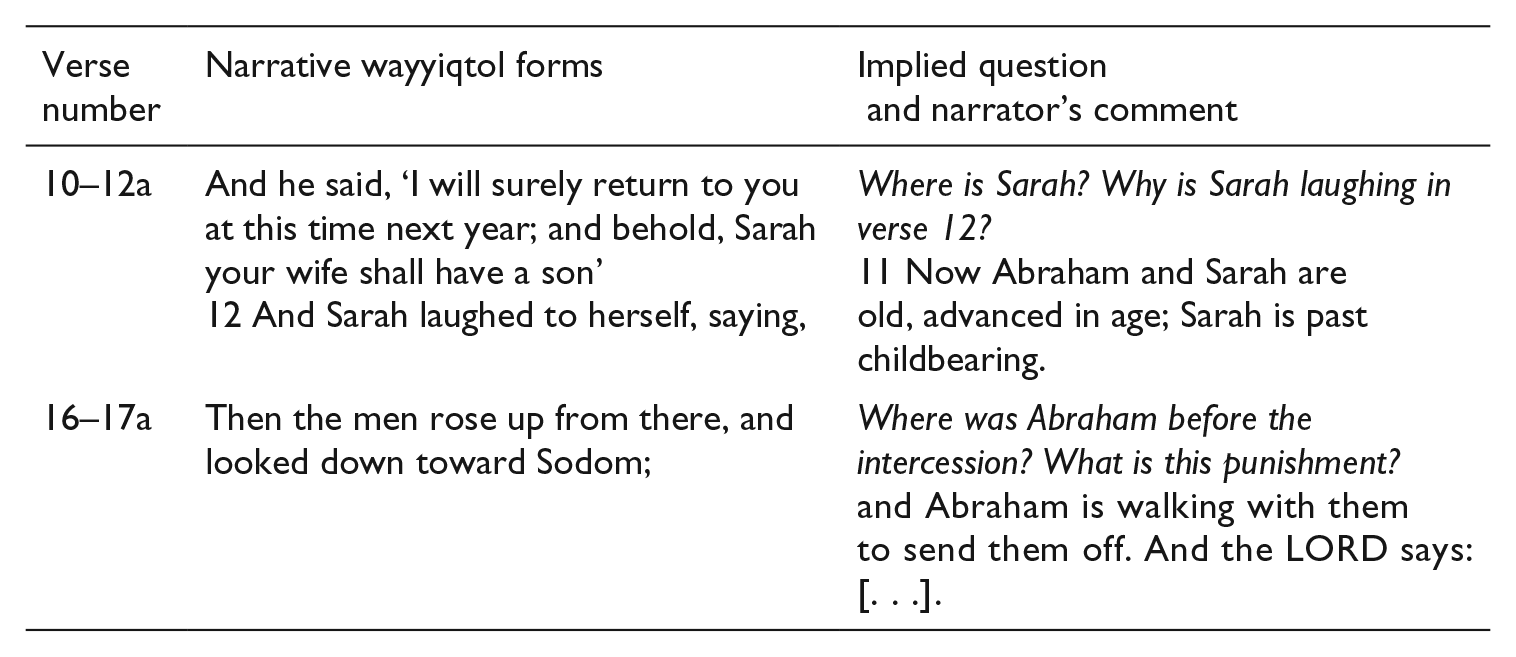
Both combinations have prominent positions in the story (comment trace 2): through the first, the narrator explains Sarah’s laugh in verse 12; through the second, he is keen to repeatedly emphasise the factual occurrence of the encounter between God and Abraham.
Do these xparticiple–xqatal forms show a lack of a narrative head (comment trace 3) or of a temporal juncture (trace 9)? The answer is definitely yes in the first case, as Sarah’s barrenness precedes and continues with the surrounding wayyiqtol (the barrenness ends when Sarah becomes pregnant). One cannot give a precise answer to this question about the second case, but looking at the preceding example, I suppose that by using an xparticiple–xqatal combination, the narrator is not interested in advancing the plot because he could have used a narrative combination (wayyiqtol or wqatal). In lieu, the information is presented in a comment situation with x-verb sentences which requires the attention of the reader: this information concerns you or it is here for your benefit.
Changing the perspective from zero-degree (xparticiple, 16c) to recovered information 36 (xqatal, 17a) would create an awkward construction. Consequently, the xqatal in 17a cannot be a comment retrospective. The two subjects walk and talk together and at the same time—17a has nothing to recover. When these x-verb forms work together, xparticiple and xqatal should be considered zero-degree forms.
I turn to answering the delayed question of delimiting the function of the xparticiple and xqatal. They should have different functions according to their different morphological compositions. If one agrees that the combination xparticiple and xqatal has a zero-degree status, two interpretations are possible, according to Weinrich 37 : foreground, equivalent to present tense (in Italian, presente), or background, with present continuous (in Italian, similar to the construction ‘sta leggendo’).
In view of the equivalences that BH and Targum Aramaic (TA) display, and of my syntactical description of the latter, 38 xparticiple means background comment, equivalent to the TA xparticiple. Only in combination with xparticiple, xqatal indicates comment foreground. This is the reason for translating the xparticiple and the xqatal forms in the preceding table with present continuous (comment background) and present simple (comment foreground), respectively. 39
In the context of the functions of xqatal (cf. 2.2, comment retrospective) and xparticiple (cf. 2.3, comment zero-degree), xyiqtol sits as a comment background form, similar to xparticiple rather than xqatal. This is for two reasons. First, BH does contain series of xparticiple and xyiqtol 40 , but there is no combination of xparticiple–xyiqtol in the indirect speech. 41 If they are of a similar type, it would not make sense articulating them together as there is no syntactic distinction to be conveyed. Second, nearly all xyiqtol forms in indirect speech are translated with xparticiple in the TA of 1 Samuel. 42
3. Conclusion
The three dimensions of language explained by Weinrich act as a testimony and as a blueprint. They are a testimony for those languages he had already discussed in his Tempus and its applications to individual languages (for Romance languages, English, and German). They act as a blueprint for those languages which have not gone through the text-linguistic analysis yet.
This blueprint tells us about how a language should be approached (larger texts) and how these three dimensions can be identified. As BH is a language no longer spoken, the work of the linguist is very similar to that of the archaeologist. He or she uses written texts or other sources to start digging in a particular place, believing that there must be a trace left. The purpose of this simile is to put into perspective the significance of the term trace for my proposal. It is an instrument which makes visible for linguistic analysis those areas of languages which have been unseen so far.
Both the Prague School and Weinrich’s Tempus resort to context elements to justify their analysis. 43 They think that these elements add weight to one syntactic decision or the other but do not say that they are part of the linguistic sign per se. What does this tell us? First, that context does indeed contribute to the meaning of the linguistic sign. Second, that analysis of language needs a way of making context part of the syntactic debate. By this, I mean that context elements should receive some sort of categorisation with regard to the linguistic sign, as morphology and word order already have.
The process of the analysis of BH syntax as laid out in this contribution starts from establishing the tense and word order as the main coordinates. It is only after observing the pattern of the verb-second sentence that one should look for the comment traces or the additional information one can derive from the overall context. I do not think that the aforementioned traces of comment are proof that the BH verb-second word order reflects comment; instead, they are further substantiation of my stance that this word order means comment.
In contrast with Niccacci’s position, 44 I believe that each sentence is as equally verbal as the others as long as they contain a predicative verbal form in the first or second position. Each sentence type has a specific function in the text-linguistic analysis:
In the narrative register, the wayyiqtol forms represent the narrative foreground, while the wqatal form is background; xqatal narrative supposes a correlation or contrast (I called it the ‘restricted clause’); the narrative forms of wayyiqtol and xqatal of contrast correspond to the English past tense; the wqatal corresponds to past continuous tense (or ‘used to’);
The forms of the comment register are as follows:
xqatal functions as the comment retrospective form and it should be translated with the English present perfect; The normal use of xparticiple is that of zero-degree background—the equivalent tense in English is the present continuous tense; The combination of xparticiple and xqatal confers on the latter, the foreground zero-degree function—the equivalent tenses in English are the present continuous tense and present tense, respectively; xyiqtol represents zero-degree of background and is considered equivalent to xparticiple at this stage of the research.
In summary, as one re-reads Weinrich’s work, it becomes clear that the most central of the three dimensions in Hebrew is the opposition of registers, not that of relievo (see Niccacci). The comment/narrative opposition tells of the general attitude with which the communication should be understood, the relaxed type of narrative or the stressed one of comment, involved or non-involved, and whether the communication affects the subject directly or is about a distant third person. With this in mind, the comment/narrative opposition should have been the first to be proposed as the explanation for the meaning of the word order in BH.
Footnotes
1.
The discussion is limited to indirect speech passages. It does not analyse: subordinate and negated sentences; nominal sentences (i.e. sentences with no verb). The element ‘x’ means any morphological value in a sentence (other than a negation or a conjunction) which takes the first position in the sentence. I analyse the texts of Genesis 18–19, Exodus 33–34, and Numbers 11.
2.
3.
Labov and Waletzky, ‘Narrative Analysis: Oral Versions of Personal Experience’, 15–17.
4.
5.
6.
The table contains all the examples of wayyiqtol discussed in this section.
7.
This wayyiqtol includes also a subordinate sentence which does not affect the analysis.
8.
9.
The wayyiqtol of מהר works both as self–standing verb (Gen 18.6–7 and Ex 10.16) and in hendiadys: Gen 43.30; 1Sam 17.48; 28.20; 2Sam 19.17; and 1Kings 20.41.
10.
In the case of 1Samuel 16.23c with wqatal, Niccacci proposes ‘David used to take the lyre’. Cf. example 2 in A. Niccacci, ‘Essential Hebrew Syntax’, in Narrative and Comment: Contributions to Discourse Grammar and Biblical Hebrew presented to Wolfgang Schneider, ed. E. Talstra, et al. (Amsterdam: Kok Pharos,  ), 113.
11.
For 33.7abc, cf. section 2.4.
12.
On the wqatal forms הָיָה as macro–syntactic forms in Niccacci, The Syntax of the Verb, §156–158.
13.
Similarly to wayyiqtol, wqatal can introduce speech events (1 Sam 2.15c).
14.
Most of the translations of the background constructions in Niccacci, The Syntax of the Verb, §39–50 use the past simple of narrative foreground (Exodus 9.23; 10.13).
15.
Cf. Niccacci, The Syntax of the Verb, §40, p. 71, for his lists of the background constructions ‘which can interrupt the chain of narrative’: waw-x-qatal; the simple nominal clause, weqatal, and xyiqtol.
16.
Cf. the massive attention that he devotes to comment retrospection in English (present perfect), French (passé compose), Italian (passato prossimo), and Spanish (perfecto compuesto) in Weinrich, Tempus, 94–118.
17.
Condrea, Syntax of Targum Aramaic.
18.
Weinrich, Tempus, 201–202.
19.
This was theoretically and practically developed with a focus on Targum Aramaic of 1Samuel in Condrea, Syntax of Targum Aramaic, 266–270.
20.
Each trace receives the same number as in my thesis, see Condrea, Syntax of Targum Aramaic, 339–340.
21.
Two traces are not used in this article:
22.
The remaining traces (13 and 10) apply to the combination xparticiple with xqatal discussed in point 2.5.2 below and to the special case of the Targumic Aramaic xparticiple, respectively.
23.
24.
25.
Niccacci analyses the xqatal of contrast as a background narrative form: see the interpretation of wayyiqtol–xqatal sequence in Exodus 1.6–7a in Niccacci, The Syntax of the Verb, , 32. However, Weinrich does not suggest that contrast (or any kind of semantic correlation) should signify background narrative.
26.
I leave aside the qatal forms in Genesis 19.4b and Numbers 11.33c whose analysis is influenced by the preceding yiqtol. The issues that are unknown are: how this method applies to subordinate sentences; the narrative anticipation in BH.
27.
The two angels who come to Sodom are referred as ‘they’ (19.1–3; and 10–13, 15–16 restate ‘המַּלְאָכִים’ the angels), but from verse 17, the plural turns into singular ‘he’.
28.
Weinrich, Tempus, 104. Cf. also Condrea, Syntax of Targum Aramaic, 250.
29.
In the case of Genesis 19:22b, the first solution proposed (present perfect of comment retrospection) is the right one.
30.
The NRSV uses a sequence of background narrative (Moses ‘used to take … and pitch’) which changes into foreground narrative (‘called it the tent of …’) as if these were narrative wqatal and wayyiqtol forms respectively.
31.
Cf. the BH text and the analysis of the surrounding wqatal forms above under point 1.2.
32.
Exodus 34:35 is the last verse of the chapter and episode.
33.
32a displays an x-verb comment structure and is incidental (comment trace 11) between the wayyiqtol narrative forms of 31c-32b – reading these forms in continuation creates a smooth narrative (NRSV): ‘and Moses spoke with them. [. . .] and he gave them in commandment all that …’
34.
Niccacci, The Syntax of the Verb, §33, cf. the examples of Genesis 24.15 and 2Kings 3.20. See also §162 under ‘simple nominal clause’. According to him, a verbless clause and one with a participle are not different from each other.
35.
The presence of xparticiple preceding or following an xqatal is a trace that the latter may have the same zero degree comment value as the former. I also called this comment trace 13: xparticiple is trace of the fact that the comment zero degree value may be attributed to BH xqatal/the Targum Aramaic xqetal; cf. Condrea, Syntax of Targum Aramaic, 333–335. There are caveats (e.g. the xparticiple and xqatal belong to different episodes) which do not apply to the examples presented in my current contribution.
36.
Recovered information is the function of xqatal whenever it has no wayyiqtol narrative head.
37.
The comment retrospective slot is reserved for xqatal, cf. 2.3.
38.
Condrea, Syntax of Targum Aramaic, 336.
39.
The xparticiple–xqatal combination in Genesis 13:13–14a has a similar analysis in the texts analysed here.
40.
TM 1Samuel displays occurrences of three xparticiples in a row in 29:1b–2ab and 26:7b–e and of three xyiqtols in 13:17b–18ab.
41.
In my analysis of MT 1Samuel for example, I found no combination of the xparticiple-xyiqtol forms in sequence.
42.
Cf. the analysis of the five occurrences of the Aramaic yiqtul and xyiqtul in the indirect speech of 1Samuel in Condrea, Syntax of Targum Aramaic, 315–318.
43.
Weinrich describes ambiguous situations in which the present tense (a comment form) indeed acts as présent historique whose narrative register is given by the surrounding imparfait occurrences, cf. H. Weinrich, Grammaire textuelle du français (Paris: Didier/Hatier, 1982/1989), 138; Firbas dedicates two chapters to discussing the ‘contextual factor’ and the ‘semantic factor’ in the process of deciding the rhematic status of an element in the sentence. cf. J. Firbas, Functional Sentence Perspective in Written and Spoken Communication (Cambridge: CUP, ), 21–66.
44.
In BH, the verb-first sentences are verbal, the verb-second sentences and the verbless sentences are nominal.