



Abstract
Providing a rationale for the composition of Numbers 1–10 continues to pose a formidable challenge to Old Testament scholarship. Most studies in Numbers seek to discern its structure by connecting keywords to concepts, moving immediately from a basic verbal to a high conceptual level of literary structure. With attention to narrative technique, the present study analyses an intermediate level by investigating the demarcation of direct speech, recurring chronological indicators and the dynamic between law and narrative. Accordingly, correspondence of patterns on different levels of literary structure suggests a main break in Numbers 1–10. The Passover command in Numbers 9 inaugurates Israel’s departure from Sinai. The calling and dedication of the Levites in Numbers 3 and 8 form an inclusion of direct divine speeches consisting of four triads around a central command to purify the camp. These observations offer a coherent interpretation of the included legal materials.
Keywords
Numbers 1–10 and the potential of studying narrative technique
Numbers 1–10 presents the final section of legislation at Sinai. Old Testament scholars struggle to find conceptual coherence in these chapters, especially in Numbers 5–10. Hence, a rationale has been sought in the idea that the latter section contains additions to Numbers 1–4, showing some correspondence in form. This approach merely led to a further dissection of the text. Rolf Knierim and George Coats (2005: 34) conclude that, although the structure of the text is still best explained by its process of growth, the lack of consensus on its genetic makeup hinders a form-critical investigation of its ordering principles. Meanwhile, the end of the 20th century showed progress in the analysis of structure through a literary, synchronic reading. Narrative units in Genesis and Samuel–Kings were extensively investigated, prompting a more literary approach to the book of Numbers too, 1 though this did not bring consensus on its structure either. 2 Consequently, scholars moved on to developing redactional theories regarding the role of Numbers in the formation of the Pentateuch that would also account for the book’s miscellaneous character (see e.g. Römer and Nihan, 2009: 175–177).
However, some forty years ago Shimon Bar-Efrat (1980: 157) observed that formal criteria often play a subsidiary role in the analysis of structure. He proposed a more grounded evaluation of literary structure by distinguishing four levels that build on one another, starting with the verbal level consisting of the repetition of words and phrases, the basic stratum of language. Secondly, the level of narrative technique includes narration mode, such as the use of direct speech and of narrated time and space. Thirdly, the level of the narrative world comprises the progress of the plot through the development of events and characters. Finally, the highest level of literary structure is the conceptual level, which contains the themes and ideas of narrative units. However, it appears that Bar-Efrat’s promising suggestions have not yet been used for the study of structure in the challenging book of Numbers.
In this article, Bar-Efrat’s model is used to evaluate the present lack of consensus by taking a more technical look at the literary structure of Numbers 1–10. Some important observations can be made at the outset. While most commentaries on Numbers 1–10 distinguish identical subunits which are grouped in different ways by varying conceptual relationships, the technical criteria for their demarcation are not discussed. Likewise, the announcement of Israel’s departure from Sinai in 10.11–13, widely seen as signalling a new section following 1.1–10.10 as a time of preparation for the journey to Canaan, is identified by its conceptual function rather than its technical function in structuring the text. 3 Jacob Milgrom (1990: xiv) articulates this modus operandi concerning the book of Numbers: ‘Regardless of how one conceives the overarching organizational structure of the book, it is more important to note the thematic and verbal links that bind the material together.’ This would indicate that the lack of consensus results from a somewhat ideological approach to literary structure. It appears that neither diachronic studies nor synchronic studies pay much attention to the narrative technique that shapes Numbers 1–10.
However, an analysis of multiple levels of literary structure – including that of narrative technique – provides the literary critic with a much-needed criterion for judging the persuasiveness of the suggested rationale of a text: congruency. The quality of perceived literary structure depends on how well the patterns on its different levels correspond. Given the basic notion that structure depends on stylistic repetition, discontinuity in patterns can be interpreted more consistently too (Alter, 1981: 97). Nonetheless, the different levels of literary structure cannot be entirely distinguished. The use of a chronological marker for example, which is situated on the intermediate level of narrative technique, reflects a particular syntax (the most basic level of literary structure) and conveys a certain concept of time (its highest level). Accordingly, the study of narrative technique must attend to the relationship between words and ideas.
The methodology of studying narrative technique
This study adopts a literary, synchronic approach to the text. The final form of the text is considered to currently offer the most stable and best verifiable context for the interpretation of its textual units. However, as Numbers 1–10 is often seen as an appendix to the main body of Sinai legislation, can it actually be studied as a separate unit? Might not its dependency on Exodus and Leviticus be the very reason for its perceived lack of coherence? Bar-Efrat (1980: 156) states that ‘narratives which on the one hand can be considered as self-contained units may be regarded on the other hand as parts of larger wholes (…). Structure can be discerned and may legitimately be studied in small sections as well as in comprehensive units’. This interdependency is typical of Hebrew narrative. Consequently, a literary reading of smaller textual units can serve well as a starting point for discerning larger structures. This inductive approach also avoids making assumptions on overarching structures that could be alien to text.
Firstly, the structure of direct speech will be investigated. This is a dominant feature in the chapters under discussion and it is also critical to the alternation of the genres of law and narrative which characterizes the book of Numbers. As the narrative genre governs all other genres in the Pentateuch, including its legal material, laws are presented in the form of direct speech and embedded in their narrative context through linguistic conventions (Bartor, 2010: 17–18). Direct speech is signalled by quotative frames. In narrative, opening frames specify speaker, addressee and sometimes additional circumstances. Closing frames, occurring less frequently, explicitly refer back to direct speech and often detail the narrative effect (Miller, 1996: 55, 215, 220). Hence, the latter will be of particular interest to this study. 4 This technical focus will helpfully preclude generic hypotheses regarding whether textual units are considered ‘law’ or ‘narrative’.
Secondly, the structure of narrated time and space is studied, discerning the chronological and geographical aspects of narrative technique.
Subsequently, the shared patterns in direct speech and chrono-geographical markers will be used as a framework for the study of patterns on the verbal level. One might think that verbal patterns should be studied independently, yet it is simply impossible to study them without a framework because their identification depends on the demarcation of the textual units in which they are studied. If verbal relationships are studied without an articulated framework, the interpreter’s implicit, ideological preconceptions will probably unduly influence the analysis. Patterns in narrative technique, however, will explicitly render suitable demarcations for the study of verbal relationships. In turn, the distribution of keywords that thus emerges must validate the framework in which they are studied: how do these verbal patterns correspond with patterns in narrative technique, and how do they substantiate conceptual coherence in the text? Consequently, the implications for the conceptual level of literary structure will be considered at the end. 5 The following analysis proceeds on the assumption that because coherent literary structure is characterized by interdependency on all its levels its study is an iterative process.
Structure in direct speech
Closure of a triad of divine speeches in Numbers 1 and 2
The first three speeches in the book of Numbers have the typical opening frame: ‘YHWH spoke to Moses (…), saying’ (1.1, 48, 2.1). The first command to take twelve chiefs and list the people is followed by a closing frame in 1.17–19:
17 Moses and Aaron took these men who had been named, 18 and on the first day of the second month, they assembled the whole congregation together (…), 19 as YHWH commanded (כאשר צוה יהוה) Moses. So he listed them in the wilderness of Sinai.
6
It explicitly refers to the speech as a command. The second speech, concerning the exemption of the Levites (1.49–53), receives a closing frame in 1.54: ‘Thus did the people of Israel; they did according to all that YHWH commanded (ככל אשר־צוה יהוה) Moses.’ The third speech with camping and marching instructions interestingly ends in a threefold manner in 2.32–34:
32 These are the people of Israel as listed by their fathers’ houses. All those listed in the camps by their companies were 603,550. 33 But the Levites were not listed among the people of Israel, as YHWH commanded (כאשר צוה יהוה) Moses. 34 Thus did the people of Israel. According to all that YHWH commanded (ככל אשר צוה יהוה) Moses, so they camped by their standards, and so they set out, each one in his clan, according to his fathers’ house.
Numbers 2.32 recalls the census and its total number as commanded in the first speech (פקד, 1.3, 46). 7 Subsequently, 2.33 refers to the second speech by confirming the exemption of the Levites (cf. 1.54). Finally, 2.34 recounts Israel’s obedient response to the camping and marching instructions of the third speech. Consequently, Numbers’ first three divine speeches are interwoven in their final closing frame – with a double reference to YHWH’s command – and are thus presented as a triad. This narrative technique separates Numbers 1 and 2 from what follows.
A deferred closure
The next divine speeches in 3.6–10 and 3.12–13 have opening frames in 3.5 and 3.11. First, YHWH commands that the Levites be brought before Aaron the priest to minister to him and perform their service at the tabernacle. The second speech – the only divine speech in Numbers 1 to 10 without a command – contains YHWH’s motivation: ‘I have taken the Levites from among the people of Israel instead of every firstborn’ (3.12). These two speeches are not immediately closed. Rather, the actual start of the Levitical service before Aaron is recounted in 8.22. The latter is part of an extended closure (8.20–22) of the divine speech with detailed instructions for the final dedication of the Levites (8.6–19):
20 Thus did Moses and Aaron and all the congregation of the people of Israel to the Levites. According to all that YHWH commanded (ככל אשר־צוה יהוה) Moses concerning the Levites, the people of Israel did to them. 21 And the Levites purified themselves from sin and washed their clothes, and Aaron offered them as a wave offering before YHWH, and Aaron made atonement for them to cleanse them. 22 And after that the Levites went in to do their service in the tent of meeting before Aaron and his sons; as YHWH had commanded (כאשר צוה יהוה) Moses concerning the Levites, so they did to them.
Immediately following the preceding instructions, 8.20 concludes in chiastic fashion: ‘Thus did (wayiqqtol, …) according to all that YHWH commanded (…) did to them (qal).’ This is specified in 8.21 with four wayiqqtol-clauses and again closed in 8.22 with the narration of the actual beginning of the Levitical service in the completing qatal. The account of the final implementation of the Levitical service logically fulfils not only the detailed instructions of 8.6–19 but also the first divine speech in Numbers 3 which called for their service. This twofold closing function of 8.20–22 is recounted with double reference to YHWH’s command in 8.20 and 8.22. If this is correct, we find an encompassing structure in the narration of the divine speeches. However, patterns on the verbal level will be required to substantiate this (see ‘Validation on the verbal level of literary structure’ below).
Closure of triads of divine speeches in Numbers 3 and 4
Numbers 3 further presents a triad of divine instructions concerning the redemption of Israel’s firstborn according to the number of Levites. Its first speech commands the census of the Levites in 3.15 and is closed in 3.16: על־פי יהוה כאשר צוה, ‘according to the word of YHWH, as was commanded (pual)’. It is referred to again in 3.39: על־פי יהוה. In the second speech, Moses is instructed to count the firstborn and take the Levites in their place (3.40b–41). It is closed in 3.42, כאשר צוה יהוה, ‘as YHWH commanded (piel)’. However, there are more firstborn than Levites, and so the third speech commands the monetary redemption of the surplus (3.45–48). It is closed in 3.49–51 with a double reference to YHWH’s instructions, combining the closing formulas of the first and second speech: על־פי יהוה כאשר צוה יהוה, ‘according to the word of YHWH, as YHWH commanded (piel)’. Accordingly, the fabric of the last closing frame intertwines the three speeches in one calculation.
Numbers 4 presents three divine speeches regarding the three Levitical families: concerning the census and duties of the Kohathites (4.2–16), precautions for the Kohathites (4.18–20) and the census and duties of the Gershonites and Merarites (4.22–33). The integration of the Gershonites and Merarites in one speech makes a group of three instead of four speeches, again demonstrating a preference for triads. The narration of the fulfillment is delayed and combined after the third speech (4.34–49). It consists of a consecutive listing of the three Levitical families, each ending with explicit reference to על־פי יהוה, ‘according to the word of YHWH’ (4.34–37, 4.38–41, 4.42–45). Lastly, their numbers are totalled in 4.46–49, again ending with double reference to YHWH’s speaking:
49 According to the word of YHWH (על־פי יהוה) through Moses they were listed, each one with his task of serving or carrying. Thus, they were listed by him, as YHWH commanded (אשר צוה יהוה).
The narration of the censuses of Gershonites and Merarites is now supplied with two distinct closures. Consequently, the unclosed speech concerning the precautions for the Kohathites is taken up in the triad, which is then closed in its totality.
Closure of divine speeches in Numbers 5 to 8
Before the deferred overarching closure of the Levitical service in 8.20–22, we find eight other divine speeches of which only the first and the last have closing frames (5.4, 8.3–4). The first speech (5.2–3) contains the command to send the unclean outside the camp because YHWH dwells in its midst. It is closed in 5.4:
And the people of Israel did so, ויעשו־כן בני ישראל and put them outside the camp; וישלחו אותם אל־מחוץ למחנה as YHWH said to Moses, כאשר דבר יהוה אל־משה so the people of Israel did. כן עשו בני ישראל
This closure is unique in referring to what YHWH said, דבר. It is shaped in chiastic form, like other closures, yet its symmetry is unmatched in Numbers 1–10.
The last explicit closure (8.3–4) follows the command that Aaron should mount the lamps so that they shine their light in front of the Menorah (8.2). It narrates Aaron’s obedience כאשר צוה יהוה, as YHWH commanded, and remembers Moses’ precise fashioning of the Menorah כאשר הראה יהוה, as YHWH had shown. It begins with Aaron doing so, ויעש כן (wayyiqtol), and ends with Moses doing so, כן עשה (qatal). This chiastic closure resembles 5.4 and unites Aaron’s and Moses’ obedience in one closing frame. 8
The intervening six divine speeches have opening frames in 5.5, 5.11, 6.1, 6.22, 7.4 and 7.11a, but they lack closing frames. Their interrelationship will be investigated on the verbal level, which will show that the distribution of keywords divides them into two triads (see ‘Validation on the verbal level of literary structure’ below).
Closure of the remaining speeches in Numbers 8 to 10
The start of the Levitical service in 8.22 is followed by an unclosed divine speech addressing their retirement in 8.24–26. Subsequently, three divine speeches are found in Numbers 9–10, yet they demonstrate a quite different dynamic. The first eight chapters displayed twenty-one divine monologues: besides YHWH, no other character was given this privilege. However, the divine command to keep the Passover, which is opened in 9.1 and closed according to all that YHWH commanded Moses (ככל אשר צוה יהוה) in 9.4–5, generates a response. The first characters besides YHWH who are granted direct speech in the book of Numbers are the unclean who are unable to keep the Passover (9.7b). Their speaking is immediately followed by the first account of Moses’ direct speech:
7b ‘We are unclean through touching a dead body. Why are we kept from bringing YHWH’s offering at its appointed time among the people of Israel?’ 8 And Moses said to them, ‘Wait, that I may hear what YHWH will command concerning you.’
A command with supplementary Passover regulations follows in 9.10–14, without explicit closure. The third divine command concerns the silver trumpets (10.2–10) and is closed with the account of Israel’s departure at the command of YHWH, על־פי יהוה (10.11–13). Furthermore, direct discourse between Moses and Hobab is recounted in 10.29–32, and Numbers 10 ends with two quotes of Moses’ habitual prayers in travelling and resting (10.35b–36). Consequently, Numbers 9 and 10 introduce additional voices that create direct discourse, demonstrating a clear break with the exclusively divine speeches in Numbers 1 to 8.
Overarching structure of divine speeches
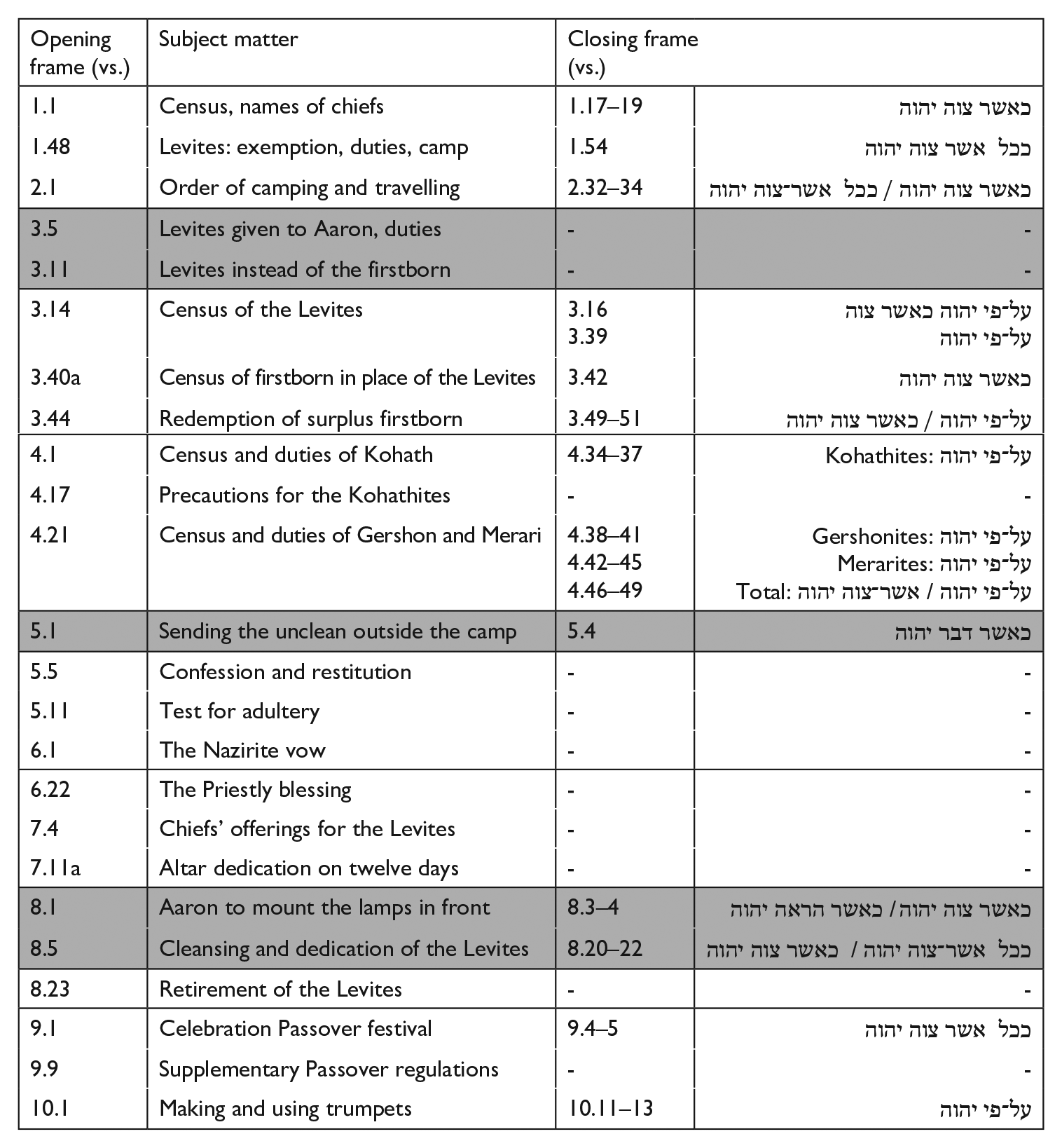
An overview of the quotative frames of all twenty-four divine speeches is here presented:
This overview reveals a concentric structure in seventeen divine speeches according to their closing frames. Its beginning, centre and ending are highlighted in grey. The structure is delineated by its first unclosed divine speech (opened in 3.5), which concludes with the narrative closure in the closing frame of its last divine speech (8.20–22). The command to send the unclean outside the camp is at the centre. It is asymmetrical in its explicit narrative closure: the first two speeches, opened in 3.5 and 3.11, are unclosed and are matched by the last two, which are closed (opened in 8.1 and 8.5). Hence, the occurrence of two closed triads of speeches in Numbers 3 and 4 anticipates the presence of two unclosed triads in Numbers 5–7, though this still requires validation. The closing frames that conclude a triad all contain a double reference to YHWH’s speech (2.32–24, 3.49–51, 4.46–49), therefore closing the triad entirely. Likewise, the double references in the closing frames of 8.3–4 and 8.20–22 indicate their overarching function in supplying narrative closure. Where 8.20–22 closes the concentric structure, the overarching function of 8.3–4 is at this point unclear and requires further investigation (see ‘Validation on the verbal level of literary structure’ below). 9
On the validity of structure in closing frames
A central question concerning the validity of the overarching structure now arises: are unclosed speeches not logically explained by the fact that they contain instructions that cannot be immediately fulfilled? The divine command to bring the Levites before Aaron in 3.6–10, for instance, could not be closed, as the Levites needed counting, instructing and consecrating first. However, the pattern is simply present in the textual data, and the following observations argue for considering the structure as a framework for interpretation.
First, the divine speech in 8.2 commands mount the lamps at the front of the lampstand when lighting them (ב + infinitive construct). This instruction is enduring and thus cannot be immediately fulfilled, yet the speech is closed. The same logic applies to the instructions for the Priestly blessing in 6.23–27, yet this speech is without a closing frame. Likewise, the divine speeches commanding the gifts of the chiefs in Numbers 7 could have naturally been followed by explicit references to their fulfilment. The command to take precautions for the Kohathites is also unclosed (4.18–20), yet it is interwoven in a triad of speeches that is closed in its totality.
Furthermore, the presence of two unclosed speeches in Numbers 3 is remarkable, especially considering the preference for triads in Numbers 1–4. These speeches contain the calling of the Levites and YHWH’s underlying motivation and could logically have been cast into one divine speech. The overarching concentric structure puts these observations into perspective. Nonetheless, this requires validation through comparison with other patterns of structure.
Narrated time and space
Another aspect of narrative technique is the shaping of narrated time and space. A list of chronological and geographical indicators is here presented:
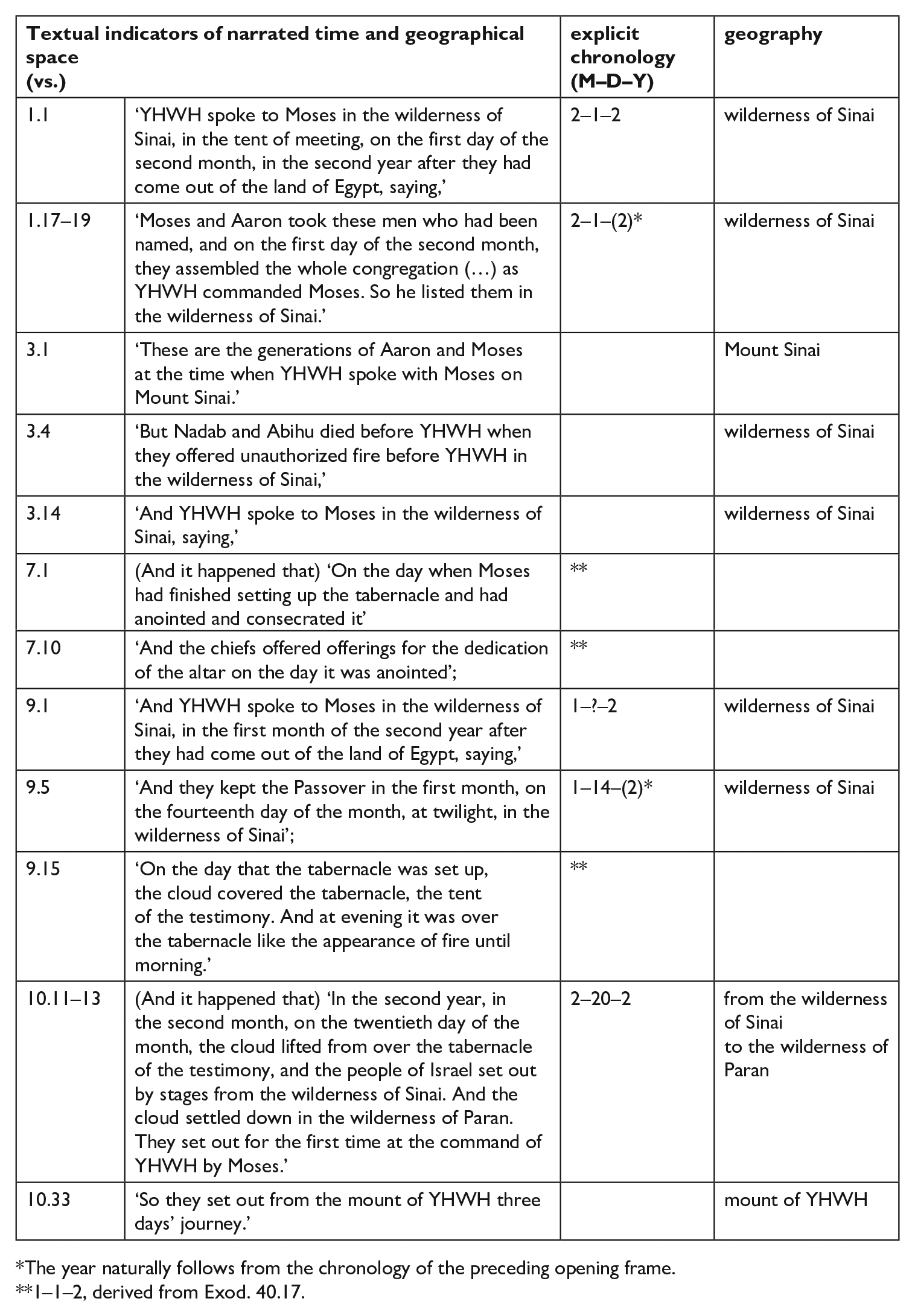
The year naturally follows from the chronology of the preceding opening frame.
1–1–2, derived from Exod. 40.17.
Narrated time
The account of Israel’s departure in 10.11–13 commences with the narrative ויהי, ‘And it happened…’, followed by the date of year, month and day (implicitly reckoned from the Exodus), and finally by the report of the event. This brings two identical markers to mind: ‘(And it happened that) in the first month in the second year, on the first day of the month, the tabernacle was erected.’ in Exod. 40.17; and: ‘(And it happened that) in the fortieth year, on the first day of the eleventh month, Moses spoke to the people of Israel according to all that YHWH had given him in commandment to them,’ in Deut. 1.3. The syntax of 10.11–13, ויהי – date – event, is unique in Numbers. Because literary structure involves stylistic repetition, this marker does not contribute to the structure within the book of Numbers. Rather, it pins Israel’s departure from the wilderness of Sinai on an overarching timeline of a few extraordinary events from the exodus to the erection of the tabernacle and finally to Moses’ grand farewell speech in the plains of Moab. One might add Israel’s arrival in the wilderness of Sinai: ‘In the third month after the people of Israel had gone out of the land of Egypt, on that day they came into the wilderness of Sinai’ (Exod. 19.1). However, though this verse recounts the date before the event, it lacks the ויהי. Consequently, 10.11–13 recalls its last identical occurrence in Exod. 40.17, which is substantiated by their mutual references to the tabernacle in relation to the divine cloud (cf. Exod. 40.34–38).
Numbers 1–10 contains four other instances of explicit chronology. Interestingly, they are part of the quotative frames of two divine speeches: 1.1 and 1.17–19 open and close Numbers’ first divine speech, and 9.1 and 9.4–5 open and close the first divine speech in Numbers 9. Both sets of indicators are unique in their explicit reference to the exodus, in being part of a double quotative frame and in the order of event – date. 10 It is therefore appropriate to consider them as the main chronological markers that structure the text of Numbers 1–10.
Furthermore, there are three distinct flashbacks, and each is closed by reference to an uncompleted situation. The chronological indicators in 3.1 and 3.4 define one textual unit which recollects Aaron’s family situation. It ends with the uncompleted service of Eleazar and Ithamar before Aaron. Secondly, the chronological markers in 7.1 and 7.10 introduce a flashback to the time the tabernacle was erected and anointed with the altar and to the following days of dedication (7.1–88). It is completed by recounting Moses’ recurrent speaking with YHWH (7.89). Thirdly, the narrative departs from the main flow of time in 9.1–14 by recounting the Passover commands and celebration in the previous month. It is marked off by 9.15–23, which recounts the anticipatory ending of the book of Exodus (Exod. 40.34–38). Technically 9.15 is a flashback, yet it is employed to open an uncompleted anticipation of Israel’s compliance with YHWH’s guidance in travelling. Following all three chronological deviations, the typical opening frame of divine speech picks up the main flow of narrated time, as defined in 1.1 (3.5, 8.1, 10.1).
Some scholars perceive 7.1–9.15 as one flashback to the first month, seeing an inclusion in the recurring reference to the day the tabernacle was set up, which fits with the reference to the first month in 9.1 (e.g. Milgrom, 1990: xii, xxix; Wenham, 1981: 4, 103; Ashley, 1993: 43, 153). 11 However, this is untenable, for it chronologically places the dedication of the Levites (8.5–22) before their calling (3.5–13). Moreover, it is not congruent with the clear break between Numbers 8 and 9 in the shaping of direct speech (also situated on the level of narrative technique).
Narrated geographical space
Most geographical references occur together with chronological references in the opening frames of direct speech, yet they do not appear to be part of the literary structure within Numbers 1–10 (e.g. Lee, 2008: 476). Israel’s departure from Sinai in 10.12 is recounted also in 10.33, suggesting that these markers are part of one literary pericope.
Validation on the verbal level of literary structure
It is necessary to investigate how structure in narrative technique corresponds with structure in verbal patterns. So far, the analysis of two aspects of narrative technique, the structure of direct speech and of narrated time and space, results in a division of Numbers 1–10 into two sections:
Numbers 1–8 opens with the first divine speech and the first main chronological marker: the first day of the second month of the second year. It consists of twenty-one direct divine monologues and has two sub-sections:
Numbers 1–2 contains a distinct triad of direct divine speeches. Numbers 3–8 contains an overarching concentric structure of seventeen direct divine speeches and one additional divine speech.
Numbers 9–10 opens with the twenty-second divine speech and the second main chronological marker: the fourteenth day of the first month of the second year. It is characterized by direct speech of different characters and direct discourse.
How does this relate to the verbal content of these chapters?
The overarching concentric structure of divine speeches
The first two speeches of the concentric structure contain YHWH’s instructions and motivation for the installation of the Levitical service (3.6–10, 12–13). From there, verbal repetitions are found throughout Numbers 3 and 4, yet they accumulate intensively in the last divine command of the main structure (8.6–19), as is widely recognized by scholars. 12 A selection is here presented:

Consequently, the account of the cleansing and dedication of the Levites in 8.20–22 fulfils not only the first but also the second unclosed divine command in the speech in Numbers 3.
The first panel of closed speeches in Numbers 3 and 4
The triads in Numbers 3 and 4 are distinct in their numbering and instruction of the Levites for service of the sanctuary. The first triad in Numbers 3 primarily deals with the guard duty or watch of the tribe of Levi, characterized by משמרת ,שמר. This is worked out in the second triad in Numbers 4 with detailed instructions for each family particularly concerning their physical work in transporting the tabernacle, characterized by עבדה ,עבד. 13
Typical of these triads is the presentation of the Levitical organization by a distinctive sevenfold על־פי יהוה, ‘at the command of YHWH’ (3.16, 39, 51, 4.37, 41, 45, 49). According to Milgrom (1990: xxxi), this accentuates YHWH’s special interest in the census of the Levites, yet it also distinguishes these triads as the first panel in the main concentric pattern. 14
The second panel of unclosed speeches in Numbers 5–7
The asymmetrical relationship with the closed triads in Numbers 3 and 4 anticipates the presence of two unclosed triads of divine speeches in Numbers 5–7. The first three unclosed speeches with opening frames in 5.5, 5.11 and 6.1 present strong verbal connections. They commence with a nearly identical command and casuistic formula, that is, ‘Speak to the people of Israel (and say to them, …) “If a man or woman/a man’s wife”’ (5.6, 5.12, 6.2). Only the first casuistic law concerning restitution has a parallel, in Lev. 5.20–26 (6.1–7 in many translations). A comparison illustrates the present concern for the priestly representation of YHWH in social relationships, in this case as redeemer (ליהוה לכהן, גאל, 5.8–10). Accordingly, the triad demonstrates a shared interest in the function of the כהן, with twenty-three out of thirty occurrences in Numbers 1–8. This is commonly recognized, as is the presence of the semantic domain of purity and sacrifice. 15
The establishment of a first triad of unclosed speeches naturally leaves a group of three (opened in 6.22, 7.4, 7.11a), of which the last two speeches share the same context, namely, the dedication of tabernacle and altar. The place of its first speech, the Priestly blessing in 6.23–27, raises questions. This passage has been investigated extensively and is commonly seen as a climatic conclusion to preceding legal material. 16 However, its position at the beginning of a triad directs the search for verbal connections forward. Consequently, remarkable verbal connections are found with the speech concerning the lighting of the lamps in 8.2. Both are uniquely directed to the priests: ‘Speak to Aaron …’ (6.23: ‘and his sons’, 8.2), and both demonstrate an unparalleled linking of אור, ‘to give light’, פנה, ‘face/in front of’ and the preposition אל, ‘toward’ (6.25, 8.2–3, אליך and אל־מול). 17 Consequently, the priestly blessing and the priestly service of the Menorah are interrelated and encompass the story of the gifts of the twelve chiefs. This substantiates the expected overarching function of the closing frame of the Menorah command (8.3–4, see ‘Overarching structure of divine speeches’ above). 18
Moreover, the blessing of the face of YHWH connects to the occurrence of a sevenfold פני יהוה in the two unclosed triads (5.16, 18, 25, 30, 6.16, 20, 7.3). It is related to the verb קרב, to come near/bring near, which occurs thirteen times, accompanied by a variety of offerings and a multitude of sacrificial animals. Only here is קרב used for the safe approach of non-Levites with their offerings. In the first panel, it is used once for the approaching stranger who is to be put to death (3.38). 19
Numbers 8 ends with an unclosed divine speech about the retirement of the Levites (8.24–26). The verbal connections of שמר /משמרת and עבדה/עבד with the Levitical service in Numbers 3 and 4 link this speech as an appendix to the overarching structure of divine speeches. They are not used for the Levites in Numbers 9 and 10. The absence of a closing frame creates an open end.
Verbal connections in Numbers 9 and 10
In Numbers 9 and 10, one verb stands out: נסע, to set out. Together with its noun מסע, stage or setting out, it occurs twenty-nine times after the Passover instructions in 9.1–14. 20 In the anticipation of Israel’s obedient journey in 9.15–23 (see Exod. 40.34–38) only the verb is found. 21 However, the rare noun occurring twice in Exod. 40.34–38 appears four times in Numbers 10, twice in the divine speech about the trumpets and twice in the following narrative (10.2, 6, 12, 28). Consequently, the predominant root נסע unifies both chapters under the theme of departure. 22
The Passover commands (9.2–3, 9.10–14) are not part of these verbal patterns. However, together with the command regarding the trumpets (10.1–10), these three divine speeches contain statutes for future generations at appointed times (חקה, דור, מועד). They have what Condren (2013: 445) calls ‘a shared concern for timing’, which relates them to the concept of נסע.
Implications for interpretation
A final question to be answered is what the observed correspondence between patterns of narrative technique and verbal patterns implies for the conceptual level of literary structure.
The Passover inaugurates Israel’s departure from Sinai
The analysis of direct speech, chronological and geographical markers, and verbal relationships clearly confirms the identification of the divine command to keep the Passover at the start of Numbers 9 as the main textual divider in Numbers 1–10. The recounting of the Passover after Numbers 1 to 8 – although occurring earlier – serves as the inauguration of Israel’s departure from Sinai, which is the main theme of Numbers 9 and 10. This clearly recollects the role of the Passover in the exodus narrative. Hence, the narration of the Passover is most likely delayed until after the travel preparations so that here too the Passover can open the narrative of the journey from Sinai as it did the exodus from Egypt. The theme of the redemption of Israel and its firstborn is therefore expected to shape the plot of the unfolding journey to the promised land.
However, the account of the Passover celebration in the first month (9.1–5) is generally interpreted as merely an introduction to additional Passover regulations (9.6–14). 23 The general logic is that 9.1 cannot form an essential part of the overarching structure, for it must be a later addition to the text because it recounts the Passover too late. While it certainly performs such an introductory role, the study of narrative technique reveals a profound shaping of narrated time, giving this account a programmatic function in Numbers 1–10. However, most often a programmatic role is instead ascribed to the chronological and geographical marker of Israel’s departure in 10.11–13. This marker is selected in correspondence with the common conceptual division of the text into a time and place of preparation (1.1–10.10) and of the actual campaign (10.11ff). A thorough analysis of chronological markers by Lee (2008: 477) explicates the general rational: in the end, 10.11–13 is selected as the main indicator because it best supports this conceptual division. 24 However, a bottom-up analysis of stylistic repetition which integrates chrono-geographical markers into a broader analysis of literary structure reaches a different result. Certainly, 10.11–13 creates a chrono-geographic structure, yet this is not automatically the same as literary structure. In this case, the textual association of Passover and departure renders a depth of literary meaning that is easily missed when analysing the text through a preconceived chrono-geographic lens.
As smaller units are together capable of forming larger structures, it follows that 10.11–13 cannot bear the weight of closing a large body of text such as the Sinai-pericope (cf. Exod. 19.1). Neither can 9.15 or 7.1, because this is simply not supported by the literary composition of Numbers 1–10. Consequently, these markers are not able to contribute to the overarching structure in the remainder of the book either. Rather, alongside the main chronological markers that open Numbers 1 and 9, they play a supporting role in picking up the narrative thread of Exodus 40 and helping the reader who had come all the way through Leviticus to be reoriented and continue the journey.
Hence, a literary analysis of Numbers 1–10 shows that its common division into a period of preparation (1.1–10.10) and of campaign (10.11ff) is understandable but not necessarily meaningful. Such a division is, for example, prone to primarily evaluating the Levitical work in Numbers 3–8 in terms of a campaign, which consequently obscures the assessment of the casuistic laws in Numbers 5 and 6, which will now be considered (e.g. Seebass, 2012: 1-10, 23).
Embraced and sustained by the tribe of Levi
The analysis of direct speech and of verbal patterns resulted in the identification of a concentric structure of divine speeches in Numbers 3–8. One would logically expect the dedication of the Levites immediately after Numbers 4. 25 However, its narration is postponed until 8.20–22, creating an inclusion which brings all the intervening textual material under the canopy of Levitical service. This prompts us to consider the rational of the textual relationships that thus emerge.
The textual centre of the concentric structure in 5.1–4 focuses attention on the work of the Levites: their concern is the purity of the camp because of the dwelling of YHWH in its midst. 26 It connects with the Levitical responsibility and guard of the tabernacle and their camping around it, as designed in Numbers 3 and 4. This had been announced in the middle speech of Numbers’ first triad (1.49–53): ‘and if any outsider (זר) comes near, he shall be put to death’ (1.51, 3.10, 38). This also sheds light on Aaron’s genealogy in 3.1–4, which introduces the overarching structure along with this theme: two sons died while bringing strange (זר) fire before YHWH, and two sons live to oversee the protection of the Israelites so they do not suffer a similar fate.
Now that a whole tribe has been privileged to deal with the sancta and elected as cordon sanitaire according to a distinctive sevenfold פי יהוה (3.14–4.49), and the camp is to be purified (5.1–4), one question seems to surface, namely, how can the other tribes of Israel approach the face of YHWH for his blessing? This is the subject of the second panel of the overarching structure with a distinctive sevenfold פני יהוה (5.5–7.89). A triad of casuistic laws illuminates the crucial role of the priest as YHWH’s representative in unsettled social and family affairs (5.6–10), in marital issues needing a divine verdict (5.12–31) and for any individual man or woman who wants to dedicate themselves to YHWH as a Nazirite (6.2–21). Purity and sacrifice are required for safely passing the Levitical barrier. Numbers 7 recounts the safe approach of representatives of the ‘ordinary’ tribes before YHWH to bless the Levites with gifts for their service. 27 However, these gifts are preceded by the verbal blessing and followed by the symbolic blessing of YHWH’s face (6.22–27, 8.1–4), both through priestly service. 28 This literary connection embodies in a nutshell the new dynamic between Levites and non-Levites: the Levitical service is supported by all Israelites who are concurrently embraced and sustained by the blessing of YHWH as mediated by the priests. The same dynamic is embodied by the concentric structure on a larger textual scale. 29 Moses is placed under the Levitical canopy too, as was anticipated by his unexpected appearance in Aaron’s genealogy (3.1): he is lastly pictured within the new spatial hierocracy as speaking with YHWH before the veil in the light of the Menorah (7.89, cf. 8.4; Milgrom, 1990: 60, 365–366).
In conclusion, the study of narrative technique adjusts an imbalance in the common evaluation of the Levitical service in Numbers 1–10, which mostly appreciates its aspect of עבדה, the transport of the tabernacle. A similar awareness of משמרת, the Levitical guard of the sanctuary, particularly illuminates the placement of its most discussed chapters 5 and 6. This clarifies the delicate interrelation between Levites and non-Levites, adding dynamic and depth to the spatial organisation of Israel’s camp.
Law as narrative
Finally, the relationship between narrative and law in Numbers 1–10 is also nuanced. Milgrom (1990: xv) clusters the entire section of 1.1–10.10 under law, yet Seebass (2012: 16) sees it as mainly narrative with five laws in Numbers 5 and 6. An awareness of narrative technique puts this difference of opinions into perspective. Accordingly, when YHWH orders a detailed dedication ritual for the Levites in 8.6–19, its fulfilment is only briefly narrated in 8.20–22. Hence, YHWH is given the privilege of recounting this event. Technically, the divine speech receives a narrative function through its closing frame. Conceptually, law functions as narrative and contributes to the development of the plot.
The same narrative technique is operative in the two Passover commands in 9.1–14. The first command (9.2–3) prompts the question of the unclean and leads to the supplementary law to observe the Passover in the second month (9.10–14). Unlike the Passover celebration in the first month, the delayed Passover itself is not recounted but implied, and so the command performs the function of guiding the reader back to the main flow of narrated time, the second month (cf. 1.1). Similarly, the actual making and using of the silver trumpets that signal Israel’s departure, as commanded in 10.2–10, is not recounted, yet the divine law is immediately followed by the account of Israel’s departure (10.11–36). This implies that the trumpets were made and used. Consequently, placed where it is, the speech of YHWH performs the very act of sounding the trumpet for departure. This again argues for the unity of 10.1–10 and 10.11–36, and Numbers 9 and 10, along the theme of departure. 30
Conclusion
The structure of Numbers 1–10 has often been investigated by relating verbal to conceptual patterns, though this has not resulted in scholarly consensus. The present study takes a more integrated approach by particularly investigating a feature of literary structure that Shimon Bar-Efrat called narrative technique. Accordingly, a comprehensive analysis of direct speech, discourse and chronological indicators identifies the divine speech opening Numbers 9 as the text’s main divider. This is supported by verbal patterns and consequently results in a meaningful conceptual structure: it is the Passover that inaugurates Israel’s departure from Sinai. Numbers 9 and 10 are unified by the theme of departure. Scholars generally agree that the account of Israel’s departure from Sinai in 10.11–13 functions as the main divider in Numbers 1–10, distinguishing 1.1–10.10 as a time and place of travel preparations. However, an integrated study of structuring elements shows that this is not supported by the text. This raises questions concerning its supposed overarching function in closing an extensive ‘Sinai pericope’ or opening a section of wanderings in the book of Numbers.
In addition, the last days of Israel’s stay at Sinai are presented as more than a time of travel preparations. The Levites are elected to facilitate the transport of the tabernacle and also to guard it. Numbers 3–8 describes their function as cordon sanitaire around the tabernacle and explains how the tribes of Israel are able to safely approach the face of YHWH to be blessed. This dynamic between closure and opening (access) is embodied in the text through an interplay of closed and unclosed divine speeches within a Levitical inclusion that is formed by their initial calling and their final dedication. In light of this, the study of narrative technique seems promising for discerning literary structure in the challenging book of Numbers, which bears marks of profound literary artistry.
