



Abstract
This article illustrates the importance of considering the narratological implications of textual variations in the Septuagint, the Greek translation of the Hebrew Bible. While these differences have traditionally concerned textual critics, this study argues for their importance in the field of narrative analysis as well. Using the divergent readings in 1 Samuel 10.5 and 1 Sam. 13.1–4 as a case study, the article analyzes the potential meaning and implications of these textual variants by showing how the different readings can offer new perspectives and uncharted avenues of interpretation, expanding our understanding of the Greek text as a distinct literary work. By bridging textual criticism and narrative analysis, this article aims to contribute to a deeper appreciation of the narratological dimensions inherent in the Septuagint and highlight its significance in the broader field of biblical narratology.
Keywords
Introduction
The Septuagint (LXX), the Greek translation of the Hebrew Bible, contains numerous textual differences from its Hebrew counterpart. While these differences have traditionally been of interest primarily to textual criticism, this study argues for the importance of considering the narratological implications of these divergent readings. In light of recent methodological discussions aimed at theoretically delineating the narratological approach to the Septuagint, this study shows how variant-oriented narratology can provide valuable insights into the narrative dynamics and interpretive possibilities of the Septuagint. As a case study, I will focus on the divergent readings in 1 Samuel 10.5 and 13.1–4 in the Masoretic Text (MT) and Codex Vaticanus (LXXB), analyzing the potential significance and implications of textual variants at the narrative level. The purpose is to show how different readings can offer new perspectives and uncharted avenues of interpretation, expanding our understanding of the Greek text as a distinctive literary work in its own right. Through a dialogue between the findings of textual criticism and the insights of modern narrative analysis, this article aims to contribute to a deeper appreciation of the narratological dimensions inherent in the Septuagint and to enrich our understanding of its significance within biblical narratology.
After some preliminary methodological considerations, I will proceed with the textual analysis of the sections chosen as case studies. Finally, in light of the preceding discussion, new potential research directions of textual variant-oriented narratology will be outlined.
Almost the same story: Narratology and the Septuagint
The dialogue between the theoretical and methodological insights of the semiotics of narrative and literary theory with biblical text has aroused, as is well known, keen interest among scholars in recent decades. Alongside early pioneering works and methodological expositions, there are many authors who have applied—with more or less success—the typical tools of narratology to the Bible. 1
Nevertheless, the vast majority of efforts to apply a narrative approach to the Bible have as their object of analysis the Hebrew text in its so-called ‘final form’, embodied in the ‘Masoretic Text’ (MT). Considerably less attention has been paid to the possibility of approaching the Greek version of the Bible with the same narratological critical tools. This hesitation is perhaps the result of scholars’ awareness that the Greek text of the Bible is not the product of the creative work of one or more authors but the result of a long process of translating into Greek a text written in a different language (Hebrew). 2 This is probably why the (few) authors who have attempted to apply a narrative approach to the text of the LXX focus more on the process of translation than on the narrative dimension of the texts analyzed. 3
Indeed, the peculiar character of the Septuagint as an ancient translation from a Semitic to an Indo-European language represents, on the linguistic level, a literary unicum that has attracted the attention of many scholars. 4 The most evident expression of this interest is the abundance of studies on so-called ‘translation techniques’ that aim to record the peculiarities of the translation process that led from the Hebrew Vorlage to the readings we find in the available codices and papyri. 5 This unique linguistic situation between the two versions of the Bible undoubtedly facilitates the comparison between the Greek and the Hebrew text and, ideally, facilitates the reconstruction process through a retroversion of the Greek readings to what must have been the Hebrew source text. 6 Moreover, the critical comparison between the Hebrew and Greek Bible reveals not only macro differences between the two corpora, such as the books found in the Greek version and not included in the Hebrew canon, but also discrepancies within those books that are present in the Hebrew version: different titles, variations in the sequence of the books, differences in content, and cases in which the Greek Bible presents a dissimilar tradition or a different edition from that reported by the MT. 7 Even greater are the differences at the micro level, that is, when the two texts are subjected to the scrutiny of textual criticism. The causes can be varied: errors or difficulties in reading the Hebrew, different vocalizations of the Hebrew text, the linguistic competence of the translators, their specific translation technique, or even theological and modernizing interpretation. 8 The sum of these differences leads to a new textual outcome, whereby the LXX, as N. Fernández Marcos notes, ‘cannot be considered a simple reproduction of the original Hebrew text, but an autonomous literary work organized around a new constellation of meaning within the Greek system’. 9 This literary dignity of the Greek Bible has been emphasized by scholars mostly where the two versions diverge significantly. 10 R. Hendel, for example, referring to the famous divergence between LXXB and MT in 1 Sam. 17, in the context of narrative analysis, says, ‘We need to read each narrative, text, and edition in its own right, and to read them in their interpretive and intertextual relations with each other’. 11
Theoretically, for the purposes of narrative analysis, it is possible to extend the suggestion offered by Hendel to any text in which even a small deviation is present. 12 Indeed, a text—or a group of texts—that provides a certain reading implies that in a certain place and at a certain time that text was read as it is, regardless of the series of textual events that produced that form. 13 If divergence is found, for the purposes of narratological analysis, it is irrelevant whether it is due to a different Vorlage, an oversight on the part of the translators or scribes who transmitted the text, or a deliberate choice of the translators. 14 Whatever the reason, even the smallest variation has the effect of producing a different text in the eyes of readers, potentially affecting, for example, the narrative dynamic, the characterization of a character, the spatiality and temporality of the story, or the isotopic and semantic pathways that the text constructs. 15 Of course, this does not mean that every deviation is necessarily significant for narrative analysis, but their relevance for narratological purposes must be evaluated case by case. However, if readings are considered significant at the narratological level, it should be noted that they produce alternative versions of the same stories, sometimes without relevant narrative implications but, in other cases, with consequences for the plot interpretation. From this point of view, where there is divergence, the Hebrew version and the Greek version present the readers with stories that are similar to each other, sometimes very similar, but not perfectly identical. In this sense, even a slight deviation can orient the understanding of certain plot elements differently and open different interpretive spaces between the two versions. The task of the analysis will be, therefore, to point out these divergences by emphasizing their respective implications for the narrative.
Before proceeding, it must be considered which Greek text of the Bible should be subjected to narratological analysis. Comparing the Greek witnesses with each other, one quickly realizes that the text of the Greek translation is not unified. A brief consideration of the variants recorded in the critical apparatus of the so-called ‘Cambridge edition’ (Brooke-McLean) suggests how readings may vary not only between the Greek text and the MT but also between the various Greek witnesses. While it is certainly true that, as L. Pessoa da Silva Pinto points out, assuming a single manuscript as ‘representative’ of the text of the LXX is problematic, 16 it is also true that, at a theoretical level, each individual witness with its own variants, deviation, or scribal errors can potentially generate new narratological dimensions in its own right and, consequently, reflect a narrative form different from that of other witnesses. Consequently, I consider it fruitful to think about the narratology of the LXX by orienting it to the different readings found in the witnesses available to us, identifying in each of them the relevant narratological implications—if any. It goes without saying that, methodologically, such an approach relies on an essentially comparative analysis between the chosen Greek witness and the MT, on a knowledge of the narrative peculiarities of the Hebrew text, and on a mastery of the tools of contemporary narratology. 17
In light of this brief overview, the intention below is to show the potential of a variant-oriented narratology of the LXX. As a case study, I will focus on 1 Sam. 10.5 and 13.1–4 comparing the Hebrew text of the MT to the Greek counterpart given in the Codex Vaticanus (LXXB)
Knowing ‘Nasib’: Narrative implication of 1 Sam. 10.5 and 13.1–4 in LXXB
An interesting example of the narratological implications of different readings is the case of 1 Sam. 10.5 and 1 Sam. 13.1–4 in LXXB with respect to their counterparts in the Hebrew text. In the first one, after anointing Saul as ruler over Israel (1 Sam. 10.1), the prophet Samuel instructs the young king on the next steps to be taken to secure victory over the Philistine troops near Gibeah. In the MT and in the LXXB, we read:
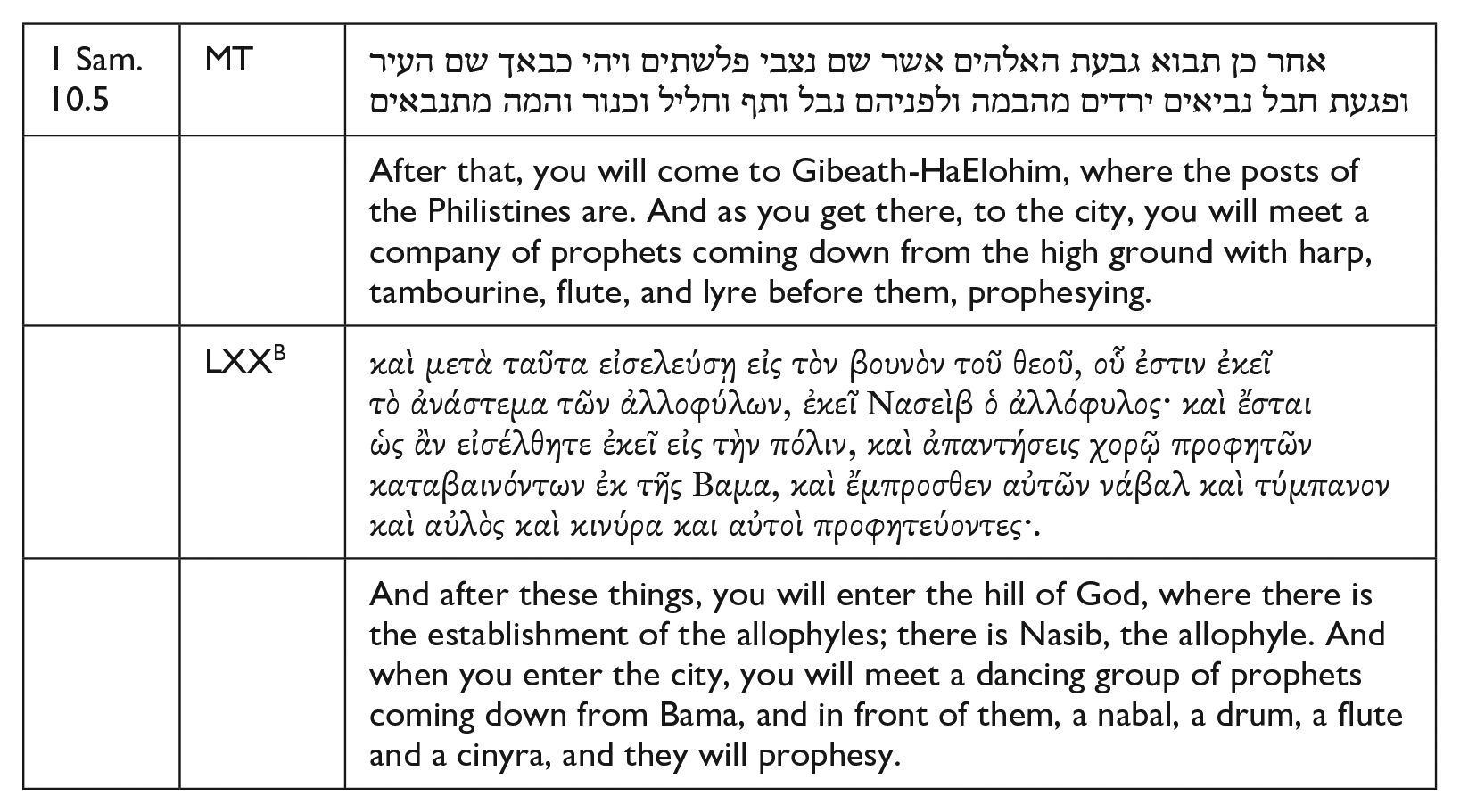
Leaving aside the different spatial configurations of the narrative world that the two texts create, 18 I will focus on the most evident divergent aspect at the narratological level: the introduction of a new character in the story in the LXXB, Nasib the allophyle. 19 Of course, if one approaches the problem from the point of view of the Greek rendering, it is plausible that, in this case, the introduction of this character is a direct consequence of the translator of Samuel’s tendency to resort to transliterations to solve translation problems or ambiguities in Hebrew. 20 In this sense, it is reasonable to assume that the name Nasib (Νασείβ) is the rendering of the Hebrew נצבי (‘outposts of’), the meaning of which was perhaps not so clear to the translator. 21 If so, this reading is not significant in the reconstruction of the Hebrew Vorlage of this text. Moreover, the Greek Νασείβ is not an exact transliteration of the Hebrew נצבי. Notwithstanding this, and whatever produced these renderings, it seems reasonable to assume that the rendering of the name Νασεὶβ connected to the Hebrew נצבי, may be based on Joshua 15.43, where Nasib is the name of a city in the inheritance of Judah. 22 In a study on the transliterations in the Greek versions of the Bible, Tov (1999b: 507–12) also classified this phenomenon into four categories: (a) Personal name, geographic name, and ethnic names, both single and compound; (b) Technical terms, often belonging to the field of religion, architecture, measures and weights; (c) Rare words and hapax legomena probably unknown to the translator; (d) Transliteration of common nouns erroneously transliterated as proper nouns because of the context. In the lists of examples provided by Tov in the appendix to his analysis, the case of 1 Sam. 10.5 does not appear, nor does the case of 1 Sam. 13.3–4, where Nasib the allophyle is mentioned again. However, while one can certainly assume the case of a common noun transliterated as a proper name by mistake (d), it is also possible that the root נצב was unknown to the translator or, at least, ambiguous to him (c). The number of occurrences, both singular and plural, is quite low (Gen. 19.26; Josh. 15.43; 1 Sam. 10.5; 13.3–4; 2 Sam. 8.6, 14; 1 Kgs. 4.19; 1 Chr. 11.16; 18.13; 2 Chr. 8.10; 17.2), and only one of these is in the Torah which, according to Aejmelaeus (2021: 218), ‘must have been well known to the translator’. Moreover, the meaning of the Hebrew ב(י)נצ is actually uncertain. In addition to ‘outpost’, it can mean ‘pillar’ (i.e., Gen. 19.26) or ‘governor’ (i.e., 1 Kgs. 4.19; 2 Chr. 8.10).
However, from a narrative point of view, what is relevant is that readers of Codex Vaticanus, and all manuscripts containing the same reading, were confronted with a new character, unknown to readers of the Hebrew text. In the context of narrative analysis, since, as noted by H. Grabes, sentences create ‘people’, the presentation of a new character brings with it inevitable consequences at the level of interpretation by adding a level of complexity to the narrative. 23 In constructing the narrative world presented by the text, readers of 1 Sam. 10.5 in the LXXB (as opposed to the MT) will imagine a specific establishment of the allophyles (τὸ ἀνάστεμα τῶν ἀλλοϕύλων) in which (ἐκεῖ) an individual identified by a proper name and worthy of mention among other allophyles is located. 24 At the level of characterization, this passage does not provide much information. It is significant that in the fictional world of the LXXB, Samuel, speaking to Saul, may refer to this character by name, trusting that his interlocutor, thus far an ordinary inhabitant of the territory of Benjamin, knows who this individual is. This suggests that Nasib is, in that narrative world, someone whose fame is somehow recognized in that geographical area.
Despite this information, as Uri Margolin notes, ‘To establish the naked existence of an individual in a given story state is a necessary but by no means sufficient condition for turning him into a literary character’. 25 In fact, with these few data, at the level of narrative dynamics and influence on the plot, the brief appearance of this character does not seem a significant change in the Greek text compared to the Hebrew text. In the chapters that follow, the story of Saul’s reign proceeds with the account of the young king appointed by fate (1 Sam. 10.17–27), the military victory against Nahash and the Ammonites (1 Sam. 11), and Samuel’s farewell announcement to the people (1 Sam. 12). Chapter 13 opens a new narrative unit (1 Sam. 13.1–15.35) in which the threat of the Philistines provides the backdrop for a series of episodes that are not always well connected to each other. 26 1 Sam. 13–14 constitutes the first narrative sub-unit that closes with a summary (1 Sam. 14.47–52) and whose first scene presents the formation of the armies in the field (13.1–7). 27 This scene’s first part recounts the battle’s first phase, which sees a military victory for Jonathan (13.1–4). However, the narrative shows some differences between the Hebrew text and that of the LXXB: 28
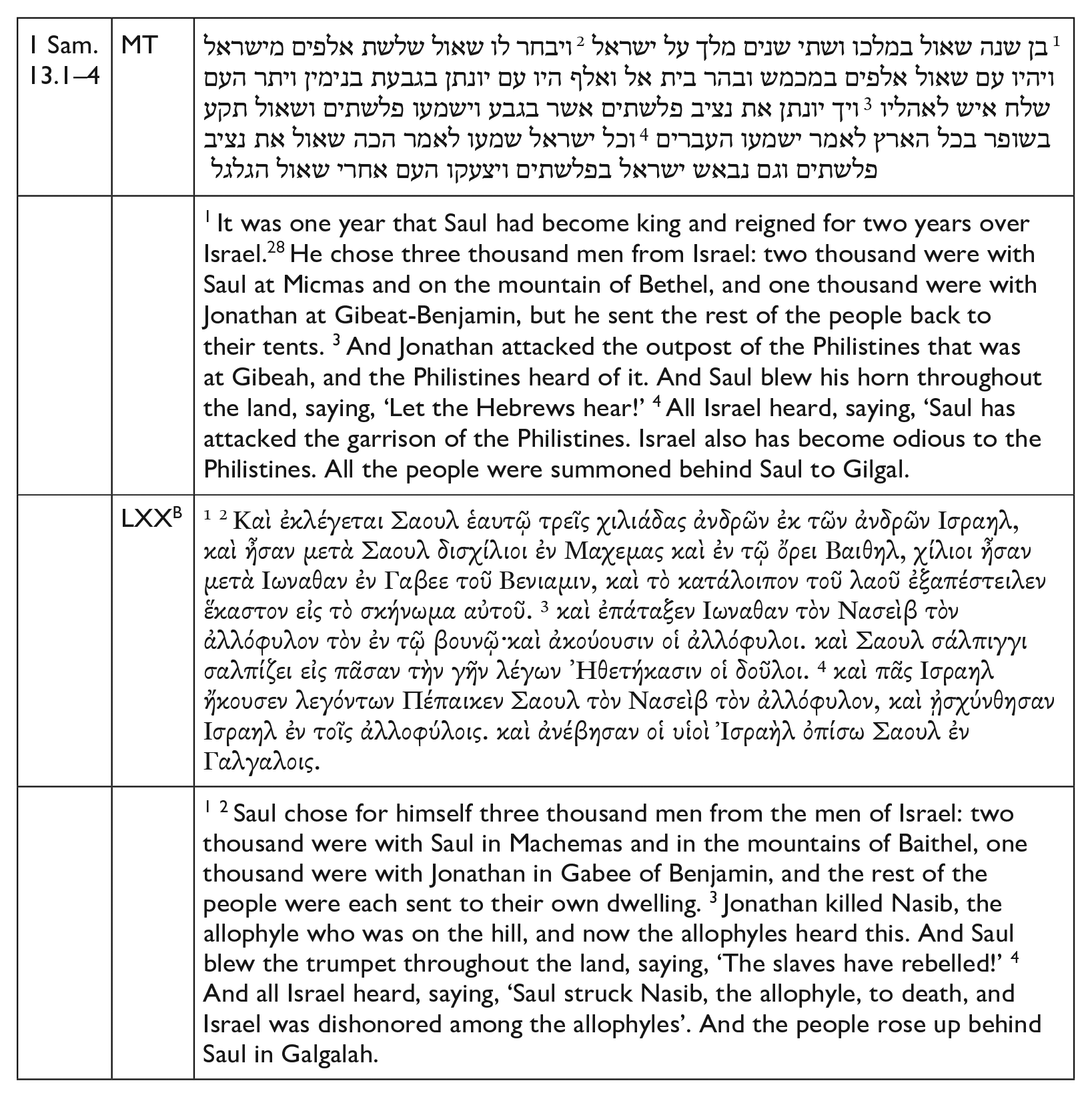
At the narrative level, the first relevant factor is the absence of the temporal datum (v. 1) in the Greek version. This difference between MT and LXXB creates a significant variation in the narrated time, conveying two different views of the early years of Saul’s reign. 29 On the one hand, MT places the events of 1 Sam. 13 in the middle of Saul’s reign, suggesting that the young king ruled without noteworthy problems for one year. On the other hand, the absence of the temporal reference in LXXB suggests that the events narrated in 1 Sam. 13—including the cultic transgression in 1 Sam. 13.8–15—are to be placed at the beginning of his reign, alerting the readers to a problematic king from the very beginning of the rule.
However, what is most surprising is that in the Greek text Nasib the allophyle reappears on the stage. Thus, from a synchronic point of view, the mention in 1 Sam. 10.5 of Nasib the allophyle can be understood as introducing readers to a character who will play a role in the context of a battle a few chapters later. Although the textual situation is probably similar to the previous one, namely the transliteration of the Hebrew נציב by the Greek translator, it now introduces an intriguing narrative difference between the MT and the LXXB. On the one hand, in the Hebrew version, Nasib the allophyle is a character completely unknown to readers. On the other hand, for readers of the LXXB, Nasib is a character who fully occupies a position among the agents present in the narrative world of 1 Samuel. 30 In addition, this particular passage not only mentions the character’s name, as seen in 1 Sam. 10.5, but also adds a layer of complexity to the story by highlighting his direct interaction with Jonathan, one of the main characters in the story. 31 This interaction adds depth to the overarching narrative that focuses on the dynamics between Israel and its adversaries, as well as the impact of individual characters’ choices on the plot. 32
In the context of narrative analysis, the narratological implications of this different reading in the text of the LXXB can be measured on at least two levels. The first is at the micro level, or sub-unit level, and concerns the influence that this variation has on the narrative unit in which it is found. The second is at the macro level and concerns how the different reading in the Greek text generates implications on a larger scale in the context of the book of Samuel in the LXXB. Of course, these two levels do not constitute two alternative analyses of each other. On the contrary, they collectively contribute to the understanding of a distinctive process of meaning-making that clarifies the broader patterns and poetic devices that are particular to the LXX. Moreover, as indicated in the previous section, it is appropriate evaluate this process in light of the narrative present in the MT in order to highlight its similarities and differences.
At the micro level, Jonathan’s act of killing Nasib changes the context of the early stages of the battle. Unlike the MT, where Israel’s military action takes place in the context of two armies vying for victory, the LXXB presents Jonathan’s action as a targeted act against a single individual in the opposing group, as the Philistine outpost is absent in the Greek version. This act of violence resonates within the enemy group, spreading to other allophyles who learn of it. The effects on the opposing army confirm in the readers the inference elaborated already in 1 Sam. 10.5, namely that Nasib is a noteworthy character within the ranks of the enemies. Indeed, in the Greek text, his death is experienced as a significant event, so much so that it resonates among the enemy people. However, the event of his death also affects the ranks of Israel. Specifically, in the LXXB, Saul’s response to Nasib’s death seems to accentuate the implications of this event since, subsequent to Jonathan’s triumph, the king proclaims victory by blowing a trumpet and declaring, unlike MT, ‘The slaves have rebelled’. This statement, which diverges from the one Saul utters in the MT, directly links Nasib’s death with Israel’s emancipation from a state of subjugation, portraying Nasib’s elimination as a decisive act of rebellion against the enemy group. Therefore, the Greek narrative implies that Nasib’s death represents the initial step toward a potential conflict or broader revolt. The reaction of the Israelites when they learn of Nasib’s death in the Greek version is also significant. Whereas in the MT, Israel recognizes that victory over a military outpost involves becoming ‘odious’ (באש) in the eyes of the enemy, in the LXXB all the people recognize that ‘Israel has been disgraced (αἰσχύνω) among the allophyles’. This reaction emphasizes the negative consequences and damage to the Israelites’ reputation resulting from Jonathan’s actions, but the responsibility for which is attributed by the people to Saul (v. 4). 33
At the macro level, the defeat of Nasib by Jonathan allows, for example, for an intriguing parallel not possible in the MT, namely, a closer connection between the episode of Jonathan against Nasib and the narrative of David against Goliath in 1 Sam. 17–18. In this sense, from a synchronic point of view, the confrontation between Jonathan and Nasib prefigures David’s battle against the Philistine giant in the Greek version, which is much shorter and leaner than its Hebrew counterpart and allows, on a narrative level, a comparison between the two episodes.
Of course, it is easy to identify differences between the two accounts. For instance, in 1 Sam. 13.2–4, the conflict centers on the Israelites and the allophyles, with Jonathan’s killing of Nasib as the pivotal event in that specific battle. On the other hand, in 1 Sam. 17, a more focused conflict emerges between David and Goliath, creating a situation where the destiny of the entire people of Israel is at stake. Despite these differences, both episodes share a common narrative pattern: introducing the characters, establishing the conflict, and ultimately resolving it through the enemy’s demise. 34 Moreover, it is remarkable that some themes in the Greek version refer to each other, creating cross-references between the two episodes. Not only are courage, loyalty, and the triumph of the losers recurring motifs in both episodes, but, for example, the theme of slavery is explicitly referred to both by Saul’s speech to Israel after Nasib’s death (1 Sam. 13.3) and by Goliath’s challenge (1 Sam. 17.9) to the Israelite army. 35 In addition, some details underscore substantial implications that bear on the overall interpretation of the episodes. While the text of 1 Sam. 13.2–4 makes explicit that Jonathan faces the battle against Nasib accompanied by 1000 men that Saul had provided for him (1 Sam. 13.2–3), David’s rejection of any armament provided by Saul emphasizes David’s faith in God (1 Sam. 17.45) and his unconventional approach to battle. This difference in attitude also leads to different outcomes in the narrative. Rejecting Saul’s militaristic approach, which is accepted instead by Jonathan (1 Sam. 13.2–3), David interprets Goliath’s threat as the allophyle’s challenge to Israel’s God (1 Sam. 17.26), then concludes that his victory will be an affirmation of YHWH’s power over his enemies. Moreover, if, on one side, Nasib’s death is interpreted negatively by the people, who attribute Israel’s disgrace to Saul, on the other, David’s victory is welcomed, and the consequences of his victory are projected at a religious level as well: first, the whole land will recognize that God is on Israel’s side; second, the entire community of Israelites will know that they do not have to rely on weapons to achieve victory because YHWH fights for it (1 Sam. 17.47).
4. Conclusion
The study of the Septuagint, with its textual departures from the Hebrew Bible, has traditionally been the domain of textual critics. However, this study has argued for the importance of integrating a narratological perspective to explore the implications of these divergent readings. This type of approach is methodologically indebted to contemporary narrative theory from a post-structuralist perspective in light of the insights of textual criticism. By valuing the final form of the Greek text, the interpreter illuminates the divergent aspects of the narratives that, in the two versions, present the reader with alternative forms of the same narrative unit. The case study showed how the inclusion of Nasib, who entered the Greek version due to a translational departure, enriches the plot of this narrative unit on both the micro and macro levels. Although he is a secondary character, his presence introduces several elements absent in the MT and has substantial narratological implications for the Greek version. In particular, he highlights the dynamics between rival groups, emphasizes the repercussions of individual actions on Israel’s reputation, emphasizes the collective response of the people, and adds layers of complexity to the analysis of the main characters.
Moreover, this approach also opens up interesting avenues of research. By valuing the final form and focusing on variants, we note that the different Greek manuscripts available may contain multiple alternative versions of the same story. In this way, it is not only the comparison between MT and Greek versions, but also the inner-Greek textual differences which can offer interesting alternative versions. To take an example related to the episode of 1 Sam. 10.5 and 13.1–4 examined in the previous section, the group of minuscule boc2e2, called Lucianic by de Lagarde and Rahlfs 36 contains a reference to Nasib the allophyle in 1 Sam. 10.5, but in 13.3–4 renders the Hebrew נציב פלשתים with το υποστεμα των αλλοϕυλων (‘allophyles’ military camp’). Consequently, even within the Greek tradition, readers may be confronted with alternative versions of the same tale, with different narratological implications and interpretive outcomes unknown to other versions.
Contributing to a disciplinary field that is still defining its methodological boundaries, a variant-oriented narratological approach to the study of the Septuagint offers valuable insights into its divergent readings. This approach not only enriches our understanding of the text’s complexity but also provides new avenues of research within the field. By fusing the considerations of textual criticism, the final form of the Greek text, and the interpretive potential of alternative versions, a narratological approach enhances our understanding of the narrative dynamics of the Greek version of the Bible and its significance in the broader context of biblical poetics.
