



Abstract
In view of persisting and multiple ‘crises’, coming to grips with sociospatial change is one of the key tasks in geographical political economy today. However, to date, philosophical misunderstandings and the related lack of productive scholarly exchange has prevented this task from being satisfyingly addressed. In this paper I discuss the Cultural Political Economy approach and discourse theory in order to expose some key misunderstandings and to argue in favour of more philosophical awareness. By setting up a dialogue between the two approaches I aim to demonstrate the benefits of a constructive engagement between perspectives rooted in ontologically different positions.
I Introduction
Since the onset of the economic crisis in 2008 there has been an increasing attention in geographical political economy to the question of how we can account for continuity and change in the spatial patterns of ‘neoliberal globalization’. Relatedly, a key concern has been how critical analytical perspectives can actively contribute to transforming sociospatial realities (see, for example, Castree, 2010; Peck et al., 2009). These efforts to study the spaces of neoliberalism as a ‘living dead’ ideology (Peck et al., 2009: 112) have touched upon the same fundamental questions as did the study of neoliberalism as an ascendant ideology from the late 1970s, such as: how to think the link between the ideational and material, objectivity and subjectivity, and the general and the particular? Back then, the pressing need to come to grips with profound restructuring processes prompted a thorough re-engagement with these and other conceptual binaries. This led to a significantly new round of culturalization and spatialization of political economy, to a cultural and spatial turn (Soja, 1999). Inspired by feminist and ‘post-prefixed’ (Sheppard, 2011) 1 thought, political economy became more concerned with aspects of politics, agency and identity, as well as the processual and spatially particular character of socio-economic change. At the same time, the welcome diversification of scholarly perspectives implied disagreement concerning the question of ‘how far this cultural [and spatial] emphasis should go’ (Soja, 1999: 70), without abandoning the ‘traditional concerns’ of political economy such as uneven development, social exclusion and poverty (Martin and Sunley, 2001; Ray and Sayer, 1999).
This question has continued to haunt geographical political economy to date. However, after the antagonistic exchanges of the 1990s between adherents of (a more traditional) Marxist political economy and proponents of poststructuralist approaches (see Sheppard, 2011), recently more conciliatory voices appeared asking for ‘a collaborative, open-minded spirit’, and stressing the urgency to exploit the persisting divergence of theoretical, conceptual and methodological choices (Brenner et al., 2011: 227; see also Sheppard, 2008). This explicit embracement of diversity and divergence echoes, in fact, remarks on the need to come to terms with the multiplicity of ontologies (Thrift in Merriman et al., 2012) and to move towards ‘engaged pluralism’ (Barnes and Sheppard, 2010) in (subfields of) human geography.
Yet accounts of how to actually proceed towards more productive dialogues in geographical political economy and of what concrete benefits such dialogues would bring are still rather absent. My aim in this paper is to (start) fill(ing) this gap by exposing what I believe to be a (if not the) main obstacle to scholarly dialogue: a lack of philosophical awareness. The key argument I advance is that we need to be more aware of the diverging meta-philosophical assumptions in which different scholarly perspectives are anchored. We need to do so not in order to ‘freeze’ them and to authoritatively demarcate scholarly positions (see Sheppard in Merriman et al., 2012), but to fully appreciate the ‘kinds’ of insights that perspectives based on diverging assumptions (tend to) offer. On this basis, it becomes possible to make perspectives dialogue across ontological divides whereby the strengths of each approach are accentuated in order to highlight and reflect on the challenges facing the other. Divergences will thus not be eliminated, but a more constructive exchange can take place, helping to make more sense of political-economic geographies of continuity and change.
I will advance the above argument by initiating a dialogue between two strands of thought that are grounded in diverging ontologies: the ‘Lancaster version’ of Cultural Political Economy and the strand referred to as poststructuralist (see Howarth, 2010) or political (see Glynos et al., 2009) discourse theory (hereafter discourse theory). In the second section, first I prepare the ground for this dialogue by giving a concise overview of some of the most influential approaches of cultural political economy and their sources of inspiration. The third, core section of the paper starts with a brief introduction of the above approaches, to be followed by a discussion of their reception in the broader field of geographical political economy. Subsequently, I propose to revisit the philosophical assumptions underlying the two approaches, in order to put the criticisms they have received under scrutiny. I argue that many of these criticisms are misplaced because critics have ignored the (diverging) underlying ontological commitments of the two approaches, and have assessed the ‘other’ approach from within their own ontological position. Before I actually make the two approaches speak to each other, a brief detour follows into the philosophy of science, suggesting that a dialogue between Cultural Political Economy and discourse theory cannot be fruitful on the metaphysical plane and should instead focus on real-world issues. The last subsection then reassesses the strengths and weaknesses of the approaches, and demonstrates how their dialogue helps to address a timely issue, the impact of the current financial-economic crisis on urban governance practices. In the concluding section, I draw some general lessons from this dialogue for how geographical political economy should deal with the division between critical realist, Marxist-informed research agendas and poststructuralist lines of inquiry.
II Ways of rethinking ‘culture’ and ‘space’ – keeping political economy as an open field
This section provides an overview of some of the most prominent attempts to develop more culturally and spatially sensitive political-economic perspectives, as well as some of their sources of inspiration. The discussion is admittedly highly selective but is intended merely as a background to the subsequent, more in-depth treatment of Cultural Political Economy and discourse theory that is at the core of this paper.
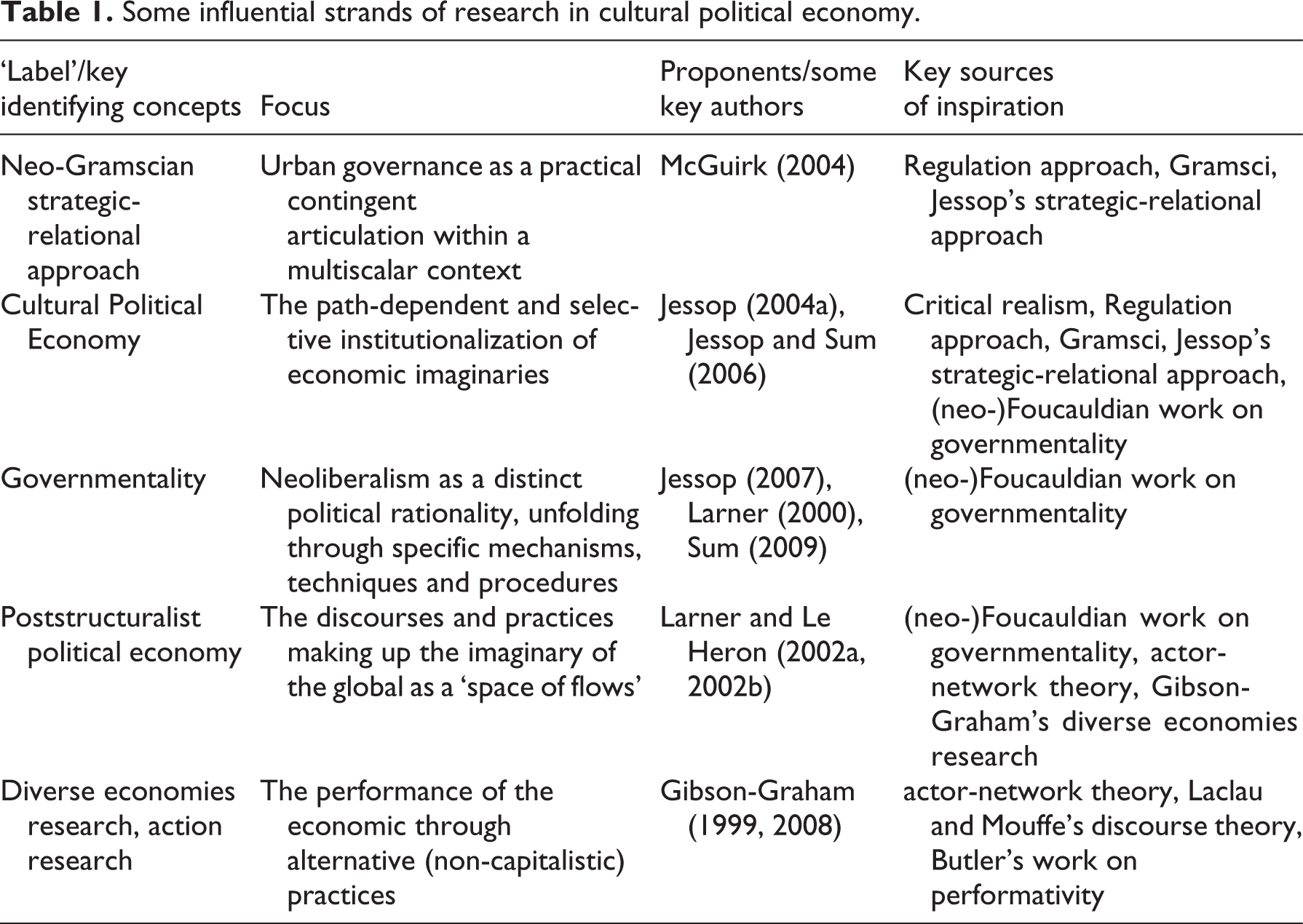
To begin with, scholars concerned with the (state-)institutional underpinnings of transforming capitalist relations have greatly drawn on the regulation approach, focusing on how the economic and the extra-economic complement each other in enabling stable capital accumulation (e.g. Jessop, 1990, 1997; Peck and Tickell, 1994; for an overview, see MacLeod, 1997, 2004). Another important source of inspiration has been Gramsci’s work (1971), especially his notion of the ‘integral’ state and that of ‘hegemony’ – concepts which were seen as providing clues to the question as to why and how the capitalist state can secure societal acceptance (Jessop, 1997). A third major point of reference has been Foucault’s (1991) and others’ (e.g. Dean, 1999; Rose and Miller, 1992) writings on governmentality, which have been found useful to show how neoliberal governance practices operate through specific technologies and procedures (see, for example, Jessop, 2007; Larner, 2000; Sum, 2009). Finally, a fourth noteworthy source of insights has been actor-network theory (e.g. Law and Hassard, 1999), drawn on by scholars who wished to challenge ‘capitalocentric’ representations of the economy, and to emphasize that economic spaces are performed through subjects and objects in situated local contexts (see, for example, Gibson-Graham, 1999, 2008; Larner and Le Heron, 2002a, 2002b).
These intellectual currents have been combined in various ways, leading to diverse and partly interrelated scholarly agendas (see Table 1), each contributing to the spatial and cultural turn in its own way. Indeed, as Ribera-Fumaz (2009) – who presents a comparable, even though more extensive overview – rightly notes, cultural political economy ‘is still a wide open field, making it difficult to set definitive borders in what [it] is and what [it] is not’ (p. 457).
Some influential strands of research in cultural political economy.
Yet, even if implicitly so, Ribera-Fumaz seems to foreground one particular approach, namely the strand of Cultural Political Economy as elaborated by Jessop and Sum (2001), by arguing that proponents of different spatial and cultural turns ‘share the agenda that Jessop and Sum (2001) claim to be the backbone of cultural economy’ (Ribera-Fumaz, 2009: 457). This (implicit) foregrounding is reinforced by the fact that he uses the CPE acronym, which has become the trademark of Jessop and Sum’s (and their colleagues’) approach, to refer to cultural political economy (cpe) ‘in general’.
Without doubt, since its inception in the early 2000s, the brand of Cultural Political Economy (hereafter CPE) developed by a group of Lancaster University scholars has incorporated insights from various bodies of thought. As a result, it has become the cultural political economy strand with perhaps one of the most sophisticated and encompassing theoretical apparatuses. Nonetheless, by suggesting that one particular approach (CPE) can ‘speak for’ the variety of existing cultural political economy (cpe) approaches, Ribera-Fumaz risks banalizing the substantial ontological and epistemological divisions (which he otherwise does recognize) that run between the approaches. For example, there is a non-negligible tension between the performative epistemology propagated by Gibson-Graham (2008) and the critical realist-informed stance of Jessop and Sum that has strong reservations concerning views that ‘seem to imply that one can will anything into existence in and through an appropriately articulated discourse’ (Jessop and Sum, 2001: 94). Also, CPE itself has combined approaches the philosophical compatibility of which has not been wholly uncontested (see, for example, Barnett, 2005, on the divergence of Foucauldian and Gramscian approaches). To be sure, by pointing to these divergences and contested combinations, I do not wish to endorse some kind of ‘philosophical purism’. However, I believe that in order to prevent any closure of the ‘open field’ of cultural political economy, we should not gloss over questions of philosophy too quickly, but should rather engage with them more explicitly and constructively.
Below I demonstrate constructive engagement in practice by bringing into dialogue two approaches that are rooted in diverging philosophical positions: Cultural Political Economy (in critical realism 2 ) and discourse theory (in poststructuralist thought). I focus on these strands of scholarship (which, to be sure, are not devoid of internal differences) for two reasons. First, the proponents of both have offered explicit and detailed accounts of their philosophical-theoretical standpoints, making the task of setting up a dialogue easier. In fact, advocates of the two bodies of thought have taken notice of each other’s work and it seems that recently there has even been some rapprochement between them under way. Nevertheless and second, to date there has been no comprehensive treatment of how these approaches actually differ, and how their divergence can be productively exploited. 3 As a result, some debilitating misunderstandings – for example, concerning discourse theory’s claim that there is no non- or extra-discursive realm of the social (Laclau and Mouffe, 2001) – still hold strong. Finally, while CPE has become a widely appreciated approach in geographical political economy, discourse theory has remained rather neglected (or at best implicitly or indirectly recognized). In line with the view of the discipline as an ‘open field’, I wish to demonstrate how insights of a rather new (for the discipline) perspective are useful for re-engaging with political-economic geographies of continuity and change. I should concede that I will do so from a position that is (or was initially) more sympathetic to a discourse-theoretical ontology. However, my aim has been to consider the potential of mutual learning and to improve discussions within the broader field of geographical political economy, rather than to improve just one particular approach (such as CPE; see Jones, 2008).
III Cultural Political Economy and discourse theory: towards a dialogue across ontological divides
1 Cultural Political Economy
The foundations of the ‘Lancaster strand’ of Cultural Political Economy were laid down in the 1990s, among others through Sayer’s work on the cultural turn in sociology and geography (Ray and Sayer, 1999), Fairclough’s writings on discourse analysis (e.g. Fairclough, 1995) and Jessop’s (1990) framework of neo-Gramscian, strategic-relational state theory. While in line with these various sources, CPE still sees itself as a pluralist project (Jessop, 2010), united by the common concern to reinvigorate classical political economy, Jessop and Sum have taken the lead to turn CPE into a well-identifiable, distinct research agenda (Jessop, 2004a; Jessop and Sum, 2001, 2006). Accordingly, the following summary of CPE’s main objectives and assumptions will mostly rely on their work.
A key concept of CPE is that of ‘semiosis’, referring to the intersubjective production of meaning (verbally and otherwise) through complexity reduction (Jessop, 2004a). Committed to critical realism and its distinction between social construals and social constructions, i.e. ‘between making a mental construction of the world and materially constructing something’ (Sayer, 2004: 7), CPE distinguishes between the semiotic and the extra-semiotic. On this basis, its main interest has been in examining social structuration in terms of ‘the path-dependent co-evolution of the semiotic and extra-semiotic aspects of actually existing political economies’ (Jessop and Oosterlynck, 2008: 1155). In other words, CPE has been mainly concerned with how some economic imaginaries, from the wide variety of imaginaries available, become selected and retained (i.e. institutionalized) (Jessop and Oosterlynck, 2008). A key postulation in this regard – again in line with critical realist thinking – is that the effectiveness of an economic imaginary depends on how it ‘correspond[s] to the properties of the materials (including social phenomena such as actors and institutions) used to construct social reality’ (Jessop, 2004a: 164). Attributions of meanings by agents institutionalize thus depending on how well these attributions resonate with the material substratum of social relations. These processes of institutionalization are contingently necessary: contingent because imaginaries become solidified through the accidental interaction of multiple causal chains, and necessary as this interaction in a definite context has necessary effects (Jessop, 1990).
CPE holds on to a ‘primary concern with the materiality of capitalism, its structural contradictions and its associated strategic dilemmas’ (Jessop and Sum, 2001: 99). This concern is grounded in a specific understanding of the link between Marxist thought and critical realism: that Marx was ‘a major precursor both philosophically and in substantive theoretical terms’ of (Bhaskar’s) critical realism (Jessop, 2005: 40). Accordingly, CPE’s focus has been more specifically on the stabilization of specific spatiotemporal fixes (Jessop and Oosterlynck, 2008). In order to account for these in a more nuanced way, CPE has called for ‘a creative synthesis’ of various disciplinary perspectives (Jessop and Sum, 2001). A key example of such a synthesis has been the incorporation of (neo-)Foucauldian and (neo-)Gramscian insights, based on the argument that these help to shed light on how economic imaginaries (spatiotemporal fixes) become hegemonic, and who and what are involved in this process (Jessop, 2007, 2008; Sum, 2009). Revealing the socially constructed nature of political-economic phenomena this way, CPE implies both Ideologiekritik, i.e. the uncovering of ideal and material interests behind meaning systems, as well as Herrschaftskritik, i.e. the exposure of how particular meaning systems become hegemonic (Jessop, 2010; Jessop and Oosterlynck, 2008).
As to concrete CPE applications, Jessop’s (2004a) seminal article introducing CPE offers an analysis of ‘the knowledge-based economy’ as a master discourse for accumulation strategies that relies on a complex network of practices across diverse systems and scales of action. In a similar manner, Sum (2009) examines the hegemonic status of the discourse of competitiveness and how that has involved ‘the circulation and suturing of heterogeneous knowledging technologies and apparatuses … across different scales and sites’ (p. 198).
Following the initial emphasis on economic imaginaries, lately CPE has increasingly been applied to examine the spatial aspects of neoliberal capital accumulation and state regulation. Jessop (2012), for example, introduced the notion of ‘spatial imaginaries’ in order to address the question as to how regions (or other spaces) are being constructed as objects of intervention, and how particular imaginaries are selected and instituted. Oosterlynck and González (2013), in their study of the geographical variation of urban policy responses to the financial-economic crisis, propose to link CPE with work on neoliberalism as a ‘variegated’ (i.e. spatially polymorphous) phenomenon (see, for example, Brenner et al., 2010), in order to examine how this variation is being (re)produced discursively. On the whole, these recent developments can be seen as the continuation of earlier efforts to ‘spatialize’ Jessop’s strategic-relational approach to the state (see, for example, Brenner, 2004; Jones, 1997). At the same time, they are complementary to recent theorizations concerning the multidimensional (territorial, place-based, scalar and networked) character of sociospatial relations (Jessop et al., 2008), and the ‘compossibility’ of spatial forms of governance (Jones and Jessop, 2010) under neoliberal capitalism.
2 Discourse theory
Discourse theory is the more commonly known designation of the Ideology and Discourse Analysis Programme in the Department of Government at the University of Essex. It was established by Ernesto Laclau in 1985 after the publication of Hegemony and Socialist Strategy: Towards a Radical Democratic Politics, a book he co-authored with Chantal Mouffe (Glynos and Howarth, 2007). Hegemony and Socialist Strategy aimed to set both a political and a theoretical agenda: the former to address the apparent impasse of conventional leftist politics focusing on ‘the working class’ (Chouliaraki and Fairclough, 1999; Torfing, 1999; Townshend, 2004; Willmott, 2005), the latter to deal with the perceived crisis of Marxist theorizing, especially its class reductionism and economic determinism. Laclau and Mouffe (2001) propose to re-read Marxist categories through the insights of poststructuralist thought, notably the work of Jacques Derrida, Jacques Lacan and Michel Foucault. The resulting ‘post-Marxist’ approach is a radical reinterpretation of Gramsci’s notion of hegemony where hegemony is no longer conceived as a strictly class practice, but as the principle of the construction of meaning in general (Martin, 2002). Thus, according to Laclau and Mouffe, all social identities become partially fixed through hegemonic practices of articulation. This fixation (or closure of meanings) occurs in terms of equivalence or difference (Torfing, 2005), and results in discourses (or discursive formations), understood as differential systems of temporarily solidified meanings. Importantly, these systems of meanings are not limited to the cognitive-ideational realm. Drawing on Wittgenstein’s view of the indissoluble totality [of] both language and…actions (Laclau and Mouffe, 2001: 108), Laclau and Mouffe view discourses as encompassing meaning and practice.
From the above it follows that for Laclau and Mouffe ‘the notion of the social [is] conceived as discursive space’ (Laclau and Mouffe, 2001: x, emphasis in original); there is no non- or extra-discursive realm of the social. Furthermore, given that relations between equivalence and difference are undecidable, discourses embody a fundamentally temporary closure of meanings. Laclau and Mouffe thus assume ‘the incomplete and open character of the social’ (p. 134). This assumption is actually key to their notion of ‘the political’ that is taken to constitute the social (p. xiv); discourses are the manifestations of political decisions. Changes in discourses are conceptualized as ‘dislocation’, as moments when hegemonic systems of meanings are confronted with events that they cannot explain or ‘domesticate’. This opens the terrain for political struggles and the articulation of new discourses (Torfing, 2005). This conception of change is grounded in the assumption of the ‘split’ subject, i.e. the idea that because structures (discourses) are constitutively incomplete the subject is incomplete (or ‘lacking’) too. Subjects develop political subjectivities once they can no longer ‘go on’ in their routinized fashion 4 (Glynos and Howarth, 2008).
As Laclau has admittedly seen himself more as a political ontologist (Laclau, 2004) and Mouffe (see, for example, Mouffe, 2005) has been above all concerned with elaborating an ethico-political stance on radical and plural democracy, 5 their highly abstract work still needed to be rendered more accessible to make a difference in social scientific research. This task has been undertaken by their (former) students and colleagues at Essex, resulting in a series of very illuminating books that have actually established poststructuralist discourse theory (hereafter DT) as a distinctive approach (e.g. Glynos and Howarth, 2007; Howarth and Torfing, 2005; Torfing, 1999). Discourse theory is seen by its proponents as both an ontological stance and a problem-driven approach focusing on the reproduction and transformation of hegemonic orders and practices (Glynos and Howarth, 2007). Glynos and Howarth (2007) in particular have greatly contributed to the practical applicability of discourse theory by elaborating a framework of critical explanation in terms of three types of logics: social, political and fantasmatic. Social logics help to characterize the rules structuring and governing social practices in different contexts. Political logics enable us to make sense of how social relations are being challenged and re-formed. Finally, the concept of fantasmatic logics captures the ideological dimension of social relations and how modes of enjoyment 6 conceal the radical contingency of social reality (see also Glynos and Howarth, 2008; Howarth, 2010). By speaking of logics, Glynos and Howarth (2007) wish to avoid the connotations of subject-independence that is (in their view) suggested by talk of causal mechanisms. At the same time, they wish to maintain the insight that not everything is reducible to the contextualized self-interpretations of subjects.
3 The reception of CPE and DT in geographical political economy
CPE has enjoyed a wide and largely positive resonance in geographical political economy. Arguably, this has been due to the generally solid position of critical Marxist(-inclined) perspectives in the field and, more particularly, to the broad consensus that Jessop’s strategic-relational approach had successfully accomplished the move away from structuralist analysis (see, for example, Hay, 2006; Painter, 2006). CPE has been similarly praised for helping to grasp how meaning making plays a role in sociospatial transformation, without neglecting structural-material aspects (e.g. Jones, 2008; MacKinnon, 2010; Moulaert and Mehmood, 2010). Due to its recentness, applications of CPE in geographical political economy have not been numerous. However, its practical use has increasingly been explored through accounts of hegemonic urban and regional development discourses (see, for example, Bristow, 2010; González, 2006; Oosterlynck and González, 2013) and in analyses of the institutional mediation of regional uneven development (Jessop and Oosterlynck, 2008; Oosterlynck, 2010).
At the same time, CPE has not remained uncontested. The main criticism that CPE has received has been that of functionalism. 7 According to van Heur (2010a), for example, (Jessop’s post-regulationist) CPE tends to prejudge the outcome of highly contested processes by framing the knowledge-based economy simply as an accumulation-regulation coupling envisaged by the state. Relatedly, van Heur also argues that CPE risks slipping towards a capitalocentric account of the economic, because Jessop discusses semiosis above all against the background of the extra-semiotic materiality of capital accumulation and state regulation, thus ‘downplay[ing] the proliferation of practices and images that are irreducible to this particular materiality’ (van Heur, 2010a: 432).
The elaboration of a hands-on discourse-theoretical research framework by Glynos and Howarth (2007) in particular has been also too recent to have any substantial resonance in geographical political economy. Hence, in discussing DT’s reception in the field I will limit myself to the impact of Laclau and Mouffe’s work. This impact has been especially related to Laclau and Mouffe’s insight that for politics to be possible we need to conceive the social as essentially open (see, for example, Gibson-Graham, 2008; Massey, 1992, 1999). Yet transposing discourse theory’s conceptual vocabulary into geographical inquiry has been far from straightforward. Especially, Laclau’s (1990: 68) remark that ‘Politics and space are antinomic terms. Politics only exists insofar as the spatial eludes us’ has been criticized, even by those otherwise sympathetic to Laclau’s agenda, for suggesting that space is static (see, for example, Massey, 1992). Some were even more categorically refusing, wondering ‘why the views of people on space and the spatial who have never tried to conceptualize the terms are taken seriously; Laclau is an irrelevant distraction’ (Gregory in Elden et al., 2011: 314). An even more recurring criticism has been that concerning DT’s conceptualization of material realities. This criticism has come in a stronger and a milder version. In its stronger form, it took the shape of charges of excessive idealism. Jessop (1990), for example, in his appraisal of Laclau and Mouffe’s Hegemony and Socialist Strategy, disapproves of the ‘metaphorical “exorbitation” of linguistic articulation’ in DT (p. 297), i.e. of the way Laclau and Mouffe extend the concepts of discourse and discursive practices beyond language to all the ways in which social relations are endowed with meaning. 8 According to Jessop, Laclau and Mouffe are ‘empty realists’ because they affirm that entities of the real world ‘lack determination until discursively constituted in so many beings’ (Jessop, 1990: 298). Also, Jessop (1990) is critical of the statement of discourse theory that society does not exist; according to him, this entails that the state does not exist either. Lately, such direct criticisms of discourse theory have been absent, but there is a marked aversion in geographical political economy towards approaches which are ‘denying an extra-discursive reality’ (Martin, 2001: 196) and ‘reduce everything to discourse’ (Ribera-Fumaz, 2009: 455; see also Jessop and Sum, 2001; MacKinnon, 2010).
In their weaker form, criticisms have concerned DT’s ‘[lack of] (or a very weak) “language” to theorise the materiality and structurality of the social’ (Chouliaraki, 2002: 94). According to Mouzelis – who otherwise does agree with Laclau and Mouffe that all institutions are discursively constructed – we need to recognize that ‘from the point of view of specific subjects situated in a specific historical time and social space, there are always institutional arrangements which are easily affected by their practices and other institutional arrangements which are not’ (Mouzelis, 1988: 113; for similar arguments, see Chouliaraki and Fairclough, 1999; Jessop, 1990; Nash, 2002).
To be sure, these criticisms have been repeatedly countered by the proponents of the respective approaches. Perhaps partly as a result, voices of disapproval have become less harsh and the opposition between the two approaches seems to have been diminishing. The side-by-side publication of an article on CPE (Jessop, 2010) and on DT (Howarth, 2010) in a recent issue of Critical Policy Studies 9 might be a sign of such a mutual rapprochement. However, even if one can easily recognize some points of convergence between their agendas, apart from a single reference neither author engages with the other. In the remainder of this section, I would like to initiate such a mutual (re-) engagement.
4 Towards more philosophical awareness
Terms such as ‘material’ or ‘discursive’ seem straightforward in their meaning but in fact they are used in various ways. The former, for example, is sometimes meant as an equivalent to ‘economic’, ‘substance’, ‘social’ (‘institutional’), but also to denote practice or the opposite of ‘ideal’ (Nash, 2002). The latter in turn refers generally to the ‘ideal’ and the ‘rhetorical/textual’, but it can also imply practice as in discourse theory; as Laclau once conceded, one of the main reasons why he preferred discourse was that ‘practice is a very neutral term … and concepts which don’t provoke the engagement of people are necessarily boring’ (Laclau in Laclau and Bhaskar, 1998: 9).
This richness of meaning is of course not problematic per se as long as one acknowledges how a particular approach uses a given term within its own frame of reference, instead of interpreting it from within one’s own (potentially different) meta-theoretical perspective. I would like to suggest that two factors have contributed to the (re-)occurrence of this mistake. A first and crucial reason for mischaracterizing both DT and CPE has been a lack of philosophical awareness. In what follows I will try to create more clarity in order to redress two main misinterpretations, one for each approach: first, that DT unduly collapses everything into discourse; and, second, that CPE is functionalist and economistic. A second source of misinterpretations has been the way in which proponents of each approach have translated their philosophical commitments into concrete research practice.
As to the criticism concerning DT, that is of course odd given the repeated statements by Laclau and Mouffe stressing that for discourse theory it is the material act of producing an effect that is regarded as discourse; that discourse is the totality of an act of performance, including both linguistic and non-linguistic elements (Laclau and Mouffe, 1987, 2001). The main reason for the persistent misreading of discourse theory has been the tendency, on the part of its critics, to read ‘discourse’ from within their own meta-theoretical frame of reference, instead of acknowledging discourse theory’s own meta-theoretical assumptions.
By putting critical realism’s (critical realist-informed CPE’s) and DT’s philosophical assumptions side by side, it becomes clearer how such a misreading could persist. As Table 2 shows, critical realism (CPE) and DT stand for different ontological and epistemological perspectives; or, to be more precise, they have a fundamentally different understanding of what ontology and epistemology are (or whether the distinction between the two is useful at all).
Critical realism and discourse theory as meta-theories (based on Fairclough et al., 2004; Jessop, 1990; Laclau and Bhaskar, 1998; McAnulla, 2006; Martin, 2002; Torfing, 1999).
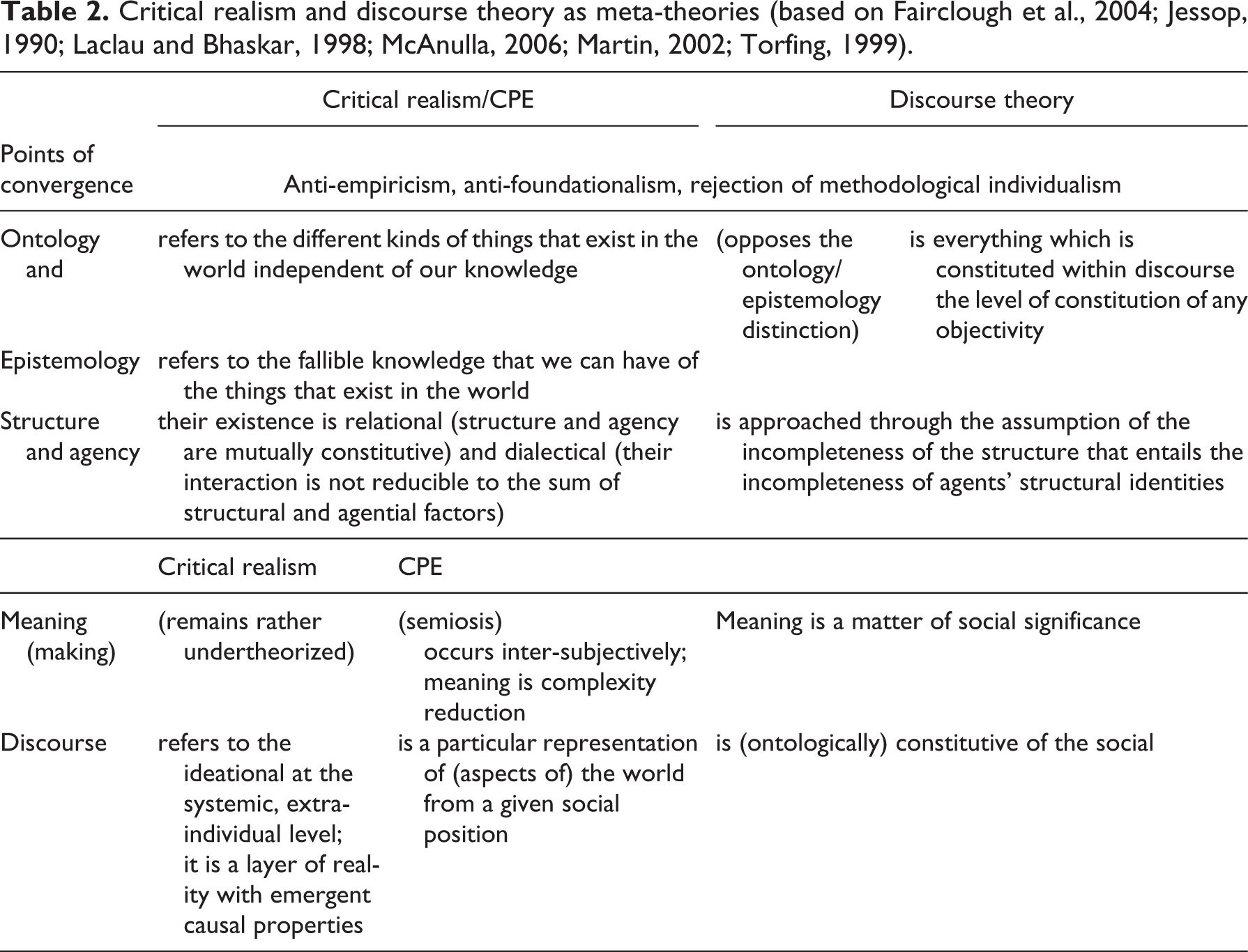
While for critical realists ontology means the acknowledgement of an independently existing world, for discourse theorists ontology is ‘the level of constitution of any objectivity’ (Laclau in Laclau and Bhaskar, 1998: 13). This latter ontology implies a concern with the underlying presuppositions that determine what is to count as a particular type of object, how it is to be studied and that it exists at all. To refer to Glynos and Howarth: ‘in our view the importance of ontology is not just about what sorts of things exist, but that they exist and how they exist’ (2007: 11, emphasis in original). In contrast to critical realists (among others), for whom ontology (‘what is’) logically precedes epistemology (‘how “what is” is’), for discourse theorists this distinction and logical order is not tenable. Aligning with Heidegger’s interpretive approach to ontology, they assume that the way we (come to) know the world and the way the world ‘is’ cannot be separated, for our knowledge of the world is inevitably shaped by (socially constructed) a priori ways of knowing.
Furthermore, by emphasizing that the ‘being’ of things is never fixed forever (i.e. that meaning can never attain full closure), discourse theory asserts the ontological contingency of being. This is not to be conflated with the notion of contingency that is used (by critical realists among others) to refer to the accidental possibility of events (i.e. that ‘things could have been otherwise’). This latter is, from discourse theory’s point of view, a matter of ontical or empirical contingency (see Glynos and Howarth, 2007).
Against this background, let us reconsider how the two perspectives conceive of meaning making and discourse (see bottom two rows of Table 2). In fact, one has to make a threefold distinction here, for CPE represents a refinement of more general critical realist frameworks that (in the eyes of CPE scholars – see Fairclough et al., 2004) have not offered a sufficiently nuanced treatment of these aspects. Looking at the meanings accorded to the concept of discourse we can see the root of misunderstandings. Critical realist and CPE scholars seem to have (mis)read DT’s ontological claims of the all-constitutive character of meaning making and discourse through their own conceptual lenses, where these are ‘only’ attributed a co-constitutive character.
Charges of functionalism and economism towards CPE need a similar reassessment from a more philosophically conscious perspective. First of all, it should be recalled that CPE has taken shape through the further refinement of the regulation approach, in dialogue with critical realism (Jessop and Sum, 2006). Importantly, as Jessop notes: ‘the regulation approach … is [in contrast to critical realism or discourse theory] concerned not with a general ontology of social structuration but with the ontology of a specific object of analysis (capitalism in its inclusive sense) that is inherently self-contradictory’ (Jessop, 2002a: 110). Regulationist CPE’s primary concern with the ‘particular materiality’ (van Heur, 2010a: 432) of capitalism is thus not an analytical bias but stems from its very ontological commitments.
10
Furthermore, Jessop explicitly rejects a view of the capitalist state as an ‘ideal collective capitalist’ and as a functional mechanism for capital accumulation. Rather, he stresses that the typical form of the capitalist state, implying the institutional separation of the state from the market economy, is actually problematizing the state’s functionality for capitalist accumulation (Jessop, 2002b). As he notes:
Thus there is no guarantee that political outcomes will serve the needs of capital … The operational autonomy of the state is a further massive complicating factor in this regard. Indeed, to the extent that it enables the state to pursue the interests of capital in general at the expense of particular capitals, it also enables it to damage the interests of capital in general. (Jessop, 2002b: 41)
On the whole, CPE as a strategic-relational, form-analytic and semiotic approach can be regarded as an attempt to give a more nuanced account of how historically and spatially specific forms of accumulation temporarily compensate ‘for the incompleteness of the pure capital relation’ (Jessop, 2002b: 48).
However, as previously mentioned, proponents of both DT and CPE have been partly themselves guilty of generating the above-discussed criticisms. As to DT, scholars applying a discourse-theoretical perspective have often focused primarily on texts (see, for example, Glasze, 2007; Glasze and Mattissek, 2009), thus perpetuating the misunderstanding that just as in various currents of discourse analysis (for an overview, see, for example, Jørgensen and Phillips, 2002) discourse theory regards ‘discourse’ in terms of language (use). Furthermore, the ‘relative reticence on methodology’ (Müller, 2010: no page number) in work drawing on Laclau and Mouffe has fed the impression that scholars applying discourse theory claim that their ‘discourse’ is scientific, without actually wanting to account for how it has been produced. While this ‘methodological deficit’ has been recognized for some time (see Howarth, 2005; Torfing, 2005), it has only recently been addressed (see Glynos and Howarth, 2007).
As to accusations of functionalism and economism directed at CPE-informed accounts, one should perhaps concede that the accounts in question have not fully succeeded in linking contingently forming spatiotemporal fixes to strategically selective state forms and these two ‘to the incompleteness of the pure capital relation’, i.e. to the contradictions inherent within the capitalist mode of production. Rather, they have tended to focus on the first two, at the same time foregrounding the influence of particular (business) interests. For example, Bristow, in her CPE-informed analysis, argues that ‘The selection of regional competitiveness [discourse] reflects the rhetorical power and usefulness of the discourse for particular groups with particular interests, notably the business community, who have played a powerful role in promoting competitiveness agendas in policy’ (Bristow, 2010: 160).
González (2006) makes similar claims in her study of urban regeneration in Bilbao, and even though she acknowledges that not all material and cultural elements serve the purpose of elites (p. 842), ultimately this aspect does not receive much attention. In fact, it seems that just as it was the case with Jessop’s earlier work (see Roberts, 2001), scholars continue to be inspired by his (and Sum’s) work on the ‘conjunctural level of analysis’, directed to the strategic use of hegemony by particular actors, while neglecting his insights concerning the inherently contradiction-fraught character of the capital relation (although see Oosterlynck, 2012).
But Jessop and Sum could also have done more themselves to offset this tendency. For example, in a more recent paper on CPE, Jessop (2010) quotes from Alan Greenspan (the former Chair of the US Federal Reserve). Even though he is quick to remark that ‘[the quote] proves nothing but is emblematic of a more general shock to the neoliberal mindset’ (p. 350), such a reference to a ‘powerful economic figure’ arguably helps to feed – instead of counter, as was Jessop’s original intention – simplistic explanations about the interlinking of economic and political power. Similarly, the remark that the main forces giving shape to economic imaginaries – Jessop mentions here, among others, political parties, think tanks, the OECD and the World Bank – ‘tend to manipulate power and knowledge’ (p. 346, emphasis added) foregrounds processes of misrepresentation without convincingly substantiating them.
5 On not becoming lost in ‘metaphysical language games’: a brief detour to the philosophy of science
Impasses in scholarly debates can thus be avoided if we attend more carefully to what a particular approach intends to achieve with a (set of) concept(s) within its own (ontological) frame of reference. However, a mere reassertion of philosophical pluralism can easily be accused of relativism and of not enabling a conception of scientific progress (see, for example, Bassett, 1999). The key question is actually how (if at all) apparently contradictory perspectives such as CPE and DT can find a common ground without this leading to one perspective subsuming the other.
Laclau and Bhaskar’s (1998) debate on the relation between scientific discourses and reality convincingly indicates the futility of discussions between critical realism and discourse theory (and thus also between CPE and DT) on the metaphysical level. In that debate, it becomes clear that neither approach can acknowledge the other without subsuming it under its own view of scientific inquiry. Discourse theory can recognize critical realism ‘only’ as one of the possible (phenomenologically rooted) world-views; critical realism can accept discourse theory ‘only’ as one of the competing, referential accounts of reality. Bhaskar seems to be right that those opposing realism also assume a reality ‘out there’ (see also Sayer, 1997), for in order to recognize other perspectives and their assumptions one necessarily has to assume that these perspectives are referring to ‘the same’, independently existing world (Ronen, 1998). However, although discourse theorists do not deny that there is a ‘world out there’, they reject the subject-object dualism implied by realists’ above referential argument 11 (Laclau and Mouffe, 1987: 85). Furthermore, they do not accept the realist view that the world has one certain shape (Torfing, 2005).
On the whole, Laclau and Bhaskar’s debate is a manifestation of the broader disagreement between realist and ‘non-realist’ perspectives on ‘reality’, ‘world’ and ‘reference’ that are rooted in diverging metaphysical commitments (see Hoyningen-Huene et al., 1996). Assuming that there is no ‘meta-meta-theoretical neutral position’ (Furlong and Marsh, 2007) from which the realist/‘non-realist’ opposition could be resolved, I would like to suggest that instead of speaking in terms of ‘the metaphysical language game of ontology’ (Kivinen and Piiroinen, 2006: 307), proponents of CPE and DT should rather engage in ‘social scientific language games’ (p. 319) that are geared to addressing shared real-world concerns.
Given the attachment of both strands to anti-foundationalism and anti-empiricism, as well as to the idea of the fallibility of scientific knowledge (see Table 2), we have good reasons to assume that proponents of CPE and DT are willing to participate in such a broader scientific language game. In fact, Jessop and Sum (2010) have noted that CPE’s links to critical realism should not be overemphasized; from the part of DT, Torfing (1999) has suggested that, despite their ontological divergence, Jessop’s strategic-relational approach and discourse theory could be combined. More recently, DT scholars have called for inter-approach conversations (among discourse-analytical approaches based on different ontologies) by ‘refocusing the debate around common problem areas’ (Glynos et al., 2009: 6–7, emphasis in original).
Such a problem-oriented approach appears workable in the case of CPE and DT as they share an interest in accounting for the (re)production of hegemonic social practices – even if this interest has not always been framed in spatial terms. Against this background, the next subsection draws the contours of a dialogue between CPE and DT on the topical issue of whether and how urban governance practices have been transformed in the course of the current financial-economic crisis (cf. Oosterlynck and González, 2013). As will be shown, such a dialogue not only helps in pinpointing aspects of complementarity, it also fosters mutual learning by exposing the prevailing weaknesses of each approach.
6 CPE and DT in dialogue: towards complementary explanation and mutual learning
In order to explore complementarities we need to reconsider first the ‘kinds’ of insights that CPE and DT tend to offer. Of course, differences in this respect are rooted in the diverging ‘original’ motivations of critical realism and discourse theory. This is nicely captured by Willmott (2005), according to whom critical realists ‘approach their subject matter primarily as “scientists” who intend to retroduce the operation of generative mechanisms’; discourse theorists in turn regard themselves as ‘“politicians” … who conceive of their subject matter, including themselves, as radically political’ (p. 762, emphasis added). To be sure, CPE should not be equated with critical realism (see Jessop and Sum, 2010) and, due to recent developments (especially Glynos and Howarth, 2007), DT has moved from being ‘just’ an ontology to a more fully-fledged framework of social scientific inquiry. Furthermore, as argued above, it is counterproductive to contrast CPE and DT at the meta-theoretical level. Nonetheless, by keeping this divergence of orientation between critical realism and discourse theory in mind, it becomes easier to discern some differences of emphasis in CPE- and DT-informed work, respectively.
To begin with, we can recognize that CPE scholars remain primarily interested in exposing the structural mechanisms that help some practices institutionalize rather than others. To this end, they make use of concepts such as ‘emergence’, ‘sedimentation’ and ‘structural selectivities’ (see Jessop, 2010). Discourse theorists, while they certainly do not deny the role of structural conditions, 12 have not been concerned to offer a systematic account of these. Instead, they tend to put more emphasis on the radical contingency (Howarth, 2010) and ‘the political “origin”’ (Torfing, 1999: 70) of all social institutions. This is certainly also acknowledged by CPE, but DT shows more explicit attention towards the ‘endless series of de facto decisions, which result from a myriad of decentred strategic actions undertaken by political agents aiming to forge a hegemonic discourse’ (Torfing, 2005: 15). Relatedly, discourse theorists are more sensitive to recognizing (the potential for) ‘radical acts of institution’ (Howarth, 2010: 309, emphasis in original).
A difference is also manifest in CPE’s and DT’s view of agency. CPE conceives of agents as strategic actors who make sense of the world ‘through complexity reduction’. This view purposively aims at ‘counterbalanc[ing] preoccupations with affect’ (Jones, 2008: 394) that are seen as potentially compromising the identification of causal structural forces. DT’s notion of ‘fantasmatic logics’ in turn, referring to ‘the different types of “enjoyment” subjects procure in … believing things they do’ (Howarth, 2010: 326), wishes to capture exactly this affective dimension. DT’s grounding in Heideggerian ontology and in Wittgensteinian philosophy implies a further significant difference vis-à-vis that of CPE. From a Heideggerian perspective, human action should be seen as a skilful coping and practical engagement with the environment. In accordance with Heidegger, Wittgenstein also argues that meaning is produced by human beings in the course of their specific activities (see Simonsen, 2007). Accordingly, DT is more attuned to capture the (‘messily’) practical dimension of agency. 13
Ultimately, CPE and DT’s different takes on issues of structure-agency and subject-object relations imply a different approach to spatiality. It should be noted here that neither proponents of CPE nor those of DT have devoted much explicit attention to theorizing ‘space’ (for the former, see Jessop, 2004b; Jessop et al., 2008; for the latter, see Howarth, 2006). Nonetheless, from their sparse remarks it is possible to sketch the contours of their understanding of space. CPE(-near) scholars assume (similarly to DT scholars) the multiple, constructed and perspectival character of spatiality, but tend to discuss it primarily in terms of relatively entrenched ‘given’ spatial (territorial, scalar, networked or place-based) forms (see Jessop et al., 2008). From this perspective, challenges of spatial (re)ordering appear as a tension between different spatial forms, such as that between the (state) logic of territory and the (capital) logic of flows (Jessop, 2012). Discourse theorists in turn wish to go beyond these (what they consider) ‘ontical categories’ of spaces (Howarth, 2006). Unlike CPE(-near) scholars, they do not ascribe to the Hegelian dialectic of the ‘spatial turn’, but propose to equate space with social space, i.e. society, and define spatialization as attempts to establish a hegemonic fixing of meanings. 14 Furthermore, the significance of space is held to be ‘relative to the projects and practices of subjects’ (Howarth, 2006: 116).
Having briefly inventoried the key tendencies of CPE- and DT-informed accounts, let us now consider how a dialogue between the two approaches could contribute to a fuller account of a concrete issue, that of whether and how urban governance practices have been transformed in the course of the current financial-economic crisis. Set next to each other, it is apparent that CPE has a more sophisticated vocabulary to grasp processes of structuration in terms of selective institutionalization. In the case of DT, while the introduction of the notions of social, political and fantasmatic logics is surely an advancement, the threefold use of the term ‘logics’ suggests that we have to deal with three dimensions of ‘equal standing’. 15 Furthermore, given its aspiration for larger-scale (but not totalizing) truths on contemporary urban change, a CPE perspective is more apt to explore the systemic reproduction of family resemblances among urban governance practices ‘beyond’ the local scale. A good example of this is Oosterlynck and González’s (2013) analysis of how transnational sites of policy discourse, such as those linked to the OECD or the EU, play a key role in framing urban policy responses to the crisis. A discourse-theoretical approach seems to offer, as yet, few (if any) clues as to how we can grasp the interconnectedness and interdependence of local governance practices.
At the same time, DT helps to highlight the limitations stemming from CPE’s focus on path-dependent macro-level economic selectivities and on the global hegemony of neoliberalism (e.g. Jessop, 2010; Oosterlynck, 2012; Oosterlynck and González, 2013). To be sure, CPE scholars recurrently caution from regarding neoliberalism as a monolithic force, and refer to the multiple (non-economic) selectivities at work, as well as to the significance of narrative appeal in securing public consent (e.g. Jessop, 2010; Oosterlynck, 2012; Oosterlynck and González, 2013). However – and this becomes especially clear in juxtaposition to DT – these aspects are eventually rather neglected in CPE-informed work, both conceptually and empirically. DT asserts namely that ‘any fully fledged explanans contains a plurality of different kinds of logics’ where none is subsumed under higher-order laws or abstractions (Howarth, 2005: 326, emphasis in original). Rather, concrete events and processes are explained in terms of the articulation of multiple social logics that brings about a modification in each of those logics. This more open-ended attitude of DT enables us to appreciate the structuring effect of those broader ‘long-term rhythms of socio-cultural change’ (Barnett, 2005: 10) on urban policies that are not straightforwardly reducible to ‘neoliberalism’. Furthermore, it also allows us to take better into account the locally particular structuring aspects of ‘inherited institutional landscapes’ (Brenner et al., 2010). On the whole, instead of tying down commonalities among urban governance practices to one aspect, DT helps to consider the multiple dimensions of commonalities across spatial scales. This is especially relevant if we want to duly consider non-capitalist cases or cases of transition to capitalism. 16
But DT should not be mistaken for emphasizing the contingency and hybridity of local trajectories at the expense of institutional frameworks (in the broad sense) of ‘extra-local’ scope (see Peck et al., 2009). Actually, DT also allows giving a more nuanced account of how such frameworks become instituted and continue to exert influence. This latter aspect is of special relevance given the widely observed paradox that ‘crisis conditions [have been] leading to more of the same rather than a sharp turn away from the neoliberal path’ (Castree, 2010: 206). DT helps in coming to grips with this paradox through its concept of fantasmatic logics that captures the organization and shaping of (individual and collective) desire without having recourse – as CPE tends to do – to notions of manipulation and ideological deception, which presuppose a demarcation between true and falsity (Howarth, 2010). For DT, the key role of fantasy is not simply to evoke a false picture of the world, but to suppress aspects of challenge and contestation so that the subject experiences the contradictions of everyday life ‘as an accepted and smooth way of “going on”’ (p. 322). This perspective could deliver useful insights concerning, among others, the stubborn persistence of the ‘perverse metaphors’ of the city as a unified actor and component of globalization (Marcuse, 2005) that continue to frame urban governance practices worldwide. Furthermore and more generally, DT could help ‘repopulate’ CPE’s useful but strikingly agentless 17 mappings of the strategic, macro-level terrains of governance by offering in-depth, ethnographic accounts of the ‘worlds’ and motivations of subjects (see Howarth, 2005), including not only ‘powerful actors’ but also policy officials and ordinary people. By doing so, DT could finally also encourage CPE to join efforts to reflect more explicitly on methodological issues (Howarth, 2005; Torfing, 2005), to which CPE has not devoted much attention to date.
IV Towards engaged pluralism in geographical political economy – concluding remarks
The aim of this paper was to demonstrate how we could move towards a (more) productive engagement with pluralism in geographical political economy. I argued that greater philosophical awareness is vital to such a move as it helps to better recognize the motivations and assumptions of diverging approaches, as well as the kinds of insights they offer. Importantly, engaged pluralism does not ‘mean agreement, let alone convergence’ (Barnes and Sheppard, 2010: 209). As the dialogue between CPE and discourse theory illustrated, differences between critical realist, Marxist-informed research agendas and poststructuralist lines of inquiry will not (cannot) become erased. The former will remain principally concerned with accounting for the geographically variegated institutions through which the contradiction-fraught dynamics of capitalism are regulated. The latter will continue to focus on how various kinds of institutions ‘become’ (hegemonic) through discourse and performance.
Nonetheless, by showing (more) ‘willingness to listen and to take seriously other people’s ideas’ (Barnes and Sheppard, 2010: 209), we can avoid the impasses that have characterized previous debates in geographical political economy, and explore the potentials of mutual learning and complementarity. Crucially, we can move beyond the prevailing view of complementarity, generally expressed from a critical realist and/or Marxist-informed position that seems to regard that position offering the bedrock of an encompassing explanation and sees poststructuralist-inclined research supplying useful additional insights on aspects of subjectivity and context (e.g. Brenner et al., 2011; Jessop, 2007). This view unduly reduces different perspectives (actually also the one from which it is proposed) to their inclinations. Relatedly, it mistakenly suggests that different perspectives can be largely assigned to one side of the structure/agency, global/local, explanation/interpretation binary oppositions (see, for example, Dixon and Jones, 2004) – ignoring that each perspective itself comprises a distinct (albeit sometimes implicit) set of propositions concerning both sides of these (and other) binaries.
From the above it follows that attempts to categorize approaches – including the tables presented in this paper – might be helpful only as a starting point, for they make approaches appear as distinct and complete totalities. However, approaches rooted in different ontologies are actually being shaped in relation to each other (Sheppard, 2008). Furthermore, as asserted by their advocates, they are ‘under construction’ (Jessop and Sum, 2010: 449) and ‘not … fully-fledged’ (Glynos and Howarth, 2007: 215). Proponents of diverging perspectives should thus steer clear of metaphysical debates and explore the possibilities of ‘relational improvement’ by addressing shared concrete concerns. The problematization of forms of governance that perpetuate uneven development, social exclusion and poverty (i.e. the ‘traditional concerns’ of political economy) do already figure central to both critical realist/Marxist-informed research agendas and poststructuralist lines of inquiry. The resolute attention of the former to the (re)production of entrenched forms of capitalist regulation, and the aptitude of the latter for highlighting how these (and other institutional) forms have achieved and retained hegemony in and through practice should be recognized as a source of productive tension. It is by constructively engaging with this tension that we will be able to make more sense of political-economic geographies of continuity and change.
Footnotes
Acknowledgements
I am very thankful to Arnoud Lagendijk, the editors and the anonymous referees for their constructive comments on earlier drafts. The usual disclaimers apply.
Funding
This paper is based on PhD research that was funded by the Netherlands Organisation for Scientific Research (NWO, Grant 450-04-142).