




Abstract
This paper takes issue with the dystopian views that have come to dominate research on privatized urban forms such as gated communities. Urban scholarship on gating is often overwhelmed by recurring case studies documenting the proliferation of urban fortressing and segregation that often warn of an impending urban dystopia with cities being besieged by neoliberal forces of privatism. Moving beyond such noir urban scholarship and universal pessimism, the paper argues for a more ‘hopeful’ research agenda by countering the overcoded mono-logic of urban fortification and segregation with a more nuanced perspective that underscores the differentiating dynamics and contingent nature of urban spaces.
I Introduction
Urban studies literature over the past decades has been overwhelmed by dismal accounts on the privatization of the city with the deepening of urban segregation and social-spatial exclusion. Since the turn of the 20th century, such dystopic images have figured prominently in literary, cinematic and academic representations of the modern city, with cities often depicted as dark and dysfunctional places wrecked by endless capitalist crises and social-ecological catastrophes (Prakash, 2010: 1). Driven in part by a discourse of fear and panic, much of this ‘critical’ urban scholarship suffers from a form of theoretical determinism that sees cities and urban spaces as helpless pawns being assailed by the ‘brutal tectonics of neoliberal globalization’ (Davis, 2004: 23). Inherent in such deterministic thinking is the reification of ‘neoliberalism’ that has often been invoked a priori as a predetermined set of theoretical explanations for diverse urban processes and outcomes.
However, as Braun (2005: 840) argues, we seem too quickly to ‘believe that capitalism, and neoliberal globalization, are larger than life entities and we grant them more reality than the practices that constitute them’. To the extent that these neoliberal urban nightmares are seen to pervade contemporary urban/geographical scholarship, Robinson (2010) further points out that the deployment of such singular dystopic narratives is often premised on the assumption that the urban conditions in many places are already dystopic to begin with and that such urban dystopia ‘is not an imaginative futuristic elsewhere but an immediate and present geographical elsewhere’, notably in ‘Third World’ cities of the Global South (Robinson, 2010: 219).
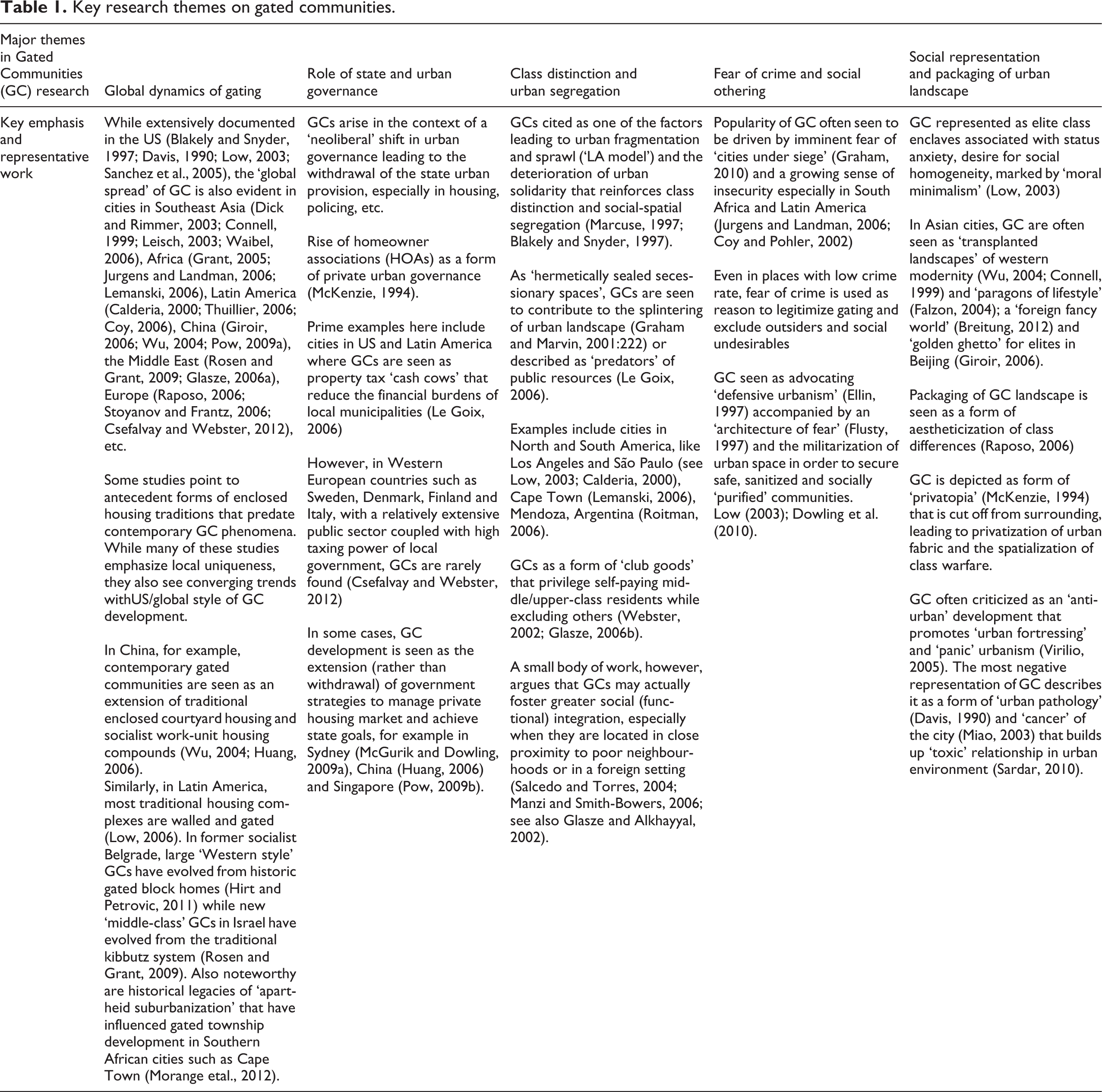
Key research themes on gated communities.
Unsurprisingly, then, the literature on gated communities is almost universally negative to the extent that even when positive aspects of gating have been identified (see, for example, Glasze and Alkhayyal, 2002; Salcedo and Torres, 2004; Huang, 2006; Le Goix and Webster, 2006), they are often seen as exceptions and thus not systematically examined in the overall theorizing of urban gating.
Fundamentally, gated communities, as Blomley (2003: 22) noted, represent an interesting form of proprietary community where holders of such ‘common property’ may ‘act in exclusionary fashion’ and ‘even be seeking admission into the realm of private ownership’. Whether by intent or effect, gated communities are underpinned by the capitalistic ‘liberal’ ownership model, echoing Walzer’s(1984) idea of(Western) liberalism as ‘a world of walls’ that keeps things separate through ‘visible geographies of property’ such as fences, gates, signs, maps, etc. (Blomley, 2004: 14). Blakely and Snyder (1997), in particular, consider gated communities as manifesting a number of social tensions ‘between exclusionary aspirations rooted in fear and protection of privilege and the values of civic responsibility; between the trend toward privatization of public services and the ideals of the public good and general welfare; and between the need for personal and community control of the environment and the dangers of making outsiders of fellow citizens’ (Blakely and Snyder, 1997: 3, emphasis added).
Indeed, many of the case studies on gated communities that endlessly invoke such hyperbolic images of a divided city seem to readily subscribe to the idea that ‘cities really are war zones and that every city must be the same’ (Virilio, 2005). In this context, this paper hopes to move beyond such universal pessimism by challenging the theoretical and methodological determinism in gated communities research. It should, however, be mentioned that this paper does not invalidate the critiques of gated communities. As many studies have demonstrated, the rise of gated urbanism is not only symptomatic of underlying issues of class division and segregation but also exacerbates these problems under current conditions of ‘global neoliberalism’ (Graham and Marvin, 2001). It should also be qualified at the outset that this paper is not an argument for or against gated communities/privatized urbanism per se, as if such positions could be delineated and marked out so neatly and starkly. Rather, this paper takes issue with the totalizing dystopian claims and paradigmatic framing of gated communities as being intrinsically the product of an overextended neoliberalism that, in its most extreme depiction, symbolizes the ‘evil paradises’ and ‘dreamworlds of neoliberalism’ (Davis and Monk, 2007).
To the extent that these critiques have become dominant narratives spurring the serial (re)production of ‘critical’ analysis on gated urbanism, they also risk foreclosing the debates by overgeneralizing the phenomenon without careful contextualizing when, where and how gating takes place in specific urban conditions. The paper thus takes onboard Robinson’s challenge to extend ‘the geographical scope of the kinds of empirical studies which dominate the discipline[s], and the kinds of places which are paid attention to in the course of theoretical innovation, and scholarly discussion’ (Robinson, 2003: 650).
In many respects, this paper’s argument is both ontological– by questioning the inherent nature of gating and urban exclusion/segregation – as well as epistemological– by challenging our knowledge of gated communities and privatized urbanism through more rigorous grounded comparative exploration and explanation. More fundamentally, this paper argues for a more ‘hopeful’ research agenda that moves beyond the dystopian determinism and bleak urban scholarship on gated communities and privatized urbanism. 2
By epistemologies of hope, I am referring to the broad intellectual commitment to seeing and understanding cities as not being hopelessly subsumed to the all-encompassing ‘capitolocentric’ discourses (Gibson-Graham, 1996) where diverse logics and rationales of urban change are invariably captured under the omnipresent ‘big N’ of neoliberalism (Sparke, 2006). The starting-point for such an epistemological standpoint is not just to recognize the contingent and ‘less-than-coherent’ nature of capitalism – and, by extension, neoliberal urbanism – but also to provide more subtly different and diverse accounts that challenge the overly pessimistic and dystopian view of an urban world overrun by neoliberal forces. By working through specific cases of gated communities in this paper, a broader remit here is to extend the critique of the analytical pitfall in urban studies that tends to frame our understanding of urban politics according to the a priori unitary logic of ‘neoliberal urbanism’ and the singular ‘neoliberal master trope’ (McGuirk and Dowling, 2009a: 276). The paper starts with the presumption that gated communities (and other privatized urban forms) exist in an over determined urban world with multiple co-evolving causes and conjoint effects that cannot be reduced to monolithic frameworks such as neoliberalism. Indeed, neoliberalism never acts alone to produce hegemonic effects, but ‘only in a fairy tale world where everything is privatised, marketised, and commodified’(Castree, 2006: 4).
Set in these terms, this paper challenges the monolithic fallacy of such noir urban explanations by deploying nuanced differentiated accounts on the ground to challenge the inevitability of dystopian reading and pessimistic assessment of gated urbanism and the urban world. As Blomley (2004) points out, private properties such as gated communities are a conditional and contingent achievement that is not reducible to the (dystopian) inner logic and operation of neoliberal privatization. Ironically, the most trenchant critiques of gated communities (or private property more generally)have a tendency to ignore their differentiated and diverse dynamics by reifying the territoriality of propertied spaces as ‘spatial containers’ of antagonistic class relations that are played out between property owners/‘insiders’ versus non-owners/‘outsiders’, private versus public, as if such supposedly determinate categories could be readily ascribed at the outset (Blomley, 2010: 205; Pow, 2009a).
To substantiate the arguments, the paper will begin by unpacking the ‘negative’ discourses on gated communities and highlight the theoretical and methodological blinkers inherent in the existing literature. The paper then proceeds to problematize the dystopian views and assumptions in gated community research before offering some analytical strategies to counter such universalizing weakness and dismal perspectives. In particular, the paper highlights three inter-related approaches: first, to go beyond the analytical fixation on the morphology/typology of gating to examine the underlying functions and diverse social meanings; second, to incorporate critical insights from comparative urbanism that go beyond the ‘comparative gesture’ of merely adding on endless case studies to disrupt dominant theories on gating; and third, to actively engage in what Robinson (2010: 230) calls ‘countercurrents to dystopian tendencies’ by searching for nuanced and differentiated accounts of gated communities. In the conclusion, the paper will signpost an ‘epistemology of hope’ (Coutard and Guy, 2007) by framing our understanding of (gated) urbanism as a co-evolving set of differentiating and contingent dynamics that challenge and unsettle the ineluctable (neoliberal) logic of urban gating and exclusion
II Gated communities and the spectre of urban dystopia
For over a decade, urban scholars have been drawn to the study of gated communities. In the late 1990s, a global research network comprising a number of interdisciplinary researchers from anthropology, geography, sociology, urban planning, etc., was established (see http://www.gated-communities.de/). An offshoot of this research network is a series of international conferences dedicated to exploring various thematic issues on urban gating and private governance with the first one being held in Hamburg, Germany, in 1999. Subsequent conferences took place in New York City (2001), Mainz (2002), Glasgow (2003), New Orleans (2004), Pretoria (2005), Paris (2007), Santiago de Chile (2009), Istanbul (2011) and Brighton (2013). In tandem with this, there is now a burgeoning literature on gated communities with case studies on virtually every major city in Europe, South America, the Middle East, South Africa, Asia and Southeast Asia (see Table 1 on the key research themes).
Specifically, it has been argued that a strong territorial logic of exclusion underpins the development of gated communities, as demonstrated by the setting up of defensive physical boundaries (walls, gates, fences) and surveillance technologies to keep out the unwanted ‘public’ and undesirable ‘others’. For their harshest critics, gated communities have often been diagnosed as an ‘urban pathology’ (Davis, 1990) that is associated with destructive forms of ‘splintering urbanism’ (Graham and Marvin, 2001) and other detrimental social impacts such as the excessive encroachment of private property on public spaces, the undermining of traditional forms of citizenship bonding and civic trust, the exacerbation of social-spatial polarization and urban inequality and, ultimately, the disintegration and eventual destruction of society at large and meaningful public life (see Caldeira, 2000; Webster et al., 2002; Low, 2003; Glaszeet al., 2006).
It is, however, ironic to note that much of such ‘critical’ urban scholarship tends to view gated communities as a universally dominating urban form originating from North American cities (in particular Los Angeles), without adequately considering the local complexities of meanings attached to these housing development as well as the varied ways that gated communities and ‘neoliberal’ urbanism take shape in particular urban contexts and are ‘reworked’ in a myriad of different settings. Notwithstanding the well-worn debates on the ‘LA School’ model of urban fragmentation, paradigmatic cities such as Los Angeles continue to form the backdrop for some highly important and influential analyses of urban gating practices (Blakely and Snyder, 1997). As such, the serial reproduction of case studies on gated communities around the world has invariably been shaped by a form of determinism with Los Angeles (and other American cities) as the theoretical/methodological referent. What is at stake here is not merely the issue of which city gets elevated to the dominant status and circulated as a theoretical model/referent but also how these travelling models shape our critical understanding and evaluation of emerging case studies of urban gating. Indeed, the policy mobility critique (Peck and Theodore, 2010; McCann and Ward, 2011) is as relevant for interrogating the modus operandi of public policy think tanks as it is for academic groupies and their peripatetic ‘schools of thought’ (e.g. LA School). Like mobile urban policies, the metonymic tagging of urban phenomena, models and theory to particular places (for example Los Angeles, Chicago or New York), people or institutions travels ostensibly with a licence of academic credibility and, sometimes, a ‘parochial universalism in which the [academic’s] home town stood for the world’ (Jacobs, 2012: 909).
Insofar as ‘Western’ urban models are seen to provide object lessons and ‘best practices’ that are disseminated zealously to developing cities around the world, it is paradoxical to observe that even dystopian traits associated with ‘paradigmatic cities’ such as the fragmented/centreless Los Angeles are readily transposed to case studies in the Global South. This may not be all that surprising after all, as Robinson (2010: 218) notes that in Western-based urban studies the recent deployment of dystopic narrative forms has often merged with decades-old habits of projecting a host of unwanted (if not unimaginable) features of cities onto ‘Third World cities’. For instance, Manila has been described as the ‘Los Angeles of the tropics’ (Connell, 1999) whereas São Paulo’s urban fortification and segregation is seen as being comparable to and indeed a mirror image of Los Angeles (Caldeira, 2000: 10).
Yet in a tongue-in-cheek review of urban studies, Dennis Judd (2005: 125) chastises urban scholars for their alleged infatuation with noir urban scholarship and doomsday prediction of ‘Mad Max’ cities. As Judd (2005: 125) argues, this love affair between urban scholars and noir can be traced back to two storylines –‘one told by the Chicago school in the 1920s and 1930s, the other version articulated, more recently, by the L.A. school’. As he elaborates: Downtown fortress buildings, gated communities, tourist bubbles, and enclosed malls have popped up on virtually all urban areas; their proliferation can be cited as evidence that the L.A. school has it right. But it requires a great leap of faith to conclude that sanitized, enclosed, privatized, fortified enclaves are replacing all public spaces. (Judd, 2005: 127)
It must, however, be acknowledged that dystopic writings have long formed the foundation for urban reform programmes. Robinson (2010:221), for example noted that for 19th-century British reformers the depiction of urban life as dystopic served to mobilize sentiment and resources for improvements of the working class and marginalized groups. Notwithstanding its close ties to utopian impulses, the mobilization of the dystopian genre in much of contemporary urban studies literature, however, tends towards an anti-utopian perspective with its ‘shock value’ of urban chaos and class warfare that forecloses ‘any sense of possible pathway towardsan alternative urban future’ (Robinson, 2010: 220).
In this context there is, hence, a danger of oversubscribing to such pessimistic views with research on gated communities reaching an intellectual impasse with the serial reproduction of dismal case studies rehashing the same storyline of an urban dystopia rife with fear and urban segregation. And as Robinson (2010: 226) further warns, dystopian urban writing can ‘profoundly misrepresent the city, drawing it toward a unitary representation, a singular narrative of the future, and thus limit opportunities for imaginative interventions’.
At stake here is also the broader question of how we write about and represent cities through our methodological decisions. As such, we need to interrogate more deeply not just the ‘geography of gated communities’ but also consider more critically the ‘geography of gated community research’ by critically reflecting on where our knowledge and theories about urban gating come from and the implications of particular ways of urban representations (see Roy, 2009).
III Beyond noir urbanism: Unsettling gated communities research
Based on the earlier critiques, the paper will now offer some analytical strategies to counter the theoretical/methodological weakness in the literature on privatized urbanism. Following Blomley (2004), the paper seeks to ‘unsettle’ and challenge the dominant view of gated communities as hegemonic propertied spaces that undermine the social-spatial integrity of cities, leading to a sense of urban despair and hopelessness. Significantly, private property such as the gated community is not seen as a pre-given monolithic entity but exists fundamentally as a diverse set of social relations among people concerning the use and ownership of things. Propertied spaces are thus not a closed system that is independent of social and political life but is produced and sustained through forms of social interaction and relationality that are constantly subject to negotiation, social contingency and appropriation. In particular, this paper takes as its starting-point a view of property as a ‘conditional achievement, ever threatened by unwanted relationality and boundary crossing’ (Blomley, 2010: 203). By challenging the inevitability of dystopian reading and pessimistic assessment of gated urbanism, this paper makes an argument for a more hopeful research agenda that balances the often stark perspective of privatized enclave and urban segregation with a more complex and nuanced view that recognizes the variegated and contingent nature of urban gating.
1 Reading beyond the gates as visual symbols of neoliberal exclusion and segregation
The first strategy proposed is to go beyond the analytical fixation on the morphology of gated communities. At the outset, it is observed that there is a tendency for urban researchers to focus on the apparent (visual) form and typology of gating and enclosures, treating them as prima facie evidences of neoliberal privatization and urban segregation without paying close attention to their underlying functions, diverse social meanings and symbolism. Such fixation on the urban morphology of gating could be attributed to the fact that some of the highly cited work on gated communities first emerged in the ‘practice’ oriented fields of architecture and urban planning that tend to privilege the morphological analysis of urban forms (see, for example, Ellin, 1997; Blakely and Snyder, 1997). As Grant (2004) reveals in her interviews with urban planners in Canada, one of the primary concerns with gated communities was with the ‘visual impact of long walls’ and their disruption to street connectivity. Undoubtedly, the privileging of visual data in urban analysis meant that highly visible forms of boundaries in gated developments (walls, fences, gates, etc.) are often exaggerated and all too readily perceived to exert a uniform function of urban segmentation and exclusion.
It bears remembering that ‘urban processes are invariably complex with a good deal of feedback effects, non-linearity and unpredictability’ (Roitman et al., 2010: 19). In other words, the relationship between the physical form of gates and their purported link to social-spatial exclusion is hardly straightforward and taken-for-granted. One could, for example, think of the presence of gates without necessarily engendering a sense of community in much the same way that the mere presence of gates does not always signal exclusion. Conversely, socially exclusive communities can and do exist without the deployment of gating. In fact, some of the predominantly white middle-class suburbs in North America are arguably prime examples of residential communities that can be highly exclusionary yet exist without the physical presence of gates (Baumgartner, 1988; Duncan and Duncan, 2003).
Importantly, as Marcuse (1997) points out, ‘boundary’ itself is a neutral term since practically everything in the urban world has a boundary by default. Yet what really matters is the social signification and effects of boundaries and how people make sense of these boundaries and their social meanings and connotations. What is being suggested here is for urban researchers to read beyond the apparent visual form of gates and attend to the contingent social-political meanings and diverse connotations of urban gating without assuming, a priori, that the presence of gates always necessarily signals urban segregation and exclusion. Furthermore, it is important to acknowledge that empirical evidence does not systematically support the dystopian view that gated communities are necessarily perceived to be oppressive and divisive urban forms. Arguably, the social meanings and perceptions of gated enclaves appear to be more ambivalent and their social impacts more contingent than what has been presented in the literature.
Indeed, a case can be made for conceptualizing and historicizing gated communities as ‘but one of a range of instances of urban gating in the long history across time and space’ where urban gating was once embedded in the larger unit of the city (Sassen, 2010: xi). By doing so, it encourages researchers to read beyond the narrow interpretation of the gated urban form and open up an analytical terrain to examine how the evolution of urban gating in particular cities has inflected contemporary development of gated communities and their reception.
In China, for example, where there has been a long tradition of walled residences from the ancient walled compounds of the gentry to the enclosed work unit compounds during the socialist era, gated communities are often seen to be ‘unremarkable’ and embedded in the strong collectivist culture and political control in Chinese urban society rather than an expression of the discourse of fear and neoliberal privatism (Huang, 2006). While it is true that newer forms of upscale gated communities in the form of enclosed commodity housing estates have rapidly emerged since economic reform in the 1980s, these contemporary gated developments should not be viewed wholly in the same (negative) light as gated communities in North America. Indeed, upscale gated communities in China are not so much seen as symbols of oppression and exclusion but instead serve as an emulative model of the ‘good life’ that even the urban poor aspire to (Pow, 2009a). As Breitung (2012: 290) notes: The estates are seen as a foreign ‘fancy world’ that is partly admired and partly ignored; but there are few signs of hostility. What was occasionally criticized is that the walled estates complicated access to the fields and orchards, but most interviewees not only accepted the separation but even approved of it.
This is, of course, not to suggest that gated communities in China and Saudi Arabia are entirely free from any social conflicts. Rather, the point here is that more attention should be given to the contingent social meanings and perceptions of gated communities rather than accepting unverified a priori assumptions about their negative impacts based on a narrow morphological reading of the physical form of gates and enclosures. In other words, researchers need to be acutely aware of the diverse ways in which gated communities are embedded in a set of wider territorial and spatial-temporal contexts as well as the diverse urban outcomes and practices of gating. The next section will elaborate further on the need for a more comparative approach.
2 Comparative gated urbanism
A second task confronting researchers of gated communities is to widen the geographical reference of their selected case studies (especially from the Global South) and be wary of generalizing from specific cases to the entire city or even a partial representation of the city. As soon as we embark on the task, it will be apparent that the highly variegated nature of gated communities both in terms of their origin as well as their diverse socio-spatial impacts will mean that researchers need to take grounded comparative analysis more seriously.
While comparative urbanism has been widely discussed, it remains rather ambiguous what such an approach entails. For Nijman (2007: 1), comparative urbanism refers to the attempt to develop ‘knowledge, understanding, and generalization at a level between what is true of all cities and what is true of one city at a given time’. More specifically, Nijman (2007: 4) has identified several fundamental issues in comparative urbanism including questioning the spatial identification of the city itself and the wider urban, economic and political system it is in; the role of the state or city-state relations; the relationship between globalization and the urban and in particular its ramifications on urban processes, networks and categories; and lastly, interrogating the convergence hypothesis that is often invoked in globalization debates.
For researchers on gated communities, comparative urbanism throws up several interesting questions on the global dynamics of urban gating and issues revolving around the different temporalities and local context of urban gating including historical antecedents of gated urban designs as well as the different roles of local/national states and urban actors (planners, property developers, civil society, etc.) that collectively shape the diverse urban outcomes.
Indeed, several edited volumes on gated communities have already taken on board such comparative challenge (see, for example, Bagaeen and Uduku, 2010; Atkinson and Blandy, 2006; Glaszeet al., 2006), but such ‘comparative gestures’ with the juxtaposition of case studies from different parts of the world still do not go far enough ‘to engage with each other or with more general or theoretical understandings of cities’ (Robinson, 2011: 2). More importantly, as Lees (2012: 157) warns, we need to deploy comparative urbanism in a way that ‘does not fall back into modernist ideas about universalism, scientism and problematic discourse on developmentalism, especially when we are researching the Global South’.
To parallel Lees’ (2012) argument on gentrification research, comparative urbanism in the context of gated community studies would entail not just the decentring of dominant narratives of gated urbanism away from the Global North but also take on the postcolonial challenge by eschewing arguments that contemporary gated communities are yet another case study of imitative forms of ‘Western’ urbanism that have been copied (from the Global North) and transplanted onto urban landscapes in the Global South. More critically, such a comparative approach will go some way to decentre the dominance of the LA School model of urban fragmentation and its ingrained dystopian orientation.
Ward (2010), in particular, has further advocated a relational comparative approach, emphasizing the interconnected trajectories of ‘how different cities are implicated in each other’s past, present and future’ that ‘moves us away from searching for similarities and differences between two mutually exclusive contexts and instead towards relational comparisons that use different cities to pose questions of one another’ (Ward, 2010: 480). Such an approach can provide a useful corrective to existing research on gated communities where comparative work has a tendency to be quickly reduced to the rather perfunctory task of describing how a particular local case study ‘measures up’ to the supposed global prototype (e.g. the LA School).
It is important to qualify that this is not to dismiss the value of local insights generated from regional case studies but to see them as producing a form of ‘strategic essentialism’ that is ‘fine-grained and nuanced but exceeds its empiricism through theoretical generalization’ (Roy, 2009: 822). Importantly, rather than to see case studies (from the Global South) as merely the ‘additive or predictive assimilation’ of Southern experiences into already existing paradigmatic models or theoretical frameworks, the point here is to use them as a resource to ‘dislocate’ the Euro-American centre of theoretical production by articulating ‘deep relationalities’ of cities that go beyond the North-South, core-periphery binary models of global urbanization (Roy, 2009: 821).
Similarly for Hart (2002), the point of such comparative work is not to argue for ‘uniqueness and endless differences’ or to measure locally-specific examples or variants against a universal yardstick (or paradigmatic case). Rather, as Hart (2006: 996) points out, the focus is on how objects and places ‘are constituted in relation to one another through power-laden practices in the multiple, interconnected arenas of everyday life’.
More critically for this paper, such a relational comparative strategy also offers an alternative to what Hart (2002) rejects as the ‘impact model’ of globalization that sees gated communities as the result of an inexorable neoliberal global logic and its inevitable (negative) impact on local society. Fundamentally, a relational comparative approach can invigorate gated communities research by treating different case studies as co-evolving on the same comparative/analytical plane and provide the impetus to move beyond the serial reproduction of case studies that takes the ‘Global North’ as an (implicit) reference point of comparison. Such an approach further provokes critical questions about the inter-connections and constitutive dynamics of gated urbanism across different cases as well as exposing potential ‘slippages, openings and contradictions’ that challenge the universalizing accounts on the ‘global spread’ of gated noir urbanism (see Hart, 2006: 996).
In many ways, Setha Low’s (2005) ‘layered model’ of cross-cultural analysis of fear, privatization and the state is an important step forward in this direction. Drawing on data from the United States, Latin America and China, Low compares a series of dimensions (such as domestic architecture, settlement patterns, role of the state and governance structure, citizenship, cultural meanings, identity, cultural patterns of sanctions, degrees of privatization, fear of crime and others, etc.) across the three regions. By working through different examples, Low’s work goes beyond merely listing the converging and diverging trends of urban gating in the three regions but is an attempt to bring onboard a multi-layered form of comparative analysis by provoking questions about the three regions across time and space.
On the notion of fear, for example, Low argues that ‘although the language and a reliance on a global discourse of fear makes people sound the same, it refers to quite distinct phenomena’ in different cities (Low, 2005: 15). By treating fear as a culturally and socially constructed (local) phenomenon rather than a universal driver of urban gating, a comparative approach makes us question how fear is experienced and understood relationally across various urban contexts and implicated in the proliferation of gated communities in the different regions and cultures. For example, while fear of crime is purportedly one of the main impetuses behind urban gating in the US, a relational comparison with other cities elsewhere examines how fear is being produced and constituted in diverse urban contexts, for instance in Latin America cities where urban violence and crime are reportedly much higher than in the US (Roitman, 2006), and in Chinese cities with relatively low crime rates where fear of ‘others’ – particularly migrant workers from the countryside – is constructed as a result of both historical prejudices against rural ‘outsiders’ as well as more contemporary anxieties over the heterogenization of urban populations (by class, ethnicity, etc.). The latter is also articulated (albeit in different ways) in US and Latin American cities where such urban fear and anxieties are encoded in the talk about ‘niceness’ and nostalgia for a traditional sense of community (Low, 2005: 19). Clearly, the point here is not merely to identify similarities and differences between case studies but to trace their interconnected trajectories and ‘relate contextually specific [urban] dynamics and outcomes to broader meso-level transformations’ (Brenner, 2004:1).
In addition, a comparative approach also poses several important questions on the variegated nature of gating across time and space. For example, given the long history of walled and gated domestic architectures in China and Latin America, why are gating and private communities keenly supported by the Chinese state where state control of the housing market remains strong and ignored in Latin American with the withering of state support in housing provision due to neoliberal policies? These are indeed difficult questions to tackle given that there are always complex webs of cause and effect in gating (Roitman et al., 2010: 20). But what is certain is that there is seldom a single unitary explanation on the phenomenon of urban gating, nor is there always a straightforward conclusion to be drawn that invariably points towards a dismal urban future. It is also noteworthy that even within the Global North there are significantly different responses to gating. We can, for example, ask why urban gating is relatively less popular in the UK than in the US (MacLeod, 2004). Goold et al. (2010), for example, have suggested that gated communities may not have taken off in Britain because there are already established enclaves in the highly segmented society or that many people are simply opposed to gating on aesthetic grounds.
Insofar as the above examples all point to the multiplicities and differentiated dynamics of gated communities and privatized urbanism, it is important to note that the objective here is not to celebrate ‘seeing difference for difference’s sake’ but ultimately to mobilize these multiplicities and differences to ‘work against the dissimulation of a singular, overcoded, explanatory framework’ (Jacobs, 2012: 906). These differences are not simply empirical variations or anomalies on the fringes but an integral part of what Webster (2011) sets out as constructing ‘refutable theories’ about urban gating which will be elaborated in the next section. As Jacobs (2012: 906) has pointed out, working with multiple cases should not be seen as ‘addition’ or adding one more city case to the project of building or reaffirming general urban theory but rather as ‘subtraction’. Drawing on Deleuze’s formula of ‘n-1’, Jacobs further emphasizes that the ‘moral imagination of comparative research’ is inclined towards thinking of multiples as subtracting from the all-encompassing explanatory power of a singularized causal account in order to expose various slippages and contradictions. This will be further elaborated in the next section.
IV Searching for nuanced and differentiated accounts
If comparative analysis aims to highlight the historical and social contingencies of gated developments, the third analytical challenge confronting researchers is to venture beyond the stark ‘black and white’ portrayal of urban gating as a zero-sum game between oppressive gated communities versus the public city and dominant elite residents versus the excluded ‘others’. Indeed, as Ong (2011: 9) points out, ‘urban environments are animated by a variety of transnational and local institutions, actors and practices that cannot be neatly mapped out in advance as being on the side of power or on the side of resistance, as if positions could be so unproblematically delineated’.
In particular, I want to advance a more nuanced and differentiated account of the contingent social impacts of gating and how people (both residents and non-residents of gated communities) live in/with, adapt to or appropriate gated living in their everyday lives. More specifically, this would mean actively searching for and exploring context-dependent and even contrary evidences that act as ‘countercurrents to dystopian tendencies’ (Robinson, 2010: 230).
To reiterate, the point here is not to jettison existing theories and explanation on urban gating but rather to complement them while at the same time guarding against the analytical danger of subscribing to a form of dystopian determinism that assumes gated communities as a universally ‘bad’ urban form. It is also important to note that it is not the intention here to replace one extreme form of narrative with another or to displace the universal dystopian arguments with naively optimistic counter-claims of exceptionalism. Rather, the aim here is to attend to the indeterminacy, multiplicity and simultaneity of urban life with its messy ‘co-evolution of problems and solutions’ (Amin and Thrift, 2002: 4).
Furthermore, given that most of the existing work on gated communities tends towards universalizing accounts of urban fortressing and segregation, the paper contends that the analytical weight should be tipped more towards exploring countervailing arguments and examples that ‘interrogate the figure of “difference” itself as it has become operative in the field of urban studies’ (McFarlane and Robinson, 2012: 766). In this respect, the paper will now briefly examine three key arguments against gated communities and offer contrary evidences and differentiated accounts that counter and complicate the overcoded mono-logic of urban gating and segregation.
1 Gated communities are socially undesirable urban developments that lead to greater urban segregation
As pointed out earlier in Table 1, there have been numerous recurring arguments on gated communities as a socially and spatially divisive urban form that segregates urban residents by physical and institutional barriers. However, it is not a foregone conclusion that gated communities will invariably lead to greater urban segregation. In fact, it may be argued that it is pre-existing and underlying social fragmentation that leads to gated enclaves emerging in the first place (Roitman et al., 2010: 20). Scholars such as Webster (2002), Salcedo and Torres (2004) and Manzi and Smith-Bowers (2006) went even further to suggest that gated communities may in fact foster social integration, especially in the Global South with high income inequalities. The crux of their argument is that for gated communities located in or near low-income neighbourhoods, the closer geographical proximity reduces the geographical scale of segregation and produces opportunities for functional integration (Roitman et al., 2010: 5). According to Salcedo and Torres (2004: 29): Any dispersion of existing forms of segregation, even through the development of gated communities, is positive and encourages social integration. The poor get from their new neighbors jobs, consumption in their convenience stores and, more importantly, the dignity of living in a district that is not stigmatized as a center of drug addiction, poverty or crime.
Yet, as Robinson (2010: 226) notes, ‘in stylized form, the dualistic imagination of gated suburban utopias existing alongside revanchist exclusions and enclosures of the urban poor misses so much of the mundane diversity and social interaction of cities’.
To this extent, urban researchers have often overlooked the mundane aspects of the everyday life and social interdependency of different social groups that sustain the daily routine life within gated communities. Non-resident labour (usually drawn from surrounding poor neighbourhoods) such as maids, cleaners, gardeners and even security guards, etc., constitute the mainstay in the household service economy within the gated enclaves. This is particularly marked in many cities in the Global South, which cannot function without the cheap labour of the service class (see Pow, 2009a; Leisch, 2002). As such, the spatial logic of urban gating is never absolute and needs to be understood through the very formation of such ‘constitutive outsiders’ who function as an integral part of gated communities. In this sense, gated communities are far from being hermetically sealed spatial containers but are bound up in ‘unwanted relationality’ of overlapping networks of labour that form the backbone in the reproduction of daily life behind the gates. Importantly, a gated community is thus not a ‘coherent system of discriminations and categorizations, but is itself expressive of multiplicity and flow’ (Blomley, 2010: 205).
It is also debatable whether gated communities are socially undesirable urban forms. Grant (2004) in particular has argued that gated developments may actually contribute to some levels of positive urban development by supporting state planning goals such as increasing residential densities, high design standards, quality open space, safe environments, and a sense of community (see also Pow, 2009b).As MacLeod (2004: 20) notes, ‘even Blakeley and Snyder, who are not entirely sympathetic to the principles underpinning gated communities, admit that in most of the gated complexes they studied, there was evidence of a greater communal spirit and of neighbourhood bonds than is often present in the wider society of America’. The point here again is not to ignore the potential problems of urban segregation associated with gated communities but to provide a more nuanced and complex understanding of gated communities beyond the well-worn bleak storyline on segregation, exclusion and fortressing.
2 Gated community residents are anti-social elites who turn their back on society
To the extent that gated communities have been vilified as a regressive form of urban development, residents of these gated enclaves have often been characterized as anti-social urban elites who lead ‘gated lives’ with ‘gated minds’ (Brunn, 2006). In the popular press, gated community residents have been accused of having a ‘bunker mentality’ and gated developments are seen to ‘churn a vicious cycle by attracting like-minded residents who seek shelter from outsiders and whose physical seclusion then worsens paranoid group thinking against outsiders’ (Benjamin, 2012).
It is, however, overly simplistic to assume that residents of gated communities are necessarily ‘anti-social’ urban elites and, indeed, empirical evidence has shown that it is not just the urban middle class who are residing in gated communities – lower-income housing estates have also been ‘gating up’ to safeguard their property against crime. Beyond such class reductionist arguments, empirical evidence also suggests that it is not always the expressed intention of gated community residents to segregate themselves from the outside world. ‘Residents’ preference for gates is sometimes in response to security concerns but there is no desire to detach themselves from surrounding communities socially’ (Roitman et al., 2010: 7). In such cases, residents do not consciously buy into gated lifestyles because of the presence of gates but instead gating is packaged as part of the housing development. In other words, urban gating is a by-product (or unintended effect) of the overall packaging of real estate development and not the key feature that motivates residents to live in these enclosed neighbourhoods (Wu, 2004).
It is also debatable whether gated communities signal the ‘revolt of the elites’ who are eager to secede from the city or withdraw from meaningful participation in civic/political life. In Walk’s (2010) study on the voting patterns of Canadian residents living in gated communities, he argues that while they appear to lean to the right, there is little reason to believe that gated community residents as a whole are opting to remove themselves from the democratic political process. In fact, ‘gated communities may even represent new forms of political engagement’ at the local community level where their residents negotiate amongst each other in the quasi-collective ‘club’ atmosphere, such as in a homeowners association (Walk, 2010: 22–3). Similarly, the emergence of homeowners associations in Chinese gated communities with officials elected by residents is also seen to promote a (limited) form of grassroots democracy and civic involvement rather than a complete withdrawal from the public sphere (Read, 2003).
3 Gated communities represent the bulldozing of public spaces by neoliberal private forces
A final critique of the dystopian scholarship on gated communities pertains to the myth of the universal public and the failure by urban researchers to contextualize the protean meanings of the public and private (Weintraub, 1995). As Blomley points out (2004: 283):‘one of the most consequential of categorical boundaries relating to the spatial order of property is that which separates the realm of private ownership from the sphere of public ownership’. However, the categorical distinctions between public and private are in reality much more fluid and contingent as people may live in more complicated and overlapping worlds when it comes to supposedly determinate categories such as property.
Within gated community research, public-private debates often draw rather selectively on various definitions of public and private that emphasize one or more of the following tensions: public provision versus private provision of civic goods and services; state planning versus market function; efficiency versus equity in service delivery as well as private space versus shared public space (Glasze et al., 2006; Webster, 2002). In the latter, gated communities have often been seen as the encroachment of private property on public streets and amenities which, if left unchecked, will lead to the eventual demise of public space. Drawing on the case of São Paulo in Brazil, Caldeira (2000) forcefully argues how fortified enclaves in the city represent an attack on the modern ideals of public space. Similarly, the spread of gated communities in Los Angeles has led Mike Davis (1990) to warn of a ‘post-liberal’ city where the defence of private luxury enclaves has given birth to an arsenal of security systems that violate shared public spaces and an obsession with the securing of social boundaries through defensive architectural designs (see also Ellin, 1997).
However, even to speak of a ‘post-liberal’ city overrun by privatized urban spaces presumes the prior ‘public’ nature (myth?) of the city. As Webster (2002: 398) argues, few urban spaces are truly public in the sense that they provide uniform benefits and equal access to the entire city’s inhabitants, and even public realm facilities cannot totally avoid the inclusion-exclusion problem; most still exclude, for example, by monetary or time costs of travel or by congestion.
Even in Western liberal democratic cities, public spaces such as urban parks and gardens have been a product of collective historical achievement that is subject to renegotiation. In other words, a more subtle classification of urban space rather than the simple division into public and private realms is necessary, not least because much of the contemporary scholarship on gated communities has failed to fully capture the nuanced ‘realities of publicness and privateness within cities’ (Webster, 2002: 400).
It is further debatable whether gated communities represent the all-encompassing forces of neoliberal privatization and the eclipse of the public state. The South African case is instructive here. As Morange et al. (2012) point out, gated residential developments in South African cities such as Cape Town are not simply the product of contemporary neoliberal forces but have co-evolved from inherited (post) apartheid urban social dynamics that are underpinned by earlier layers of racial segregation. 3 In other instances, Thompson (2013: 87) points out that several studies have shown how master-planned gated estates have been developed with ‘state or local government actors leveraging private investments in infrastructure’. For example, McGuirk and Dowling (2009b) argue that master-planned private estates in Sydney have been channelled towards various strategic directions defined by the state such as provision of affordable housing and incorporating ecologically sustainable design. Indeed, ‘more-than-market logics of care and socialization’ can conceptually co-exist with logics of profit and privatization (McGuirk and Dowling, 2009b: 130). Seen in this light, gated communities are not yet another urban manifestation of ‘actually existing neoliberalism’ but are something other than ‘purely’ neoliberal – that is, an articulation between neoliberal urban policies and the conjoint effects of a host of other social-historical urban processes (Castree, 2006: 4).
In the Global South, Hogan et al. (2012: 61) further point out that many of the urban infrastructure projects (including housing) have long been undertaken by the private sector due to the relatively weak public sector and ‘there has often not been anything public to undergo privatization through neoliberalization’ in the first place. Thus there is an analytical danger here of accepting the myth of an erstwhile public city that has now been encroached by gated communities and other private forces. In other words, most city-building initiatives in the Global South are already private to begin with –being funded privately by rich and poor alike and reflecting their (different) interests and values, though it must be stated that ‘in terms of the Western political left’s conventional understanding of the public–private divide, the preponderance of private space in much of Asia resembles a dystopian urban nightmare’ (Hogan et al., 2012: 61).
Even in places where the state-driven public sector is dominant, such as in China, the proliferation of private gated communities does not necessarily signal the decline of the public and the onset of a dystopian city overrun by post-liberal privatism. While gated communities are often cast in a negative light in Anglo-American literature, the rise of private housing markets and gated communities in post-socialist China, for example, could be interpreted as potentially increasing personal/household autonomy away from authoritarian state control rather than representing the bulldozing of public spaces by private forces (Pow, 2007; cf. Hirt and Petrovic, 2011).
In summary, what the preceding discussion hopes to achieve through some of these counter-examples and contrary evidences is to challenge the overall urban dystopianism and pessimism and also offer different ways of knowing and theorizing gated communities. In doing so, researchers have to confront the question of how to deal with ‘empirically refutable hypotheses’ and variegated outcomes that counter the theoretical determinism and pessimism in gated community research.
It needs to be reiterated that this paper does not ignore or downplay the problem of urban segregation and social exclusion. If anything, the paper heeds the call by urban scholars like Blomley (2004: xv) to ‘take property more seriously’, while at the same time avoiding essentializing and reifying the power of private property. As Blomley (2004: 15) argues, the arbitration of what counts as (private) property is not an objective categorization but an active form of boundary place-making and purification. As a corollary to this, the social production and consumption of property (in this case gated communities) is always an ongoing construction and constant negotiation of power in and over urban space and never a straightforward process that leads inevitably to the theoretical cul-de-sac of a bleak urban world dominated by segregation and social division.
V Conclusion: Towards epistemologies of hope
To return to the central theme of this paper, it has been argued that there is a tendency for researchers of gated communities to search for stories that support a universalizing argument of urban dystopia and decline. This tendency both ignores and downplays the complexity of gated communities and also leads to a kind of resignation, cynicism and pessimism that is intellectually and politically disabling. Not least, dystopic narrative functions to ‘structure the description of problems in particular ways and to shape, if not constrain, the form of possible responses’ (Robinson, 2010: 221).
What this paper aims to do is to go beyond the stereotypical one-dimensional view of gated communities and offer a more complex, situated understanding of gated communities that reveals not only cases of exclusion and polarization but also spaces of indeterminacy and contingencies that challenge and unsettle dominant assumptions and notions of the singularity of the power of private property and urban spaces. Specifically, the paper offers three analytical strategies to counter such noir urbanism scholarship: the first strategy is to go beyond the analytical fixation on the morphology of gated urban forms to consider its contingent social cultural meanings; the second strategy is to incorporate critical insights from comparative urbanism; and the third strategy is to actively search for more nuanced and differentiated accounts of gated communities that complicate the overcoded logic of urban gating and segregation.
As demonstrated in the paper, empirical evidence does not consistently point to cases of exclusion and segregation and, even if it did, the story is much more nuanced, differentiated and complex than those typically portrayed and often points to the co-evolution of problems and solutions (Amin and Thrift, 2002: 4). Gated urbanism is not a deterministic and coherent system of exclusion and discrimination that is independent from the messy urban dynamics of flow and multiplicities.
More critically, empirical examples should not be seen as merely providing yet another case study that adds to the overarching theory of urban exclusion/segregation. Rather, countervailing arguments about urban gating from multiple case studies can serve a useful methodological and heuristic function of ‘subtracting from the all-encompassing explanatory power of singularized causal accounts’ and ultimately ‘reading urban difference in the name of producing alternative futures’ (Jacobs, 2012: 908).
To this extent, this paper hopes to point towards an argument for a more hopeful research practice and an epistemology of hope that seeks to formulate different ways of knowing and understanding of the politics of urban space by challenging the inevitability of a dismal urban future (Coutard and Guy, 2007). To draw inspiration from the words of Raymond Williams (1983: 268), it is when ‘inevitabilities are challenged, [that] we begin gathering our resources for a journey of hope’. As Amin and Thrift (2002: 5) point out, the trajectories of cities have to be seen as an ‘ordering of uncertainty’ and research should actively seek to reveal how cities and urban development could be seen as a set of potentials which contain unpredictable elements where ‘each urban moment can spark performative improvisations which are unforeseen and unforeseeable’ (Amin and Thrift, 2002: 4). In this sense, what we typically take for granted as the city as an analytical/empirical object and, by extension, the urban life or urbanism are not pre-given static entities with predetermined pathways but are continuously being assembled and produced through ‘an unfolding set of uneven practices that are –while being more or less open or enclosed –never inevitable, but always capable of being produced otherwise’ (McFarlane, 2011: 221).
By challenging and unsettling the dominant representation of gated communities and dystopian urbanism, this paper is not arguing that the city has become more just and equitable or that urban segregation is no longer a problem confronting cities. Rather, this paper’s argument parallels Coutard and Guy’s (2009) call for a more hopeful research agenda that is both ontological (by recognizing that gated communities and the nature of private (neoliberal) urbanism are not the same everywhere and their social meanings and impacts are highly contingent) and epistemological (that our knowledge of gated communities needs more rigorous grounded comparative exploration and explanation that account for empirically refutable evidences). As JK Gibson-Graham (1996: 3) reminded us, ‘representations of capitalism are a potent constituent of the anticapitalist imagination, and as such depictions of “capitalist hegemony” deserve a skeptical reading’. In doing so, a more complex, situated understanding of gated communities and private urbanism will emerge that will reveal both cases of urban fortressing, exclusion and segregation and also adaptation, contestation and appropriation.
Another broader implication of this paper is to caution against ‘over theorizing’ urban dystopia and to guard against the excesses of noir urbanism, as such dystopian scholarship too easily bleeds from ‘critical analysis into political dead end’ (Robinson, 2010: 230). We need a commitment to an epistemology of hope that animates our research by recognizing the ‘political potential of a world understood as differentiating and contingent, a world built around the open equation’ of (hopeful) multiplicities rather than the singular paradigmatic case’ (Jacobs, 2012: 904–5). Such a hopeful approach is important, for as Thrift (2005: 355) warns, the ‘relentless negativism about the future in the present’ is not only unhelpful butin fact ‘is likely to lead to despair, surely the ultimate political sin’. Not least, as Harvey (2004: 239) further points out: ‘If our urban world has been imagined and made then it can be reimagined and remade’.
Footnotes
Acknowledgements
I would like to thank the participants at a seminar organized by the Oxford Programme for the Future of Cities for their comments on an earlier version of this paper. I am also very grateful to the anonymous referees and editors of the journal for their generous feedback and suggestions. The usual disclaimer applies.