



Abstract
Globalizing animal geographies scholarship illuminates the complexity of human-animal relations and the variety of topical realms and contexts in which interspecies encounters take place. This report highlights the multitude of ways in which humans think about, place and interact with animals around the world, as well as the range of circumstances, experiences and lives of animals themselves. Decolonizing animal geographies raises questions regarding sub-disciplinary tendencies, practices and assumptions, and encourages alternative paths for knowledge construction. This report argues for investigating further the implications of colonial, racial and cultural dynamics for human-animal relations, and embracing subaltern perspectives – both human and nonhuman – to ensure a diverse global community of animal geographies.
I Introduction
Where in the world do animal geographers work? What contributions do animal geographers make to global understandings of human-animal relations? What might decolonizing animal geographies entail? To answer these questions, I build upon Henry Buller’s ‘Animal Geographies’ trilogy, which expertly traces the sub-discipline’s ontological and epistemological scope (2013), methodological innovations and contributions (2014), and ethical positioning and implications (2015) given our more-than-human lifeworlds. Now that we have ‘brought the animals back in’ to Geography (Wolch and Emel, 1995), the onus is on us to ensure that we truly expose and embrace the ‘heterogeneity of ideas, practices, methodologies and associations’ (Buller, 2014: 310) of our wide-reaching and diverse interspecies networks. Globalizing animal geographies scholarship offers avenues to enhance an already rich sub-discipline that illuminates the complexity of human-animal relations, as well as the various contexts in which interspecies encounters take place. Decolonizing animal geographies raises questions regarding our sub-disciplinary tendencies, practices and assumptions, and encourages alternative paths for knowledge construction.
This thematic focus on globalizing and decolonizing animal geographies was inspired by my participation in the Minding Animals 3 Conference in New Delhi, India, in January 2015. This gathering brought together a diverse crowd of animal studies scholars and practitioners. Numerous attendees (from the Global North) remarked upon ‘how different human-animal relations were in this part of the world’ (the Global South), prompting lively exchange about diverse contexts and raising concerns about the predominantly white, Anglophone and Western origins and trajectories of animal studies scholarship. Further inspiration for a globalizing and decolonizing theme emerges from my long-standing research program in Botswana, Southern Africa. In this context, the racial, cultural and colonial politics shaping human-animal relations are front and centre: a focus on animal-based agriculture reveals global reach of Western-influenced factory farming, a focus on wild animal conservation exposes colonially-instigated and racially-charged ideas about which animals ‘matter’ and need protection, and a focus on domestic animal welfare issues expose culturally-diverse perspectives on the ethical use or treatment of animals.
Clearly, different people around the world relate differently to different animals. These relations are mediated by complex and nuanced social constructs, material realities and political dynamics, and as researchers we interpret human-animal relations through particular – and arguably often privileged – viewpoints. I argue that animal geographies are well positioned to illuminate these differences across various places, spaces and contexts, and indeed offer a global perspective on human-animal relations. At the same time, I argue that it is important for the sub-discipline to reflect critically upon the places, knowledges, insights and ethics that it privileges. Hence globalizing necessarily requires decolonizing so as to ensure a plurality of understanding and perspectives are brought into the fold.
I begin by surveying the global scope of animal geographies scholarship to emphasize the complexities of human-animal relations around the world. I document the places in which animal geographers study, as well as prominent topics such as everyday encounters, conservation, tourism, agriculture, and associated socio-spatial processes. This survey highlights the multitude of ways in which humans think about, place and interact with animals, as well as the range of circumstances, experiences and lives of animals themselves. I continue by arguing that globalizing animal geographies requires that we also decolonize our scholarship. Specifically, we must recognize the importance and implications of colonial, racial and cultural dynamics to human-animal relations and push our investigations further into these intersectional realms. We need to open up opportunities for expanding our ways of knowing, embracing subaltern perspectives, and allowing those silenced human and nonhuman voices to speak. We need to recognize that these silenced ‘others’ may challenge our existing knowledges, practices and ethics, (hopefully) giving rise to an increasingly diverse and enhanced global community of animal geographies.
II Globalizing
Animal geographies are global in scope. My survey (comprehensive but not necessarily exhaustive) focuses specifically on case study locales outside of the United States and United Kingdom – where arguably a substantial amount of attention is cast – and concentrates on the past 20 years of animal geographies scholarship. Notable beyond this timeframe is early work by Carl Sauer and Charles Bennett, whose research on human-animal relationships in different parts of the world provided insights on animal domestication and animal-based landscape changes under the umbrella of cultural ecology and cultural animal geography (see Urbanik, 2012: 33–36). In some instances, my survey steps outside of those who may self-identify as animal geographers (into cognate sub-disciplines such as political ecology) when studies clearly foreground animals as objects or subjects of study. Less acceptable is my neglect of non-Anglophone scholarship given limited access to research conducted and/or published in other languages; clearly this reinforces arguments for globalizing and decolonizing animal geographies.
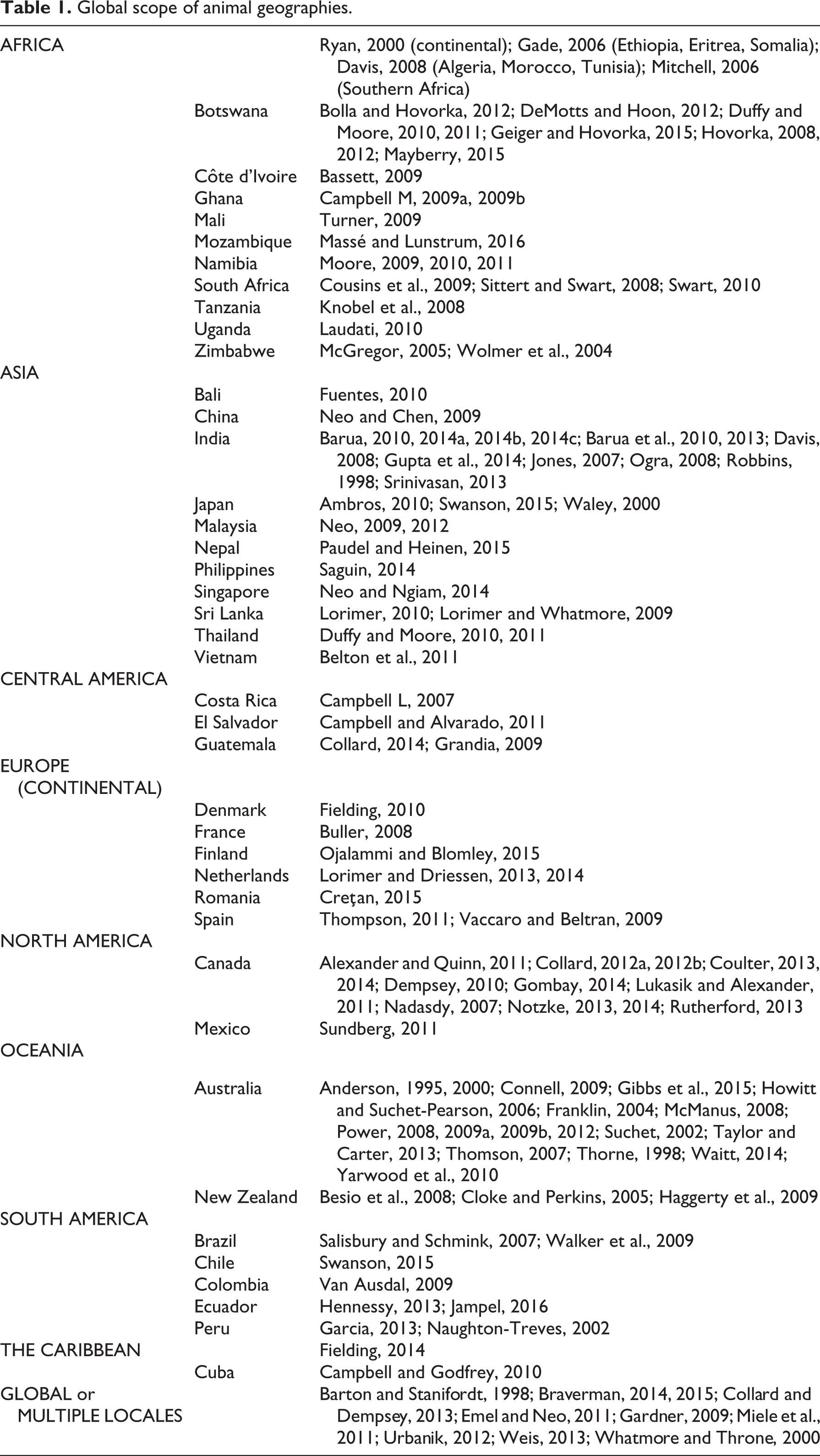
Let us begin with a snapshot of where in the world animal geographers work (Table 1). Substantively, global animal geographies enhance our understanding of human-animal relations in several ways. First, animal geographies reveal the complexity and range of animal engagements in people’s everyday lives, as well as the various species encountered, in all kinds of spaces around the world. Studies reveal multifaceted human symbolic constructions and material orderings of space/place that create differential interspecies encounters and practices. I offer some examples here: Campbell (2009a) explores human perspectives on and reactions to hooded vulture and pied crows in Accra and Kumasi, Ghana. He reveals that birds consuming waste are viewed positively, while birds eating other foods, or birds in close proximity to people and exhibiting unusual behaviours, are viewed negatively; this latter tendency is especially prevalent amongst women and older persons who view birds as spiritual agents on account of their cultural conditioning. Neo and Ngiam (2014) analyse public debates surrounding captive non-endangered bottlenose dolphins in Singapore, revealing how dolphin representations (as free or captive) shape place-based practices of captivity (as natural and necessary or unnatural and unnecessary) and generate opposing views and subsequent actions of animal welfare practitioners compared to animal rights activists. Power (2009a) documents human residents’ everyday experiences with brushtail possums in Sydney, Australia, through sound and smell-scapes permeating physical borders of homesteads. Encounters prove unsettling for residents and contribute new texture to home spaces that shape human lived experiences of home and navigation of home-making. Collard’s (2012a) work on Vancouver Island, Canada, demonstrates how human and cougar spatial practices entangle with one another in complex and precarious ways. As one story illustrates, cougar occupation of space around a raccoon den – with occasional trespassing into nearby yards to eat small prey – intertwines with domestic spaces of human residents, plants, pets and livestock to create insecure and unsafe space for non-cougar actors. As a final example, Fielding (2014) illuminates how the Barrouallie shoreline of St. Vincent, Caribbean, becomes a space where pilot whales and other small cetaceans’ identities, physical forms and status as living organisms are changed on account of human food- and income-generating activities. Day-to-day work of artisanal whalers catching, killing and processing whales reflects multifaceted transitions that do not occur elsewhere on account of place-based tradition and dynamics.
Global scope of animal geographies.
Second, animal geographies reveal global scale processes, namely neoliberal commodification of nature, wildlife conservation mandates, and animal food production, connecting humans and animals around the world and shaping human-animal engagements at the local scale. For example, neoliberalism and commodification of nature clearly drive animal-based tourism industries and operations by connecting international travellers to far-away places featuring exotic animals and local communities whose livelihoods depend on such exchange. Numerous studies investigate the ways in which animal-based tourism exacerbates or reconciles inequities between international tourist desires and community needs (Duffy and Moore, 2010; Fuentes, 2010; Laudati, 2010; Notzke, 2014). Other studies highlight how globally-oriented animal-based tourism becomes wrapped up with conservation efforts via niche tourism realms. Besio et al. (2008) explore the narratives used to engage tourists with dolphins in New Zealand and to foster underlying connections between environmental protection and ‘tourist dollars’ while Connell (2009) explores how global growth of birdwatching positively impacts economic development and environmental management of rural and remote areas in Australia. Others investigate how these consumptive tourist experiences may entail contradictory – both joyful and frustrating – encounters with animal ‘nature’ (Cloke and Perkins, 2005) or animal conservation efforts (Cousins et al., 2009). Neoliberalism and commodification of nature, as global scale processes, are similarly prominent in animal geography case studies highlighting the international trade of animal bodies and parts (Collard, 2014; Collard and Dempsey, 2013; Moore, 2011; Thorne, 1998).
Animal geographies also illuminate the ways in which international wildlife conservation mandates manifest themselves locally around the world. In particular, case studies examine the rise and dynamics of human-animal conflicts whereby livestock reared on agricultural lands cross paths with wild animals transgressing parks and protected area boundaries established for conservation and/or tourism purposes (or vice versa), with consequences for humans, livestock and wildlife (Barua, 2010b, Barua et al., 2013; Dempsey, 2010; Gade, 2006; Jampel, 2016; Naughton-Treves, 2002; Ogra, 2008; Vaccaro and Beltran, 2009). Other case studies investigate the material implications (for humans and animals) of discursively labelling species based on their perceived vulnerabilities within international conservation realms, be they for example ‘threatened’ (Braverman, 2015; Campbell, 2007; Gupta et al., 2014; Hennessy, 2013; Massé and Lunstrum, 2016; Paudel and Heinen, 2015) or ‘flagship’ (Barua et al., 2010; Gupta et al., 2014) or ‘invasive’ species (Gibbs et al., 2015). Additional case studies isolate and highlight global-scale constructions of wildlife conservation (Braverman, 2014; Whatmore and Thorne, 1998) and wildlife management discourse (Wolmer et al., 2004) while others focus specifically on local-scale dynamics of traditional animal-based practices (Fielding, 2010) and perceptions of wildlife (Campbell and Alvarado, 2011).
Animal geographies also explore the global dynamics and local expressions of animal-based food production. In particular, they investigate the broad political economic processes promoting industrial livestock production systems and consumption of animal foodstuffs, which have substantial implications for human, animal and ecological health (Barton and Stanifordt, 1998; Emel and Neo, 2011, 2015; Swanson, 2015; Weis, 2013). They also reveal how scientifically-informed discourses, including those of production and enslavement (Mitchell, 2006), or contested ideas about animal health to support ‘good farming’ (Haggerty et al., 2009), drive practices, narratives and farmer experiences. Or how broad cultural constructions of rurality (Yarwood et al., 2010), edibility (Waitt, 2010), and gastronomy (Garcia, 2013) shape how humans present, consume, and identify with particular food animals around the world. Other case studies focus on the important role of livestock in subsistence and income-generating activities in development trajectories in the Global South (Campbell, 2009b; Turner, 2009; Sayer, 2009). Specific attention is paid to the cattle economy and its land use and/or its environmental impacts (Bassett, 2009; Grandia, 2009; Robbins, 1998; Salisbury and Schmink, 2007; Walker et al., 2009; Van Ausdal, 2009), as well as the pig industry and its racialized dynamics (Neo, 2009), the chicken industry and its gendered dynamics (Hovorka, 2012), and aquaculture and its class dynamics (Belton et al., 2011).
Third, animal geographies reveal the varied lives of individuals or groups of animals around the world to illuminate within-species differences. Elephants, for example, find themselves embedded in contexts of captivity, conflict or circulation such that they are necessarily ‘caught up in social networks of livelihood and transport, commerce and war, ceremony and entertainment’ (Whatmore and Thorne, 2000: 187). Elephants’ lived experiences converge and diverge given different contexts. Some elephants work as labourers in agriculture, transport, and tourism sectors in Southern Africa and South/South East Asia with animal geographers exposing the conditions in which they labour, implications for their welfare, and opportunities for improvement (Duffy and Moore, 2010, 2011; Hart, 2000). Other elephants in these regions range freely within and beyond parks and protected areas, bringing them into contact and often conflict with humans. Animal geographers explore the movements, behaviours and impacts of these elephants, as well as their role in conservation politics and human livelihood pursuits (Barua, 2010, 2014b; Barua et al., 2013; DeMotts and Hoon, 2012; Mayberry, 2015). Ultimately, animal geographies demonstrate that domestic, captive elephants live different lives (indeed they are different elephants) from wild, free-ranging elephants. This raises questions as to what is a true ‘elephant’. What is its ideal quality of life? Which elephants matter more, to whom, for what purpose? Similarly, animal geographies reveal that domestic dogs live different lives around the world: as street animals in Romania (Creţan, 2015), Tanzania (Knobel et al., 2008) and India (Srinivasan, 2013) or as companion animals in Australia (Power, 2008, 2009a), with, again, their histories, circumstances, experiences and welfare tangled up with local contexts and place-based dynamics (Sittert and Swart, 2008).
Importantly, then, existing global animal geographies offer a wealth of insights and illustrations as to the complex, nuanced and varied relations that humans have with animals, and that animals have with humans around the world. Case studies feature all kinds of people (within different regions and countries) and all kinds of animals (different species and individuals within species), all kinds of topics (including everyday encounters, animal-based tourism, conservation, and food production), and all kinds of scales and connections (be it global-local flows of capital, mandates and ideas, or linkages between economic, political, social, cultural, and ecological realms). Furthering the global scope of animal geographies – hence globalizing – offers valuable directions through which the sub-discipline can enhance substantive insights on human-animal relations as manifested in spaces and places around the world. At the same time, however, this global scope must expose inequitable and unjust relations of power, as well as embrace a plurality of worldviews, knowledges and ways-of-knowing. I now turn to explore how we may decolonize animal geographies to this end.
III Decolonizing
Recent calls for decolonizing geographies challenge ‘centres’ and hegemonies of white, Anglophone, Western geography (Panelli, 2008) and question the associated assumptions, practices and politics of knowledge construction. Specifically, calls from more-than-human geographers argue that the largely exploitative human relations with nature present in Western settings are grounded in nature-society binaries with devastating consequences for humans and nonhumans alike, and have been exported throughout the world via imperialist projects (Howitt and Suchet-Pearson, 2006; Sundberg, 2014; Thomas, 2015). Further, colonial logics fortify a Western/non-Western binary whereby civilization discourses position the former as superior while racial and cultural constructions privileging whiteness inform questions related to the human/animal divide (Deckha, 2012). We risk perpetuating colonial relations by privileging particular knowledges and enacting universalizing claims that necessarily subordinate other worldviews and ways of knowing (Sundberg, 2014; Thomas, 2015). As such, we must take the opportunity to situate established knowledge-cultures alongside those with which we are less familiar (Panelli, 2008). We must embrace co-constituted understandings of nature-society relationships (Sundberg, 2014) and pluralist ontologies (Howitt and Suchet-Pearson, 2006) situated within a relational ethic (Thomas, 2015).
The process of decolonizing animal geographies is thus twofold: it requires that we understand how power operates to establish and reinforce racial and cultural difference through imperialist projects, and it requires that we reimagine our scholarship in inclusive and integrative ways. Animal geographies, given its existing global scope, reveals the importance and implications of racial, cultural, and colonial dynamics to species constructions, as well as human-animal relations more broadly. On the one hand, ideas of absolute difference between human and animal (and superiority of the former over the latter) owe much to the colonial legacies of European modernity (Armstrong, 2002). Indeed, ‘human-human relations and the ideas of cultural hierarchies, civilizational progress, and racial distinctions take their timber quite heavily from ideas about animals’ (Deckha, 2012: 537; see also Anderson, 2000). For example, Neo (2012) details social constructions of the pig and the pig industry in Malaysia, arguing that a pattern of ‘animal-linked racialization’, grounded in religious and nationalist tropes, continually polices the boundary between dominant, elite Malay-Muslim hegemony and the comparatively less powerful Chinese pig farmers. In another example, Elder et al. (1998: 73) explore how animal practices create racialized differences in the United States; they illustrate such dynamics through postcolonial stories of Hmong (Laos) immigrant dog killing or Latino deer hunting deemed ‘out of place’ by dominant (white) groups and then used to devalue subaltern groups. Notably, as Anderson (2000) argues, among the most damaging set of associations between animality, savagery and select peoples has been that reserved for indigenous societies of the ‘New World’ – including New Zealand’s Maori, Australia’s Aborigine, and North America’s First Nation, Inuit and Métis populations – encountered during the global extension of European empires.
On the other hand, animal geographies consider how human-animal relations are shaped by colonialism. They demonstrate how Western ideas of how humans should relate to nature (dominate, commodify, protect) are exported around the world through policies and management strategies. For example, Grandia (2009) explains the idealization, normalization and persistence of cattle as a land use activity in Petén, Guatemala, during the colonial period through to the present government emphasis on cattle programs facilitating corral development, infrastructure investment, and global trade while exacerbating land degradation trends in this region. Ryan (2000) explores how spatial practices of taxidermy and photography in the African context operate within discourses emphasizing control of wild human ‘savages’ and preservation of animal ‘wildness’ grounded in an underlying European faith in scientific theories of racial evolution and the ‘struggle for existence’. Davis (2008) investigates the differential influence of colonial veterinary medicine to the development of environmental policy in French North Africa and British India given variation in animal diseases, vet education, and colonial administration. Further, animal geographies explore how racial and colonial relations are mediated and expressed through historical relations with particular species, including dogs (Sittert-Swart, 2008), horses (Swart, 2010) and elephants (Lorimer and Whatmore, 2009) or through neo-colonial interspecies relations with crocodiles (McGregor, 2005) and gorillas (Laudati, 2010) that entrench or create forms of control and vulnerabilities for humans and animals alike. Finally, animal geographies expose the extent to and ways in which Indigenous perspectives and approaches are excluded from wildlife or wilderness management, highlighting especially settler-colonial contexts of Australia (Howitt and Suchet-Pearson, 2006; Suchet, 2002), Canada (Gombay, 2014; Nadasdy, 2007) and the United States (Yarborough, 2015).
Existing animal geographies scholarship offers a springboard from which to decolonize the sub-discipline by furthering our global understanding of human-animal relations and by critically investigating species intersections with racial, cultural, and colonial relations of power. In doing so, we must resist and move away from universalizing approaches in our scholarship that may silence specificity and particular voices (Collard and Gillespie, 2015). Indeed, animal geographies must engage (post)colonial contexts around the world, as well as other voices such as those subaltern human voices that have been unable to ‘speak’ or express their worldviews (à la Spivak) or those nonhuman animal voices that have ‘disappeared’ or been rendered ‘speechless’ in human society (à la Baudrillard or Berger respectively) (Armstrong, 2002: 415). This requires us to acknowledge that indigenous and animal circumstances, experiences, and standpoints have been plundered alongside one another through dominant Western worldviews and imperialist projects. Importantly, these contexts and voices may post challenges to animal-based lifestyle practices or species preferences or ethical stances deemed appropriate or right within dominant value systems. Where might we land when we venture away from cultural imperialism towards perhaps an equally unsettling (for some) cultural relativism in regards to human-animal relations? How may we embrace a curious, respectful, and critically engaged approach to the richness and complexity of cross-cultural and interspecies differences, intersections, knowledges, and ways-of-knowing in global spaces? At the least, a decolonized animal geographies should opt for ontological and epistemological plurality that takes disparate positions, experiences and claims of all humans and all nonhumans seriously without privileging anyone presumptively. This may be the first step in radically reconstructing ‘our relationships with each other, with animals, and the earth outside of domination’ (Kim, 2015: 21).
Footnotes
Declaration of conflicting interests
The author(s) declared no potential conflicts of interest with respect to the research, authorship, and/or publication of this article.
Funding
The author(s) received no financial support for the research, authorship, and/or publication of this article.